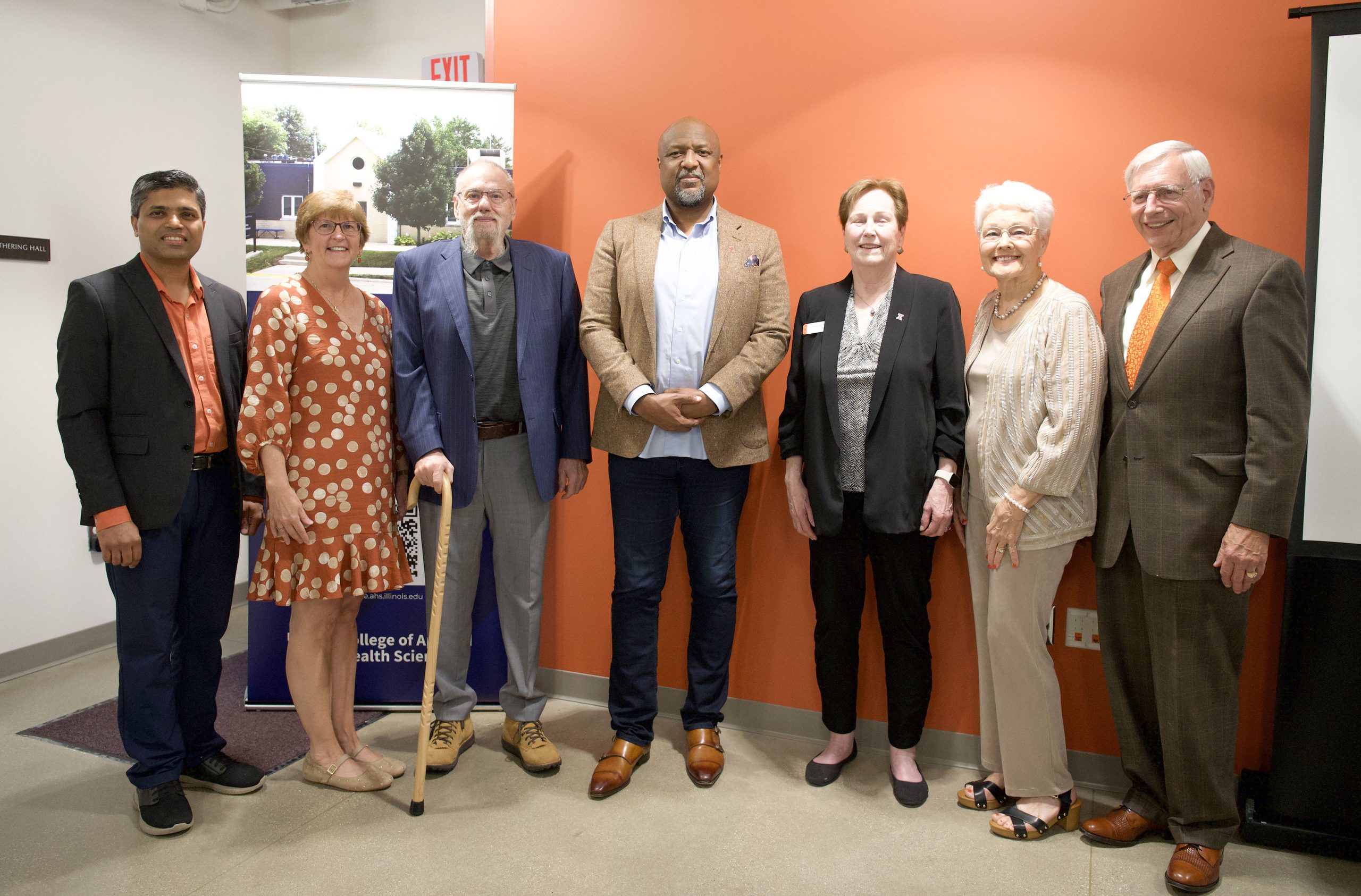
A group photo from RST 199: IC-ChangeS first section in spring 2025, in Kenney Gym. The course had Recreation, Sport and Tourism undergrads teach local student-athletes about social justice through sport. (Provided)
This Recreation, Sport and Tourism course brought together undergrads and local high school student-athletes, to understand how sport can produce positive social change.
A new Recreation, Sport and Tourism course—Inclusive Champions for Change through Sport, or IC-ChangeS for short—is challenging Illinois students to understand how sports can provide a platform for positive social change.
And what better way to learn than leading their own classes with local high school athletes?
Lead instructor Yannick Kluch, an assistant professor in RST, piloted this course in the spring. His team found a willing partner in University Laboratory High School, the small high school on the Urbana campus.
“I’ve always thought about why people are not doing more to engage high school athletes in social justice work, because they do tend to have a platform in their community,” Kluch said. “The idea had been brewing in my head for years, but I never felt like I could turn it into reality. But here at Illinois, I felt supported right away to make it happen.”
The pilot of this course felt like a step outside the comfort zone to many of the undergrads who enrolled. They would have to don their professors’ caps while wading through potentially prickly topics with their peers. But students left feeling transformed by the experience.
“Being in that smaller group made me feel comfortable sharing my ideas and thoughts, knowing I was in a safe space,” said Lauren Ratajczak, a senior in RST. “I felt like I actually was making a difference in people’s lives. These students can go on to pursue social justice and change in their futures.”
The syllabus explored key social justice topics, mapped onto the sports world: What does systemic injustice mean and look like? What are social identities and unconscious biases? How do these concepts play out for modern-day sport icons?
Kluch researches how sport is used as a platform to advance equity and inclusion on a societal level. When he arrived at Illinois, he quickly connected with Mariela Fernandez, an associate professor in RST who researches environmental justice.
When they heard about the University of Illinois’ Call to Action grants, the project seemed like a perfect fit. The annual grant program from the Chancellor’s office funds research and community engagement projects that tackle social inequities head-on.
With $90,338 from the Chancellor’s grant, and a team of collaborators including RST doctoral student Solomon Siskind, RST master’s student Kevin Gillooly, and Anna Baeth from the national sports inclusivity nonprofit Athlete Ally, the IC-ChangeS team got to work. The group later added two staff members from Uni High as well as a local high school student from Champaign Central High School to the team.
Uni High offered up four sessions of their normal Physical Education class periods for RST to work with. The organizers quickly realized, to best deliver the material, the students would have to become the teachers.
“I wanted to leave the students with a new sense of agency when it comes to social justice topics,” Kluch said. “That was a key goal, to make students not shy away from this. Especially when these topics are under attack.”
‘You can make a difference’
In one of the first IC-ChangeS sessions, Uni High student Aldo Zepeda Flores walked up to a large piece of paper hanging on the wall, with the question “What does social injustice look like to you?” written on the top.
One by one, students jotted down their answers on the sheet before discussing with the group.
“It was really nice because you got to see everyone else’s perspective and everyone else’s opinions, but it also gives a sense of privacy when you can express stuff a lot more than when you’re called on in class,” Zepeda Flores said.
The Uni High students participated in four sessions during their usual gym class period, with the support of their high school PE teachers.
An IC-ChangeS group activity in action. Each class period was designed to be as interactive as possible.
With only a handful of sessions, each IC-ChangeS session was designed to be as interactive as possible. In one activity, the high schoolers played a card game called “Buffalo: The Name Dropping Game.” Two cards were quickly flipped, one with a noun and the other with an adjective. If the words were “Muslim” and “athlete,” for example, whoever can first think of a person that combined the two terms won the round. Unbeknownst to the high schoolers at the time, the game had been developed to address unconscious biases at play.
“It was no thinking, no time for analyzing the question or what you were about to say,” Zepeda Flores said. “And then you start to realize, maybe I’m thinking in a different way than I should be. You acknowledge your own biases.”
For Flores, who has played soccer his entire life, what resonated most was the sense of belonging: “I’ve done club sports my entire life, a person’s sense of belonging can affect their style of play. I reflected on my own experience, on the times I wasn’t as welcoming, or the times I felt excluded.”
“It gave me perspective of how in every environment, not just sports, my class, and home, you want everyone to feel a sense of belonging, where they all feel welcome,” he said.
Each session was interactive and carefully planned, but the RST undergraduates were the main shapers of the instruction, Kluch said. They were free to figure out how to best deliver lessons to the group of young athletes.
“It’s not just us telling the undergrads, ‘teach that,’ it’s us asking the undergrads, ‘How would you teach that? What would you teach?’ and then they take agency and facilitate,” Kluch said. “They were super creative, and it resonated with the high schoolers because they found engaging ways to talk about these issues.”
The RST students began to make connections between their own lives and the class content – and used that to connect with the high schoolers. “We were teaching the high school athletes, no matter how small the community, you can make a difference,” Ratajczak said. These young athletes do have power and they do have a voice.”
Having supervised the pilot run of the course at Uni High, Uni Physical Education Teacher Luke Bronowski feels the innovative format would be appealing for other high schools. At Uni, the students looked forward to the interactive sessions.
“We have a diverse population at Uni High, some students who’ve experienced social injustice, and so I think it was eye-opening not only for the high school students to hear some of these stories, but I felt the college students were learning from our students, too,” Bronowski said. “Our students were getting tools to use their platform as athletes to be agents of change.”
Lasting bonds
Lexie Breymeyer came to the University of Illinois in 2021 from Hoopeston, a town of 5,000 roughly an hour drive away from campus. Prior to enrolling in this course, concepts like microaggressions and cultural competence were relatively foreign to her, she said.
“This class has singlehandedly changed my mindset, my values, how I look at the world. I could not ask for more from a class—it’s truly changed me as an individual,” Breymeyer said.
After graduating in the spring from the RST program, Breymeyer was accepted to the Medill School of Journalism at Northwestern University. She credits IC-ChangeS’ content for inspiring her to go into sports journalism.
“Sport is not just a game, it’s a tool, and learning how to use sport as a tool for change opens countless amounts of doors. For journalism, I want to do sports broadcasting, setting up a platform to have these uncomfortable conversations,” Breymeyer said.
Even at Northwestern, she’s still in touch with her IC-Changes classmates: after the semester of IC-ChangeS concluded in May, their group chat is still active, updating each other on their lives and keeping up with the news, just like they did in class.
It’s not just us telling the undergrads, ‘teach that,’ it’s us asking the undergrads, ‘How would you teach that? What would you teach?’ and then they take agency and facilitate.
Yannick Kluch
Assistant Professor in Recreation, Sport and Tourism
“We would spend time processing what was going on in higher ed,” she said. “The world we live in is hectic right now, having a safe space to discuss those things and how it relates to what we were teaching students was one of my favorite things about the class overall. It was a community where we could talk about tough topics.”
The plan for this course is to “scale up,” Kluch said. He hopes the peer-to-peer class framework is replicable for other high schools and colleges in-state and throughout the country, which can be adapted for topics with a specific social justice focus, such as inclusion for people with disabilities or sexual violence prevention. He’s submitted for the course to become a permanent part of the Recreation, Sport and Tourism curriculum.
“The pilot run couldn’t have gone better, and I am so proud of our RST students, the IC-ChangeS athletes, and our partners at Uni High for keeping an open mind and making the course as impactful as it has been,” Kluch said. “This course represents the very fabric of what we do in RST; we use our passion for recreation, sport and tourism to make a difference in the world.”
Two researchers uncover dynamics that challenge the assumption that more parks lead to more activity
Mariela Fernandez and Miki Sato uncovered complex dynamics that challenge the assumption that having more parks automatically leads to increased physical activity (Stock image)
In cities across the United States, physical activity is often promoted as a cornerstone of public health, yet disparities in access and engagement persist. Despite the well-documented benefits of leisure-time physical activity, many communities remain physically inactive. This issue is particularly pronounced in racially segregated areas, where systemic inequalities shape health outcomes.
A recent study by RST faculty members Mariela Fernandez and Miki Sato set out to explore how racial residential segregation impacts leisure-time physical activity—or LTPA—prevalence and how park availability influences this relationship. By focusing on Chicago—a city marked by stark racial divides—researchers uncovered complex dynamics that challenge the assumption that having more parks automatically leads to increased physical activity in all communities.
Fernandez said although Chicago has many parks, many older, larger ones were built downtown in a time where space wasn’t as constrained as it is today. These older, larger parks are located in neighborhoods near middle-income white populations and also serve tourists.
“(The Chicago) Park District didn’t meet the demand. In some cases, African Americans and Latinos did have access to park spaces, but they didn’t have the recreational amenities that were most appropriate for them,” said Fernandez. “Some (racial) groups might have more small children, but those parks might not have playgrounds, so those (parks) weren’t as relevant.”
The study aimed to answer some fundamental questions:
Is racial residential segregation associated with LTPA prevalence?
How is the availability of public parks associated with LTPA prevalence?
Does it affect the relationship between racial residential segregation and LTPA prevalence?
Fernandez and Sato sought to determine whether increasing park availability could serve as an effective strategy for encouraging physical activity in segregated communities.
Just because the space is there doesn’t necessarily mean everybody can utilize it.
Mariela Fernandez
RST associate professor
The Role of Racial Segregation in Physical Activity
The findings of the study revealed that racial residential segregation is indeed associated with lower levels of LTPA. Specifically, Black/African American and Hispanic/Latino isolation correlated negatively with LTPA prevalence. This suggests that communities with higher concentrations of these racial groups—often shaped by historical and systemic segregation policies—experience lower levels of leisure-time physical activity.
The reasons behind this trend are multifaceted, Fernandez said. Segregated neighborhoods frequently face socioeconomic disadvantages, including higher poverty rates, reduced access to recreational facilities and increased safety concerns. Additionally, cultural and structural barriers—such as limited time for exercise due to work and family responsibilities—further contribute to disparities in physical activity levels.
But sometimes the green space doesn’t include amenities that some groups want or focus on amenities that park officials believe residents want.
Of people she surveyed, Fernandez said they did want soccer fields, but they also wanted playgrounds and restrooms.
“When the city was working with the community, they couldn’t really get away from ‘Oh, you want soccer fields.’ There’s still a lot of stereotypes, I feel, that need to be undone.”
The Influence of Park Availability
The study also examined how park availability interacts with these racial disparities in physical activity. Unsurprisingly, greater access to public parks was generally associated with higher LTPA prevalence. Parks offer crucial spaces for exercise, community engagement and outdoor recreation, making them valuable assets for promoting public health. However, the study’s findings challenge the notion that simply increasing the number of parks in segregated communities is a one-size-fits-all solution.
“When some of these places were created, the highways went into neighborhoods of color or they went around them,” Fernandez said. “If you live between the highways, you’re not going to go outside and do physical activity because it’s unsafe to cross streets. And you also have the issue of pollution. Air pollution, sound pollution.”
Another finding from the study is the negative influence effect of park availability on the relationship between Hispanic isolation and LTPA prevalence. The findings indicate that while increasing park availability can enhance LTPA prevalence in communities, the benefits are diminished in areas with high levels of Hispanic or Latino isolation.
Implications for Public Health Policy
Fernandez and Sato’s findings hold significant implications for policymakers and urban planners seeking to promote physical activity in racially segregated communities.
Beyond Infrastructure: While increasing park availability is a positive step, it is not a standalone solution. Investments must also address safety concerns, programming and community engagement to ensure that parks are truly accessible and welcoming spaces.
Culturally Relevant Programs: To effectively encourage LTPA, public health initiatives should incorporate culturally relevant exercise programs that resonate with the target communities.
Addressing Structural Inequities: Efforts to reduce racial residential segregation and the socioeconomic disparities that accompany it should be a long-term priority. Economic investment in historically marginalized neighborhoods can help create environments where physical activity is more feasible and appealing.
Community Involvement: Residents must have a voice in the development and implementation of public health initiatives. By incorporating local perspectives, planners can better understand and address the specific barriers to physical activity that different communities face.
“Miki and I will definitely have to do some outreach to folks in urban planning, public health officials and park officials,” Fernandez said.
The overall goal, Fernandez and Sato say, is improving physical health and health outcomes, but simply building more parks will not be enough to close the gap, the researchers say.
“Just because the space is there doesn’t necessarily mean everybody can utilize it,” Fernandez said.
RST researchers set out to explore how racial residential segregation impacts leisure-time physical activity prevalence and how park availability influences this relationship
Mariela Fernandez and Miki Sato uncovered complex dynamics that challenge the assumption that having more parks automatically leads to increased physical activity (Stock image)
In cities across the United States, physical activity is often promoted as a cornerstone of public health, yet disparities in access and engagement persist. Despite the well-documented benefits of leisure-time physical activity, many communities remain physically inactive. This issue is particularly pronounced in racially segregated areas, where systemic inequalities shape health outcomes.
A recent study by RST faculty members Mariela Fernandez and Miki Sato set out to explore how racial residential segregation impacts leisure-time physical activity—or LTPA—prevalence and how park availability influences this relationship. By focusing on Chicago—a city marked by stark racial divides—researchers uncovered complex dynamics that challenge the assumption that having more parks automatically leads to increased physical activity in all communities.
Fernandez said although Chicago has many parks, many older, larger ones were built downtown in a time where space wasn’t as constrained as it is today. These older, larger parks are located in neighborhoods near middle-income white populations and also serve tourists.
“(The Chicago) Park District didn’t meet the demand. In some cases, African Americans and Latinos did have access to park spaces, but they didn’t have the recreational amenities that were most appropriate for them,” said Fernandez. “Some (racial) groups might have more small children, but those parks might not have playgrounds, so those (parks) weren’t as relevant.”
The study aimed to answer some fundamental questions:
Is racial residential segregation associated with LTPA prevalence?
How is the availability of public parks associated with LTPA prevalence?
Does it affect the relationship between racial residential segregation and LTPA prevalence?
Fernandez and Sato sought to determine whether increasing park availability could serve as an effective strategy for encouraging physical activity in segregated communities.
The Role of Racial Segregation in Physical Activity
The findings of the study revealed that racial residential segregation is indeed associated with lower levels of LTPA. Specifically, Black/African American and Hispanic/Latino isolation correlated negatively with LTPA prevalence. This suggests that communities with higher concentrations of these racial groups—often shaped by historical and systemic segregation policies—experience lower levels of leisure-time physical activity.
The reasons behind this trend are multifaceted, Fernandez said. Segregated neighborhoods frequently face socioeconomic disadvantages, including higher poverty rates, reduced access to recreational facilities and increased safety concerns. Additionally, cultural and structural barriers—such as limited time for exercise due to work and family responsibilities—further contribute to disparities in physical activity levels.
(The Chicago) Park District didn’t meet the demand. In some cases, African Americans and Latinos did have access to park spaces, but they didn’t have the recreational amenities that were most appropriate for them.”
Mariela Fernandez
Associate Professor, RST
But sometimes the green space doesn’t include amenities that some groups want or focus on amenities that park officials believe residents want.
Of people she surveyed, Fernandez said they did want soccer fields, but they also wanted playgrounds and restrooms.
“When the city was working with the community, they couldn’t really get away from ‘Oh, you want soccer fields.’ There’s still a lot of stereotypes, I feel, that need to be undone.”
The Influence of Park Availability
The study also examined how park availability interacts with these racial disparities in physical activity. Unsurprisingly, greater access to public parks was generally associated with higher LTPA prevalence. Parks offer crucial spaces for exercise, community engagement and outdoor recreation, making them valuable assets for promoting public health. However, the study’s findings challenge the notion that simply increasing the number of parks in segregated communities is a one-size-fits-all solution.
“When some of these places were created, the highways went into neighborhoods of color or they went around them,” Fernandez said. “If you live between the highways, you’re not going to go outside and do physical activity because it’s unsafe to cross streets. And you also have the issue of pollution. Air pollution, sound pollution.”
Another finding from the study is the negative influence effect of park availability on the relationship between Hispanic isolation and LTPA prevalence. The findings indicate that while increasing park availability can enhance LTPA prevalence in communities, the benefits are diminished in areas with high levels of Hispanic or Latino isolation.
Implications for Public Health Policy
Fernandez and Sato’s findings hold significant implications for policymakers and urban planners seeking to promote physical activity in racially segregated communities.
Beyond Infrastructure: While increasing park availability is a positive step, it is not a standalone solution. Investments must also address safety concerns, programming and community engagement to ensure that parks are truly accessible and welcoming spaces.
Culturally Relevant Programs: To effectively encourage LTPA, public health initiatives should incorporate culturally relevant exercise programs that resonate with the target communities.
Addressing Structural Inequities: Efforts to reduce racial residential segregation and the socioeconomic disparities that accompany it should be a long-term priority. Economic investment in historically marginalized neighborhoods can help create environments where physical activity is more feasible and appealing.
Community Involvement: Residents must have a voice in the development and implementation of public health initiatives. By incorporating local perspectives, planners can better understand and address the specific barriers to physical activity that different communities face.
“Miki and I will definitely have to do some outreach to folks in urban planning, public health officials and park officials,” Fernandez said.
The overall goal, Fernandez and Sato say, is improving physical health and health outcomes, but simply building more parks will not be enough to close the gap, the researchers say.
“Just because the space is there doesn’t necessarily mean everybody can utilize it,” Fernandez said.
Budding student researchers at the College of Applied Health Sciences presented on a diverse range of topics.
Kinesiology juniors Elizabeth Martinez (center) and Aubrey Cervantes (left) present their research at the AHS Undergrad Research Expo on April 24, 2024. (Photo: Ethan Simmons)
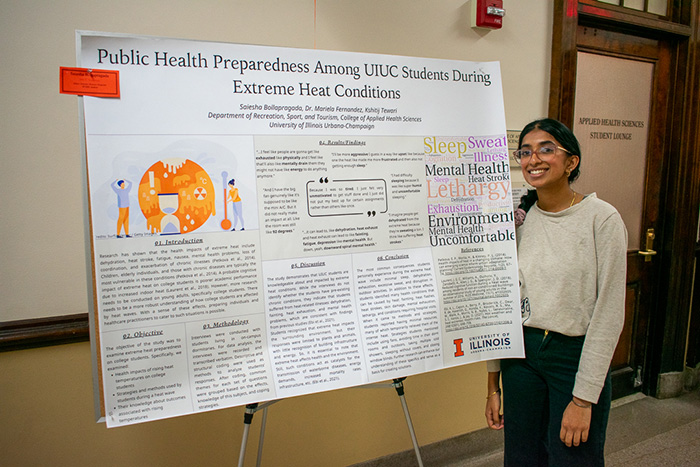
For a freshman at the College of Applied Health Sciences, Saiesha Bollapragada’s research portfolio is impressive.
At last week’s Undergraduate Research Symposium, the I-Health major got to present the results from her first research project, “Public Health Preparedness Among UIUC Students During Extreme Heat Conditions,” where she examined students’ awareness and handling of severe heat in the spring semester.
She completed her study with a push from Students Pursuing Applications, Research and Knowledge, or SPARK, an AHS program that jump-starts incoming undergraduate students research experiences by pairing them with professors in the college. Bollapragada was placed with Recreation, Sport, and Tourism Associate Professor Mariela Fernandez, whose experience with urban environmental injustices fit her research topic perfectly.
“Professor Fernandez motivated me to start this project on my own,” Bollapragada said. “There’s a lot more reading involved than I thought there was, it was a lot of work preparing for the symposium, but if it’s something you’re interested in it’s a fun process.”
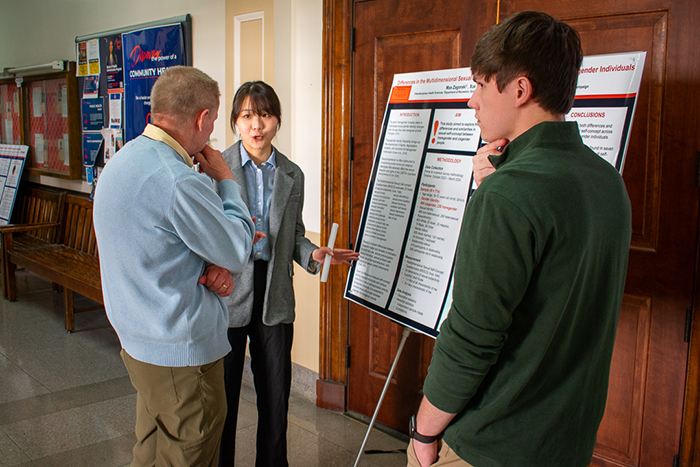
Students, faculty and staff got a taste of the findings from AHS’ budding student researchers during the AHS Undergraduate Research Expo at Huff Hall on Wednesday, April 24, where a roster of undergraduates gave poster presentations on a diverse range of research topics.
Many students spearheaded their own research projects with significant support and guidance from faculty and graduate students. Others, like a group of Speech and Hearing Science students from the Intellectual DisAbilities Communication Lab led by Associate Professor Marie Moore Channell, provided updates on long-range research projects they’ve assisted with on campus.
Three SHS seniors, Emma Mueller, Abigail Keasler and Liz Gremer, presented initial findings from their glimpse into the Speech Accessibility Project, an ongoing research endeavor looking to make voice recognition software—such as Apple’s Siri or Amazon’s Alexa—more accessible for people with different speech patterns.
Each of the students has helped recruit participants with Down syndrome or aided vocal transcriptions from the samples they’ve collected. Under the leadership of Channell, the lab hopes to collect 240,000 voice samples from 400 participants.
“Our poster looked into the recruiting process with that population and took a look at patterns of articulation differences exhibited by individuals with Down syndrome,” said Mueller, who transcribed vocal samples for the project.
All three of the students met in Channell’s lab, and immediately found research responsibilities once the Down syndrome portion of the project came under Channell’s purview.
“It’s been very rewarding, very interesting and very impactful,” Keasler said. “A lot of families in meetings or over the phone say, ‘Siri doesn’t really understand what we’re trying to say,’ so this is very important and I can’t wait to see the results of it.”
Coming to a project affiliated with SHS with “so much publicity and so much money coming in is encouraging,” said Gremer, who has helped recruit participants and set up their first meetings for collecting voice samples.
AHS student programs, such as the first-generation focused Mannie L. Jackson Illinois Academic Enrichment and Leadership Program (I-LEAP), were well represented in the research symposium. I-LEAP juniors Elizabeth Martinez and Aubrey Cervantes, both studying kinesiology, brought results from their research collaboration on high-intensity interval training.
Working within KCH Professor Steve Petruzzello’s Exercise Psychophysiology Lab, the pair analyzed 25 participants’ emotional responses to high-intensity exercise, compared with their scores and symptoms of several mental health qualities: namely anxiety, depression and neuroticism.
“We were looking at exercise adherence—how can we get more people to get more active—and we were really interested in HIIT exercise, so we put it all together in one research project,” Cervantes said.
What they found: Participants with more symptoms of depression reported more negative affect responses during the HIIT exercise, while anxiety and neuroticism didn’t show significant predictive power, they said.
“This is my first hands-on [study] that I can call my own and Aubrey’s,” said Martinez, who’s applying to physical therapy schools. “My favorite part is meeting with the participants. It’s so fun getting to know everyone, even if there’s a lot more hours behind the desk just plugging and chugging data.”