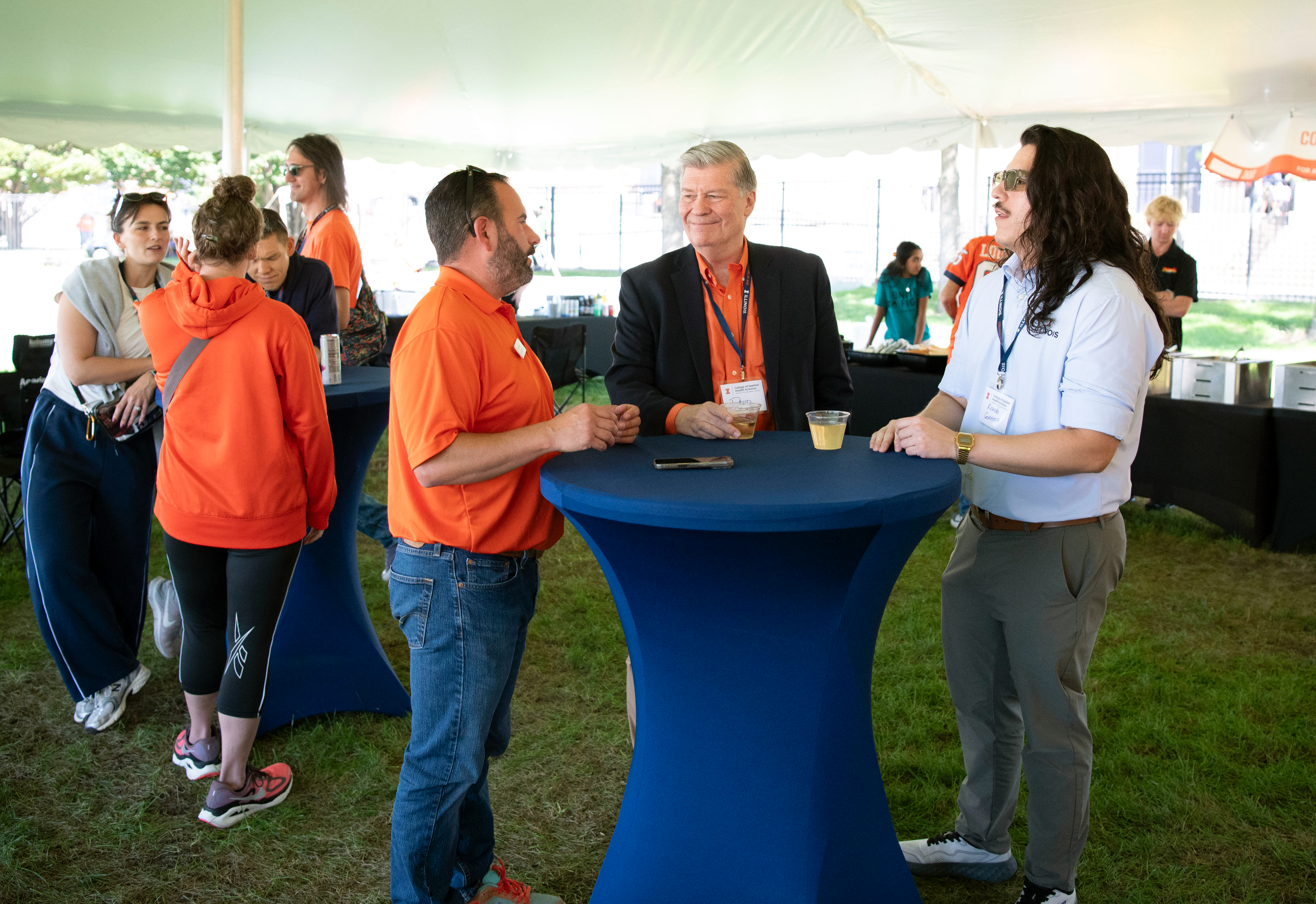
AHS students present diverse projects for Undergrad Research Week


Kinesiology juniors Elizabeth Martinez (center) and Aubrey Cervantes (left) present their research at the AHS Undergrad Research Expo on April 24, 2024. (Photo: Ethan Simmons)

For a freshman at the College of Applied Health Sciences, Saiesha Bollapragada’s research portfolio is impressive. 

At last week’s Undergraduate Research Symposium, the I-Health major got to present the results from her first research project, “Public Health Preparedness Among UIUC Students During Extreme Heat Conditions,” where she examined students’ awareness and handling of severe heat in the spring semester. 

She completed her study with a push from Students Pursuing Applications, Research and Knowledge, or SPARK, an AHS program that jump-starts incoming undergraduate students research experiences by pairing them with professors in the college. Bollapragada was placed with Recreation, Sport, and Tourism Associate Professor Mariela Fernandez, whose experience with urban environmental injustices fit her research topic perfectly. 

“Professor Fernandez motivated me to start this project on my own,” Bollapragada said. “There’s a lot more reading involved than I thought there was, it was a lot of work preparing for the symposium, but if it’s something you’re interested in it’s a fun process.” 

Students, faculty and staff got a taste of the findings from AHS’ budding student researchers during the AHS Undergraduate Research Expo at Huff Hall on Wednesday, April 24, where a roster of undergraduates gave poster presentations on a diverse range of research topics.
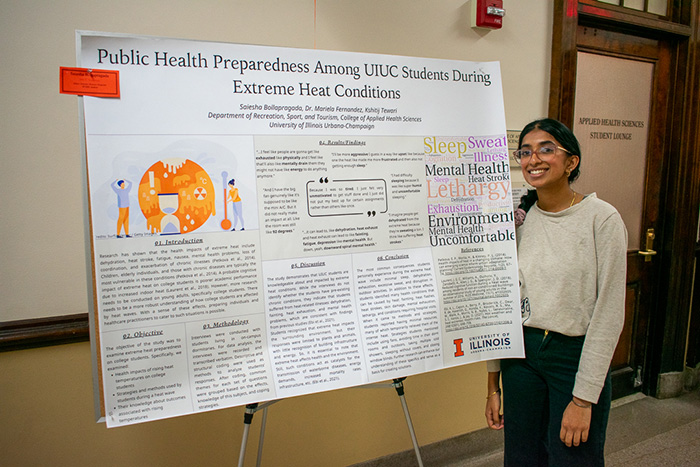
An AHS freshman smiles next to her research poster

Many students spearheaded their own research projects with significant support and guidance from faculty and graduate students. Others, like a group of Speech and Hearing Science students from the Intellectual DisAbilities Communication Lab led by Associate Professor Marie Moore Channell, provided updates on long-range research projects they’ve assisted with on campus. 

Three SHS seniors, Emma Mueller, Abigail Keasler and Liz Gremer, presented initial findings from their glimpse into the Speech Accessibility Project, an ongoing research endeavor looking to make voice recognition software—such as Apple’s Siri or Amazon’s Alexa—more accessible for people with different speech patterns.

Each of the students has helped recruit participants with Down syndrome or aided vocal transcriptions from the samples they’ve collected. Under the leadership of Channell, the lab hopes to collect 240,000 voice samples from 400 participants. 

“Our poster looked into the recruiting process with that population and took a look at patterns of articulation differences exhibited by individuals with Down syndrome,” said Mueller, who transcribed vocal samples for the project. 

All three of the students met in Channell’s lab, and immediately found research responsibilities once the Down syndrome portion of the project came under Channell’s purview. 

“It’s been very rewarding, very interesting and very impactful,” Keasler said. “A lot of families in meetings or over the phone say, ‘Siri doesn’t really understand what we’re trying to say,’ so this is very important and I can’t wait to see the results of it.” 

Coming to a project affiliated with SHS with “so much publicity and so much money coming in is encouraging,” said Gremer, who has helped recruit participants and set up their first meetings for collecting voice samples. 
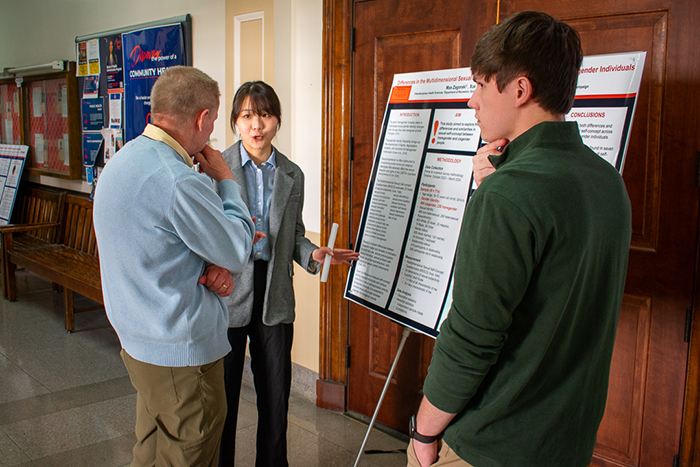
A man in a blue sweater listens to students give a research poster presentation.

AHS student programs, such as the first-generation focused Mannie L. Jackson Illinois Academic Enrichment and Leadership Program (I-LEAP), were well represented in the research symposium. I-LEAP juniors Elizabeth Martinez and Aubrey Cervantes, both studying kinesiology, brought results from their research collaboration on high-intensity interval training. 

Working within KCH Professor Steve Petruzzello’s Exercise Psychophysiology Lab, the pair analyzed 25 participants’ emotional responses to high-intensity exercise, compared with their scores and symptoms of several mental health qualities: namely anxiety, depression and neuroticism. 

“We were looking at exercise adherence—how can we get more people to get more active—and we were really interested in HIIT exercise, so we put it all together in one research project,” Cervantes said. 

What they found: Participants with more symptoms of depression reported more negative affect responses during the HIIT exercise, while anxiety and neuroticism didn’t show significant predictive power, they said.

“This is my first hands-on [study] that I can call my own and Aubrey’s,” said Martinez, who’s applying to physical therapy schools. “My favorite part is meeting with the participants. It’s so fun getting to know everyone, even if there’s a lot more hours behind the desk just plugging and chugging data.” 

Editor’s note:

To reach Ethan Simmons, email ecsimmon@illinois.edu
 

Related news


AHS students find varied paths to research


Kinesiology senior Ilya Ahmad stands with his research presentation on Wednesday, April 26, 2023.

By ETHAN SIMMONS

For her last semester as an undergraduate student, Daniela Hernandez spent a lot of time in campus libraries—more than the Community Health major had in her entire college career.

But all of Hernandez’s hours in the Main Stacks and Grainger Engineering Library went toward a worthy cause: conducting a literature review for her first research study, exploring the labor market value of Spanish-English bilingualism.

“It was very ambitious of me to do this my last semester of college, but it was something that I had never done before,” Hernandez said. “So I was like, ‘Why not?’”

Hernandez is enrolled in the Illinois Academic Enrichment and Leadership Program or I-LEAP, a support and mentorship program for underrepresented minority students, student-athletes and first-generation students in the College of Applied Health Sciences such as her.

“I’m excited to pass this on to my (I-LEAP) mentee and just say, ‘Hey, this is a great opportunity to develop those skills that you might not have,” she said.

Dozens of students from AHS lined the walls of Huff Hall on Wednesday to present findings from their recent research endeavors working in the labs of their mentors. The presentations coincided with the university-wide Undergraduate Research Symposium on April 27.

Plenty of paths exist for AHS undergrads looking for research involvement. There’s Students Pursuing Applications, Research and Knowledge (SPARK), which onboards high-achieving freshmen into research programs within the college, and Student Aging Researchers in Training (START), which brings students from underrepresented backgrounds into aging research.

Department of Speech and Hearing Science juniors Natalia Rzepa and Holly Panfil found their first research experiences through START and SPARK, respectively.

Both found their way into in SHS Associate Professor Raksha Mudhar’s Aging and Neurocognition Lab and stuck around because they liked it so much.

With SHS doctoral candidate Lizzy Lydon and School of Molecular and Cellular Biology senior Sharbel Yako, the group compared brain activity between older adults and younger adults during word recall tests.

Though both groups performed comparably in the test, event-related spectral perturbation data collected from participants suggested older adults had to use higher levels of neural compensation during the exercise, Panfil said.

“Research opens a lot of doors, and I think that we’re so lucky to be at a university that has so many different labs and ways to get involved,” said Panfil, who’s heading for a Fulbright-MITACS Globalink research internship in Canada this summer. “I’d really recommend it to anyone to just give it a shot.” 

For Recreation, Sport and Tourism sophomores Genna Peters and Vanessa Ramos, their presentation “Developing a Quality Evaluation Protocol for Racial Equity Park and Recreation Plans” was just a snapshot of their progress. Working with mentors RST Associate Professor Mariela Fernandez and doctoral student Wonjin Jeong, the students will reach out to community members.

Ramos, who transferred to Illinois from DePaul, called her first stab at research “a great experience.”

“Being able to learn how to work as a group, collect data, and just having someone to guide me through my first year at UIUC has been very helpful,” Ramos said.

Especially for underclassmen, joining a study can seem an intimidating task. Community Health sophomore Afnaan Afsar Ali transferred into AHS late last year, wanting a “broader outlook” on healthcare, but didn’t initially care for exploring any research opportunities.

“I think there’s a lot of fear when you first begin to try and get into a research lab,” Afsar Ali said. “But it does get easier, the whole purpose of research is so that you are able to develop as well.” 

However, some of the college’s work with health technology caught her interest. She contacted the Human Factors and Aging Laboratory led by KCH Professor Wendy Rogers, which connected the sophomore to an interview-based project involving sociable robot “Misty,” one of which exists inside the McKechnie Family LIFE Home.  

The project titled “Understanding the Role of a Socially Assistive Robot to Successfully Age in Place” surveyed eight older adults on their comfortability and interest in the open-source programmable robot after seeing videos of Misty in action. 

The eight adults, surveyed from across the country, all had warm responses on Misty’s appearance, size and functions, Afsar Ali said. Participants came up with three main use areas for the robotic companion: Completing domestic tasks, setting daily reminders, and socializing at home. 

Afsar Ali assisted in the literature review, sifting through previous research on the role of robots and health tech in the lives of older adults, and helped conduct video conference interviews with participants. 

“I realized that we have a really big misconception about how older adults feel about technology,” Afsar Ali said. “I thought that they wouldn’t be open to it at all, but they really are—they want to be involved and have more technology in their lives, things that can support them.” 

With a bit of luck, undergrads can find research labs that perfectly fit their interests. Fitness buff Ilya Ahmad, a senior in Kinesiology, combined two of his favorite topics for his presentation: working out and hormone function.

Under KCH Assistant Professor Diego Hernandez-Saavedra, Ahmad reviewed the effects of anabolic steroids on the body. He discussed how steroids impedes the body’s ability to produce testosterone, which can cause decreases in testicular size, sperm count and sex drive. Steroids can also cause other hormone dysregulation, and even cause DNA damage, he said.

A first-generation student, Ahmad said he had “no idea about research” when he came to the University of Illinois. He wants to attend medical school after graduation, but knows he wants to keep research in his life.

“I love research. I love endocrinology,” Ahmad said. “It’s kind of cool to show people things that are based on research findings.”

Find out more about the AHS Undergraduate Research Expo at this site, including a list of all projects.

Editor’s note:

To reach Ethan Simmons, message him at ecsimmon@illinois.edu.

Related news

Proud To Be A Philanthropist


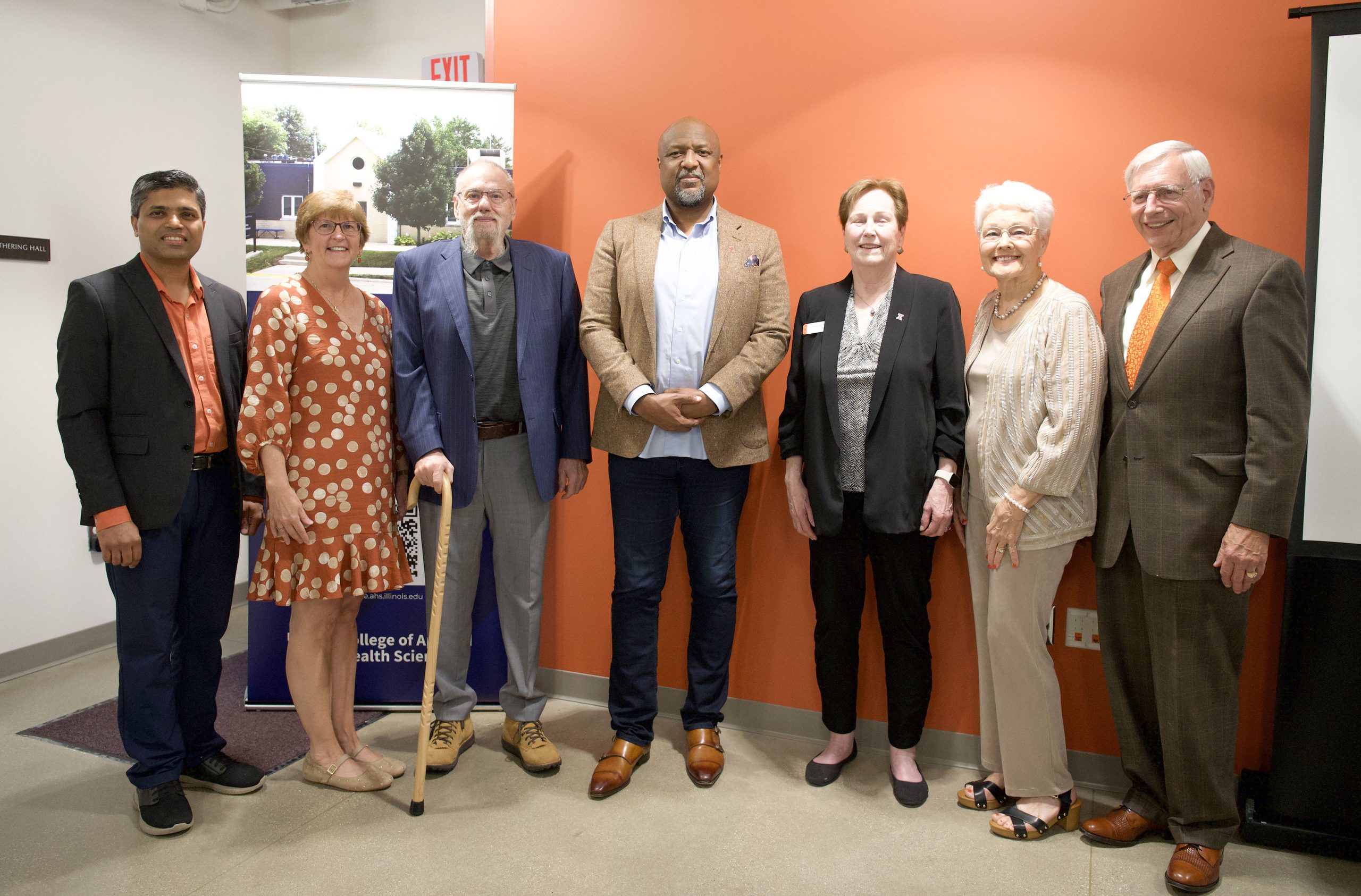
Mannie Jackson with AHS Dean Cheryl Hanley-Maxwell

Mannie Jackson has been lauded for his sharp business sense and entrepreneurial spirit. Of All his many achievements, however, Mr. Jackson says his most important is being a philanthropist.

Mannie Jackson has been lauded for his sharp business sense and entrepreneurial spirit. Of All his many achievements, however, Mr. Jackson says his most important is being a philanthropist.

From Boxcar to Boardrooms

Mannie Jackson was born and lived for three years in a boxcar in Illmo, Missouri. After moving to Edwardsville, Illinois, he became a stand-out player in basketball and earned a full scholarship to the University of Illinois. He and his best friend Govoner Vaughn were the first African American starters for the Fighting Illini and the first to earn varsity letters. Mr. Jackson also was the first African American team captain.

He went on to work and play for the Technical Tape Corporation, which had a team in the National Industrial League, before joining the Harlem Globetrotters. He followed his basketball career with a successful career in business, working first for General Motors and then for Honeywell, from which he retired as international senior vice president of marketing, administration, and logistics. At the time of his retirement, Mr. Jackson was serving on the Board of Directors of six Fortune 500 companies.

Giving Back

Mannie Jackson returned to the world of professional basketball after retiring as the first African American owner of a major sports franchise when he bought the nearly-bankrupt Harlem Globetrotters. He not only restored the team to international fame and fortune but also made it a leader in charitable giving.

Mr. Jackson endowed the Mannie L. Jackson Illinois Academic Enrichment and Leadership Program (I-LEAP) in the College of Applied Health Sciences, which provides academic and personal support services to first-generation and underrepresented college students. His gift to Lewis and Clark College helped to establish the Mannie Jackson Center for the Humanities.

In accepting the 2017 Distinguished Alumni Award, Mr. Jackson said, “I like being called a philanthropist. When you decide to be a philanthropist and you help others and improve the world when you go, the legacy and the memory of what your family meant to the world and what you tried to accomplish lives forever.”

Mr. Jackson is a two-time inductee into the Naismith Memorial Basketball Hall of Fame, as an owner and as a player. He was named Laureate in the Order of Lincoln, the State of Illinois’ highest honor. He also received the NCAA’s highest honor, the Theodore Roosevelt Award, and the University of Illinois Alumni Achievement Award, the highest honor bestowed upon alumni by the University of Illinois Alumni Association.

Share on social

Related news

College of Applied Health Sciences
110 Huff Hall
1206 South 4th Street
Champaign, IL 61820
(217) 333-2131