Leisure and recreation were ways of life for Payne and led to her passion and career
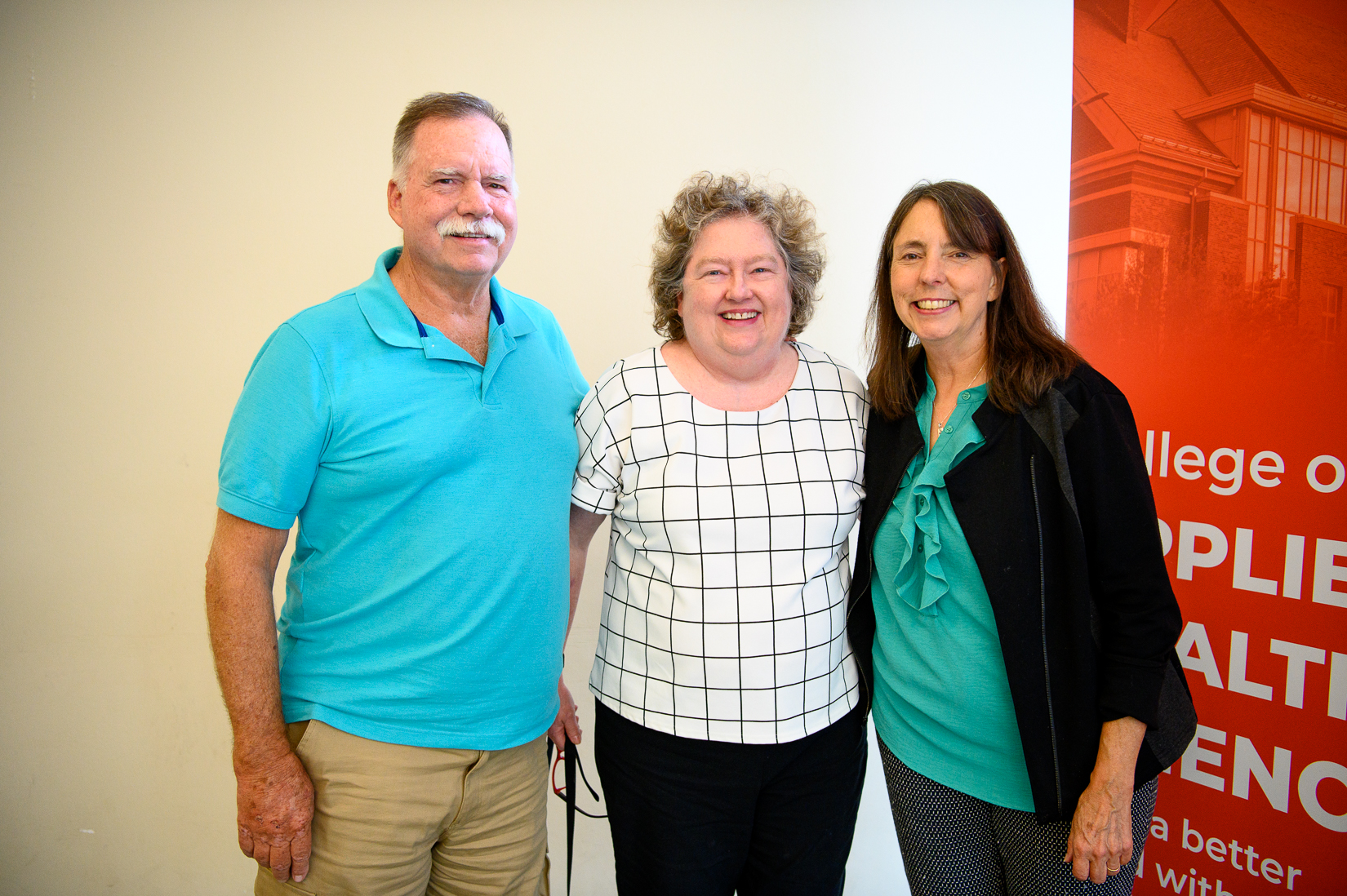
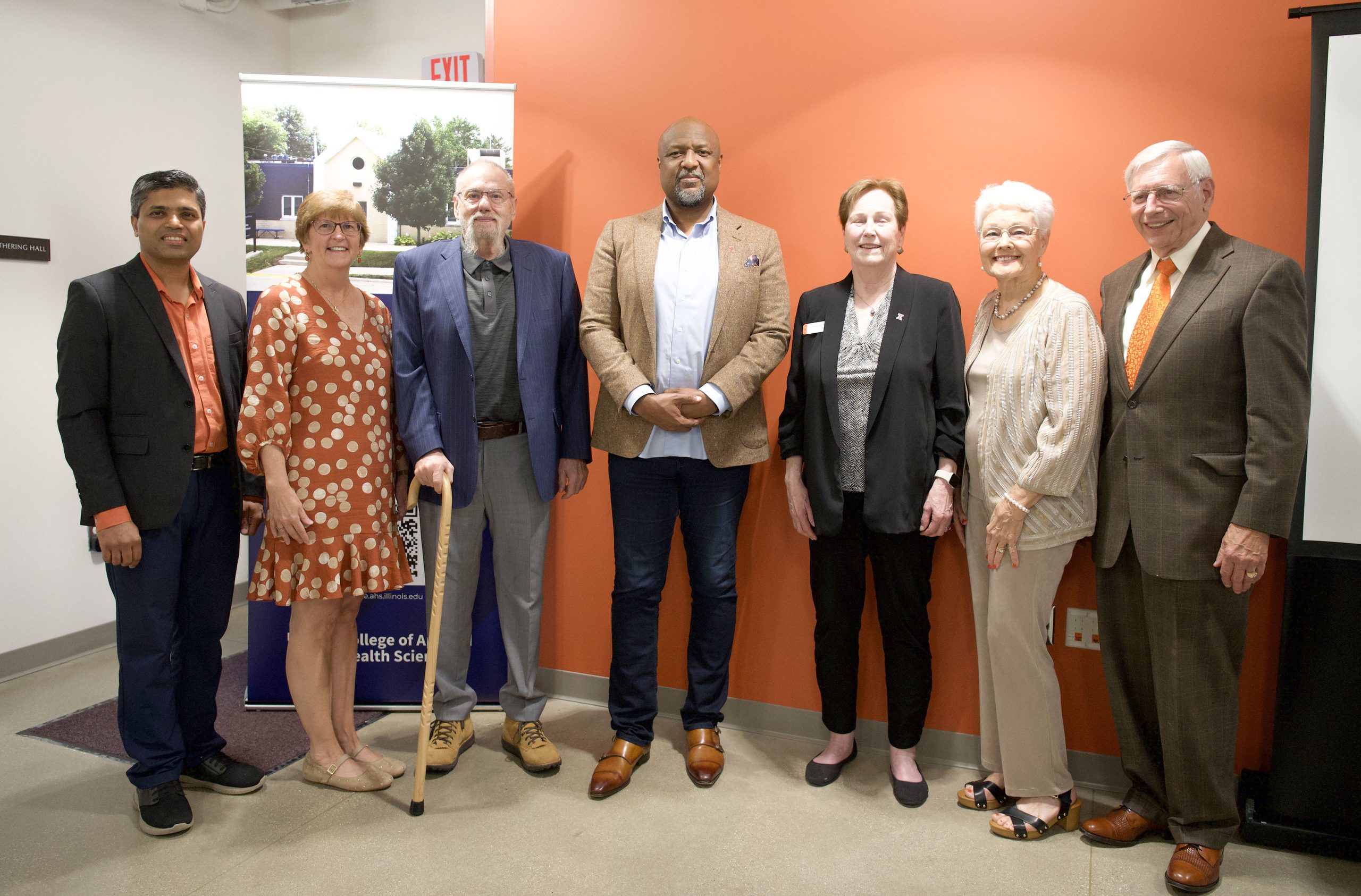
Laura Payne, right, was joined by brother Tom, left, and her cousin Mary Lynn O’Connor at the McCristal Lecture (Photo by Bridget Lee-Calfas)
For Laura Payne, the study of leisure is anything but idle work. It is a way to understand how people build identity, sustain relationships and protect their health across a lifetime, and how communities can make those benefits available to everyone.
That career-long commitment was celebrated as Payne was honored as the 2026 King James McCristal Distinguished Scholar in the College of Applied Health Sciences at the University of Illinois. The distinction recognizes outstanding scholarships and gives the college community an opportunity to learn from researchers whose work is shaping their fields and improving health and well-being.
Payne, whose scholarship explores how recreation affects quality of life, marked the honor with a lecture titled “Leisure, Health, and Well-Being: Expanding Research Impact Through Public Engagement.”
Her remarks traced the roots of her research from childhood experiences in suburban Chicago to questions about resilience, chronic disease and healthy aging.
“I’m really delighted and greatly appreciate this honor,” Payne said.
Growing up, she found that recreation helped shape her confidence and sense of self. Access to a park district opened a world of activities and eventually led to jobs at a swimming pool, first as a lifeguard and later as a pool manager. She did not realize recreation could become an academic field until she was well into an undergraduate communications degree. After several years at a Chicago management consulting firm, however, she knew she wanted to work with a mission that felt more personal.
Leisure and recreation had mattered deeply to Payne and her family. Over time, that understanding developed into an interest in aging, a subject she describes as inherently personal. One of the most important influences was her older brother, Tom, who was diagnosed in early adulthood with ankylosing spondylitis, a form of inflammatory arthritis. Payne watched him navigate disruptive symptoms, evolving treatments and changing lifestyle demands while remaining committed to the activities he loved.
She was struck by his resilience and by the grit of others who adapted cherished pursuits rather than surrendering them. “Tom, you were a big reason why I pursued this line of research,” she said during her remarks. Her mother’s concise philosophy offered another guide: “Healthy aging is about ‘adapt, adapt, adapt.’”
Those experiences helped Payne frame leisure not as an optional luxury but as an essential part of a good life. To prepare for her talk, she said she asked 25 people about what made a good day. Every participant named two leisure activities. Her research also found that people with broader leisure repertoires reported substantially better physical and mental health than those with fewer activities.
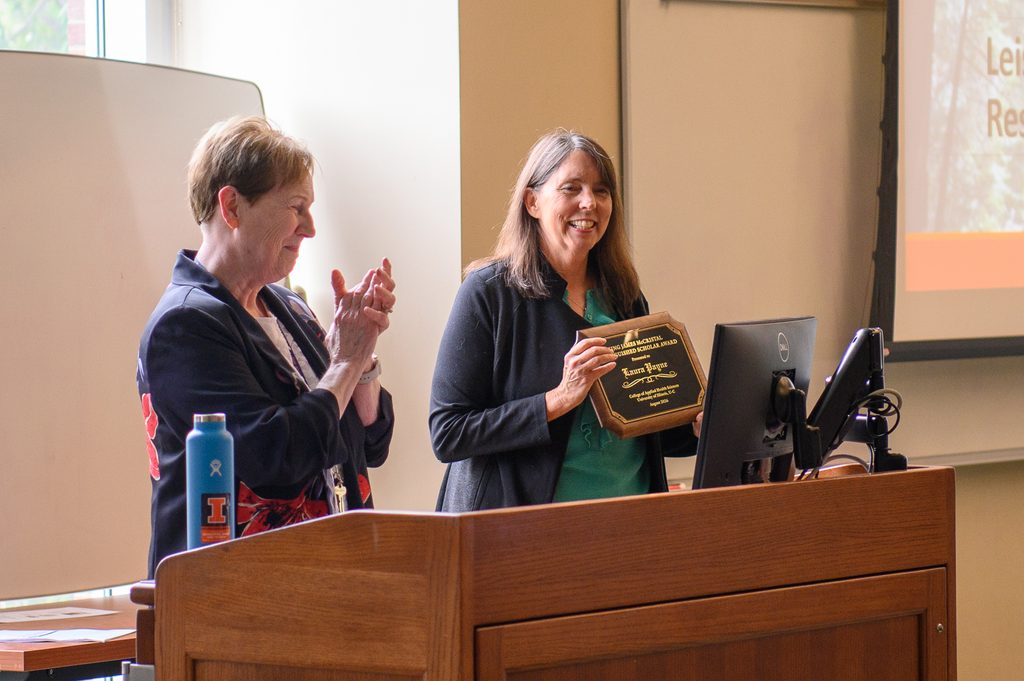
Laura Payne, right, accepts her plaque from Dean Cheryl Hanley-Maxwell (Photo by Bridget Lee-Calfas)
The findings carry increasing urgency as the population ages. Payne noted that people 100 and older are the fastest-growing segment of the older population, with many living more independently. Yet longer lives also bring challenges, including rising risk of developing chronic disease, uneven access to recreation and broader social conditions that affect whether people can pursue and define good health. Personal circumstances matter, too. Understanding healthy aging, in her view, requires attention to all of those forces and to what older adults are already doing well.
Cheryl Hanley-Maxwell, dean of the College of Applied Health Sciences, praised Payne as an accomplished scholar who has advanced understanding of leisure, health and well-being while ensuring that her research makes a difference beyond the university.
“Her work reflects a deep commitment not only to generating knowledge, but also to ensuring that research reaches beyond the university and makes a meaningful difference in the lives of individuals and communities,” Hanley-Maxwell said.
That public-facing commitment is especially visible in Payne’s leadership of the Office of Recreation and Park Resources, which she took over in 2020. Payne refreshed the office’s mission: to collaborate on recreation, sport and tourism initiatives that build healthy communities. Under her leadership, the office responds to community and industry needs, issues and trends while giving undergraduate and graduate students hands-on experience through projects.
Hanley-Maxwell said Payne’s approach demonstrates that research can have greater impact when scholars build relationships with communities, listen to the people their work is meant to serve and translate evidence into practices that are useful and accessible. That approach, the dean added, embodies the values of the McCristal honor.
The King James McCristal Scholar Award was established in 1988 to honor King McCristal, dean of AHS from 1961-1973.
“Dr. Payne’s research reminds us that leisure is far more than how we spend our free time,” Hanley-Maxwell said. “It can be an important contributor to health, quality of life, social connection and well-being, and a powerful avenue through which research can engage communities and create broader societal impact.”
For Payne, the recognition brings a career built around that idea full circle: from a child finding confidence through local recreation, to a scholar asking how leisure can help people adapt, connect and thrive, to a public-engagement leader working alongside communities to put that knowledge into practice.
The Office of Recreation and Park Resources is making tangible impacts for communities and nonprofits
The ORPR team has worked with more than 20 community and nonprofit organizations on facility planning, capacity building and more methods of improving residents health and quality of life, writes Director Laura Payne. (Photo provided)
On any given day, a graduate student at the University of Illinois Urbana-Champaign might be found leading a focus group in a small Illinois town, presenting data to local officials or helping design the future of a community park. It’s not a simulation—it’s real work with real impact, made possible by the Office of Recreation and Park Resources.
Since its founding in the mid-1960s by Joseph Bannon, Ph.D., ORPR—which is affiliated with the Department of Recreation, Sport and Tourism in the College of Applied Health Sciences at Illinois—has been guided by a simple but powerful vision: connect research to real-world practice while strengthening communities through parks and recreation. Decades later, that vision is not only alive: it’s expanding to enhance ORPR’s reach and impacts.
In recent years, ORPR has worked with more than 20 community and nonprofit organizations, helping them tackle challenges ranging from facility planning to capacity building toward helping communities enhance their health and quality of life for their residents. At the heart of this work is a commitment to service, education and collaboration.
“We take our lead from the communities, as they are experts of their own communities and we partner with them on their projects,” said Laura Payne, director of ORPR. “Students gain hands-on experience while helping organizations make meaningful, data-informed decisions.”
That hands-on experience is transformative. Students don’t just learn theory; they conduct focus groups, analyze survey data and present recommendations to real clients. For many, it becomes a defining part of their professional journey.
“The experience I gained with ORPR helped my application stand out,” said Aaron Hoyle-Katz, a recent master’s graduate who secured a park planner position with the Champaign County Forest Preserve District. “I wasn’t just learning about planning—I was doing it.”
ORPR’s impact extends far beyond the classroom. In Naperville, a needs assessment conducted by ORPR revealed strong demand for a multipurpose recreation facility—insight that guided efforts to secure funding for a new community activity center and to acquire additional land to preserve, restore and maintain parks and extend multiuse trails. In the village of Brookfield, feasibility studies are shaping the future of local multipurpose community recreation spaces.
A rendering of the Naperville park district’s multipurpose facility, born of a needs assessment by ORPR. (Photo provided)
Perhaps one of the most compelling examples comes from the village of Crete. There, ORPR partnered with multiple municipal agencies to conduct a comprehensive community needs assessment. Through shared planning workshop sessions, the Park District, Library District, Village and Township aligned around common goals.
The results were tangible. Community feedback highlighted priorities such as expanded bike infrastructure, more youth and adult programming and the need for a central gathering space. Since the project concluded, Crete has already acted, purchasing and transforming a building into a community center.
For students, projects such as these often evolve into deeper research opportunities. Hoyle-Katz, for example, conducted his thesis research on trail development in Crete, uncovering both community concerns and opportunities for collaboration. Another graduate student, Ryan McGrath, partnered with the Illinois Park and Recreation Association to study how agencies responded to the COVID-19 pandemic—work that now helps guide future resilience planning.
ORPR’s reach also extends into the classroom. Through partnerships with courses such as the Community and Open Space Design Studio in the Department of Landscape Architecture, students collaborate directly with municipalities such as Rock Island, helping reimagine parks such as Mel McKay Park while gaining invaluable design and planning experience.
Looking ahead, ORPR continues to push the boundaries of research and practice. In collaboration with the Rails-to-Trails Conservancy, the team is assessing research on the economic, social and health outcomes of trails to assist in developing an impact calculator that will help communities demonstrate the return on investment in multiuse trails. They are also working on initiatives to position parks and trails as solutions to social isolation and loneliness.
At its core, ORPR is more than a program—it’s a bridge. Between students, educators and professionals. Between research, education and real-world application. And between communities and the resources they need to thrive.
When students leave here, they’re not just prepared—they’re experienced. And the organizations they serve professionally and communities we work with are stronger because of it.
Huff Hall today, left, and the building in 1924. (Photo illustration by Michelle Hassell).
By Anna Flanagan
Many people still think of the home of the College of Applied Health Sciences as Huff Gym. The building opened in 1925 as the New Gymnasium, giving the University of Illinois men’s basketball team what was then state-of-the-art facilities for home games. Renamed for longtime athletic director and coach George Huff in 1936 after his death, Huff Gym later became Huff Hall to better reflect its significant role in the academic life of the university.
The four hallways on the first floor of the building surround the gym, which is still used for volleyball, wrestling and gymnastics events. But faculty associated with Huff have cemented its scholarly reputation as the site of pioneering research and groundbreaking advancements in health and leisure studies.
The Father of Physical Fitness
The early academics residing in Huff Gym were the faculty of the School of Physical Education. They included Seward Staley, who served as director and dean from 1936 to 1960. Staley was a strong advocate of building physical education programs around a sport-based curriculum and conducted extensive research on physical education and sport throughout his career. He guided the School of Physical Education to prominence as a leader in health-related research.
Staley’s own commitment to research-based practice influenced his faculty recruitment. In 1941, Thomas “T.K.” Cureton, known as the “father of physical fitness,” joined the School of Physical Education. He established the Physical Fitness Research Laboratory in Huff Hall, one of the first of its kind in the nation. He conducted cutting-edge research on what he called the six primary components of physical fitness—endurance, flexibility, agility, strength, power and balance—and revolutionized existing knowledge about weight and fitness, oxygen’s role in athletic performance and the role of exercise in cardiovascular health, among other things.
As Jack Berryman, then the official historian of the American College of Sports Medicine, observed in a 1996 article in Research Quarterly for Exercise and Sport, Cureton was the only fitness enthusiast of the 1950s (a group that included Charles Atlas and Jack LaLanne) “who produced the research to substantiate his beliefs regarding the positive influence of physical activity on health.” Cureton’s work helped to elevate the reputation of physical education and led to the establishment of research labs in departments across the country.
In addition to the hundreds of journal articles, books and research monographs published during his career, Cureton shared his beliefs widely through numerous lectures around the world, called Cureton Clinics, and frequent appearances in magazine and newspaper articles and on television programs focused on health and fitness. His son, Kirk Cureton, who himself had a long and distinguished career in kinesiology at the University of Georgia, said he wasn’t aware of his father’s reputation in the field of physical fitness science as a child. He participated in the Sports Fitness Experimental School that his father established in 1950 to improve the physical fitness of youth, still running today as the Sports Fitness Program, and recalls going to his father’s lab where Cureton and his graduate students assessed such things as cardiovascular health and muscle endurance.
Kirk Cureton’s knowledge of his father’s stature grew as he did, and he feels it played a positive role as he established his own career.
“My father was known, and it helped me with networking,” he said, adding that TK was “a good model.”
“What I learned from him was persistence and the value of hard work,” Cureton said. “He was devoted to his field. He loved what he did. He thought working at a university was the best thing you could do.”
Poised for the future
Many outstanding scholars walked the halls of Huff as the School of Physical Education evolved into the College of Applied Health Sciences. They established the first driver education teacher training program in the Midwest, created the first K-12 sex education curriculum that was adopted throughout the country, conducted a groundbreaking study on driving and alcohol consumption that resulted in the lowering of the DUI threshold from .15 to .10, conducted a comprehensive anti-smoking education study of youth that resulted in the first academic contribution to the annual Surgeon General’s Report on smoking and health, and put sport psychology on the map as a legitimate academic discipline, among many other contributions.
T.K. Cureton was ‘devoted to his field,’ his son Kirk said. (University of Illinois Archives)
“Our current faculty engages in research that, in a lot of ways, wouldn’t have been possible without Cureton and the other pioneers,” she said. “We still focus on issues related to physical fitness and health, cardiovascular health, for example, which was so important in Cureton’s work. But we have developed a more discipline-focused approach, looking at biomechanics, exercise physiology, brain health or exercise psychology, and so much more.”
Graber noted that while the department has expanded far beyond its early focus on training school health educators, teacher training is still an important part of its mission as evidenced by its Physical Education Teaching Licensure program. Huff Hall is still an important hub for the department, she said, serving as the home of its three professional degree programs—Master of Public Health (MPH), Master of Health Administration (MHA) and Master of Science in Health Technology (MS-HT). Many health and kinesiology faculty have their offices and laboratories in Huff, where they are addressing current and emerging health challenges such as the role of technology in successful aging, gut health and chronic disease in underrepresented populations.
“Our research is cutting edge,” Graber said. “It’s innovative. It’s futuristic. We’re in a good position to tackle the problems of the next generation.”
Giants of recreation and leisure
Huff Hall also is the home of the Department of Recreation, Sport and Tourism, which had its beginnings in the Department of Physical Education for Women. That department, which included recreation in its curriculum, joined the Department of Physical Education for Men to form the School of Physical Education. The School began offering a bachelor of science degree in recreation in 1948, thanks to the efforts of Allen Sapora. The curriculum he developed became a model for programs around the country. Sapora believed strongly in the importance of applied research and was one of the first scholars to integrate research into recreation education and professional practice.
Charles Brightbill joined the Illinois faculty as a professor of recreation in 1951 and, working together with Sapora, built the program into one of the leading park and recreation education programs in the world. Brightbill had a well-established national reputation in the field of recreation by the time he joined the Illinois faculty, having served as the executive secretary of President Harry Truman’s Committee on Religion and Welfare in the Armed Forces, among other positions. In 1957, he became the inaugural head of the Department of Recreation, which was created when the School of Physical Education was reorganized and renamed the College of Physical Education. His advocacy of cooperation between citizens and professionals in the parks and recreation field played a significant role in the formation of the National Recreation and Park Association.
After Brightbill’s death, Sapora served as department head and created the Office of Recreation and Park Resources in partnership with University of Illinois Extension. He hired Joseph Bannon, who had completed his master’s degree in recreation at Illinois, to lead the new initiative. Like Sapora, Bannon firmly believed that practice in the parks and recreation field needed to be informed by scientific research, and that research needed to address real world issues. His own research focused on the development of recreation organizations. Laura Payne, professor of recreation, sport and tourism and Joseph J. Bannon Director of the Office of Recreation and Park Resources, said Bannon’s contributions are still relevant today.
Charles Brightbill, left, and Allen Sapora, right front, were pivotal to the establishment of what is now known as the Department of Recreation, Sport and Tourism. (University of Illinois Archives)
“He was the expert nationally and internationally in public parks and recreation organizational development, leadership, management and administration,” she said. “His work addressed policy and practice, and how organizations relate to one another.”
Bannon, who became head of what was then the Department of Leisure Studies in 1973, was instrumental in strengthening the interdisciplinary nature of the department’s research, hiring faculty with backgrounds in such fields as psychology and sociology. He was a co-founding editor of the Journal of Park and Recreation Administration and, along with Allen Sapora, a founding Fellow of The Academy of Leisure Sciences, or TALS. Fellowship in TALS is a prestigious honor, one that many RST faculty and PhD graduates have earned since the organization’s founding in 1980. Among them are John “Jack” Kelly and Lynn Barnett, also giants in the field of leisure studies.
Kelly, in fact, played an instrumental role in establishing the field of leisure studies. He believed that knowledge of leisure theory would help practitioners make informed decisions and design more relevant and effective programs. He wrote the first textbook in the field of leisure studies, appropriately entitled Leisure, and encouraged scholars to address the sociological and psychological aspects of leisure.
“Jack Kelly is a legend in our field,” Payne said. “He was ahead of the curve on many societal issues and trends in the 1970s and early ‘80s, anticipating and working on healthy aging, work and leisure, socialization and leisure and family leisure. He really catapulted us forward by making our research more relevant and increasing our visibility to people outside of parks, recreation, sports, tourism and leisure studies.”
Barnett studied the role of play and playfulness in the lives of children and adults for more than 40 years. As a doctoral student in educational psychology, she became convinced that children learned as much or more outside of the classroom as they did within it. Over the years, she found that playfulness is a fairly stable construct that is related to cognitive and socioemotional functioning. Her research showed that playfulness was linked to flexibility in thinking, enjoyment, positivity, and social skill, and that it was often used to cope with anxiety.
“Lynn brought education, human development and play together in a way that hadn’t been done before,” said Monika Stodolska, Brightbill/Sapora Professor and associate head of recreation, sport and tourism. “She inspired generations of scholars, students and practitioners to look at play as being integral to learning, and socioemotional, physical, and cognitive development.”
The commitment remains
Scholars in the Department of Recreation, Sport and Tourism continue to believe in practice-based research and research-based practice. RST faculty still examine leisure’s role in the healthy development of individuals, families and communities, focusing on such contemporary issues as the role of sport in human and community development, equity in access to parks and green spaces and how social, cultural, environmental and political factors affect tourists and host communities. As RST professor and department head Carla Santos put it, “We keep our ears to the ground, listening and observing and staying connected to what’s going on in recreation, sport and tourism in order to be responsive to needs and priorities. That has been true of this department throughout the nearly 70 years we’ve been in Huff Hall.”
The College of Applied Health Sciences has grown beyond the walls of Huff, now also occupying Freer Hall and the Speech and Hearing Science Building. But one hundred years after its opening, Huff Hall remains the nerve center of AHS, and that’s just fine by Cheryl Hanley-Maxwell, dean of AHS.
“With the addition of the Khan Annex and modernization of instructional spaces, Huff wears its age well and is a comfortable academic home,” she said. “It’s a campus landmark and I’m proud that it’s the heart of AHS. But in the end, what really makes a building special are the people who work within it, our students, faculty and staff. We are blessed in AHS to have exceptional students, creative and dedicated faculty and skilled and supportive staff. I’m proud of all of them.”
May 22, 2025 | Laura Payne, Mike Raycraft, Kim Shinew and Monika Stodolska
Jack Kelly, a professor in the Department of Leisure Studies at Illinois for many years, died on Feb. 10, 2025, at the age of 94 (University archives)
Jack Kelly, a professor in the Department of Leisure Studies at Illinois for many years, died on Feb. 10, 2025, at the age of 94. Faculty members of the Department of Recreation, Sport and Tourism collaborated to write this remembrance of Kelly.
Professor Emeritus Jack Kelly was a trailblazer in the field of Leisure Studies and was instrumental in establishing the field of Leisure Studies. Kelly anticipated many societal issues and trends in the 1970s and early 1980s that advanced knowledge of healthy aging, the study of work and leisure, socialization and leisure and family leisure.
“We as a field owe Jack a great deal,” said retired RST faculty member Kim Shinew, who joined Kelly at the University of Illinois in 1993. “He catapulted us forward by making our research more relevant, and he increased our visibility to others outside the field.” Dr. Kelly’s research laid the theoretical foundations of the field through seminal works such as Leisure; Sociology of Leisure; Freedom to Be: A New Sociology of Leisure; and Leisure Identities and Interactions.
Kelly was one of the first leisure scholars to recognize that research advances were not keeping pace with societal trends and issues. He pushed the field to address the sociological and psychological aspects of leisure, which offered important advancements in leisure research and contributed to the development of professional best practices. A dynamic teacher, Kelly emphasized the connections between research and professional practice.
“I was fortunate to be a student in Dr. Kelly’s final LEIS 501 course in the early 1990s,” said RST faculty member Michael Raycraft. “He made it clear that an appreciation of leisure theory was critical for practitioners as it guided informed decisions and was the basis for effective RST programming. That was heavy stuff for a kid fresh out of business school. I am grateful to have learned from one of the best!”
Kelly’s pioneering research and dynamic teaching are stellar accomplishments in their own rite, but even more impressive since higher education was his second career.
Kelly grew up in Chicago and studied philosophy at Monmouth College and then earned an M.A. in Theology from Yale University to pursue a career as a congregational minister. Newly married to his beloved wife Ruth, the couple moved to rural Montana where Kelly served in two parishes that were so far apart, he flew his Cessna airplane back and forth between church services. In the 1960s, he decided to change careers and earned both master’s and doctoral degrees in sociology from the University of Oregon.
Kelly spent most of his career at Illinois as a professor in the Department of Leisure Studies and the Institute for Human Development. He was also the Director of the Gerontology and Aging Studies program. “He enjoyed mentoring young faculty and encouraging them to conduct creative and meaningful research,” Shinew said. “Over coffee on campus or dinner at his home, Jack stressed the importance of research to advance the field.”
Faculty member Monika Stodolska remembers meeting Kelly when she joined the faculty in 1999. “He mentored me in the first course I taught at UIUC. Jack taught Theories and Concepts of Leisure for a long time, and I began teaching the course when he retired from our faculty. I still use some of the classic texts that Jack put on the reading list. His legacy lives on.”
Jack’s life exemplified his knowledge of the importance of leisure throughout the lifespan. He practiced what he preached.
Kim Shinew
Retired RST faculty member
After retiring, Kelly remained active doing research, teaching and publishing journal articles and books. He returned to Illinois in 2001 for one semester to teach a graduate course on Sociology of Leisure and connect with faculty and students.
Faculty member Laura Payne recalled her first meeting with Dr. Kelly when she joined the department in 2001.
“Jack was so welcoming and tried to connect with me,” Payne said. “We got together and discussed our shared interests in trends and issues, especially about health and aging, and I learned a lot from our thought-provoking conversations.”
A prolific writer, Kelly authored 11 books, many of which were considered seminal, including the classic conceptual and theoretical texts already mentioned, and widely read books such as Leisure, Activity and Aging, Recreation Business, and Recreation Trends and Markets in the 21st Century, whom he co-authored with Dr. Rodney Warnick, a faculty member at the University of Massachusetts.
Kelly had a wide range of leisure interests. He enjoyed the arts, tennis, singing, reading, flying and the outdoors. After he retired, he and Ruth spent time at their homes on Beaver Island, Michigan and on Jekyll Island, Georgia where they enjoyed bicycling, tennis and other outdoor pursuits.
“Jack’s life exemplified his knowledge of the importance of leisure throughout the lifespan. He practiced what he preached,” Shinew said.
ORPR is designed to be an asset to faculty and the Department of Recreation, Sport and Tourism
Of ORPR, Laura Payne says, ‘We want to be known as a leader in conducting applied research and outreach across recreation, sport and tourism.’ (Photo provided)
In November 2021, while Laura Payne was the interim director of the Office of Recreation and Park Resources, a group of stakeholders held a retreat to focus on the core missions of ORPR.
“We generated a lot of rich discussion and accomplished a lot in a short amount of time,” Payne said. “One of the key points to emerge from the planning meeting was that ORPR can and should play a key role in addressing emerging challenges related to community health and well-being by generating creative and innovative solutions.”
Fast-forward to 2023, and Payne—now the Joseph J. Bannon director of ORPR—said, “We want to be known as a leader in conducting applied research and outreach across recreation, sport and tourism.”
ORPR, which is affiliated with the Department of Recreation, Sport and Tourism within the College of Applied Health Sciences at Illinois, is designed to be an asset to faculty and RST, Payne said.
“We see ourselves as an applied research and outreach unit that serves the entire department,” she said. “Where it makes sense, we’d like to be a resource for faculty. We can assist with grant applications, community engagement and outreach efforts. Since we have a formal connection with Illinois Extension, we can assist with building collaborations between Extension and RST.”
Payne is a professor in RST and an Extension specialist who has directed statewide outreach and research programs. Her research has examined the relationship between leisure style and the health of older adults with chronic conditions and the role of local parks and recreation agencies in health promotion and health behavior change.
Sport and tourism initiatives can play important roles in enhancing human health and improving environmental sustainability evolving media landscape, the spread of misinformation and disinformation regarding scientific topics such as natural disasters, vaccines and climate change can pose a risk to public health.
Laura Payne
Drector of the Office of Recreation and Park Resources
Joelle Soulard, assistant professor in RST, called Payne “a respected colleague. Her dedication and expertise have been invaluable to our field. As the leader of ORPR, Laura is committed to enhancing health and well-being through research, education and outreach programs. Her vision aligns perfectly with the university’s land grant mission.”’
Payne is focused on channeling the expertise and knowledge of RST faculty and students to impact people’s lives positively and address many of society’s health and wellness challenges.
“It is our goal to become the place RST organizations and professionals seek out for evidence-based information and research-based resources that are useful for organizations,” she said.
Payne said the core principles and mission of ORPR have not changed, but she wants to build on what was done before she was appointed to the top role.
“I view this stage of ORPR’s continued development as fine-tuning,” she said.
To that end, ORPR has refreshed its mission statement, which is to collaborate on recreation, sport and tourism initiatives to build healthy communities. The values that guide their mission include utilizing scientifically sound applied research and best practices, being responsive to community and industry needs, issues and trends and providing undergraduate and graduate students with hands-on educational experience via projects.
Soulard said Payne’s “innovative approach has been instrumental in advancing statewide outreach and research initiatives that directly benefit communities across Illinois. Her work is driving the next wave of innovation in our field, making a meaningful impact on the quality and sustainability of recreation, parks and wellness programs and services.”
RST Assistant Professor Sharon Zou said that Payne “speaks multiple languages with community leaders, RST professionals, Extension colleagues, academic faculty and students. She involves undergraduate and graduate students in ORPR projects, which have been great learning experiences for our students.”
Most importantly, Payne said, wants people to understand how parks and recreational activities enhance lives.
“Sport and tourism initiatives can play important roles in enhancing human health and improving environmental sustainability,” she said. “Parks and recreation agencies offer places for people to be physically active, reduce stress, engage in social activities and strengthen community ties through festivals and events.”
The College of Applied Health Sciences has experts in many areas that have been affected by the COVID-19 outbreak. Periodically we will ask these experts about how their areas of expertise have been impacted and what we can expect in a post-COVID-19 world. Today, we ask Laura Payne, professor and director of graduate studies in Recreation, Sport and Tourism, about how COVID-19 affects local parks and recreation.
Q: Which parts of the recreation industry are feeling the most pain now, and which will be the ones that are slowest to come back online when social distancing guidelines are eased or lifted?
A: Community recreation and parks agencies have been hit hard by COVID-19. Summer is the busy season for parks and recreation, and with the ongoing threat posed by the pandemic, many agencies have had to cancel or postpone programs and events such as sport leagues, fitness and arts programs, camps, and special events. Many agencies have moved to online fitness, arts, and e-sports programs. Youth and adult sports programs are likely to come back most slowly—this is due to the fact that many sport programs involve contact. Also, it is hard to say when playgrounds will be open again. A positive trend is that more, now than ever, people are drawn to parks for their physical, social and mental health benefits. Maintaining six feet of distance is vital for safe park use and as observed by my colleague Dr. Kim Shinew, this is difficult to practice consistently, especially on nice days when more people are outside.
Q: What will be the probable impact of COVID-19 on park and recreation agencies?
A: Some agencies have postponed capital projects such as construction of new and remodeled facilities and others have decided to continue some of their programming online, even after restrictions start easing. I have also heard of some agencies furloughing staff and re-organizing.
Q: What steps should agencies and employees be taking now?
A: Most agencies have pivoted to limited online programming. Much of this programming is free, with some more extensive programs being fee-based such as e-learning pre-school programs. They should also start planning for re-opening some of their facilities, but with different use guidelines. For example, when fitness and recreation centers re-open, they will clean and disinfect their facilities several times per day.
Q: What resources are available for agencies to utilize now?
A: The Illinois Park and Recreation Association is hosting Virtual Community Talks once per week—this is an online forum where professionals can share resources, ask and answer questions, and support each other. Each call is recorded so they can be played back. They can be accessed here. Also, the National Recreation and Park Association (NRPA) provides guidance for parks and recreation spaces, facilities and programs. They offer specific guidance and links to additional information.
Q: What measures can recreation sites, such as parks, take that allow them to re-open in a modified fashion but still assure the public?
A: Many parks never closed—and agencies have placed signs in parks with guidance for maintaining six-foot distance and remind people that courts and playgrounds are not available for use. When facilities re-open, they will follow capacity guidelines, which means only the facility can be occupied up to 50 percent of its capacity and staff and patrons will wear masks. The facilities will also be cleaned and disinfected regularly.
Q: How does COVID-19 compare to other recent events such as SARS and 9/11 in terms of economic impact upon the recreation industry?
A: SARS was nothing compared to COVID-19; Also, 9/11 impacted the travel and tourism industry more than the local parks and recreation industry. If anything, community recreation and parks probably benefitted from 9/11 in that more people planned stay-cations and used their local parks and recreation agencies even more because it was comfortable and familiar.