Prepared for the unexpected: How Bedford Park and RST built a living laboratory for safety


Students from RST 441 and faculty from the department have developed a model for emergency preparedness at the Wintrust Sports Complex at the Village of Bedford Park. (Photo provided)

On any given weekend, the parking lots around the Wintrust Sports Complex fill with minivans and team buses, their passengers streaming through the doors with duffel bags and folding chairs in tow. Inside, basketballs thud against hardwood, volleyballs whistle across nets and tournament brackets inch toward championships. Over the course of a busy stretch, as many as 2,000 athletes, coaches and family members can pass through the facility.

What most of them never see is the intricate choreography required to keep that many people safe, and the multiyear partnership quietly reshaping how that work gets done.

Over the past three years, the Village of Bedford Park, Wintrust and students and faculty from the Department of Recreation, Sport and Tourism in the College of Applied Health Sciences at the University of Illinois Urbana-Champaign have built a model for emergency preparedness that doubles as a proving ground for experiential learning. What began as a consulting-style project in faculty member Mike Raycraft’s course has evolved into a collaborative, partner-supported initiative central to the department’s engaged scholarship.

At its core, the collaboration reflects RST’s broader strategy: strengthening its national leadership in experiential education through a growing network of community, industry and governmental partnerships that give students high-impact, hands-on training opportunities while addressing real-world challenges.

One prominent example is the funded contract with Bedford Park and the Wintrust Sports Complex led by co-principal investigators Carla Santos—RST’s department head—and RST faculty members Mike Raycraft and Toni Liechty. Through that work, faculty and students are not only developing applied learning opportunities, but also assisting their sponsor in tackling pressing issues tied to community development and facility and operational readiness.

“Our sponsored partnership with Bedford Park and the Wintrust Sports Complex enables us to translate research into practice while providing students with direct, hands-on experience in the field,” Santos said. “Through engagement with practitioners and meaningful service to communities, our students develop the professional competencies, leadership skills and applied judgment that employers increasingly demand. This investment in experiential learning strengthens course relevance, deepens community impact and reinforces RST’s national reputation for preparing career-ready graduates.”

The practical engine behind much of that work is RST 441, a course led by Adjunct Instructor Robyn Deterding. In the class, graduate students function less like traditional students and more like consultants embedded in a working sports venue.

When the partnership began, Deterding said, the first task was to assess the complex’s existing safety infrastructure.

“Wintrust didn’t have much in the way of plans and emergency practices when we started,” she said. “So first we had to find out what they had, what they did and when they did it.”

Students evaluated routine facility checks, reviewed staff training frequency and examined equipment inspection practices. They presented recommendations to venue leadership, who were responsible for implementation. In the second year, the focus sharpened on evacuation planning—a critical need for a multicourt complex hosting youth tournaments, adult leagues, corporate events and special competitions, often simultaneously.

“You know you can’t prevent accidents and incidents from occurring,” Deterding said. “But you can plan and train for them. If they don’t happen, excellent. If they do, you have a plan to work from.”

The partnership has since expanded to include coordination with the Chicago Office of Emergency Management, Homeland Security and other public safety agencies. This year, students in RST 441 are partnering with the complex, the village and Chicago emergency officials to plan and deliver the Safe Chicago training program, an initiative designed to train up to 100 community and agency participants in CPR/AED, Narcan administration and Stop the Bleed techniques.

The Safe Chicago program represents the next phase of the “living lab” concept: moving beyond internal planning to outward-facing community resilience. By training coaches, staff, volunteers and local collaborators, the effort extends preparedness beyond the building’s walls.

For Bedford Park officials, the collaboration has provided both practical benefits and a long-term talent base.

“Our goal is to be able to develop a pipeline to give students an experience and give them an internship where they’re actually going to learn something and be in charge of the task with a project as opposed to going to an already established relationship,” said Joe Ronovsky, the village’s chief business officer. “We view this as like the lab in the Chicagoland area.”

That lab connects students with a broader ecosystem of sports and corporate partners, including the Chicago Sky, the Chicago White Sox, Wintrust Financial and Special Olympics Illinois.

“We really wanted to create kind of this lab that gave them real-life experience as opposed to just an internship where you’re cold calling or doing mailing,” Ronovsky said. “A real-life lab.”

For students, the difference is tangible. Rather than drafting hypothetical plans for a classroom grade, they are producing emergency guides, training protocols and communication strategies that can be adopted and implemented immediately.

“Any students working on these projects with us can actually go into a job interview and talk about things that have actually been done and implemented versus a hypothetical project that they did in grad school,” Ronovsky said.

The arrangement also acts as an external audit for the village and complex.

“The return on it for us is that we get third-party validation of changes or things that we need to implement,” Ronovsky said. “They’re the brightest minds, and one day all those students are going to be in leadership positions. The best thing you can do is just open up the opinions of the room and let all the brighter people talk and contribute to what we want to do. The return for us is just to be able to create this incubator.”

The inside of the Wintrust Sports Complex. (Photo provided)

Co-investigator Raycraft said the “leadership of Dave Brady and Chief Business Officer Joe Ronovsky has been transformative for the Village of Bedford Park.

 “Their forward-thinking vision has accelerated economic development, strengthened tourism and elevated the village’s profile as a hub for sport, business and community engagement. Importantly, this collaborative environment has created a unique living laboratory for our students and faculty and provided opportunities to explore innovative ideas, conduct impactful research  and contribute meaningfully to community-based service initiatives.”

Deterding emphasizes that emergency planning hinges on the principle of reasonable care, the obligation to take appropriate precautions to protect patrons. In a venue that can host thousands of visitors in a weekend, many of them minors, the stakes are high.

“Making sure everyone is receiving the same information and coordinating the work each is doing is difficult,” she said. “There are a lot of moving parts, but that’s what we do, and we do it well.”

Risk management can easily fade from attention in the absence of crisis, she acknowledged. Part of her role is ensuring that safety remains integrated into daily operations rather than relegated to a binder on a shelf.

The broader lesson, Santos said, is that experiential learning is most powerful when it serves both students and communities. The Bedford Park partnership complements a wider array of industry-engaged projects across RST, each designed to blur the line between classroom and field.

As whistles blow and crowds cheer inside the Wintrust Sports Complex, much of that work remains invisible. Yet embedded in updated evacuation guides, coordinated agency protocols and community-wide trainings is a model for how universities and municipalities can collaborate—strengthening public safety while preparing graduates ready to lead from day one.

In Bedford Park, the game plan now extends well beyond the court.

Share on social
Related news

How ORPR is shaping the future of parks and recreation


The ORPR team has worked with more than 20 community and nonprofit organizations on facility planning, capacity building and more methods of improving residents health and quality of life, writes Director Laura Payne. (Photo provided)

On any given day, a graduate student at the University of Illinois Urbana-Champaign might be found leading a focus group in a small Illinois town, presenting data to local officials or helping design the future of a community park. It’s not a simulation—it’s real work with real impact, made possible by the Office of Recreation and Park Resources.

Since its founding in the mid-1960s by Joseph Bannon, Ph.D., ORPR—which is affiliated with the Department of Recreation, Sport and Tourism in the College of Applied Health Sciences at Illinois—has been guided by a simple but powerful vision: connect research to real-world practice while strengthening communities through parks and recreation. Decades later, that vision is not only alive: it’s expanding to enhance ORPR’s reach and impacts.

In recent years, ORPR has worked with more than 20 community and nonprofit organizations, helping them tackle challenges ranging from facility planning to capacity building toward helping communities enhance their health and quality of life for their residents. At the heart of this work is a commitment to service, education and collaboration.

“We take our lead from the communities, as they are experts of their own communities and we partner with them on their projects,” said Laura Payne, director of ORPR. “Students gain hands-on experience while helping organizations make meaningful, data-informed decisions.”

That hands-on experience is transformative. Students don’t just learn theory; they conduct focus groups, analyze survey data and present recommendations to real clients. For many, it becomes a defining part of their professional journey.

“The experience I gained with ORPR helped my application stand out,” said Aaron Hoyle-Katz, a recent master’s graduate who secured a park planner position with the Champaign County Forest Preserve District. “I wasn’t just learning about planning—I was doing it.”

ORPR’s impact extends far beyond the classroom. In Naperville, a needs assessment conducted by ORPR revealed strong demand for a multipurpose recreation facility—insight that guided efforts to secure funding for a new community activity center and to acquire additional land to preserve, restore and maintain parks and extend multiuse trails. In the village of Brookfield, feasibility studies are shaping the future of local multipurpose community recreation spaces.

A rendering of the Naperville park district’s multipurpose facility, born of a needs assessment by ORPR. (Photo provided)

Perhaps one of the most compelling examples comes from the village of Crete. There, ORPR partnered with multiple municipal agencies to conduct a comprehensive community needs assessment. Through shared planning workshop sessions, the Park District, Library District, Village and Township aligned around common goals.

The results were tangible. Community feedback highlighted priorities such as expanded bike infrastructure, more youth and adult programming and the need for a central gathering space. Since the project concluded, Crete has already acted, purchasing and transforming a building into a community center.

For students, projects such as these often evolve into deeper research opportunities. Hoyle-Katz, for example, conducted his thesis research on trail development in Crete, uncovering both community concerns and opportunities for collaboration. Another graduate student, Ryan McGrath, partnered with the Illinois Park and Recreation Association to study how agencies responded to the COVID-19 pandemic—work that now helps guide future resilience planning.

ORPR’s reach also extends into the classroom. Through partnerships with courses such as the Community and Open Space Design Studio in the Department of Landscape Architecture, students collaborate directly with municipalities such as Rock Island, helping reimagine parks such as Mel McKay Park while gaining invaluable design and planning experience.

Looking ahead, ORPR continues to push the boundaries of research and practice. In collaboration with the Rails-to-Trails Conservancy, the team is assessing research on the economic, social and health outcomes of trails to assist in developing an impact calculator that will help communities demonstrate the return on investment in multiuse trails. They are also working on initiatives to position parks and trails as solutions to social isolation and loneliness.

At its core, ORPR is more than a program—it’s a bridge. Between students, educators and professionals. Between research, education and real-world application. And between communities and the resources they need to thrive.

When students leave here, they’re not just prepared—they’re experienced. And the organizations they serve professionally and communities we work with are stronger because of it.

Editor’s note:

To reach Laura Payne, email lpayne@illinois.edu.
 

Share on social

Related news

Full circle: Illinois alumni reunite through friendship and the U.S. Open


Three Recreation, Sport and Tourism alums, Eva Schmidt, Chelcia Abajian and Christine Stromberg work together through the U.S. Tennis Association. “It’s incredible to see the three of us together again.” (Photo provided)

More than a decade after their time together at the University of Illinois Urbana-Champaign, three alumni from the Department of Recreation, Sport and Tourism have found themselves reunited in a place far removed from campus, yet deeply connected to their shared past.

Today, Chelcie Abajian, Eva Schmidt and Christine Stromberg work together through roles connected to the U.S. Tennis Association, contributing to the operations and hospitality surrounding one of the sport’s most prestigious events: the U.S. Open in New York. Their professional reunion, however, is only part of the story. At its core lies a friendship that began during their graduate school days at Illinois and endured long before their careers converged again.

Seeing one another again in the same professional space has been both surreal and deeply meaningful.

“It’s incredible to see the three of us together again,” said Abajian, who is senior manager, conferences and events at the USTA. “Even during the years we weren’t working side-by-side, our bond never wavered.”

Some of their most vivid memories from Illinois weren’t formed in classrooms or lecture halls, but in moments of spontaneity that helped cement their friendship. All three got both their undergraduate and graduate degrees in RST.

“My favorite memory from our Illinois days is more on a personal level,” Abajian said. “Just three months after we met, we took a spontaneous trip to New York City, which was Eva’s first time ever visiting. Looking back, that was the moment we knew this friendship was for the long haul. It’s pretty remarkable that the city where we first bonded as friends is now the same place where we’re making our mark together during the U.S. Open.”

Another favorite memory comes from the final days of their time at Illinois.

“My favorite memory together at Illinois was taking our graduation pictures at Memorial Stadium,” said Schmidt, now director of premium hospitality, office of the president with the USTA. “With the help of a colleague, we were able to take pictures in the Colonnades and it was a fun way to reflect on the last two years. Today, 12 years later, it’s surreal to be working together again, but I love the camaraderie!”

Their journey from classmates to colleagues was never guaranteed, but perhaps it wasn’t entirely surprising either.

“In a way, I think we always knew,” Abajian said. “Christine and I have been a team since 2008, first as student-athletes and now as colleagues who share a love for event operations and tennis.”

That long-standing partnership eventually played a role in bringing the trio back together professionally. When Abajian joined the USTA in 2022, she quickly realized the potential of reconnecting with familiar talent.

“When I landed at the USTA in 2022—due to Christine referring me—one of my first major events was managing the president’s suite,” she said. “I called Eva because her hospitality background was the missing piece of the puzzle for our staff. Watching her move into a full-time role afterward was the ‘full-circle’ moment we’d been building toward since college.”

Another member of the group shared a similar perspective about their eventual reunion.

“Similar to Chelcie’s answer, I always knew we’d be working together again in some capacity,” Schmidt said. “Our paths were always parallel and it was only a matter of time before they intersected.”

Even so, the exact setting was a surprise.

“When we were at Illinois, if I could have predicted where we would end up, at least for me and Eva, I thought it would be in Chicago somewhere, not all living in new places,” said Stromberg, who is director of U.S. Open Player Services. “The years after graduation, following each other’s careers and supporting each other in what we were pursuing is one of the things that kept us all together.”

Their individual career paths since college have been anything but identical.

Abajian remained closely tied to athletics after completing her master’s degree, eventually transitioning into her current role with the USTA.

“I stayed in college athletics until I shifted to the USTA in 2022,” she said. “I’m not surprised by my journey. I have a love for tennis and event management and this role marries the two together.”

Schmidt said her trajectory was far less predictable.

“My career journey since college has been completely nonlinear,” she said. “Every time I thought I had a pathway, I’d pivot and go the polar opposite direction. Working at the USTA has felt the most stable so far.”

Unexpected turns ultimately became a rewarding part of the journey.

“I never thought I’d end up outside of the state of Illinois but that’s my favorite part of my career path,” she said. “I never expected any of this and I continue to surprise myself. Who knows what’s next!”

For Stromberg, tennis itself became the unexpected thread tying everything together.

“Even though I grew up as a tennis player, my original goal was not to work in tennis,” she said. “I started taking opportunities as they arose and walked through some doors that were open and found the career path that I was ultimately looking for; I just didn’t know it’s what I was looking for.”

Many of the skills they rely on today trace directly back to their student-athlete experiences and time at Illinois.

“My skills go back to being a student-athlete,” Abajian said. “Most importantly: time management. I can juggle multiple tasks, prioritize what needs to get done and work my daily life around a schedule.”

Schmidt credited her early experiences working within Illinois athletics as formative.

“I was fortunate enough to have an internship in the Division of Intercollegiate Athletics as an undergrad that took me into my graduate assistantship at Illinois,” she said. “Those years were so formative and have influenced everything I’ve done.”

Accountability, Stromberg added, remains central to how she approaches leadership today.

“Similar to Chelcie, my skills go back to being a student-athlete,” she said. “In addition to what she mentioned, accountability is one of the most important things I learned and it drives how I make decisions and lead today.”

Their friendship has only strengthened as their relationship has shifted from classmates to colleagues.

“It has only grown,” Abajian said.

Working together professionally has also given them new perspectives on each other.

“It’s certainly grown and also allows us to approach things from a different perspective,” Schmidt added.

“It continues to grow every day,” Stromberg said.

One moment in particular made their shared journey feel complete.

During one U.S. Open, the three unexpectedly found themselves together in the player walk-on tunnel at Louis Armstrong Stadium during the retirement ceremony for American tennis player John Isner.

“In my first year full time with the USTA, the three of us found ourselves in the player walk-on tunnel at Louis Armstrong Stadium for John Isner’s retirement ceremony,” Schmidt said. “Each of us were there for different reasons and we had yet to organically bump into each other at the Open. We all paused and acknowledged the greatness of the moment and even took a selfie.”

Their long history together also shapes how they work.

“Having been friends since 2012, our professional partnership at the USTA is built on a decade-plus of mutual trust,” Abajian said. “This shared history allows us to solve problems with total confidence and zero hesitation. We are each other’s most reliable sounding board and always the first phone call when it’s time to get to work.”

Honesty is part of that dynamic as well.

“We aren’t afraid to tell each other the hard things,” Stromberg added. “That’s really where growth comes from.”

Looking back, each of them has advice for the younger versions of themselves who were navigating graduate school in Champaign-Urbana.

“Work hard, but work does not define you,” Abajian said. “Chill out on the perfectionism; mistakes are just proof that you’re actually out there trying things. Your worth doesn’t go up or down based on your productivity, so don’t forget to clock out and find some sun.”

Schmidt emphasized patience.

“Take a breath,” she said. “Don’t feel like you have to have your whole life figured out by 25.”

And while their professional futures may take them in different directions, one thing is certain: their friendship will remain constant.

“Our friendship comes first in our circle,” Abajian said. “We are fortunate to have each other to lean on for work and personal advice. We hope to keep growing and learning together in this organization.”

As Stromberg summed up, the next step might be uncertain, but the foundation they share is not.

“We don’t know where the professional path will take each of us,” she said. “But we know where our friendship will.”

Editor’s note:

To reach Vince Lara-Cinisomo, email vinlara@illinois.edu
 

Share on social

Related news

Talking to families about forever chemicals


The IKIDS research team at the Beckman Institute for Advanced Science and Technology at the U. of I. studies maternal and child health outcomes and their relationship to environmental and nutritional exposures. Participant Margo Schiro, age 7, speaks to doctoral student Cai Zhang. (Photo by Fred Zwicky) 

Among the last things a mother wants to hear is that chemical compounds found nearly everywhere in the modern environment—our clothing, packaging, plastics and drinking water—could have implications for their child’s development in the womb.

Sarah Geiger, assistant professor of health and kinesiology at the College of Applied Health Sciences at the University of Illinois Urbana-Champaign, has studied the adverse impacts of environmental pollution and chemical exposures on human development for more than 15 years as a researcher. 

Now she’s part of emerging research to hone those conversations: how do we communicate these findings without creating undue levels of fear or concern?

“You don’t want them to feel like, ‘Great, now I’ve somehow unknowingly put my developing child at risk,’” Geiger said. “The conversations we try to have with mothers is, ‘Here’s what we know so far and here’s what we’re trying to learn; here’s what could be the case, or not.

“We also equip them with knowledge to empower them to avoid chemical exposure in a way that is tailored to their individual chemical measures, as well as protective behaviors that could help to mitigate any effects of existing chemical exposure.’”

This process, known as ethical report-back of research results (“report-back”) is a science unto itself. With an R01 grant from the National Institutes of Health, Geiger is collaborating with the Silent Spring Institute—a women’s and environmental health research organization—and colleagues at the University of California San Francisco to experiment with the report-back process. 

Geiger has teamed up with Silent Spring and UCSF previously to make a tutorial for research participants to understand chemical exposure. In this new study, participants will be tracked on several biomarkers that have not typically been reported back to participants—like telomere length, oxidative stress and inflammation—then informed of the results in separate groups.

“We’re doing a randomized controlled trial, not with vaccines or pharmaceutical products, but with report-back,” Geiger said. “If one study group gets the report-back report, and the other received their results with a feature designed to facilitate them taking action around these results, are there differences in behavior change outcomes? 

“The idea is that we want to learn what best helps research participants understand and act on their individual results in a way that has the potential to enhance health.”

The report-back process is important because our polluted environment isn’t going away. Even as larger studies, including a birth cohort study hosted at the University of Illinois, continue to reveal how common chemicals impact children’s development, the United States industrial ecosystem doesn’t seem to be improving, Geiger said.

“Most of the chemicals far and away that I’ve studied are endocrine-disrupting. And the situation is not getting better—it’s getting worse because we’re stripping away environmental regulations in this country,” Geiger said. “Whatever your political persuasion is, the reality is that we don’t abide by the precautionary principle for chemical exposures and chemicals in products to the extent that our counterparts in other developed nations do.” 

Understanding forever chemicals

Among the many compounds Geiger studies as an environmental epidemiologist, so-called “forever chemicals” are recurring characters. 

Per- and polyfluoroalkyl substances, or PFAS, are manmade compounds used in water-resistant clothing, stain-resistant food packaging, nonstick cookware materials and countless other consumer products. Also found in drinking water, PFAS earned the moniker of forever chemicals for their durability and tendency to accumulate in human and animal bodies. 

PFAS were long considered chemically inert. But a crisis in middle America opened new investigations into their health effects, and Geiger had a front-row seat. 

Sarah Geiger (Photo provided)

For decades, chemical producer DuPont knowingly dumped perfluorooctanoic acid, called PFOA or C8, in the Ohio River, which flowed into drinking water for the surrounding communities. DuPont used C8 to produce nonstick Teflon products. 

In 1998, more than 70,000 residents of the mid-Ohio River Valley in West Virginia and Ohio reached a $671 million settlement with DuPont. The class action lawsuit also funded a massive cohort study to observe PFOA’s long-term effects on human health. 

Geiger obtained her doctorate at West Virginia University School of Medicine, where many researchers were untangling the damage done. 

“I was really interested in environment and human health—and pediatrics, too,” Geiger said. “I had a couple kids at that time: I was interested, partially just from being a mom, in child development.” 

What they learned: PFAS disrupts human endocrine systems. PFAS chemical structures are similar to the sex hormones estrogen and testosterone. Significant adult exposure is associated with kidney and testicular cancer risk, lowered fertility, and damage to the immune system.

Other common endocrine disruptors include bisphenol A, a chemical used in plastic manufacturing which coats the insides of metallic products like food and beverage cans, and parabens, preservatives commonly found in cosmetic products like shampoos and moisturizers.  

Exposure to endocrine disruptors in utero can disrupt and complicate children’s pre-birth sexual development and affect their developmental trajectory years down the line—leading to lower birth rate, decreased bone density and accelerated puberty. 

“How can a chemical exposure for a developing fetus in the womb change child behavior at age 5? Physically, chemically, how in the world does that happen? That’s what we’re trying to get to the bottom of,” Geiger said.  

Geiger is an investigator on the Illinois Kids Developmental Study, or IKIDS, a cohort study led by neuroscientist Susan Schantz at the Beckman Institute at Illinois.

Prospective human cohort studies are the gold standard in epidemiology. They enroll participants and follow up with them for years or even decades, collecting relevant health data to find patterns in their development and life outcomes. 

In IKIDS, pregnant women are enrolled early in their pregnancy and continue to check in from their child’s birth up to age 8 in many cases. More than 600 mothers, fathers and their children have been enrolled so far, and they’ve secured funding from the National Institutes of Health to continue the study through 2030. 

Most of the chemicals far and away that I’ve studied are endocrine-disrupting. And the situation is not getting better—it’s getting worse because we’re stripping away environmental regulations in this country.

Sarah Geiger

HK Assistant Professor

Some participating mothers have been tested on a variety of chemical exposures in their blood during pregnancy. Their kids’ development is tracked for any significant associated outcomes, particularly around neurodevelopment, or the growth of the brain and nervous system. 

“We don’t always know exactly what the causal factors are biologically for an outcome we see, but cohort studies allow us to drill down into it in a way that most studies don’t allow you to do,” Geiger said. 

Communicating risks

In the large research group at IKIDS, Geiger has led the report-back process for participating families. With grant funding, she helped pilot an app made for the task. 

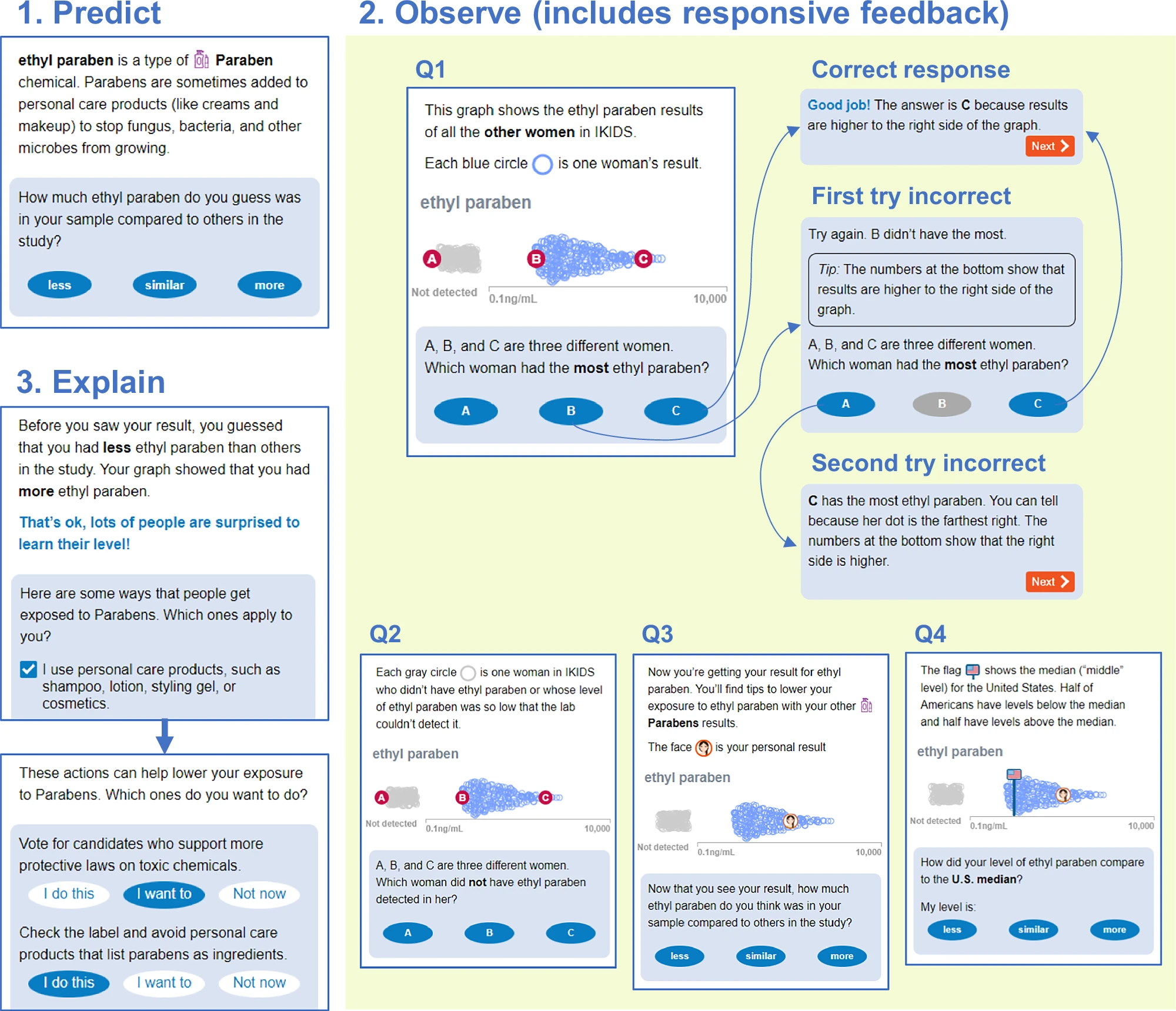
Screenshots of the graph-reading tutorial for study participants, walking them through their chemical exposures. (Source: A personalized tutorial to improve understanding of individual chemical results and opportunities for reducing exposure)

Collaborators at the Silent Spring Institute and UCSF created a smartphone-based tutorial for mothers who participated in two cohort studies, including IKIDS, that walked participants through their chemical exposure results and offered personalized recommendations for reducing contaminants in the future. 

According to their study published this February, the tutorial helped study participants understand graphs that detailed their own chemical exposures, aimed at accessibility to participants of all education levels and backgrounds. 

The digital interface showed participants how their own chemical exposure levels compared against other mothers collectively in both the study and nationally, then offered pointers to reduce exposure to endocrine-disrupting contaminants.

Some practical recommendations shared in the study: eating more fresh and frozen food, opting for drinks in glass bottles instead of cans, moisturizing with natural oils like shea butter or avoiding household products that are advertised as “antimicrobial.”

The tutorial proved effective at “creating intentions to adopt health-protective behaviors,” the study’s authors wrote, while providing a report-back tool that scaled for participants across different socioeconomic and educational backgrounds. 

The tricky part, Geiger said, is framing risks in the proper dose. Since many of these chemicals are still being researched, investigators must give participants their best guidance off of incomplete or evolving information. 

“We have to think really hard about how to report these levels back—it’s a little bit of a double-edged sword because we’re getting grants to study these chemicals simultaneously,” Geiger said. “It’s still emerging research with many of these chemicals, so we don’t always have that hard and fast guidance to give back.

“We’re continuing to do this work and hoping that, at the policy level, we become more aware that we may be doing damage to children at these crucial developmental stages, by dosing them with chemicals that are not tested or understood commensurate with the value that our children hold for the future.” 

Editor’s note

To contact Sarah Geiger, email smurphy7@illinois.edu 

Share on social

Related news

From the lab to the concert hall, virtual reality plays a growing role in acoustics studies


To simulate classrooms, performance halls and other indoor environments, the Speech Accommodation to Acoustics Lab uses virtual reality and “auralization” techniques in controlled settings. (Photo provided)

At the Speech Accommodation to Acoustics Lab, researchers are trying to solve a common problem for teachers and vocal performers. How can they be heard and understood without straining their voices? 

Pasquale Bottalico, associate professor of speech and hearing science, runs the Speech Accommodation to Acoustics Lab, which investigates the acoustical conditions of rooms—classes, restaurants and concert halls alike—that lend themselves to intelligible speech with minimal vocal effort from the speakers. 

Over the last 5 years, the lab’s research has steered toward virtual reality and auralization, a technique to replicate the sound conditions of different spaces, to simulate these indoor conditions and make their studies more applicable to real-life scenarios. Here, Bottalico expands on his SpAA Lab’s recent projects and VR experiments.

When did your lab begin using virtual reality? What compelled you about this type of technology for your area of research?

Our lab began working with virtual reality (VR) in 2020 as part of our broader research on how acoustic environments influence voice production and communication. In many traditional speech and voice studies, experiments are conducted in quiet laboratory settings that do not fully represent the complex environments people encounter in everyday life.

VR provides a powerful way to bridge that gap. It allows us to recreate realistic environments—such as classrooms, concert halls, or social settings—while still maintaining precise experimental control. For example, VR makes it possible to manipulate room acoustics, background noise and visual cues independently and observe how speakers adapt their voice. Research has shown that both auditory and visual environmental information can influence voice production and perception, highlighting the importance of studying communication in multisensory contexts rather than purely auditory ones.  

For virtual reality studies you’ve worked on, could you describe what these experiences look, feel, and sound like for participants?

Participants wear a virtual reality headset and headphones that immerse them in a simulated environment. For example, someone might find themselves standing in a classroom, a concert hall or a restaurant while speaking or singing. The visual environment allows them to look around the space, while spatialized audio reproduces how their voice would sound in that particular room.

This means participants hear realistic acoustic effects such as reverberation, reflections and background noise. Studies using these methods have shown that speakers and singers naturally adjust their vocal production depending on the acoustic properties of the environment, even when those environments are simulated.  

What equipment or tools do you use to simulate these experiences?

To create these simulations, we combine several technologies. 

Participants typically use a VR headset for the visual environment and high-quality headphones to deliver spatial audio that reproduces realistic room acoustics.

Behind the scenes, we use auralization techniques, which allow us to simulate how sound propagates in real spaces such as classrooms, concert halls or lecture halls. We use real measurements to simulate the acoustics of the environments, like a University of Illinois classroom, or venues at the Krannert Center for the Performing Arts. 

Microphones and acoustic analysis tools are also used to measure vocal parameters such as sound pressure level, pitch, and vocal effort while participants interact with the virtual environment.

Because virtual reality can replicate the sensory conditions of real communication environments, it may help improve the transfer of therapeutic strategies from the clinic to everyday life.

Pasquale Bottalico

Associate Professor Speech and Hearing Science

Tell us more about VR as a training or therapy tool. How might virtual reality benefit professional voice users and individuals with voice disorders?

VR has enormous potential as a training and therapy tool, especially for professional voice users such as teachers, singers and public speakers. These individuals often need to communicate in demanding environments for long periods of time, which can lead to vocal fatigue or voice disorders.

One challenge in voice therapy is that exercises performed in a quiet clinic may not transfer easily to real-life environments. VR can help address this problem by allowing people to practice communication in realistic scenarios—such as teaching in a noisy classroom or speaking in a crowded social setting—while still being in a safe and controlled therapeutic environment.

Because VR can replicate the sensory conditions of real communication environments, it may help improve the transfer of therapeutic strategies from the clinic to everyday life.

What are some examples of virtual reality studies you’ve performed? What did you learn?

Our lab has been exploring VR applications for voice and speech research through several projects and doctoral dissertations.

For example, the doctoral work of Charles Nudelman, Ph.D., supported by the Raymond H. Stetson Scholarship, examined how visual aspects of an environment—such as room size and occupancy—affect voice production using immersive virtual reality. His research demonstrated that visual characteristics of a room can influence acoustic voice parameters and self-perceived vocal fatigue and discomfort, highlighting the importance of visual cues in voice production.  

Similarly, the doctoral research of Ümit Daşdöğen (now at CSD University of Delaware), funded through an NIH R21 grant, investigated how auditory, visual and audiovisual sensory inputs influence voice perception and production in immersive VR environments. This work showed that multisensory factors can significantly affect vocal loudness, vocal effort, and acoustic voice parameters, helping establish a scientific foundation for the use of VR in voice training and therapy.  

Another related project is the doctoral research of Carly Wingfield at the Illinois School of Music in collaboration with Professor Yvonne Gonzales Redman, which was supported by the prestigious Kate Neal Kinley Fellowship. Her work explored the use of VR simulations to help singers rehearse in virtual replicas of performance venues. The results suggested that practicing in VR environments allowed singers to better adapt to the acoustics of the real performance space and feel more confident when performing in unfamiliar venues.  

We also currently have a new project underway in the lab focusing on virtual reality–based voice therapy and communication training. This study involves Giulia Fusari, a visiting scholar from the Politecnico di Milano, and Mariah Bates, a master’s student in Health Technology at the University of Illinois completing her capstone project with our lab.

The project is developing a human-centered VR platform designed to simulate realistic conversational environments, such as social interactions in restaurants or other everyday communication settings. Participants complete weekly sessions over several weeks, and we evaluate usability, communication effort, realism of the environment and overall user experience. The goal is to better understand how immersive environments can support communication training and voice therapy in ecologically valid contexts.

In future developments, these types of VR environments could also be adapted to support individuals with neurological conditions that affect speech and voice, such as Parkinson’s disease, where patients often struggle to generalize speech therapy skills from the clinic to real-world communication settings.

If there are studies open to participants, how can they reach out?

Individuals interested in participating in research studies in our lab can contact us directly at pb81@illinois.edu. We regularly recruit participants for studies involving speech perception, voice production and immersive communication environments.

Editor’s note:

To learn more about the Speech Accommodation to Acoustics Lab, visit their website.


Share on social

Related news

Where does AI fit into the big picture of public health?


Bruno Nunes is trained as an epidemiologist. Now he studies how machine learning can lead to better health outcomes at the population level. (Photo by Ethan Simmons)

In the view of University of Illinois public health researcher Bruno Nunes, artificial intelligence shapes up as a potent tool to predict and prevent public health problems, such as chronic diseases. 

But before AI-powered models are deployed in public health settings, they must be trained on richer data sets so they don’t amplify inequalities that exist in our healthcare system and society.

“To reach this future, we need to have better data to develop these models,” said Nunes, associate professor at the Department of Health and Kinesiology at the College of Applied Health Sciences. “Machine learning is a data learning process. It’s not just about using the fanciest algorithm—the problem is if you don’t have good data, you won’t have a good model.” 

Trained as an epidemiologist, Nunes is focused on public health strategies: how to prevent chronic disease and promote positive health outcomes at the population level, in some cases before people visit the doctor’s office. 

Artificial intelligence is already widely deployed in healthcare settings to better diagnose patients, especially reading medical imagery like X-rays, MRIs and CT scans.

With machine learning’s superior ability to detect patterns using huge tranches of data, Nunes envisions a future where models can accurately predict the risks of developing chronic diseases and allow populations to intervene earlier than before.

Part of this, Nunes argues, is AI may help us untangle “multimorbidity.” Many healthcare patients show up to the doctor’s office with two or more diseases, such as hypertension combined with diabetes or high cholesterol, which complicates management and quality of life. 

“Our health system and services are tailored to one disease. But in most cases, especially when talking about populational aging, most people are presenting different diseases at the same time,” Nunes said. “And the worst part of that is when we aren’t able to manage this patient well because they have such complex conditions and interactions.” 

His recent research has tested machine learning models on their ability to predict real-world outcomes. One recent study showed that machine learning models can predict a population’s dental service usage with solid accuracy but show poorer results with certain demographic subgroups. 

Machine learning is a data learning process. It’s not just about using the fanciest algorithm—the problem is if you don’t have good data, you won’t have a good model.

Bruno Nunes

HK Associate Professor

Nunes collaborated on a study that used an AI model to predict dental service use for adults in Southern Brazil. The model used 47 different characteristics—sociodemographic data, behavioral traits and oral and general health markers—to predict whether participants went to the dentist in the past year from a cohort study in Pelotas. 

Though the machine learning model’s predictions were largely accurate, it performed significantly worse across the board for mixed-race individuals in the study compared to Black and white participants, making the model unsuitable for real-world implementation in its current form.  

“None of the models are perfect: they present an error rate, and we need to deal with it,” Nunes said. “But if this error rate is higher for a subgroup of the population, the subgroup may be under- or over-diagnosed.

“If the model is not so good for people who already present with historical inequalities in the health system, the model can amplify these inequalities instead of decrease them.”   

Nunes tries to teach his students to frame the right questions in his new class, Artificial Intelligence in Public Health, which debuted in fall 2026 in HK.

Through critical discussions, he hopes to get students to think more about how “AI can fit into the big picture of public health,” and construct their own models around the right questions. 

“In most cases we tend to develop models for disease-related consequences or for problems which we already have an effective public health strategy, for example—but what if we could create equitable models to predict the problems in advance or issues without scalable solutions?” Nunes said. 

“You can’t just press a button to develop a machine learning model. You must have prior knowledge of the topic, skills and abilities to interpret the model considering public health principles. How can it be useful to solve the disease burden at the population level?”

Editor’s note:

To reach Bruno Nunes, email nunesb@illinois.edu 

“Dental services use prediction among adults in Southern Brazil: A gender and racial fairness-oriented machine learning approach” is available online.  

DOI: 10.1016/j.jdent.2025.105929The database is publicly available: https://dataverse.harvard.edu/dataset.xhtml?persistentId=doi:10.7910/DVN/BTLAAD


Share on social

Related news

Spring 2026: Message from HK Department Head Kim Graber


Kim Graber

As we move through another dynamic semester in the Department of Health and Kinesiology, I am continually struck by the breadth and impact of the work happening across our department. This spring, our faculty, students and alumni have advanced important conversations at the intersections of health, behavior and society—work that not only contributes to scholarship, but also to real-world understanding and change.

Among our recent highlights, Jacob Allen and Elisa Caetano-Silva’s work on inflammatory bowel disease and stress-related colitis is helping to deepen our understanding of how physiological and psychological factors interact in complex ways. Similarly, Thayna Flores and Pedro Hallal’s research on toddler diets is offering fascinating insight into how early nutrition may shape not just physical development, but cognitive and behavioral patterns as well.

We are also excited to share an upcoming story on iPALS, which underscores the power of alumni engagement and support in sustaining meaningful programming. This story reflects the strong community that continues to define our department.

Our faculty are also pushing into emerging and interdisciplinary areas. Bruno Nunes’ work exploring the relationship between artificial intelligence and mortality raises compelling questions about the future of health analytics and prediction. Sarah Geiger’s early childhood investigations continue to illuminate foundational stages of development, adding depth to our understanding of lifelong health trajectories.

Additional articles highlight the impactful work from Laura Rice (research on fall prevention and management) and Sandraluz Lara-Cinisomo (postpartum depression and pain during and after childbirth in racial/ethnic minority women), as well as Soyoung Choi’s interdisciplinary collaborations and Robyn Gobin’s work in areas of Veterans’ health and mental health research.

Thank you for being part of a community that values curiosity, collaboration and meaningful impact. I look forward to all that the remainder of the semester will bring.

Warm regards,

Kim Graber

Department Head, Health and Kinesiology

Share on social

Related news

AHS Faculty Q&A: Robyn Gobin understands trauma as both professor and clinician


Robyn Gobin said the authenticity of research participants and clients motivates her work. (Photo provided)

Health and Kinesiology Associate Professor Robyn Gobin inhabits many roles—teacher, researcher, psychologist, author—which continue to influence each other. Gobin is a trauma specialist: she works with domestic violence survivors and military Veterans and has published studies about their experiences.  

Gobin joined the Department of Health and Kinesiology in 2015, after clinical and research fellowships at UCSD and Brown University. She obtained her Ph.D. in Clinical Psychology from the University of Oregon in 2012, then worked at the VA Providence Healthcare System’s PTSD Clinic and the VA San Diego Healthcare System, as an Advanced Women’s Health Research Fellow and postdoctoral clinician.

Part of what keeps Gobin motivated to do this work is “the authenticity and courage” she witnesses from research participants and clients as they navigate their healing journeys.   

“It is a privilege to contribute, in both small and meaningful ways, to people reclaiming their sense of self and well-being in the aftermath of trauma,” she said. 

Gobin reflected this semester on her background and ongoing work for the College of Applied Health Sciences. 

Why did you want to become a psychologist? When did academia and the research world come into the picture for you? 

Growing up, I always knew I wanted to have a career that would allow me to help the people in my community experience less stress and have more joyful and fulfilling lives. I discovered the field of psychology during my senior year in high school when I took an AP Psychology course. What attracted me most to the field was that it would allow me to enjoy the best of both worlds: research and practice. I knew I wouldn’t be limited to using just one skill set. Psychology gives me the freedom to use many gifts and talents. As a research psychologist who is also licensed to practice, I get to help shape the knowledge that informs interventions in clinical and community settings, while my work with clients helps shape the way I conceptualize my research.

What brought you to the University of Illinois and the College of Applied Health Sciences? 

As a trauma specialist, I’ve had the opportunity to receive both research and clinical training as a predoctoral and postdoctoral fellow at several Veterans Affairs hospitals. It has truly been an honor to work with military Veterans. When my postdoctoral fellowship concluded, I knew I wanted to continue serving this population. During my job search, I stumbled across a tenure-track faculty position affiliated with the Chez Veterans Center, housed in the College of Applied Health Sciences. I was immediately drawn to the opportunity to continue my Veteran-centric research in a university setting. 

What is it like to occupy the roles of therapist, researcher and professor? Are there ways that each role affects the others for you personally? 

It provides a meaningful balance. I enjoy work that keeps me on my toes by offering opportunities to engage different parts of my brain. One of my core values is being of service and having a direct impact in the community, and these three roles allow me to integrate service and impact into my professional identity. Teaching and therapy allow for immediate, direct impact while collaborative research allows me to contribute to longer-term, broader impact by generating knowledge that can shape practice and policy. Each role is influenced by the others. 

My clinical work grounds my research in real-world experiences and helps ensure it remains relevant and responsive. My research strengthens my teaching and clinical practice by providing evidence-based frameworks and keeping me abreast of emerging topics and the latest research in the field. Teaching allows me to draw directly from both my clinical experiences and research to facilitate rich, nuanced conversations about the complexities of trauma and mental health while engaging learners at all levels, from undergrad and graduate students to new and experienced clinicians. 

You co-authored two recent papers detailing the responses of women who experienced intimate partner violence about their beliefs and practices around forgiveness. What was it like to collaborate on these studies, and what did you learn from them? 

These projects were very special because I got to collaborate with former graduate student Kristen Golden, Ph.D., around our shared passion for enhancing well-being and supporting healing among women survivors of domestic violence. 

I always consider it an honor when survivors are willing to share their stories with us. As a trauma researcher who embraces feminist and intersectional frameworks, one of the biggest takeaways for me was that it matters how we socialize women and girls around forgiveness both in communities and in religious contexts where expectations are often shaped by the intersection of gender, race, culture and faith. 

When women internalize beliefs around forgiveness that align with rigid gender role expectations, they may make choices that inadvertently increase risk for continued harm. However, when women are supported in adopting more expansive beliefs about forgiveness that are not solely about nurturing others but also allow them to retain agency (i.e., believing that it is possible to forgive their abusers without reconciling), they are better positioned to make choices that prioritize their safety and well-being. 

Your research areas and mental health practice undoubtedly expose you to profound grief and trauma of your clients and participants. How do you manage this as a practitioner, and what keeps you motivated to work in this field? 

I manage this by being highly devoted to my self-care practices. Having a nourishing morning routine, setting boundaries and intentionally creating space to recharge allow me to do this work from a grounded and resourced place. I also prioritize time with family, friends and community, which helps sustain me both personally and professionally. What keeps me motivated is radical hope and the belief that we can work collectively to reduce harm and create safer environments where women and girls are better protected from sexual violence and all other forms of interpersonal trauma. 

I am also inspired by the authenticity and courage I witness in research participants and clients as they navigate their healing journeys. It is a privilege to contribute, in both small and meaningful ways, to people reclaiming their sense of self and well-being in the aftermath of trauma. 

Is there anything else you’re working on right now that you’d like to share?

I have several exciting new collaborations with colleagues at the University of Illinois and other institutions. This work includes examining the influence of radical hope on psychological and physiological responses to race-based stress; conducting community-engaged research on intellectual health and scholarly identity as pathways to promoting educational equity and well-being among Black youth; exploring cultural betrayal trauma theory in Black men; and developing patient-centered, community-engaged strategies to enhance mental health outcomes for military sexual trauma survivors.

Is there anything in particular you would like students or others working in the college to know about you? 

My work is inspired, in part, by Dawna Markova’s poem, “I Will Not Die an Unlived Life.” It serves as both an inspiration and a continuous invitation to live and work with intention:

“I will not die an unlived life 

I will not live in fear 

of falling or catching fire. 

I choose to inhabit my days, 

to allow my living to open me, 

to make me less afraid, 

more accessible, 

to loosen my heart 

until it becomes a wing, 

a torch, a promise. 

I choose to risk my significance; 

to live so that which came to me as seed 

goes to the next as blossom 

and that which came to me as blossom, 

goes on as fruit.”

Editor’s note:

To reach Robyn Gobin, email rgobin@illinois.edu.
 

Share on social

Related news

Researcher Soyoung Choi pushes Pilates toward evidence-based wellness


Health and Kinesiology Assistant Professor Soyoung Choi, left, handles various Pilates-related books and research materials with her doctoral students, Hyun Seo Ko and Diego Soto at Freer Hall. (Photo by Ethan Simmons)

In the age of algorithm-driven fitness trends and curated wellness aesthetics, reformer Pilates has become a cultural phenomenon, celebrated as much for its sleek studios and celebrity endorsements as for its exercise benefits. But beneath the social media sheen, Soyoung Choi, an assistant professor in the Department of Health and Kinesiology at the University of Illinois Urbana-Champaign, is asking a more grounded question: what does the science actually say?

Choi’s research challenges some of the most popular assumptions surrounding Pilates, especially the idea that it is a reliable path to weight loss. According to her recent meta-analysis, the evidence does not support strong claims that Pilates significantly reduces body weight. 

“Pilates primarily focuses on strengthening the core musculature,” she said, noting that it typically does not generate enough caloric expenditure for meaningful weight reduction. 

That conclusion might surprise practitioners who associate reformer classes with lean physiques and body transformations. But Choi said the disconnect lies not in the effectiveness of Pilates itself, but in how it is framed. Rather than positioning the workout as a fat-burning solution, she believes it should be understood as part of broader physical activity recommendations that support long-term health.

Evidence from her research suggests that Pilates delivers measurable improvements in areas that are often less visible but deeply meaningful for overall well-being: core strength, muscular endurance, flexibility, balance, posture and functional movement. These benefits can translate to reduced injury risk, improved daily mobility and better quality of life.

“Pilates has a strong mind-body component,” Choi said, pointing to its emphasis on breathing, concentration and controlled movement. These elements may help with stress management and encourage sustained exercise participation—factors that public health experts increasingly view as critical for lasting health behavior change.  

Still, Choi is careful to distinguish what research can confidently support from what remains uncertain. Studies show clear gains in flexibility, especially in the hamstrings and lower back, as well as improvements in functional stamina measured through walking-based endurance tests. Some evidence even points to reductions in systolic blood pressure.  

But when data from multiple studies are combined, several popular claims about Pilates lose strength. The research has not consistently demonstrated significant effects on body mass index, body fat percentage, cholesterol levels, bone mineral density or agility. Choi said inconsistent program designs, varied exercise intensity and uneven reporting standards make it difficult to draw stronger conclusions. In other words, Pilates is not ineffective; it is simply more nuanced than is often suggested.

“Too often, the fitness industry is designed around a ‘standard’ population.”

Soyoung Choi

HK assistant professor

That nuance becomes even more complicated when filtered through modern fitness culture. Choi’s work in health behavior and literacy has led her to examine how cultural narratives about body ideals shape exercise motivation. When Pilates is framed primarily as a path to thinness or a certain aesthetic, she said, participants may focus on appearance rather than health.

“That kind of motivation can be short-lived,” she said, especially when visible changes fail to appear quickly. The emphasis on external results can overshadow less obvious but meaningful outcomes like improved mobility, reduced pain or increased body awareness. 

Social media intensifies this tension. Online, reformer Pilates is frequently showcased through images of toned bodies and minimalist studio spaces, visuals that can create unrealistic expectations. Choi said that the scientific evidence supports flexibility, functional fitness and core strength more consistently than dramatic body reshaping. When expectations collide with reality, participants might feel discouraged even though they are making genuine health gains.  

Bridging this gap between research and public perception, she said, is essential for promoting informed decision-making around wellness.

Choi’s broader academic work also widens the conversation beyond aesthetics and trends. Much of her research focuses on accessibility in physical activity, particularly for disability populations. From that vantage point, mainstream Pilates reveals another challenge: inclusivity.

Most classes rely heavily on visual demonstrations, assuming participants can watch and replicate precise movements. For individuals with visual impairments, this creates an immediate barrier. Likewise, routines that assume full mobility can exclude people who use wheelchairs or have limited range of motion.  

“Too often, the fitness industry is designed around a ‘standard’ population,” Choi said. When accessibility is overlooked, entire groups miss opportunities for health promotion, contributing to broader disparities over time. 

In response, her lab is developing an audio-guided Pilates program specifically for menopausal women with visual impairments. Instead of relying on demonstration, the program uses structured verbal cues to guide movement. The goal is not only inclusion but reimagining how exercise instruction can adapt to diverse needs.

Her work in health literacy also informs how she views influencer-driven wellness culture. Health literacy, she said, involves more than understanding information—it means evaluating whether claims are evidence-based or shaped by marketing. In digital spaces dominated by appearance-focused content, distinguishing science from promotion can be difficult.

When fitness messaging centers narrowly on weight or shape, people might adopt definitions of health that ignore functional ability or mental well-being. Choi believes strengthening critical thinking around health information is increasingly necessary in a landscape flooded with simplified advice.

Looking ahead, Choi hopes research on Pilates and similar trends will evolve beyond short-term outcomes and aesthetic narratives. Longitudinal studies that track mobility, injury prevention, cardiovascular health and healthy aging could provide a clearer picture of Pilates’ role across a lifespan. Mental health outcomes, such as stress, anxiety, confidence and body awareness, also need more rigorous investigation, she said.  

Equity is another priority. Many existing studies involve relatively homogeneous groups who already have access to expensive studios or wellness resources. That limits how widely findings apply. Choi suggests that researchers should design studies from the outset with accessibility and diversity in mind, rather than treating inclusion as an afterthought.

Ultimately, her perspective reframes Pilates not as a quick fix, but as a tool whose value depends on how society chooses to define health. The question, she suggests, is not whether Pilates lives up to social media hype, but whether fitness culture is ready to embrace a broader understanding of wellness.

As trends come and go, Choi’s research serves as a reminder that the most meaningful benefits of exercise may be the ones that don’t always show up in a mirror.

Editor’s note:

To reach Soyoung Choi, email soyoung@illinois.edu.
 

Share on social

Related news

Our 2026 College of Applied Health Sciences award winners


At the spring college meeting for the College of Applied Health Sciences, our faculty and staff gathered to celebrate this year’s college award winners, and give send-offs to two faculty leaders who are entering retirement: Speech and Hearing Science Professor and former Department Head Pamela Hadley and AHS Professor and Associate Dean for Research Jeff Woods.

(Two of our award winners, Christy Bazan and Mary Flaherty, won equivalent awards from campus as well.)

Here are our AHS college award winners for 2025-26. A recording of the meeting is available on Media Space:

AHS Staff Excellence Award

  • Chez Veterans Center Outreach Coordinator and Veteran Recruiter, Garrett Anderson
  • College of AHS Assistant to the Dean, Robbin King

AHS Excellence in Undergraduate Advising Award

  • Health and Kinesiology Academic Advisor, Patty Hudek

AHS Excellence in Undergraduate Teaching Award – Faculty

  • Speech and Hearing Science Associate Professor, Mary Flaherty

AHS Excellence in Undergraduate Teaching Award – Teaching Assistant

  • Health and Kinesiology Graduate Teaching Assistant, Ashley Morgan

AHS Access, Belonging and Community Awards

  • SHS student Zhitong Zhu
  • RST graduate research assistant Jenna Fesemyer-Ayers
  • RST Assistant Professor Yannick Kluch
  • Chez Veterans Center Research Assistant Professor Michael Lotspeich-Yadao

AHS Excellence in Guiding Undergraduate Research Award

  • Recreation, Sport and Tourism Assistant Professor, Joelle Soulard

AHS Excellence in Graduate and Professional Teaching Award

  • SHS Associate Professor, Dan Fogerty

AHS Excellence in Graduate Student Mentoring Award

  • HK Associate Professor, Laura Rice

AHS Excellence in Online Teaching Award

  • HK Instructor, Christy Bazan

Phyllis J. Hill Faculty Award for Exemplary Mentoring

  • HK Teaching Assistant Professor, Jesse Couture

Share on social

Related news

College of Applied Health Sciences
110 Huff Hall
1206 South 4th Street
Champaign, IL 61820
(217) 333-2131