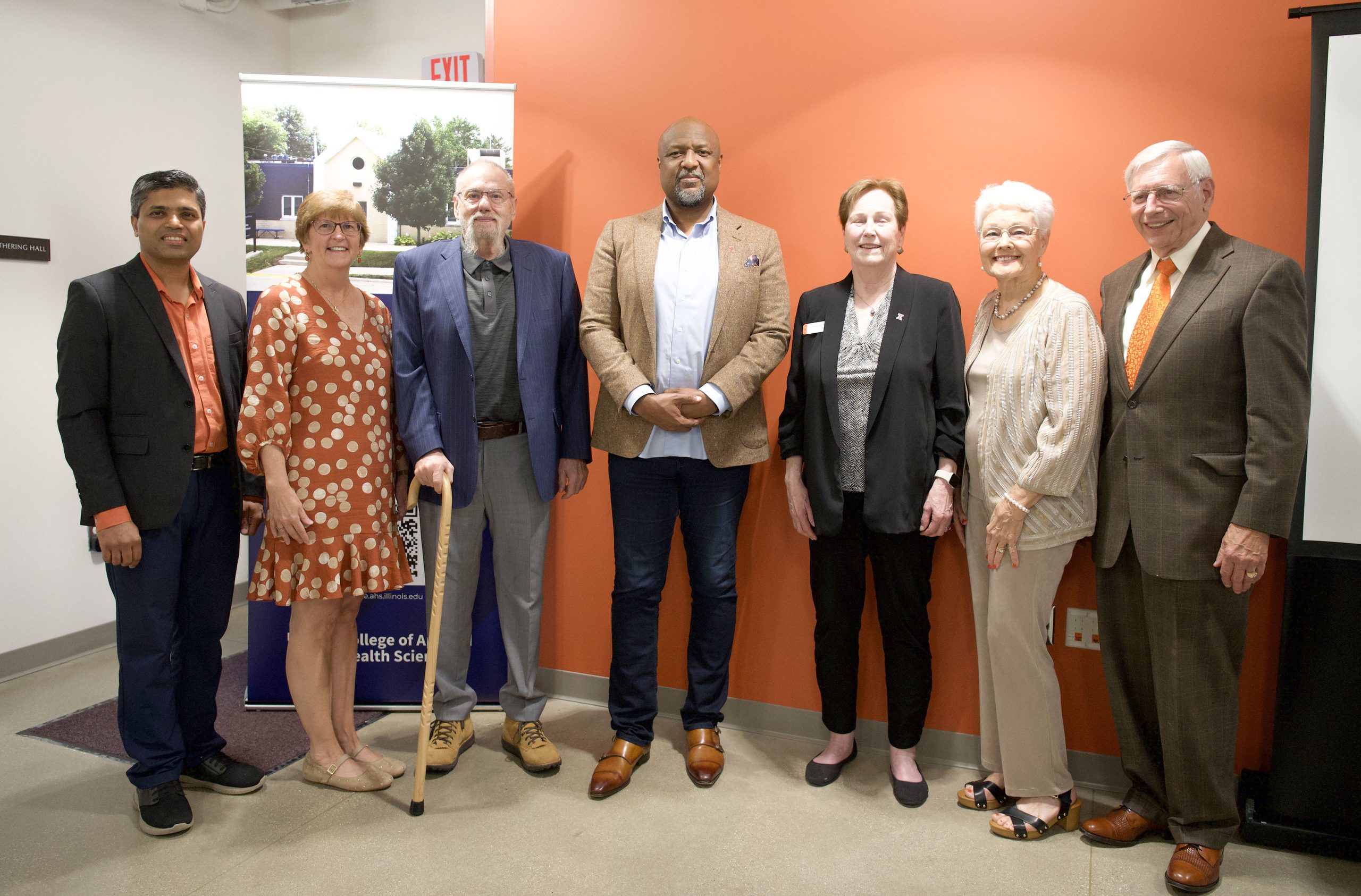
At the spring college meeting for the College of Applied Health Sciences, our faculty and staff gathered to celebrate this year’s college award winners, and give send-offs to two faculty leaders who are entering retirement: Speech and Hearing Science Professor and former Department Head Pamela Hadley and AHS Professor and Associate Dean for Research Jeff Woods.
(Two of our award winners, Christy Bazan and Mary Flaherty, won equivalent awards from campus as well.)
Here are our AHS college award winners for 2025-26. A recording of the meeting is available on Media Space:
AHS Staff Excellence Award
Chez Veterans Center Outreach Coordinator and Veteran Recruiter, Garrett Anderson
College of AHS Assistant to the Dean, Robbin King
AHS Excellence in Undergraduate Advising Award
Health and Kinesiology Academic Advisor, Patty Hudek
AHS Excellence in Undergraduate Teaching Award – Faculty
Speech and Hearing Science Associate Professor, Mary Flaherty
AHS Excellence in Undergraduate Teaching Award – Teaching Assistant
Health and Kinesiology Graduate Teaching Assistant, Ashley Morgan
AHS Access, Belonging and Community Awards
SHS student Zhitong Zhu
RST graduate research assistant Jenna Fesemyer-Ayers
RST Assistant Professor Yannick Kluch
Chez Veterans Center Research Assistant Professor Michael Lotspeich-Yadao
AHS Excellence in Guiding Undergraduate Research Award
Recreation, Sport and Tourism Assistant Professor, Joelle Soulard
AHS Excellence in Graduate and Professional Teaching Award
SHS Associate Professor, Dan Fogerty
AHS Excellence in Graduate Student Mentoring Award
HK Associate Professor, Laura Rice
AHS Excellence in Online Teaching Award
HK Instructor, Christy Bazan
Phyllis J. Hill Faculty Award for Exemplary Mentoring
Woods leaves a legacy of groundbreaking research and inspired mentorship
Jeff Woods, center, got a rousing sendoff from faculty and staff at the AHS college meeting on May 7. (Photo by Ethan Simmons)
After a noteworthy tenure spanning more than three decades at the University of Illinois, Jeffrey Woods, Ph.D., the associate dean for research in the College of Applied Health Sciences and a national leader in exercise physiology research, has announced his retirement, marking the end of an era for one of the campus’ most influential scholars in health and aging studies.
Woods, whose work has reshaped scientific understanding of how physical activity benefits the immune system and human health, retires as one of the College of Applied Health Sciences’ most honored researchers and mentors. Named the inaugural Mottier Family Professor in Applied Health Sciences in 2019, Woods leaves a legacy of groundbreaking research and institutional leadership that has influenced both scholars and students alike.
“When Jeff started his career at Illinois 32 years ago, life looked very different. His days began with an hour-long commute from Charleston, Illinois, to the University of Illinois. Even in tough winter conditions, he never complained; he simply did what needed to be done,” said Amy Woods, the James K. and Karen S. McKechnie Professor and associate dean for faculty affairs in AHS and Jeff’s wife.
“All the while, his impact extended far beyond home. He traveled widely, shared his expertise with colleagues around the world and contributed to NIH grant reviews, helping to shape the future of research in his field. Now, he has a well-earned chance to slow down and enjoy life on his own terms. Jeff’s dedication and integrity have made a lasting difference, and this milestone is so richly deserved. We are so proud of him and so grateful for the life we’ve built together.”
Woods earned his B.S. from the University of Massachusetts at Amherst, an M.S. from Springfield College and his Ph.D. in Exercise Science from the University of South Carolina. He joined the University of Illinois faculty in 1994, eventually holding appointments across multiple disciplinary programs, including the Departments of Health and Kinesiology, Nutritional Sciences and the Carle-Illinois College of Medicine.
In his retirement announcement, Woods credited the undergrad and graduate students he worked with, as well as faculty and staff, whom he called the “unsung heroes” of the university.
“It has been a great career at a great university,” he wrote. “I look forward to observing your future success through the lens of my emeriti role.”
Throughout his career, Woods became internationally respected for his pioneering research into how regular exercise counteracts inflammation, bolsters vaccine responses in older adults and, perhaps most notably, alters the gut microbiome in ways that promote health independent of diet. His research findings have appeared in over 140 peer-reviewed publications and helped define new directions in the study of aging and preventative health.
“Jeff has been a defining presence in the College of Applied Health Sciences—as a scientist, as a mentor and as a leader. His career represents the very best of our mission: rigorous research, collaborative innovation and an unwavering commitment to improving human health,” said Cheryl Hanley-Maxwell, dean of the College of Applied Health Sciences. “From the moment he arrived, he brought with him a spirit of curiosity and a deep belief in the transformative power of research.”
In addition to his pioneering scientific contributions, Woods served in numerous leadership capacities on campus. He was associate dean for research in the College of Applied Health Sciences and director of the Center on Health, Aging and Disability, where he guided interdisciplinary collaborations and championed integrative research programs aimed at improving the quality of life for aging populations.
Jeff has been a defining presence in the College of Applied Health Sciences—as a scientist, as a mentor and as a leader.
Cheryl Hanley-Maxwell
Dean, College of Applied Health Sciences
Colleagues and students will also remember him as a committed mentor. Over the years, Woods supervised more than 30 graduate students and served as a guiding force for early-career researchers, helping to cultivate a new generation of scholars in health sciences. His leadership extended beyond campus, with roles in national organizations and review panels that have shaped federal research agendas.
“One thing I’ve always appreciated about Jeff is the space he gave his trainees to grow,” said Jacob Allen, an associate professor in Health and Kinesiology. “As his Ph.D. student, he trusted me early on to think independently, take risks and develop my own scientific voice—practicing over and over how to communicate science clearly. That’s what ultimately matters: making an impact with your science. Jeff always reiterated that. That kind of environment is not easy to create, and it made a lasting impact on how I approach mentorship and science today. Now Jeff gets to apply that same approach to his golf game—plenty of time, plenty of reps, … but now no deadlines! Though he may still need a little extra ‘scientific creativity’ when his ball ends up in the woods.”
The Mottier Family Professorship, established through a generous estate gift honoring Charles and Audrey Phyllis Mottier, was awarded to Woods in recognition of his outstanding contributions to both science and education. At the investiture ceremony in 2019, Woods spoke warmly of the collaborative spirit of his colleagues and his gratitude for their daily challenges and inspirations.
As he steps away from his official duties, Woods said he looks forward to continuing to engage in collaborative projects, writing and opportunities to speak on issues at the intersection of exercise, aging and public health.
Rachel Hoopsick, Assistant Professor in the Department of Health and Kinesiology, studied teens’ misuse of inhalants in two recent papers. (Photo by Michelle Hassel)
Two new studies co-authored by Health and Kinesiology Assistant Professor Rachel Hoopsick offer insights into the spread of nitrous oxide misuse among adolescents.
What Hoopsick found in two studies: Millions of Americans were exposed to content about recreational nitrous oxide use from just 30 social media videos uploaded in early 2025. And younger teens were more likely to engage in inhalant misuse than older adolescents, with teenage girls being more likely to develop inhalant misuse disorder than boys.
Hoopsick led the two studies with University of Mississippi public health professor Andrew Yockey, who will join the University of Illinois Urbana-Champaign faculty in August.
“Inhalant use can cause serious harm, including neurologic damage, hearing loss, liver and kidney dysfunction, cardiac arrhythmias, psychological dependence and even sudden death after a single episode of use,” said Hoopsick.
HK Associate Professor Laura Rice (right) joined WCIA 3 News for University Updates, to share her research on the risks of falls for wheelchair users. (WCIA 3 News)
The U.S. Centers for Disease Control and Prevention (CDC) reports falls are the leading cause of injury for adults 65 and older. People in wheelchairs are at an even higher risk. That’s a primary focus for Health and Kinesiology Associate Professor Laura Rice and her research at the University of Illinois Urbana-Champaign.
Rice spoke with WCIA 3 News on the University Updates segment, to shed light on fall statistics and how users of wheelchair and scooters can manage the risks of falling.
“A lot of times, the wheelchair isn’t fit for the person very well, maybe they got a hand-me-down that wasn’t set up for them, people don’t have training on transfers when they’re moving the person from one place to another. Those are all very common reasons for falls,” she explained.