Pedro Hallal honored with King James McCristal Distinguished Scholar award


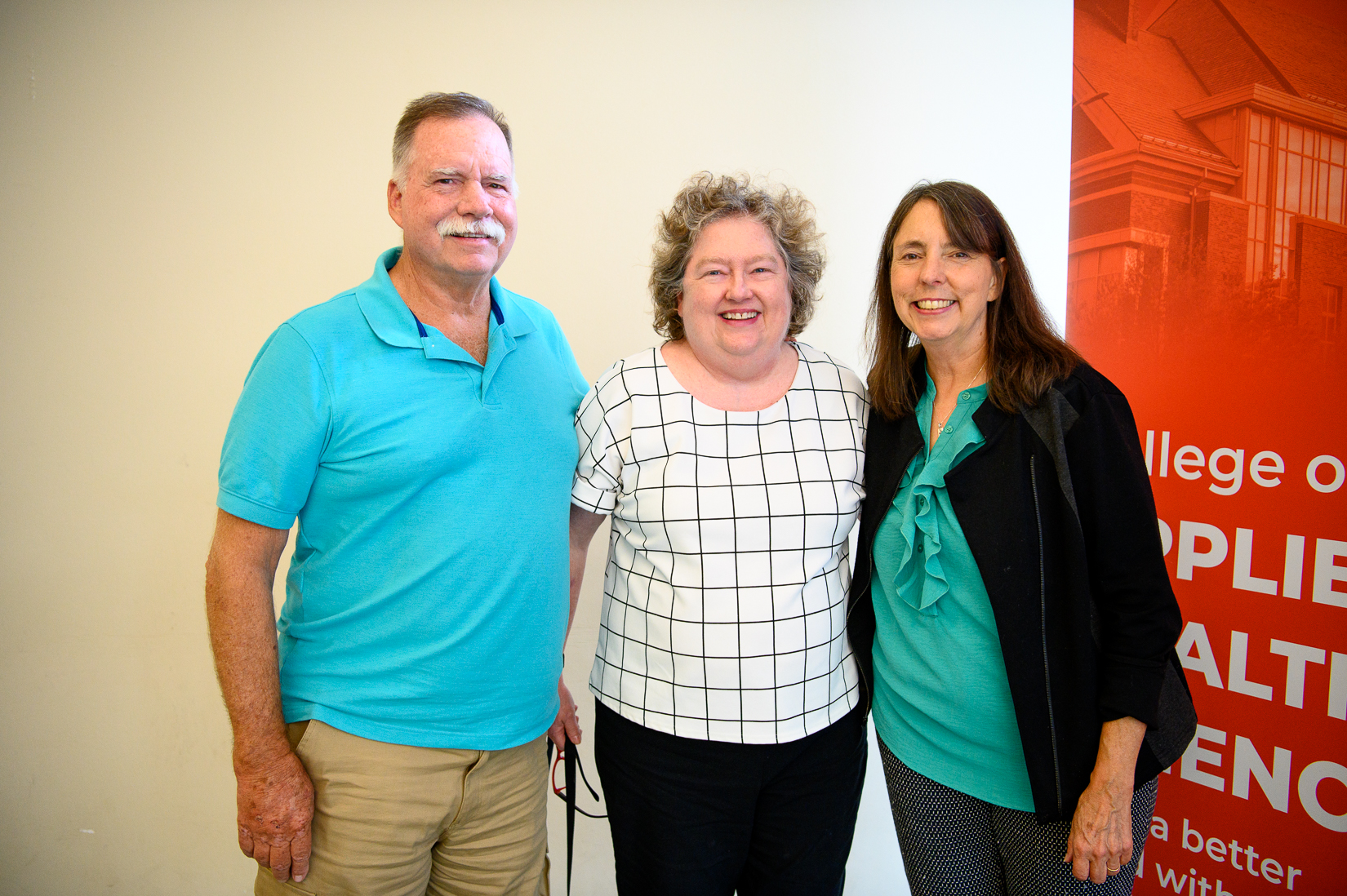
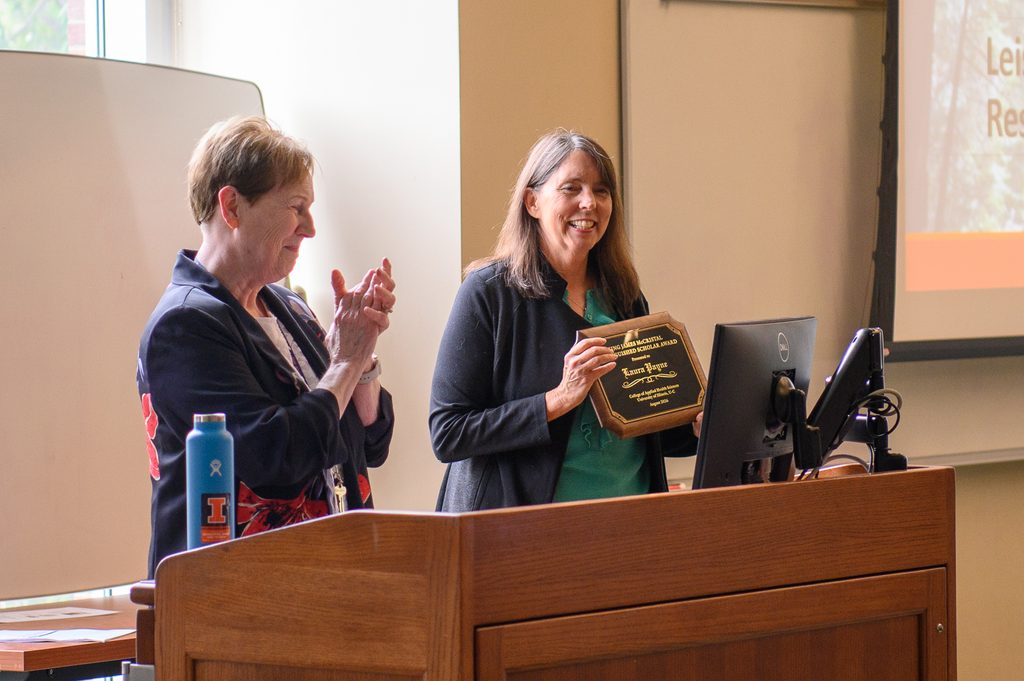
Pedro Hallal accepts the King James McCristal Distinguished Scholar Award on Wednesday, Sept. 23, 2025.

Like many young researchers, Pedro Hallal thought his first study would be groundbreaking and potentially change the paradigm of the study of physical activity. Ultimately, he said, it didn’t, but now, with the value of experience at hand, he understands that was OK.

“We are trained to think of things that no one has ever studied. But science is much more about consistency of results nowadays, than about brand-new findings,” said Hallal, the Alvin M. and Ruth L. Sandall Professor in the Department of Health and Kinesiology at the University of Illinois Urbana-Champaign. “We do research because of the questions; we don’t start with the answers.”

Thanks to that curiosity and because of the breadth of his research, Hallal on Sept. 24 was awarded the King James McCristal Distinguished Scholar Award, one of the most prestigious recognitions in the College of Applied Health Sciences. The award honors faculty whose scholarly contributions have significantly advanced their disciplines while elevating the reputation of the university.

For Hallal—whose research has transformed global understanding of physical activity and health—the honor represents both a recognition of past achievements and an encouragement to push forward in addressing one of the world’s most pressing public health challenges: physical inactivity.

“Professor Hallal’s scholarly work has substantially elevated the profile of his department, our college and the university by advancing public health knowledge and global health equity,” said Cheryl Hanley-Maxwell, dean of the College of Applied Health Sciences.

A Global Lens on Physical Activity

Hallal, who is also director of AHS’ Master of Public Health program, has built an international reputation for his research on physical inactivity, a phenomenon he argues must be understood in the context of modern life.

“Today, we have fewer people being active,” Hallal said. “Most of them are indoors, looking at a screen. We have to think about what physical activity is today, not decades ago. The notion that physical activity is good for health has been known for centuries. Only since the 1950s and ‘60s have we really been studying it.”

His scholarship began in Brazil, where his master’s thesis—“Physical Inactivity: Prevalence and Associated Variables in Brazilian Adults”—found that 41.1 percent of the surveyed population did not meet recommended activity levels of 150 minutes per week. This early work set the stage for his career-long focus on understanding inactivity as both a personal and societal issue.

Hallal’s impact expanded dramatically with his contributions to a series in The Lancet, one of the most influential medical journals in the world. His research revealed that one-third of adults worldwide—approximately 1.5 billion people—failed to achieve the minimum recommended level of physical activity. Equally concerning, four-fifths of children ages 13 to 15 fell short of the one-hour daily activity guideline. The findings underscored physical inactivity as a global pandemic, drawing international attention to a public health crisis with profound implications for chronic disease and health equity.

Hallal has often said that this work in The Lancet is the “research I am most proud of.”

Redefining Scientific Inquiry

Throughout his career, Hallal has emphasized the importance of scientific rigor and humility.

That philosophy has guided him to produce a body of work that does not merely identify problems but interrogates the systems that perpetuate them. His studies consistently highlight how socioeconomic and geographic inequalities shape access to safe and purposeful physical activity.

“Access to safe, purposeful physical activity must be a societal priority,” Hallal said. By framing physical inactivity not only as an individual choice but also as an issue of structural inequities, he has pushed the field toward broader, more inclusive approaches to solutions.

Access to safe, purposeful physical activity must be a societal priority

Pedro Hallal

Professor of Health and Kinesiology

A Legacy of Impact

The King James McCristal Distinguished Scholar Award cements Hallal’s place among the most influential scholars at Illinois. The recognition highlights not only his academic achievements but also his role in shaping the conversation around health equity worldwide.

From uncovering high rates of inactivity in Brazil to leading global efforts to quantify physical inactivity, Hallal has consistently produced research that informs public policy, inspires further scientific exploration, and elevates the role of physical activity in public health discourse.

Looking Ahead: Challenging Assumptions

As Hallal reflects on the future of his field, he sees opportunities to question prevailing assumptions and generate new lines of inquiry.

He is particularly interested in challenging the idea that “every movement counts.” While small bursts of activity are beneficial, Hallal believes that the global challenge lies in ensuring people have the opportunity for meaningful, sustained physical activity. He also underscores the importance of recognizing how time scarcity and resource inequality reinforce global disparities in health behaviors.

“I think this place, this campus and college, are in a great position to tackle these things,” Hallal said. “We are already one of the country’s leaders in the field, and we are one of the most productive groups in the world on this topic.”

Editor’s note:

To reach Vince Lara-Cinisomo, email vinlara@illinois.edu.
 

Share on social

Related news

Dr. Husain Named McCristal Scholar


Fatima Husain uses magnetic resonance imaging in her research.

Dr. Fatima Husain, professor of speech and hearing science, has been named the 2022 King J. and Marjorie R. McCristal Distinguished Scholar in the College of Applied Health Sciences, the most prestigious recognition of scholarly achievement given by the College. The award presentation and McCristal Lecture will take place on August 16, 2022, as part of the AHS Fall College Meeting.

Dr. Husain joined the Department of Speech and Hearing Science as an assistant professor in 2008. She earned her PhD in cognitive and neural systems at Boston University and joined the National Institute on Deafness and Other Communication Disorders, part of the National Institutes of Health, first as a post-doctoral fellow and then as a research fellow.

Dr. Husain uses a combination of computational modeling, brain imaging experiments, and behavioral experiments to research hearing and speech perception, as well as the disorders associated with them, such as hearing loss and tinnitus. Through this multi-method approach, she is able to simulate auditory and speech perception in the brain. The modeling enables her to make predictions that can be tested using behavioral and imaging tools, ultimately facilitating the evaluation of existing therapies and the proposal of novel treatment methods. She is the director of the Auditory Cognitive Neuroscience Lab.

The King James McCristal Scholar Award was established in 1988 to honor King McCristal, dean of AHS from 1961-1973.

Share on social

Related news


McCristal Lecture Focuses on Robots


Wendy Rogers at the 2021 McCristal Lecture.

Living independently requires the ability to perform what are called Activities of Daily Living, or ADLs. Fundamental ADLs include things such as bathing, eating, getting dressed, and so on. Instrumental Activities of Daily Living, or IADLs, include more complex activities such as paying bills, preparing meals, managing medications, and the like. In 1998, Dr. Wendy Rogers, Khan Professor of Applied Health Sciences, defined a third level of Activities of Daily Living that she called Enhanced Activities of Daily Living, or EADLs. Activities such as volunteering, taking part in community activities and engaging in hobbies enhance the quality of our lives.

Dr. Rogers, the 2021 King McCristal Distinguished Scholar in the College of Applied Health Sciences, focused her McCristal Lecture on designing robots that support successful aging related to the different kinds of activities. The lecture took place at the Fall College Meeting on August 17.

A world renowned scholar in the area of human factors and aging, Dr. Rogers has been collaborating on research related to human-robot interaction for more than 10 years, going back to her days as a professor of psychology and a principal investigator in the NIH-funded Center for Research and Education on Aging and Technology Enhancement at the Georgia Institute of Technology. Since joining AHS in 2017, she has conducted research under the auspices of the Collaborations in Health, Aging, Research, and Technology, or CHART, initiative, and also directs the recently opened McKechnie Family LIFE Home, where much of the research on health and wellness robots takes place.

When designing robots for successful aging, she said, it is important to consider the entire system. “We need to consider the characteristics of the human—their demographics, abilities, attitudes, and experiences,” she said. “We also need to think about the characteristics of the robot. What does it look like? Does it have a personality? What are its capabilities and functionalities? To what degree is it autonomous or being controlled?”

Developers also need to consider the characteristics of the task the robot and human are trying to do together, things such as how critical the task is, and whether it requires the robot and human to be co-located. Finally, the context of the interaction must be considered, whether the task is home-based or in a public setting, for example.

Dr. Rogers and her colleagues currently are investigating usability and other issues related to a robot developed by Hello Robot called Stretch. “We’ve been doing task analyses and prototyping different types of devices that Stretch could have at the end of its arm to perform different tasks, and comparing different types of control interfaces and control by different users,” she said. University of Illinois students soon will have the opportunity to participate in a competition in which they generate ideas for using Stretch to help people aging with long-term disabilities. The prize will be time with Stretch in the LIFE Home to further develop their ideas, guided by the LIFE Home’s expert staff.

Other Illinois research related to health and wellness robots includes designing socially assistive robots, robots with soft rather than rigid arms for telehealth applications, and robots that provide wayfinding assistance to individuals with visual impairments.

“We have made huge advancements in robotics in the last decade,” Dr. Rogers said, “but there’s still a lot more to be done.” And, she concluded, the McKechnie Family LIFE Home positions scholars at the University of Illinois really well to explore some of those questions.

Related news

College of Applied Health Sciences
110 Huff Hall
1206 South 4th Street
Champaign, IL 61820
(217) 333-2131