“Seeing my academic training translate into practical solutions has been one of the most rewarding aspects of my graduate experience”
Bisola Adeleke, a community health Ph.D. student, at her internship for Argonne Leadership Computing Facility. (Provided)
While still working on her Ph.D., a University of Illinois community health student researcher landed an internship at the biggest national laboratory in the Midwest.
This summer, Bisola Adeleke has conducted user experience research at Argonne National Laboratory, a federally funded science and engineering lab in Argonne, Illinois.
“Although my research focuses on older adults, the principles of human-centered design are universal,” Adeleke said.
This summer, her UX research has taken place in the Argonne Leadership Computing Facility, which provides supercomputing and AI resources to academic researchers, government agencies and industry scientists.
“Even world-class computing systems need intuitive, user-centered design,” Adeleke said. “The researchers who use ALCF are experts in their scientific fields, but that doesn’t necessarily mean they should have to struggle with complex workflows or documentation.”
What she’s seen so far: good user experience can make these advanced computing resources operate more efficiently and accessibly, allowing the researchers to spend more time on discovery and less navigating technical barriers, Adeleke said.
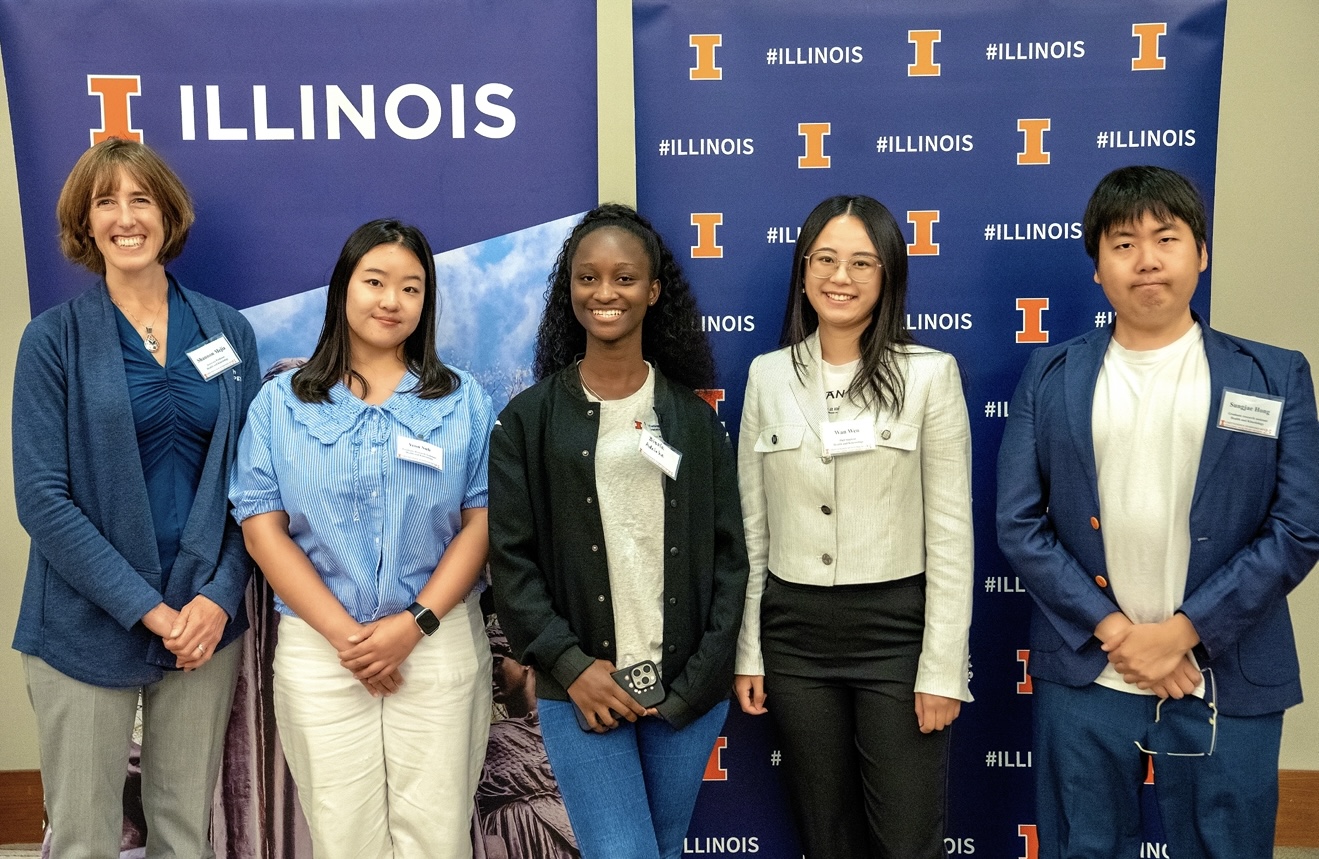
Members of the ADAPT Lab, led by Shannon Mejía (left).
An extended time working with professionals from computing and tech backgrounds has strengthened her ability to communicate across a diverse set of disciplines.
“One of the things I’ve valued most about my time at the University of Illinois is the emphasis on applying research to real-world challenges,” Adeleke said. “My coursework has provided a strong foundation in public health and research methods, while my internship at Argonne has shown me how those skills can be applied to improving technologies that support scientific research.
“Seeing my academic training translate into practical solutions has been one of the most rewarding aspects of my graduate experience.”
Before joining the University of Illinois Urbana-Champaign, Adeleke’s academic journey spanned two continents: she obtained her bachelor’s in health education from Lagos State University in Nigeria, and her master’s degree in research and development in educational studies from Palacky University in Olomouc, Czech Republic.
On October 8, faculty, students, and researchers from the Department of Industrial and Enterprise Systems Engineering and Department of Health and Kinesiology gathered at the iHotel for the 2025 Chittenden Symposium: “Lifelong Health by Design – Human-Centered Innovations in Chronic Disease Prevention.” The event united experts across disciplines to explore how engineering precision and health science insight can combine to design systems that foster long-term, equitable health outcomes.
Wendy Rogers said she always planned to get the Health Tech program established and build a strong foundation before passing it on
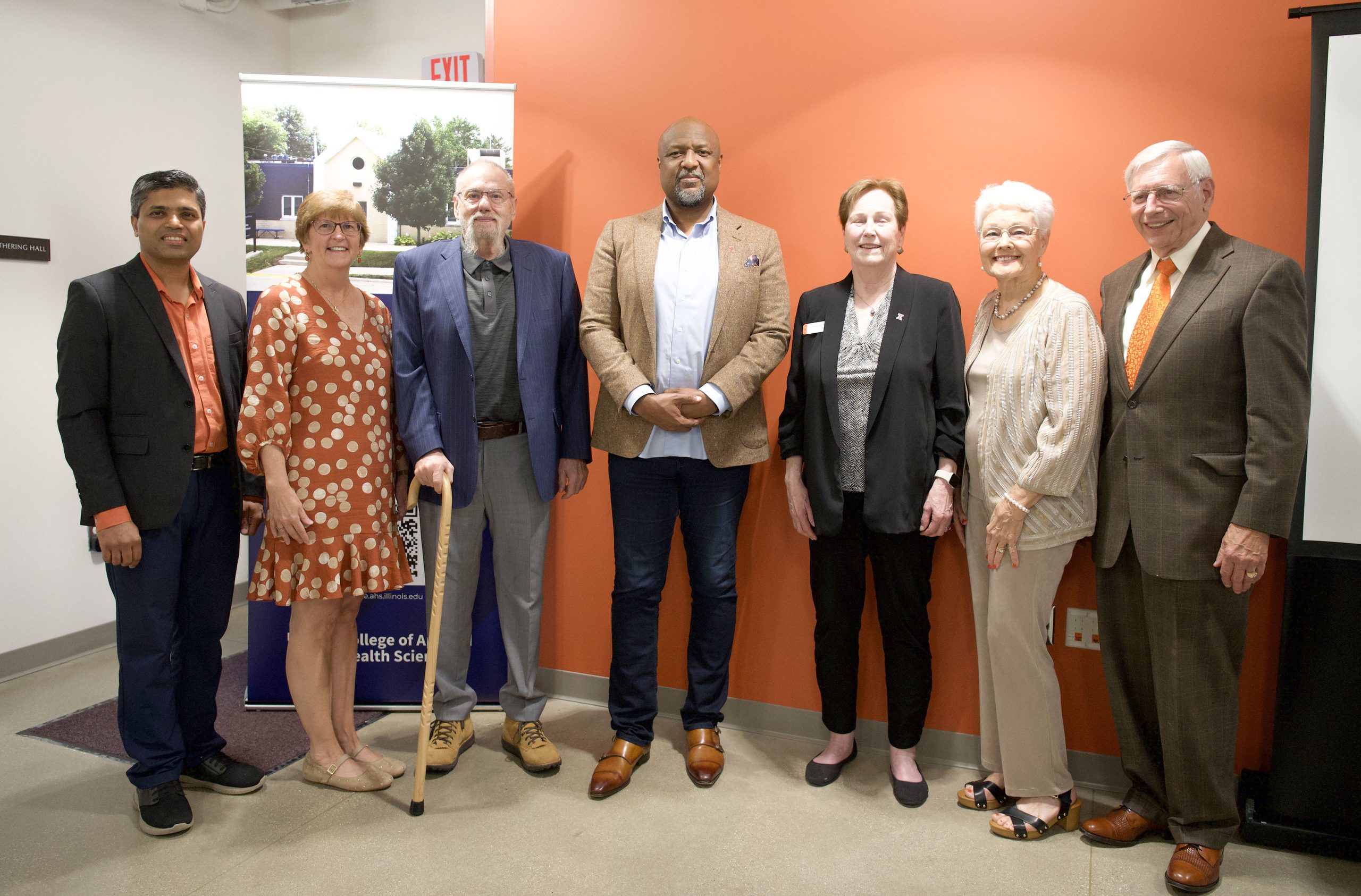
Wendy Rogers, center, says Shannon Mejia, left, is ready to lead the Health Tech program (Photo provided)
Health and Kinesiology Professor Wendy Rogers, the founding director of the Health Technology Education Program in 2017, stepped aside in the summer of 2024 and Shannon Mejía, an associate professor in HK, was named her successor.
Rogers had already had an illustrious academic career, primarily at Georgia Tech, before coming to the University of Illinois Urbana-Champaign in 2017. Together with her husband, Dan Fisk—also a Ph.D. in the field of experimental psychology, Rogers created the Human Factors & Aging Laboratory in 2003 at Georgia Tech. After Fisk retired in 2013, Rogers relocated the lab to Illinois—where Fisk got his doctorate—four years later.
Rogers’ arrival at Illinois coincided with an Investment for Growth proposal led by the College of Applied Health Sciences and The Grainger College of Engineering aimed at developing the Health Technology Education Program. Health and Kinesiology Professor Jeff Woods, who spearheaded the IFG with Kesh Kesavadas, a professor of Industrial and Enterprise Systems Engineering, knew who he wanted to lead the Health Tech program.
“Jeff asked me if I would be willing to lead the educational component and I agreed,” said Rogers, who is the Shahid & Ann Carlson Khan Professor of Applied Health Sciences.
“We hired Nicole Holtzclaw-Stone in January 2018 and the four of us (Jeff, Kesh, Nicole, and I) spent a lot of time together developing the Health Technology Education Program,” Rogers said. “We shepherded our Master of Science in Health Technology through department and college educational policy committees, the Graduate College, the Faculty Senate, the Board of Trustees, and finally the Illinois Board of Higher Education. In December 2019, Nicole and I drove to Chicago for the Illinois Board of Higher Education meeting in case there were any questions but there were none and we were officially approved. We welcomed our first cohort in August of 2020,” during the COVID-19 pandemic.
Rogers said she always planned to get the Health Tech program established and build a strong foundation before passing it on.
“The time was right to transition to a new director, but we want to continue to build on the trajectory we are on,” she said. “The mission is to advance health technology education for learners at all levels through our interdisciplinary undergraduate certificate and minor (joint with Industrial & Enterprise Systems Engineering), our Master of Science in Health Technology (in collaboration with Grainger College of Engineering), and our Health Technology Professional Education Program.”
Mejía praised her predecessor’s vision.
“She led the development and implementation of an innovative education program that provides cross training in user needs, human factors and user experience methodologies, and engineering principles to develop leaders who can speak the language of both health care and engineering,” Mejía said of Rogers. “To address the critical challenges facing health care today, it is essential to understand user needs and technological capabilities in order to assure that technological solutions truly support the well-being of individuals, families, organizations, and communities. We train students to fulfill this essential role. This program is one of a kind in the nation. And it is my privilege to take the program to its next level.”
Rogers said the move was eased by knowing Mejía was ready to step in.
“Dr. Mejía has been an active member of the Health Technology Education Program since its inception,” Rogers said. “She is the right person at the right time to take the program to the next level. She has a lot of energy and creative ideas. Together, with Dr. Katelyn Talbott as the assistant director, I know the program will continue to be successful and to grow.”
For her part, Talbott said Mejía “has great ideas for growth and increased recognition in the field.”
“As with any change in leadership, new leaders are able to bring their perspectives to the challenges and goals in front of them,” Talbott said. “Shannon will be no different. I look forward to working with Shannon as we work to grow all aspects of the Health Technology program.”
Rogers will continue in her roles as director of the McKechnie Family LIFE Home, program director of CHART: Collaborations in Health, Aging, Research, and Technology and director of Human Factors & Aging Laboratory. “I have plenty to keep me busy and I look forward to having more time to devote to these activities,” she said.
As a recognition of their continued support of the MS-HT program, Rogers and Fisk have endowed the Wendy A. Rogers Health Technology Travel Award. The award will provide master’s students with the opportunity to travel to conferences to share their own work, to learn from other researchers, and to participate in networking opportunities. Additional donations to the fund are welcome and will help to provide travel support for more students.
Donation instructions for mail or online gifts are on uif.uillinois.edu/how-to-give. For online donations, in the dropdown menu under Gift Designation, click on the “Other” box and enter Fund #777754 or “Wendy A. Rogers Health Technology Travel Award” or write this information on the memo line of your check.
“In August of 2024 we welcome our fifth cohort into the program,” Rogers said of the Health Tech program. “Alumni from our program are already out in the working world making a difference in health technology to improve quality of life for all of us.”
As with most of the research agenda for the LIFE Home, the focus is to support healthy aging in midlife and older adulthood. KCH Assistant Professor Shannon Mejia is spearheading some of the research opportunities, including one that involves a voice assistant that guides participants through a study.
“We’re testing ideas that people, in the future, are using these types of devices to provide task assistance,” Mejia said.
Mejia said she and a collaborator—Jesse Chin, an assistant professor in the School of Information Sciences—are studying the outcome of enrichment seeking, which she describes as “the process of this willingness to go out and challenge yourself” as opposed to the idea of learning to dependence.
“Your entire room is connected and automated, or your kitchen is automated … Why cook for yourself when your voice assistant and kind of run the show for you?” Mejia said.
But Mejia said the objective is to provide conversations with a voice assistant that is “supporting the motivation to be independent.
“So, even though you could ask (the voice assistant) to turn on a light for you from the nature of your interaction with her you’d almost be compelled to try to do it yourself.”
Starting in February, some 70 participants will be going through the LIFE Home five days a week, Mejia said, led by a voice assistant, taking part in a series of games designed to cognitive well-being, on a tablet. The voice assistant will guide participants through the games and gauge their feelings after each game.
The study participants will spend about two hours in the LIFE Home dining/living room area and the home office. The LIFE home mimics a natural environment and the home illusion, , Mejia said, allows us to accurately measure participants’ cognitive and emotional responses during the study.
The hope, Mejia said, is that they conduct science that can optimize voice assistant technology so that it can encourage more exploration over exploitation and build independence.
“Then, even as people are bringing technology into their home, they can do it that could, in a way, increase independence,” she said.