Community health doctoral student lands internship at leading national laboratory


Bisola Adeleke, a community health Ph.D. student, at her internship for Argonne Leadership Computing Facility. (Provided)

While still working on her Ph.D., a University of Illinois community health student researcher landed an internship at the biggest national laboratory in the Midwest. 

This summer, Bisola Adeleke has conducted user experience research at Argonne National Laboratory, a federally funded science and engineering lab in Argonne, Illinois. 

Adeleke’s research specialty is in healthy aging, which she studies at the Adult Development Adaptation and Technology Laboratory, or ADAPT Lab, led by Health and Kinesiology Associate Professor Shannon Mejía. 

“Although my research focuses on older adults, the principles of human-centered design are universal,” Adeleke said. 

This summer, her UX research has taken place in the Argonne Leadership Computing Facility, which provides supercomputing and AI resources to academic researchers, government agencies and industry scientists.

“Even world-class computing systems need intuitive, user-centered design,” Adeleke said. “The researchers who use ALCF are experts in their scientific fields, but that doesn’t necessarily mean they should have to struggle with complex workflows or documentation.” 

What she’s seen so far: good user experience can make these advanced computing resources operate more efficiently and accessibly, allowing the researchers to spend more time on discovery and less navigating technical barriers, Adeleke said. 
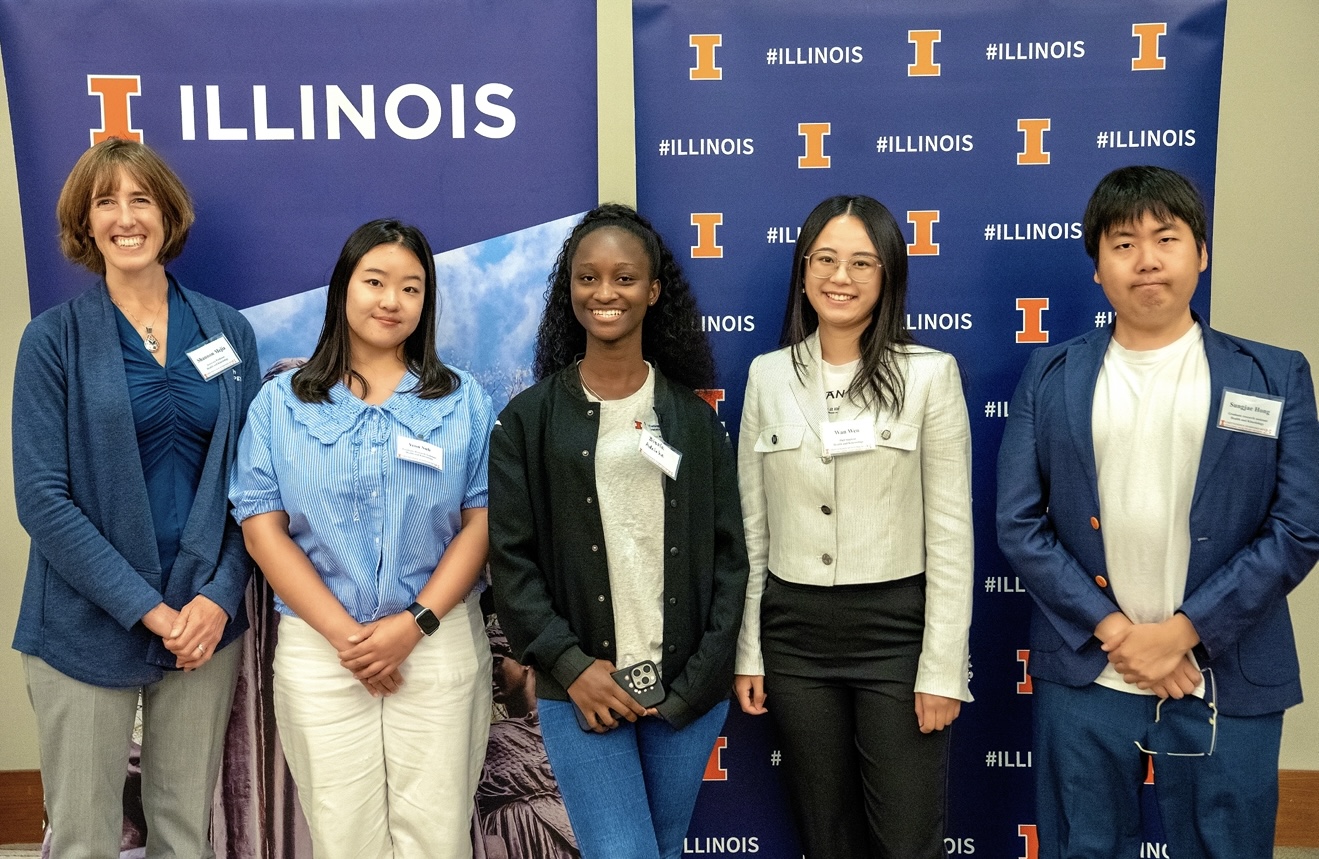
Members of the ADAPT Lab, led by Shannon Mejía (left).

An extended time working with professionals from computing and tech backgrounds has strengthened her ability to communicate across a diverse set of disciplines. 

“One of the things I’ve valued most about my time at the University of Illinois is the emphasis on applying research to real-world challenges,” Adeleke said. “My coursework has provided a strong foundation in public health and research methods, while my internship at Argonne has shown me how those skills can be applied to improving technologies that support scientific research. 

“Seeing my academic training translate into practical solutions has been one of the most rewarding aspects of my graduate experience.”

Before joining the University of Illinois Urbana-Champaign, Adeleke’s academic journey spanned two continents: she obtained her bachelor’s in health education from Lagos State University in Nigeria, and her master’s degree in research and development in educational studies from Palacky University in Olomouc, Czech Republic.

Editor’s note:

To reach Bisola Adeleke, email bisolaa2@illinois.edu
 

Share on social
Related news

Aguiñaga looks at the benefits of dance


Can dancing slow cognitive decline and improve health of middle-aged and older Latinos?

Can dancing slow cognitive decline and improve health of middle-aged and older Latinos? That’s something that KCH Assistant Professor Susan Aguiñaga is seeking to find out.

Aguiñaga has a new publication entitled, “BAILAMOS With mHealth Technology! Improving Physical Activity and Well-Being in Middle-Aged and Older Latinxs: A Pre–Post Feasibility Study” in the journal Health Education and Behavior. Aguiñaga and her collaborators looked at the physical activity and health outcomes of middle-aged and older Latino and Latina adults in BAILA TECH—an intervention that combines the BAILAMOS™ Latin dance program with mobile health technologies (such as a Fitbit Charge 2). The study found that participants in the intervention increased physical activity and fitness levels, social support, quality of life, and executive function.

BAILAMOS™ (Balance and Activity In Latinos, Addressing Mobility in Older Adults) is a Spanish-language, Latin dance program for older Latinos that was created by Dr. David Marquez at the University of Illinois at Chicago and Miguel Mendez, a professional dance instructor, Aguiñaga said.

For Aguiñaga, a Latina, the study is personal.

“I have witnessed how the social determinants of health create disparities that negatively impact my Latino community,” she said. “As a physical activity researcher, I know that many health disparities can be ameliorated through physical activity. I have chosen to create physical activity interventions that are community-based and culturally responsive for Latinos to reduce the burden of disease in this population.”

Aguiñaga said the study aim is to increase Latinos’ physical activity levels and improve cognitive performance and/or slow cognitive decline in this population that is at high risk of health disparities, and particularly increased risk of developing Alzheimer’s disease.

Aguiñaga said the most surprising result was an increase in 34 minutes of moderate-to-vigorous physical activity at post-testing. The data was collected in Pilsen, a predominantly Mexican neighborhood in Chicago, she said.

The next step, Aguiñaga said, is to assess the efficacy of combining BAILAMOS™ with a culturally tailored diet program to see if it improves cognition further in middle-aged to older Latinos.

Editor’s note:

To reach Susan Aguiñaga, email saguina2@illinois.edu.
 

Share on social

Related news

College of Applied Health Sciences
110 Huff Hall
1206 South 4th Street
Champaign, IL 61820
(217) 333-2131