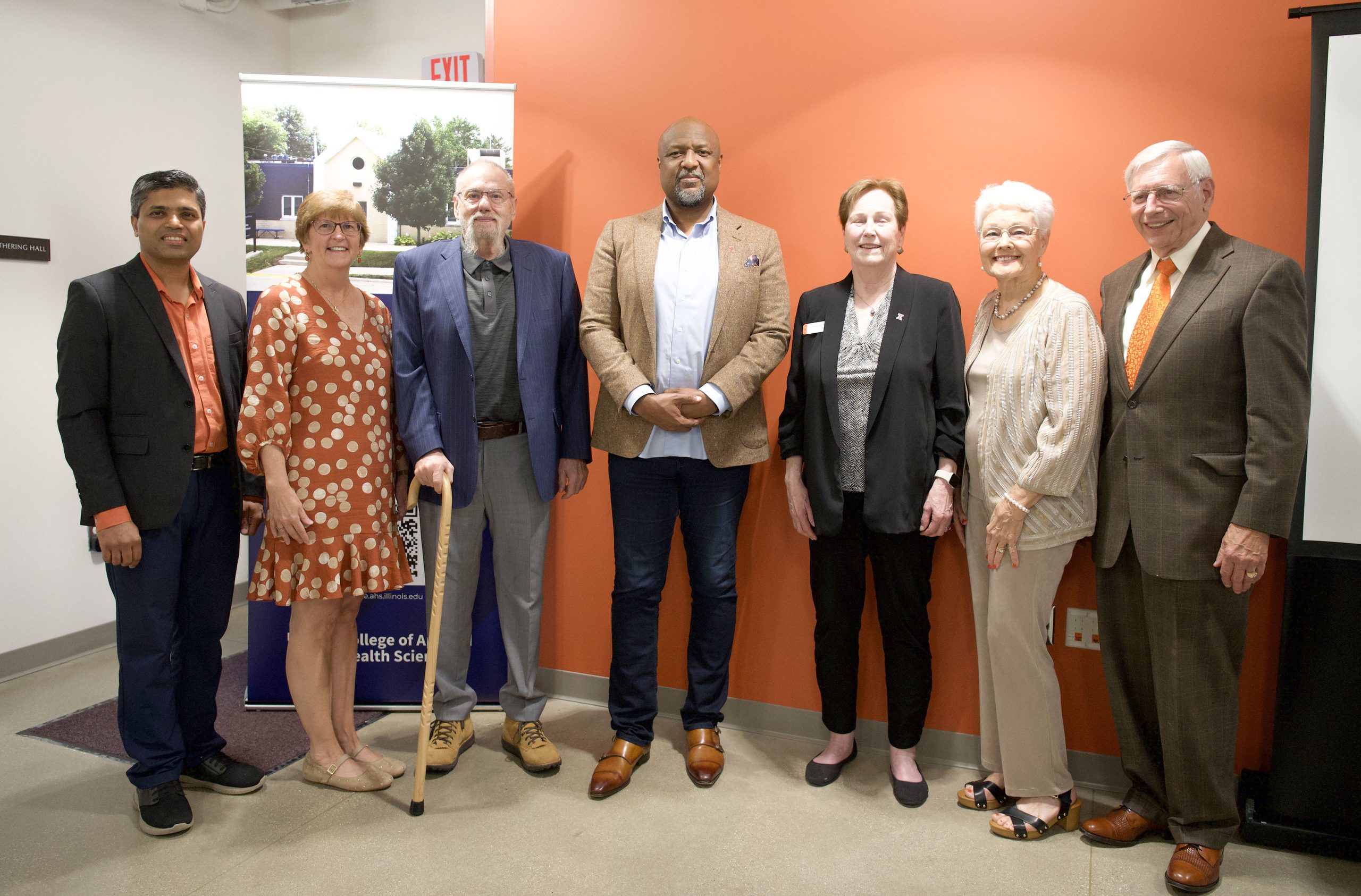
On October 8, faculty, students, and researchers from the Department of Industrial and Enterprise Systems Engineering and Department of Health and Kinesiology gathered at the iHotel for the 2025 Chittenden Symposium: “Lifelong Health by Design – Human-Centered Innovations in Chronic Disease Prevention.” The event united experts across disciplines to explore how engineering precision and health science insight can combine to design systems that foster long-term, equitable health outcomes.
KCH Dept. Head Kim Graber, left, with Bill Chittenden and Wendy Rogers, right (Photo by Michelle Hassel)
The focus of the Chittenden Symposium was on human factors in health technology, with the goal of advancing a research agenda. But according to Kinesiology and Community Health Professor Wendy Rogers, the roadmap needs to first be drawn.
Rogers was part of the final presentation on April 13 of the symposium, a collaboration between the College of Applied Health Sciences’ Kinesiology & Community Health Department (KCH) and the Grainger College of Engineering’s Department of Industrial & Enterprise Systems Engineering (ISE).
Rogers was part of a panel discussion—along with ISE Associate Professor Girish Krishnan—entitled, “Future Directions for Collaborative Opportunities.”
“What we’re talking about is relevant to what the National Academy of Engineering has proposed in terms of grand challenges,” Rogers said. “We need to have these opportunities (future symposiums) to see what each of us is doing and how we can work together.”
Rogers also talked about the need to match up research priorities with funding streams.
“Some of the things that the (National Institutes of Health) is highlighting is what we are doing here,” the Khan Professor of Applied Health Sciences said. “We want to think about how best to capitalize on our strengths to best match what their priorities are. I was excited and inspired about what we can do.”
The symposium is the vision of William and Carol Chittenden, two Illinois alums who long supported research combining Health/Kinesiology and engineering technology, including aging and later-year quality of life issues. The symposium, which began in 2015, returned this year after a five-year hiatus.
Susan Martinis, the Vice Chancellor for Research & Innovation, was the first speaker of the day and said she couldn’t “imagine a timelier topic” and that the university’s response to COVID-19 was an “extraordinary national model.”
“This kind of innovation just doesn’t happen,” she said. “Our response to COVID is really part of the DNA at Illinois. Decades of investments in people and symposiums like this. The spirit of collaboration can tackle the most vexing of problems. Our bench is incredibly deep.”
AHS Dean Cheryl Hanley-Maxwell said she was “proud of the role the Department of Kinesiology and Community Health has played in organizing this important event, and grateful for our ongoing partnership with the Grainger College of Engineering.”
“The collaboration between health and engineering has led to developments that we couldn’t have imagined in the not-too-distant past,” Hanley-Maxwell said. “Virtual reality as a means of helping patients manage pain; companion robots that entertain chronically ill children while allowing them to monitor their condition; 3-D printing of personalized prosthetics; and wearable sensors that enable patients to share vital health statistics with their doctors from the comfort of their own homes. Technology is revolutionizing and improving health care, and the potential for its impact seems boundless.”
Hanley-Maxwell noted that AHS made a commitment to taking a leadership role in education and research related to health care and technology.
“I hope today’s symposium inspires further discussion, collaboration, and innovation,” she said.
“This kind of innovation just doesn’t happen. Our response to COVID is really part of the DNA at Illinois. Decades of investments in people and symposiums like this. The spirit of collaboration can tackle the most vexing of problems. Our bench is incredibly deep.”
Susan Martinis
Vice Chancellor for Research & Innovation
Keynote speaker Emily Patterson, a professor in the School of Health and Rehabilitation Sciences in the College of Medicine at Ohio State, talked about the need to incorporate human factors into health research, and the importance of “framing problems differently.”
Patterson was followed by four presentations, two each from ISE and KCH.
ISE Assistant Professor Abigail Wooldridge discussed the importance of health technology in improving the “handover,” meaning the transition of patient care, whether it is in the same hospital and different shifts, or to a different hospital and medical staff.
“Care transitions are a process, and the things that happen before or after that are really important. They are really crucial to patient care.”
Wooldridge said strategies are needed to augment human coding to improve care transitions and the “tension between reporting and interrogation. Social glue is what helps clinicians work together down the road.”
KCH Assistant Professor Manuel Hernandez talked about advances in wearable technology to prevent fall prevention, noting that one in four adults over the age of 65 falls each year, and that one in five falls lead to serious injury.
“In the near future, wrist bands, watches, shoes and shirts will be able to measure how much we move on a daily basis,” Hernandez said. He said this wearable technology will be able to detect any changes in movement, slowing, or gait malfunction. The use of wearable technology can mitigate or even prevent the odds of falling and reduce injuries, Hernandez said.
ISE Specialized Teaching Assistant Professor Avinash Gupta talked about the role of human interaction in designing virtual reality-based healthcare training. Among Gupta’s proposals is a virtual reality-based training environment for first responders, a 3D educational platform for healthcare students and a VR simulation training for neonatal procedures.
KCH Professor Ken Wilund wrapped up the presentations with his talk on how technology can be used to improve hemodialysis patient outcomes.
“Hemodialysis is pretty brutal,” Wilund said. “It’s a difficult, challenging life, and it’s treated pharmacologically, with 18 pills a day. It’s one of the most expensive diseases to treat. It costs about $100,000 per patient per year … pretty close to one percent of the federal budget is spent on dialysis patients.”
Wilund said his biggest questions were how to get hemodialysis (HD) patients moving more and make it sustainable, and how to get HD patients to eat fewer processed foods and less salt. Technological advances might help, Wilund said, noting that an Internet-based Positive Psych Intervention (PPI) reduced depression in HD patients, but that the iPad might not be a sustainable delivery method.
Wilund acknowledged that a personalized plan for patients was necessary, that behavior change principles need to be incorporated into treatment, and that remote treatment would be necessary to achieve long-term success.
“We have been sticking bikes in front of dialysis patients and telling them what they can’t eat… for 40 years,” Wilund said. “There has to be a better way.”
Following the presentations, Rogers and Krishnan engaged in a lively discussion with audience members on what can be done to advance collaborations and build on the momentum of the symposium.
“Seminars are great, but how do we scale this up?,” Krishnan asked. “What’s the best mechanism to get the engineers and health care researchers together?”
Rogers said, “It’s really going back and forth and making sure we’re talking to each other. We’ve talked about how to do that better to provide opportunities for both colleges.”
KCH Professor Jeff Woods, who was the master of ceremonies, suggested leveraging virtual platforms to increase collaboration, while Wilund said giving increased responsibilities to graduate students would give them more opportunities to build their CV, while giving faculty members the space for big-picture ideas.
But all in attendance agreed on one point: they need to keep in contact.
“A future meeting to spark collaborations is important,” Rogers added.
When the symposium ended, attendees—including Bill Chittenden III, son of Bill and Carol—boarded vans for the opportunity to tour the McKechnie Family LIFE Home and see demonstrations of current collaborative research in human factors and health. Directed by Dr. Rogers, the McKechnie Family LIFE Home includes a simulation of a two-bedroom home with a garage for research and development, as well as meeting and office space to support the research activities.
Hope and optimism emphasized by speakers at Chittenden Symposium
KCH Dept. Head Kim Graber, left, with Bill Chittenden and Wendy Rogers, right (Photo by Michelle Hassell)
The theme of the 2022 Chittenden Symposium is Human Factors for Health Technology. But the heart of the event is really a love story.
The Chittenden Symposium, which returns in 2022 after a five-year hiatus, is a collaboration of the Dept. of Kinesiology and Community Health (College of Applied Health Sciences) and The Department of Industrial and Enterprise Systems Engineering (The Grainger College of Engineering).
The symposium is the vision of William and Carol Chittenden, who long supported research combining engineering technology and health, including aging and later-year quality of life issues. For the Chittendens, their support of the University of Illinois is borne of their experiences on campus. William, a member of the College of Engineering Hall of Fame, graduated from the College of Engineering in 1951. During his time on the Urbana-Champaign campus, he met Carol, a Kinesiology major. It was the beginning of a lifetime of love that spanned more than 65 years.
“I think they just felt that the university added so much to their lives that they wanted to give back, pay it forward,” said Bill Chittenden III, William and Carol’s son. “And that’s how (their support of Illinois) got started.
The idea to support KCH and ISE made perfect sense, Bill said, given his father’s engineering expertise and his mother’s kinesiology studies.
“I think it started, really, as my dad supporting the engineering college,” he said. “And then my mom, given her degree, wanted to help her college. And then at some point they thought they could make a bigger impact by combining their resources to develop and support the interdisciplinary work between those colleges.
“As far as Health Sciences goes, my mom was truly fascinated with the human body. Her detailed knowledge of human anatomy, which she learned at Illinois, was often a topic of conversation. I think that was the impetus for focusing on Applied Health Sciences.”
Bill said the symposium serves another purpose: providing an opportunity for students and faculty to further develop and utilize their communication skills.
“It had a lot to do with my dad’s belief in the importance of strong communication skills. He was an excellent writer and speaker, which are strengths not always found in technical fields,” Bill said. “It was important to him that engineers and people with other technical backgrounds be good writers and speakers, so they are able to communicate technical subjects and ideas effectively to a wider audience. The interdisciplinary feature of the symposium is designed to encourage people to hear different perspectives.
Those different perspectives will be on full display in this year’s symposium. It is headlined by keynote speaker Emily Patterson, a professor at The Ohio State University. Dr. Patterson’s topic is “Enhancing innovation by incorporating human factors engineering into allied health research.”
Four faculty members will make presentations, with two each from KCH and ISE.
Abigail Wooldridge, ISE: Designing digital health technology to support care transitions in hospitals
Manuel Hernandez, KCH: Advances in Wearable Technology for Fall Prevention
Avinash Gupta, ISE: Role of Human Computer Interaction in the Design of eXtended Reality (XR) based Training Environments in the Healthcare Domain
Ken Wilund (KCH): Technology Applications for Promoting Behavior Change in Hemodialysis Patients
A discussion will follow the presentations, and then attendees will have the opportunity to tour the McKechnie Family LIFE Home, which Bill Chittenden said he was eager to see. Directed by Dr. Wendy Rogers, a professor in the Department of Kinesiology and Community Health, the McKechnie Family LIFE Home includes a simulation of a two-bedroom home with garage where research and development will take place, and meeting and office space to support the research activities.
For the Chittendens, the symposium is only one of the opportunities they’ve created through their more than 30 years of support for the University. They created the Carol Chittenden Scholarship, awarded annually to an undergraduate student in the Kinesiology and Community Health Department; and the William Chittenden Fellowship, awarded annually to a graduate student in Industrial and Enterprise Systems Engineering. They also sponsor an award for best graduate thesis relating Engineering and Applied Health Sciences.
Now, they are hoping this event becomes a source of inspiration for participants that lead to solutions to problems. “The goal is primarily to inspire participants, get people together to exchange ideas, see what others are working on, and make connections in the field. You get people thinking about how they can make a difference and get new ideas on ways to do that. Technology is moving so fast. And I think the goal of the symposium and the financial support is really to get technology and the benefits it brings moving even faster.”