From Huff Hall to national impact: American Lung Association CEO visits his alma mater


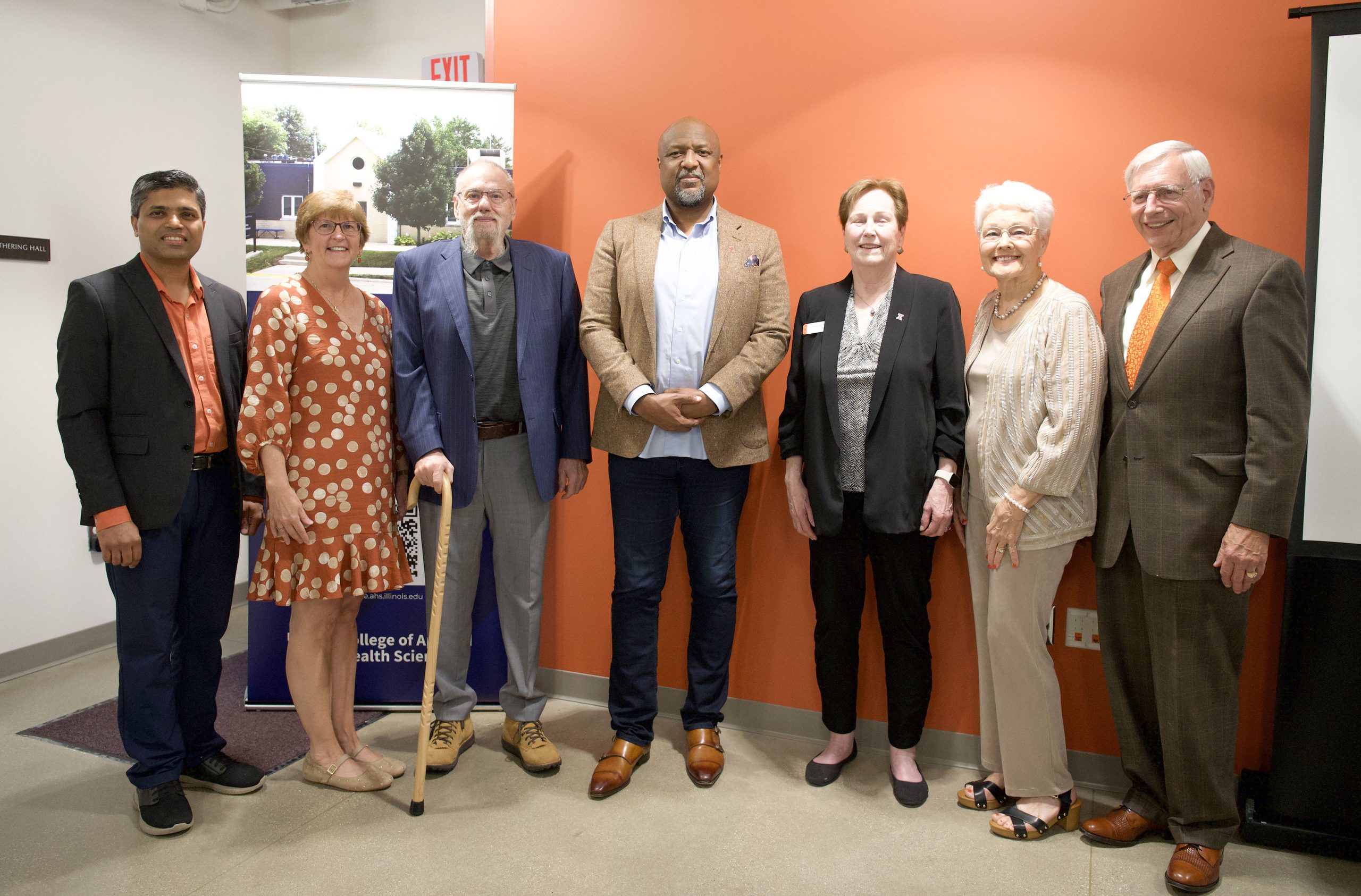
Harold Wimmer, left, with Applied Health Sciences Dean Cheryl Hanley-Maxwell, got his undergrad and master’s degrees in AHS. (Photo by Ethan Simmons)

When Harold Wimmer returned to the College of Applied Health Sciences at the University of Illinois, it wasn’t just a professional visit—it was a homecoming shaped by decades of purpose, mentorship and public health leadership.

Wimmer, president and CEO of the American Lung Association, first walked the halls of what was then the College of Applied Life Studies as a student searching for direction. His visit offered a glimpse into how early moments of uncertainty can evolve into a career leading one of the nation’s most influential health organizations.

“I came into this college because as a freshman, I started in (the College of Liberal Arts & Sciences), more general studies, and I was really trying to find where I would best fit,” said Wimmer, who’s been working with the American Lung Association since 1978, the year he earned his master’s in health administration from the University of Illinois. He also got his undergrad from what is now Applied Health Sciences.

That sense of searching is familiar to many undergraduates. For Wimmer, the turning point came not from a formal advising session, but from a conversation with a roommate. It was a simple nudge—one that ultimately redirected his entire career trajectory.

“And it happened that my roommate was in kinesiology,” he said. “He talked about his experiences and the courses. I certainly had a passion for personal health and community also and working with others, so I came to (AHS) in my sophomore year.” 

The decision to transfer to community health set the foundation for everything that followed.

If Wimmer’s story has a central theme, it is the power of mentorship. During his time at Illinois, he found not only academic rigor but also a network of professors who helped shape his thinking and ambitions.

“I got connected with Tom O’Rourke, Larry Olsen (and) Bill Creswell,” he said, listing faculty members who left a lasting impression. “Those individuals just really impacted me in so many different ways.” 

What stood out wasn’t just their expertise, he said.

“They were also accessible. If you had any issues … their doors were always open. And that’s something that I remember.” 

Wimmer’s academic focus quickly sharpened once he entered the community health curriculum. Courses in epidemiology and population health proved challenging, but transformative.

“I certainly fell in love with the curriculum and the work that’s behind it in terms of community health, public health,” he said. 

What I studied here really aligned with the work of the American Lung Association.

Harold Wimmer

Applied Health Sciences alumnus and CEO, American Lung Association

He credits those classes with giving him a framework that still underpins his work at the national level.

“They were tough courses, but they were ones that have helped me throughout my career in terms of how to really work through public health … using sound data and epidemiology to help track diseases from the earliest points to a way to treat disease also.” 

That emphasis on data-driven decision-making has become even more critical in today’s public health landscape, where emerging diseases, environmental challenges and health disparities require evidence-based responses.

Wimmer’s path to the American Lung Association began in an unexpectedly local way—with a job posting.

“I was fortunate to come across a job posting that the American Lung Association had in the office here at Huff Hall,” he said. 

At the time, he admits, he didn’t know if he was prepared for the setting.

“I wasn’t really sure what I was getting into going into a nonprofit health organization,” he said. 

But the alignment between his education and the organization’s mission quickly became clear.

“What I studied here really aligned with the work of the American Lung Association,” he said. “The mission … is not only about assisting patients with a lung disease, but it’s also working to prevent lung disease.” 

That dual focus—treatment and prevention—is a hallmark of public health and one that reflects the principles taught in AHS.

Harold Wimmer became president and CEO of the American Lung Association in 2013 (Photo by Ethan Simmons).

Wimmer, who became president and CEO in 2013, oversees a nationwide organization tackling issues ranging from air quality to chronic lung disease. Yet when asked what skills matter most, he doesn’t point first to technical expertise.

Instead, he emphasizes communication.

“One thing that I think is really key in community health or public health is to have good communication skills and to be able to interact with individuals … and also groups,” he said. 

For Wimmer, those skills were nurtured during his time at Illinois, through classroom discussions, group work and faculty mentorship.

During his visit, Wimmer—who met with AHS Dean Cheryl Hanley-Maxwell as well as taking visits to Carle Illinois College of Medicine, the Cancer Center at Illinois and the Beckman Institute—also offered practical advice to students eager to make an impact in public health, a field that has gained renewed visibility in recent years.

“I would say really study epidemiology and population data,” he said. “I think [that] is really critical in the field today.” 

But technical knowledge alone isn’t enough. He stressed the importance of understanding diverse communities and advancing health equity.

“Having great communication skills, the ability to communicate with others in really diverse populations … health equity is very important,” he said. 

It’s a message that aligns closely with the college’s current mission—demonstrating how its core values have remained consistent even as the field has evolved.

Like many alumni, Wimmer’s visit also prompted reflection. When asked what advice he would give his younger self, his answer was both practical and revealing.

“I would have probably looked at a minor in finance on the business side,” he said, noting how much of his current role involves budgeting and financial management. 

It’s a reminder that careers in health aren’t confined to science alone—they often require a blend of skills, including leadership, strategy and financial acumen.

He also acknowledged a lingering curiosity about further education.

“I always think I would have liked to continue my education to get a Ph.D.,” he said, before adding with a laugh, “but I think I’m OK where I’m at.” 

Editor’s note:

To reach Vince Lara-Cinisomo, email vinlara@illinois.edu.
 

Share on social

Related news

University of Illinois researchers explore collaboration on innovative skilled nursing model


From left, Wendy Rogers, Raksha Mudar, Elizabeth Hsiao-Wecksler, Lynne Barnes and Cathy Emanuel (Photo by Carrie Wennerdahl)

Researchers from the University of Illinois Urbana-Champaign gathered Thursday to explore a strategic partnership with Advocates for Aging Care (AAC), a local grassroots organization working to bring an innovative skilled nursing facility to Champaign County.

The workshop brought together university faculty, clinicians and leaders to begin shaping how research, education and clinical practice could align to strengthen person-directed aging care.

The guest speaker was Susan Ryan, CEO of Maryland-based AgingIN, whose Green House model is a finalist for the project. 

Building an Innovative Model for Skilled Nursing Care

The overarching goal is to establish The Cottages as a quality, person-directed skilled nursing setting inspired by the Green House model. Through collaboration with the university, project leaders aim to embed research into practice, pilot new technologies and create hands-on educational opportunities for students across disciplines.

The long-term vision is for The Cottages to serve as a flagship model for Illinois and the nation—distinguished not only by its design, but by its integration with a leading research university and its strengths in aging research, technology, design and education.

Turning Shared Interests into Action

The workshop was designed to generate potential models for collaboration based on the mutual needs of university researchers, clinicians, educators and students, as well as residents, families, caregivers and staff at The Cottages. Insights gathered during the session will inform the formation of working groups to advance the partnership.

“AAC is pleased to welcome researchers from the University of Illinois Urbana-Champaign as we identify new ways to advance person-directed skilled nursing care,” said AAC Steering Committee Chair Cathy Emanuel. “This unique Green House model can be strengthened by applying the latest research in aging technology, safety, environmental design, and innovative care practices. By partnering with the university, we aim to create a truly distinctive, high-quality care environment grounded in leading-edge research.”

Broad University Engagement

Interest across campus has been strong.

“We have been impressed by the level of enthusiasm we have seen as we organized this event,” said Wendy Rogers and Elizabeth Hsiao-Wecksler of the University of Illinois Urbana-Champaign. “Nearly 100 have already expressed interest in being engaged with The Cottages. They represent a broad spectrum of areas, including The Grainger College of Engineering, the College of Applied Health Sciences, Carle Illinois College of Medicine, the College of Liberal Arts and Sciences, the School of Social Work, the College of Media, the College of Fine and Applied Arts, the Interdisciplinary Health Sciences Institute, the Beckman Institute, Illinois Extension and UIC Nursing. We expect a long and fruitful relationship with Advocates for Aging Care, AgingIN, and The Cottages.”

Project leaders hope the Champaign County location will become a destination site for organizations seeking to implement innovative skilled nursing models—recognized not only for its Green House–inspired design, but also for its deep integration with university research, education and community engagement.

Additional details about construction timelines and future collaborative initiatives will be shared as planning progresses.

Editor’s note:

To reach Sarah Laufenberg, email info@advocatesforagingcare.org.
 

Share on social

Related news

Master of Health Administration program receives accreditation


Lynne Barnes is director of the MHA program and a longtime healthcare executive.

The Commission on Accreditation of Healthcare Management Education (CAHME) Board of Directors approved the initial accreditation of the University of Illinois Urbana-Champaign College of Applied Health Sciences’ Master of Health Administration for a four-year term.

The accreditation affirms that the Illinois MHA program meets CAHME’s high standards for healthcare management education and demonstrates a strong commitment to academic excellence, professional preparation and continuous improvement.

“We are pleased to have the recognition of the premier accrediting body for master’s degrees in health administration,” said Lynne Barnes, clinical professor and director of the MHA program and a longtime healthcare administrator. “The requirements are rigorous and further strengthen the quality of education and number of opportunities that we are providing for our students. This distinction will allow us to continue to attract top students from across the country and internationally.”

The four-year term of accreditation marks a significant milestone for the Illinois MHA program and reinforces its commitment to educating the next generation of healthcare leaders. An online MHA degree program will launch in 2026, along with several graduate certificates that will enhance specialized training in the field.

Cheryl Hanley-Maxwell, dean of the College of Applied Health Sciences—where the MHA program is housed in the Department of Health and Kinesiology—emphasized the significance of the milestone for the university and its students.

“This accreditation reflects the dedication and collaboration of our faculty and staff in building a curriculum that prepares graduates to become highly effective healthcare management professionals,” Hanley-Maxwell said. “Our mission is to equip students with the leadership skills, analytical expertise, and ethical foundation necessary to improve healthcare delivery systems and advance health outcomes in Illinois and beyond.”

CAHME accreditation is widely recognized as the benchmark of quality in graduate healthcare management education. Programs that earn accreditation undergo an extensive self-study process and peer review to ensure alignment with standards designed to prepare graduates for leadership roles in healthcare organizations.

“CAHME’s mission is to advance the quality of healthcare management education,” said Al Faber, interim president and CEO of CAHME. “CAHME-accredited programs have successfully navigated a complex and careful accreditation process managed by experts in the study and practice of healthcare management. The program meets the rigorous standards set by leading academicians and practitioners who are experts in their fields.”

 For more information, visit cahme.org

Editor’s note:

To reach CAHME, email dalexander@cahme.org .
 

Share on social

Related news

College of Applied Health Sciences
110 Huff Hall
1206 South 4th Street
Champaign, IL 61820
(217) 333-2131