From Huff Hall to national impact: American Lung Association CEO visits his alma mater


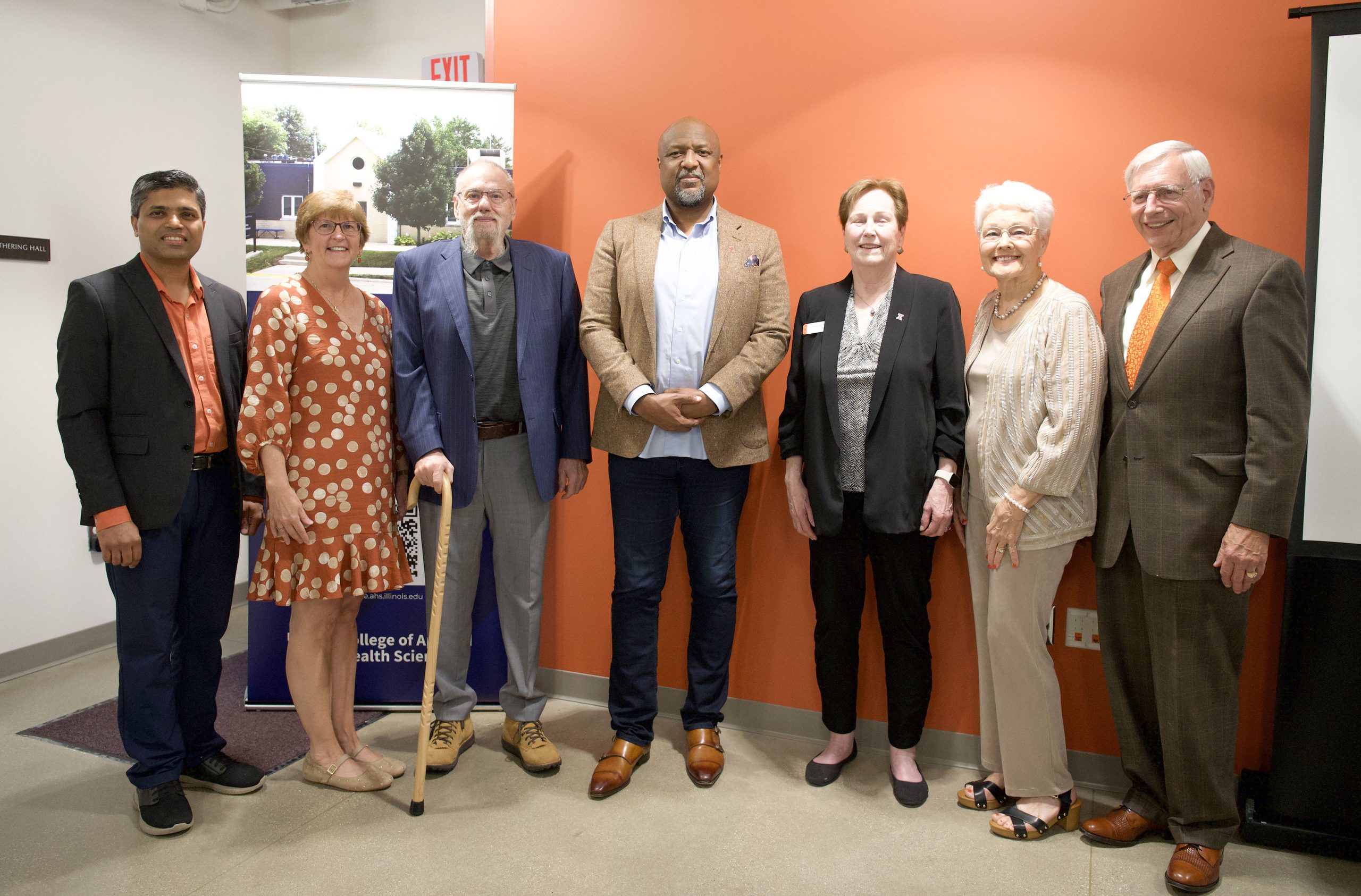
Harold Wimmer, left, with Applied Health Sciences Dean Cheryl Hanley-Maxwell, got his undergrad and master’s degrees in AHS. (Photo by Ethan Simmons)

When Harold Wimmer returned to the College of Applied Health Sciences at the University of Illinois, it wasn’t just a professional visit—it was a homecoming shaped by decades of purpose, mentorship and public health leadership.

Wimmer, president and CEO of the American Lung Association, first walked the halls of what was then the College of Applied Life Studies as a student searching for direction. His visit offered a glimpse into how early moments of uncertainty can evolve into a career leading one of the nation’s most influential health organizations.

“I came into this college because as a freshman, I started in (the College of Liberal Arts & Sciences), more general studies, and I was really trying to find where I would best fit,” said Wimmer, who’s been working with the American Lung Association since 1978, the year he earned his master’s in health administration from the University of Illinois. He also got his undergrad from what is now Applied Health Sciences.

That sense of searching is familiar to many undergraduates. For Wimmer, the turning point came not from a formal advising session, but from a conversation with a roommate. It was a simple nudge—one that ultimately redirected his entire career trajectory.

“And it happened that my roommate was in kinesiology,” he said. “He talked about his experiences and the courses. I certainly had a passion for personal health and community also and working with others, so I came to (AHS) in my sophomore year.” 

The decision to transfer to community health set the foundation for everything that followed.

If Wimmer’s story has a central theme, it is the power of mentorship. During his time at Illinois, he found not only academic rigor but also a network of professors who helped shape his thinking and ambitions.

“I got connected with Tom O’Rourke, Larry Olsen (and) Bill Creswell,” he said, listing faculty members who left a lasting impression. “Those individuals just really impacted me in so many different ways.” 

What stood out wasn’t just their expertise, he said.

“They were also accessible. If you had any issues … their doors were always open. And that’s something that I remember.” 

Wimmer’s academic focus quickly sharpened once he entered the community health curriculum. Courses in epidemiology and population health proved challenging, but transformative.

“I certainly fell in love with the curriculum and the work that’s behind it in terms of community health, public health,” he said. 

What I studied here really aligned with the work of the American Lung Association.

Harold Wimmer

Applied Health Sciences alumnus and CEO, American Lung Association

He credits those classes with giving him a framework that still underpins his work at the national level.

“They were tough courses, but they were ones that have helped me throughout my career in terms of how to really work through public health … using sound data and epidemiology to help track diseases from the earliest points to a way to treat disease also.” 

That emphasis on data-driven decision-making has become even more critical in today’s public health landscape, where emerging diseases, environmental challenges and health disparities require evidence-based responses.

Wimmer’s path to the American Lung Association began in an unexpectedly local way—with a job posting.

“I was fortunate to come across a job posting that the American Lung Association had in the office here at Huff Hall,” he said. 

At the time, he admits, he didn’t know if he was prepared for the setting.

“I wasn’t really sure what I was getting into going into a nonprofit health organization,” he said. 

But the alignment between his education and the organization’s mission quickly became clear.

“What I studied here really aligned with the work of the American Lung Association,” he said. “The mission … is not only about assisting patients with a lung disease, but it’s also working to prevent lung disease.” 

That dual focus—treatment and prevention—is a hallmark of public health and one that reflects the principles taught in AHS.

Harold Wimmer became president and CEO of the American Lung Association in 2013 (Photo by Ethan Simmons).

Wimmer, who became president and CEO in 2013, oversees a nationwide organization tackling issues ranging from air quality to chronic lung disease. Yet when asked what skills matter most, he doesn’t point first to technical expertise.

Instead, he emphasizes communication.

“One thing that I think is really key in community health or public health is to have good communication skills and to be able to interact with individuals … and also groups,” he said. 

For Wimmer, those skills were nurtured during his time at Illinois, through classroom discussions, group work and faculty mentorship.

During his visit, Wimmer—who met with AHS Dean Cheryl Hanley-Maxwell as well as taking visits to Carle Illinois College of Medicine, the Cancer Center at Illinois and the Beckman Institute—also offered practical advice to students eager to make an impact in public health, a field that has gained renewed visibility in recent years.

“I would say really study epidemiology and population data,” he said. “I think [that] is really critical in the field today.” 

But technical knowledge alone isn’t enough. He stressed the importance of understanding diverse communities and advancing health equity.

“Having great communication skills, the ability to communicate with others in really diverse populations … health equity is very important,” he said. 

It’s a message that aligns closely with the college’s current mission—demonstrating how its core values have remained consistent even as the field has evolved.

Like many alumni, Wimmer’s visit also prompted reflection. When asked what advice he would give his younger self, his answer was both practical and revealing.

“I would have probably looked at a minor in finance on the business side,” he said, noting how much of his current role involves budgeting and financial management. 

It’s a reminder that careers in health aren’t confined to science alone—they often require a blend of skills, including leadership, strategy and financial acumen.

He also acknowledged a lingering curiosity about further education.

“I always think I would have liked to continue my education to get a Ph.D.,” he said, before adding with a laugh, “but I think I’m OK where I’m at.” 

Editor’s note:

To reach Vince Lara-Cinisomo, email vinlara@illinois.edu.
 

Share on social

Related news

150 Years Strong


Founded in 1867, the University of Illinois celebrates 2017 as its sesquicentennial year as an international leader in education, research, and engagement. Over the last 150 years, University faculty, research staff, and students have been responsible for landmark achievements that have changed the world. These include the development of PLATO, the world’s first shared computer-based education system; the first multi-disciplinary research unit focused on children who struggled to learn, which led to the concept of “learning disabilities” and to new techniques of remedial education; and the development of Magnetic Resonance Imaging, which is widely used in medical diagnostics.

The roots of the modern-day College of Applied Health Sciences go back to the very beginning of what was then the Illinois Industrial University, when students were required to increase and maintain their physical health through the performance of manual labor. Physical education was formalized with the establishment of the Department of Physical Training in 1895, now the Department of Kinesiology and Community Health. Research in physical fitness led to groundbreaking discoveries about human health and physiology. In fact, units within AHS have been responsible for numerous innovations and improvements in individual, family, and community health, speech and hearing science, and overall quality of life.

Health and Kinesiology (HK)

That was then

T.K. Cureton

Dubbed the “Father of Physical Fitness,” Thomas Cureton developed methods to test motor and cardiovascular fitness in his physical fitness research laboratory, one of the first in the nation. Although he measured fitness and performance in many elite athletes, his focus was on bringing the benefits of everyday fitness to people who did not consider themselves athletes. He worked to bring his message to both adults and children, and offered physical fitness camps for children in the summer.

Health education professor Dr. William Creswell played a critical role in the development of comprehensive health education programs in K-12 schools. His efforts led to the nationwide research and curriculum development project, the School Health Education Study. In the early 1960s, he co-authored a national curriculum for K-12 health education that advanced health as the quality of life resulting from the dynamic interactions among an individual’s physical well-being, mental and emotional reactions, and social environment.

This is now

Today, scholars in kinesiology and community health investigate the effects of exercise on immune function, cognition, and co-morbidities associated with chronic kidney disease; the neuroscience of dance in health and disability; motor control in individuals with multiple sclerosis; molecular features that protect muscles against injury; the relationship between nutrition and exercise performance; the impact of disability and chronic health conditions on career development and performance; neighborhood influences on health; health and aging; and cancer epidemiology. The department name was changed from Kinesiology and Community Health to Health and Kinesiology in August 2024.

Recreation, Sport and Tourism

That was then

The first undergraduate course in recreation was offered in 1937, with a graduate course following in 1939. The recreation curriculum did not achieve departmental status until 1957. Charles K. Brightbill was the first head of the Department of Recreation and Municipal Park Administration, followed by Allen V. Sapora.

Dr. Charles Brightbill

That the University of Illinois was among the first to offer degrees in recreation can be attributed to their leadership. Drs. Brightbill and Sapora played key roles in the local, state, national and international park and recreation movements. Dr. Brightbill was a champion of the concept of professional and lay cooperation in the recreation field and contributed greatly to developing the principles that helped bring about the formation of the National Recreation and Park Association. Dr. Sapora was one of the first scholars to integrate research within recreation education, and a founding member of the Academy of Leisure Studies.

This is now

Over the years, scholars have studied how the businesses of recreation, tourism, and sport work together within the larger leisure industry to enhance the quality of life of individuals, families, communities, states, and nations. Now known as the Department of Recreation, Sport and Tourism, undergraduate and graduate students study the industry with renowned scholars who investigate the socio-political and cultural impacts of recreation, sport, and tourism; the role of leisure and play in improving health and well-being and supporting individual and community development; connections between physically active leisure and body image; and recreation and aging.

Speech and Hearing Science

That was then

Dr. Severina Nelson works with a child in the Speech Lab.

Two individuals made profound contributions to the well-deserved reputation for excellence that the Department of Speech and Hearing Science holds today. Dr. Severina Nelson initiated the clinical practice of speech therapy in a janitor’s mop closet in 1938, working with a student experiencing articulation problems. Two years later, she had earned the title of director of the speech clinic, an office and a $2,000 grant to continue her clinical work. A great believer in early intervention, Dr. Nelson started a training program for speech therapists that consisted of four years of undergraduate training and a fifth year of graduate study.

In 1948, Dr. Grant Fairbanks joined the University of Illinois as the director of the newly established Speech Research Laboratory. His laboratory became renowned for technical research in speech and hearing. Under his guidance, students earned the first doctoral degrees in speech and hearing science bestowed by the University of Illinois and went on to have significant impact upon the field. Dr. Fairbanks also expanded the University’s influence in speech and hearing science by serving as the editor of the Journal of Speech and Hearing Disorders, which was at the time the only scholarly journal of the American Speech and Hearing Association.

This is now

Today, scholars in the Department of Speech and Hearing Science continue to explore ways to improve the early diagnosis and treatment of communication disorders. That work has been expanded to include investigations of biological, cultural, and age-related differences in communication practices. Research also addresses brain anatomy and physiology to better understand the neural and sensory bases of speech, hearing, and language, both normal and disordered. Our scholars also focus on treatment, conducting research related to the neurology and treatment of tinnitus, the role of assistive technology in treating communication disorders, and the improvement of hearing devices such as cochlear implants.

Throughout its history, the College of Applied Health Sciences has been proud to add the accomplishments of its research faculty to the international reputation enjoyed by the University of Illinois at Urbana-Champaign. As we look forward to the future, we are excited by the challenges and opportunities that lie ahead and pledge to continue our efforts toward improving the lives of individuals, families, and communities through education, research, and engagement.

Editor’s note:

To reach Marketing and Communications, message marcom@ahs.illinois.edu

College of Applied Health Sciences
110 Huff Hall
1206 South 4th Street
Champaign, IL 61820
(217) 333-2131