Skating career led to kinesiology studies for Weinstein


Lindsay Weinstein recently found out she was accepted into the Doctor of Physical Therapy program at the University of Illinois at Chicago

At one time in her life, Lindsay Weinstein thought admitting she needed a physical therapist meant she was “weak.” Now she is studying to be one.

The four-time national medalist figure skater is now a kinesiology major in the College of Applied Health Sciences at the University of Illinois. Weinstein, 22, recently found out she was accepted into the Doctor of Physical Therapy (DPT) program at the University of Illinois at Chicago, one of the top DPT programs in the country.

It was a circuitous route to the University of Illinois for Weinstein, a Buffalo Grove, Ill., native who left home at the age of 15 to train at the U.S. Olympic Training Center for Figure Skating in Colorado Springs, Colo. But for Weinstein, the ice patch began long before that.

“A lot of parents from my hometown put their kids into beginner skating around the age of three,” Weinstein said. “Around that age, my older brother had best friends performing in the local ice show at the rink that would end up becoming my home rink. And my parents took me and my brother to go watch it. And I’m watching them on the ice, and I looked up at my mom, and I was, like, ‘I can do that. I know I can do that.’ And my mom replied, ‘Whatever.’”

Weinstein’s mother had been reluctant to sign her up because her brother had not enjoyed skating and “made my mom’s life miserable. Every time they got to the rink, he would start crying. She (said) ‘I’m not signing you up. I don’t want to go through that again.’”

But Weinstein did not relent.

“Being the three-year-old little menace that I was, every time we drove past the rink, I would say, ‘Well have you signed me up? Have you signed me up? Why haven’t you signed me up? I know I can do that. Why haven’t you signed me up?’ And I just kept insisting that I could do it.

And so finally, I would say it took four months before they finally did it. And I got on the ice, and it was just like true love.”

It might have been love, but it was not always easy, Weinstein admits.

“You learn from a very early age in figure skating that it’s not a sport that you can be in halfway,” she said. “It’s not a sport that’s like a hobby. I was skating at 6:20 a.m. before school, getting picked up at 7:30, being taken to school. I had a special schedule. So I’d get picked up from school at maybe like 2 p.m., three periods before anyone else. And I would go back to the rink and go skate. It was my life. I wasn’t doing normal things, like having sleepovers, like the other kids were.”

Starting at the tender age of six, Weinstein began competing in the U.S. Figure Skating Association (USFSA) events. She competed for several years as a singles competitor but found her true passion was in pairs skating. By May 2013, she had partnered with Jacob Simon, and in their first season together, they won the pewter medal (fourth place) in the Novice level at the 2014 U.S. Championships. After this competition, Weinstein and Simon were named to Team USA and sent on several international assignments to compete at the Junior level on behalf of the United States of America.

At the 2015 U.S. Championships, the team earned another pewter medal, this time at the Junior level. Around this time, U.S. Figure Skating approached Weinstein and Simon about moving to Colorado to train at a more elite facility. Her partner, a senior in high school, planned to either go to college or to Colorado to train.

“At 14, I was put in a position where ‘Do I want to do this for a living? Am I willing to give up a normal high school life, a normal kid life for this?’ And I made the decision, ‘Yes, it is worth it to me,” she said.

Weinstein and Simon—without their parents—moved to Colorado Springs to train at the Olympic Training Center. Skating was the top priority, not school.

“College wasn’t necessarily on my agenda. I wasn’t looking at colleges,” she said. “I wasn’t thinking about college. I was thinking about getting through high school, and I was thinking about my skating career.”

That career began to bloom. Coached by Dalilah Sappenfield and Drew Meekins, Weinstein and Simon won the junior silver medal at the 2016 U.S. Championships and were named to the U.S. team for the 2016 World Junior Championships in Debrecen, Hungary. The pair finished ninth overall in Hungary.

“That was definitely the highlight of both of our careers,” she said. “The season following was a tad difficult due to being a female, you start going through body changes. There is a lot of emphases and talk about body and eating.”

Around that time is when Weinstein first thought about kinesiology, although she didn’t know what kinesiology was at the time.

“I would say that was when I got my first pique of interest in physical therapy,” she said. “I have never been someone who had been injured. I had known so many people who had been off the ice with injuries. And I just was super lucky. I had never been injured. (But) when I moved to Colorado, and we were training at a more elite level, I started to feel a lot of impact on my knees.”

Reluctantly during that successful 2016 season, Weinstein started seeing a physical therapist.

“I hid the fact that my knees hurt,” she said. “I hid the fact from my coach. I hid the fact from my parents. And then finally the pain became too much. My right knee was my landing knee, and I was just wincing every single time I landed.”

Friends and colleagues advised her to see a physical therapist, “but I thought going to a physical therapist meant I was weak. I did not want to see one, which is interesting because now I am starting to become a physical therapist.”

That year was a turning point in many ways for Weinstein.

She and Simon were under pressure to stay certain sizes, and Weinstein especially felt “under a microscope” as she went through puberty at age 16. The Olympics, she realized, likely would not happen. Then 2017 became a year of change as she and Simon broke up—both professionally and romantically—and she decided to leave Colorado, where she felt mistreated by Sappenfield. Weinstein was one of several skaters to file complaints against Sappenfield with the United States Center for SafeSport, leading to Sappenfield’s suspension in October 2021 pending further investigation.

Weinstein ended up moving to Aliso Viejo, Calif., to train and rediscover her love for figure skating. But she also discovered something else.

“It helped me realize as much as I love this and as much as I am the person I am today because of skating, I’m ready to move on to something else,” she said.

That something else was physical therapy. A physical therapist who was treating her in California recommended applying to San Diego State; her father was convinced she needed to apply to more than one school, and she chose the University of Illinois, her dad’s alma mater. She got into both and chose San Diego State, but the temptations of the Southern California lifestyle made it challenging to stay academically motivated, Weinstein admitted.

But that changed when she transferred to Illinois.

“I’ve made Dean’s List every semester here,” she said. “The choice to come here, in particular, had a lot to do with proximity because I had been away from home since 15. And when I was in college at San Diego, I just realized it was way harder to be away from home in college.”

Weinstein, who will graduate in May, knew graduate school was the next step, but also knew she didn’t want to leave Illinois again. There are seven accredited DPT programs in Illinois, four in the Chicago area, close to home. She applied to Rosalind Franklin, Midwestern University, UIC, and Northwestern University, with UIC her top choice.

“I’d love to be in a big city,” she said, explaining her decision. “I’d love to not have to make all new friends again because I had to do that for San Diego and then again coming here to Illinois. Yes, UIC was my top choice, and I did get in.”

Weinstein knows a long road remains to complete her doctorate. But she knew the kinesiology program itself was no cakewalk.

“I will never forget sitting at my very first lecture and the advisor at San Diego (State) coming in and looking around the room and saying, ‘Most of you will not get into grad school. Honestly, a good portion of this room will probably not even be a kinesiology major next semester. This is a really hard major, and you will not achieve your dreams.’ And every semester that I made it through, I would just thank my lucky stars that I made it through,” she said.

After she completes her DPT program, Weinstein definitely has an idea of which populations she’d like to work with.

“I got into this as an athlete. And if I had the ideal situation that could come about for me, I would love to be a PT for a sports team. I would love to go watch practices, learn why injuries are happening, learn how to prevent them in specific regards to one specific sport.”

If not athletes, she’ll turn to another passion: children.

“I have always loved kids. I was the girl, who at 10 years old, was being driven to babysit. I adore kids. And if I could somehow go into (pediatrics), that would be my other dream. I feel like it would be awesome as a PT to work with girls that are around the same age as I was when things started kind of getting messy. And I can be there as somewhat of a guide to let them know the rights and wrongs of when someone’s talking about their body and body image and eating and eating disorders and depression. I do think that I could definitely make a huge impact as a PT for all people, whether athletes or not.”

Editor’s note:

To reach Vince Lara-Cinisomo, email vinlara@illinois.edu.
 

Share on social

Related news

Alumni Spotlight—Megan Gaseor


Q: Why did you pick AHS?

A: Applied Health Sciences, and specifically Recreation, Sport and Tourism, has talented professors, an industry-focused curriculum, and allowed for hands-on experiences outside of the classroom which ultimately provided a unique opportunity to best position me for a career in sports.

Q: Which professors had the most impact on you?

A: Dr. (Ryan) Gower’s passion for this industry was evident in some of my first RST classes, and made me want to find a career where I felt that same passion. Dr. (Michael) Raycraft was and continues to be an advocate for all of his students, especially to ensure their success within in the sports industry. My goal is to bring a piece of that to those I manage.

Q: What course did you most enjoy?

A: RST 410: Strategic Thinking in Recreation, Sport and Tourism.

Q: Did you enter AHS knowing your career path, or did AHS help you decide?

A: I was interested in a career within sports-related business operations, but I didn’t have a definitive focus in mind. The classes and opportunities within RST allowed for me to explore a handful of different avenues, ultimately leading to events and operations.

Q: Did your AHS experience lead to your current job?

A: Definitely. My RST 485 internship at a large scale event production company turned into a full-time position after graduation. After four years at that role, the opportunity presented itself at the Chicago Cubs, and I made the transition over professional sports (while still focusing on events). AHS provided me with the foundation to obtain that initial internship, and continue to grow in my career.

Q: What is your current job?

A: I am the Assistant Director of Special Events at the Chicago Cubs. I focus on the strategy, development and operations of the Cubs’ Special Event business including Wrigley Field concerts, non-baseball sports, and other large scale events.

Q: What was your favorite on-campus experience?

A: I truly appreciated my time within my sorority and value the friendships I gained there (many of whom are AHS Alumni). Then again, you can’t beat an Illinois football night game or Illinois basketball beating No. 1 Indiana at Assembly Hall in 2013.

Q: What would you say to recommend AHS to a prospective student?

A: AHS provides the opportunity to take learning outside of the classroom, with classes and opportunities that lend themselves to what you’ll experience after graduation. In addition, the network and relationships that you build within the AHS community will stay with you well beyond your years at Illinois. I could not have asked for a better experience.

Editor’s note:

To reach Vince Lara-Cinisomo, email vinlara@illinois.edu.
 

Related news

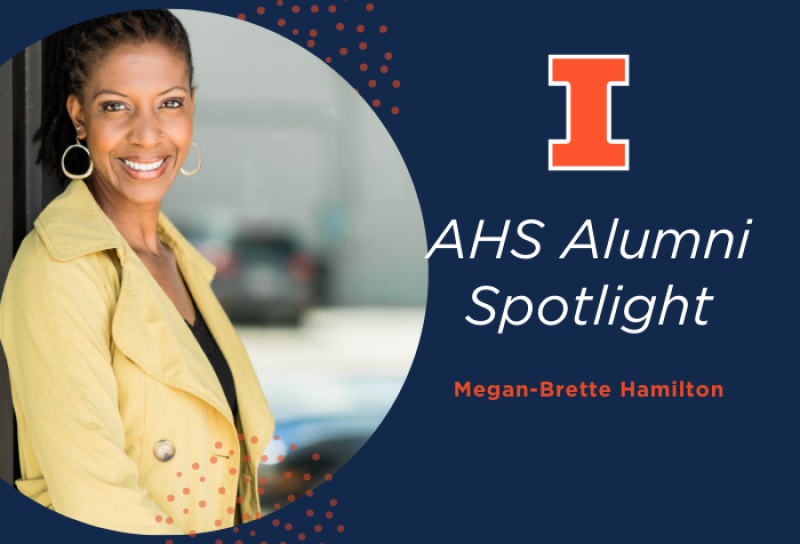
Alumni Spotlight—Megan-Brette Hamilton


Q: Why did you pick SHS?

A: I remember writing my personal statement in 2011 and, as you do, you write the first part as a general statement and then address a specific school for the latter part. As I was writing the latter part of my personal statement for University of Illinois, I realized how much the school aligned with what I was looking for; reputation, professors, university campus setting. It helped that my aunt, someone who had been in the field for decades before me, encouraged me to choose UIUC, and that both of my parents earned degrees from UIUC. Finally, I got advice from a professor at another university to choose my program according to the person I was going to work with for four plus years. And then I found (former SHS Associate Dept. Head) Laura DeThorne. I emailed her, she and I had a phone conversation and I became excited about the work she was doing in her lab and the idea of learning from her. After that, I was convinced I needed to go to AHS/SHS. From day 1, Dr. DeThorne was a strong advocate for me and as a result I received the Graduate College Distinguished Fellowship Award. To be honest, not having to pay for school, that also helped me make my decision.

Q: Which professors had the most impact on you?

A: As I mentioned before, Dr. DeThorne was an advocate for me from day 1. She wasn’t just my advisor, she was someone who valued my clinical background and my prior experience. We eventually formed a very strong friendship and collegial relationship, and we still collaborate. I also was impacted by Dr. Julie Hengst. Not only was she a committee member of mine for 2 of my projects, but because she also had an extensive clinical career before academia, she was able to speak to me in a way that disarmed me about leaving a job where I was a master clinician to re-learning how to be a student. Dr. Robin L. Jarrett was also someone who has had a huge impact on me. I worked in her lab in a different department across campus. In order for me to be the kind of researcher I am today, I needed to learn other ways of doing research from her perspective. The field of CSD often uses quantitative methods and is predominantly White. Working with Dr. Jarrett helped me to learn about qualitative methods from a sociological perspective and understand academia from someone like me, a Black woman, who also was a full professor. Finally, working with Dr. Cynthia Johnson made a long-lasting impact on me. She was a constant source of encouragement as a growing researcher and I learned first-hand from her about how our field and academia had changed throughout the years.

Q: What course did you most enjoy?

A: You have to remember that I earned a degree that allowed/encouraged me to explore classes in other departments. The way I look at my journey at that stage of my life was to take what I knew about my field in the 17 years I’d been in it and then add to it other content areas to enhance the impact I wanted to have on the field of CSD. All that to say, Language, Identity, and the Politics of Schooling taught by Dr. Anne Haas Dyson in the College of Education was a course I really enjoyed. I loved this course because it brought together all of the areas I was passionate about, language, culture, education, and communication. It was a class that wasn’t afraid to talk about race and class and dialects. And it used qualitative methods:) It reminded me why I decided to return to school at the ripe old age of 34, lol.

Q: Did you enter AHS knowing your career path, or did AHS help you decide?

A: As I mentioned earlier, I entered into the PhD program at age 34, after having had a first career as a practicing speech-language pathologist. I entered the program knowing that I was going to have three outcomes; 1) I was going to learn about some amazing content areas that I’d never been privy to, 2) I was going to learn how to do research, and 3) I was going to earn my doctorate. After that, I wasn’t sure what I’d do. I think being in the program prepared me well for my next steps even though I wasn’t sure what they’d be exactly. I ended up going into academia and constantly call myself “the accidental professor,” lol. I also didn’t know where my research focus would end up when I first started. I originally entered the program to study language processing differences with a concentration in cognitive neuroscience and ended up studying cultural-linguistic diversity with a focus on African American English. To be honest, being in the program helped me see a gap in our field that I could fill, so that’s what I’ve been working on ever since.

Q: Did your AHS experience lead to your current job?

A: Yes. I earned a doctorate from a research-intensive university in a department where I was taught how to do research and provided opportunities to teach and supervise. The skills I acquired in the program, including opportunities across departments and disciplines, allowed me to confidently apply for a tenure-track assistant professor position; which is my current job.

Q: What was your favorite on-campus experience?

A: As a daily enjoyment, I really loved working with my PhD classmates. We were from all different backgrounds and studied so many different areas of communication. We learned so much from each other about life and our field. As a one-time kind of experience, I have to say that it was when I ended up working with a wonderful group of doctoral students from the College of Education and being awarded an internal grant. We used it to put on a 2-day workshop aimed at reimagining education for youth in and beyond the classroom. We brought in Drs. Geneva Smitherman, Ana Celia Zentella, H. Samy Alim, and David E. Kirkland. I loved being around all of those intellectual minds and inserting my communication sciences and disorders perspectives into their conversations of education and language.

Q: What does AHS mean to you?

A: I saw AHS as a place that provided me with opportunities to connect with a variety of people and to grow as a researcher and educator. As I said earlier, I originally entered the program to study language processing differences and ended up studying cultural-linguistic diversity. The beauty is that AHS was a place that allowed me to do either. As a result, I was able to become a researcher with a strong interdisciplinary focus who impacts clinical practice within the field of speech-language pathology and beyond.

Dr. Megan-Brette Hamilton is an assistant professor at Auburn University and an ASHA certified speech-language pathologist (SLP)/communication specialist. Prior to academia, Dr. Hamilton worked as an SLP for 10 years in New York City, the largest school district in the U.S., where most of her caseload consisted of African American and Hispanic children. Currently, her research focuses on the classroom/educational and clinical experiences of speakers of other dialects of English, with a particular focus on African American English-speaking children and adults. Her passion lies in exploring the intersection of culture, language/dialect, communication, and literacy. Dr. Hamilton’s work also focuses on the cultural-linguistic competence and perspectives of professionals and students working with culturally-linguistically diverse populations. Through her work, she engages with such professionals by educating them on the importance of recognizing and validating language variations, culture, and identity; thereby raising one’s cultural-linguistic competence. Dr. Hamilton is the host of the Honeybee Connection podcast, author of Successful Strategies for Classroom Communication, and owner of www.meganbrettehamilton.com where she blogs and provides resources. 

Editor’s note:

To reach Vince Lara-Cinisomo, email vinlara@illinois.edu.
 

Related news

Alumni Spotlight—Marilyn Adibu


Q: Why did you pick AHS?

A: I chose AHS because it provided me with the academic and professional knowledge and skills to pursue my career opportunities.

Q: Which professors had the most impact on you?

A: The professors who had the most impact on me were Dr. (Susan) Farner and Dr. (Reggie) Alston (my advisor).

Q: What course did you most enjoy?

A: I enjoyed my Health Administration, Rural Health (Special Topics), Introduction to Medical Ethics, Health Services Financing, and Community Health Organizations.

Q: Did you enter AHS knowing your career path, or did AHS help you decide?

A: AHS helped me decide. I also joined a program called I-LEAP.

Q: What was your favorite on-campus experience?

A: One of my favorite on-campus experiences was going to sports games (wrestling, volleyball, hockey, etc) as well as attending the AHS Alumni Speaker Series.

Editor’s note:

To reach Vince Lara-Cinisomo, email vinlara@illinois.edu.
 

Related news

Alumni Spotlight—Jamaal Rahman


Q: Why did you pick AHS?

A: I chose AHS because the program looked great! I loved the size of the program and it was very relevant to my career path which is chiropractic.

Q: Which professors had the most impact on you?

A: I would say Dr. (Marni) Boppart was one of my favorite professors at U of I period and Amy O’Neill was the best advisor that I’ve ever had. She was so great in my journey in the college.

Q: What course did you most enjoy?

A: That seems like forever ago, but I loved all of Professor Boppart’s classes and most labs!

Q: Did you enter AHS knowing your career path, or did AHS help you decide?

A: I knew that I wanted to be a chiropractor and decided on kinesiology as my major later due to the above reasons.

Q: Did your AHS experience lead to your current job?

A: My AHS experience gave me more of a thirst for knowledge. To this day I still continue to be a student of how the body works, moves and heals so that I can help every patient who steps in my clinic.

Q: What was your favorite on-campus experience?

A: I loved being around my peers all day. Labs were great! Who wouldn’t love working out for class! I still remember doing the VO2 test in class. Great memories.

Q: What does AHS mean to you?

A: AHS was the start of my career and helped further establish my passion for my field and bettering musculoskeletal help for my patients. Thank you, U of I and AHS!

Editor’s note:

To reach Vince Lara-Cinisomo, email vinlara@illinois.edu.
 

Related news

Alumni Spotlight—Sarah Beth Reno


Q: Why did you pick AHS?

A: I started my freshman year at U of I as a journalism major. But when I found out there was a major specifically for recreation, I immediately applied to transfer over. Growing up in a small town in Illinois, I always watched “The Love Boat” growing up. My dream was to leave small town and cold weather and work on a cruise ship. I really wanted my career to be fun. And I figured this was the path to get there.

Q: Why did you pick RST?

A: At the time, it was called Leisure Studies, so it took some courage to tell my friends and family this was my choice. And, when I went to visit someone at the college to talk about career opportunities, she informed me that “only magicians and comedians” work on ships. According to her, my career focus should be with the Chicago Park District. I’m sure she thought I was crazy when I asked her what that was (remember, I was from a VERY small town). Despite my lack of understanding, they let me in. I forged ahead, with the hope that a door would open for me somehow.

Q: Which professors had the most impact on you?

A: I had one professor that I will remember forever, and I lost track of him over the years (I know that’s a crazy thing to say in 2021). His name was Michael Phelan, and he made me and my fellow students feel we could do anything. We sat in his office for hours before and after class and talked about everything in life. He always told me that taking opportunities naturally leads to other opportunities. So, even if the job was not perfect—open the door and walk through it. That door will get you to another room (with another door or window) that may just be the opening to the perfect career. It was great advice. He also encouraged me to take an internship with the National Recreation and Park Association for a broader perspective. He was an amazing teacher, husband and father, and I will always remember his kindness and inspiration.

Q: What course did you most enjoy?

A: I’m too old to remember specific courses, but I enjoy all my courses because my professors were so much fun. Everyone was demanding but accessible, which I really valued. I always felt I found my home at AHS. I was no longer “lost” at a big university. This was a place I felt I could be myself and be appreciated for what I contributed.

Q: Did you enter AHS knowing your career path, or did AHS help you decide?

A: I was able to secure a job within the cruise industry through AHS. A recent graduate, Sally Evans, worked at Norwegian Cruise Line. She returned to interview students to work as youth staff onboard during high-season holidays. I secured a job as a teen coordinator onboard during my college breaks and continued within the industry ever since.

Q: Did your AHS experience lead to your current job?

A: The program Sally set up for us was an inspiration for me as my career progressed. When I arrived at Carnival Cruise Line’s Entertainment department, I worked with my team to set up an internship program for recreation students across the country. It was a big success, and many of the students secured full-time jobs within the entertainment department after graduation. I actually returned a few years ago to speak to AHS students about this opportunity. The students were so impressive and far more well-rounded than I ever was at that age. They knew what they wanted and were going for it.

Q: What does AHS mean to you?

A: Looking back to my college career, there were two, distinct benefits to being part of AHS:

1. The camaraderie everyone had with each other. The atmosphere was like working on board a cruise ship. Everyone was so different, but we all had the same “zest” for life. We all supported each other 100 percent—whether it be for a personal reason or to help with a class project. We were in it together.

2. The staff’s focus on true learning and improving yourself for a better future. I recall taking business and marketing classes where students were so competitive and hyper-focused on their grade-point average—people would calculate their grades at the end of each test. I was always perplexed by these hard-driving business majors, who thought I was crazy for majoring in Leisure Studies. In AHS, it truly was about the love of learning, doing your best and developing skills to forge your path in life. The professors taught us so much more than just the facts. I’m so grateful for their guidance.

Editor’s note:

To reach Vince Lara-Cinisomo, email vinlara@illinois.edu.
 

Related news

Alumni Spotlight—Jonathan Reed


Q: Why did you pick AHS?

A: I picked AHS because I had an interest in Community Health. I knew I wanted to help provide people a better quality of life and build underserved communities by addressing health disparities.

Q: Which professors had the most impact on you?

A: My Academic Advisor (Mr. Chris Cosat) had the most impact on me. He did a great job of showing different career paths in AHS and helped guide me through the curriculum with no conflicts.

Q: What course did you most enjoy?

A: The course I enjoyed the most was an Intro to Epidemiology course (CHLH 274). It allowed me to get a new perspective on how patterns of disease are studied and how much they affect healthcare as a whole. Material from this course has become even more relevant with the current Pandemic.

Q: Did you enter AHS knowing your career path, or did AHS help you decide?

A: My career path was not well-defined upon entering AHS. After taking courses, I was able to better grasp my values and passion which are rooted in Community Health/Health Administration.

Q: Did your AHS experience lead to your current job?

A: Yes, my AHS experience exposed me to different areas of healthcare and colleagues within the college. These experiences and connections are what helped me land my current job working in medical education/health administration.

Q: What was your favorite on-campus experience?

A: My favorite on-campus experience was tailgating at Homecoming football games, ILL-INI!!!

Q: What does AHS mean to you?

A: For me, AHS means “focusing on promoting healthier, happier lifestyles to allow an optimal life for all individuals.”

Editor’s note:

To reach Vince Lara-Cinisomo, email vinlara@illinois.edu.

Related news

Alumni Spotlight—Ariana Mazza Bensyl


Q: Why did you pick AHS?

A: Being active in sports growing up fostered my interest in exercise and how the body works. I knew going into college that I wanted to be a Physical Therapist. When I was looking into colleges, I was looking for one that provided me the opportunity to get a great education and prepare me for PT school. The College of Applied Health Sciences offered Kinesiology as a program of study, which fit my PT path. I was confident the curriculum would prepare me for getting into PT school, as well as the academic demands of PT school.

Q: Which professors had the most impact on you?

A: One person that most impacted me was my academic advisor, Amy O’Neill. She encouraged me to challenge myself and work hard to attain my goals throughout my time at the University of Illinois. Amy also brought the idea of completing the Physical Education Teacher Licensure program to my attention. I completed the Pedagogy track within Kinesiology and I really enjoyed it. Dr. Amy Woods was one of my professors who saw a lot of potential in me and pushed me to be a better teacher. Another professor that had an impact on me was Mary Carlton. She had such passion and excitement for what she was teaching that it made learning exciting!

Q: What course did you most enjoy?

A: I really enjoyed my Injuries in Sport class. Learning about injuries, how to tape an ankle, preventative care and emergency care was cool! Especially for a kid who had her ankles taped throughout her high school sports career. I also really enjoyed Psychophysiology in Exercise & Sport.

Q: Did you enter AHS knowing your career path, or did AHS help you decide?

A: I did enter AHS knowing my career path. I knew I wanted to go to PT school, but I thought I wanted to work in the sports world of physical therapy. When I was doing my student teaching, I learned that physical therapists could also work in the school environment. This opened my eyes to a different path within physical therapy that was interesting to me and has actually taken me to my current job.

Q: Did your AHS experience lead to your current job?

A: Yes, it did lead me to my current job. My time in AHS prepared me to get into and be successful in PT school. I have received my doctorate of Physical Therapy from Northwestern University (’14) and am currently a PT in Northbrook School District 28. I have been able to combine the love of education and teaching that I learned from my time in AHS with my passion for physical therapy.

Q: What was your favorite on-campus experience?

A: I was part of the Alpha Chi Omega sorority during my time on campus. Creating so many memories and lifelong friendships with my sorority sisters really made for many favorite on-campus experiences. Not necessarily an on-campus experience, but an experience related to my time in AHS, was meeting my husband. A colleague I met while doing my student teaching introduced me to him. He is a fellow AHS ’11 graduate! We have talked about how we were probably in some of the same intro KIN classes our freshmen year but didn’t know it!

Q: What does AHS mean to you?

A: The University of Illinois is such a big university and being part of AHS made it feel smaller. The professors and academic advisors in AHS really created an environment where I felt they wanted me to succeed. AHS means being part of a community that truly cares about their students.

Editor’s note:

To reach Vince Lara-Cinisomo, email vinlara@illinois.edu.
 

Related news

Alumni Spotlight—Paige Schober


Q: Why did you pick AHS?

A: I chose AHS because the areas I was interested in studying all fell in the cross section between science and research fields and the health and human study fields.

Q: Why did you pick KCH?

A: I knew I wanted to study Kinesiology because I was passionate about the growing field and all the areas one can take a degree into such as human performance and athletics.

Q: Which professors had the most impact on you?

A: I had so much respect and appreciation for Tina (Matilla) Greenlee, who taught and served as the teaching assistant for several of my courses in KCH. She was so helpful to me and supportive of my growth in the classroom and on the dance team as she was an alumni herself. Amy O’Neill also made a tremendous impact on me in how well she helped me map out my path with such care and consideration.

Q: What course did you most enjoy?

A: I enjoyed KIN 355, Biomechanics of Human Movement with Dr. (Ian) Rice. It was the first time I experienced a crossover between physics and physiology. I was very interested in the quantifiable aspects of movement and the technologies that accompany that tracking.

Q: Did you enter AHS knowing your career path, or did AHS help you decide?

A: I did not know my career path specifically, just that I wanted a career in movement. I started on the Physical Therapy track because it seemed like that was what most people did. It was Amy O’Neill that helped me explore all my options and ultimately discover the world of strength and conditioning through a summer internship.

Q: Did your AHS experience lead to your current job?

A: My experience in AHS absolutely laid the foundation for the rest of my career. I went on to earn a M.S. in Exercise Science from the University of Montana and now I work as an athletic performance coach at UCLA.

Q: What was your favorite on-campus experience?

A: I was a member of the Illinettes Dance Team, so my favorite experience was performing at football games in Memorial Stadium.

Q: What does AHS mean to you?

A: I’m so grateful for my experience in AHS because it truly laid the foundation for the rest of my career. I was exposed to literature, research, and technology at such a high level and it opened my eyes to the world of kinesiology. I learned tools and techniques that I carried with me into graduate school and into my career in exercise science and athletic performance.

Editor’s note:

To reach Vince Lara-Cinisomo, email vinlara@illinois.edu.
 

Related news

Alumni Spotlight—Edward Harvey


Q: Why did you pick RST?

A: I actually entered the University in the College of Commerce (now Gies College of Business). I had been working for the Urbana Park District on a seasonal and part-time basis, doing park maintenance and working in sports and recreation programs. I really enjoyed the work but didn’t realize it was a career. When Robin Hall started at the Urbana Park District, he had a profound influence on me taking another look at my career plans. He arranged for me to talk to Chuck Pezoldt, who was on the faculty at that time. Chuck’s genuine enthusiasm for and boots-on-the-ground experience in the parks and recreation profession proved too persuasive to resist, and I transferred into the then-Department of Recreation and Park Administration.

Q: Which professors had the most impact on you?

A: As mentioned, Chuck Pezoldt’s background in Illinois Parks and Recreation on a local level fit right in with what I was interested in doing when I graduated. Jim Brademas was the Director of (Office of Recreation and Park Resources) ORPR at that time. He also had a wealth of practicable experience as a parks and recreation administrator and also as a consultant. Bob Espeseth didn’t come to the university until I was in graduate school but his background in Wisconsin State Parks and other park systems was very valuable to my education. Bob and I have continued a great relationship for nearly fifty years.

Q: What course did you most enjoy?

A: Chuck Pezoldt taught the undergraduate course in parks and recreation administration, which I found extremely interesting as well as directly related to my background. He gave a quiz on the Illinois Park District Code every class. Great way to learn the code!

Q: Did you enter AHS knowing your career path, or did AHS help you decide?

A: I had already tried two years in the College of Business taking accounting, economics and finance courses. I liked it a learned a lot but part of what I learned was that I probably didn’t want to do it for a profession. Once I learned that parks and recreation was a career choice, it sounded perfect for me.

Q: Did your AHS experience lead to your current job?

A: I’m retired now but yes, it did lead to a career of 38 years in three park districts: Urbana, Champaign and Northbrook. In retirement, one of my favorite activities is bicycle riding. I often ride through the local Champaign and Urbana Parks and see how the trees I planted 50 years ago are doing. It’s more than a career when you do it for a lifetime.

Q: What was your favorite on-campus experience?

A: I played in the Marching Illini for three seasons, carrying a sousaphone. I also played tuba in the Concert Band under Mark Hindsley for three years and under Harry Begian for one year. Those experiences provided a lifetime of memories.

Q: What does AHS mean to you?

A: I have always felt the college and department provided me with what I needed to have a successful career. At the time I was in school, I vowed that if I ever had the opportunity, I would try to help future students get the same opportunity. For that reason, my wife and myself have established a scholarship fund for undergraduate Recreation, Sport and Tourism students named for my late parents. It makes me feel good that I have been able to provided a small level of assistance for these future leaders in our profession.

Editor’s note:

To reach Vince Lara-Cinisomo, email vinlara@illinois.edu.
 

Related news

College of Applied Health Sciences
110 Huff Hall
1206 South 4th Street
Champaign, IL 61820
(217) 333-2131