A Few Minutes With … Alan Nathan


Alan Nathan

At the Sapora Symposium, University of Illinois emeritus professor of physics Alan Nathan speaks with College of Applied Health Sciences media relations specialist Vince Lara about his research on the physics of baseball.

Transcript

VINCE LARA: This is Vince Lara at the College of Applied Health Sciences at the University of Illinois. Today I spend a few minutes with Alan Nathan, emeritus professor of physics at Illinois, and renowned baseball physicist. Alan recently gave a presentation at the Sapora Symposium on the campus of Illinois.

Alan, Rob Arthur, who you know, recently wrote about the baseball– “Did they dejuice the baseball? Did they rejuice the baseball? The answer is both, depending on the day.” I’m wondering what your opinion is.

ALAN NATHAN: Well, the thing that Rob did was he looked at so-called drag coefficient. So it’s a measure of how much speed the ball loses as its going through the air. So it’s a very important factor for fly balls. The more the air drag, the less likely it is to be a home run. Turns out, you can measure these things actually very, very well, just with all of the pitching data that we have from Statcast. We have thousands and thousands and thousands of pitches that we can analyze, and if you look over the last couple of years, and even within any given year, you see a lot of fluctuations up and down of this quantity, suggesting that the ball itself is quite variable from one ball to the other, and you see changes from year to year. So for example, in 2018, the drag was somewhat higher than it had been in 2017. The ball didn’t carry as far, and consequently fewer home runs. Things reversed again in 2019, where the drag was down– home runs were up. And then the post-season happened, and home runs are up, home runs were down, and then they were up, and it became a rather confused situation. I think it’s probably fair to say it’s still a somewhat confused situation. Although one thing I would say about the postseason, of course– you have fewer games being played than on a typical day during the regular season, so you sort of have to take that into account. But–

VINCE LARA: And better pitching, too.

ALAN NATHAN: And better pitching, colder weather on the average. I mean, there are all kinds of things you have to take into account.

VINCE LARA: Mm-hmm. OK. You know, Rob also wrote at the beginning of this season, that the ball had lower drag, and that was something that was later corroborated by MLB officials. Your 2014 study however, found that the primary reason for variation is due to a difference in the drag properties of different types of baseball. And there’s even variation within a given type. So are you talking about the seam height, or are you talking about the inside of the ball, are you like– what sorts of things were you looking at in that study?

ALAN NATHAN: Yeah. Well, the study that I did in 2014 was entirely simply looking at trajectories of baseballs, and measuring how far they’d gone. We didn’t dissect the ball or do anything on the inside of the ball. What we did do is we did measure the seam height, and we found that there was a definite correlation between the seam height and the drag. So the higher the seams, the more drag, the less well the ball carries. We found that particularly when looking at different types of balls. So at the time, the NCAA was using a raised seam baseball. They have since switched to a flat seam baseball. And we definitely found that that raised seam baseball simply didn’t carry as far. In fact, the fact that the ball didn’t carry as far led the NCAA to switch to a flat seam ball, to basically get more home runs.

VINCE LARA: Right.

ALAN NATHAN: So we didn’t look at the interior of the ball, we didn’t look at the seams. Now in our initial study from Major League Baseball, which took place in 2017– the report was issued in 2018– we were looking at the home run increase over the 2015-17 period, and we found you could pretty much attribute all that increase in home runs to drag. However, we really were not able at that time to figure out what exactly changed in the ball that would lead to more drag– or less drag, and therefore more home runs. Now for sure it’s true that, as I said, the drag was up, homers down in 2018, and the reverse in 2019. The home committee of Major League Baseball sort of got back into action around mid-season this year, and we’re–

VINCE LARA: Which you’re part of.

ALAN NATHAN: Which I’m part of. And we are getting close.

VINCE LARA: OK.

ALAN NATHAN: We’re getting close to the point where we’re going to go public with our findings.

VINCE LARA: Interesting.

ALAN NATHAN: I can’t talk about it, what they are, but we’re getting quite close to that. Hopefully maybe at the Winter Meetings, which will be in a few weeks.

VINCE LARA: OK. You know, Rob Manfred has said– and Rawlings has said– that the baseball recipe remains the same, regardless of year. However, Meredith Willis, who you also know, and Rob Arthur concluded this year that ball construction was different, including lower seam height. Do you have any insight into that? Like, how that happens? If baseball’s saying it’s not– you know, baseball’s saying that the recipe is the same.

ALAN NATHAN: Well, for sure. I believe it’s true that the recipe is the same. I mean, I really do believe– I visited the plant in Costa Rica where the balls are made a couple of years ago. We’ve talked extensively with people from Rawlings. There are changes that are made, but largely due to the fact that you’re dealing with organic materials– wool, leather, cotton– and there’s variation in those materials. So– but the process really hasn’t changed. There could very well be differences from one ball to another within a given year, differences in average properties of the balls from one year to another, and that’s just a natural consequence of the materials that are used and the actual process that’s made. I mean, there’s a lot of hand work that’s done to create a baseball, particularly sewing the cotton threads through the leather on the outside– that’s all done by hand.

So for sure, Meredith Wills has taken some balls apart, she’s found differences from one year to the next. Her latest article came out, in fact, just yesterday, and she looked at the postseason balls, and– OK, she drew some conclusions there. What she hasn’t done– because she really has no way to do it– is to show in any conclusive way that whatever changes she does see actually affect the drag on the ball. That is something that we, our group, is actually uniquely able to do, because we can take baseballs– we have large samples of baseballs, we can take them into the laboratory, we can measure their drag with very, very high precision, much higher precision than you can actually measure by tracking pitches in a ballgame. And we can measure seam height very accurately, we could measure the roundness of the ball, we can measure the thickness of the seam, and the surface of the ball. I mean, the drag is largely a surface effect. It’s the air interacting with the ball, and the only thing the air sees is the surface of the ball. So you know, you could pretty well isolate it. Is it– to be something associated with the leather, the smoothness of the leather, for example? Or something to do with the seams? And if you look at a baseball, there’s a lot of little holes there in the leather, and the seams are sticking up, and there’s a lot going on there, and no one has been able to model this from a fundamental physics point of view from First Principles. So ultimately, you’re stuck with just doing the best measurements you can, which is I believe what we’re able to actually do.

VINCE LARA: Now, the very fact that Major League Baseball has your committee, and the very fact that you looked at things like a humidor in the Diamondbacks’ park in Chase Field, says to me that Major League Baseball is concerned about this explosion of home runs. Now–

ALAN NATHAN: I have no inside information.

VINCE LARA: OK.

ALAN NATHAN: I don’t question people’s motivations at all, so I can’t say what’s on their mind. I don’t interact directly with Rob Manfred.

VINCE LARA: OK.

ALAN NATHAN: I do interact with the people I interact with– Reed MacPhail. MacPhail’s a famous name in baseball, this is the fourth generation MacPhail.

VINCE LARA: OK, fourth generation.

ALAN NATHAN: And Morgan Sword is the other person I interact with. And I can tell you, from having talked with him extensively, that– I don’t know what their bosses are thinking, but they for sure are very concerned.

VINCE LARA: OK.

ALAN NATHAN: And I can also say that having–

VINCE LARA: Are they concerned because it’s affecting the integrity of the game?

ALAN NATHAN: I guess– I don’t know. Look, I don’t want to characterize why they’re concerned. I know they’re concerned. I mean, maybe they’re just concerned because they’re getting a lot of bad publicity, I don’t know.

VINCE LARA: Right, right.

ALAN NATHAN: But they are concerned. And I know Rawlings is concerned. I think Rawlings is largely concerned because of bad publicity.

VINCE LARA: Sure.

ALAN NATHAN: They really don’t like all the bad publicity they’re getting, and sometimes they’re even a little defensive about it. But all by way of saying, that I think they’re– I believe, personally, that they’re all honest brokers, that they really are– for whatever their reasons– are trying to figure out why there is an increase in home runs. If the ball has changed, what has changed? How can we, going forward, better control the production of the ball? And I really do believe that they are genuinely concerned about that, but I don’t know their motivations for being concerned.

VINCE LARA: I’m going to ask you something that I asked Charlie Young, who was on an earlier podcast. Which came first for you, your love of baseball or your love of physics?

ALAN NATHAN: It’s an interesting question. So I like to tell people that I have been a physicist all of my professional life. I’ve been a baseball fan virtually all of my life. Now, it is true that I had a long career as a nuclear physicist– faculty member here at the University of Illinois, teaching physics, doing research. And it was really well into the game that I got interested in baseball. So although I’ve– in applying physics to baseball, I’ve been interested in baseball, but in the specific job of applying physics to baseball, it’s been much more recent. It’s been over 20 years, but still I was well into my career when that happened.

VINCE LARA: What sparked that?

ALAN NATHAN: Interesting question.

VINCE LARA: Yeah.

ALAN NATHAN: There’s actually an interesting story. So the physics department has this outreach program where we give talks on Saturday mornings– used to be for high school honor students, but now they’ve opened it up to the public, they call it Physics for Everyone. And way back in 1997, it was my turn to give a talk. And normally the faculty talk about their research but they present it in a way that the general public can understand it. So I was thinking of doing something like that, but then there was this book called The Physics of Baseball, written by another physics professor, that I had had in my bookshelf for about five or six years. I bought the book, I thought I’ll do this one someday, but I never read it. All right, so then I said, you know, I’m going to talk about the physics of baseball, which will force me to read the book, and I’ll learn something and it’ll be a one shot deal but it’ll be kind of fun. And it would have been a one shot deal, never to be returned to, except that there was a News Gazette reporter in the audience who interviewed me afterwards, wrote it up in the front page of the Sunday paper, and then everyone started calling me up to give talks, and this and that, and then it just sort of blossomed from there.

VINCE LARA: My thanks to Alan Nathan. This has been “A Few Minutes With.”

Related news
Podcast: A Few Minutes With … Clarion Mendes


AHS media relations specialist Vince Lara speaks with clinical assistant professor Clarion Mendes about her speech pathology work and work with helping transgendered individuals find their voice.

Transcript

VINCE LARA: This is Vince Lara in the College of Applied Health Sciences at the University of Illinois. Today, I spend a few minutes with Clarion Mendes of the Speech and Hearing Science Department to talk about speech pathology, alternative communication, and helping transgender individuals find their voice.

Clarion, thanks for meeting with me today. I really appreciate it. I wanted to ask you– I commonly ask this question– did you always want to teach?

CLARION MENDES: So no. And I think that’s one thing that’s really fascinating and exciting about the fields of audiology and speech language pathology. When I went into graduate school, I initially started graduate school in a different field, and then I transitioned into speech and hearing science.

And what’s phenomenal about it is, if you approach the fields of audiology and speech pathology with an open mind, with a curious mind, you’ll never know what you might discover as far as what your strengths are. So if you had asked me 10 years ago when I graduated, would I end up teaching at a large research university, I’d probably say no way. But it’s been a really fantastic journey.

VINCE LARA: Yeah, so speaking about your research, what led you to do what you do? Was there something– some inspiration in your life that made you decide on this kind of field?

CLARION MENDES: So I have always been fascinated by the prospect of language. And as I was studying the fields of linguistics and psychology, I realized that I had a deep fascination with the idea of what can happen when a system that was previously entirely intact has had some degradation from some sort of neurological event or some other situation. And so I switched in to speech and hearing science and became a speech language pathologist.

And I started out working with the geriatric population in skilled nursing facilities as well as acute care. So that’s kind of how I fell into this field. Yeah.

VINCE LARA: Yeah, interesting. Well, I know the geriatric population is your favorite population of people to work with, and I wonder, why?

CLARION MENDES: I think the geriatric population has the best stories. So when you have lived that long of a life– and it’s also my grandmother’s 89th birthday today–

VINCE LARA: Oh, wow.

CLARION MENDES: –so happy birthday, Grandma.

VINCE LARA: Yeah. [CHUCKLES]

CLARION MENDES: They have the most rich life experiences. And so it’s so rewarding to be able to give back to individuals that have given so much of their lives to their hobbies, and their interests, and their vocations. So it’s great.

VINCE LARA: That’s fantastic. So I wonder, today’s era of communication is all about text, and it’s all about non-speech communication. Does that help someone who has a speech difficulty communicate?

CLARION MENDES: Well, if we look at the idea that pretty much everybody uses communication in multiple modalities– so we’re not just robots who are producing information that we process in our brain, right? We are using communication in so many different ways, whether it’s texting, email, body language, dress, so on and so forth. So I think we probably should look at it not just as something that helps individuals that might have a communication disorder, but we all benefit from having multiple different options to communicate, not just speech.

VINCE LARA: Because it makes the message easier to convey?

CLARION MENDES: Sometimes, yes. Sometimes it might make it more complex, right? You can think of the situation where you sent a text message and then regretted it shortly thereafter, realizing, oh it didn’t convey the right tone or it didn’t convey the right message that I was looking for. So just like any tool– if we look at communication as a tool– it can be used for good or not so good.

VINCE LARA: That is true. Now, you’ve been involved in helping transgendered people find their voice. Very popular research that you’ve undertaken. Now, how does that process work? And to you, why is it important?

CLARION MENDES: So it’s been very, very rewarding. And I will say that since I started working with this population about four years ago, the vocabulary and the terminology has changed, and the culture has changed quite a bit. So I’m just going to say that we don’t say transgendered people, we say transgender individuals.

VINCE LARA: OK.

CLARION MENDES: So I stumbled upon working with this community about four years ago, and it was completely by accident. So, like, a lot of, like I mentioned earlier, having a curiosity and an eagerness to learn has just been super rewarding in this field, and is one of the reasons why I love being in speech path. So about four years ago, a young woman had reached out to somebody– a couple of people my department– my department head as well as the professor who was here at the time, tenure track working with voice. And she had mentioned that she wanted to work on voice feminization because her gender identity was female, and it was causing a lot of distress that she had this masculine-sounding voice.

And so my department head and my colleague said, why don’t you speak with Clarion? She’d probably be a good fit for you as far as this kind of treatment is concerned. And I met with this young woman and I was completely honest with her. I said, I’ve not worked with this population before. I said, once I heard from you I started digging into the research a little bit to see what’s out there. And I said I’m open-minded, but it’s going to be a learning journey for us together.

And she’s like, that sounds good. Let’s do it. And it was a great experience. Made a tremendous positive impact in her life. And since then, I’ve pursued additional education, done a lot of readings. I have to pull– because it’s a relatively new field of study– when I’m working with individuals, I have to pull from research in lots of different fields. So possibly acoustics– I’ve looked into the forensic linguistics literature, and linguistics in general. And so since then, I’ve just had a big increase in caseload from word of mouth, from different health care practitioners in the community.

VINCE LARA: Locally, or have you extended beyond that?

CLARION MENDES: Locally, although I do hear– I do get people from all over the state. So for instance, Lurie in Chicago has reached out to me for resources as well as some places in Wisconsin, and just around the state because it’s a relatively rare specialty.

VINCE LARA: Can you talk a little bit about how you go about changing someone’s voice?

CLARION MENDES: Yeah, absolutely.

VINCE LARA: Oh, great.

CLARION MENDES: So I think a lot of people, when they think of voice feminization, immediately their brain goes to, let’s increase the pitch. But if we think about when an individual is speaking in a falsetto, it doesn’t sound particularly feminine, right? It just sounds like a male speaking with a really high squeaky voice. So while there is a baseline pitch that a person needs to achieve in order to be perceived as having a feminine voice, there’s a lot of other factors involved.

So I focus a lot on resonance, which is kind of a tricky term, right? Sort of difficult to define, it’s difficult to train. But some of the things that I’m looking for when we’re training residents is, how do we modify our articulators? So for instance, our lips and our tongue, to make the oral cavity, the mouth, present sound with a more feminine manner?

So some of the ways we do that is, if we sort of move the position of the tongue to be more forward in the mouth, it’s going to sound more feminine than if we were to retract the tongue to the back of the mouth. So things like that– playing with the articulators, playing with inflection, helping to better connect breath support with foundation– these are all things that can help shape the voice. But it’s a process. And it’s a lot of work for the folks that choose to pursue this, but it generally is very rewarding for them as well.

VINCE LARA: I imagine so. Do you ever look at the person who is asking for this kind of help and try to fit the right voice with them by doing that? Or is it something they say to you, I’m trying to sound like this? I mean, how does that process work?

CLARION MENDES: That’s such a great question. So something that’s super important– and I’m so glad that you brought that up– is I’m their guide. It’s not my job to tell them exactly what they’re supposed to sound like. Everybody’s goals are going to be different. But it might be my job to help shape expectations to be realistic.

So we can do amazing things transforming the voice and communication. But if somebody has a very deep bassy voice, probably not going to make them a soprano. However, what we can do is make a voice that helps them feel like themselves, express themselves in the identity that they truly are.

VINCE LARA: Mm-hmm. Well, as a clinical professor, then, you have a course load. Are there courses that are your favorites? I know it’s like asking who your favorite child is, right?

CLARION MENDES: Yeah, right, right right. So I primarily have taught the motor speech disorders class. And so I’ll be teaching that again in the summer. I am excited, though, because coming up in the spring, I teach a medical methods in speech language pathology class.

And what I love about that is, that is helping students prepare for the final step before they actually get their master’s degree in speech language pathology. So at our institution, the last 10 weeks of their graduate career they’re in a full time medical externship. And that’s really exciting because in that opportunity they get to work with patients full-time and get to show what they know– show what they’ve acquired and learned during their experience here.

And so the medical methods and speech language pathology class prepares them so that they can take all of the coursework and all of the clinical work and be able to apply it to patients directly.

VINCE LARA: My thanks to Clarion Mendes. This has been A Few Minutes With.

Related news

Podcast: A Few Minutes With Kim Shinew, Monika Stodolska and Liza Berdychevsky


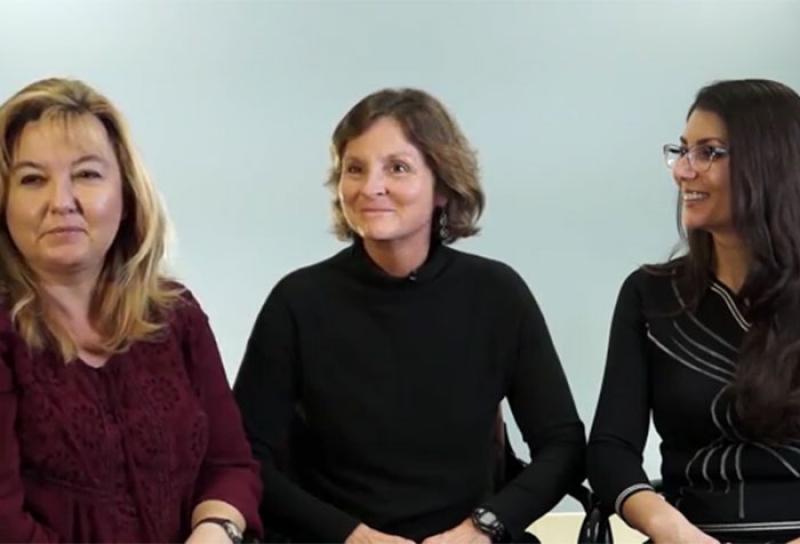
In this new podcast, Recreation, Sport and Tourism Department faculty Kim Shinew, Monika Stodolska and Liza Berdychevsky discuss their study and findings on youth gang involvement and recreation programs.

Transcript

VINCE LARA: This is Vince Lara in the communications department of the College of Applied Health Sciences at the University of Illinois. Recently, Kim Shinew, Monica Stodolska and Liza Berdychevsky, all of the recreation, sport, and tourism department, discussed their research on how recreation programs can be effective in addressing youth gang involvement and violence.

KIM SHINEW: My name is Kim Shinew, and I’m a faculty member in the department of recreation, sport, and tourism, in the College of Applied Health Sciences. And I’m here with my two colleagues.

MONIKA STODOLSKA: Monika Stodolska– I’m also the faculty of the department of recreation, sport, and tourism. And I work with Kim for almost 20 years.

LIZA BERDYCHEVSKY: My name is Liza Berdychevsky. I’m also a faculty of the department of recreation, sport, and tourism. And we’ve been working together on this project for several years now.

KIM SHINEW: Well, we’re here today to talk about a study that we did up in Chicago. The study started many years ago in a project that Monica and I did as it relates to youth in Chicago and their access to recreation and sport programs. When Liza joined us, she had an interest in gang activities. And that coincided very nicely with research findings that we had had in previous studies. And so we wanted to conduct a study that focused more specifically on the gang experience and their motivations for joining gangs and their experiences once they left gangs.

MONIKA STODOLSKA: Some of our research topics were the factors that affect people’s use of outdoor recreation spaces, specifically Latina youth. And we conducted focus groups. And some of the things that people talked about over and over again was how crime affects people’s ability to use public spaces and recreation resources. And that’s how it all started.

LIZA BERDYCHEVSKY: And then in this particular study, which was funded by the campus research board grant, we have focused on the roles and benefits of using recreation in the prevention, intervention, and rehabilitation programs targeting youth involved in gangs. Recreation is a tool that can be used on many levels in the prevention, intervention, and rehabilitation efforts for vulnerable youth who are involved in gang violence. Now, not every recreation effort would necessarily work.

There are key features that we have to deliver to those recreation programs. They have to be consistent. They have to be affordable.

They have to be attractive to youth. They have to offer structure and supervision. And they have to target high risk youth appropriately.

And then if we are successful with that, we can deliver pro-social relationships, positive role models. We can deliver capacity for transformation and reappraisal. And we can also offer safe havens to vulnerable youth, which is extremely important.

One of the programs that was particularly instrumental in our society and helped us a lot, both with recruitment and data collection and even understanding the results that we’re getting, is Cure Violence, formally known as Ceasefire. They’re actually an intervention program. They employ former gang members who act as violence interrupters and mentors and coaches who work with high risk youths who are already involved in gangs and gang violence.

So many of the features that we are discussing were successfully implemented in their programming efforts. They were using recreation both as a hook to entice people to join their programs, but they were also using it as much more than that to helping them open up, grieve over things that happened, connect to each other, communicate better to each other, connect to positive role models, and even things like learning how to be a father because some of them– not all of them.

Some of him never had a fatherly role model. So they use recreation in various roles. And many of our findings are linking well to that example.

KIM SHINEW: And I would just like to add to what Liza said about Ceasefire. They were instrumental in the success of this study. As you might imagine, it is difficult to find former gang members that want to sit down and talk to you about a research study.

And we reached out to Ceasefire, and they reached out to their group, their members, and asked them if they would participate in this study. So when we would go up to Chicago, they coordinated the interviews. And we would sit in this room with them, and we would interview someone. And then we would walk out, and we would say next.

And the next person would come in. So in terms of data collection, it was a dream because of their willingness to help us. And when we asked them about their willingness to help us, they felt that our studies, goals, aligned with the goals of their project. And that’s why they wanted to assist us with recruiting people for the study.MONIKA STODOLSKA: It was actually interesting because some of the older gang members who, you know, deceased from the activity decades ago, they mentioned that gangs in the 1960s and ’70s and ’80s, there were action organization that provided recreation opportunities to youth. They were the ones who set up the soup kitchens in the neighborhoods. They are the ones who took kids to Six Flags, and they actually provided recreation opportunities for the kids. And now they comment that is no longer the case.

It’s more everybody’s, you know, on their own, and they’re focused more on obtaining money from drug sales than caring for the community. Obviously, this was the more of a romanticized notion of gangs, what happened 20, 30, 40 years ago. But they were sort of disillusion about the landscape of crime that is happening in Chicago and major urban areas right now. And it’s more difficult to police them as well.

KIM SHINEW: Monika mentioned something that I just thought of when she was talking about the type of individual that is attracted to gangs. I mean, sometimes, it’s been a family tradition, and they just, it’s what they know. Other times, it’s youth looking for thrills, right, and the risk associated with being a member of the gang. And I believe that this is another place where recreation and sport programs could play a role because if they can find other avenues to get that thrill and that excitement that comes with a gang, then that might be a good alternative to joining a gang.

MONIKA STODOLSKA: Absolutely, and the role models. For many of the youth, they mentioned that they’ve never had a real family. They never had someone they could depend on and someone who would actually care for them. And this is what they are looking for in gang affiliation. So the recreation practitioners whom we spoke with, they mentioned that a recreation professional, a coach, can be the mentor, can be this important person that can actually change the life of a child.

KIM SHINEW: The other thing we learned doing that study when we were interviewing middle school students is how early the recruitment for gangs started. It was much earlier than what we had anticipated and that it was happening in late elementary school, early middle school when they were being approached and asked to join gangs. We need to be on the lookout for gang activity in elementary schools and that that’s where a lot of the recruitment happens. I remember interviewing someone who said that by the time they get to high school, they’ve already decided, right?

They’re either in or they’re out. But it’s that late elementary school where they’re making that decision and then into middle school. So I think by the time you get to high school and you think about programs to prevent gang involvement at high school, that’s too late. And so it really needs to be much earlier.

LIZA BERDYCHEVSKY: And I think it also refers to what kind of programs would be offered to those different age brackets because if we’re talking about primary and middle school, we should be focusing on primary prevention efforts– so focusing on broader youth. And then when we are offering programs that are targeting high school age kids, at that point, since, like Kim said, the decision for most of them has been made already, maybe offering intervention programs that are more tailored towards high risk groups who are already involved in gangs– so different efforts and using recreation differently in those efforts.

MONIKA STODOLSKA: Our study had a lot of interesting findings, and some of the things that really struck us was that gangs have evolved in recent decades, and they have become much less organized, much less structured, more violent. There is much less cohesion among gang members and less loyalty. And what happens is that they’re mostly focused right now on earning money from drug sale.

What we are also seeing increasingly is the influence of Mexican drug cartels, especially the Sinaloa cartel in Chicago. And that really affects the landscape of violence in the city. So one of the things that we need to learn from future research is how to protect you from that new violence that is happening in our urban areas.

Another thing that was really interesting in our study that we discovered is that gangs operate not only in those impoverished central city communities– gangs are present in every city, in every neighborhood, even in small communities like Champagne Urbana. They attract youth not only from working class families but also from middle class families. So youth of all kinds of backgrounds are exposed to gang activity. So what we need to learn more in future research is what are the protective factors, what are the personal characteristics of youth that makes some kids more resilient to crime than others, and how communities and how families can use recreation to protect their children from crime and violence.

KIM SHINEW: Some of the areas that we haven’t talked about today that was certainly evident in our findings was a difference between males and females and their gang experience. And I think that is also a fertile area of research just as it relates to sexuality and risk-taking. And that’s an area that Liza has done quite a bit of work in.

LIZA BERDYCHEVSKY: Mm-hm, that’s one of the papers that we are currently writing up gangs have an extreme chauvinist culture. It’s like taking double standards that we still unfortunately have in the society and magnifying the amplitude of their influence on what roles are available to men and what roles are available to woman, what different kinds of victimization female and male gang members are being subjected to. And unfortunately, a gang is a horrible place for everybody but even more so for young women.

KIM SHINEW: What we feel is that we need to be at the table when these different intervention and rehabilitation programs are being developed because if those key qualities are not there, they will not be successful. So practitioners who are working for YMCAs and park districts and public schools and Boys and Girls Clubs can play a really pivotal role. But they need to be included at the initial stages to ensure that the programs are set up in a way that allows them to be successful.

So recreation in sports is not a panacea. It’s not an automatic that they will have a positive impact. But I think our findings highlight very well the potentially positive impact that they can have.

VINCE LARA: My thanks to Monica, Liza, and Kim. This has been A Few Minutes With.

Share on social

Related news

MPH alums are on the front line of the pandemic battle


Graduates of the Master of Public Health degree program in the College of Applied Health Sciences are finding themselves on the front line in the battle against COVID-19. And thanks to their University of Illinois education, they are better-equipped to handle a pandemic for which few could have been prepared.

Ken Borkowski, a 2012 MPH graduate, is working for the Michigan Department of Health and Human Services, conducting contact tracing with known cases of COVID-19 within the Metro-Detroit area. He credits his ability to succeed in the job in part because of what he learned in the MPH program.

Going back to the basics of EPI 101, it kind of goes back to how this disease moves, and collecting all the information that’s necessary to give us accurate models of how things are going to look and progress, and what do we need to do to inform the public-health work that we do here in Michigan.”

Borkowski’s job involves calling people dealing with COVID-19—or their family members if the patient is too ill—and collecting information.

Some of the key things that we’re looking at now is onset date of symptoms, as well as have people been able to quarantine and then did they go to any sort of high-risk areas such as nursing homes, long-term-care facilities, childhood daycare centers, and so on.”

Teresa Castaneda, who graduated from the MPH program in 2019, has a similar job as a communicable disease investigator for the Champaign-Urbana Public Health District, and also gives credit to her Illinois experience.

“The (epidemiology) knowledge and biostatistics prepared us for how a pandemic is going to come in waves, how we can track cases. There’s really no way to prepare for this, but just knowing the science and the (epidemiology) behind it really helps,” she said.

Castaneda started at CUPHD as a case manager for HIV patients, and was working with a communicable diseases investigator for routine communicable disease cases.

“I assist her when we have someone who tests positive for e-coli or salmonella, or hepatitis B or C, so I’m used to doing that type of investigation.” But she wasn’t surprised when the pandemic hit, or by getting pulled into that type of investigation.

“I’ve been involved in these conversations since right around Christmastime,” she said. “We’ve been having ‘When-it-comes-to-Champaign-County conversations,’ not ‘If-it-comes-to-Champaign-County conversations.”’

Derrius Carter is also a 2019 MPH grad and working for CUPHD in contact tracing and as a public information officer. Part of his job is akin to what Borkowski and Castaneda are doing, but Carter also has a public-facing role.

“What we do is create and provide guidance,” Carter said. “How to grocery shop, how long people should stay home.” Like Castaneda, Carter’s background was more involved with HIV and other infectious disease.

“But we have to be mindful about how all the variables intersect, and create avenues in which we can educate people about both HIV and COVID-19.”

One of Carter’s task is engaging in community-based risk reduction.

“Like using dating apps,” he said. “Just because COVID-19 is around, it doesn’t mean people aren’t being sexually active; so talking about how to reduce their risk of contracting COVID-19, in addition to contracting HIV.”

Like Borkowski and Castaneda, Carter credits his MPH education for getting him ready as he could be.

“We had some classes that touched on emergency preparedness, but I don’t think anybody can prepare you for doing the work,” he said. “Moreso learning the different mechanisms to respond. But when you’re actually in it, it’s a little bit different.”

One thing the MPH alums agree on is that their knowledge and healthcare experience have caused them to approach their personal lives with a high degree of COVID-19-related care.

“Because I take this very seriously, I have not been in a grocery store in so long,” Carter said. “I just feel like it makes the most sense. Limiting my risk. I haven’t been to the gym in quite some time. I knew gyms weren’t practicing social distancing.”

Castaneda also tries to limit her time outside.

“Definitely going less frequently (to the grocery store),” she said. “My husband and I, one of us goes once a week. I pretty much go to work, and go to the store once a week.”

The MPH alums are heeding their own advice, but they are most concerned that some people are listening to advice from less-reputable sources.

“Misinformation is most alarming for me,” Carter said. “I’ve gotten calls from people asking, ‘Oh, I can hold my breath for a minute. Does that mean I don’t have COVID-19?’ And I’ve gotten calls asking if a specific demographic is immune.

“And that’s alarming to me because then it means people aren’t taking it as seriously. (Director of the National Institute of Allergy and Infectious Diseases) Dr. (Anthony) Fauci has been continuously been on a media campaign to spread information about COVID-19, but it’s Facebook articles that people are adhering to, and not his guidance.”

Castaneda agreed.

“The public’s response … I didn’t expect the craziness.”

The Illinois graduates remain hopeful the crisis can end in the upcoming months, but are imploring people to follow state and federal guidelines.

“Pandemics come in waves, and we see that historically,” Castaneda said. “So I don’t think when we get to the end of the downturn of this one, that will be the end of COVID-19, but social distancing and washing your hands are the best things you can do for yourselves.

“Look at the amount of flu outbreaks we have every year, and think about what social distancing and hand-washing could do to those. I do hope in a couple of months we will return to some normalcy,” she said.

“My advice for anybody who wants good information is follow your local health department or the state, we always have the best stuff.”

Now engaged in the worst pandemic since the outbreak of H1N1 in 2009, Michigan-native Borkowski is grateful for what he learned at Illinois.

“There’s been times where people that ask me, ‘Do you regret going out of state for school and doing your degree elsewhere and so on? And given everything that my schooling has led me to and got me into the field that I’m in and working in the job that I’m currently working, it was all well worth it. I definitely appreciate knowing that I have such a profound impact on the community that I’m trying to help and serve.”

Editor’s note:

To reach Vince Lara-Cinisomo, email vinlara@illinois.edu.
 

Share on social

Related news

College of Applied Health Sciences
110 Huff Hall
1206 South 4th Street
Champaign, IL 61820
(217) 333-2131