Aug. 20, 2026 | Vince Lara-Cinisomo
Hearing protection helps musicians safeguard their sound
Before incoming Marching Illini members fill Gies Memorial Stadium with music, faculty members and students from the Department of Speech and Hearing Science delivered a lesson designed to help them keep playing for years to come: loud sounds can cause permanent damage long before musicians notice a problem.
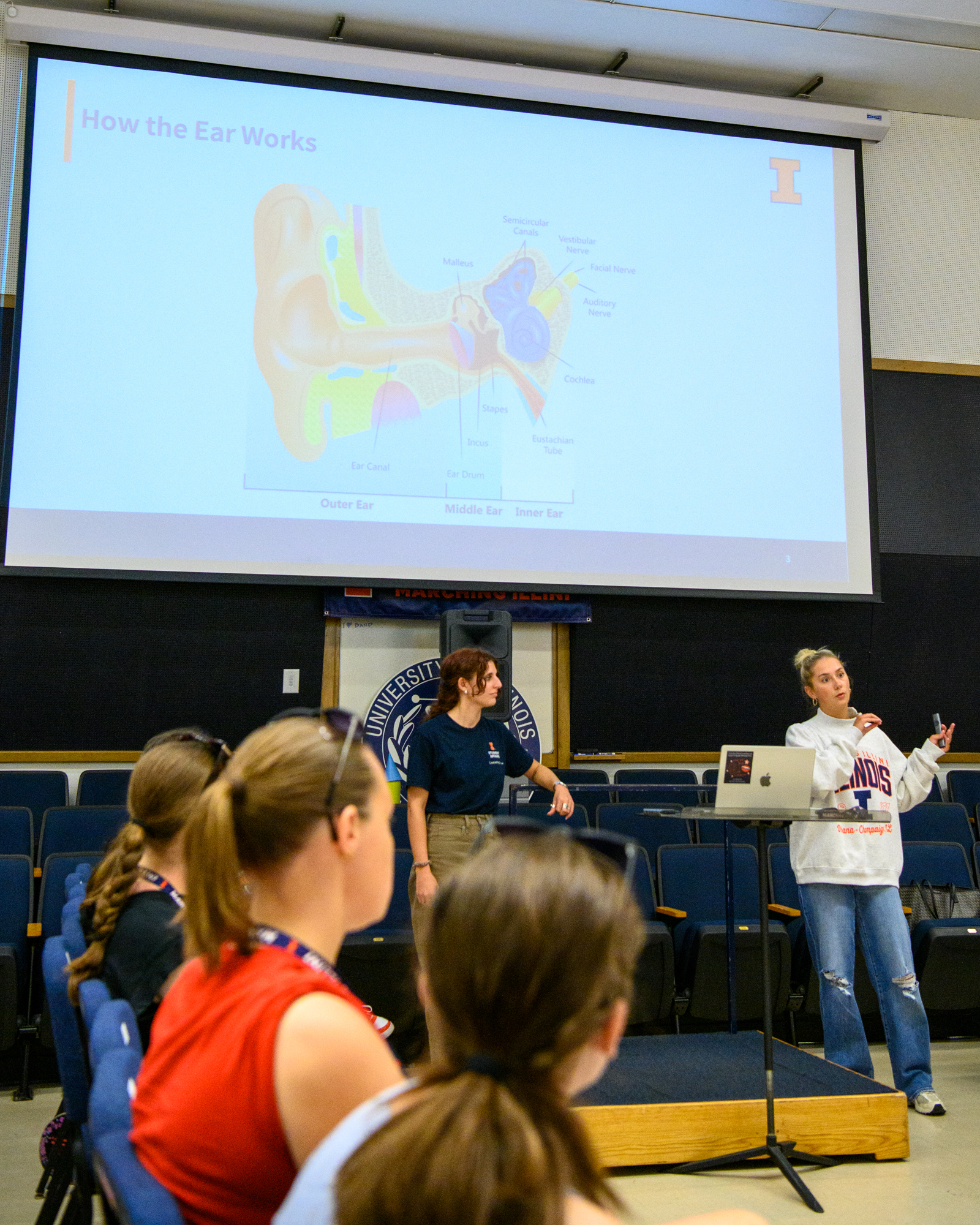
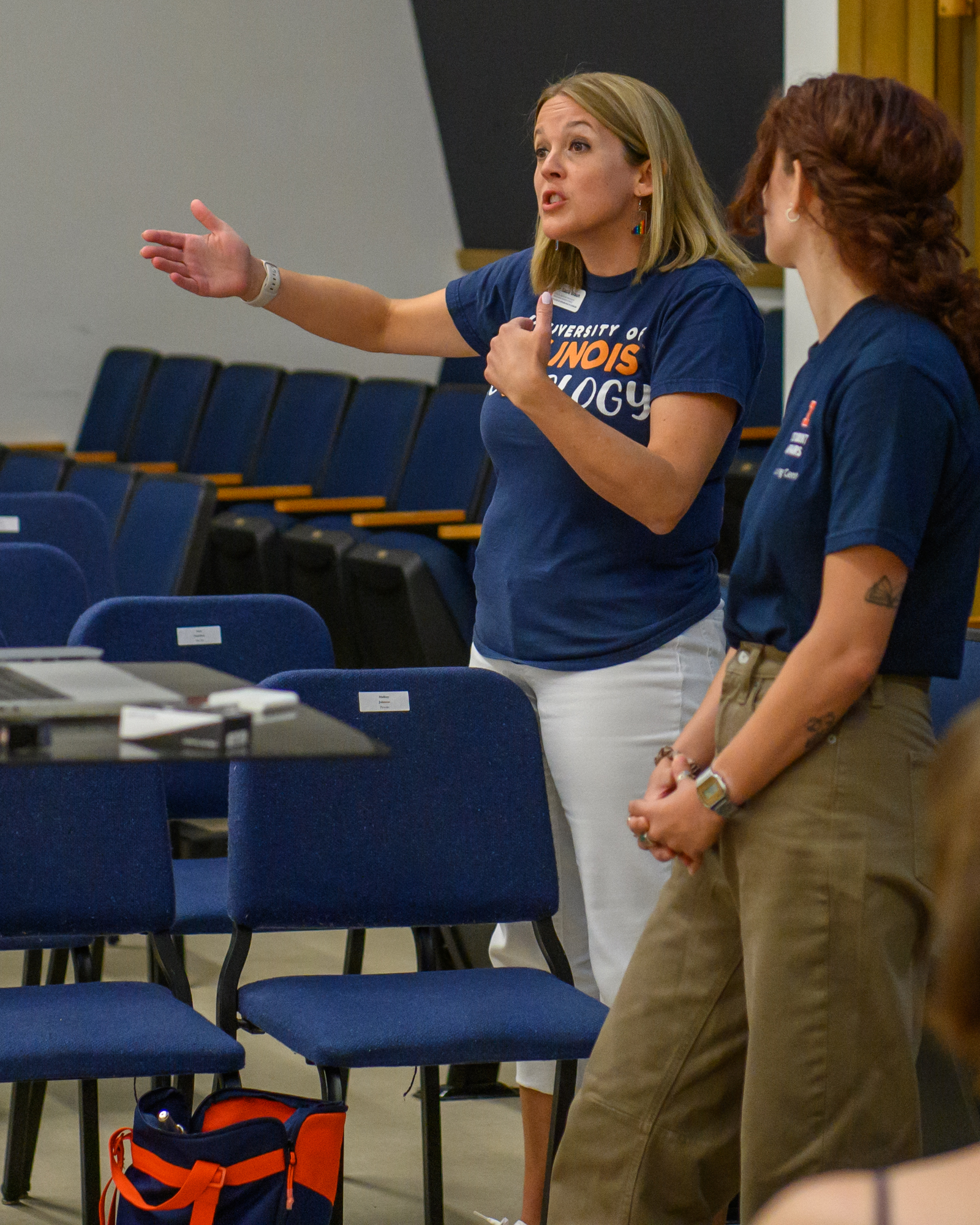
SHS Clinical Assistant Professor Sadie Braun, who is an audiologist; and doctoral audiology students Lauren Stec and Avery Waner presented information about noise exposure and hearing protection during the band’s preseason training. The annual session takes on added significance this year as the university completes the largest main video display in college football at Gies Memorial Stadium—another powerful source of sound in an already loud environment.
Braun said one of the presentation’s most memorable images shows healthy sensory hair cells in the inner ear alongside cells damaged by significant noise exposure.
“It’s a pretty shocking picture,” Braun said. “I think just seeing it in such vivid terms like that, it really does catch some of them by surprise.”
Those cells play an essential role in hearing, but damage caused by repeated exposure to excessive noise generally cannot be reversed. A single impact sound, such as a nearby gunshot or firework, can cause a temporary hearing loss that may improve over days or weeks, Braun said. Hearing loss that accumulates gradually is usually permanent.
The effects also may not become apparent immediately.
“They could be exposed right now, thinking this isn’t a problem, I’m hearing just fine,” Braun said. “And then 20, 30, 40 years from now, that noise damage can show up and cause hearing problems.”
That delayed effect can make hearing conservation a difficult concern to communicate to college students. Some musicians understand the risks, particularly if they know someone with hearing loss, Braun said. For others, it is not something they have considered.
“You’re not thinking down the road about the impacts of some of the stuff you’re doing if nobody’s ever talked to you about it before,” she said.
Marching Illini Director Barry Houser said many band members began playing instruments in fifth or sixth grade without receiving hearing-conservation instruction. The topic also is not typically part of the curriculum when students advance to high school marching bands, he said.
20, 30, 40 years from now, that noise damage can show up and cause hearing problems.”
Sadie Braun
Clinical Assistant Professor, Speech and Hearing ScienceBraun and SHS Associate Professor Pasquale Bottalico visited sixth grade band students at Franklin STEAM Academy in Champaign to educate them about the effect of noise exposure and also to take noise measurements of their classroom, at the request of Franklin’s band teacher.
At Illinois, the risk is amplified by the size of the ensemble. More than 400 musicians rehearse indoors for four days during preseason training. Even when the band moves outside, instruments remain close to musicians’ ears.
Then comes game day, with instruments, amplified audio and tens of thousands of cheering fans contributing to the sound.
“A lot of people think, well, we’re outside, so it’s not going to impact you to the same extent,” Houser said. “… then you get into the football setting—60,000 people yelling. This Megatron video board, largest in college football, and that volume that’s going to be coming out of that. It all contributes.”
The south end zone video display will measure about 69 feet high and 250 feet wide, covering more than 17,300 square feet. It is part of a 16-display project scheduled for completion before the 2026 football season, according to the University of Illinois Division of Intercollegiate Athletics.
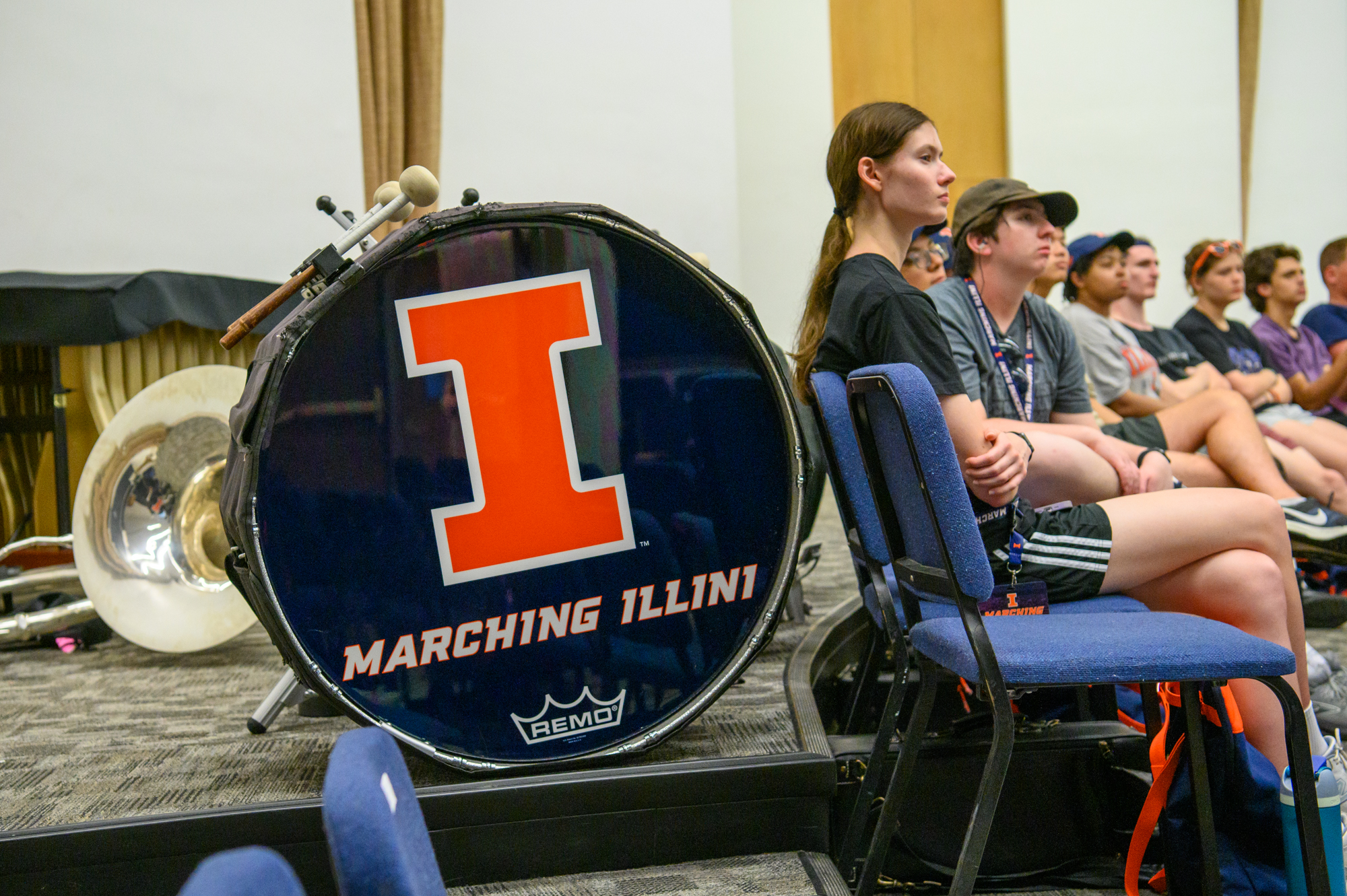
Within the band, percussionists face some of the greatest exposure. Houser said the 36-member drum line can collectively produce sound approaching the level of a jet engine, depending on a listener’s proximity. Braun said musicians closer to the center of the band also may experience more sound from surrounding instruments than those positioned along its edges.
Risk depends not only on volume but also on duration. A level that might be tolerated briefly can become dangerous during a 30-minute or two-hour rehearsal.
Houser said the band provides hearing protection so cost does not prevent students from taking an initial step. The presentation also introduces them to other options and to hearing services available on campus.
Band members receive hearing protection that reduces sound by an average of about 15 decibels, Braun said. The university’s audiology clinic also offers custom musician earplugs made from impressions of a person’s ears, with a discount available to Marching Illini members.
The partnership between the band and speech and hearing science has existed for years, though it was interrupted at times, including during the COVID-19 pandemic. Braun said the program initially included the entire band but now focuses on incoming members. Houser, who is beginning his 16th year at Illinois, said the sessions have been offered during most of his tenure.
Students do not often approach him with questions afterward, Houser said. Their most common response is simpler: they had no idea.
For musicians, preserving hearing is tied directly to preserving their craft. Players must hear themselves clearly to monitor their sound, maintain pitch and adjust to the ensemble around them, Braun said. That ability is particularly important for students who hope to continue performing after college or pursue careers in music.
Houser said hearing from audiology experts gives band members both practical guidance and the science behind it.
“It’s a game-changer,” he said.
Editor’s note:
To reach Sadie Braun, email svojak@illinois.edu@illinois.edu.
Share on social