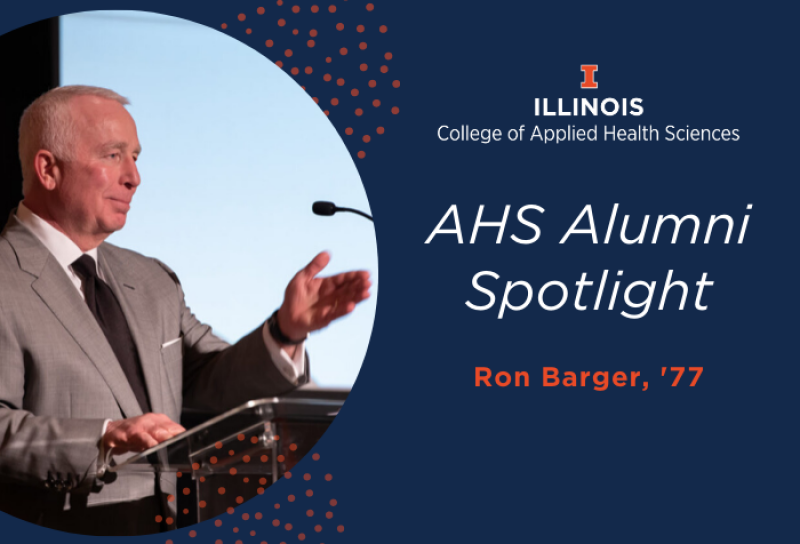
Alumni Spotlight—Ron Barger


Q: Why did you choose the University of Illinois?

A: I grew up in a very small town in Southern Illinois. I was the first kid from either side of my family to go to college. I was lucky enough and did well enough to receive a scholarship and was entered into the University of Illinois. I originally went to Illinois because my mom wanted me to be a doctor. In fact, my first year at Illinois was in premed. At the end of that first year, when I finished my freshman year at Illinois, I didn’t like what I was studying, and I was looking for something else I had such an affinity for sport and athletics and the things that I had been raised with that I looked at what was then the Applied Life Sciences school and enrolled in that, transferred into ALS. From there, it was a magical time, because for me, it ignited the passions that I had, something I didn’t have my freshman year. When I was growing up, Illinois was this wonderful university. It still is. But it was almost something so much greater than what I could expect and so for me, going to Illinois was like a dream come true.

Q: What about AHS inspired things in you? What was it about that program or whatever you saw? Was it a brochure you saw? Was there something on campus that said, hey, transfer into ALS?

A: No, I think I sought it out. I think you have to remember back in the ancient days, when I was in school, and this was in the early to mid ’70s, we didn’t have the Internet in the sense we have now. You didn’t have digital marketing. You didn’t have those kinds of things. I knew some people that were in the college. A lot of the things that it was, what I saw in terms of kinesiology and coaching and the aspects around sport, fit with where I was in my life at that point in time. So it seemed like a natural place to transfer and to then pursue that area of my life.

Q: Were there professors that had a profound impact on you from ALS?

A: Yes, yes. I was blessed. There were several that I think—and I still think about them from time to time. Marianna Trekell was there. Jim Meisner, and, I think, Don Arnold were both involved in the summer program that the college put on for the community that I participated in and helped in. But Jim Meisner, Don Arnold—Helga Deutsch was a professor I thought a great deal of—and Susan Greendorfer. There was a class I had, and I couldn’t tell you the name of it today, but it was along the lines of sociology and sport. I can remember the paper that I wrote. It was about it was about Althea Gibson and Billie Jean King and the impact that their lives and what they were doing, specifically in tennis and their larger role that they had in society because of that, because of their tennis and their recognition. I remember writing a paper in that class as sort of the capstone of that class with Dr. Greendorfer. For me, doing the research and the writing, I still have a very vivid memory of that experience.

Q: You got your law degree from SMU, so maybe AHS didn’t lead to your current career path. But what did you learn here that’s been instrumental to your career?

A: Vince, thank you for the question. I think there is something that I took away from Illinois—in specific, ALS at the time—a couple things, one of which was being exposed to different thoughts, different ways of seeing concepts. All those kinds of things contributed to where I wanted to go. Originally, as I graduated from Illinois, I wanted to go into politics and ultimately return to Southern Illinois and get into politics and represent that region. I ended up going to SMU and then went into a legal career, and from there, being in a large Dallas-based firm. Then I left after, I think, 17 years in private practice, and I went to a company that was being formed by Goldman Sachs called Archon, which was a real estate subsidiary of the firm and being in that organization that we grew to be worldwide, and very large. Then ultimately, I left Archon and went to a company called ORIX. In those roles, what I found is that my talent or my passion is building. It’s building people. It’s building organizations. It’s leading. A lot of the things I took from my time at ALS and some of the classes as well as student teaching at Urbana high school was, how do you coach people? What I found is that in business, the way you move the business is through people. You help them become the best expression of themselves, the fullest expression of who they are. So the same way that you build teams in a sport environment and the same way that you educate people in a classroom is the same way you lead a business—by building people, by building processes, by building organizations and letting them flourish and letting them succeed and how you motivate and how you inspire and how you give them vision and how you build them up and how you coach them and how you mentor them. All those things go into making a successful organization and a successful business. So while there is not a direct correlation to a specific class that I took, being immersed in those kinds of activities and those experiences ultimately is what made—the success that I’ve had as a business leader came based upon those foundations.

Q: As you said, there’s not a direct correlation between the law and what you learned at ALS. But clearly, there was the foundation in place from here and from those classes that you enjoyed. You talked about the courses you enjoyed the most. Were there any others that you could say really stood out to you?

A: I remember the anatomy classes I had. I loved cutting on the cadavers. I loved the labs, the exercise physiology labs that I had. Student teaching at Urbana High School was a wonderful classroom experience and working for a gentleman by the name of John Stergulz over there. Those kinds of things are life experiences that helped form me. I look at this stage in my life and in my career and it’s one in which you’re formed along the way by all those little experiences and people that touch you. One of my favorite philosophers—and a business philosopher, strangely enough—is John Wooden. Coach Wooden, if you’ve ever read any of his quotes, he didn’t think of himself as a basketball coach. He thought of himself as an educator. Some of the things that he said, and I still follow those, I’m trying to think of the exact quote, but something like, “Five years from now, you’re going to be the product of those people you’ve met and those books you’ve read.” I frankly think that goes from the beginning of your life until any point in time that you look at it you are the result of those people that are around you and the intellectual curiosity and the continued learning that you have to make you who that person that you are at that particular moment. I think all of my experiences, and Illinois is certainly formational for me in terms of helping me move from a small town in Southern Illinois to widening my horizons, thinking about things more broadly than that I had until that point in time, and then launching me into, ultimately, a legal career, which then launched into a business career. I’ve been blessed. I’ve been blessed by being associated with some amazing institutions and some amazing people.

Q: What were some of your favorite on-campus and then off-campus experiences?

A: I’m glad you phrased it like that. I can tell you there are a couple of experiences specifically to AHS that I remember. There was one summer that I was working for the recreation department and was sort of the gym supervisor for Huff Gym. And I can remember being in there late at night, not another person in the gym, and looking around and feeling the people and the events that had taken place in that facility and in that gym. And just sitting there in the dark and feeling it around you and knowing that at so many different times, during the time that Huff was being used as the basketball arena and the state high school basketball championships were played there, that it touched me very deeply. I take that with me. Something that I’ve found as well is just the relationships I had with some of the professors. And that’s what surprised me. For example, Don Arnold wrote a book with regard to, I think it was about the legal aspects of the administration of physical athletics or physical education and athletics in public schools. I was in law school when he sent me a draft of it and said, will you look at this for me now that you’re in law school? Having that sort of relationship was something that impacted me. Having professors that were very engaged with you, were very willing to be a part of your journey, and that’s something—I don’t have a specific recollection of a class. I can just tell you the way I felt is that they were engaged and willing to be partner, mentor and coach, and teach me along my journey. So that’s a wonderful thing. You ask about things that happened that were off-campus. I happened to be on-campus my freshman year when all the streaking was going on. So I can still remember that part of the college experience. I have just the fondest of memories of the University of Illinois. Walking down the quad late at night, I remember walking on campus as a freshman, feeling like you didn’t know a soul and when you walked away as a senior, you couldn’t pass five minutes walking down the quad without running into somebody and seeing a friend. At that time, I think you’re very impressionable. I think you’re very open to what is available to you as you’re in that part of your life and for me, it was a very formative time.

Q: In closing, I’d like to ask you what you would say to someone, a prospective student, to recommend the College of Applied Sciences?

A: I’ve been fortunate to be on the Board of Visitors and so I’ve had an opportunity to be around the college. I am deeply impressed with Dean Hanley-Maxwell. I think she is doing a phenomenal job guiding the college, expanding its reach, enhancing its reputation, looking at ways to integrate what the college is doing, what AHS is doing, into other parts of the university, other parts of the community, and frankly, other parts of the world. I’m really impressed with that and the depth of the areas that the college now touches is amazing. A good friend of mine has recently rejoined as the head of development, Jean Driscoll. I think she will be a wonderful return addition and an Illini coming back home to lead development for the college. Every time I go to a board meeting, and I listen to what is being done, I am amazed. I’m gratified by what I hear and frankly; I am just so thankful that I was able to be a graduate of that college and this University. So if you have a passion in this area, you can take this college, the curriculums that it provides to you, and do amazing things. I think it also prepares you for, if that is not where you necessarily see your journey ultimately taking you, it gives you a great foundation for going and following that dream, if you have something outside of it. I look at my undergraduate degree as being something that has been foundational for both my legal career and my business career. And I think that is probably even more enhanced today with the current state of AHS.

Editor’s note:

To reach Vince Lara-Cinisomo, email vinlara@illinois.edu.
 

Related news

Alumni Spotlight—Marty Morse


Q: Why did you pick AHS?

A: In 1980, my coach told me that the Department of Kinesiology at Illinois was the finest in the world. Also in 1980, the Director of Boston University’s Spinal Cord Injury Center, Dr. Murray Freed, recommended that I pursue my wheelchair athletics dreams at the Division of Disability Resources and Educational Services (DRES). I visited in 1980 with both kinesiology and DRES faculty. I fell immediately in love with the campus.

Q: Which professors had the most impact on you?

A: In kinesiology, it was Dr. Helga Deutsch and Dr. Richard Boileau. At DRES, it was Dr. Bradley Hedrick and Dr. Stephen Figoni. In kinesiology, I was surrounded by professors who knew of my goals and they became involved in making sure I reached or surpassed my academic dreams. At DRES, Doctor Hedrick and Figoni set the bar high for me in athletics and academics. Each day was crammed full with learning at the feet of these two giants in the field of athletics and academics.

Q: What course did you most enjoy?

A: Everything I was required to take in kinesiology I enjoyed. The same can be said for DRES. Hedrick and Figoni kept the learning challenging, but fun.

Q: Did you enter AHS knowing your career path, or did AHS help you decide?

A: I had no idea where I was going when I entered AHS other than the fact I would be coaching. Dr. Hedrick made sure I received a graduate assistantship at DRES. That alone set my career path in coaching at DRES.

Q: Did your AHS experience lead to your current job?

A: Yes. I was (the first) wheelchair track and field coach at DRES from 1984-2005.

Q:What is your current job?

A: I retired from full-time coaching in 2009.

Q: What was your favorite on-campus experience?

A: Day-to-day contact coaching Illinois student-athletes. There is a vibe being around Illinois student-athletes that can’t be found anywhere else. I thrived in that environment. Each day I was surrounded by the best and the brightest wheelchair athletes that come to the Urbana-Champaign campus to realize their academic and athletic dreams.

Q: What would you say to recommend AHS to a prospective student?

A: Kinesiology and DRES remain where I found them in 1981, the best. If you want to help people live an active, vigorous, healthy lifestyles, the College of AHS is the place to be. You will be challenged outside your current comfort level to achieve your dreams.

Editor’s note:

To reach Vince Lara-Cinisomo, email vinlara@illinois.edu.

Related news

Alumni Spotlight—Katie Bradbury


Q: Why did you pick AHS?

A: There has not been a chapter of my life that did not include recreation, be it county recreation programs I took part in as a kid, or working at overnight summer camps for the better part of my teens and early 20s. My life has been pretty much dedicated to the field of recreation, and what better program to gain further knowledge in recreation than the RST program. Although there are plenty of universities that offered Recreation, Sports, and Tourism, the University of Illinois Urbana-Champaign was the only one (that) multiple professors from my undergrad days had mentioned to further my educational career.

Q: What course did you most enjoy?

A: I would say financing and budgeting as well as Human Resources in RST were both classes I enjoyed because I learned so much more than I did in my undergrad outdoor recreation budgeting classes. The course I enjoyed, because it was just a fun course, was marketing. It really allows a level of creativity to be used for each assignment.

Q: Did you enter AHS knowing your career path, or did AHS help you decide?

A: My career path was set a long time ago. I was working at a summer camp in Lake of the Woods, Ontario, Canada, when my director told me he has a degree in recreation. I had never heard of such a thing. Come to find out (Eastern Washington University) had outdoor recreation as a degree, I graduated a few years later. During that time I had learned so much about the business side of the field, we became certified in everything we could; however, seasonal work was difficult and getting your foot in the door of government agencies or not-for-profits at an administrative level was extremely difficult without having more education or more experience. As recreation professionals know, this field changes every 7-10 years. Continuing education is a necessity. Going back to school and becoming a part of the AHS RST program has really helped in employment and immediate job advancement.

Q:Did your AHS experience lead to your current job?

A: I owe a lot to my experience at AHS and I do believe it has led me to my current career choice. During college, I worked at the State Farm Center and Memorial Stadium and I would not have known about those positions without the College of Applied Health Sciences. It allowed me to network and let me know of positions that were available in event management. It ultimately lead me to finalize my decision on exactly what I wanted to be in addition to the qualities that I wanted and did not want to have as a leader in my field.

Q: What was your favorite on-campus experience?

A: My favorite on-campus experience was graduation, and meeting the professors I had only talked to online.

Q: What would you say to recommend AHS to a prospective student?

A: For me, AHS has allowed me the opportunity to work within the communities to help keep people active, children engaged, seniors mobile and social, and provide a service that are vital to the population we serve.

Editor’s note:

To reach Vince Lara-Cinisomo, email vinlara@illinois.edu.
Related news

Alumni Spotlight—Christian Perez


Q: Why did you pick AHS?

A: From a young age, I always had a fascination and passion for sports. My dream as a kid was to be a professional soccer player, but recognized early on that perhaps I didn’t have the full skillset to do it, but I knew I wanted to be involved in the game off the field. When it came time to apply for colleges, AHS made the most sense for the career path I wanted to take.

Q: Why did you pick RST?

A: I knew I wanted to be involved on the business side of sports, and the Sport Management program provided within RST caught my attention from the start. The atmosphere and family feel of RST and AHS made it a very comfortable environment to be in. You basically knew almost every one of your classmates since you were in 95 percent of the same classes every semester.

Q: Which professors had the most impact on you?

A: My academic advisor at the time, LoriKay Paden, played a big role in me wanting to stay in RST. As a freshman I had my doubts about the academic path I was on, but talking to LoriKay reassured me that I was making the right decision staying in RST. Dr. Michael Raycraft was someone that kept class interesting, even when he maybe knew that the material from that particular day in class wasn’t the most glamorous. He wasn’t afraid to put students on the spot in class when answering questions, which I am thankful for now. It’s always good to be comfortable being uncomfortable. Dr. Ryan Gower always had time to meet and chat with you, no matter what he was doing. I remember on days before class, my friends Tim, Tom and I would stop by his office and he was always down to chat or to tell us one his undergrad stories or how his kids were doing. That’s a personality trait that I hope I can replicate.

Q: What course did you most enjoy?

A: Not sure if it is still around, but RST 300 was my first introduction to real world experience. Events and Planning made us engage with outside businesses to put on an event from the bottom up and most of the skills I learned in that class, I can still apply today.

Q: Did you enter AHS knowing your career path, or did AHS help you decide?

A: I had an idea of the career path I wanted to take as far as being involved in the front office of a sports team. However, at the time I did not know that I wanted to get into game day and stadium operations, which is my current role. I always thought that I wanted to get into marketing, and to be honest it just sounded “cool” at the time, but really didn’t know what it entailed to be involved in marketing with a sports team. I was able to get an internship with a minor league baseball that first exposed me to stadium operations, but was not the biggest fan. When an opportunity for an operations internship came up with the Chicago Fire, I took it and haven’t looked back since.

Q:Did your AHS experience lead to your current job?

A: My AHS experience definitely helped prepare me for life after graduation. Being in RST helped build a foundation for what it means to be a business professional and how to market and network yourself to industry leaders. The skills I obtained from time management, communication and organization throughout my Illinois tenure definitely set me up for success post-undergrad.

Q: What was your favorite on-campus experience?

A: It is hard to narrow down a few experiences, let alone just one. That said, the friends I gained throughout my college experience will always be the best part about Illinois. Taking down No. 1-ranked Indiana basketball in 2012 will always be a good memory, though!

Q: What would you say to recommend AHS to a prospective student?

A: First and foremost, always try to keep an open mind! The close connections you can develop with your professors and staff can serve as a great steppingstone for your career post-undergrad. Being involved in a college like AHS gives you the opportunity to meet all your classmates, build relationships, and seek out your professors whenever you need them. Take advantage of being on a Big Ten campus and start to develop your professional network as early as possible, it never hurts to reach out to someone just ask some questions or to pick their brain.

Editor’s note:

To reach Vince Lara-Cinisomo, email vinlara@illinois.edu.
 

Related news

Alumni Spotlight—Charles Burton


Q: Why did you pick AHS?

A: If you are driven by curiosity, creativity, and the desire to improve the lives of others or you are interested/fascinated by the human body and the sciences it is natural, pursue a degree in Applied Health Science. As an athlete, with a passion for helping others, I chose AHS as a springboard to gain relevant practical experience working closely with other students and professors in fast-moving environments. The college of applied health sciences equips you to implement scientific principles together with practical clinical experience toward improving quality of life for patients in the rapidly growing and ever-changing healthcare and recreational, sport and tourism industries.

Q: Why did you pick RST?

A: As previously stated, as an student-athlete, I had become to appreciate the competition, adversity, theory practice and science that is required to be successful in sports. In looking at the professional climate, Recreation, Sport & Tourism had began to grow on a world-wide scale. The NBA had become a global brand and other sports were using metrics and science to gain competitive edges in competition. Hospitality & Tourism had also began to grow with more families traveling abroad and more individuals looking to become entrepreneurs in specific sciences. The concept of leisure had been studied and were in its early stages of understanding its effects on mental health and a healthy lifestyle. In Parks & Recreation as well as Youth Development, logic models and fundamental program development principles were becoming the standard. RST allowed me to gain experience in all of these arenas and develop analytical and critical thinking skills to adapt to the fast-growing and ever-changing environment. RST provided me with the opportunity to gain necessary hard & soft skills to be able to have success in any career. The transferable skills allowed to me to be flexible in my career choices and use my passion for helping others in a variety of ways professionally.

Q: Which professors had the most impact on you?

A: It’s hard for me to name one. Each professor brought a different perspective and level of expertise, which challenged me to adapt and always look at challenges as opportunities. The professors gave me more than academic information, they gave me perspective and skills that allowed me to be successful today. Here is a quote, “The world will never stop evolving, our responsibility is to accept the discomfort with change but use it to grow/expand our knowledge through the change to create new opportunities!”

Q: What course did you most enjoy?

A: RST 501 Concepts & Applications in Recreation, Sport & Tourism. This course opens your eyes to various opportunities via a conceptual lens.

Q: Did you enter AHS knowing your career path, or did AHS help you decide?

A: I had no idea of what I wanted to do! Outside of being an athlete, I didn’t know what I was good at.

Q:Did your AHS experience lead to your current job?

A: Yes, it did. I have worked in almost every aspect of Recreation, Sport & Tourism. My current position as Director of Operations/COO requires me to work conceptually on changing critical issues, finance/budgeting, problem solving, looking for new opportunities through challenges, program development, community relations, customer services, organizational leadership, mentoring/coaching, etc. The foundation for all of these skills came from AHS.

Q: What was your favorite on-campus experience

A: The Quad! Such a beautiful space and seeing the diversity and being able to speak with and understand various cultures were amazing. Spaces like this help us come together and develop a higher level of cultural competency.

Q: What does AHS mean to you?

A: AHS means 4 P’s (Passion; Purpose: Potential; Pathways). Getting a degree from AHS will assist you with Finding your Passion, Defining your Purpose, Discovering your Potential, and Developing Pathways to a Greater Future! These are the strategies for growth and development that are used every day.

Editor’s note:

To reach Vince Lara-Cinisomo, email vinlara@illinois.edu.
 

Related news

A Journey to Empowerment


Harold Scharper Award recipient Kevin Fritz is flanked by Susann Sears, director of Beckwith Residential Support Services, and Pat Malik, former director of Disability Resources and Educational Services.

Kevin Fritz’s disability made his childhood difficult. People noticed his wheelchair before they noticed him. The severity of his disability made it impossible for him to perform the tasks of daily living for himself, and he was often hospitalized with intense illnesses. Despite all of this, he had a strong will to succeed.

So when his health finally stabilized during high school, his thoughts immediately turned to taking advantage of opportunities. It was the first time he felt empowered in his life.

“That was the first time I truly felt authority or power to do something,” he said. “And I did. I immersed myself in academics. I tried to learn things. I tried to become more articulate, sensitive, ambitious.”

In his junior year, he came across an article in New Mobility magazine that listed the top ten universities for people with disabilities. What intrigued him most about the article were the photos of people in wheelchairs.

“They were doing things, going to classes, wearing clothing that wasn’t from a hospital. It was fascinating,” he said.

The University of Illinois was at the top of the list. Although this Pennsylvania resident wasn’t even sure where Illinois was, he called the Division of Disability Resources and Educational Services (DRES) and spoke with Susann Sears, who now directs the Beckwith Residential Support Services program for people with severe physical disabilities who require personal assistants. She recommended a campus visit.

“She said I could take a tour on a special bus that was accessible and see the place where I would live with other students and get care,” he said. “That was the second time in my life that I felt empowered.”

His father drove him 12 hours for the visit. The ride home was quiet, with Kevin feeling “shell-shocked and elated.” His father broke the silence, saying, “Kevin, if you can get in, you can go.”

At Illinois, Kevin learned how to maximize his quality of life. He credits Susann in particular with igniting a fire in him to push back when people said no. “She fought for me to change what is commonplace,” he said. “I have rights. I’m allowed to be here. I deserve to be here.”

He seized opportunity after opportunity, becoming the first student with a known physical disability to be elected to the Illinois Student Senate, which he also chaired, and to serve as director of the Illini Union Board. A student in Community Health, he served as president of Future Health Care Executives, the largest student organization in the College of Applied Health Sciences, and of the rehabilitation service fraternity Delta Sigma Omicron. He landed coveted internships with then-Senator Barack Obama and with Lynne Barnes, vice president of hospital operations at Carle, who encouraged Kevin to apply his analytical mind and passion to law school.

During his studies at Washington University School of Law, he served as the primary editor of the Washington University Journal of Law & Policy, as a board member of Wiley Rutledge Moot Court, and as executive director of advocacy for the National Association of Law Students with Disabilities. He won several mock trials as well as an Excellence in Oral Advocacy Award. As an associate in the firm Seyfarth Shaw LLP, he counsels clients on a wide range of employment issues. His courtroom experience covers the full spectrum of litigation. He co-chairs the firm’s All Abilities Affinity Group, which focuses on inclusion in the workplace, and speaks extensively on disability and diversity issues throughout Chicago.

Looking back on his days at Illinois, Kevin is grateful for the many opportunities that he had through his affiliations with AHS and DRES. He considers the University of Illinois to be a mechanism that allows people to master their lives, adding that he is very honored and proud to have mastered his own.

Share on social

Related news

College of Applied Health Sciences
110 Huff Hall
1206 South 4th Street
Champaign, IL 61820
(217) 333-2131