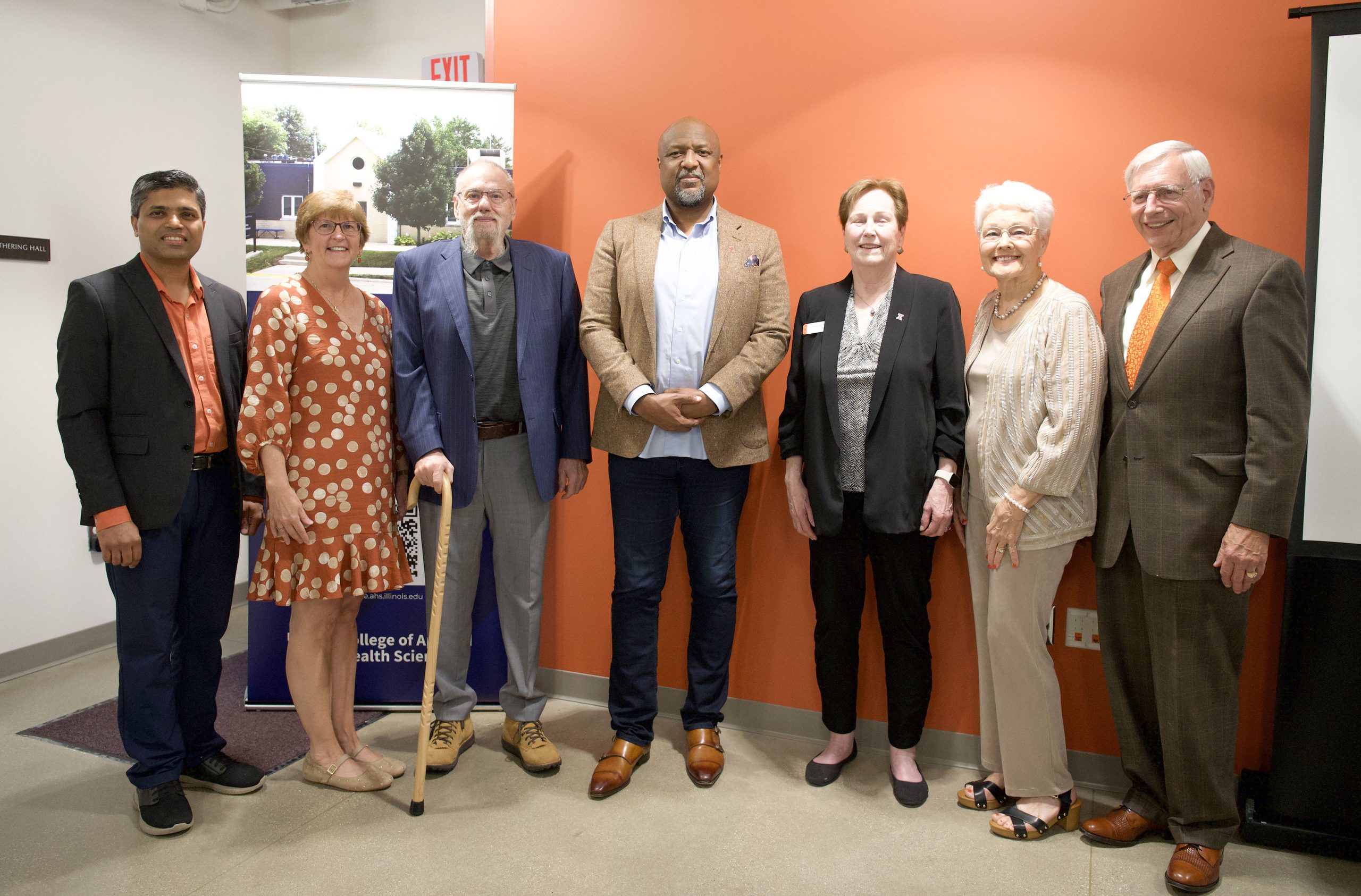
Congratulations, 2024 scholarships and awards winners! We are very proud of your achievements. You have shown us all the benefits of setting goals, hard work and excellence. We wish you the best as you move through your academic life. Click the link to see a PDF of the award booklet.
Dear students, faculty, alumni, and friends of the Department of Speech and Hearing Science,
As we embrace the vibrant colors of fall on campus, I am thrilled to welcome you to the latest edition of our departmental newsletter. It is a pleasure to share news of recent accomplishments and to offer a glimpse into the exciting developments on our horizon.
Our efforts to advance the field of communication sciences and disorders grow more impactful each year. In this edition, we highlight the inspiring stories of our faculty, students and alumni who are making significant strides in different areas. Additionally, we are proud to announce that the Audiology & Speech-Language Pathology Clinic is now Medicare certified. This enables the clinic to serve an even broader segment of our population, particularly older adults and those with disabilities, to ensure that everyone has access to the services they need.
I encourage you to delve into the newsletter, celebrate our collective achievements, and imagine the boundless opportunities that lie ahead. Together, we will keep pushing the boundaries of research, supporting individuals with communication challenges, and shaping the future of communication sciences and disorders.
Finally, I extend my deepest gratitude to our SHS faculty, staff, and students for your unwavering dedication. Your hard work and enthusiasm are the foundation of our success and drive us forward.
Wishing you all a wonderful and inspiring fall season.
Congratulations to the recipients of 2024 scholarships and awards. The undergraduate and graduate students recognized within these pages have shown outstanding dedication and creativity in the pursuit of their personal and professional goals. We are very proud of your achievements. Click the link to read the PDF program.
Three faculty members from the Department of Speech and Hearing Science earned promotions and tenure prior to the fall 2023 semester. SHS congratulates Raksha Mudar, Brian Monson and Pasquale Bottalico for their well-earned promotions.
Raksha Mudar
Raksha Mudar, who joined the faculty of the Department of Speech and Hearing Science in 2011, was promoted to full professor in 2023. Mudar, who earned her Ph.D. from the University of Texas at Dallas, is the director of the Aging and Neurocognition Lab.
Mudar investigates the effects of normal cognitive aging and brain diseases including mild cognitive impairment, Alzheimer’s disease and frontotemporal dementia on higher order semantic functions. She uses a combination of behavioral methods, event-related potentials and functional magnetic resonance imaging in her research.
“I am deeply honored to be promoted to full professor at such an esteemed institution of higher education and research,” Mudar said. “My path to full has been very rewarding. I chose academia because both research and teaching bring so much joy to me. Looking back, I know I chose right, and am excited for what lies ahead.”
Mudar was elected as a fellow of the American Speech-Language-Hearing Association at the ASHA Convention 2022—one of the highest forms of recognition given by ASHA. Mudar has been involved in several federally funded grants and is currently the primary investigator on an R01 titled “Digital Technology to Support Adherence to Hypertension Medications for Older Adults with Mild Cognitive Impairment.”
Brian Monson
Brian Monson, who joined the faculty of the Department of Speech and Hearing Science in 2017, was promoted to associate professor in 2023. Monson, who received his Ph.D. from the University of Arizona, is the director of the Auditory Neuro Experience Lab. His field of research is in auditory neuroscience.
Monson holds degrees in electrical engineering, acoustics and speech/language/hearing science, with further specialization in neuroscience and music. With this background, he takes an interdisciplinary approach to auditory research, interfacing with clinicians, scientists, engineers and musicians. His research interests center around auditory neurodevelopment and speech/voice perception.
Monson is the principal investigator on an R01 grant from NIH-NIDCD for his project titled, “The ecological significance of extended high-frequency hearing in humans,” and the PI on an R21 from the NIH-NIDCD as well as the co-PI on another R21.
“I’m quite honored to become a tenured faculty member at such a reputable institution as the University of Illinois,” Monson said. “I very much look forward to continuing to serve our students and our community with my colleagues in Speech and Hearing Science and in Applied Health Sciences.”
Pasquale Bottalico
Pasquale Bottalico, who joined the faculty of the Department of Speech and Hearing Science in 2017, was promoted to associate professor in 2023. Bottalico earned his bachelor’s degree in telecommunications engineering from Univeristà Mediterranea di Reggio Calabria (Italy), while simultaneously pursuing a degree in opera singing at the F. Cilea Music Academy of Reggio Calabria (Italy).
In 2005, he moved to Turin where he earned his master’s degree in telecommunications engineering from Politecnico di Torino (Italy). Bottalico earned his Ph.D. in metrology, studying acoustics with particular attention to the uncertainty of measurements and statistical analysis of data. Bottalico is particularly interested in the professional voice user and singer techniques, as well as the definition and the quantification of vocal load. Other fields he is interested in are speech intelligibility, room acoustics and musical acoustics.
Bottalico is also a professional chorister, having performed under such prestigious directors as Rafael Frühbeck De Burgos, Yuri Ahronovitch, Jeffrey Tate, Juanio Mena, Gianandrea Noseda, Ottavio Dantone, Wayne Marshall, Helmuth Rilling, Christopher Hogwood, Robert King and Ivor Bolton.
“Attaining tenure and rising to the role of associate professor is a profound validation of my dedication to enlightening minds, pushing the boundaries of knowledge and contributing to the ever-evolving academic landscape,” Bottalico said. “It signifies not just personal achievement but the faith others place in my ability to continually inspire students and illuminate the paths of intellectual exploration.”
New Master of Health Administration director Lynne Barnes says, “After decades of working in healthcare, it’s really exciting for me to have the opportunity to impact the careers of future healthcare leaders.” Find out more about the past president of Carle Foundation Hospital and her move to lead the MHA program.
‘I’ll give them everything I’ve got,’ Lynne Barnes said about her new job.
A year of retirement felt like enough for Lynne Barnes, the longtime healthcare administrator.
After finishing her four-decade career at Carle Foundation Hospital as president, Barnes soon found herself auditioning for her newest challenge: directing the Master of Health Administration degree program in the College of Applied Health Sciences at the University of Illinois.
It was the third interview she’d ever taken, after her first Carle interview and her high school gig at the pastry chain Mister Donut.
Today, at 70, Barnes has “lots of energy, that’s a blessing,” she said. “I was ready to do something different.”
As the newest director of the six-year-old MHA program, Barnes brings an invaluable trove of administrative experience she hopes to impart to future healthcare leaders.
Barnes’s appointment officially began Aug. 1 when she succeeded two-year interim director Laura Rice.
“I’ll give them everything I’ve got, in terms of investing the program and helping it to grow in the ways that the university wants to see it grow,” Barnes said. “I want to see this program rise in the ranks of status.”
Raised in Catlin, Ill., Barnes was hired by Carle Health in January 1977 straight out of college as the system’s first occupational therapist. She went on to direct several departments and held numerous administrative roles before finishing her Carle career as president of the Urbana hospital.
“Throughout her career, Lynne has served the community and distinguished herself as a leader in healthcare innovation,” said Kim Graber, head of the Department of Kinesiology and Community Health. “Her background in clinical operations and occupational therapy, along with her distinguished experience as president of Carle Foundation Hospital, will provide graduate students in health administration with unrivaled leadership.
“Lynne has boundless energy and will help take our program to the next level.”
Barnes will continue to teach as a part-time clinical professor, a role she’s held at University of Illinois Urbana-Champaign since 2007. A frequent community volunteer, Barnes is board chair of the Stephens Family YMCA and Experience Champaign-Urbana, and previously served as a member of the United Way of Champaign County and Urbana City Council.
Barnes oversaw the growth of Carle Foundation Hospital’s therapy programs and clinical operations, leading the flagship location in the face of the COVID-19 pandemic before retiring in February, 2022.
“Everything I’ve done there is such a joy,” Barnes said. “I love healthcare, because all the time we’re just serving people, and serving people who are in a vulnerable situation.
“Nobody wants to have to go to the hospital. And I love the opportunity to serve people in that way and make that experience as palatable and positive as it can be under their circumstances. That is a joy.”
Barnes earned her bachelor’s degree in the emerging field of Occupational Therapy from the University of Illinois-Chicago in 1976, later obtaining her master’s degree in public administration from UIUC in 1988.
The MHA program was established in 2017 and accredited by the Council on Education for Public Health in 2019.
The opportunity to educate the next generation of healthcare leaders compelled Barnes to take the MHA directorship. She will work to develop the department’s new online MHA program and strengthen its position in the graduate landscape.
“The support has been terrific,” Barnes said. “I have no doubt we will be able to achieve these goals. I enjoy teamwork and I have already experienced that it is ‘all hands-on deck’ to continue to improve and optimize our educational opportunities for our students.
“After decades of working in healthcare, it’s really exciting for me to have the opportunity to impact the careers of future healthcare leaders.”
A gutsy start
Growing up the youngest of three, 30 miles east of the University of Illinois campus, Barnes said attending the U. of I. was basically inevitable.
Interested in taking a hands-on role within healthcare, Barnes enrolled in the new Occupational Therapy degree program, which sought to train physicians who could help patients with physical and sensory problems to regain their independence.
The program was run through the University of Illinois-Chicago, but the 10-student cohort studied on the Urbana-Champaign campus.
Upon graduating, Carle Hospital put out an ad for its first occupational therapist position. Half of Barnes’ class applied for the job, she said.
“The [physical therapy] director had a hard time figuring out who to hire,” Barnes said. “And he laid our resumes out on the table at home and his wife—who was the emergency department director at Carle—said, ‘Well, just pick the one that had the highest grade-point average.
“And I got the job.”
Barnes hit the ground running in Carle’s relatively small therapy department, back when the hospital only had about 150 beds.
I remember thinking, ‘I love this, I want to be a part of it.’ I’ve always had the desire to lead and share the enthusiasm and passion I have for whatever it is I’m doing. And I had that opportunity at Carle.”
Soon, her success led to a promising offer: work on her Ph.D. while teaching future occupational therapists on the UIC campus.
But Barnes went straight to administration and leveraged a proposal of her own. If she were to get a promotion, she’d grow her own occupational therapy department and stay at Carle Foundation. It worked.
“I was kind of gutsy, I had only been there a couple years,” she said.
Barnes quickly found an affinity for the business side of healthcare, growing the therapy department by about 60 employees before being promoted to Carle’s director of therapy.
Soon, the current CEO of Carle Healthcare, Jim Leonard, came to her office and asked if she’d like to be a vice president of the hospital.
“I was all about therapy, I was very focused on what I did,” she said. “But whether I could translate my leadership skills to other departments was unknown. They thought maybe I could, but they were taking a chance on me.”
The decision led to years of multifaceted administrative work for the Urbana hospital, while the system continued its growth trajectory, adding a handful of new hospitals across Illinois.
Barnes’ attention stayed fixed on Carle Foundation, where she took pride in handling complaints from patients and families in vulnerable situations.
“To me, a patient who’s had a complaint and had it successfully resolved is more loyal than a patient who’s never even had a problem. I’m competitive, and I like to win back people,” Barnes said.
“I love the atmosphere and culture of Carle, of always striving to fix things and make it better and push ourselves so we could be noted for having the best care around.”
Mission-driven healthcare leaders
While still at Carle, Barnes found a new passion bubbling up alongside her administrative duties. She took joy in passing on her knowledge to both peers and students.
Along with becoming teaching faculty at the College of AHS, she’s become a professional life coach, dispensing career advice for those inside her field and outside of it.
For the present and future students of the MHA program, Barnes wants to pass on the idea of healthcare as a mission-driven calling, not just a job.
“They’ve got to learn facts about what it’s like to run a healthcare system, but they also need what I would call the characteristics that make the kind of healthcare leader that you want. I try to blend them, and share with them the need for energy, for enthusiasm, the need for passion,” Barnes said.
With MHA embarking on the brand-new construction of an online degree, and the spotlight on healthcare after the COVID-19 pandemic, Barnes has high-minded goals for the future of the program.
“By the time I’m done, my goal is this place will be more well known and people will be clamoring to get their graduate degree from the University of Illinois Urbana-Champaign MHA program,” she said.
“That’s going to take work and it’s going to take connectivity, so I’m hoping I can use some of my healthcare connections to be able to get the word out.”
Rabel Lohana joined the Department of Speech and Hearing Science this fall as the first practice manager for the Audiology and Speech-Language Pathology Clinic. Find out more about her career and life journey below.
Q: You are from Pakistan, and worked to provide medical care there. How did you end up in Indiana? What made you want to come to the United States?
A: A better career is what drove us to leave our home country and relocate to the United States. The job chances in the United States are superior to those available to immigrants at home. Regardless of color, ethnicity, or religious beliefs, the United States appears to be one of the safest countries to live and provide equal opportunities to all. There are many educational possibilities for those who desire to further their education because the United States has so many universities and it turned out to be so beneficial for me, when I decided to pursue an MBA at (Indiana University).
Q: You have a variety of skills, including practicing as a physician. How and why did you make the decision to pivot to an MBA and work on healthcare business aspects?
A: Patient care is only one aspect of working in the healthcare industry. Healthcare professionals that are focused on patient care may be unaware of the business aspects of the healthcare industry. But how hospitals and other healthcare institutions and organizations run their operations depends heavily on this business aspect. That excited me when I worked as a medical administrator in Pakistan. Making sure these institutions and groups function efficiently on a daily basis can help guarantee that patients can access and receive high-quality medical care. Keeping institutions and organizations in good standing generally is essential for their continued operation, and healthcare management is a key component.
Q: What have you noticed is different about medical care in the U.S. than Pakistan?
A: A healthcare system is one of the most essential pillars of any country. The primary role of a healthcare system is to ensure that all people get the best available health facilities in a timely, acceptable, affordable and accessible manner. However, for a healthcare system to function as such, it requires proper infrastructure and financial support. To a large extent, the healthcare system in Pakistan is facing several challenges. There is a massive shortage of hospitals, doctors, nurses and paramedical staff. Most life-saving medications are too expensive for people to afford. Above all, there exists a lack of trust in the healthcare system, which gives way to the ever-increasing quackery in the country. In contrast, in the U.S., patients’ lives and needs come before the expense of receiving care, universal access to healthcare for the poor and the desperate. Along with that, the U.S. invests a lot of money promoting new, innovative health concepts for the wellbeing of its citizens, which benefits not only Americans but also the rest of the world.
Q: What made you decide to choose Illinois to work and live?
A: I’ve always wanted to work for an institution that will not only support my professional growth but also for the prosperity of students and the community. And, as I was looking for work, I discovered that the University of Illinois not only had that, but also an extraordinary team of people that not just support the university’s mission, but also the people who work here.
Q: How did you make the decision to work for the Dept. of Speech and Hearing Science? What about the job was interesting to you?
A: Having a background in medicine and business experience in the healthcare industry, I immediately knew this job at SHS was suited for me when I learned about it. I was seeking a combination of the operational side of the business and collaboration with other institutions to extend the vision and organizing outreach activities for the education of the community, and how they may benefit from the clinic services, and this job has it all.
Q: The Audiology and Speech-Language Pathology Clinic has never had a business manager. What changes do you anticipate making to help the clinic be more visible and successful?
A: As the clinic’s business manager, it is my goal to implement as many outreach programs as possible for the community’s good that will not only draw in more patients but also spread the word that students can enroll in our well-rounded curriculum. I believe the clinic has a lot of potential, and some of its aspects are still untapped, therefore I’d be interested in exploring those possibilities, in order to build a prosperous and well-known clinic in the community. I do see myself as a representative of our outstanding clinical faculty and staff, assisting them in overcoming obstacles so they can give patients good treatment and give students uninterrupted time and attention.
SHS Clinical Assistant Professor Sadie Braun said she’ll incorporate the results of the study into her counseling of her patients who need hearing aids.
Long-term speech understanding can improve the earlier a patient uses hearing aids, Sadie Braun said. (Photo by Brian Stauffer)
A study published in the medical journal The Lancet found that hearing aids might slow cognitive decline for at-risk older adults with hearing loss.
Sadie Braun, audiologist and clinical assistant professor in the Department of Speech and Hearing Science in the College of Applied Health Sciences at the University of Illinois, said she’ll incorporate these findings into her counseling with patients.
“For people who have any sort of high risk for cognitive decline such as dementia [or] Alzheimer’s, this study tells us that those individuals should get hearing aids as soon as they need them,” Braun said. “The average person waits 5 to 7 years or more to get hearing aids once they know they have a hearing loss.”
The study, co-led by Dr. Frank Lin of Johns Hopkins University School of Medicine and the Bloomberg School of Public Health, analyzed cognitive performance for groups of older adults (ages 70 to 84) with untreated hearing loss.
Participants were randomly assigned to either the control group that received counseling on disease prevention, or to the intervention group, which received regular audiology treatment and hearing aids.
Researchers followed up with participants every six months for three years. For participants at lower risk of cognitive decline, hearing aid interventions showed no significant effect on cognitive function. But for participants with high risk for dementia, cognitive decline slowed by 48 percent over the three-year period.
“That’s a pretty amazing statistic to me,” Braun said. “We’ve known there was a correlation between hearing loss and cognitive decline, but there were a lot of unknowns regarding the exact nature of that correlation as well as whether hearing aids or other treatments could have a positive impact.”
The connection between hearing loss and dementia is well-documented, but the “why” is still up for research inquiry, Braun said. Regardless, the finding adds to the growing list of reasons for adults to check their hearing sooner rather than later.
Long-term speech understanding can improve the earlier a patient uses hearing aids, Braun said.
“Cognitive health is something that people really care about,” Braun said. “I think this is going to cause more people to be more concerned about a mild or moderate hearing loss.”
For at-risk adults and anyone interested in checking their hearing, Braun recommends a visit to an audiologist.
The Audiology and Speech-Language Pathology Clinic at 2001 S. Oak Street in Champaign is open to all patients, regardless of affiliation to the University of Illinois and accepts some insurance plans. It is operated by the College of Applied Health Sciences’ Department of Speech and Hearing Science.
New patients are required to schedule an appointment by calling 217-333-2205 or emailing shsclinic@illinois.edu.
Meaghan McKenna joined the faculty of the Department of Speech and Hearing Science in the fall of 2023. McKenna’s research focuses on engaging in collaborative partnerships to solve educational problems of practice. Find out more about her below.
Q: Who or what influenced you to go into research or academia?
A: I have always been interested in implementation of evidence-based practices in educational settings. The summer before my senior year of college, I joined the team at the Shafer Center for Early Intervention [in Maryland]. One of my job responsibilities was attending summer camp with a child to support his interactions with peers. I observed that his expression language output was always highest during movement-based activities. The following year I conducted my first research study at the Shafer Center with Dr. Janet Preis to answer each of the research questions I generated. When working as a speech-language pathologist in educational and private practice settings, I engaged in ongoing data collection to evaluate the effectiveness of interventions. I also served as a member of interprofessional teams in school-based and medical settings where we engaged in ongoing data-based decision-making to inform tiered instructional plans/comprehensive plans of care for children. In 2016, I was encouraged to return back to the university setting to pursue an educational leadership certification and the professor of my first course at the University of South Florida, Dr. Steve Permuth, asked me to meet with him after reading my first assignment. During this meeting he encouraged me to consider a doctorate degree. He also involved me in educational policy research and writing. The following semester [spring 2017] I enrolled in educational leadership doctoral coursework. However, I soon sought mentorship in the investigation of multi-tiered system of supports (MTSS). I began meeting with Drs. Jose Castillo and Howard Goldstein in the summer of 2017 and they each invited me to become part of research projects they led. I realized that completing the doctorate degree in Communication Sciences and Disorders was best for me while continuing to collaborate with the College of Education. I continued working in Hillsborough County [Fla.] Public Schools for the entirety of my doctoral studies and my colleagues helped me realize that all of our collaborations addressing MTSS and early elementary writing could shape my research agenda. I was able to form instantaneous research partnerships because the foundation of trust was already established. All that needed to change was a more rigorous approach to evaluating the work we were already doing.
Q: What led you to study speech-language pathology?
A: I completed observations in a variety of work settings before declaring my major. When I went to observe a speech-language pathologist in a school-based setting I was intrigued by the diversity of her caseload. I also enjoyed learning about the different options for service delivery. It was exciting to watch how effectively the SLP collaborated with administration, general education teachers, special education teachers and related service providers. I became interested in all of the possibilities within this field. I also had opportunities for different service learning experiences with adults and children while attending Loyola University in Maryland as an undergraduate. All of these experiences along with the exceptional mentorship I received from Dr. Lisa Schoenbrodt and Dr. Janet Preis while completing my undergraduate coursework in the Department of Speech-Language-Hearing Sciences solidified my decision.
Q: Did you always want to teach?
A: I realized the importance of providing high quality learning experiences to the future of the field while serving as a speech-language externship supervisor and providing professional development to different groups of educators in Hillsborough County Schools. Teaching allows me to impact generations of future speech-language pathologists, general and special educators and healthcare professionals who can in turn influence more people than I can reach through my individual efforts. I hope to pass on the legacy of the wonderful professors and mentors who I have learned from, and encourage students to be lifelong learners.
Q: What led you to Illinois?
A: The tenure-track position at Illinois in educational speech-language pathology was a perfect match for my skills and interests. Beginning my career as a school-based speech-language pathologist allowed for identification of problems of practice, a desire to equip myself with the skills to investigate under-researched areas and an understanding of the importance of engaging practitioners. My entire research agenda is influenced by my experiences as an educational SLP. The Speech and Hearing Science Department embraces implementation science and recognizes the value of translation of research into authentic practice settings. I knew this institution was the ideal environment to continue learning, growing and accomplishing my career objectives.
Q: What is your primary area of research?
A: My objective is to engage in ongoing communication, collaboration and continuous problem-solving in partnership with early childhood centers and school districts to drive system-wide change and continuous quality improvement. My overriding research aim is to optimize the success of educators and students, especially in preschool and early elementary grade levels. This has led to a variety of opportunities to join large teams investigating components of a multi-tiered system of supports framework. My primary area of focus is early elementary writing in kindergarten through second grade. I study assessment, data-based decision-making, tiered instruction and professional development.
Dear students, faculty, alumni and friends of the Department of Speech and Hearing Science,
As the vibrant colors of fall start to grace our campus, I am delighted to welcome you all to the latest edition of our departmental newsletter. It is with immense pride that I share the remarkable strides we have taken over the past few months and offer a glimpse into the exciting opportunities that lie ahead.
Our commitment to further the fields of audiology and speech language pathology remains unwavering. In this issue, we highlight stories of faculty, students and staff making their mark in diverse corners of the field. These narratives illuminate the strength of our community and the profound impact we have.
I am thrilled to introduce our new faculty and staff members who bring a wealth of expertise to our department. Their diverse backgrounds and innovative research interests promise to enrich our academic environment and push the boundaries of our knowledge. Additionally, you’ll read about the well-earned promotions of three faculty members, an amazing overseas experience for a doctoral student, and see photos and videos of campus and community events led by students and faculty.
Lastly, I would like to express my gratitude to each member of our department for your dedication and passion. Your contributions are the driving force behind our accomplishments, and your enthusiasm fuels our collective progress.
I invite you all to immerse yourselves in the pages of this newsletter, celebrate our achievements and envision the possibilities. Together, we will continue to empower individuals with communication challenges, advance the frontiers of research and shape the future of speech and hearing science.
Warmest wishes for a productive and inspiring fall semester.
Sincerely,
Pamela Hadley, Ph.D. Head, Department of Speech and Hearing Science