Kraay: NPIs, Boosters work to battle COVID-19


In a recent publication, Kinesiology and Community Health assistant professor Alicia Kraay and her collaborators write that combining boosters and non-pharmaceutical interventions results in a 30 percent decrease in cumulative deaths due to COVID-19, with potential for greater impacts if variant-adapted boosters are used.

Non-pharmaceutical interventions, or NPIs, include wearing a mask and social distancing, but also “surface decontamination and improved hygiene,” said Kraay.

According to Kraay’s publication, “The role of booster vaccination and ongoing viral evolution in seasonal circulation of SARS-CoV-2” in the journal The Royal Society, a rise in COVID-19 infection rates are expected this fall as the use of NPIs is relaxed.

“This year, we expect a fall surge, in part because we expect the transmission rate to be seasonal,” she said. “And we’ve also seen people have relaxed NPIs.”

Kraay attributed the decrease in NPIs in part to pandemic fatigue.

“Also, people’s different perception of safety now that vaccination is more widespread,” she said. “Some of the initial strategies that were proposed are simply not sustainable in the long term. It’s not really possible for elementary schools to do virtual learning only for the next 10 years. And there are issues with feasibility in certain contexts like elementary schools, with adequately distancing young children and getting perfect mask compliance.”

But Kraay wanted to emphasize that the important thing about NPIs is they’re not all or nothing.

“You don’t just tell people, ‘Oh, you need to stay at home now because cases might be increasing, and you should do nothing. That’s, I think, what happened at first early in the pandemic,” she said “You’re not going to get high compliance if you make recommendations like that. And it’s also not scientifically appropriate because not every type of interaction has the same level of risk. I think in order to get NPI compliant, it’s being clear about when NPIs are needed and when they’re not and what type is the most effective.”

Kraay, an infectious disease epidemiologist who did her undergraduate work at North Carolina-Chapel Hill and got her Ph.D. at Michigan, recommends wearing a mask in crowded situations you cannot avoid, and limiting appearances at large gatherings.

In terms of boosters, Kraay said ongoing safety studies will be important to ease concerns about vaccine safety, especially among parents.

“It’s going to be important to understand more about the impact of boosters,” she said. “In my paper, we assumed that boosters could reduce risk of infection. But the booster data hasn’t been fully analyzed yet. Seeing what happens with these variant-specific boosters and are there impacts in reducing transmission, and really quantifying how much it can help if you get boosted … at the population level, I think it could be useful.”

One thing Kraay remains uncertain about is whether the current pandemic has made the United States, and the world, for that matter, better prepared to handle the next global health crisis.

“I think we definitely have a better public health infrastructure, [but] I think there are still challenges from the health care access perspective. We know that there’s been a lot of new sources of funding that have been created to allow researchers to respond quickly to emergent priorities. We also know the way that vaccine development was streamlined is a major achievement.

“We have a better capacity to forecast infectious disease patterns over time. And we have new positions that have been created in pandemic preparedness at academic institutions throughout the country. There are challenges with health care access that I think still need to be worked out, [such as] health care access for marginalized populations. I do think we are in a better position just in terms of being able to respond from a public health and testing perspective, hopefully being able to respond more quickly from a vaccination perspective. The challenge still remaining of how to treat the people who do get sick is what I see going forward.”

And although President Biden declared the pandemic over in September 2022, Kraay isn’t as certain.

“COVID as we knew it in February and March 2020 is over,” she says. “I think that it’s true that our experience of COVID-19 has dramatically changed now. But I don’t think that we’re all the way to the point that it’s just in the background. It’s something that we definitely need to monitor. And we’re just not there yet.”

Editor’s note:

To reach Vince Lara-Cinisomo, email vinlara@illinois.edu.
 

Share on social
Related news

Department Head Message from Kim Graber


Welcome to the fall issue of KCH E-News!

The 2022-23 academic year is off to a great start. We enrolled 396 first-year and transfer students in August, and added seven tenure-track and specialized professors to our faculty. Although the return of students to campus led to a spike in COVID cases, the University of Illinois’ revolutionary testing program and voluntary masking in classrooms helped us to bring the positivity rate back down. We will, of course, continue to follow best practices to keep our students, faculty, and staff safe throughout the year.

The KCH faculty continues to experience outstanding success in securing external funding for their research, and you’ll read about some of the most recent grants in this newsletter. Our scholars apply their research to the benefit of the community, as you’ll learn when you read about Dr. Laura Rice’s Illini Wheelchair and Scooter Clinic. You’ll also read about graduate students in our professional master’s degree program in health technology, who contribute to community organizations while gaining valuable experience through capstone projects. 

I am so proud to lead this renowned and accomplished group of scholars, earnest and enthusiastic students, and dedicated and hard-working staff who come together to make the Department of Kinesiology and Community Health a truly vibrant and exciting place to be. It gives me great pleasure to report to you that KCH is thriving, thanks in no small part to your continued interest and support!

Kim Graber
Department Head

Share on social

Related news

MS-Health Tech students celebrate capstone presentations


The capstone is the final presentation for the students’ Master of Science degrees.  Invited guests included faculty members and capstone sponsors as well as friends and family of the students.  Special guests included Illinois alumni and donors Michael Vitoux and Jim and Karen McKechnie.

Falguni Deshpande was selected to receive the Michael Vitoux Capstone Excellence Award, which included a $2,000 prize. Deshpande’s capstone was entitled “Inclusion of Minority Patients in Alzheimer Disease and Related Dementias (ADRD) Clinical Trials through Care Partner Engagement” and was supervised by Kinesiology and Community Health Assistant Professor Mina Raj in the Aging, Caregiving and Technology Laboratory.

Lauren Komrska received honorable mention in the same category, which includes a $1,000 award. Komrska’s capstone in the Disability, Participation, and Quality of Life Laboratory with KCH Associate Professor Laura Rice was entitled “Development and Validation of a Fall Detection Device for Older Adults who use Wheelchairs or Scooters”.

Vitoux was present for the award presentations and said he was impressed by the students’ work.  The recipients were selected by the awards committee based on presentations and assignments about their capstone projects throughout the academic year.

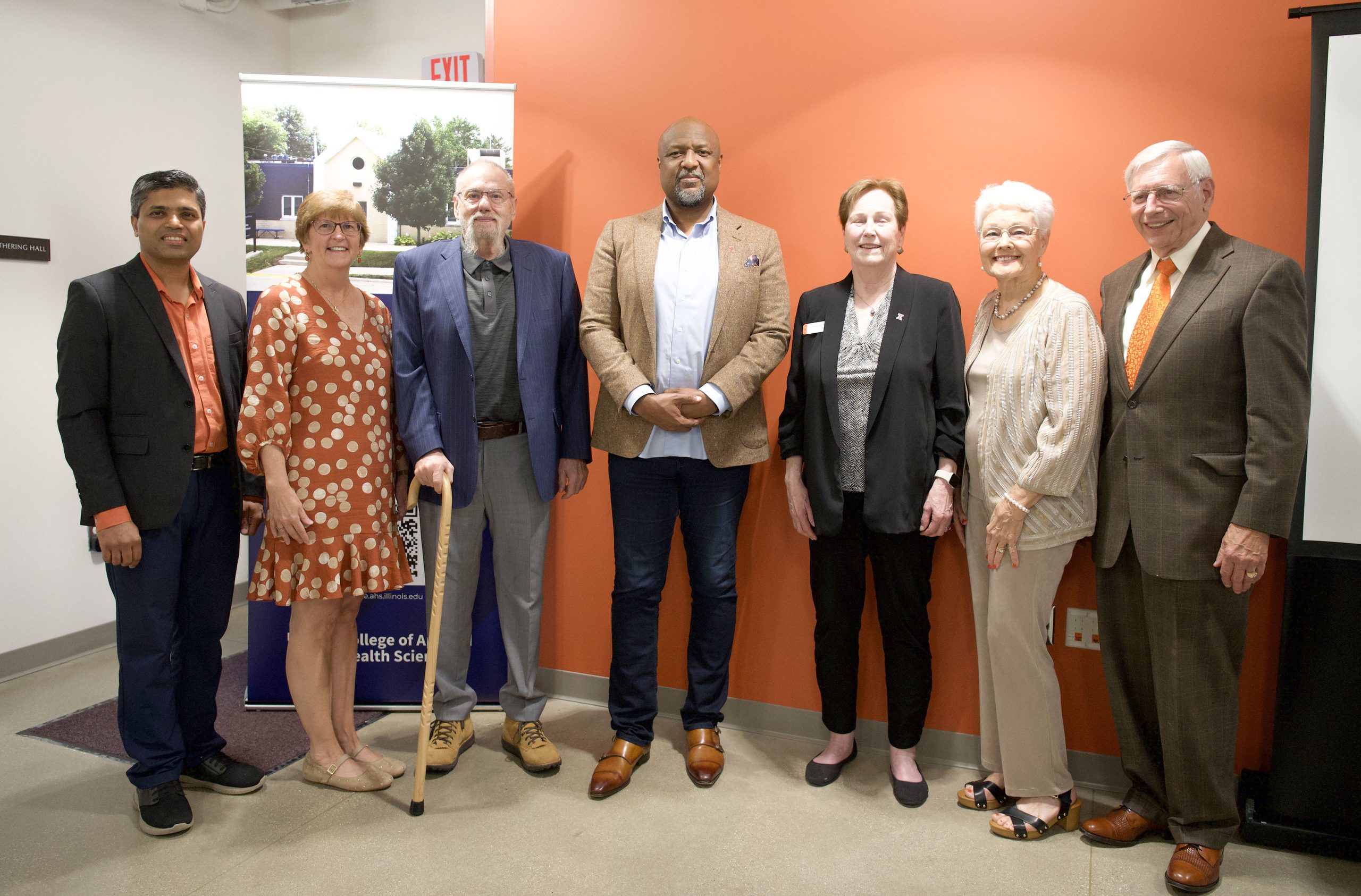
Dr. and Mrs. McKechnie celebrated all of the MS-HT students’ accomplishments at the luncheon and poster session. They were especially proud of the work of Deshpande and Komrska, who were recipients of the 2021-2022 James and Karen McKechnie Fellowship in Applied Health Sciences.

Editor’s note:

To reach Vince Lara-Cinisomo, email vinlara@illinois.edu.
 

Share on social

Related news

Illinois part of team receiving $14.7M grant to study emerging tech for older adults


University of Illinois Professor Wendy Rogers—of the Dept. of Kinesiology and Community Health within the College of Applied Health Sciences—is the principal investigator for the Illinois site. Co-investigators include Raksha Mudar of the Dept. of Speech and Hearing Science, Dan Llano of the Dept. of Molecular & Integrative Physiology, and Avinash Gupta and RS Sreenivas, both of the Dept. of Industrial & Enterprise Systems Engineering.  “One of the most exciting aspects of the Illinois engagement is the breadth of our involvement, representing four departments across three colleges,” Dr. Rogers said. “Such interdisciplinarity is critical for advancement in technology designed to support older adults.”  

Weill Cornell Medicine, Florida State University, and Illinois are the lead universities on CREATE, a multi-institutional, interdisciplinary center. The research will focus on employing emerging and existing technologies to promote wellbeing, quality of life and independence for diverse populations of older adults, and to provide support for older adults with cognitive impairments.

Initially funded in 1999, the goal of CREATE is to ensure that older adults can use and realize the benefits of technology for improving daily living. Through the four previous funding cycles of CREATE, the landscape of aging and technology has changed dramatically. 

Given that age is a significant risk factor for cognitive impairments such as mild cognitive impairment (MCI) and Alzheimer’s Disease/Alzheimer’s Disease Related Dementias, CREATE V will expand its target populations to include older adults with MCI and involve three integrated cross-site projects. With a focus on enhancing cognitive health, social engagement and preventing cognitive impairment, the first study will look at how virtual reality technology can be used to foster cognitive and social engagement among aging adults. 

It will be one of the largest randomized controlled trials of virtual reality in home settings. Preliminary development and testing will be conducted at the McKechnie Family LIFE Home on the Illinois campus.

Share on social

Related news

Freer Hall, Makeover Edition


In January 2015, the University of Illinois Board of Trustees approved campus funding for the College of Applied Health Sciences’ plan to renovate the north wing “to develop needed spaces that directly support the long-range vision for the Department of Kinesiology and Community Health and the College of Applied Health Sciences at Urbana-Champaign.”

After delays attributable to COVID-19, Freer’s renovation reached what was called “substantial completion” in November 2020. Unfortunately, the pandemic got in the way of a fancy grand re-opening, but the building is now in heavy use thanks to the full return to campus this fall.

The highlight of the renovation is the multipurpose testing and research facility that occupies the first floor of the former pool wing. Described as an “historic renovation” by Dr. Amy Woods, a professor in the Department of Kinesiology and Community Health, the project significantly enhanced the department’s teaching, research, and outreach missions.

The pool building at UIUC’s historic Freer Hall was repurposed to capture much-needed space for the College of Applied Sciences. The renovation provides infrastructure for advanced testing research facilities, including modular and adaptable dry test labs and a wet lab. Newly created classrooms and offices are part of the program. Although the central feature looks like a fitness center, it is actually a first-of-its-kind, interdisciplinary research laboratory to study health, rehabilitation, and human movement.

The long-awaited completion of the renovation brought new life and purpose to one of campus’ most stately academic buildings.

Editor’s note:

To reach Vince Lara-Cinisomo, email vinlara@illinois.edu.
 

Share on social

Related news

Allen receives NIH grant to study and combat rise of IBD


In 1999, an estimated 1.8 million adults in the United States had inflammatory bowel disease (IBD), according to the Centers for Disease Control. By 2015, that number had risen to 3.1 million. Not only are incidences of IBD rising, but the costs associated with treating IBD have soared as well. According to a study published in 2019 in the journal Inflammatory Bowel Diseases, patients with IBD incurred a greater than three-fold higher direct cost of health care on a per-annual basis, compared with non-IBD controls ($22,987 vs $6,956 per-member per-year paid claims) and more than twice the out-of-pocket costs ($2,213 vs $979 per-year reported costs).

Statistics like those above are why researchers such as Assistant Professor Jacob Allen of the Dept. of Kinesiology and Community Health in the College of Applied Health Sciences at Illinois are working to determine a way to prevent IBD and other conditions caused by mucosal dysfunction. Allen received a $3.8 million grant from the National Institutes of Health (NIH) in July 2022 for his project titled “Role of epithelial ROS signaling in mediating psychological stress-induced mucosal dysfunction and colitis predisposition.”

In his grant application, Allen wrote, “exposure to psychosocial stressors increases the likelihood of developing IBD in genetically predisposed individuals, implicating a brain-gut axis in the IBD etiological framework.” His preliminary data “indicate(d) that the reactive-oxygen species (ROS)-generating capacity of intestinal epithelial cell (IECs) may be the most proximate causes of stress-induced dysbiosis and mucosal disruption.”

“If you look at inflammatory bowel disease rates over the past 30 to 40 years, you see an exponential rise in IBD rates, which is obviously problematic,” Allen said. “But also they’re often relapsing, remitting diseases, meaning that if you have IBD, you often will have periods of flares, symptoms, followed by periods of remission where you don’t have symptoms, which makes it kind of a unique type of disease in that way in that it’s a recurring disease. What we’re learning is that there are certain things that cause the recurrence, including diet, but also relevant for this grant, psychological stress can drive recurrence of disease flares.”

According to the Crohn’s and Colitis Foundation, the costs associated with people missing work, treatments, and  medical costs that are indirectly associated with having IBD ranges from $30 billion to $50 billion annually.

As Allen explains, IBD consists of two major diseases in humans—Crohn’s disease and ulcerative colitis. They’re slightly different in their etiology, he said, meaning that the symptoms are a little different and they arise at different points in the intestine. Crohn’s disease usually arises in the small intestine and moves down to the colon, whereas colitis is generally focused in on the colon, located in the distal bowel region.

“Finding the mechanisms underlying why the disease occurs and then also what causes flares and what causes recurrence is also important,” he said, “and so that’s kind of the big picture goal of why this is an important thing to study.”

In his grant application, Allen cites “an emerging line of work has established that stress-induced disruptions to the gut microbiota may be the most proximate cause of stress-induced IBD predisposition.” Researchers in Allen’s lab found that a mouse-adaptive pathogen was more effective at inducing colitis in mice colonized by a microbiota from mice exposed to a chronic social defeat stressor.

Additionally, they found that stress exacerbates chronic colitis.

“We think that essentially comes down to a disrupted communication between the microbiome and the host immune system,” he said. “And what happens is that the adaptive immune system, which recognizes certain bacteria and can attack those bacteria, is disrupted to some degree with IBD. It’s thought to be similar to (but not the same as)  classical autoimmune diseases, whereby T cells and B cells start to mistakenly attack our own cells. However, with IBD, it appears that the immune system develops abnormal inflammatory reactions to our endogenous microbiota.” What sets off this reaction, however, is not fully understood. Allen and his team hypothesize that excessive production of stress hormones may be one of the key factors underlying IBD predisposition.

Allen explains that the body and bacteria, under normal circumstances, under a healthy condition, live in homeostasis. However, when people experience high levels of psychological stress, Allen said, that communication pathways get shut down. That can lead to mucosal dysfunction, through which diseases such IBD can occur, as well as food allergies and other gut-related conditions.

“Certain bacteria bloom in response to psychological stress that aren’t necessarily good. They start to break down what we call the mucosal barrier—a line of mucus that lines our colon and protects the cells,” he said.  “Understanding how the hormone interacts with epithelial cells or what bacteria are doing to actually degrade the mucus, that kind of stuff will give us targets that we can then look at for potentially modifying with pharmaceuticals or others that would limit IBD. So that’s kind of the big picture goal.

“We want to get back to that balance of where the microbes and our cells live in harmony. But we have to understand the mechanisms behind what happens or what goes wrong in the first place for us to do that.”

Editor’s note:

To reach Vince Lara-Cinisomo, email vinlara@illinois.edu.
 

Share on social

Related news

Clinic helps wheelchair users adjust their ride


That’s the mission of the Illini Wheelchair and Scooter Clinic on the campus of the University of Illinois. The clinic is the creation of Laura Rice, an associate professor of Kinesiology and Community Health within the College of Applied Health Sciences.

The clinic began as a labor of love for Rice.

“Prior to the formal clinic, I was helping students on campus if they needed a new wheelchair, kind of just through DRES (Disability Resources & Educational Services) helping them out, but nothing was really formalized because I just didn’t have time,” said Rice, who is also interim director of the Master of Public Health (MPH) and Master of Health Administration (MHA) programs and associate director of the Center on Health, Aging, and Disability (CHAD).

[When I first moved to Illinois] “I had a 50 percent appointment at DRES, but it was helping out Jeanette Elliott, the physical therapist there,” Rice said. “Then I moved into a tenure track position and I needed to focus my time and effort on research. When I did get promoted, this was a nice opportunity where I had a bit more space to go back to that model. That’s why I started trying to formalize the clinic.”

The idea of a clinic came out of Rice’s previous work in Pittsburgh.

“I did work at a large seating clinic at the University of Pittsburgh. I felt that my interactions in the clinic with end users was really important to fuel my research. And then I also could help support the clients better because I had a strong research background,” she said.

The Illinois clinic has been open for approximately one year, operating out of Freer Hall on the Urbana-Champaign campus. The clinic helps clients select a piece of assistive technology, primarily a wheelchair or a scooter, to help them go about their day-to-day life, whether that’s going to class, going to work, or engaging with friends and family. 

“We really try to provide that support so that they can do the activities that they like and they need to do in everyday life,” Rice said.

The Wheelchair and Scooter Clinic is small, and students in the MHA program help Rice with clinic policies, working with clients and helping with billing.

“We’re not part of a large health care system,” Rice said. “The (client) can contact me, and then I work with them. It’s on campus, especially for students, they don’t have to try to figure out transportation to an off-campus location. The majority of people that I work with are people in need of new devices. I’ll talk to them, we’ll do an evaluation. I work with a wheelchair vendor. An example is like, you go to a doctor, he prescribes you a medication, but he doesn’t actually give you the pills. You go to CVS to get the pills. That vendor is the one who provides the actual device in consultation with me, making those recommendations and the person’s physician, ultimately.”

After the chair arrives, Rice and her assistants help make sure it fits the client and makes sure they have proper training.

For Rice, the clinic is the culmination of marrying her research to her work as a physical therapist.

“I really wanted to be able to step back and kind of really look at like, ‘Why am I doing these things? And how can we improve?’ Because, especially for individuals with disabilities, there’s really a lack of research on different ways to support quality of life and community participation. So that is why I got into research was to have that opportunity to better understand the needs of clients I would like to serve and be able to implement those ideas.”

To contact the Wheelchair and Scooter Clinic, email wheelchair-clinic@mx.uillinois.edu.

Editor’s note:

To reach Vince Lara-Cinisomo, email vinlara@illinois.edu.
 

Share on social

Related news

College of Applied Health Sciences
110 Huff Hall
1206 South 4th Street
Champaign, IL 61820
(217) 333-2131