McKechnie Family LIFE Home opening a milestone for Wendy Rogers


Jim and Karen McKechnie are the primary donors for the McKechnie Family LIFE Home

Even for someone as accomplished as Kinesiology and Community Health Professor Wendy Rogers, the night of Oct. 7 represented a milestone.

Rogers has so many appointments and affiliations—she is a Khan Professor of Applied Health Sciences; she directs the Collaborations in Health, Aging, Research, and Technology, or CHART, initiative in AHS; the Health Technology Education Program, which offers a one-of-a-kind master’s degree in health technology; and the Human Factors and Aging Laboratory—that during her introduction for the dedication of the McKechnie Family LIFE Home on Oct. 7, College of Applied Health Sciences Dean Cheryl Hanley-Maxwell had to pause and catch her breath.

But with all the federal funding Rogers has received and the collaborations she’s sparked, the McKechnie Family LIFE Home holds a special and unique place for her.

The McKechnie Family LIFE Home is a cutting-edge research center focused on innovations in home environments. This facility mimics existing home dwellings as well as provides space for the development of next generation smart homes that would allow people of all ages and abilities to live fuller, healthier, and autonomous lives.

“I am delighted that the name of the facility is the Family LIFE Home because that is what home is all about—family,” Rogers said during the dedication ceremony. “Family has always been at the heart of my life and my work. I am the youngest of six children. I grew up in a small house in Massachusetts—we had eight people in a three-bedroom home with one bathroom—imagine that. We had no choice but to be close.”

Rogers said that of her inspiration for creating a facility such as the LIFE Home is that because of the support of her and her siblings, her parents were able to continue living until their final days in the family home.

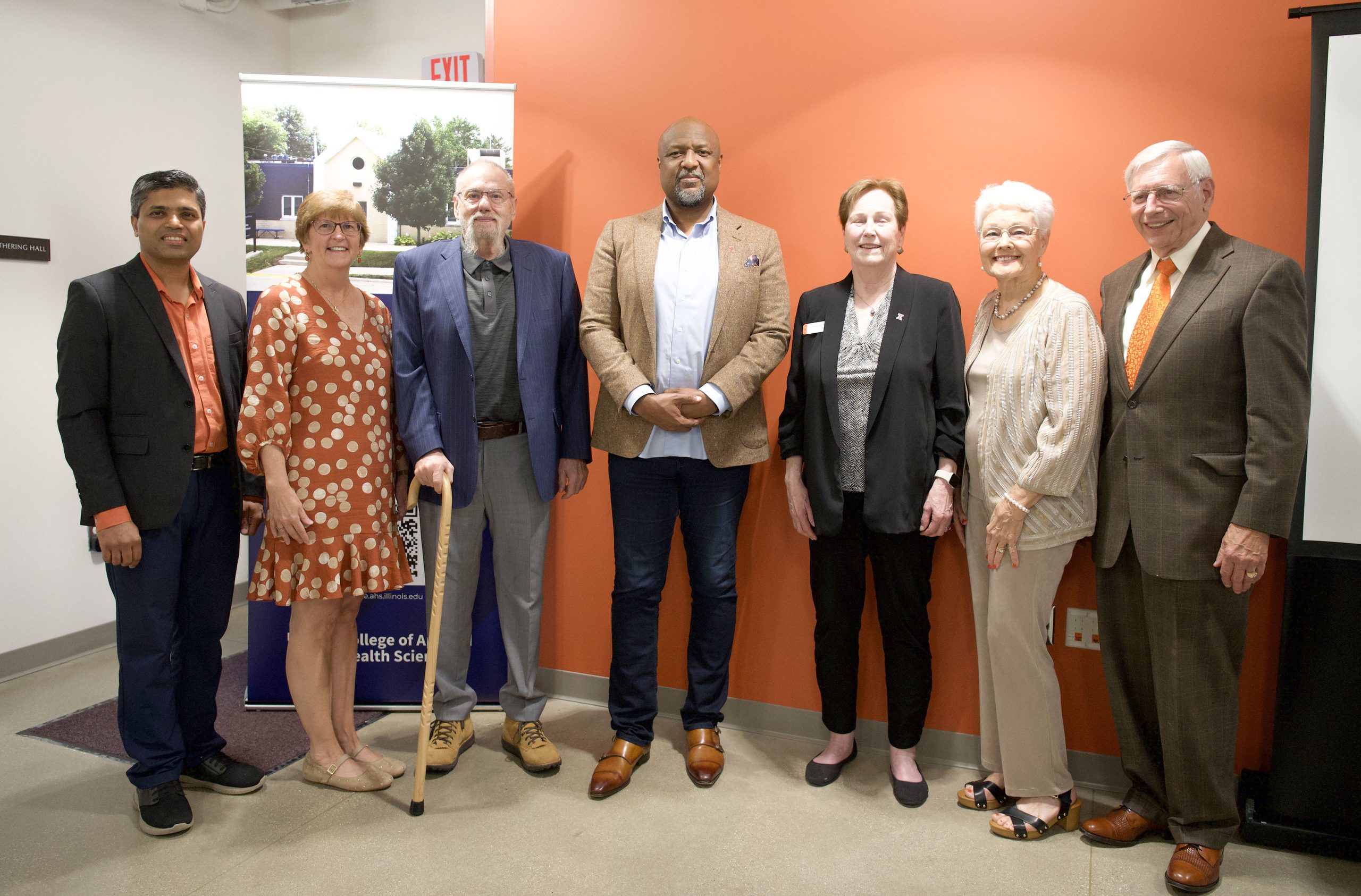
“I remember when my Dad was near the end of his life (back in 2005) and we were all coordinating his care, he said to me, “We need more of that smart technology of yours,”’ Rogers told attendees of the dedication ceremony, which included University of Illinois Chancellor Robert Jones and Jim and Karen McKechnie, the primary donors of the LIFE Home.

“After he died and my mom, was alone we certainly relied on technology tools to remain connected with her and to provide the support she needed,” Rogers said.

That is Rogers’ goal for the McKechnie Family LIFE Home.

“Our vision is to develop technologies that can support quality of life in the home for everyone, people of all ages and abilities. We want to think about all of the activities that occur in the home from fundamental activities of daily living such as bathing, eating, mobility through to the enhanced activities of daily living such as social engagement, community participation, and lifelong learning.”

For Chancellor Jones, the opening of the facility was the culmination of what the university sought in bringing Rogers aboard.

“Professor Rogers, in some ways, today marks the completion of a full circle for the two of us,” Jones said. “I had the honor of speaking at your investiture ceremony just a few months after I came here to Illinois. You were recruited here under one of the initiatives laid out in the university’s Visioning Future Excellence strategic plan. And now, just four years later, we can draw a bright and clear line from that starting point to today’s dedication of the McKechnie Family LIFE Home.”

To an observer, the LIFE Home looks like someone’s home: it has two bedrooms, a bathroom, an open-concept kitchen—we all know, thanks to HGTV how popular that is these days—a living room, dining room and even some green space outside. But the LIFE Home is foremost a research facility. The site is available for use by researchers from within and outside the university, or for collabortions with companies who want to use the facility to conduct research and test new products.

You can find more information about the McKechnie Family LIFE Home here.

“It is a space in which researchers from across the campus, industry partners, healthcare providers, and community stakeholders can come together to develop and test technologies that support all dimensions of healthy, socially connected, independent living,” Dean Hanley-Maxwell said.

Chancellor Jones praised the McKechnies for their generosity and said, “I don’t think there are any more visible examples of the impact of private investment in public universities. These gifts are direct investments in ideas and in human potential. They are feeding the true heart of this college and this university.”

And as much as the dedication ceremony of the facility proved to be a key step, Rogers said there was much still to do.

“It really has been a labor of love –we are all passionate about improving people’s quality of life and believe in the potential of this space to support that mission. This is only the beginning.”

Editor’s note:

To reach Vince Lara-Cinisomo, email vinlara@illinois.edu.
 

Share on social

Related news

McCristal Lecture Focuses on Robots


Wendy Rogers at the 2021 McCristal Lecture.

Living independently requires the ability to perform what are called Activities of Daily Living, or ADLs. Fundamental ADLs include things such as bathing, eating, getting dressed, and so on. Instrumental Activities of Daily Living, or IADLs, include more complex activities such as paying bills, preparing meals, managing medications, and the like. In 1998, Dr. Wendy Rogers, Khan Professor of Applied Health Sciences, defined a third level of Activities of Daily Living that she called Enhanced Activities of Daily Living, or EADLs. Activities such as volunteering, taking part in community activities and engaging in hobbies enhance the quality of our lives.

Dr. Rogers, the 2021 King McCristal Distinguished Scholar in the College of Applied Health Sciences, focused her McCristal Lecture on designing robots that support successful aging related to the different kinds of activities. The lecture took place at the Fall College Meeting on August 17.

A world renowned scholar in the area of human factors and aging, Dr. Rogers has been collaborating on research related to human-robot interaction for more than 10 years, going back to her days as a professor of psychology and a principal investigator in the NIH-funded Center for Research and Education on Aging and Technology Enhancement at the Georgia Institute of Technology. Since joining AHS in 2017, she has conducted research under the auspices of the Collaborations in Health, Aging, Research, and Technology, or CHART, initiative, and also directs the recently opened McKechnie Family LIFE Home, where much of the research on health and wellness robots takes place.

When designing robots for successful aging, she said, it is important to consider the entire system. “We need to consider the characteristics of the human—their demographics, abilities, attitudes, and experiences,” she said. “We also need to think about the characteristics of the robot. What does it look like? Does it have a personality? What are its capabilities and functionalities? To what degree is it autonomous or being controlled?”

Developers also need to consider the characteristics of the task the robot and human are trying to do together, things such as how critical the task is, and whether it requires the robot and human to be co-located. Finally, the context of the interaction must be considered, whether the task is home-based or in a public setting, for example.

Dr. Rogers and her colleagues currently are investigating usability and other issues related to a robot developed by Hello Robot called Stretch. “We’ve been doing task analyses and prototyping different types of devices that Stretch could have at the end of its arm to perform different tasks, and comparing different types of control interfaces and control by different users,” she said. University of Illinois students soon will have the opportunity to participate in a competition in which they generate ideas for using Stretch to help people aging with long-term disabilities. The prize will be time with Stretch in the LIFE Home to further develop their ideas, guided by the LIFE Home’s expert staff.

Other Illinois research related to health and wellness robots includes designing socially assistive robots, robots with soft rather than rigid arms for telehealth applications, and robots that provide wayfinding assistance to individuals with visual impairments.

“We have made huge advancements in robotics in the last decade,” Dr. Rogers said, “but there’s still a lot more to be done.” And, she concluded, the McKechnie Family LIFE Home positions scholars at the University of Illinois really well to explore some of those questions.

Related news

Grant permits interdisciplinary research team to explore how soft robots can support healthcare


The McKechnie Family LIFE Home is a cutting-edge research center focused on innovations in home environments.

An increasing number of older adults live independently but have health conditions that must be managed—both chronic and acute. A grant awarded to an interdisciplinary team including KCH Professor Wendy Rogers aims to investigate some solutions to those issues.

Rogers will be working with Professor Girish Krishnan, an assistant professor in The Grainger College of Engineering, and Dr. Robert Riech of OSF HealthCare on a newly funded $74,086 grant from the Jump Applied Research through Community Health through Engineering and Simulation (ARCHES) program of OSF HealthCare.

The main objective of the one-year project is to explore the potential for soft robots for telehealth monitoring of older adults.

Soft robots, for the uninitiated, are composed of soft, elastic materials and offer unique opportunities in areas in which conventional rigid robots are not viable; for example, for drug delivery, non-invasive surgical procedures, as assistive devices, prostheses or artificial organs.

The project will have two prongs in the next year: first, there will be the design and building of a soft robot with a camera that can navigate toward a wound or other area of an older patient.

Krishnan has already built some soft robotic actuators known as Fiber Reinforced Elastomeric Enclosures (FREEs). The robots can achieve different motions such as bending, contraction and axial rotation.

The researchers plan to investigate a technique known as visual servoing, by which the robot can position its arms near a wound or a predetermined area, guided by visual feedback from the camera; the second aim involves exploring the needs of those who will interact with the robot, specifically healthcare providers and older adults.

Researchers plan to interview the healthcare providers to identify the cases in which the robots would be commonly used. They willl also interview older adults to determine how to build trust between them and the robots with which they will interact.

The interactions will take place in the new McKechnie Family LIFE Home on campus, Rogers said. The home simulation space will be used to enable older adults to interact with the robot prototypes. The video capabilities and remote access lab in the LIFE Home will also support the simulation of telehealth contexts for the healthcare providers to assess the utility of the prototypes.

If successful, the use of soft robotics for older adults through telehealth could disrupt the market as a cost-effective and safe alternative to more-costly health care. Additionally, the robots could be fitted with a gripper that could help older adults with daily activities such as reaching into kitchen cabinets, loading dishwashers and searching for lost items.

Editor’s note:

To reach Vince Lara-Cinisomo, email vinlara@illinois.edu.
 

Share on social

Related news

Study suggests that social engagement technology has the potential to broaden older adults’ social networks


OneClick.chat, a video chat platform, announced positive outcomes in the study of older adults, with and without mild cognitive impairment (MCI), who used their video chat technology to engage in social activities to meet new people of all ages with shared interests. Some of the participants’ favorite topics of conversation were books, health, family, and exercise. The results of this study were published in Gerontechnology, the official journal of the International Society for Gerontechnology.

OneClick.chat, a web-based video chat platform that provides users with easy, accessible ways to connect with others, partnered with Drs. Wendy Rogers and Raksha Mudar in the College of Applied Health Sciences at the University of Illinois Urbana-Champaign to conduct a three-phased study to examine experiences, attitudes, and preferences of video chat systems, particularly the OneClick video chat platform, among older adults with and without MCI. It also evaluated and optimized the OneClick.chat platform to accommodate the interests, abilities, and usability concerns of older adults. These objectives were accomplished in three phases:

  • Phase 1 examined older adults’ experiences with well-known video chat systems (e.g. Skype, Facetime), their attitudes toward video chat in general, and to OneClick.chat specifically, and their preferences on how they would like to use OneClick.chat.
  • Phase 2 worked to identify potential usability problems with the OneClick.chat platform through experiential evaluations conducted by experts with knowledge of human factors, aging, and MCI. The OneClick.chat platform was then optimized based on Phase 1 and Phase 2 findings.
  • Phase 3 participants interacted with the optimized OneClick.chat platform over a period of four weeks in their own homes. They gave feedback on their attitudes toward the improved system and their opinions about using the system for real conversations.

The study provided valuable and novel insights from participants about their experiences and preferences for using video chat systems, as well as understanding their perceived ease of use and technology acceptance. Overall, participants found the OneClick.chat platform useful and easy to use. This process also showcased how technology for older adults can be developed by engaging them in the iterative design process. Importantly, this study will provide insights, not only for the design of OneClick.chat, but more generally for the design of technology-based social engagement platforms for older adults with and without MCI.

“Older adults are at increased risk of social isolation and loneliness due to significant life changes, including retirement, restricted mobility – and now with the global pandemic putting older adults in isolation—we fear this will only further exacerbate the development of chronic health conditions,” said Dillon Myers, CEO of OneClick.chat. “The results of this study help us understand from research leaders in aging and technology, how to develop the best video chat and social engagement platform for older adults. Soon we will launch version 2.0 of our platform, which will include significant enhancement upgrades as a result of this study.”

OneClick.chat will launch version 2.0 next month which will include a new video chat interface designed to maximize usability for older adults, enhanced security and data privacy features, as well as curated classes and social events for residents of senior living organizations. The Company plans to build on this research through Phase II grant funding from The Small Business Innovation Research (SBIR) program of the National Institutes of Health (NIH). OneClick.chat will partner with home and community-based organizations (CBOs) to utilize the platform in their community outreach and demonstrate improved quality of life for older adults through social activities that use technology. 

OneClick.chat will continue its study in partnership with Dr. Wendy Rogers, Director of the Human Factors and Aging Laboratory and Dr. Raksha Mudar, Director of the Aging and Neurocognition Laboratory.

“It’s critical that companies, like OneClick.chat, focus on the socialization needs of one of our most vulnerable populations,” Dr. Rogers said. “Many older adults are already at high risk of social isolation and the global pandemic continues to have a major impact on their ability to interact with family and friends or develop new social connections.”

Editor’s note:

To reach Vince Lara-Cinisomo, email vinlara@illinois.edu.
 

Share on social

Related news

AHS researchers get grant to study social engagement over video technology


OneClick’s software is similar to Zoom, but easier to use, says Wendy Rogers (Photo provided)

Never has there been a more important time to help older adults stay connected. A grant awarded to two University of Illinois researchers aims to advance that goal.

Kinesiology and Community Health professor Wendy Rogers and Speech and Hearing Science associate professor Raksha Mudar are the principal investigators of a National Institute on Aging (National Institutes of Health) Phase II Small Business Innovation Research (SBIR) grant.

The researchers are collaborating with OneClick.chat co-founder Dillon Myers on a study entitled, “Enhancing Quality of Life for Older Adults with and without MCI through Social Engagement over Video Technology.”  MCI refers to Mild Cognitive Impairment, which affects millions of older Americans.

The technology in question is OneClick video communication software along the lines of Zoom and Skype, but easier to use, Rogers said. 

“So, by definition, OneClick, you don’t have to download any software,” Rogers said. “If I want to engage somebody to participate in a meeting with me—I can send them a link. And they just click on that link, and they’re automatically into the system. And one of the things we did in our first phase was to optimize it for older adults, making sure that the icons and the language and the information that was presented was easy to understand by older adults with and without cognitive impairment.”

Myers and Rogers connected in a serendipitous manner. 

“I was interviewed on (National Public Radio) about a project we were doing,” Rogers said. “It was early stages on tele-health. And one of the comments I made was we may be able to connect people who are living alone or are at risk for social isolation to have conversations and to be engaged socially with other individuals. And Dillon Myers heard the interview on NPR and called me.”

It took about a year—“luckily he was very persistent,” Rogers said—but the two decided to work together. The original idea, which was funded by a Phase I SBIR grant, was to connect older people with and without mild cognitive impairment (MCI). Mudar got involved because of her expertise with mild cognitive impairment, and she was the lead investigator on an additional seed grant from Discovery Partners Institute that explored the use of OneClick for older adults of low socioeconomic status.

The Phase I SBIR included a small pilot study to make sure older adults with and without MCI could use OneClick on their own in their homes.

However, Phase II will be a much larger assessment, Rogers said.

“We’ll be doing a clinical trial to determine whether it actually improves social engagement and reduces feelings of loneliness for older adults, assessed for 120 participants, including people with and without MCI. Another component of the Phase II is partnering with agencies. We have three partners—Clark-Lindsey Village, CRIS Healthy-Aging Center, both in the Champaign and Vermilion County areas, and then CJE SeniorLife up in the Chicago area.”

Rogers said the work with community partners will focus on how agencies that support older adults can integrate OneClick to provide support services, and how they might find it helpful for serving their clients.

“It’s great that we have these community partners located in urban and micro-urban areas,” Mudar said. For example, within the greater Chicago area, the CJE allows us to capture the population, which is really diverse in terms of ethnic and cultural diversity. These three partners allow us to reach out to a really wide audience or a purpose-built group.”

The grant award totals approximately $1.8 million, with approximately $850,000 earmarked for the University of Illinois. The funding runs from May 1 of 2020 through March 31 of 2022.

According to research from the National Institutes of Health, social isolation and loneliness have been linked to higher risks for a variety of physical and mental conditions: high blood pressure, heart disease, obesity, a weakened immune system, anxiety, depression, cognitive decline, Alzheimer’s disease, and even death.

OneClick’s goal is to connect people with shared interests in an accessible way, thereby stimulating social connectedness, which has been found beneficial to health and quality-of-life outcomes for older adults.

Connectedness is more important than ever now as most of the globe is forced to shelter in place in the wake of COVID-19. OneClick is enabling people to sign up right now and use OneClick for free, during the pandemic, Rogers said, adding that the timeliness of this study could not be more apparent.

“Raksha and I have been interested in social engagement for older adults for quite a long time already,” she said. “And we recognize the importance of that for older adults and even more so, given today’s situation. And this technology is designed with their needs and capabilities in mind. We only wish we were even further along in some of this research so that more older adults could be using it right now. 

Mudar said one of the participants in the first study summed up OneClick perfectly.

The participant said “it’s like having a friend at the touch of a button.”

About OneClick.chat
OneClick.chat is a web-based video chat platform based in Philadelphia. The platform, designed by a cross-generational team, makes it easy for people of any age to join and participate in video-based meetings and events. No downloads, and no more logins. Just a single click from a computer/tablet/smartphone, and you’re in!
 

Editor’s note:

To reach Vince Lara-Cinisomo, email vinlara@illinois.edu.
 

Related news

AHS to launch first-of-its-kind degree


Wendy Rogers, left, and Nicole Holtzclaw-Stone were on hand Dec. 10 as the Illinois Board of Higher Education approved the new Master of Science in Health Technology program. (Photo provided)

Following the approval this week of the Illinois Board of Higher Education, AHS will welcome its first cohort of students into the new Master of Science in Health Technology (MS-HT) degree program in the fall of 2020.

The degree, designed to advance applied health technology design and implementation, resulted from an “Investment for Growth” proposal submitted to the campus by AHS and the Grainger College of Engineering. It fills a void in the development of a workforce in the increasingly important areas of health technology and human factors, which addresses such issues as ergonomics, product design, and human-computer interaction.

Dr. Wendy Rogers, Khan Professor of Applied Health Sciences, will serve as director of the Health Technology Education Program. Dr. Nicole Holtzclaw-Stone will serve as Assistant Director.

At the first meeting of the MS-HT advisory board, Dr. Rogers shared findings of comprehensive research conducted by Illinois Business Consulting (IBC) and a survey she and Dr. Holtzclaw-Stone developed to assess the need and interest for such a program.

“Through surveys, focus groups, and cold calls to industry, IBC found that there are no existing master’s programs in health technology, either within the United States or internationally,” Dr. Rogers said. “Moreover, interest in this degree is high at both the undergraduate and graduate levels.  In our survey of 65 industry experts in health technology, 92 percent said the degree would be valuable.” That same survey revealed that 65 percent of respondents thought it was likely that their organization would be interested in hiring the program’s graduates. One industry respondent summed it up by saying, “There is a dire need for this unique program in the healthcare industry.”

While housed in the Department of Kinesiology and Community Health, the MS-HT is a collaborative effort with the Grainger College of Engineering, primarily the Department of Industrial and Enterprise Systems Engineering. Other collaborating departments in engineering include Mechanical Engineering, Electrical and Computer Engineering, Bioengineering, and Computer Science, as well as the Departments of Speech and Hearing Science and Recreation, Sport and Tourism in AHS.

Related news

Rogers, Mudar receive $4.6M grant to establish center focused on older adults with cognitive impairment


The University of Illinois is part of a team receiving a $4.6 million grant aimed at helping adults with cognitive disabilties deal with challenges associated with everyday activities.

The grant from the National Institute on Disability, Independent Living, and Rehabilitation Research runs from Sept. 30, 2019 to Sept. 29, 2024 and is a collaborative effort with Weill Cornell Medicine and Florida State University, with Illinois’ share amounting to approximately $1.4 million.

Kinesiology and Community Health professor Wendy Rogers and Speech and Hearing Science associate professor Raksha Mudar are the principle investigators on the research for Illinois. Harshal Mahajan, assistant research professor of Kinesiology and Community Health, is also an investigator on the project.

The funding is for a Rehabilitation Engineering Research Center entitled ENHANCE (Enhancing Neurocognitive Health, Abilities, Networks, and Community Engagement).

Rogers and Mudar said the primary research aims are to understand challenges adults with cognitive disability deal with every day, and to identify existing and emerging technology that can help. Three segments of the population are part of the study group: Adults 60 and older with mild cognitive impairment, cognitive impairments due to stroke and those who have sustained a traumatic brain injury.

“What we’re trying to do is understand the challenges that they experience in their daily activities,” Rogers said. “In one study, we’ll be interviewing them about what they do outside the home, what they do around the home; shopping, transportation, health, finances and then just basic daily activities, such as mobility and medication regimen.”

Rogers said the study’s participants will include both the the individuals with cognitive disability as well as their family members who provide support and care. They will be exploring whether needs change over time, with interviews repeated across the five-year project.

“Really, we’re trying to get an understanding in general of people with cognitive disability on an everyday basis, what kind of challenges are they experiencing and how might we design technology to support that.”

Another goal is understanding what this population uses in terms of current technology to mitigate their impairments.

One of the projects, Rogers said, involves helping adults with cognitive disability use Google Maps and rideshare apps, through additional instructions and support, which could include an app on their phone that walks them through steps, or a video that illustrates what to do and helps them as they learn.

Mudar explained that they also plan to engage healthcare providers and the technology industry in hopes of developing partnerships.

Editor’s note:

To reach Vince Lara-Cinisomo, email vinlara@illinois.edu.
 

Share on social

Related news

College of Applied Health Sciences
110 Huff Hall
1206 South 4th Street
Champaign, IL 61820
(217) 333-2131