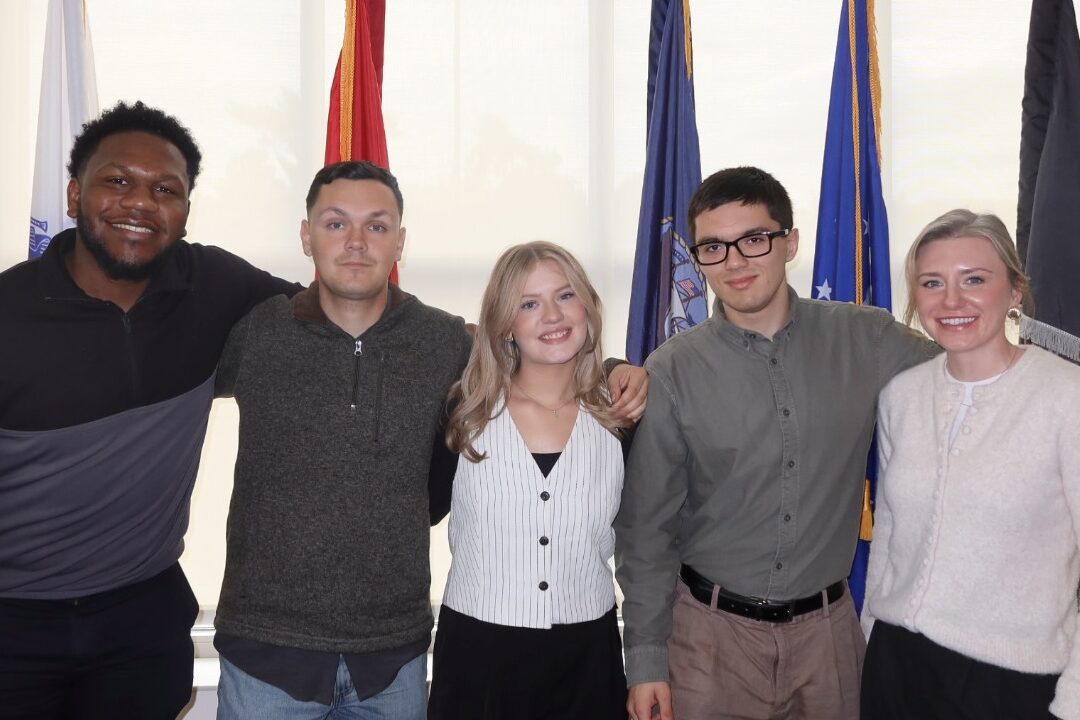
Andrew Bender served in the U.S. Army and reached the rank of lieutenant colonel (Photo provided)
Andrew Bender has been hired as Director of Operations at Chez Veterans Center, effective July 1.
Bender, who served in the U.S. Army and reached the rank of lieutenant colonel, comes to Chez from the University of Illinois Urbana-Champaign Career Center, where he has been serving as the associate director for operations and strategic initiatives. Prior to coming to Illinois, Bender worked as a workforce development manager for the McLean County Chamber of Commerce, and an operations manager and learning and development manager for Amazon.
“I am humbled and deeply honored that AHS has given me the privilege to join the Chez Veterans Center team,” Bender said. “I embrace the opportunity to continue my service supporting the men and women who have given so much to our nation. I cannot wait to come on board and work with the fantastic AHS and Chez team to create a better place for our veterans and military-affiliated students.”
Bender steps into the role that has been served for the past four years by Dr. Reggie Alston, the associate dean for academic affairs in the College of Applied Health Sciences.
Bender also served as the chair of and professor in the Department of Military Science at Illinois State University’s ROTC program. In his time in the U.S. Army, Bender served in a variety of administrative roles, most recently as the Chief of Staff/Deputy Commander of the Joint Communications Unit at Fort Bragg, N.C.
Apsan Bishwokarma looks over notes in a Warrior-Scholar Project class, hosted at the Chez Veterans Center. (Photo by Ethan Simmons)
While Adam Sherman Jr. sat for the two-hour bus ride from Chicago O’Hare Airport to the University of Illinois Urbana-Champaign campus, a pit was forming in his stomach.
He’d spent six years in the Navy, stationed in Japan and California for three years apiece, sometimes working out at sea for six or 12 months at a time. But a few preparatory problem sets for the Warrior-Scholar Project’s academic boot camp had him stumped.
“I didn’t know if I’d be able to knock off the dust and the rust to get going in this program,” said Sherman, who grew up in New Jersey.
After spending four days in the camp absorbing astronomy and physics lectures from University of Illinois faculty at the Chez Veterans Center, Sherman’s first taste of higher education was going “really smooth,” he said.
“They broke it down in a way that’s really digestible, and they’re building it up in a way where it’s really fast-paced, but it’s comprehensible,” he said.
This July, 15 student Veterans took classes and teamed up on projects in the Chez Veterans Center, the University of Illinois’ one-stop shop for military-connected students. The center has hosted the nonprofit Warrior-Scholar Project for the three consecutive years.
The Warrior-Scholar Project, or WSP for short, takes place in college campuses across the country as an eight-day higher ed experience for military Veterans of all ages.
The WSP and Chez Veterans Center’s missions are aligned—both are dedicated to easing the transition of military-connected students back into education and civilian life.
“The premise of WSP is really about showing them they can do it, giving them the confidence they can leave the military and go to a place like the University of Illinois,” said Chez Veterans Center Director of Operations Andy Bender.
“I think what’s great for us in particular is (WSP) follows our mission. We’re all about the successful transition from the military into higher education—this is a good steppingstone for it. But it also gets a lot of our campus partners who may not have connections to the military to come and meet these students.”
WSP Education Programs Coordinator Rebecca Mills called Illinois’ Chez Veterans Center one of the program’s “top campus stakeholders,” for going “above and beyond” for student cohorts. A core component for both organizations: Showing Veterans that the talents they’ve built in the service are transferable to the classroom.
“It’s less the content—we know they’re capable, we know they have the experience. But how do they use the skills they developed in the military to be successful in higher ed?” Mills said.
A whopping 88 percent of Warrior-Scholar Project alumni have either obtained a college degree or are on track to complete one (Photo by Ethan Simmons)
Some students, such as Sherman, enter the Warrior-Scholar Project with no college credits. Others, such as Sergio Perez Jr., a 26-year-old Marine Corps veteran from Oklahoma, used WSP to re-familiarize himself with the pace of university life.
When he left the service in October 2023, he “had one goal in mind: and that was to go back and finish my degree,” he said.
“For me, WSP was a ‘two birds with one stone’ type of deal, because University of Illinois was actually one of the schools I’m thinking about applying to in the future,” Perez added. “When I saw they still had openings for this, I thought, ‘You know what? I can do a quick campus tour while still self improving.’ So this has given me a better understanding of how this campus functions.”
A whopping 88 percent of Warrior-Scholar Project alumni have either obtained a college degree or are on track to complete one, according to their internal statistics. This year, Illinois also hosted WSP’s annual alumni conference, where bootcamp graduates return to network and listen to industry professionals with military connections.
A Veteran careers panel discussion included Mona Dexter, Comcast’s vice president of Military and Veteran Affairs; Michael Pett, Uber’s head of Military and Veteran Programs at Uber; Erica Jeffries Purdo, vice president of Strategy and Operations at Johnson & Johnson; and Tommy Jones, senior director of Military and Talent Programs at Walmart.
During the campus visit, the student cohort got to tour Research Park businesses such as Caterpillar’s Innovation Center and Hourglass Medical, a wearable technology company. Before they left campus, Chez staff brought them to a celebratory visit to the Colonnades Club in Memorial Stadium, itself a tribute to U. of I. veterans who fought in World War I.
“Illinois might be one of the best-kept secrets in higher ed; You walk into a building and learn about a Nobel prize winner who invented something you use every day,” Bender said. “We’ve had a couple people who’ve told us, ‘I wanna come here.’”
The Chez Veterans Center at Illinois serves more than 550 military-connected students
(from left) Dean Cheryl Hanley-Maxwell, Chancellor Robert Jones and Chez’s Garrett Anderson
The University of Illinois was designated Friday as a Purple Heart university, awarded the honor because of the university’s longstanding commitment to military veterans.
“This university has a tradition unlike any other that goes far beyond just remembering those who lost their lives in service,” Chancellor Robert Jones said. “This has been a place of world-changing ideas, innovations and, sometimes just plain old hard-headed determination to help those who come home to find success in their educational hopes and to lead lives and careers of impact after they earn their degree.”
Illinois was the first university to call for compulsory military training at all land grant colleges, as part of the Morrill Act of 1862, and developed the first post-secondary disability support service program in the world for Veterans. Established by Dr. Tim Nugent, this program allowed injured World War II veterans to use their GI Bill benefits for higher education.
In 2015, UIUC opened the doors at the Chez Veterans Center to provide an open, welcoming space for all student veterans and military-connected communities.
“During my tenure as dean of the College of Applied Health Sciences, I have had many opportunities to feel proud of leading such an outstanding unit. Today, that pride deepens with this truly humbling recognition by the Military Order of the Purple Heart,” said AHS Dean Cheryl Hanley-Maxwell.
“The commitment of this college and this university to helping wounded veterans pursue their degrees goes back more than 70 years, when Dr. Timothy Nugent established the very first support program in higher education for World War two veterans with disabilities. At a time when people in wheelchairs were not expected or encouraged to attend college and dream of careers, Dr. Nugent said, “Why not?”’
The Chez Veterans Center is the largest, most comprehensive facility of its kind in the United States, and serves more than 550 military-connected students.
“AHS continues to be the unwavering force pushing us forward to do more and to find new and better ways to open doors of access and success to the student-veterans who trust this university with their academic futures,” Chancellor Jones said.
The event was well-attended and VIPs included Matt Janes from the office of Congressman Rodney Davis; State Senator Scott Bennett; State Senator Chapin Rose; State Representative Mike Marron; State Representative Brad Halbrook, Champaign Mayor Deborah Frank Feinen, members of the Chez Veterans Center advisory board, and members of the Veterans Assistance Commission and Department of Veterans Affairs.