Sept. 08, 2026 | Vince Lara-Cinisomo
A new Illinois scholarship recognizes that military service reshapes whole families—and that spouses and partners have ambitions of their own
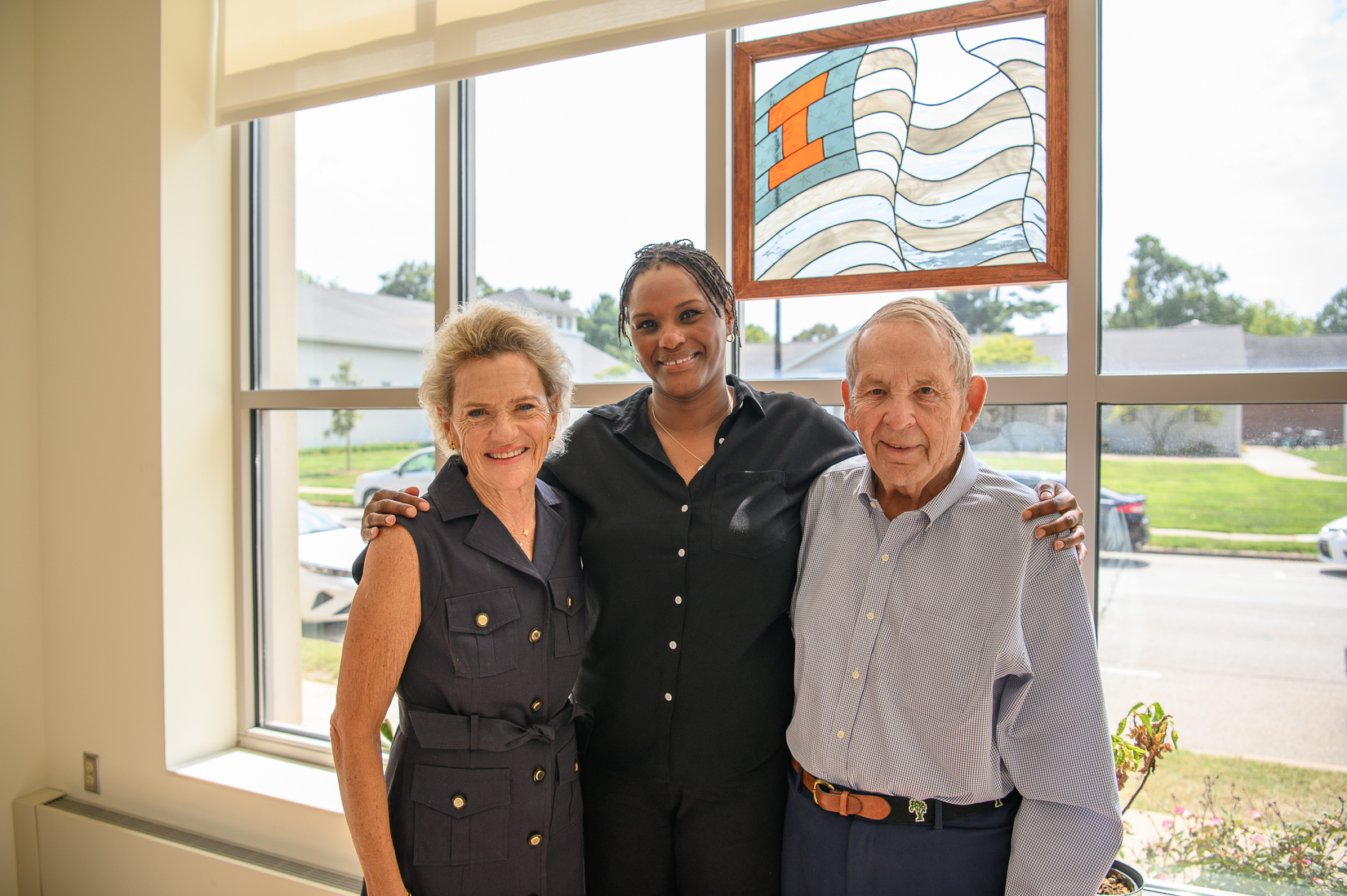
Phoebe Mbuvi had already built a career when her husband, John Goeken, arrived at the University of Illinois Urbana-Champaign to begin another one. Mbuvi had worked as a physician assistant for more than a decade. Goeken, a former U.S. Marine, enrolled in an electrical engineering program at the Grainger College of Engineering in his late 30s. His return to school prompted a question that soon became a plan: why shouldn’t she pursue a doctorate, too?
She enrolled in the School of Information Sciences. Together, they balanced two demanding academic lives with work and two very young children. Then, before Goeken could begin his final year, he died in a motorcycle accident in May 2026. He was 39, six weeks shy of his 40th birthday, Mbuvi said. Their children were 2 and 3.
The loss reordered everything. Mbuvi stepped away from employment to care for the family, but she did not want grief and financial pressure to close the door on the doctorate she and Goeken had imagined. The new Skinner Family Foundation Scholarship offers a way to keep that door open.
A family mission
Announced through the Chez Veterans Center, the scholarship is funded by Sam Skinner, a Chicago native who attended the University of Illinois before serving in the U.S. Army and going on to a distinguished career in public service as secretary of transportation and White House chief of staff under President George H.W. Bush. The scholarship supports spouses and domestic partners in military-connected families who are pursuing higher education or career training. Its focus is deliberate: the demands of military service rarely stop with the person in uniform. Careers are interrupted, moves complicate schooling and employment, and childcare can become a daily obstacle.
For Mbuvi, that understanding was central to Goeken’s own life at Illinois. He had joined the Marines in 2004, served in Operation Iraqi Freedom over multiple tours, survived an improvised explosive device blast and received a Purple Heart. After leaving the military, he came to Illinois as a nontraditional student and found a community at Chez.
“He loved the Chez Veterans Center. He spent all his time here,” Mbuvi said. Goeken served on committees and pushed others to see the web of needs surrounding a student Veteran: housing, children, childcare and a spouse’s own goals. “The Veteran can’t be the best student that they can be if they’re not being supported in other ways.”
That conviction now echoes through a scholarship his family can use. The award does more than recognize Mbuvi as someone connected to a Veteran. It recognizes her as a scholar in her own right, one whose education strengthens the family Goeken left behind.
Why spouses
The 88-year-old Skinner arrived at the same idea from another direction. Skinner’s visit to Chez showed him an organization he believed could translate a gift into tangible help.
“You associate yourself with quality people, they bring you up. The same is true with organizations,” Skinner said. At Chez, he saw a center that “got their act together” and was serving Veterans and their families in practical ways.
His concern for military spouses has also been shaped by his involvement with America’s Warrior Partnership, which helps connect Veterans and families with employment and other services. Again and again, he said, spouses absorb the cost of military mobility: a transfer can mean losing a job, surrendering professional momentum or putting education on hold.
He loved the Chez Veterans Center. He spent all his time here.”
Phoebe Mbuvi
Scholarship awardee, wife of John Goeken“They gave up a lot. A lot of them gave up education to support their spouse,” Skinner said. When a family reaches a university prepared to support them, he added, it may be the right moment for a spouse or partner to begin again. “That’s the way you impact. Little did I know that there was no one more qualified than Phoebe,” he said.
Skinner credited Andy Bender, Chez’ director of operations and services; and Jean Driscoll, the former assistant dean for advancement in the College of Applied Health Sciences, for cementing his agreement to endow the scholarship.
“Jean kept pushing us to get it done right, and I know it took a long time, but we got to the right place,” Skinner said.
The life behind the legacy
Goeken’s path made that kind of second beginning visible. Mbuvi remembers a husband and father first, a Marine second and then an engineering student who was unbothered when classmates mistook him for a professor. His age did not diminish his sense that he belonged in a top program or that he could use what he learned in public service.
He also understood how improbable the journey might have looked to people who knew his difficult early life. After his funeral, Mbuvi said, one of Goeken’s brothers told her that no one would have believed he would one day be married, raising two children and pursuing an engineering degree.
“He leaves behind a big legacy,” she said. “Lots of people have been touched by John.” She wants their children to grow up knowing the shape of that legacy: his patriotism, his belief in democracy, his devotion to family and his refusal to let an unconventional route keep him from the classroom.
Mbuvi is carrying part of that story forward each time she returns to her own studies. The scholarship cannot ease every burden military families carry, and it cannot restore the future her family expected. It can, however, protect one hard-won possibility: that her education continues.
About the scholarship
The Skinner Family Foundation Scholarship recognizes the critical role military spouses and partners play in supporting family well-being, academic persistence and the success of military-connected students. The scholarship is open to spouses of U.S. military Veterans and to spouses or domestic partners of active-duty, Reserve or National Guard service members. Applicants must have a current connection to the University of Illinois Urbana-Champaign and be enrolled in or admitted to an accredited degree-granting, vocational or technical program. Full-time, part-time, online, hybrid and returning students are eligible.
Funds may support education-related expenses, including certification and licensing fees, professional development and other qualifying costs. Recipients also join a small cohort with access to community events, leadership and professional development opportunities and ongoing support from the Chez Veterans Center. For information or to apply, visit the online application form.
Editor’s note:
To reach Vince Lara-Cinisomo, email vinlara@illinois.edu.
Share on social