Expert Q&A: Laura Rice on COVID-19, vaccinations and returning to pre-pandemic life


By July 2021, businesses had re-opened, but in-person instruction was still in question because of the pandemic (Stock image)

Q: Do you think universities should require vaccinations for in-person students?

A: The University of Illinois Urbana-Champaign, similar to other universities across the United States, are now requiring students to be vaccinated prior to returning to campus for the fall semester. Students with extenuating circumstances may request an exception from this requirement. Given the close living quarters of students and challenges associated with social distancing in residence halls, classrooms and other locations on campus, the vaccination requirement is an important component in keeping students safe and facilitating a return to normal campus life. While precautions should still be taken, vaccination is an important tool to support a safe return to campus in Fall 2022.

Q: How does the current COVID Delta spike in Missouri impact Illinois?

A: Given the increased frequency of the Delta variant in Missouri and other places in the United States, we all must continue to be vigilant in our response to COVID. All individuals should follow the recommendations of the Centers for Disease Control and Prevention (CDC) which includes getting vaccinated if you are able. If you are not vaccinated, it is critical that people continue to wear masks, social distance, avoid crowds and poorly ventilated spaces, wash your hands, and monitor your health through frequent testing. Everyone should continue to cover their mouth when they sneeze or cough and make sure that high touch surfaces are cleaned frequently. While many of us are facing fatigue adhering to COVID recommendations, it is important to continue to be vigilant and do your part to avoid mandatory quarantine requirements.

Q: How would you persuade those who oppose getting a vaccine to get one?

A: To persuade an individual who is unvaccinated to become vaccinated, it is important to make sure that the individual is fully educated about the safety of the vaccines from reliable, peer reviewed resources. For the example, the Centers for Disease Control and Prevention offers evidenced based, easy to understand information regarding vaccine safety. Unfortunately, false information that is circulating on social media and other unreliable sources is causing confusion regarding the safety of vaccines. Educating yourself, and others, from evidenced based sources is critical to understanding the safety of vaccines and making an informed choice regarding vaccination.

Q: Should people still get tested after getting fully vaccinated?

A: After an individual has been vaccinated, they should continue to comply with federal/state and local requirements regarding testing. COVID is still an evolving situation with new variants emerging frequently. Thus far, vaccines have shown to be effective against a variety of variants. However, it is critical that citizens continue to comply with rules and regulations that are implemented regarding testing as the situation is still changing frequently.

Q: Would you recommend still wearing a mask in places where large numbers gather (such as grocery stores, classrooms)?

A: An individual who is fully vaccinated should review peer-reviewed, evidenced-based literature and COVID-19 rates in their local area to make an informed choice regarding mask usage in crowded areas. Review of such information will help the individual who make an informed choice regarding mask use in this evolving situation. If you are in close contact with non-vaccinated individuals or have other medical conditions, mask use will continue to help protect you. Given the evolving nature of the situation, it is important to stay updated on current recommendations from reliable sources and comply with those recommendations.

Editor’s note:

To reach Vince Lara-Cinisomo, email vinlara@illinois.edu.
 

Related news

Alumni Spotlight—Tim Clary


Q. Why did you pick AHS?

A: In high school, I knew I wanted to be an Athletic Director/Coordinator, and AHS provided the pathway to doing that with Sports Management. 

Q: Which professors had the most impact on you?

A; Dr. (Michael) Raycraft: A personable man that would lead with honesty but connect on a level that helped you understand the intricate complexities within RST. Also, Nuno Ribeiro: he was a man that helped me a ton even after I graduated. He taught me about his life experiences and how they shaped his life in hopes it could influence mine. 

Q: What course did you most enjoy?

A: Two courses equally, both taught by Dr. Raycraft. One, Sports Management and two, Sports Ethics. 

Q: Did you enter AHS knowing your career path, or did AHS help you decide?

A: I entered knowing I wanted to be in athletics in some capacity. 

Q: What was your favorite on-campus experience?

A: Most of my time was taken up by athletics; I did appreciate the study sessions in the underground library prepping for some of the harder courses (Research Methods). 

Q: What does AHS mean to you?

A: I’m thankful for my time in AHS. Led by many wonderful professors and provided the path to achieving my goal of becoming an athletic director one day. 

Editor’s note:

To reach Vince Lara-Cinisomo, email vinlara@illinois.edu

Related news

Community Health senior Briana Aldama discusses COVID and the class of 2021


Q: Why did you pick KCH?

A: I chose it because it aligned well with my occupational therapy career path in a way that would set me up for success.

Q: Which professors had the most impact on you?

A: Jeanine Bensken taught a course I took and introduced the class to research opportunities. I then took advantage of that and met with her to see my options. I ended up being most interested in her research within the college. I learned a lot from this experience and found that she was great support for me both personally and professionally.

Q: What course did you most enjoy?

A: I enjoyed most of my community health courses but CHLH 206: Medical Ethics really stood out to me these past 4 years. I think applying your knowledge to really difficult real-life examples is hard to do, but this course really challenged each student to think in a way that allows you to professionally acknowledge what decision will provide the best outcome.

Q: Did you enter KCH knowing your career path, or did KCH help you decide?

A: I did know I wanted to do occupational therapy when entering KCH, however, I feel these courses really allowed me to gain a new perspective in a way that a good occupational therapist should.

Q: What do you hope to do after you graduate?

A: I will be attending Midwestern University to obtain my doctorate degree in Occupational Therapy. As of right now, I am keeping an open mind as to which setting I would like to work in after graduation because I find all areas within this field to be integrating in their own ways.

Q: What was your favorite on-campus experience?

A: My favorite on-campus experience was running from Foellinger to the Kappa Delta house after I opened my sorority bid. It was such a fun experience and was the beginning of the friendships made during this time.

Q: What do you miss most because of the pandemic?

A: I missed the social aspect of college. School can get intense and stressful, so I feel that social support is very important to help get through the tough times. Having people to study with and then hang out with during moments of downtime is very important and helps to keep a healthy balance for students.

Q: What are the biggest changes on campus, pre and during COVID?

A: I would say the courses were the biggest change. Before COVID students would walk to class each day and have a set time to focus on class, as well as get to know the professors well. The campus also provided great study environments that may have not been as available for students at home during this time.

Q: What would you say to recommend KCH to a prospective student?

A: This is a perfect major to get into because I felt it prepared me well for health-related issues across the board and if you are interested in the health field, perhaps these courses can even help pique an interest you didn’t even realize you had!

Editor’s note:

To reach Vince Lara-Cinisomo, email vinlara@illinois.edu.

 

Related news

Paceley receives award for excellence in graduate contacts


Andrea Paceley is ‘indispensable,’ according to nominators. (Photo by Jerry Thompson)

The Graduate College in February announced that Andrea Paceley (Office Manager, Speech and Hearing Science) was named a winner of the 2024 Graduate College Excellence Award for Graduate Contacts. The award is given annually as part of the Graduate College’s Annual Workshop for Directors of Graduate Study and Graduate Contacts. It recognizes staff members whose service has exceeded expectations in enhancing graduate students’ experiences and has positively impacted their graduate program or department’s operations.

Paceley has served as the Office Manager in Speech and Hearing Science for more than eight years. Nominators named her an “indispensable” part of the department for her streamlining of processes, commitment to transparency and “contagious cheerfulness.” One nominator said that Andrea “has demonstrated sustained excellence in support of our graduate programs, students, and faculty.” A graduate student in Speech and Hearing Science added that “her skills, kindness, and ability to navigate challenges with grace set her apart as a truly exceptional graduate secretary.”

Graduate Contacts are essential to the success of our graduate students. They welcome students into our campus community, provide valuable support through both the good and challenging times, and celebrate students’ accomplishments. The care and compassion that Graduate Contacts demonstrate every day are an invaluable contribution to the university and its community of students, faculty, and staff. The Graduate College extends its thanks to all of our Graduate Contacts for their work in our campus community.

Related news

Community Health student feels confident about return to in-person instruction


Nick Olivieri is an EMT and can give vaccines (Stock image)

Nick Olivieri is a senior in the University of Illinois’ College of Applied Health Sciences, and expects to graduate with a bachelor’s degree in community health in May. But if he was returning to school in the fall—when UIUC and many other schools are expecting to return to in-person instruction in the midst of the pandemic—he would be looking forward to it.

“100 percent,” said Olivieri, an Orland Park, Ill., native. “U of I has put on an example for the rest of the nation. I get tested multiple times a week, and if people continue to do that, I don’t see a reason why I can’t be sitting next to my fellow classmates once we all know we’ve had some negatives. People are going to get vaccinated. I don’t see why our campus can’t be back in person, and people will actually get the real U of I experience that they thought they would when they signed up to come to the school.”

Part of the reason Olivieri is so confident is that, as a licensed Emergency Medical Technician, he is eligible to administer COVID-19 vaccines. As part of his graduation requirement, Olivieri is doing an internship as a medical assistant at Frances Nelson Health Center, a walk-in clinic in Champaign, where UIUC is based.

“One of the first things they said my first day on the internship, was like, ‘OK, cool. You got your EMT license. You are eligible to give the vaccine,’” he said. “And it took a bit of asking after that. But eventually a slower day around the clinic, so one of the physician’s assistants brought me over to the vaccination clinic, and he let me do it. And only through this internship would I be able to do that, which I’m grateful for.”

Not that Olivieri—who has himself gotten vaccinated—didn’t have some hesitation about putting needles into arms.

“Well, I won’t lie. When I first was approached, asked to do it, I was a little hesitant. I didn’t have any previous experience giving shots, but I knew someone would be training me. And I’ve always learned throughout EMS that you’re only going to learn through actually doing it. You can’t overthink it.”

Most people age 16 and older in Central Illinois are now eligible for a COVID-19 vaccine, and Frances Nelson is administering vaccines to “almost anyone who asks,” Olivieri said. Still, some are naturally concerned about taking the needle or the potential side effects.

“There are cases where people get a wave of anxiety or fear,” he said. “And these people, we take them to the side and we try to calm them down by just like talking to them. Because these bad reactions, they’re very rare. But I do tell these people that I take this vaccine. And every institution worth their while in the U.S. opts for the vaccine. And I think it’s a civil duty getting it.”

In his role as an EMT and at Frances Nelson, Olivieri is an obvious choice for classmates and friends to come to for advice.

“I am somewhat knowledgeable about health care, and I’ve taken enough science classes to know how the vaccine works,” he said. “But I’m still no expert on this whatsoever. (Classmates) do ask me questions about the vaccine. And I have nothing but good to say about it. I’m pretty confident in the safety of it. (But) with the collective knowledge of all the scientists in America, the CDC is the best source.”

Olivieri added that he will not “baby-sit” his fellow classmates about their behavior on campus.

“It is frustrating to see a large group of campus going out every weekend, things like that,” he said. “But people are also in control of their own decisions. But I would say yes, it is a bit frustrating when people do not follow such recommendations given by the CDC and university.”

Olivieri is quick to point out that he wouldn’t be in the position he’s in without his AHS training.

“You can enter many different fields through Community Health, and they kind of give you a good way of thinking about health care,” he said. “I wanted to help people in health care, but I wasn’t really sure in what way. Community Health at AHS really helps you learn about all the types of positions throughout the health system.”

Olivieri already has had a number of experiences for someone of his age. Yet, he has big plans ahead.

“I want to get a job at an ambulance company, but also look for other jobs in a clinical setting. I want to do that for a couple of years and hopefully take the (Medical College Admission Test), do well, and gain admission into medical school.”

With his training, Olivieri is well on his way.

Editor’s note:

To reach Vince Lara-Cinisomo, email vinlara@illinois.edu

Related news

Alumni Spotlight—Eric Seper


Q: Why did you pick AHS?

A: I chose AHS because I knew I wanted to be in a healthcare field. The college has a family-like aspect, which was very welcoming. As I began my AHS coursework, I learned that the school was tight-knit and filled with bright individuals working towards a common goal.

Q: Which professors had the most impact on you?

A: Could I say all of them?! My first class in the department was an introduction to communication disorders and was taught by Dr. David Gooler. His teaching style resonated with me and many of my classmates. Dr. Gooler co-chaired my doctoral capstone project along with another influential professor—Dr. Ron Chambers. Dr. Chambers was available to speak with me as I decided upon a doctoral program in Audiology. He helped make the transition into graduate school easy and less intimidating than I anticipated. Our clinical supervisors—Lou Chambers and Carol Parker—taught me countless clinical lessons that I still employ today!

Q: What course did you most enjoy?

A: I completed two semesters of American Sign Language in the department and wish I had started sooner so I could complete the third course while an undergraduate. The instructors were thoughtful and great at understanding what each student needed to work on. Learning another language is powerful, especially when you are able to use that language to communicate with others in everyday situations.

Q: Did you enter AHS knowing your career path, or did AHS help you decide?

A: I entered AHS with the intention of learning more about speech-language pathology and audiology—AHS helped me decide from there. My first course introduced various communication disorders from both fields. Once the audiology portion began, I immediately knew that this was what I wanted to pursue long-term.

Q: Did your AHS experience lead to your current job?

A: Yes! AHS helped craft my professional experience in multiple ways. I developed strong clinical skills under the clinical leadership on campus. I still employ many lessons in the professional clinic today. The smaller, family-like atmosphere in AHS helped make me more comfortable with public speaking; the doctoral capstone project was a major learning process. That project allowed me to feel more comfortable in a research-based position where I authored and co-authored peer-reviewed journal articles. I also felt much more confident speaking at conferences following my experiences in AHS.

Q: What is your current job?

A: I am currently a clinical audiologist at the University of Chicago Medicine. I see mostly adult patients and we are fortunate to offer diagnostic audiology, cochlear implant services, vestibular evaluations, and hearing aid services to our patients. Seeing all these different disciplines—sometimes all in the same day—is a thrill. I am extremely fortunate to work alongside a tremendously skilled team of audiologists, physicians, and speech-language pathologists.

Q: What was your favorite on-campus experience?

A: If I need to pick only one, then graduating from the Doctor of Audiology program was a special day. Everybody graduating (from all programs) put in an amazing amount of work to develop skills and understanding in a particular field. For my Audiology classmates and I, we spent eight years honing our skills. Our hard work was rewarded with degrees and the trust that we will be strong practitioners in the field.

Q: What would you say to recommend AHS to a prospective student?

A: AHS is dedicated towards making sure students feel comfortable in the college. They are interested in developing strong students, but also strong societal contributors. I highly recommend AHS!

Editor’s note:

To reach Vince Lara-Cinisomo, email vinlara@illinois.edu.
 

Related news

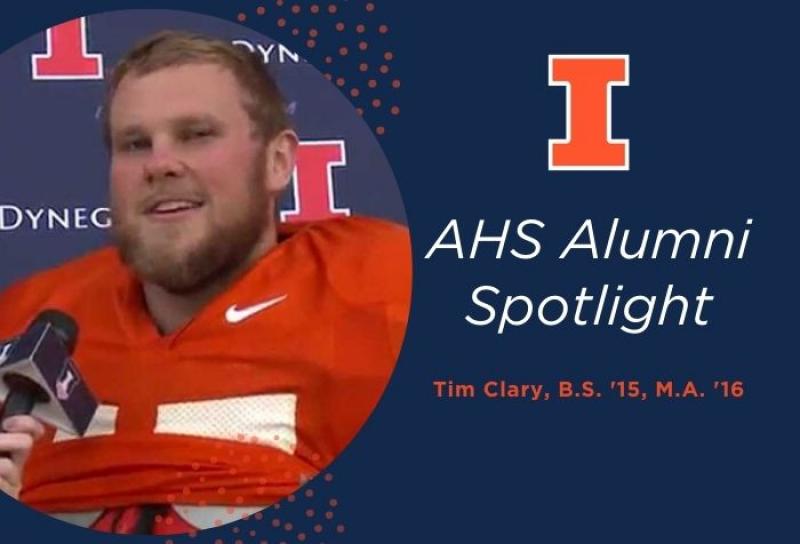
Alumni Spotlight—Andy Szabo


Q: Why did you pick AHS?

A: I entered the university in general studies as an undeclared student. Through a year or so of discovery and exploration, I was denied by the College of Business and at a loss. At a similar time, I was introduced to the College of AHS, specifically Sports Management. Ultimately, I chose AHS for its people, experiential opportunities and practical application to my aspirational career path—a college basketball coach, collegiate athletic director or professional sports team/agency executive. 

Q: Which professors had the most impact on you?

A: LoriKay Paden, Don Hardin, Kim Shinew, Ryan Gower, Michael Raycraft and so many others created an inclusive, collaborative, challenging and supportive educational experience. Specifically, LoriKay for her unconditional positivity and Professor Hardin for his mentorship and coaching.

Q: What course did you most enjoy?

A: Loved any Leadership, Strategy or Philosophy course… And Sports Law with Kyle Emkes was a great introduction to the business of sport. For a Leadership/Comms class, I recall having to reenact Jack Nicholson’s courtroom scene in ‘A Few Good Men’—mortifying but hilarious lesson in owning a room and breaking down mental barriers.

Q: Did you enter AHS knowing your career path, or did AHS help you decide?

A: A healthy mix of both. I had a vision to explore a few different paths. Through the AHS/RST curriculum, you learn so much about yourself. I did my best to focus on diversifying my experiences and it not only led to a discovery of what I was interested in, but most importantly why.

Q: Did your AHS experience lead to your current job?

A: Yes—in a variety of ways. First and foremost, it revealed to me my passion for the business of sport. Secondly, it taught me the value of relationships. One of the joys of my Illinois experience was the planning and execution of the annual Sapora Symposium, where we had the opportunity to host some of the most talented professionals in sports and entertainment for a two-day event. Dan Migala, Co-Founder and Chief Innovation Officer at 4FRONT, was kind enough to be our keynote speaker and offered an opportunity with his sports marketing agency upon graduation. Our then-Head Men’s Basketball Coach John Groce and then-Director of Basketball Operations Mark Morris also supported the event and went so far to recommend me for the Ohio University Sports Administration MBA/MSA graduate program. What was intended to be a simple volunteer opportunity, turned into an event that fundamentally changed the trajectory of my life and professional career. I owe a lot to Dan, Mark and Coach Groce for believing in me and showing me how to effectively navigate the industry through authentic relationships. 

Q: What is your current job?

A: Currently, I serve as the Director of Partnership Development for the Oakland Athletics of MLB. My role primarily consists of establishing marketing, business and community partnerships on behalf of the organization, working as a revenue generator, storyteller and strategist, while managing a partner portfolio of 20+ local, regional and global brands.

Q: What was your favorite on-campus experience?

A: Too many to count! As a team manager for the Fighting Illini men’s basketball team, I was grateful to learn from amazing coaches, build impactful relationships within the athletic department and represent the university as a whole. Winning the Maui Invitational, beating Gonzaga on the road and taking down No. 1 Indiana at home at the buzzer made for a memorable senior year, to say the least.

Q: What would you say to recommend AHS to a prospective student?

A: The University of Illinois is world-class, and the College of AHS provides a world-class, student-first experience. It felt like a family and there was reason for everything we did. Not an education for the sake of a degree and not a test for the sake of a grade. It is what you make of it, and there are plenty of chances to lean in and create your own personalized journey.

Editor’s note:

To reach Vince Lara-Cinisomo, email vinlara@illinois.edu.
 

Related news

Alumni Spotlight—Brian Smith


Q: Why did you pick AHS?

A: I just had and still do a real passion for sports, concerts, and events. I love the idea of working as a team to accomplish goals, problem solve, and to put something on that’s fun for people. I also enjoy the rush of the moment of things like live events that are happening in real time.

Q: Which professors had the most impact on you?

A: Professors Ryan Gower and Michael Raycraft, because they made learning fun. And as a disabled individual with a speech impediment, they made me feel very welcome and treated me just like any other student.

Q: What course did you most enjoy?

A: It was a long time ago so I don’t remember the names, but basically the ones that dealt directly with sport and event management.

Q: Did you enter AHS knowing your career path, or did AHS help you decide?

A: They helped me decide. I was debating between going into sports management or just a business degree.

Q: Did your AHS experience lead to your current job?

A: Unfortunately no. After I graduated I had went through some physical changes due to my disability, which hindered some of my capabilities, so my job search took some twists and turns.

Q: What is your current job?

A: I’m a digital strategist and social media manager at an advertising agency.

Q: When did you graduate and with what degree?

A: I got my bachelor’s degree in ‘05 in Recreation, Sport, and Tourism Management. I got my master’s in Sports Management in ‘07.

Q: What was your favorite on-campus experience?

A: I just enjoyed being a part of a major university and there’s nothing like a Big Ten atmosphere, and all the great friends I made. One great memory I have is celebrating the ‘05 Final Four basketball team.

Q: What would you say to recommend AHS to a prospective student?

A: You won’t regret your time at U of I and the College of AHS.

Editor’s note:

To reach Vince Lara-Cinisomo, email vinlara@illinois.edu.
 

Related news

Alumni Spotlight—Megan McKenna


Q: Why did you pick AHS?

A: After graduating from high school, I started my undergraduate studies at a small liberal arts college and quickly found that it wasn’t the right fit for me. Knowing that I wanted to become a speech-language pathologist, I quickly discovered that the University of Illinois had a well-respected Speech & Hearing Science department. I was fortunate enough to be accepted and start at Illinois for the second semester of my freshman year. I was worried about the change from such a small college to a large university, but I found that AHS was the perfect balance. My classes within AHS were smaller than my general education courses, so I felt I had a better opportunity to really retain coursework and get to know my professors and classmates. I also ended up becoming very interested in research, and AHS allowed me to participate in research as an undergraduate and graduate student. That is definitely not an option at many other universities!

Q. Which professors had the most impact on you?

A: Dr. Pamela Hadley was incredibly impactful during my time in AHS and beyond. It was in her undergraduate class on child language that I became fascinated by the language development process in young children, and I was drawn to her passion on the topic. I ended up completing my James Scholar Honors project, writing a master’s thesis, and working as a research assistant all under her guidance! Since my graduation, we have co-authored a paper together in one of the American Speech-Language-Hearing Association’s journals. I also enjoyed courses with Dr. Cynthia Johnson and Dr. Raksha Anand Mudar.

Q: What course did you most enjoy?

A: I really enjoyed most of my courses within the SHS department but also the courses I took from other departments in AHS for my interdisciplinary minor. My favorite courses focused on child language, language disorders, and language and the brain. I also loved completing independent study coursework as part of my James Scholar project because I was able to build experiences specific to my interests.

Q: Did you enter AHS knowing your career path, or did AHS help you decide?

A: When I started college, I already knew I wanted to study to become a speech-language pathologist, but I had a particular interest in working with the adult population. I even completed an interdisciplinary minor in Aging Studies within AHS! However, after my interest in child language and development was peeked in course and experience working in the Applied Psycholinguistics Laboratory within SHS, I became convinced that working with the pediatric population was actually a better fit for me. My experiences within AHS helped me to identify my true passion and guide me to the career I have now.

Q: Did your AHS experience lead to your current job?

A: My experiences in AHS and the department of SHS really helped me to identify my passion for working with the pediatric population. I had the opportunity to begin clinical hours in speech therapy as a senior and continued into graduate school. I was able to be placed in a wide range of clinical assignments—far more than other SLPs I know that attended other schools. I felt really confident in my clinical skills when I started my first job as an SLP in the Illinois public schools. After 4 years working in schools, I transitioned to the outpatient clinic setting. I know that all of my clinical experiences within AHS gave me the background I needed to be successful across these different settings, and my coursework and research experiences made me comfortable applying evidence-based practice and pursuing new responsibilities, training, and certifications.

Q: What is your current job?

A: I am a pediatric speech-language pathologist and certified autism specialist at two suburban hospitals within Northwestern Medicine. I specialize in providing speech therapy to pediatric patients at-risk or diagnosed with autism spectrum disorder, but I see pediatric patients 14 months of age to 18 years of age with a wide range of diagnoses and needs. I also serve on an interdisciplinary early intervention medical diagnostic team and complete autism diagnostic assessments to support physicians’ clinical decisions. I am fortunate to be able to work closely with parents and my colleagues in other disciplines.

Q: When did you graduate and with what degree?

A: I graduated with a B.S. in Speech & Hearing Science in 2011 and with a clinical M.A. in Speech & Hearing Science in 2013.

Q: What was your favorite on-campus experience?

A: Where to begin?! I worked for campus housing at the front desk and as an RA, and I loved building relationships with my co-workers and the residents on the floors. So many fun times! I was also part of Alpha Phi Omega service fraternity and had the opportunity to volunteer on campus as well as the communities surrounding Urbana-Champaign. The University of Illinois is a busy and exciting campus—there are so many options as far as joining groups/clubs, attending events, and going out with friends! There is always something to do or somewhere to go.

Q: What would you say to recommend AHS to a prospective student?

A: AHS is a smaller college on campus, so you get to know your classmates and faculty more personally. AHS allows you to experience a more tight-knit, community feel within the large university setting that Illinois is. It’s the best of both worlds!

Editor’s note:

To reach Vince Lara-Cinisomo, email vinlara@illinois.edu.
 

Related news

Alumni Spotlight—Monique Mills


Q: Why did you pick AHS?

A: After taking a class in Special Education, titled Exceptional Children, I decided that I wanted to become a speech-language pathologist, to help persons who are nonverbal communicate. This led me to begin taking courses in Speech & Hearing Science.

Q: Which professors had the most impact on you?

A: All of my professors impacted me. Most especially Dr. Ruth Watkins, my doctoral advisor and Dr. Adele Proctor, who first introduced me to subject I’ve been studying since: narrative assessment in school-age African-American children. My dissertation committee deeply influenced my thinking around qualitative research methods (Anne Hass Dyson) and how African-American English was presented in children’s literature (Violet Harris, Betsy Hearne). Then, there were professors within my department who influenced me through their stellar teaching (Cynthia Thompson) and clinical research (Pam Hadley).

Q: What course did you most enjoy?

A: As an undergraduate, I most enjoyed courses in SHS that focused on child language development. I also quite enjoyed the Kinesiology course on ice skating that I took with a friend. As a doctoral student, I most enjoyed coursework in Curriculum & Instruction because I met an interdisciplinary group of friend I remain in touch with. I also very much enjoyed learning situation modeling from Elizabeth Stein-Morrow in Psychology.

Q: Did you enter AHS knowing your career path, or did AHS help you decide?

A: I knew that I was interested in speech-language pathology. It’s interesting, Education led me to AHS.

Q: Did your AHS experience lead to your current job?

A: Yes, I majored in Speech & Hearing Science (SHS) in the undergrad program at UIUC, the master’s program at Ohio State University, and the doctoral program at UIUC.

Q: What is your current job?

A: Currently, I’m an associate professor of communication sciences and disorders.

Q: When did you graduate and with what degree?

A: I graduated with a bachelor of science in SHS and a PhD in SHS from UIUC. So I have two degrees from AHS. At the time, it was ALS.

Q: What was your favorite on-campus experience?

A: My favorite on-campus experience was partaking in all of the yummy food on Green Street and strolling across the quad, of course.

Q: What would you say to recommend AHS to a prospective student?

A: I would say AHS values excellence. As an undergraduate student I was on the Dean’s list a lot, and it felt good to be appreciated publicly in receptions at mom’s day weekend.

Editor’s note:

To reach Vince Lara-Cinisomo, email vinlara@illinois.edu.
 

Related news

College of Applied Health Sciences
110 Huff Hall
1206 South 4th Street
Champaign, IL 61820
(217) 333-2131