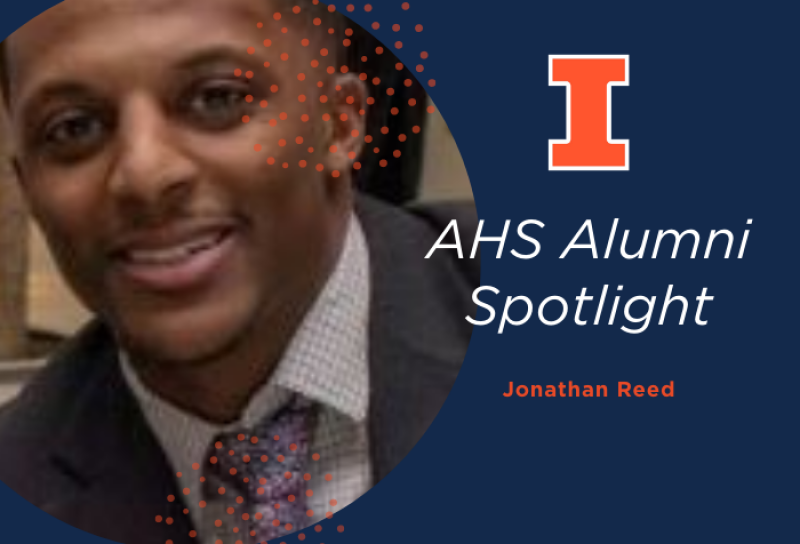
Alumni of the College of Applied Health Sciences have myriad career options thanks to the tremendous diversity of programs. We periodically will put the spotlight on an alum to find out what they’re doing now, what experiences they had and what AHS means to them. This week, we talk to Jonathan Reed, a KCH alum now working in medical education/health administration.
Q: Why did you pick AHS?
A: I picked AHS because I had an interest in Community Health. I knew I wanted to help provide people a better quality of life and build underserved communities by addressing health disparities.
Q: Which professors had the most impact on you?
A: My Academic Advisor (Mr. Chris Cosat) had the most impact on me. He did a great job of showing different career paths in AHS and helped guide me through the curriculum with no conflicts.
Q: What course did you most enjoy?
A: The course I enjoyed the most was an Intro to Epidemiology course (CHLH 274). It allowed me to get a new perspective on how patterns of disease are studied and how much they affect healthcare as a whole. Material from this course has become even more relevant with the current Pandemic.
Q: Did you enter AHS knowing your career path, or did AHS help you decide?
A: My career path was not well-defined upon entering AHS. After taking courses, I was able to better grasp my values and passion which are rooted in Community Health/Health Administration.
Q: Did your AHS experience lead to your current job?
A: Yes, my AHS experience exposed me to different areas of healthcare and colleagues within the college. These experiences and connections are what helped me land my current job working in medical education/health administration.
Q: What was your favorite on-campus experience?
A: My favorite on-campus experience was tailgating at Homecoming football games, ILL-INI!!!
Q: What does AHS mean to you?
A: For me, AHS means “focusing on promoting healthier, happier lifestyles to allow an optimal life for all individuals.”
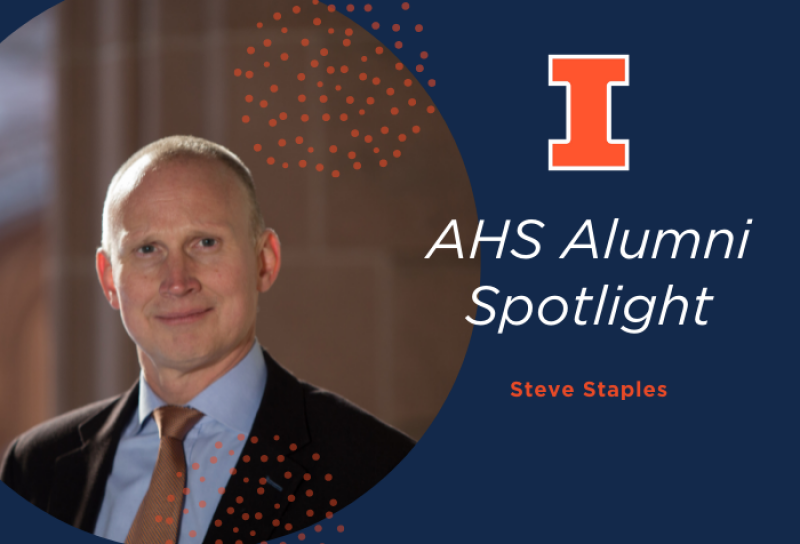
Alumni of the College of Applied Health Sciences have myriad career options thanks to the tremendous diversity of programs. We periodically will put the spotlight on an alum to find out what they’re doing now, what experiences they had and what AHS means to them. This week, we talk to Steve Staples, an RST alum who is now Executive Director of International Development at Princeton University.
Q: Why did you pick AHS?
A: I wanted to pursue a career in sports management and AHS (then known as Leisure Studies) was just starting to offer a M.S. in Sport degree at the time (early 1990s).
Q: Which professors had the most impact on you?
A: Bill McKinney had the most impact on me, academically and professionally. The vast majority of students in the program at that time were planning to pursue careers in parks and recreation. As the chair of the department at that time, Bill made sure that the handful of us interested in sports management, were not overlooked. While working on my master’s degree, I became interested in pursuing a Ph.D., as well. Bill was very supportive and became a terrific advocate and friend throughout the process. I feel very fortunate that I had the opportunity to thank Bill in person in Arizona before he passed away earlier this year.
Q: What course did you most enjoy?
A: I can’t remember the specific course, but I recall really enjoying Dr. (Joseph) Bannon’s class. He emphasized the importance of theoretical concepts in practical settings. His insight had a significant impact on my career and he was an excellent role model.
Q: Did you enter AHS knowing your career path, or did AHS help you decide?
A: I did enter AHS knowing that I wanted a career in sports. What I didn’t know is how much I would like working in athletic administration. After volunteering at (Division of Intercollegiate Athletics), I became a graduate assistant for the athletic department and spent 12 years of my career working in intercollegiate athletics.
Q: Did your AHS experience lead to your current job?
A: I feel that my experience as a master’s and especially a Ph.D. student prepared me well for my current role at Princeton. Writing a thesis and dissertation helped improve my writing skills and critical thinking. Being able to write articulately helps me every day in my job as a major gifts fundraiser.
Q: What was your favorite on-campus experience?
A: My favorite on-campus experiences were Illinois athletic events. Whether it was football at Memorial Stadium, basketball at the Assembly Hall or volleyball in Huff Hall, I attended a lot of games during my three years on campus and I loved every minute of it.
Q: What does AHS mean to you?
A: It means a great deal to me. It was a transformative experience for me. I help to support the study tour that Dr. (Michael) Raycraft leads each year because in my mind, it is the perfect blend of academic and experiential learning. I had a similar experience through my academic training and work at DIA. To understand the theoretical and practical sides of any industry is incredibly important. I am a proud alum of RST, AHS and the university as a whole!
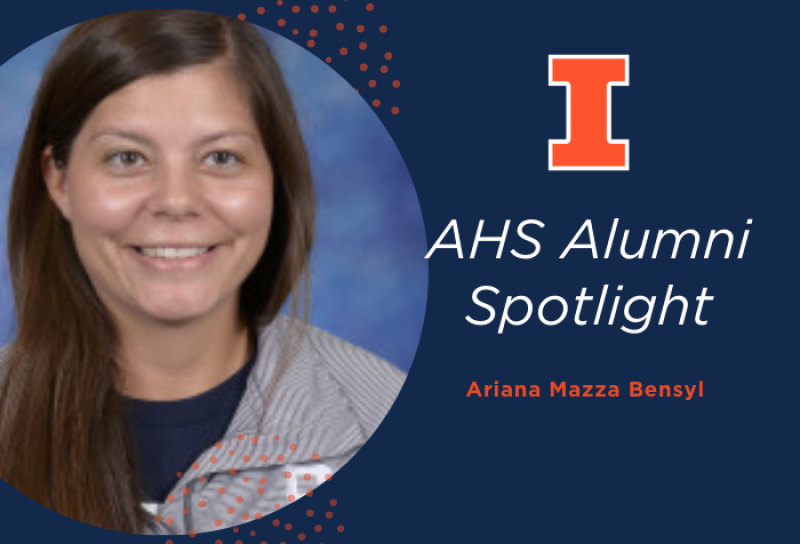
Alumni of the College of Applied Health Sciences have myriad career options thanks to the tremendous diversity of programs. We periodically will put the spotlight on an alum to find out what they’re doing now, what experiences they had and what AHS means to them. This week, we talk to Ariana Mazza Bensyl, a KCH alum who now works as a Physical Therapist in Northbrook School District 28.
Q: Why did you pick AHS?
A: Being active in sports growing up fostered my interest in exercise and how the body works. I knew going into college that I wanted to be a Physical Therapist. When I was looking into colleges, I was looking for one that provided me the opportunity to get a great education and prepare me for PT school. The College of Applied Health Sciences offered Kinesiology as a program of study, which fit my PT path. I was confident the curriculum would prepare me for getting into PT school, as well as the academic demands of PT school.
Q: Which professors had the most impact on you?
A: One person that most impacted me was my academic advisor, Amy O’Neill. She encouraged me to challenge myself and work hard to attain my goals throughout my time at the University of Illinois. Amy also brought the idea of completing the Physical Education Teacher Licensure program to my attention. I completed the Pedagogy track within Kinesiology and I really enjoyed it. Dr. Amy Woods was one of my professors who saw a lot of potential in me and pushed me to be a better teacher. Another professor that had an impact on me was Mary Carlton. She had such passion and excitement for what she was teaching that it made learning exciting!
Q: What course did you most enjoy?
A: I really enjoyed my Injuries in Sport class. Learning about injuries, how to tape an ankle, preventative care and emergency care was cool! Especially for a kid who had her ankles taped throughout her high school sports career. I also really enjoyed Psychophysiology in Exercise & Sport.
Q: Did you enter AHS knowing your career path, or did AHS help you decide?
A: I did enter AHS knowing my career path. I knew I wanted to go to PT school, but I thought I wanted to work in the sports world of physical therapy. When I was doing my student teaching, I learned that physical therapists could also work in the school environment. This opened my eyes to a different path within physical therapy that was interesting to me and has actually taken me to my current job.
Q: Did your AHS experience lead to your current job?
A: Yes, it did lead me to my current job. My time in AHS prepared me to get into and be successful in PT school. I have received my doctorate of Physical Therapy from Northwestern University (’14) and am currently a PT in Northbrook School District 28. I have been able to combine the love of education and teaching that I learned from my time in AHS with my passion for physical therapy.
Q: What was your favorite on-campus experience?
A: I was part of the Alpha Chi Omega sorority during my time on campus. Creating so many memories and lifelong friendships with my sorority sisters really made for many favorite on-campus experiences. Not necessarily an on-campus experience, but an experience related to my time in AHS, was meeting my husband. A colleague I met while doing my student teaching introduced me to him. He is a fellow AHS ’11 graduate! We have talked about how we were probably in some of the same intro KIN classes our freshmen year but didn’t know it!
Q: What does AHS mean to you?
A: The University of Illinois is such a big university and being part of AHS made it feel smaller. The professors and academic advisors in AHS really created an environment where I felt they wanted me to succeed. AHS means being part of a community that truly cares about their students.
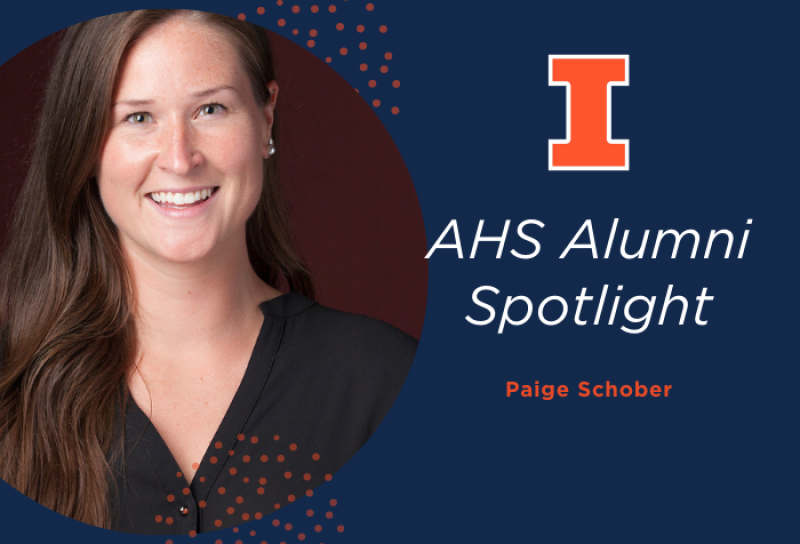
Alumni of the College of Applied Health Sciences have myriad career options thanks to the tremendous diversity of programs. We periodically will put the spotlight on an alum to find out what they’re doing now, what experiences they had and what AHS means to them. This week, we talk to Paige Schober, a KCH alum who now works as an athletic performance coach at UCLA.
Q: Why did you pick AHS?
A: I chose AHS because the areas I was interested in studying all fell in the cross section between science and research fields and the health and human study fields.
Q: Why did you pick KCH?
A: I knew I wanted to study Kinesiology because I was passionate about the growing field and all the areas one can take a degree into such as human performance and athletics.
Q: Which professors had the most impact on you?
A: I had so much respect and appreciation for Tina (Matilla) Greenlee, who taught and served as the teaching assistant for several of my courses in KCH. She was so helpful to me and supportive of my growth in the classroom and on the dance team as she was an alumni herself. Amy O’Neill also made a tremendous impact on me in how well she helped me map out my path with such care and consideration.
Q: What course did you most enjoy?
A: I enjoyed KIN 355, Biomechanics of Human Movement with Dr. (Ian) Rice. It was the first time I experienced a crossover between physics and physiology. I was very interested in the quantifiable aspects of movement and the technologies that accompany that tracking.
Q: Did you enter AHS knowing your career path, or did AHS help you decide?
A: I did not know my career path specifically, just that I wanted a career in movement. I started on the Physical Therapy track because it seemed like that was what most people did. It was Amy O’Neill that helped me explore all my options and ultimately discover the world of strength and conditioning through a summer internship.
Q: Did your AHS experience lead to your current job?
A: My experience in AHS absolutely laid the foundation for the rest of my career. I went on to earn a M.S. in Exercise Science from the University of Montana and now I work as an athletic performance coach at UCLA.
Q: What was your favorite on-campus experience?
A: I was a member of the Illinettes Dance Team, so my favorite experience was performing at football games in Memorial Stadium.
Q: What does AHS mean to you?
A: I’m so grateful for my experience in AHS because it truly laid the foundation for the rest of my career. I was exposed to literature, research, and technology at such a high level and it opened my eyes to the world of kinesiology. I learned tools and techniques that I carried with me into graduate school and into my career in exercise science and athletic performance.
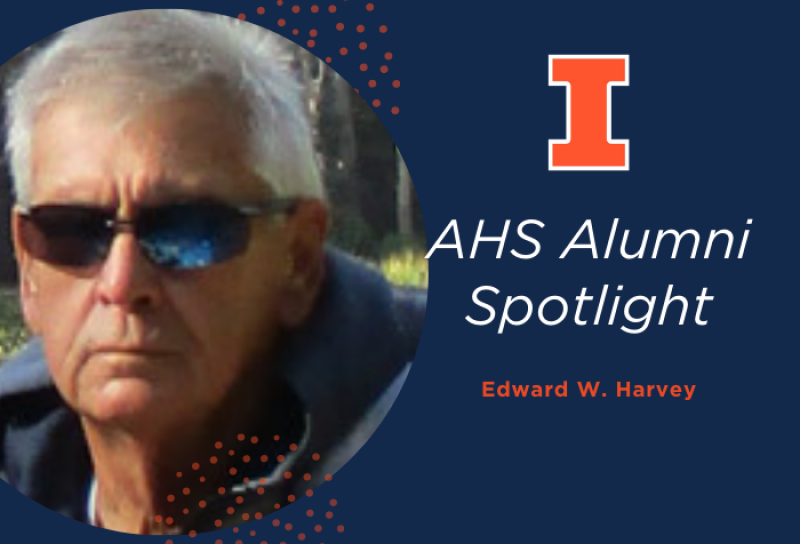
Alumni of the College of Applied Health Sciences have myriad career options thanks to the tremendous diversity of programs. We periodically will put the spotlight on an alum to find out what they’re doing now, what experiences they had and what AHS means to them. This week, we talk to Edward W. Harvey, who used his RST experience as a springboard to working for 38 years in park district leadership.
Q: Why did you pick RST?
A: I actually entered the University in the College of Commerce (now Gies College of Business). I had been working for the Urbana Park District on a seasonal and part-time basis, doing park maintenance and working in sports and recreation programs. I really enjoyed the work but didn’t realize it was a career. When Robin Hall started at the Urbana Park District, he had a profound influence on me taking another look at my career plans. He arranged for me to talk to Chuck Pezoldt, who was on the faculty at that time. Chuck’s genuine enthusiasm for and boots-on-the-ground experience in the parks and recreation profession proved too persuasive to resist, and I transferred into the then-Department of Recreation and Park Administration.
Q: Which professors had the most impact on you?
A: As mentioned, Chuck Pezoldt’s background in Illinois Parks and Recreation on a local level fit right in with what I was interested in doing when I graduated. Jim Brademas was the Director of (Office of Recreation and Park Resources) ORPR at that time. He also had a wealth of practicable experience as a parks and recreation administrator and also as a consultant. Bob Espeseth didn’t come to the university until I was in graduate school but his background in Wisconsin State Parks and other park systems was very valuable to my education. Bob and I have continued a great relationship for nearly fifty years.
Q: What course did you most enjoy?
A: Chuck Pezoldt taught the undergraduate course in parks and recreation administration, which I found extremely interesting as well as directly related to my background. He gave a quiz on the Illinois Park District Code every class. Great way to learn the code!
Q: Did you enter AHS knowing your career path, or did AHS help you decide?
A: I had already tried two years in the College of Business taking accounting, economics and finance courses. I liked it a learned a lot but part of what I learned was that I probably didn’t want to do it for a profession. Once I learned that parks and recreation was a career choice, it sounded perfect for me.
Q: Did your AHS experience lead to your current job?
A: I’m retired now but yes, it did lead to a career of 38 years in three park districts: Urbana, Champaign and Northbrook. In retirement, one of my favorite activities is bicycle riding. I often ride through the local Champaign and Urbana Parks and see how the trees I planted 50 years ago are doing. It’s more than a career when you do it for a lifetime.
Q: What was your favorite on-campus experience?
A: I played in the Marching Illini for three seasons, carrying a sousaphone. I also played tuba in the Concert Band under Mark Hindsley for three years and under Harry Begian for one year. Those experiences provided a lifetime of memories.
Q: What does AHS mean to you?
A: I have always felt the college and department provided me with what I needed to have a successful career. At the time I was in school, I vowed that if I ever had the opportunity, I would try to help future students get the same opportunity. For that reason, my wife and myself have established a scholarship fund for undergraduate Recreation, Sport and Tourism students named for my late parents. It makes me feel good that I have been able to provided a small level of assistance for these future leaders in our profession.
Vince Lara-Cinisomo in the AHS office of communications spoke recently with Jon Gunderson and other members of the DRES Accessible IT Group.
Online technology is an evolving ecosystem for some disabilities (Stock image)
VINCE LARA: Jon, what does the DRES Accessibility IT Group do?
JON GUNDERSON: Our mission on campus is to help the university understand the accessibility of the online resources that the university creates and uses. Online information technology is still, really, a frontier in terms of digital barriers to people with disabilities. While it’s been an enabling technology for some types of disabilities, it’s still a barrier for other types of disabilities. And the history of UI in breaking barriers on disability is a big part of what motivates our group. Nick, did you want to talk a little bit about that?
NICHOLAS HOYT: Sure. I think another part of what Jon has just said is that we are carrying on the work that the founder of DRES—Tim Nugent—started. He was a pioneer in so many ways and was working in a context—the post-World War II era—helping veterans get access to higher education, and that took the form of a transportation system—the first bus system in this country with wheelchair lifts, and wheelchair access to buildings through ramps, and curb cuts, and things like that.
In the Accessible IT Group, we are carrying on that work, but obviously, things have changed. So much of our lives—our work lives and our personal lives—are now online, and we are trying to deal with this new environment in similar ways to what Dr. Nugent was doing. And with digital information technology—as Jon has mentioned, these barriers weren’t recognized immediately. The Accessible IT Group is trying to increase awareness of IT accessibility requirements and, in so doing, provide means—techniques—for reducing or getting rid of these barriers in information technology.
VINCE LARA: Let me ask you—I know the group is ostensibly housed in DRES. Does it work cross-campus? Do you work with other colleges and units?
JON GUNDERSON: Yes, most of our work is with other campus entities, with other Big Ten Universities and also international through our work with the W3C Web Accessibility Initiative. We are involved with web standards for accessibility—through the Web Accessibility Initiative—for over 20 years. I’ve been a working group member of the Accessible Rich Internet Applications Working Group. And the AInspector WCAG and FAE tools that we’ve built to help people understand accessibility are built on the foundations of the Web Content Accessibility Guidelines and the ARIA standards—ARIA stand for Accessible Rich Internet Application standards—for best practices for accessibility.
And one thing that makes our tools different than tools that you might find from other businesses or organizations, for one, is that they’re entirely open-source. And, more importantly, they’re designed to be educational—helping people understand the accessibility requirements, whereas other accessibility tools tend to be what I call “whack-a-mole” tools. You know, tell me where the problem is, and if I have enough time and resources, I’ll just start fixing things until I run out of time or I get everything fixed.
But unfortunately, being able to point to a particular place in the code or on a web page and fix things only addresses about 30% to 40% of accessibility requirements. So, many people, even though they might get zero errors with an automated tool, and they don’t understand the other requirements, may not have addressed the other 50% to 60% of the requirements related to having an accessible and inclusive website. I mean, we talk about accessibility, but it’s really about inclusiveness, making people with disabilities feel included in the Illinois experience.
When people talk about accessibility, it seems to be something like, oh, yeah, I met that criteria of being accessible. But if you don’t really understand the accessibility principles, like I’m satisfied some tool told me I don’t have any errors—but you still don’t know if you’re being inclusive by making the website usable. And maybe Lori could talk a little bit about some of her work with campus web developers or other campus organizations in terms of helping them understand accessibility. Lori?
LORI LANE: I’m involved with the Canvas Accessibility Working Group on campus. My role in that group is to do evaluation and assessment, look over what Canvas offers, and identify any issues that might come up related to accessibility barriers. I also analyze the accessibility checker they offer to see how it functions and notice any accessibility issues that it flags or doesn’t flag.
It’s a way to help the group make accessibility resources available for instructors who are developing courses and students with disabilities who are taking these courses. We help them improve the accessibility of Canvas within that group. That would be one example of a partnership.
Another example might be that I’m also involved with WebCon, the Web Conference planning committee. I’ve been on that committee for the last two years. And when COVID happened, of course, we were caught off guard and forced to cancel the in-person conference that we had been planning at that point. And we made the pivot, as so many did, to an online platform for our conference. And the committee was discussed different ways to make that change.
And one of the first experiences that we had with an online conference—was CVENT. Our committee was interested in talking about things that they liked about the platform, which they saw that seemed very interesting or flashy. I had to keep reminding the group that we had to consider accessibility. That was crucial for planning a successful conference, not just all the bells and whistles.
And so doing this conference online, and what an online conference platform would mean, is that a wider range of attendees with disabilities who might attend online; would not have been able to come in person. And we had to ensure that the platform we selected for the conference was accessible to all of them. And I took that opportunity to educate the rest of the committee on ways to keep that in mind and evaluate for some of those issues.
We ended up going with CVENT, which is the name of the conference platform that we used. And we worked closely with their developers from the CVENT team in making sure that our conference was as accessible as possible. I help other groups and entities across campus be more aware of their product and help improve the accessibility of what they offer and develop.
VINCE LARA: Excellent. Thank you for that answer. Jon, or anyone who wants to answer this, can you explain, broadly, accessibility and its importance?
NICHOLAS HOYT: Jon and Lori, you may want to weigh in as well—but an analogy came to mind for me this morning, and that’s the analogy of when the printing press was invented. In order to make this new technology (at the time) work, people had to understand certain technical aspects of how to produce a book or other printed material. There was typesetting for example, and it involved the amount of ink needed to print each page. Too much ink, and it’s blurred. Not enough ink—it’s not visible.
But just as there were technical issues people had to understand in that era, there’s a similarity with the era of information technology—of digital technologies for information. There are ways that digital information can be made accessible to people regardless of their abilities. And going back to the printing press analogy—somewhere along the line, someone came up with the idea of using Braille. And Braille allowed people who were blind to be able to read the same texts that were being produced in printed format. Unfortunately, there was about a 400 year gap between the invention of the printing press and the invention of Braille.
Today, digital technology gives us the ability to publish something in a format that includes within it the information that someone—just to take an example, someone who is blind—that will help them be able to not only get to the information but to understand its structure—to be able to navigate around and through that document or that information. So hopefully, that’s a helpful analogy.
VINCE LARA: Absolutely. I love that analogy, actually. It helps me understand the basis—how that even arose. Very interesting, Nick. Thank you for explaining that.
LORI LANE: I was listening to what Nick was saying, and I wanted to add another example that I might use: our users with disabilities aren’t able to use a mouse, for example, and they’re dependent on the keyboard. That’s how they’re navigating the web page they’re on. Most of us have no problem using a mouse to access and navigate the internet.
But for people who depend on keyboard navigation only, when they use the Tab key to navigate to active elements on websites as a way to get where they’re trying to go—to the form controls or the search bar. It helps them navigate across a page or through content.
For example, if there aren’t any visual focus cues—something to show where the visual focus is at that moment or on what element it’s highlighted. We need something that clearly defines a link visually, for example, with an underline. If you use a mouse and hover over the element, you’ll see that underline pop up or something that indicates that this is a link. But for a keyboard-only user who can’t hover over with a mouse, they use the keyboard to navigate through, and they do not see any visual focus cues on the page and get stuck because there are no visual focus cues to lead them. They can’t go anywhere or get to the desired destination.
Web developers can put defined styles into their CSS files, for example, background colors, underlines, borders, and text colors—things that identify as a dynamic element. It’s one little CSS change that they can put in, and it dramatically increases the accessibility for someone who uses a keyboard and needs that visual focus. I hope that explains how to make it more accessible.
VINCE LARA: Oh, tremendously. It makes me understand that we’re not doing enough, clearly, on some of our text-only things. And so, absolutely. Thank you for really planting that seed for me.
JON GUNDERSON: I have a story about a blind student. When I first got started working with Illinois students on IT accessibility in the ’90s, I was helping a law student who was blind use LexisNexis. And the web wasn’t being used at that time, but LexisNexis had their own interface, and you could dial-up and get access to law information—almost any information from print materials on a wide variety of topics. And this student—and I think all law students had free access to LexisNexis, I believe this is true even today.
So working with the blind student to help them—they could access the information pretty well since it was primarily the old style character based interfaces, but it took them two to three times longer to access that same information, and there were still problems. It wasn’t ideal. Sometimes, some things weren’t possible.
But, you know, at that time, it cost $200 to $300 per hour to use LexisNexis. I don’t know if that’s still true or not. And so this student– people with disabilities—are used to having to spend more time—work harder—to get the same level of work done for their classes. But when they graduate, and they go try to get a job, a lot of first-year graduates are going to be doing law research—doing research for partners or other lawyers, in at least in the larger law firms.
And now, if it’s taking this student two to three times longer, they will be costing that law firm two to three times more to use that service. And now the law firm says, well, if I hire you, you’re going to be more expensive than other graduates because of the extra time you will be spending on line to do research—I mean, if you’re the top law student from Illinois that might be fine.
But if you’re not the top law student, or maybe towards the bottom of the class, well, maybe you’re going to be too expensive to hire because you’re taking too much time with Lexus/Nexus searches. Or, you know, after the first year and they see your bill is twice as high as other first-year law schools, or maybe more. That’s an economic disincentive to employ someone with a disability. So these are kind of the hidden costs of inaccessibility, and it affects career opportunities.
And to me, at that time, I said, it doesn’t have to be that way. It’s because we design these systems without thinking about accessibility. And just like curb cuts have helped more than just people who use wheelchairs to get into buildings and ramps and things, when we look at technology for accessibility, we’re helping usability for everybody—to use technology better and more efficiently.
VINCE LARA: Oh, fantastic explanations from everyone. I really appreciate that. Lastly, I wanted to talk to you about—Jon, you had mentioned the software extensions, and I wanted to ask you if you could talk more about those and how they can be utilized.
JON GUNDERSON: Well, I think the latest extension we’ve worked on—maybe Nick could explain—but I think it’s a little bit different direction for us. We’ve been mostly focusing on tools to help people analyze websites for accessibility, but this new tool Nick’s been working on is really an assistive technology. It kind of speaks to what Lori Lane was talking about earlier in terms of providing keyboard navigation. So I’ll let Nick talk a little bit more about that project.
NICHOLAS HOYT: OK. Well, I will just begin by saying that the term “extension” generally refers to a web browser extension—something you can just add into the browser, and then its functionality is just there available to you. And of the tools Jon was referring to that do evaluation, probably the tool that we recommend first is a tool called AInspector WCAG, which is a Firefox browser extension. And that will allow you to evaluate—apply many different accessibility rules to the page, have those rules evaluated, and then get that feedback of—are there any aspects of the page that didn’t meet the requirements?
But since we had experience with creating browser extensions, we saw an opportunity with the latest extension, which is called the SkipTo Landmarks & Headings extension. We saw an opportunity for actually creating something that served a dual purpose. And primarily it allows people to navigate a web page by the headings and the landmarks on that page.
So headings have been around for a long time in the world of web development and HTML web pages. They define different sections of content, and they’re hierarchical—they can be of different levels. For example, a level-2 heading might define a major section of a document, and then there might be several level-3 headings under that that define subsections.
On the other hand, landmarks are relatively new. They’re defined by a more recent standard that Jon mentioned—the ARIA standard. Landmarks define regions on a page, which are common regions that users may want to navigate to or skip over. An example is the header region—oftentimes, the same header is there on page after page within a website, containing the website logo and often a site navigation menu. And people that are just using the Tab key to navigate the page starting from the beginning are going to– if they can’t skip over that header—have to tab through many, many links to get beyond it. The SkipTo extension allows a user to skip over the page header and go directly to some other region on the page.
Another very useful landmark is the main landmark. If you put the main content of the page into that region, the SkipTo extension will allow you to skip directly to it. It’s a replacement for the “skip to main content” link, but does not depend on the page actually containing that link.
In summary, the SkipTo extension give people who are using the keyboard—as I mentioned it’s serving a dual purpose–the ability to navigate the page through landmarks and headings very efficiently. And the other way it can be used—for example, a web developer who just wants to spot-check different pages to see if the heading structure makes sense—it’s useful to them as well. Or to anyone that is looking for information on a fairly complex web page—they can get a list of the headings and scroll directly through them, rather than having to scroll through a very long page with lots of visual distractions.
Illinois recognized 16 staff, including SHS office manager Andrea Paceley
Andrea Paceley provides support to SHS’ graduate programs (Photo provided)
Sixteen civil service employees were recognized for exceptional performance by University of Illinois Urbana-Champaign—eight this year and eight in 2020. For the second consecutive year, concerns related to the COVID-19 pandemic precluded a banquet for employees honored with the Chancellor’s Distinguished Staff Award.
Each recipient receives $1,000 and a plaque. Recipients’ names also are engraved on a plaque displayed in the Illinois Human Resources Office. The names of past winners are online.
Permanent staff members with at least two years of service and retired employees in status appointments during the calendar year may be nominated for the award. A committee recommends finalists, who are then approved by Chancellor Robert Jones.
Experiences in managing pandemic-related issues came to the forefront in many of the nomination forms for 2021 recipients, including Andrea Paceley in the Department of Speech and Hearing Science in the College of Applied Health Sciences.
Paceley, the office manager of SHS, provides support to the graduate program – including graduate admissions – and carries out general office duties.
“The pandemic required a pivot on how we conduct recruitment events, such as our open house for admitted students. Andrea worked closely with the Educational Policy Committee and director of graduate studies to transition to a virtual format,” wrote nominator Ian B. Mertes, an assistant professor of speech and hearing science. “This required a tremendous amount of effort on Andrea’s part to help develop materials, ensure that necessary information was obtained from faculty, interface with the prospective students, schedule the events and send invites, and follow-up with attendees.”
Paceley’s workstation in the front office makes her the department’s first point of contact. “Those who call, e-mail or stop in are greeted with a friendly personality and a willingness to assist. On the occasion when she does not know the answer, she tracks it down and responds quickly,” Mertes wrote. ”She also sends timely reminders to make sure tasks have been completed, keeping departmental operations running smoothly.”
Dr. Wendy Rogers spoke about designing robots that support successful aging
Wendy Rogers at the 2021 McCristal Lecture.
Living independently requires the ability to perform what are called Activities of Daily Living, or ADLs. Fundamental ADLs include things such as bathing, eating, getting dressed, and so on. Instrumental Activities of Daily Living, or IADLs, include more complex activities such as paying bills, preparing meals, managing medications, and the like. In 1998, Dr. Wendy Rogers, Khan Professor of Applied Health Sciences, defined a third level of Activities of Daily Living that she called Enhanced Activities of Daily Living, or EADLs. Activities such as volunteering, taking part in community activities and engaging in hobbies enhance the quality of our lives.
Dr. Rogers, the 2021 King McCristal Distinguished Scholar in the College of Applied Health Sciences, focused her McCristal Lecture on designing robots that support successful aging related to the different kinds of activities. The lecture took place at the Fall College Meeting on August 17.
A world renowned scholar in the area of human factors and aging, Dr. Rogers has been collaborating on research related to human-robot interaction for more than 10 years, going back to her days as a professor of psychology and a principal investigator in the NIH-funded Center for Research and Education on Aging and Technology Enhancement at the Georgia Institute of Technology. Since joining AHS in 2017, she has conducted research under the auspices of the Collaborations in Health, Aging, Research, and Technology, or CHART, initiative, and also directs the recently opened McKechnie Family LIFE Home, where much of the research on health and wellness robots takes place.
When designing robots for successful aging, she said, it is important to consider the entire system. “We need to consider the characteristics of the human—their demographics, abilities, attitudes, and experiences,” she said. “We also need to think about the characteristics of the robot. What does it look like? Does it have a personality? What are its capabilities and functionalities? To what degree is it autonomous or being controlled?”
Developers also need to consider the characteristics of the task the robot and human are trying to do together, things such as how critical the task is, and whether it requires the robot and human to be co-located. Finally, the context of the interaction must be considered, whether the task is home-based or in a public setting, for example.
“We also need to think about the characteristics of the robot. What does it look like? Does it have a personality? What are its capabilities and functionalities? To what degree is it autonomous or being controlled?”
Wendy Rogers
2021 King McCristal Distinguished Scholar in the College of Applied Health Sciences
Dr. Rogers and her colleagues currently are investigating usability and other issues related to a robot developed by Hello Robot called Stretch. “We’ve been doing task analyses and prototyping different types of devices that Stretch could have at the end of its arm to perform different tasks, and comparing different types of control interfaces and control by different users,” she said. University of Illinois students soon will have the opportunity to participate in a competition in which they generate ideas for using Stretch to help people aging with long-term disabilities. The prize will be time with Stretch in the LIFE Home to further develop their ideas, guided by the LIFE Home’s expert staff.
Other Illinois research related to health and wellness robots includes designing socially assistive robots, robots with soft rather than rigid arms for telehealth applications, and robots that provide wayfinding assistance to individuals with visual impairments.
“We have made huge advancements in robotics in the last decade,” Dr. Rogers said, “but there’s still a lot more to be done.” And, she concluded, the McKechnie Family LIFE Home positions scholars at the University of Illinois really well to explore some of those questions.
All SHS students complete external internships, strengthening real-world skills and career pathways
All SHS students are required to take part in external placements, which are essentially internships with an external organization (Photo by Brian Stauffer)
Students in the Department of Speech and Hearing Science in the College of Applied Health Sciences expect excellent instruction in the classroom. When they venture off campus, however, is when they get a better sense of the career paths they might choose.
All SHS students are required to take part in external placements, which are essentially internships with an external organization. For some students in the master’s program for Speech-Language Pathology, external placements might begin as early as their second semester, said Noa Hannah, director of the audiology and speech-language pathology clinic in SHS. On the audiology side, said Clinical Assistant Professor Sadie Braun, students are given external placements in the summer after their first year in the four-year program.
“I think that our external placements are really the first place that our students get a sense of what audiology is like in the real world,” Braun said. “I think that’s when a lot starts to gel between what they’re learning in their academic classes and what they’re doing in clinic—that starts to come together when they get to their external placements.”
Hannah, who joined the university in 2019 and became clinic director in 2020, agreed, calling external placements “pivotal.”
“They’re pivotal in their learning because there’s only so much we can teach within the clinic,” Hannah said. “Going out on these externals is about professionalism, but … it’s really about understanding different cultures—different cultures of schools, different cultures of hospitals, different supervisory styles than what we have here at the university. So it’s pivotal in their learning how to apply their skills to new patient populations as well as new environments.”
Braun said audiology students gain experience in environments that we just can’t simulate within the SHS clinic environment.
“For example, we send them to a hearing aid manufacturer to get experience with the manufacturer side of things, or to a private practice or a big hospital so they get to see different environments audiologists can practice in and figure out where they might want to start in their first job,” she said.
Hannah said external placements give students the opportunity to deal with different patient populations, such as patients with dementia or traumatic brain injuries, or patients who have had strokes.
Braun said the external placements also help students to increase their independence and competence in using their skills.
There are also benefits for the organizations, such as hospitals and clinics, in which the students are placed.
“I think a lot of professionals just appreciate having some input in shaping the future of our field,” Braun said. “And when we send our students who have more experience, like a third-year audiology student, sometimes they can utilize that student who can be more independent to get a little bit of extra work done themselves.”
Braun said the external placements can also be a job “pipeline,” as some students are hired right out of their fourth-year placements.
For some UIUC alumni, it is a chance to give back, Hannah said.
“I have heard that they want input into teaching the next generation and I think the other thing is, people like teaching. People like sharing their knowledge … a lot of professionals enjoy that part of their profession and maybe don’t get that opportunity as often as they would like. This is a way to give back to a program that’s helped them to be successful.”
Any organization that is willing to act as an external placement for students in the Department of Speech and Hearing Science is encouraged to email Noa Hannah.
Justin Aronoff’s study will provide insight into how the binaural auditory system combines signals from the two ears. (Photo provided)
Bilateral cochlear implants are used to provide hearing to both ears for deaf children and adults, as well as provide binaural hearing. But the benefits of bilateral implants can be hampered by poor integration of the devices’ left and right inputs. Thanks to an R01 grant, Department of Speech and Hearing Science associate professor Justin Aronoff has a plan to combat that.
Aronoff was awarded a $1.57 million grant from the National Institute on Deafness and Other Communication Disorders for his project “The contributions of interaurally correlated signals and interaurally symmetric place of stimulation for the binaural auditory system.” The proposed study will provide insight into how the binaural auditory system combines signals from the two ears and lay the groundwork for a shift in how and when clinicians program bilateral cochlear implant users’ devices to maximize binaural benefits.
Aronoff has just begun data collection, and recently gave a demonstration of some of the study’s testing, with research assistant Simin “Tina” Soleimanifar as the subject.
In Aronoff’s lab, Tina, who does not have a cochlear implant, sat next to a scope where she can see the signal that is coming out of a cochlear implant.
“The first thing that we need to do when we’re testing a cochlear implant patient is the same thing that you would do if you go into the (audiology) clinic,” Aronoff said. “And that’s basically setting what are the comfort and safety levels.”
As Aronoff explains, the simulations of cochlear implants are not really simulations of what it would sound like to cochlear implant users. “Most of them are just simulations of what it would sound like to only have 22 notes on your piano,” he said, “but everything has to be done on those 22 notes. That’s all you can hear. … (Renowned researcher) David Landsberger (said) listening with the cochlear implant is like playing the piano with a ping pong paddle.’ That you’re hitting a bunch of notes at once. And so if I turn off an electrode, that paddle gets a little wider for all the other notes. That’s the way to think about it.”
For Aronoff, the potential impact is deeply motivating. “Our ultimate aim is to improve speech perception in noise for cochlear implant users,” he said. “Being able to follow conversations in noisy environments is one of the biggest challenges they face, and we hope this technology can make a meaningful difference in their everyday lives.”
To understand what the signal from the cochlear implant actually is, you need to use a scope. Aronoff said the scope is connected to breakout boards, which allow him to tap the output from each electrode and put it on a scope and record it, to make sure the signal is what he thinks it is. Different devices have a different number of electrodes, Aronoff said. He was working with a cochlear device during this test run, which has 22 electrodes. During the test, he gradually increases the amount of stimulation until Tina can see something on the scope.
Aronoff compared the electrodes to shining a flashlight beam.
“As you walk away from a wall that you’re shining a flashlight beam on, the beam gets wider and wider. And these are fairly far away from the wall. What that means is if you have two flashlight beams right next to each other, they illuminate mostly the same spot on the wall. There’s a little difference on the edges, but they’re mostly overlapping. And that’s what’s happening as well with these electrodes. And so that’s why when you go from one electrode to the next, you’re stimulating most of the same neurons.”
One of the most important issues Aronoff hopes to tackle with this grant is about perception of interaural time differences (ITDs) and interaural level differences (ILDs), which limit the ability of bilateral cochlear implant users to localize sounds and understand speech in noisy environments.
“This is actually a big question of the grant,” he said. “We know for a pitch that it is very malleable. That over time whatever I tell you in your map, whichever electrodes get the same frequencies in the outside world will start sounding the same in terms of pitch. We don’t know if that’s true for ITDs and ILDs. That if the best electrodes paired together change over time or not. It definitely seems to be less malleable. We don’t know if it’s malleable at all. And that’s a big purpose of this grant, to see if that correlated input only affects the pitch that you hear, or if it’s affecting the entire auditory system.”
Another issue is that people who have two cochlear implants don’t always hear one coherent sound from the two ears. They will sometimes hear a left ear sound and a right ear sound, Aronoff said.
“If you’re listening over headphones and one of them is bad, the way to tell is you lift one up. You can’t be like, ‘Oh, I can hear it’s the left one that’s bad. You have to lift one up.’ That’s how well things fuse together into one perception. Now, for cochlear implant users, that’s often not the case. They often do not have things fusing together completely. And so that’s one thing that we look at. There’s big benefits to it.”
The benefit of having bilateral cochlear implants is more than just having a backup if one implant goes out, Aronoff said. They will allow you to hear better in noisy environments.
“If you’re listening to someone who’s across the table from you and there’s background noise, being able to spatially separate out where are the speakers from everyone else helps you. And having two ears gives you that ability. If you only have one ear, you cannot tell something’s coming from the left or the right. So two ears is really what you need. And most cochlear implant users can localize reasonably well. Not as good as normal hearing listeners, but reasonably well. So that’s a big benefit of having two ears as well. There’s other things in terms of when someone comes up on one side of you. If it’s on the side that doesn’t have a cochlear implant, you might not even know they’re talking to you. There’s a lot of benefits of having two instead of one.
Getting a good measure of fusion has been one of the more challenging aspects of the project, Aronoff said, since fusion is a central idea to the grant, and because everyone has a different idea of what fusion means.
“A lot of the other things are largely predicated on this idea that you hear it as a coherent sound,” he said. “You can’t localize a sound if it sounds like it’s coming from both ears. And so, yeah, fusion is very central to this grant. And so we have a lot of experiments where we are looking at that fusion and how different things affect it. “