I love doing projects, so I spent a lot of time doing those. I was able to even refurbish a 100-year-old round dining room table, and I love how it turned out. I also enjoyed having lazy days with my husband and my dog when I wasn’t working on coursework.
What inspired you to pursue a MHA degree?
I started my undergraduate college career thinking I wanted to be a doctor, then I switched to being a nurse. I even took a CNA course through Parkland College, and I realized that the clinical side of healthcare was just not for me. I knew I wanted to have a career in healthcare, so that led me to getting my Bachelors in Community Health. Once I was done with that, I knew I wanted to have the ability to hold a leadership position in healthcare someday, which ultimately led me to purse a MHA degree.
Why did you choose Illinois for your MHA?
My choice to go to Illinois for college started when I was super young. That’s why I pursued my undergraduate degree at Illinois, and I loved the university so much that I decided to stay two more years to complete the MHA program.
What advice do you have for current students OR prospective students?
Enjoy your time as a student and take advantage of all of the opportunities the program and university have to offer. I know all too well what it’s like to feel like you’re behind, like you should be onto the next step of life already. BUT once your time as a student is over, you have to enter the scary world of adulting so take full advantage of the life as a student while you can as everything will work itself out, and you’ll be grateful for all of the experiences you received during your time at Illinois.
Hope and optimism emphasized by speakers at Chittenden Symposium
KCH Dept. Head Kim Graber, left, with Bill Chittenden and Wendy Rogers, right (Photo by Michelle Hassell)
The theme of the 2022 Chittenden Symposium is Human Factors for Health Technology. But the heart of the event is really a love story.
The Chittenden Symposium, which returns in 2022 after a five-year hiatus, is a collaboration of the Dept. of Kinesiology and Community Health (College of Applied Health Sciences) and The Department of Industrial and Enterprise Systems Engineering (The Grainger College of Engineering).
The symposium is the vision of William and Carol Chittenden, who long supported research combining engineering technology and health, including aging and later-year quality of life issues. For the Chittendens, their support of the University of Illinois is borne of their experiences on campus. William, a member of the College of Engineering Hall of Fame, graduated from the College of Engineering in 1951. During his time on the Urbana-Champaign campus, he met Carol, a Kinesiology major. It was the beginning of a lifetime of love that spanned more than 65 years.
“I think they just felt that the university added so much to their lives that they wanted to give back, pay it forward,” said Bill Chittenden III, William and Carol’s son. “And that’s how (their support of Illinois) got started.
The idea to support KCH and ISE made perfect sense, Bill said, given his father’s engineering expertise and his mother’s kinesiology studies.
“I think it started, really, as my dad supporting the engineering college,” he said. “And then my mom, given her degree, wanted to help her college. And then at some point they thought they could make a bigger impact by combining their resources to develop and support the interdisciplinary work between those colleges.
“As far as Health Sciences goes, my mom was truly fascinated with the human body. Her detailed knowledge of human anatomy, which she learned at Illinois, was often a topic of conversation. I think that was the impetus for focusing on Applied Health Sciences.”
Bill said the symposium serves another purpose: providing an opportunity for students and faculty to further develop and utilize their communication skills.
“It had a lot to do with my dad’s belief in the importance of strong communication skills. He was an excellent writer and speaker, which are strengths not always found in technical fields,” Bill said. “It was important to him that engineers and people with other technical backgrounds be good writers and speakers, so they are able to communicate technical subjects and ideas effectively to a wider audience. The interdisciplinary feature of the symposium is designed to encourage people to hear different perspectives.
Those different perspectives will be on full display in this year’s symposium. It is headlined by keynote speaker Emily Patterson, a professor at The Ohio State University. Dr. Patterson’s topic is “Enhancing innovation by incorporating human factors engineering into allied health research.”
Four faculty members will make presentations, with two each from KCH and ISE.
Abigail Wooldridge, ISE: Designing digital health technology to support care transitions in hospitals
Manuel Hernandez, KCH: Advances in Wearable Technology for Fall Prevention
Avinash Gupta, ISE: Role of Human Computer Interaction in the Design of eXtended Reality (XR) based Training Environments in the Healthcare Domain
Ken Wilund (KCH): Technology Applications for Promoting Behavior Change in Hemodialysis Patients
A discussion will follow the presentations, and then attendees will have the opportunity to tour the McKechnie Family LIFE Home, which Bill Chittenden said he was eager to see. Directed by Dr. Wendy Rogers, a professor in the Department of Kinesiology and Community Health, the McKechnie Family LIFE Home includes a simulation of a two-bedroom home with garage where research and development will take place, and meeting and office space to support the research activities.
For the Chittendens, the symposium is only one of the opportunities they’ve created through their more than 30 years of support for the University. They created the Carol Chittenden Scholarship, awarded annually to an undergraduate student in the Kinesiology and Community Health Department; and the William Chittenden Fellowship, awarded annually to a graduate student in Industrial and Enterprise Systems Engineering. They also sponsor an award for best graduate thesis relating Engineering and Applied Health Sciences.
Now, they are hoping this event becomes a source of inspiration for participants that lead to solutions to problems. “The goal is primarily to inspire participants, get people together to exchange ideas, see what others are working on, and make connections in the field. You get people thinking about how they can make a difference and get new ideas on ways to do that. Technology is moving so fast. And I think the goal of the symposium and the financial support is really to get technology and the benefits it brings moving even faster.”
Our College of Applied Health Sciences college awards.
The College of Applied Health Sciences has awarded eleven faculty, staff, and students college awards for excellence. Three individuals received campus-level awards. All recipients will be honored at the Spring College Meeting in May.
AHS Excellence in Undergraduate Teaching Award: Faculty Campus Award for Excellence in Undergraduate Teaching Associate Professor Andiara Schwingel, Department of Kinesiology and Community Health Since joining KCH as a visiting scholar in 2008, Dr. Schwingel has taught more than 40 courses and appears regularly on the List of Teachers Ranked as Excellent. She founded START, Student Aging Researchers in Training, which places undergraduates in labs across the college, and has mentored more than 30 START scholars in the Aging and Diversity Lab. She is the current Associate Head for Undergraduate Studies in Community Health. She also received this award in 2018, and in 2013 was awarded the Phyllis J. Hill Award for Exemplary Mentoring in the Edmund J. James Scholar Program.
AHS Excellence in Undergraduate Teaching Award: Teaching Assistant Allyson Box, Ph.D. student, Department of Kinesiology and Community Health Allyson is a Graduate Research Assistant in Dr. Steve Petruzzello’s Exercise Psychophysiology Lab and a Teaching Assistant for his undergraduate class on the social and psychological aspects of physical activity. She has been named to the List of Teachers Ranked as Excellent every semester since the fall of 2017. Students described Allyson as “approachable,” “passionate,” “an exemplary teacher,” and “an exceptional communicator.” One said, “She encourages us to share our ideas and asks us thought-provoking questions, which has allowed me to gain confidence and develop my critical thinking skills.”
AHS Excellence in Online & Distance Teaching Professor Monika Stodolska, Department of Recreation, Sport and Tourism Dr. Stodolska played an instrumental role in developing and implementing RST’s online master’s program in 2012. She created the first RST course offered online, Theories and Concepts of Leisure, which she recently revised by developing new content and engagement activities that foster meaningful student interaction, and recording more than 40 video lectures. The AHS e-Learning team regularly shares her lectures with other faculty as outstanding examples of online content. She also converted the campus-based undergraduate course on diversity in recreation, sport, and tourism into an online course that enrolled more than 450 students in the fall of 2021.
AHS Excellence in Graduate and Professional Teaching Award Campus Award for Excellence in Graduate and Professional Teaching Associate Professor Toni Liechty, Department of Recreation, Sport and Tourism Dr. Liechty has taught courses for both the on-campus and online master’s degree programs in RST, and developed a course on legal aspects of RST that she has taught in both programs. She also teaches classes for the doctoral program. Dr. Liechty is deeply committed to diversity and takes steps not only to ensure that all students in her classes are able to make meaningful contributions, but also to make all of her students aware of the value of the diversity of perspectives. She often adjusts course syllabi to accommodate students’ various research interests.
AHS Excellence in Graduate Student Mentoring Award Associate Professor Raksha Mudar, Department of Speech and Hearing Science Dr. Mudar has guided the work of three Ph.D. students and several M.A. students in the Aging and Neurocognition Lab. All three Ph.D. students published research papers under her mentorship. Her two current doctoral students have received highly competitive 2021-2022 national scholarships from the American Speech-Language-Hearing Foundation. One also received a prestigious Dissertation Completion Fellowship from the University of Illinois Urbana-Champaign Graduate College. As the Director of Graduate Studies in SHS, Dr. Mudar ensures that more than 100 graduate students meet program milestones and provides support to faculty for graduate mentoring and advising.
Phyllis J. Hill James Scholar Award for Exemplary Mentoring Professor Steven Petruzzello, Department of Kinesiology and Community Health Dr. Petruzzello also received this award in 2018. Since that time, he has mentored almost 40 additional students enrolled in the James Scholar Program. He works with each student to help them identify their area of research interest and how best to pursue it, guides them through relevant literature reviews, and provides them with regular feedback as they complete their projects. Students describe him as enthusiastic, caring, and passionate. He has been called “one of the most impactful faculty members that I have worked with” and students greatly appreciate his commitment to their success and well-being.
Campus Award for Excellence in Undergraduate Advising Amy O’Neill, Department of Kinesiology and Community Health Since joining KCH as an Academic Advisor for kinesiology in 2003, Amy has shepherded thousands of undergraduate students through their studies. In addition to her one-on-one advising duties, she teaches the introductory kinesiology course to new first-year and transfer students. She developed a kinesiology advising website to share important resources with students and sends out a weekly email message to make them aware of opportunities for involvement in the department, college, and campus. She also has played significant roles on departmental, college, and campus committees related to student registration, honors and awards, and scholarships.
AHS Academic Professional Staff Excellence Award Ann Fredricksen, Division of Disability Resources and Educational Services After starting with DRES captioning videos in 2008, Ann has become the Coordinator of DRES’s Accessible Media Services. She oversees the captioning of videos, trains and manages student workers, develops captioning and audio description standards for the campus, and creates and administers educational outreach activities related to captioning and accessibility. Since the COVID pandemic began in late March 2020, she has been responsible for the captioning of more than 1000 hours of video material. She has created Math and Science Captioning Standards and Best Practices for STEM fields and co-developed an online captioning certification course.
AHS Custom Class Staff Excellence Award Heidi Krahling, Center on Health, Aging, and Disability Heidi has been providing outstanding support to faculty, staff, and students before and during the grant submission process as CHAD’s Grant Specialist since 2018. She brings her commitment to the advancement of science, keen eye for detail, and dedication to submitting grants error free and on time to bear on each proposal, and played a critical role in the college’s success in receiving its greatest amount of external research funding ever in 2020, more than $18 million. Grant seekers appreciate that Heidi’s skills enable them to focus on the scientific content of their proposals.
AHS Staff Excellence Awards Sally Marshall, Dean’s Office Sally brings strong organizational, communication, and multitasking skills to her work as the Office Administrator in the AHS Dean’s Office. She has provided support to the Senior Assistant Dean for Undergraduate Recruitment, Advising, and Enrichment, and is the primary support person for the Associate Dean for Academic Affairs. She assists with planning major events such as Ph.D. Recruitment Day and the AHS Distinguished Lecturer Series, serves as the liaison between the Associate Dean and departmental directors of undergraduate and graduate studies, and supports the Associate Dean in his role as Interim Director of the Chez Veterans Center.
Kathy Saathoff, Office of Advancement As the Office Administrator, Kathy supports the Assistant Dean for Advancement, two Major Gift Officers, and the Associate Director for External Engagement. She manages the execution of the critical gift acknowledgement process, handles multiple requests for research and reports, plans donor visits, and helps to complete donor fund agreements. Advancement personnel across campus regard Kathy as a friendly resource with deep institutional knowledge, developed during both her current position and her previous position with the University of Illinois Foundation. Colleagues describe her as “an exceptional teammate” who is always able to see the big picture.
Community Health senior urges Governor Pritzker to sustain education funding
Gov. Pritzker was on campus on Feb. 9 and Community Health student Hadiya Jagroop made a speech (Photo by Vince Lara-Cinisomo)
Community Health senior Hadiya Jagroop’s grandmother once told her, “Education is the key to success.”
But when the Guyana-born Jagroop moved to Oakwood, Ill., when she was 10, she knew “right away acquiring the dream was not going to be easy.”
Jagroop was one of two student speakers Wednesday at the Siebel Center for Design on the campus of the University of Illinois as Gov. J.B. Pritzker unveiled the education portion of his proposed statewide budget.
Jagroop, who plans to complete her degree in 2023 and then enroll in a master’s program in Public Health before enrolling in a dual MD/JD program, praised the state’s Monetary Award Program (MAP) Grant for putting her in position to accomplish her goals. The MAP Grant is a state-funded, need-based grant awarded by the Illinois Student Assistance Commission.
“The MAP Grant gave me a golden opportunity to acquire professional skills and build important relationships with faculty and students,” she said before encouraging Pritzker to make a “greater investment” in education to give “other students the opportunities I have had.”
Pritzker praised the University of Illinois for its “ninth consecutive year of record enrollment,” adding “that doesn’t happen everywhere, especially during a pandemic.”
Pritzker later added that the statewide indoor mask mandate in Illinois will be lifted by Feb. 28, except in schools.
Carmen Rossi has pledged $250,000 over a five-year period to the RST Domestic Site Tour Fund
Charity is fundamental, University of Illinois graduate Carmen Rossi says (Photo by Vince Lara-Cinisomo)
Lawyer, entrepreneur and University of Illinois Urbana-Champaign graduate Carmen Rossi has long been a believer in the importance of charitable works.
Rossi, who earned his undergraduate and master’s degrees at Illinois—the master’s in recreation, sport and tourism—years ago established the Chicago Knight Life Charities Scholarship. In 2014 he started “Chicago Knight Life,” a company he built to involve his hospitality portfolio with local Chicago charities. Chicago Knight Life reaches out directly to Chicago organizations and charities to provide a warm meal and companionship. All employees of his hospitality portfolio are encouraged to volunteer for weekly visits to charities.
“I would just put up signup sheets throughout our businesses and just say, ‘Hey, I’m going to show up here at this time. And if you want to, as well, great. If not, sounds good.’ And those signup sheets were never empty. I mean, every single day,” Rossi said.
The activities ranged from passing out food and engaging in conversation to enhance life. Chicago Knight Life has worked with Little Black Pearl, Sarah’s Circle, Ronald McDonald House, Asian Youth Services and many others.
Now Rossi has pledged $250,000 over a five-year period to the RST Domestic Site Tour Fund that will go toward paying part of students’ costs for RST180, a summer term class created and overseen by RST Clinical Associate Professor Mike Raycraft. The class includes a bus trip to historic sites of relevance for RST majors.
“I live in the community,” Rossi said, explaining his motivation for the donation. “And the community has been amazing. I’m so absolutely fortunate for being able to have experienced the degree of success as a product of the community. And the community is representative of so many different cogs in so many different organizations.”
Rossi started his academic career at Illinois as an English and political science major as an undergrad. Then he earned a master’s degree in RST and then he received a law degree at Northern Illinois University. He passed the bar in 2012, and worked for a law firm in Joliet, Ill., where he concentrated primarily on appellate court drafting. But he pivoted and founded 8 Hospitality Group, a restaurant, hospitality-development, and management company that specializes in food and beverage marketing, branding, promotions, public relations, and operations.
Rossi owns several restaurants in the Chicago area and recently became a partner with Champaign bar owner Scott Cochrane in the purchase of KAM’s, a fixture in campustown. The route might seem circuitous, but to Rossi, it is all part of the journey.
“Not everyone knows exactly where they’re going to land in the next four years or what they’re interested in,” said Rossi, who is from Frankfort, Ill. “I mean, I have a law firm today. And our concentration is mostly regulatory, government lobbying. But that was not at all what I had ever envisioned, even while I was in law school. And I think it is a contributor to a larger footprint, a larger vision.”
For his generous spirit, Rossi also credits his parents, who he said were patient as he matriculated for 10 years and tried to find what suited his interests best.
“Failure is sometimes a very necessary part of life’s lessons and journey,” he said. “And for any students out there who are frustrated with themselves and any parents who are equally frustrated or kicking themselves in the butt, I am one of those who lived with my parents until I was 27 years old. And I am super grateful that they allowed me that roof because it took off so many of the pressures and allowed me the time to develop.”
That is part of the reason Rossi wants to give back.
“(Charity) is fundamental,” he said. “If we had to create a bubble chart with singular themed words of this conversation, one of the words might be, community. If you believe that, and you make that a central tenet of your mission statement, then giving back is not a preference. It is a daily commitment.”
And it is a commitment Rossi takes seriously. His five-year pledge to RST180 will help students go on a trip that for many—including Rossi himself—can be life-changing, as they learn about how to deliver a variety of leisure experiences to different populations. This can include anything from managing a professional sports team to running a historical museum to overseeing a state park facility.
In previous iterations, the multiple day bus trip has included visits to the Baseball Hall of Fame in Cooperstown, N.Y., the Pro Football Hall of Fame in Canton, Ohio, the Rock N’ Roll Hall of Fame in Cleveland, as well as Niagara Falls, the Olympic training center in Lake Placid, N.Y., the site of the famed Woodstock concert, and Indianapolis Motor Speedway.
“I loved it,” Rossi said about his RST180 experience. “When you talk about political science in English, and then you go, RST has disciplines that are much—they’re hands on, boots on the ground. And the best way to learn is to engage. Not to take away from the academic curriculum, specifically. But there is a practical application that will best serve you for success. And that practical application is showing up, is getting involved, is trying it out. There’s only so much a textbook or course tech can teach and educate.”
Rossi gives much of the credit to Raycraft.
“Shout out to Mike Raycraft. He’s had a significant impact on my experience at the University of Illinois and in the larger community. He came up with the idea of creating a program through which I could provide financial support to help students to enroll in RST 180. And I’m so excited to participate in our next idea together.”
One former RST student who was a participant in RST180 loved the experience.
“This trip was definitely one of my most memorable experiences at Illinois!,” said Meridith Bradford, a 2017 RST graduate who now works as a specialist at Apple.
That kind of enthusiasm is thrilling for Rossi.
“I’m excited to see where this goes. And I’m not hardly done. And as long as you’ll have me, as long as the AHS family and community will have me, I’m committed to staying involved and excited to see where our journey together will go next.”
Alumni of the College of Applied Health Sciences have myriad career options thanks to the tremendous diversity of programs. We periodically will put the spotlight on an alum to find out what they’re doing now, what experiences they had and what AHS means to them. This week, we talk to Megan Gaseor, an RST alum who is now Assistant Director, Special Events for the Chicago Cubs.
Q: Why did you pick AHS?
A: Applied Health Sciences, and specifically Recreation, Sport and Tourism, has talented professors, an industry-focused curriculum, and allowed for hands-on experiences outside of the classroom which ultimately provided a unique opportunity to best position me for a career in sports.
Q: Which professors had the most impact on you?
A: Dr. (Ryan) Gower’s passion for this industry was evident in some of my first RST classes, and made me want to find a career where I felt that same passion. Dr. (Michael) Raycraft was and continues to be an advocate for all of his students, especially to ensure their success within in the sports industry. My goal is to bring a piece of that to those I manage.
Q: What course did you most enjoy?
A: RST 410: Strategic Thinking in Recreation, Sport and Tourism.
Q: Did you enter AHS knowing your career path, or did AHS help you decide?
A: I was interested in a career within sports-related business operations, but I didn’t have a definitive focus in mind. The classes and opportunities within RST allowed for me to explore a handful of different avenues, ultimately leading to events and operations.
Q: Did your AHS experience lead to your current job?
A: Definitely. My RST 485 internship at a large scale event production company turned into a full-time position after graduation. After four years at that role, the opportunity presented itself at the Chicago Cubs, and I made the transition over professional sports (while still focusing on events). AHS provided me with the foundation to obtain that initial internship, and continue to grow in my career.
Q: What is your current job?
A: I am the Assistant Director of Special Events at the Chicago Cubs. I focus on the strategy, development and operations of the Cubs’ Special Event business including Wrigley Field concerts, non-baseball sports, and other large scale events.
Q: What was your favorite on-campus experience?
A: I truly appreciated my time within my sorority and value the friendships I gained there (many of whom are AHS Alumni). Then again, you can’t beat an Illinois football night game or Illinois basketball beating No. 1 Indiana at Assembly Hall in 2013.
Q: What would you say to recommend AHS to a prospective student?
A: AHS provides the opportunity to take learning outside of the classroom, with classes and opportunities that lend themselves to what you’ll experience after graduation. In addition, the network and relationships that you build within the AHS community will stay with you well beyond your years at Illinois. I could not have asked for a better experience.
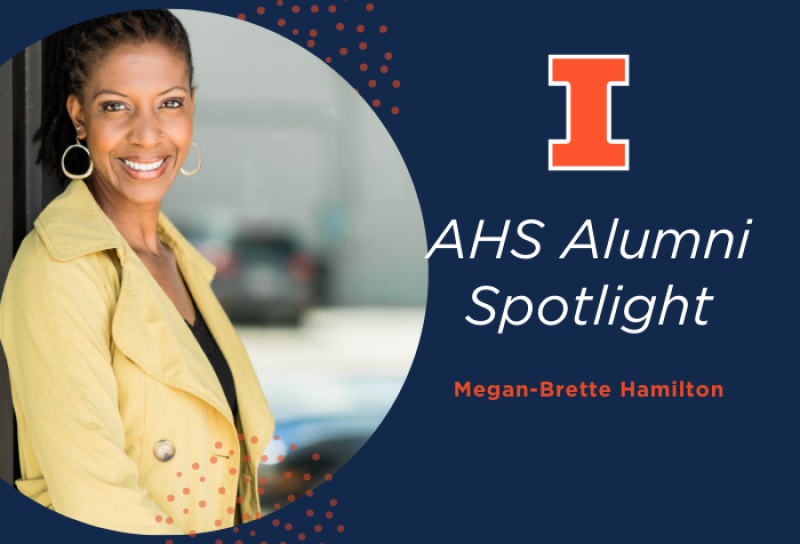
Alumni of the College of Applied Health Sciences have myriad career options thanks to the tremendous diversity of programs. We periodically will put the spotlight on an alum to find out what they’re doing now, what experiences they had and what AHS means to them. This week, we talk to Megan-Brette Hamilton, an SHS alum who is now an assistant professor in the Department of Speech, Language, and Hearing Sciences at Auburn University.
Q: Why did you pick SHS?
A: I remember writing my personal statement in 2011 and, as you do, you write the first part as a general statement and then address a specific school for the latter part. As I was writing the latter part of my personal statement for University of Illinois, I realized how much the school aligned with what I was looking for; reputation, professors, university campus setting. It helped that my aunt, someone who had been in the field for decades before me, encouraged me to choose UIUC, and that both of my parents earned degrees from UIUC. Finally, I got advice from a professor at another university to choose my program according to the person I was going to work with for four plus years. And then I found (former SHS Associate Dept. Head) Laura DeThorne. I emailed her, she and I had a phone conversation and I became excited about the work she was doing in her lab and the idea of learning from her. After that, I was convinced I needed to go to AHS/SHS. From day 1, Dr. DeThorne was a strong advocate for me and as a result I received the Graduate College Distinguished Fellowship Award. To be honest, not having to pay for school, that also helped me make my decision.
Q: Which professors had the most impact on you?
A: As I mentioned before, Dr. DeThorne was an advocate for me from day 1. She wasn’t just my advisor, she was someone who valued my clinical background and my prior experience. We eventually formed a very strong friendship and collegial relationship, and we still collaborate. I also was impacted by Dr. Julie Hengst. Not only was she a committee member of mine for 2 of my projects, but because she also had an extensive clinical career before academia, she was able to speak to me in a way that disarmed me about leaving a job where I was a master clinician to re-learning how to be a student. Dr. Robin L. Jarrett was also someone who has had a huge impact on me. I worked in her lab in a different department across campus. In order for me to be the kind of researcher I am today, I needed to learn other ways of doing research from her perspective. The field of CSD often uses quantitative methods and is predominantly White. Working with Dr. Jarrett helped me to learn about qualitative methods from a sociological perspective and understand academia from someone like me, a Black woman, who also was a full professor. Finally, working with Dr. Cynthia Johnson made a long-lasting impact on me. She was a constant source of encouragement as a growing researcher and I learned first-hand from her about how our field and academia had changed throughout the years.
Q: What course did you most enjoy?
A: You have to remember that I earned a degree that allowed/encouraged me to explore classes in other departments. The way I look at my journey at that stage of my life was to take what I knew about my field in the 17 years I’d been in it and then add to it other content areas to enhance the impact I wanted to have on the field of CSD. All that to say, Language, Identity, and the Politics of Schooling taught by Dr. Anne Haas Dyson in the College of Education was a course I really enjoyed. I loved this course because it brought together all of the areas I was passionate about, language, culture, education, and communication. It was a class that wasn’t afraid to talk about race and class and dialects. And it used qualitative methods:) It reminded me why I decided to return to school at the ripe old age of 34, lol.
Q: Did you enter AHS knowing your career path, or did AHS help you decide?
A: As I mentioned earlier, I entered into the PhD program at age 34, after having had a first career as a practicing speech-language pathologist. I entered the program knowing that I was going to have three outcomes; 1) I was going to learn about some amazing content areas that I’d never been privy to, 2) I was going to learn how to do research, and 3) I was going to earn my doctorate. After that, I wasn’t sure what I’d do. I think being in the program prepared me well for my next steps even though I wasn’t sure what they’d be exactly. I ended up going into academia and constantly call myself “the accidental professor,” lol. I also didn’t know where my research focus would end up when I first started. I originally entered the program to study language processing differences with a concentration in cognitive neuroscience and ended up studying cultural-linguistic diversity with a focus on African American English. To be honest, being in the program helped me see a gap in our field that I could fill, so that’s what I’ve been working on ever since.
Q: Did your AHS experience lead to your current job?
A: Yes. I earned a doctorate from a research-intensive university in a department where I was taught how to do research and provided opportunities to teach and supervise. The skills I acquired in the program, including opportunities across departments and disciplines, allowed me to confidently apply for a tenure-track assistant professor position; which is my current job.
Q: What was your favorite on-campus experience?
A: As a daily enjoyment, I really loved working with my PhD classmates. We were from all different backgrounds and studied so many different areas of communication. We learned so much from each other about life and our field. As a one-time kind of experience, I have to say that it was when I ended up working with a wonderful group of doctoral students from the College of Education and being awarded an internal grant. We used it to put on a 2-day workshop aimed at reimagining education for youth in and beyond the classroom. We brought in Drs. Geneva Smitherman, Ana Celia Zentella, H. Samy Alim, and David E. Kirkland. I loved being around all of those intellectual minds and inserting my communication sciences and disorders perspectives into their conversations of education and language.
Q: What does AHS mean to you?
A: I saw AHS as a place that provided me with opportunities to connect with a variety of people and to grow as a researcher and educator. As I said earlier, I originally entered the program to study language processing differences and ended up studying cultural-linguistic diversity. The beauty is that AHS was a place that allowed me to do either. As a result, I was able to become a researcher with a strong interdisciplinary focus who impacts clinical practice within the field of speech-language pathology and beyond.
Dr. Megan-Brette Hamilton is an assistant professor at Auburn University and an ASHA certified speech-language pathologist (SLP)/communication specialist. Prior to academia, Dr. Hamilton worked as an SLP for 10 years in New York City, the largest school district in the U.S., where most of her caseload consisted of African American and Hispanic children. Currently, her research focuses on the classroom/educational and clinical experiences of speakers of other dialects of English, with a particular focus on African American English-speaking children and adults. Her passion lies in exploring the intersection of culture, language/dialect, communication, and literacy. Dr. Hamilton’s work also focuses on the cultural-linguistic competence and perspectives of professionals and students working with culturally-linguistically diverse populations. Through her work, she engages with such professionals by educating them on the importance of recognizing and validating language variations, culture, and identity; thereby raising one’s cultural-linguistic competence. Dr. Hamilton is the host of the Honeybee Connection podcast, author of Successful Strategies for Classroom Communication, and owner of www.meganbrettehamilton.com where she blogs and provides resources.
Alumni of the College of Applied Health Sciences have myriad career options thanks to the tremendous diversity of programs. We periodically will put the spotlight on an alum to find out what they’re doing now, what experiences they had and what AHS means to them. This week, we talk to Marilyn Adibu, a KCH alum who is now at IT consultant.
Q: Why did you pick AHS?
A: I chose AHS because it provided me with the academic and professional knowledge and skills to pursue my career opportunities.
Q: Which professors had the most impact on you?
A: The professors who had the most impact on me were Dr. (Susan) Farner and Dr. (Reggie) Alston (my advisor).
Q: What course did you most enjoy?
A: I enjoyed my Health Administration, Rural Health (Special Topics), Introduction to Medical Ethics, Health Services Financing, and Community Health Organizations.
Q: Did you enter AHS knowing your career path, or did AHS help you decide?
A: AHS helped me decide. I also joined a program called I-LEAP.
Q: What was your favorite on-campus experience?
A: One of my favorite on-campus experiences was going to sports games (wrestling, volleyball, hockey, etc) as well as attending the AHS Alumni Speaker Series.
Alumni of the College of Applied Health Sciences have myriad career options thanks to the tremendous diversity of programs. We periodically will put the spotlight on an alum to find out what they’re doing now, what experiences they had and what AHS means to them. This week, we talk to Jamaal Rahman, a KCH alum who now owns and operates Burke Mill Chiropractic in Winston Salem, N.C.
Q: Why did you pick AHS?
A: I chose AHS because the program looked great! I loved the size of the program and it was very relevant to my career path which is chiropractic.
Q: Which professors had the most impact on you?
A: I would say Dr. (Marni) Boppart was one of my favorite professors at U of I period and Amy O’Neill was the best advisor that I’ve ever had. She was so great in my journey in the college.
Q: What course did you most enjoy?
A: That seems like forever ago, but I loved all of Professor Boppart’s classes and most labs!
Q: Did you enter AHS knowing your career path, or did AHS help you decide?
A: I knew that I wanted to be a chiropractor and decided on kinesiology as my major later due to the above reasons.
Q: Did your AHS experience lead to your current job?
A: My AHS experience gave me more of a thirst for knowledge. To this day I still continue to be a student of how the body works, moves and heals so that I can help every patient who steps in my clinic.
Q: What was your favorite on-campus experience?
A: I loved being around my peers all day. Labs were great! Who wouldn’t love working out for class! I still remember doing the VO2 test in class. Great memories.
Q: What does AHS mean to you?
A: AHS was the start of my career and helped further establish my passion for my field and bettering musculoskeletal help for my patients. Thank you, U of I and AHS!
Alumni of the College of Applied Health Sciences have myriad career options thanks to the tremendous diversity of programs. We periodically will put the spotlight on an alum to find out what they’re doing now, what experiences they had and what AHS means to them. This week, we talk to Sarah Beth Reno, an RST alum who is now Vice President of Guest Operations at Carnival Cruise Line.
Q: Why did you pick AHS?
A: I started my freshman year at U of I as a journalism major. But when I found out there was a major specifically for recreation, I immediately applied to transfer over. Growing up in a small town in Illinois, I always watched “The Love Boat” growing up. My dream was to leave small town and cold weather and work on a cruise ship. I really wanted my career to be fun. And I figured this was the path to get there.
Q: Why did you pick RST?
A: At the time, it was called Leisure Studies, so it took some courage to tell my friends and family this was my choice. And, when I went to visit someone at the college to talk about career opportunities, she informed me that “only magicians and comedians” work on ships. According to her, my career focus should be with the Chicago Park District. I’m sure she thought I was crazy when I asked her what that was (remember, I was from a VERY small town). Despite my lack of understanding, they let me in. I forged ahead, with the hope that a door would open for me somehow.
Q: Which professors had the most impact on you?
A: I had one professor that I will remember forever, and I lost track of him over the years (I know that’s a crazy thing to say in 2021). His name was Michael Phelan, and he made me and my fellow students feel we could do anything. We sat in his office for hours before and after class and talked about everything in life. He always told me that taking opportunities naturally leads to other opportunities. So, even if the job was not perfect—open the door and walk through it. That door will get you to another room (with another door or window) that may just be the opening to the perfect career. It was great advice. He also encouraged me to take an internship with the National Recreation and Park Association for a broader perspective. He was an amazing teacher, husband and father, and I will always remember his kindness and inspiration.
Q: What course did you most enjoy?
A: I’m too old to remember specific courses, but I enjoy all my courses because my professors were so much fun. Everyone was demanding but accessible, which I really valued. I always felt I found my home at AHS. I was no longer “lost” at a big university. This was a place I felt I could be myself and be appreciated for what I contributed.
Q: Did you enter AHS knowing your career path, or did AHS help you decide?
A: I was able to secure a job within the cruise industry through AHS. A recent graduate, Sally Evans, worked at Norwegian Cruise Line. She returned to interview students to work as youth staff onboard during high-season holidays. I secured a job as a teen coordinator onboard during my college breaks and continued within the industry ever since.
Q: Did your AHS experience lead to your current job?
A: The program Sally set up for us was an inspiration for me as my career progressed. When I arrived at Carnival Cruise Line’s Entertainment department, I worked with my team to set up an internship program for recreation students across the country. It was a big success, and many of the students secured full-time jobs within the entertainment department after graduation. I actually returned a few years ago to speak to AHS students about this opportunity. The students were so impressive and far more well-rounded than I ever was at that age. They knew what they wanted and were going for it.
Q: What does AHS mean to you?
A: Looking back to my college career, there were two, distinct benefits to being part of AHS:
1. The camaraderie everyone had with each other. The atmosphere was like working on board a cruise ship. Everyone was so different, but we all had the same “zest” for life. We all supported each other 100 percent—whether it be for a personal reason or to help with a class project. We were in it together.
2. The staff’s focus on true learning and improving yourself for a better future. I recall taking business and marketing classes where students were so competitive and hyper-focused on their grade-point average—people would calculate their grades at the end of each test. I was always perplexed by these hard-driving business majors, who thought I was crazy for majoring in Leisure Studies. In AHS, it truly was about the love of learning, doing your best and developing skills to forge your path in life. The professors taught us so much more than just the facts. I’m so grateful for their guidance.