AHS researchers adapt iPALS for the COVID-19 world


Nothing in 2020 has gone according to anyone’s expectations, because of the pandemic. But thanks to some adaptation and innovation from College of Applied Health Sciences researchers and their cross-campus collaborators, Champaign County schoolchildren are learning some new life skills.

The Illinois Physical Activity and Life Skills Wellness Program, or iPALS for short, engages children in kindergarten through fifth grade in both physical activity and nutrition instruction. But according to KCH assistant professor K. Andrew R. Richards, iPALS was forced to undergo a COVID-related makeover.

“What we’re doing now is not what we had intended to do,” he said. “We’d been funded on an Illinois State Board of Education grant to run a summer program, an in-person, face-to-face summer camp style program in collaboration with (Champaign) Unit 4 (schools) that was going to be hosted at one of the local elementary schools. And we’d have about 150 kids that would come and spend the day with us for five consecutive weeks. And so that was the original plan, but then COVID happened. And all of that went out the window.”

With summer programming canceled by the University of Illinois and the school district, Richards and his collaborators were faced with a choice of having to spend the money by the end of this semester or having to return it to the state.

“And so that kind of left us with this decision, do we want to return the money?,” he said, “Or do we want to find some way to do some good with this in the local community to help children and family in the time of this pandemic, when health, and nutrition, and wellness are perhaps even more important than they ever have been?”

That’s where some of Richards’ collaborators come in, including fellow KCH assistant professor Naiman Khan, and graduate students in KCH and the Division of Nutritional Sciences. For example, Richards credits KCH doctoral student Shelby Ison for developing multiple options for a fall version of iPALS that included some face-to-face elements as well as virtual and asynchronous plans.

Richards and Khan then worked with Champaign Unit 4 Schools Director of Student, Family & Community Engagement, Katina Wilcher, about opportunities to engage more with the community.

“We brainstormed schools that might benefit most, developed a framework, the two agencies co-wrote a grant, and here we are,” Wilcher said in an email. “Of course, we had to adjust due to COVID, but the University did an outstanding job coming up with an alternative virtual program that is going well.”

IPALS has existed at UIUC in some form since the 1950s, Richards said, and at one point was called the Sport Fitness Program. It was once a multi-activity sport program, but Richards et al recognized iPALS needed to be more responsive to wellness in a broader sense. So, while there continues to be a physical activity component, they’ve added a social and emotional learning component, and a nutrition and wellness component.

Annabelle Shaffer, a master’s student in the Division of Nutritional Sciences, helped craft the nutrition element, part of which involves videos.

“They’ll get a video … basically just why you should hydrate,” she said. “What types of drinks are best for hydration, things like that. And then for their activity they’ll be provided cooking video that we’re making in collaboration with the ARC Instructional Kitchen, who has primarily dietetics and human nutrition undergrads teaching the courses. So they’ll create the cooking class video with the recipes given to them. And also we provide all the food for the kids with the socially distanced pickups.”

One-hundred and 10 children are participating in the program, which runs until Nov. 12. For the cooking program, they receive a set of child-safe knives, a spatula, their own mixing bowls, their own measuring spoons and cups.

“We wanted to be able to engage them in both physical activity and nutrition instruction,” Richards said. “But because we’re targeting primarily communities affected by poverty, we didn’t want to have to rely on them to have things that they were going to need.”

The researchers stressed that parents are involved in most aspects of the program, while still allowing their children to have creative freedom.

“Our current program is six weeks long, and each week students participate in three virtual activities through platforms such as Flipgrid and Edpuzzle. Each of the 3 activities have a different objective,” Ison said. “Activity 1 is designed to facilitate peer-to-peer social and emotional learning, Activity 2 is meant to educate children on physical activity and nutrition, and Activity 3 is the application of the learnings from Activity 2 where students work with their family members to complete a physical activity or nutrition activity or challenge.”

Khan, whose research interests focus in most part on nutrition, said one set of research outcomes would be “qualitative and getting an idea of the experience of the children participating in the program. We have an interest in our lab with physical health and mental and cognitive health in kids. So the Fitbits, for example, will be used to assess students’ physical activity.

“We’ll use a survey approach for them to report their nutritional intake. There’s a survey also on nutrition literacy that we’ve concluded to get an idea of their knowledge of foods and healthy eating. And some additional surveys that we have in place for understanding the home environment, in terms of just commotion and chaos in the household, some demographic information.”

The researchers plan to replicate iPALS next summer, although they’re uncertain if they’ll be able to host children in person. But they certainly hope for bigger grants as they go forward.

“If we were able to use what we’re learning and down the road leverage that towards larger, perhaps federal grant structures, then that might be able to set us up so we’d have funding for consecutive years,” Richards said.

“I feel like we’re in a position now, having been through this, where we won’t be going into that blind and trying to create the wheel while we’re driving the car. We’ll have the car created. And we can just gas it up along the way.”

Editor’s note:

To reach Vince Lara-Cinisomo, email vinlara@illinois.edu.
 

Related news

Bleakney and collaborators want to disrupt the wheelchair market


Illinois’ wheelchair track coach Adam Bleakney leads a cross‑campus team of engineers and designers from AHS and Grainger in testing PURE, the innovative hands‑free robotic wheelchair prototype aimed at “disrupting the wheelchair market” (Photos by Michael Hansen)

As coach of the Illinois wheelchair track team, Adam Bleakney knows about the chronic overuse of shoulders and elbows by his athletes. But as a daily wheelchair user himself, he also knows about the challenges of navigating life.

So Bleakney and his colleagues from Disability Resources and Educational Services, as well as cross-campus collaborators from the Grainger College of Engineering, and the College of Fine + Applied Arts, embarked on a plan to disrupt the wheelchair market.

“We wanted to design something that would break the mode of traditional wheelchairs, which has been essentially a chair supported between two large drive wheels with two casters, and has not changed since the first patents awarded in the 1860s,” said Dr. Elizabeth Hsiao-Wecksler, a professor in the Department of Mechanical Science and Engineering in the Grainger College of Engineering and the principal investigator on a project that recently received a $1.5 million grant from the National Science Foundation under the National Robotics Initiative program to develop a wheelchair that will provide individuals with a physical disability a new and novel mode of mobility.

The project, called PURE (Personalized, Unique Rolling Experience) offers users hands-free movement using an interactive and adaptive robot that is uniquely personalized for each user.

Hsiao-Wecksler said the project was started in 2018 in response to the call for “radical improvements in the mobility and independence of people with lower-limb paralysis through smarter assistive technology” by the Toyota Mobility Unlimited Challenge.

Bleakney had worked with Toyota on a previous project, so he was intrigued by the opportunity, and he spoke with then-DRES director Dr. Pat Malik, whose husband, Ron, is a daily wheelchair user.

“The intent was to achieve an interdisciplinary effort, to combine the tradition and knowledge we have at DRES and AHS as leaders in disability access with the incredible resources that exist across campus,” he said.

“And Pat, Jeannette Elliott, Arielle Rausin, and I each bring a unique and personal disability experience perspective to the project. Pat, who’s married to a daily wheelchair user; Jeanette, who in addition to being the physical therapist at DRES uses a prosthesis and manual wheelchair; and Arielle and me as daily wheelchair users.”

Hsiao-Wecksler was asked to join the team since she had been working on hardware design of devices to assist people with disabilities and also wheelchair technology.

“I have worked on both wheelchair propulsion biomechanics with (KCH faculty) Jake Sosnoff and Ian Rice, and wheelchair wheel development with IntelliWheels, Inc., which was a local start-up that I, Jake Sosnoff, and our graduate students created.”

Three mechanical engineering graduate students—Chenzhang Xiao, Yinan Pei, and Yu Chen—worked on PURE prototypes, and Dr. William (Bob) Norris of Grainger, of Grainger (ISE faculty) who has expertise in control of autonomous vehicles and robots, was brought on as a co-PI. Dr. João Ramos, also of Grainger (MechSE faculty) and with experience with design and control of robotic devices, was added for the NSF proposal.

Illinois’ project reached the top 10 out of 80 applications for the Toyota Challenge. Bleakney and project co-PI Dr. Deana McDonagh of FAA represented the team in London for the competition, but only the top five submissions were funded.

Illinois’ team was unbowed and continued to move ahead, knowing it had a good idea.

“Without question everyone on the team recognized the value of the project and the need to look for funding opportunities to continue working on it,” Bleakney said.

“The traditional manual wheelchair needs to be reimagined,” McDonagh added.

Although Bleakney works with some of the best wheelchair athletes in the country, including multi-marathon winner Daniel Romanchuk, he knows there is a broader application for PURE.

“It’s (for) all daily wheelchair users and other individuals with a lower limb mobility impairment. So we do envision that it would be a mobility device that can be used by both daily wheelchair users and others that don’t necessarily always use a wheelchair but would perhaps use some other some other form of accessible mobility in certain situations.”

The device’s name—PURE—came about as a result of a team meeting, Hsiao-Wecksler said.

“We wanted to express the organic and pure nature of using lean-to-steer technology to propel the device, rather than requiring constant occupation of the hands such as with a manual wheelchair,” she said. “This mobility device will utilize personalized driving calibration to accommodate different trunk function abilities and custom seating of each user. The design is a uniquely different mode of rolling instead of the traditional wheelchair with two drive wheels and castors. And it will be a wonderful mobility experience for the user.”

The traditional manual wheelchair needs to be reimagined.

Deana McDonagh

Professor of Industrial Design in the School of Art + Design

The PURE design plan describes it as “discreet,” which McDonagh said refers to “seeing the person before the chair—which translates to seeing the person before the disability.”

Hsiao-Wecksler added that PURE’s footprint is “smaller than a manual wheelchair’s, being no larger than the user’s body dimensions while seated, providing access to smaller spaces such as inaccessible public restroom stalls.”

Bleakney also stressed PURE’s ability to address long-term health and wellness and safety.

“We look at how can we decrease acute injuries that may occur from falling,” he said.“And we wanted to mitigate that risk, but also mitigate the risk posed to the shoulders from pushing a wheelchair around on a daily basis.”

And McDonagh said, “health is not just the absence of disease. Health is connected with one’s sense of independence, mobility and ability to live the life you need to live. This device will enable the user to traverse a more diverse terrain while holding a coffee in one hand! Or holding the hand of a loved one. We are blending the functional with the emotional needs of real people.”

A prototype of PURE was developed for the Toyota Challenge in 2018, but since it had rather inexpensive components, it could only support a payload of 25 pounds. A second-generation prototype is in the works, one that can support a rider up to 250 pounds and operate on level flooring.

Thanks to the NSF grant, plans are in the works for more development of the second-gen device and then a third-generation chair with more advanced control. Eventually, the researchers see commercial opportunities, and recently submitted an application to the U.S. Patent and Trademark Office.

“We think the value is transformative enough that it can be used by not just daily wheelchair users, but also by a broader audience,” Bleakney said. “Envision being at Disney World. And instead of hundreds of three-wheeled scooters being driven around by folks needing mobility assistance, PURE is being used and providing a much more inclusive and fulfilling experience. So I think it has a fairly broad application to a lot of different individuals who would benefit from it.”

Editor’s note:

To reach Vince Lara-Cinisomo, email vinlara@illinois.edu.
 

Related news

Alumni Spotlight—Skylar Peters


Q: Why did you pick AHS? ​

A: I knew I wanted to choose a master’s program in the Parks and Recreation Management field. I am passionate about outdoor and environmental education and the use of our public land to encourage outdoor exploration, especially in the younger years. While exploring online options for master’s programs with that in mind, I came across this program at University of Illinois. After speaking with Tim Tiger, the academic advisor, I knew that AHS was the place for me! I am so grateful I chose this program!

Q: Which professors had the most impact on you? ​

A: Because I completed an online master’s degree so I could work full-time in Extension, I wasn’t able to meet any of my professors personally. They all were wonderful and understanding of our schedules as adult learners and often were graceful when we turned in late assignments. I was always so thankful for that! My advisor, Tim Tiger, had a huge impact on me, he had so much confidence in my abilities and was so supportive that it made the online process a lot easier and more enjoyable! I am very grateful for him and all that he does for his students!

Q: What course did you most enjoy? ​

A: I really enjoyed my first class I took, which had me exploring the start of parks in the United States. It set a solid foundation for me to remember the “why” in our goal in parks and recreation programs. When you can understand and appreciate the history behind your passion, it helps to support your goals and vision for the future.

Q: Did you enter AHS knowing your career path, or did AHS help you decide? ​

A: I entered AHS already working professionally as an Extension Assistant working with youth development and the 4-H program in Pennsylvania. AHS helped support my professional career so I could be promoted to an Extension Educator (my current role) and support the events and programming that I develop. I knew I had a passion for parks and recreation and knew that AHS would help me explore that passion while I completed my degree. Because of AHS, I know my future career options are wide open in both the agriculture and parks fields. 

Q: Did your AHS experience lead to your current job? ​

A: My master’s degree and the work I did in AHS aided in my promotion to Extension Educator. In AHS I refined my research abilities and my evaluation skills to finish a project that directly impacted the work I was doing in Extension. Without AHS, I would not be where I am professionally. 

Q: What was your favorite on-campus experience? ​

A: Because I completed an online master’s degree, I only have one experience on campus. I was lucky enough to be able to make the trip to receive the Outstanding Online Masters Degree Student Award before I graduated. I explored campus, tried local favorites and was able to meet my advisor in person! It was a great trip!

Q: What does AHS mean to you? ​

A: AHS means the opportunity to explore my passion, challenge my thinking and develop new ways of thinking about the industry that is near and dear to my heart. AHS means establishing a future for myself while supporting my professional career. AHS was a chance for me to learn more about myself and my capabilities and learn from peers in the field. AHS was a chance for me to grow and become a better educator. 

Editor’s note:

To reach Vince Lara-Cinisomo, email vinlara@illinois.edu

Related news

Exercise Is Medicine Is Gold For Illinois


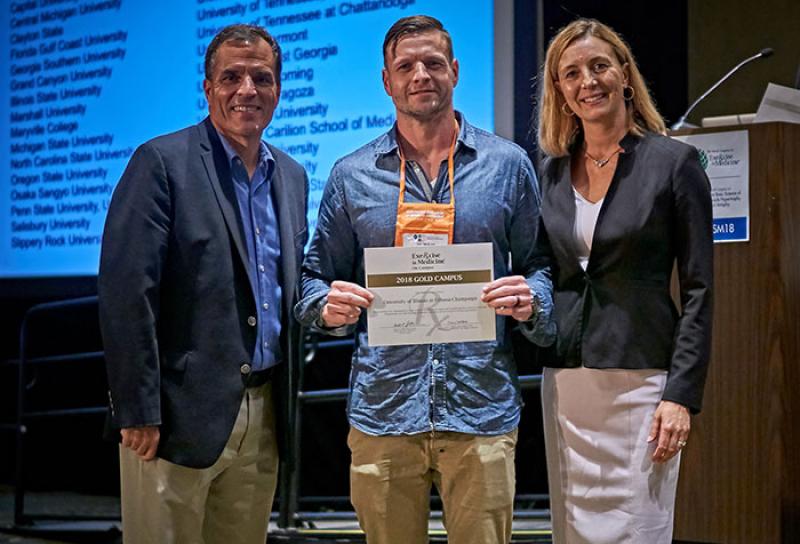
Nick Burd, center, is chair of the Exercise Is Medicine—On Campus committee (Photo provided)

The Illinois Exercise is Medicine—On Campus initiative has been recognized by the American College of Sports Medicine as a gold-level campus. UIUC is being recognized as a healthy academic environment, with physical activity and exercise opportunities and the commitment to create a culture of wellness on campus.

By encouraging faculty, staff and students to engage in regular physical activity and exercise, EIM-OC is positively influencing the overall health of the community. A focus of the initiative is to make movement a part of the daily campus culture, assessing physical activity, and giving students tools to build good physical activity habits, said Alana Harris, Associate Director Assessment, Student Wellness, and Adventure Recreation at Illinois Campus Recreation, who was a member of the founding committee at Illinois in the fall of 2017.

“It is creating a space and a place for students to see all of the different ways they can engage in physical activity and find things they enjoy doing,” she said. “We serve as a hub for all of the things related to physical activity and exercise that are available as resources and services to students on our campus.”

EIM-OC at Illinois has members from across campus and the community, with representation from the following areas: Kinesiology and Community Health, Campus Recreation, Counseling Center, McKinley Health, Christie Clinic and the Kinesiology Students Association. KCH assistant professor Nick Burd is the committee chair, and other members include Harris, Dr. Scott Paluska (Christie Clinic), Felicia Fordyce (McKinley Health), Deidre Weathersby (Counseling Center) and Alexis King, who is serving as the grad student representative.

The program serves multiple objectives: relationship builder, recruiting student participants for other programs, and spreading the word on important topics of wellness. The committee is designed as a mix of professionals and students to engage listeners in different ways, as well as provide experience to student facilitators.

“Everybody was working independently with the same common goal of improving the health and well-being of students and faculty,” Burd said. “And  this was an initiative to integrate us, people who have the same common goals—students and professionals on campus—to work together, to promote all of these great programs that we certainly have on campus. And that, I think, encompasses what EIM is.”

Harris agreed.

“We were doing great things already, but the recognition requirements state that your campus health center must discuss physical activity at health appointments. By simply asking students, during intake, at the McKinley Health Center if they are achieving the recommended 150-minutes of moderate intensity physical activity weekly we are building awareness and potentially giving a cue to action,” she said, “Something simple but potentially very impactful. We have partners at the Counseling Center who are represented on this committee … mental health is another new area of emphasis for this committee. And so we invited colleagues from the Counseling Center last year to assist in having conversations with students about the benefit of regular physical activity on mental health and cognition. Just recognizing that physical activity isn’t just for students who are already in good health, but that it has a positive impact no matter where you are on the health continuum and that your gateway to a more active lifestyle could be through many different doors on this campus.”

One of the main functions of the EIM program is making movement part of campus culture, but Burd and Harris were quick to point out that physical activity and exercise are different.

“Some of our initiatives have been around active transport,” Harris said. “So, building physical activity into your day. There is a deep pool of research supporting the benefits of moderate intensity exercise on health outcomes, but reductions in sedentary time and the accumulation of short bouts of physical activity throughout your day are also shown to have positive health effects. As part of our initiative, we encourage people to walk when they can, to ride their bikes when they can, and to engage structure moderate intensity exercise at the ARC if that’s what they enjoy.”

Harris says that as part of EIM month, in October every year, that the committee and Kinesiolosy students regularly set up activities on the quad.

“As students pass by on their way to class, we engage them. We bring Frisbees, soccer balls, skipping ropes, and footballs, and we had all different ways to ‘play’. We talk to them about opportunities on campus and the benefits of finding activities they enjoy doing to accumulate the recommended physical activity that they should get in a day, and that there are a lot of health benefits to that if that’s what you can fit in.”

But the part that “bumped us up into gold-level status” was the assessment piece, Burd said. “The first step of our assessment piece occurs at McKinley Health, where students provide information related to their physical activity levels, with the ultimate goal of McKinley Health to provide a referral system for students to increase their physical activity.” 

Harris said there is no formal assessment of activity levels, but added, “We’re focusing on awareness building and identifying gaps in opportunities. We’ve put out marketing and promotional materials about wearing activity trackers and set up free physical fitness assessments, again as cues to action. We encourage people to put prompts on their calendars every 60 minutes to get up and move until it becomes habitual.”

Of course, because of COVID-19, keeping people active when just going outside is fraught with issues can be problematic, and the Activities and Recreation Center on campus is closed.

But Harris said “we have really focused on maintaining our community through virtual opportunities. We have Illini Running and Illini Cycling intramural programs, where people are tracking and logging their participation. Our group fitness classes are being offered for free over Zoom, and in the fall we plan to continue virtual offerings via Facebook Live. So we’re looking at connecting people and creating community around physical activity and exercise in a virtual way. Students have been really positive about this and we would not have had this shift in programming without COVID 19. I think that outdoor space may allow us to continue to meet people where they are as well. Connecting exercise with being outside could prove to have positive impacts as well. But I think this next year will focus a lot on engaging people and creating communities virtually.”

Editor’s note:

To reach Vince Lara-Cinisomo, email vinlara@illinois.edu.
 

Related news

Can a wearable device combined with PT improve results?


A new publication from Kinesiology and Community Health assistant professor Manuel Hernandez looks at how use of a wearable device combined with physical therapy can improve patient results.

The paper, entitled, “Design of a Low-Cost, Wearable Device for Kinematic Analysis in Physical Therapy Settings,” was published in the June 2020 edition of Methods of Information in Medicine.

Hernandez said he hoped to learn if test subjects—who were from the Champaign-Urbana area—had a positive or negative experience with a novel wearable device, and to identify key areas for improvement in future versions of the device, so as to improve how well future wearable devices get adopted.

The wearable device, Hernandez said, was a standalone suite of sensors that track movement (using IMUs, or inertial measurement units), together with a power supply and mini computer (i.e., a Raspberry Pi), aimed at aiding physical therapy patients in improving exercise technique, through the classification of different upper extremity exercises, monitoring of progress, and biofeedback.

Participants were asked to complete nine upper-extremity exercises while wearing the device: Standing row; external rotation with arm abducted 90 degrees; external rotation; bicep curl; forearm pronation/supination; wrist curls; lateral arm raise; front arm raise, and horizontal abduction.

The aim, Hernandez said, is to validate the ability of the wearable device to accurately identify different upper extremity exercises using machine learning techniques and improve the ergonomics and usability of the device through further miniaturization, increased wireless connectivity, and development of a companion smartphone app.

“It is important to note that everyone is unique and will benefit from personalized care following an injury,” Hernandez said. “We hope that through the integration of smart devices together with evidence-based physical therapy practices, we can achieve improved rehabilitation outcomes, such as a higher restoration of function and speed up recovery, by providing an affirmation of exercise quality, feedback on progress, and minimization of re-injury.”

Related news

Expert Q&A: KCH’s Jeff Woods on COVID-19 and epidemiology questions


Jeff Woods (Photo by Jerry Thompson)

Q: What are some of the complicating risk factors of COVID-19?

A: There seem to be many conditions, including advanced age, that complicate the severity of SARS-CoV-2 infection. Others include cardiovascular disease, asthma, obesity, high blood pressure, and diabetes. Exacerbation of COVID-19 symptoms in those with underlying respiratory or heart problems is self-evident, but we do not know why other comorbidities make some susceptible to it. In addition, recent reports indicate that even young adults can experience hospitalization and severe symptoms. On the other hand, many others have tested positive without symptoms. Bottom line is that it is too early to tell all the factors that may make us susceptible to COVID-19 and it is too early to understand the mechanisms of why some condition increase or reduce severity. One factor that is always difficult to ascertain is the viral load of the inoculum that an infected person experienced. High loads should lead to more severe consequences. This is why wearing masks and reducing exposure to people via social distancing or reducing contact time is so important not just to prevent infection but also to lessen the viral load of exposure.

Q: The Spanish Flu erupted in spring, went dormant in the summer and then came back in the fall. Do you expect a similar pattern with COVID-19?

A: I do not think we know what to expect. This is a new virus we don’t know a lot about and comparing social dynamics as it relates to virus transmission across a century of time (e.g. comparing with Spanish Flu) is fraught with interpretive problems. The main reason that scientists believe that some viruses are seasonal have to do with living conditions—more people inside during winter, therefore greater chance of exposure and spread between people. In addition, some viruses are susceptible to light and humidity, both of which are lower in winter months thereby reducing fomite transmission.

Q: Dr. Fauci expressed hope for a vaccine within the next 6-8 months. But we haven’t been able to find a vaccination for the common cold. Is there any reason to have any greater hope for COVID-19 than we’ve had for these common diseases that have been around for decades?

A: Yes, I think so. The common cold has never shut down our economy before or caused significant human suffering or death. COVID-19 has. This fact alone has motivated much research and development regarding a vaccine. There is currently an unprecedented and well-funded effort to realize one or more SARS-CoV-2 vaccines in the near future. Scientists are also using different strategies, either targeting viral RNA or the ‘spike’ protein of the virus that increases the probability of success. That said, there are no guarantees in a war with a virus. One reason that you need an annual influenza vaccine is that influenza can mutate rather quickly. There is evidence that SARS-CoV-2 mutates more slowly, which is a good thing when trying to develop a universal vaccine against it.

Q: For people who have aging parents or relatives, how do we best protect them?

A: The best thing to do, at least until we get a successful vaccine, is to isolate them against potential infection. This means mask wearing and social distancing of at least six feet, but maybe more. This is important for older adults because their immune systems undergo senescence making the system less effective at combating pathogens or responding to vaccinations. If they get infected, there is a higher chance of a poor outcome.

Q: When will we know that the pandemic is lessening in the U.S.?

A: When the number of laboratory confirmed COVID cases (i.e. virus testing) drops and stays low for a significant time period. Symptom confirmed cases are not a great indicator because some people are infected and remain asymptomatic. Antibody tests tell us about individual exposure and in the case of some other viruses (e.g. influenza) indicates a certain level of protection from reinfection. However, at present, we do not know if antibody presence predicts protection against COVID. This big unanswered question needs to be answered.  In short, we do not know if prior exposure leads to protective immunity or whether people can become reinfected after an initial exposure.

Editor’s note:

To reach Vince Lara-Cinisomo, email vinlara@illinois.edu.

Related news


Alumni Spotlight—Grace Merrett


Q. Why did you pick AHS?

A. The majors in AHS center around serving others; I picked this college because I knew it would allow me to be surrounded by students and professors that cared deeply about taking care of their people. The small class sizes and ample group projects allowed me to build a deep and wide network of funny, intelligent, and loving friends and mentors that I am super thankful to still have today.

Q. When did you graduate and with what degree?

A. August of 2018 with a degree in Recreation Management, minor in Horticulture, Certificate in Leadership

Q. Which professors had the most impact on you?

A. Robyn Deterding and Jonathan Hicks: These professors really saw their students as people and genuinely cared about my passions and accomplishments. They were incredibly thoughtful and intentional about the content they taught and were able to foster classes that felt more like communities.

Q. What course did you most enjoy?

A. I found so much joy in a course called “Children and Nature,” which focused on the importance of green space for kids. Our final project was to create a program for kids in the outdoors. Mine was creating a garden bed that included all of the ingredients you would need to make salad (tomatoes, cilantro, garlic, onion, jalapeños). Fast-forward three years, and I was able to actually facilitate this lesson as a garden educator! Over the course of three months, we learned about what seeds need to grow, parts of the plant that we eat (did you know the part of celery that we eat is actually the stem?!), and gained knife skills in cutting our tomatoes and de-seeding our jalapenos to create what was seriously the most delicious salsa I’ve ever had. I was smacked in the face with real world experience during my time in the Community Recreation Planning course. We were tasked with partnering with a small town to facilitate a SWOT (strengths/weaknesses/opportunities/threats) analysis, and then put together a proposal to the town’s mayor on our recommendations. I was part of the leadership team for a parking lot-to-park renovation. Through this, I was able to explore my passion for graphic design by creating a digital 3-D model of our vision, and I lived out my once-dream of being a landscape architect, as I was responsible for choosing the specific trees and flowers that would best flourish in the space. AHS allows for so many opportunities for cross-discipline exploration!!

Q. Did you enter AHS knowing your career path, or did AHS help you decide?

A. I did not enter AHS knowing my career path—all I knew is that I liked being outside and working with people. My professors and advisors (shout out Patty and Lori Kay Paden!) encouraged me to reflect on other aspects of work I enjoy and I included “creating programs” and “hands-on work” to my list of things I like. Because of their encouragement to self-reflect, I sought out work with the National Park Service and worked 2 seasons as a park ranger and fell in love with informal education in the outdoors. I plan to go to graduate school in the fall to develop my educational philosophy and techniques.

Q. What is your current job?

A. After being a park ranger at Canyonlands National Park, I made my way to San Diego, Calif., where I work as a garden and cooking educator for two elementary schools. This upcoming fall I will be pursuing a Master’s degree in Education at the University of Washington to develop my educational philosophy and techniques.

Q. What was your favorite on-campus experience?

A. I have super-fond memories of eating Auntie Anne pretzels on the blue tables outside of the union, laughing the days away with my friends while colorful leaves sweeping across the union patio.

Q. What does AHS mean to you?

A. To me, AHS means dedication to improving communities through providing essential wellness opportunities.

Editor’s note:

To reach Vince Lara-Cinisomo, email vinlara@illinois.edu.
 

Related news

Alumni Spotlight: Lynn Bielski


Q: Why did you pick AHS?

A: I selected AHS because the Department of Speech and Hearing Science was part of it and had the major I selected. When I began my undergrad degree I wanted to become a speech-language pathologist. Later, I changed focus to audiology after taking a Hearing Science course with Dr. David Gooler.

Q: Which professors had the most impact on you?

A: I was very fortunate to work with many wonderful professors and clinical supervisors including Drs. Charissa Lansing, Ron Chambers, Cynthia Johnson, David Gooler, Lou Echols-Chambers and Carol Parker.

Q: What course did you most enjoy?/Did you enter AHS knowing your career path, or did AHS help you decide?

A: I began as an undergrad thinking I wanted to become an speech-language pathologist. Then I took a hearing science course with Dr. David Gooler, and I changed my mind. I learned more about audiology and realized the blend of anatomy/physiology, physics, neuroscience and clinical practice was perfect for me.

Q: Did your AHS experience lead to your current job?

A: Yes, the mentorship, training and experience I received from AHS and Speech and Hearing Science led me to my current position.

Q: What was your favorite on-campus experience?

A: This is so hard to answer! One of the most exciting experiences was watching the Illini beat No. 1 Wake Forest at Assembly Hall (Dec. 1, 2004). The energy was electric!

Editor’s note:

To reach Vince Lara-Cinisomo, email vinlara@illinois.edu.

Related news

AHS researchers get grant to study social engagement over video technology


OneClick’s software is similar to Zoom, but easier to use, says Wendy Rogers (Photo provided)

Never has there been a more important time to help older adults stay connected. A grant awarded to two University of Illinois researchers aims to advance that goal.

Kinesiology and Community Health professor Wendy Rogers and Speech and Hearing Science associate professor Raksha Mudar are the principal investigators of a National Institute on Aging (National Institutes of Health) Phase II Small Business Innovation Research (SBIR) grant.

The researchers are collaborating with OneClick.chat co-founder Dillon Myers on a study entitled, “Enhancing Quality of Life for Older Adults with and without MCI through Social Engagement over Video Technology.”  MCI refers to Mild Cognitive Impairment, which affects millions of older Americans.

The technology in question is OneClick video communication software along the lines of Zoom and Skype, but easier to use, Rogers said. 

“So, by definition, OneClick, you don’t have to download any software,” Rogers said. “If I want to engage somebody to participate in a meeting with me—I can send them a link. And they just click on that link, and they’re automatically into the system. And one of the things we did in our first phase was to optimize it for older adults, making sure that the icons and the language and the information that was presented was easy to understand by older adults with and without cognitive impairment.”

Myers and Rogers connected in a serendipitous manner. 

“I was interviewed on (National Public Radio) about a project we were doing,” Rogers said. “It was early stages on tele-health. And one of the comments I made was we may be able to connect people who are living alone or are at risk for social isolation to have conversations and to be engaged socially with other individuals. And Dillon Myers heard the interview on NPR and called me.”

It took about a year—“luckily he was very persistent,” Rogers said—but the two decided to work together. The original idea, which was funded by a Phase I SBIR grant, was to connect older people with and without mild cognitive impairment (MCI). Mudar got involved because of her expertise with mild cognitive impairment, and she was the lead investigator on an additional seed grant from Discovery Partners Institute that explored the use of OneClick for older adults of low socioeconomic status.

The Phase I SBIR included a small pilot study to make sure older adults with and without MCI could use OneClick on their own in their homes.

However, Phase II will be a much larger assessment, Rogers said.

“We’ll be doing a clinical trial to determine whether it actually improves social engagement and reduces feelings of loneliness for older adults, assessed for 120 participants, including people with and without MCI. Another component of the Phase II is partnering with agencies. We have three partners—Clark-Lindsey Village, CRIS Healthy-Aging Center, both in the Champaign and Vermilion County areas, and then CJE SeniorLife up in the Chicago area.”

Rogers said the work with community partners will focus on how agencies that support older adults can integrate OneClick to provide support services, and how they might find it helpful for serving their clients.

“It’s great that we have these community partners located in urban and micro-urban areas,” Mudar said. For example, within the greater Chicago area, the CJE allows us to capture the population, which is really diverse in terms of ethnic and cultural diversity. These three partners allow us to reach out to a really wide audience or a purpose-built group.”

The grant award totals approximately $1.8 million, with approximately $850,000 earmarked for the University of Illinois. The funding runs from May 1 of 2020 through March 31 of 2022.

According to research from the National Institutes of Health, social isolation and loneliness have been linked to higher risks for a variety of physical and mental conditions: high blood pressure, heart disease, obesity, a weakened immune system, anxiety, depression, cognitive decline, Alzheimer’s disease, and even death.

OneClick’s goal is to connect people with shared interests in an accessible way, thereby stimulating social connectedness, which has been found beneficial to health and quality-of-life outcomes for older adults.

Connectedness is more important than ever now as most of the globe is forced to shelter in place in the wake of COVID-19. OneClick is enabling people to sign up right now and use OneClick for free, during the pandemic, Rogers said, adding that the timeliness of this study could not be more apparent.

“Raksha and I have been interested in social engagement for older adults for quite a long time already,” she said. “And we recognize the importance of that for older adults and even more so, given today’s situation. And this technology is designed with their needs and capabilities in mind. We only wish we were even further along in some of this research so that more older adults could be using it right now. 

Mudar said one of the participants in the first study summed up OneClick perfectly.

The participant said “it’s like having a friend at the touch of a button.”

About OneClick.chat
OneClick.chat is a web-based video chat platform based in Philadelphia. The platform, designed by a cross-generational team, makes it easy for people of any age to join and participate in video-based meetings and events. No downloads, and no more logins. Just a single click from a computer/tablet/smartphone, and you’re in!
 

Editor’s note:

To reach Vince Lara-Cinisomo, email vinlara@illinois.edu.
 

Related news

Alumni Spotlight: Tiffany Wilkinson


Q: Why did you pick AHS?

A: The University of Illinois became a collegiate option when I was approached and offered a scholarship from the Wheelchair Basketball Program at the university. I am originally from Arizona, born and raised, and the thought of going out of state hadn’t crossed my mind until I was recruited to the program. I knew I had an area of focus I wanted to get into and when I did my research into the university it was very clear that the College of Applied Health Sciences was where I needed to be. I wanted to stay in the realm of health education and public health, as my goal transitioning out after college was to get back into the nonprofit sector because I believed in working with communities and helping to improve the quality of life of those who benefited from such organizations and services. After careful consideration and debate I knew I wanted to get into AHS and get my degree in Community Health because it closely matched what I wanted to pursue as a career after college.

Q: Which professors had the most impact on you?

A: This is a tough question as I loved all my classes, professors, and experiences at Illinois. But if I had to name a couple people here who had the most impact on me I would have to say for one, Professor (David) Strauser. I loved his courses and the enthusiasm, dedication, and passion he brought resonated with me. I conducted a research project with two other students under his supervision for one of our courses. I love research, data analysis, and statistics, and conducting our project, and getting to present it at the Symposium on campus, was one of the highlights while I was there. He supported what we wanted to do, what areas we wanted to focus on, and guided us to do our work and due diligence during the whole process. It was a valuable learning experience but it was also fun at the same time. And that research project, which was based in the disability community, helped provide another lense to what I was doing and where I wanted to go. His courses truly helped shape the path I wanted to continue on and I am forever grateful for those experiences. He was definitely one of my favorite professors on campus. To this day I work within the disability community, and have been for several years, and I have to thank him for what I learned in his courses but for also grounding even deeper my passion for wanting to work within the disability community as well. 

I also want to make mention of two other amazing people, my academic advisors, Christopher Cosat and Carol Firkins, as they probably were two of the most hands-on and supportive people on campus. I cannot express enough gratitude for those two advisors in the College of Applied Health Sciences. They were fantastic at supporting me, keeping me on track for graduation, advising what classes I should take and what semester, advice on professors, you name it. Besides them being extraordinary at their job, they were both kind, caring, and compassionate. They went above and beyond to help students and showed me such heart and warmth during my time there that I can’t say enough about them. There were several occasions where I struggled, lost two grandparents in the same year and was away from family, and I could turn to them, no questions asked, and they would listen to my struggle and offer as much help as they could. It isn’t just doing the job, but also caring about the human being who is a student, but also someone’s daughter or son, niece, brother, sister, whatever. And that is the side that made them two very influential people during my time at Illinois. 

I would also like to add that I had an incredible experience in one of my classes that has stayed with me since that day in class. It was Community Health 100, I believe, an entry-level course. And one day we had a guest speaker who came in to talk with us about cancer (that was the section we were on in the course). She was 35 years old, a wife, mother, daughter, and she had breast cancer. She was there to tell us her story and what she was going through. I remember it like it was yesterday and I will never forget it. She shared how her goal was to see her son’s fifth birthday, as the cancer she had was very aggressive. To see him get to five, I couldn’t even fathom that. Her strength, conviction, life experiences, all of that touched my heart. I don’t remember there being a dry eye in the classroom that day after she shared her story. And at the end she said she was leaving us and going to get a double mastectomy at the hospital right after. I was just blown away that this brave woman took the time out of her life to come talk to us, share her story, right before having a life changing surgery. That to me was one of the most incredible experiences I had on campus in that sense and forever grateful to my professor (I can’t remember his name) that he did that for us. 

These are the reasons why Illinois stands out to me and why I know deep down I made the right choice going to the university and choosing the College of Applied Health Sciences. It was these experiences, and individuals that still shape who I am today since I graduated. And as I have said, I am forever grateful for them and my time at Illinois.

Q: What course did you most enjoy?

A: It is really tough choosing just one course that I enjoyed the most. In response to a previous question I did make mention of one day in a course that has stayed with me, the guest speaker we had. But it is hard to choose just one course overall as each one taught me something different and my experiences were also unique in each one as well. But one course that did stand out the most for me was REHB 402: medical aspects of disability with Professor Strauser. During the semester we had the opportunity to study and become more familiar with various physical, mental, and cognitive disabilities and what they look like for those individuals in the community who have them. I found the class very fascinating and highly educational. Plus it was a special area of interest for me as well. One part of the class I thoroughly enjoyed was when we got to work in small groups where we were given case studies and we had to diagnose (and) figure out what the disability was. The ones I found the most intriguing were disabilities that fell under mental health. The psychological side of those disabilities and how someone’s mind and brain manifests and changes was so intriguing. To this day I remember working on those case studies and it was one of my best learning experiences in a class. I am a hands on, experience, kinesthetic learner so when we got to work in groups and on projects like that it helped me turn what I learned knowledge wise into something applicable, by working on case studies and real-life experiences.

I also thoroughly enjoyed all of my other health education courses, as well as a couple of the kinesiology courses I had to take as well. I have always been fascinated by how the body and mind work, so when I had the opportunity to take all these courses related to that, and disability as a part of, I just dove right in.  I do have to add that one course I took outside the College of Applied Health Sciences was Sociology. That course also aided in my career path because I got to take a bigger look outside us as individuals and look at the community level and how we as humans fit into that. With my career goals post graduation of going to work in the nonprofit sector I knew that this course would also better prepare me on how to look not just at the individual but also the whole of the community and how we interact and intersect. To choose just one course is really hard as I could look back over my career at Illinois and give hundreds of examples of educational experiences I had in each course and what they taught me. But the ones mentioned above would have to be at the top of my list and most impactful courses I took. 

Q: Did you enter AHS knowing your career path, or did AHS help you decide?

A: As mentioned above, I had an idea of my career path going into AHS. I had some life/work experience under my belt prior to attending the university. I knew I wanted to stay in the area of community/public health with an emphasis on health education. But it did help me decide what I wanted my future to look like. I would also have to add that my internship at the Women’s Resource Center on campus also helped shape my future as well. (I am) grateful for that experience and what it taught me that semester in college. I had a passion for service, for helping others, and doing what I could to make this world a better place, one person at a time. And I found my passion within the disability community, but also within violence education and prevention as well. AHS helped foster that, along with my many other wonderful and educational experiences on campus. 

Q: Did your AHS experience lead to your current job?

A: I would say AHS did in fact help get me better prepared for the career path I have gone down. What I learned while attending the university gave me the tools, resources, and education to back up some of my previous experiences in the career force before attending the university. It also validated that I was on the right path and pursuing the right degree for what I wanted to do. Every position I have held post graduation has been supported by my academic success at the university but also my internship as part of my degree as well. Everything I learned from AHS, my professors, academic advisors, peers, has benefited me in some shape or form during my journey. 

Q: What is your current job?

A: My current job is Senior Public Health Research Associate with the company Empowerment Research, LLC based in Arizona. Dr. Susan Wolf and I provide training, education, and technical assistance to the community on brain injury and neuro-impairment. The courses and trainings we offer cover a variety of topics related to brain injury and how to support individuals in school, the workplace, and community. On top of those annual events we also do program evaluation and curriculum development, and consulting on other various projects. 

Q: What was your favorite on-campus experience?

A: I do not know how I can choose just one on-campus experience but since I have to, I would have to say my career being a wheelchair basketball player for the university would definitely be one of my highlights. Nothing beats playing a tournament on your home court. Teammates by your side, coaches supporting from the sidelines, the competition, the adrenaline, playing against a tough opponent, and that feeling of a big win. I was proud to be a student at the university, but I was even more honored to be a student-athlete and play the game I love. Those experiences from tournaments, to practices, watching film, developing a game plan, weight training program, all of it was incredible and made me feel even more part of the university. I cherish those moments and my time there and hands down some of my most memorable experiences were on that basketball court wearing orange and blue to represent the university.  I would also like to add that I am incredibly grateful on so many levels for the staff, coaches, athletes, student volunteers, athletic trainers, and overall support from the University and the Wheelchair Basketball Program. DRES was a second home for me and the love and support from everyone involved with the program was incredible. One person that always went above and beyond for every single athlete and student was Maureen Gilbert, and I want to say a special thank you to her for everything she did for me while I was there but for every other student as well. I am beyond grateful for her and the program is very lucky to have her, along with the amazing other staff and coaches. 

Q: What does AHS mean to you?

A: AHS means family, community, and a lifelong belonging to something bigger than us individually. I am proud to be a graduate of the University of Illinois but I am also incredibly proud to be a graduate from the College of Applied Health Sciences. The adventure I embarked upon by becoming a Fighting Illini is one of the best adventures in my life so far. I feel a humbling honor to be a part of a community of individuals that is out there doing their part to make this world a better place. I feel everything does happen for a reason, and the reason I ended up at Illinois was to help guide me to where I am today but also to where I am going tomorrow. 

Editor’s note:

To reach Vince Lara-Cinisomo, email vinlara@illinois.edu

Related news

College of Applied Health Sciences
110 Huff Hall
1206 South 4th Street
Champaign, IL 61820
(217) 333-2131