Proud To Be A Philanthropist


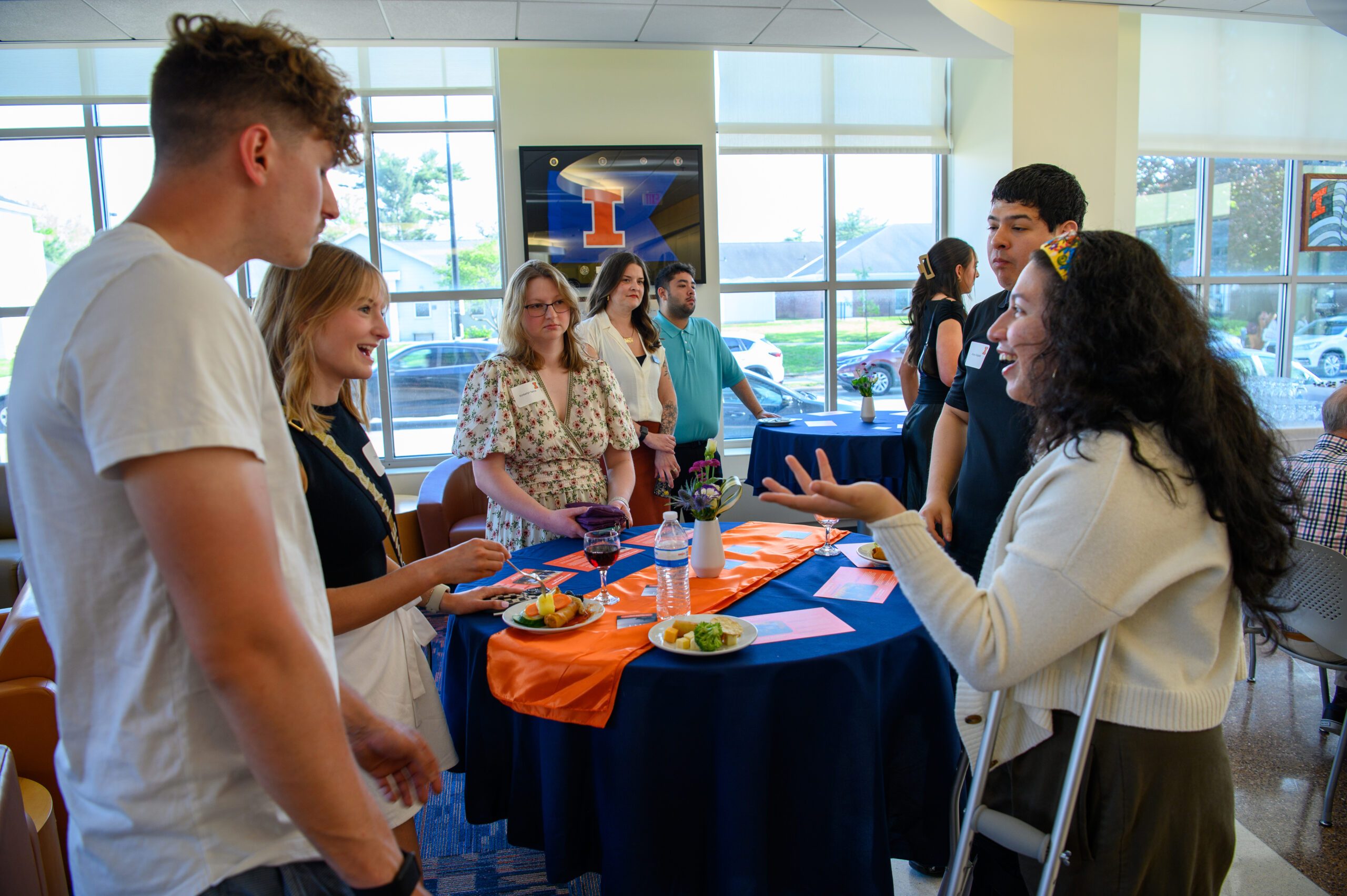
Mannie Jackson with AHS Dean Cheryl Hanley-Maxwell

Mannie Jackson has been lauded for his sharp business sense and entrepreneurial spirit. Of All his many achievements, however, Mr. Jackson says his most important is being a philanthropist.

Mannie Jackson has been lauded for his sharp business sense and entrepreneurial spirit. Of All his many achievements, however, Mr. Jackson says his most important is being a philanthropist.

From Boxcar to Boardrooms

Mannie Jackson was born and lived for three years in a boxcar in Illmo, Missouri. After moving to Edwardsville, Illinois, he became a stand-out player in basketball and earned a full scholarship to the University of Illinois. He and his best friend Govoner Vaughn were the first African American starters for the Fighting Illini and the first to earn varsity letters. Mr. Jackson also was the first African American team captain.

He went on to work and play for the Technical Tape Corporation, which had a team in the National Industrial League, before joining the Harlem Globetrotters. He followed his basketball career with a successful career in business, working first for General Motors and then for Honeywell, from which he retired as international senior vice president of marketing, administration, and logistics. At the time of his retirement, Mr. Jackson was serving on the Board of Directors of six Fortune 500 companies.

Giving Back

Mannie Jackson returned to the world of professional basketball after retiring as the first African American owner of a major sports franchise when he bought the nearly-bankrupt Harlem Globetrotters. He not only restored the team to international fame and fortune but also made it a leader in charitable giving.

Mr. Jackson endowed the Mannie L. Jackson Illinois Academic Enrichment and Leadership Program (I-LEAP) in the College of Applied Health Sciences, which provides academic and personal support services to first-generation and underrepresented college students. His gift to Lewis and Clark College helped to establish the Mannie Jackson Center for the Humanities.

In accepting the 2017 Distinguished Alumni Award, Mr. Jackson said, “I like being called a philanthropist. When you decide to be a philanthropist and you help others and improve the world when you go, the legacy and the memory of what your family meant to the world and what you tried to accomplish lives forever.”

Mr. Jackson is a two-time inductee into the Naismith Memorial Basketball Hall of Fame, as an owner and as a player. He was named Laureate in the Order of Lincoln, the State of Illinois’ highest honor. He also received the NCAA’s highest honor, the Theodore Roosevelt Award, and the University of Illinois Alumni Achievement Award, the highest honor bestowed upon alumni by the University of Illinois Alumni Association.

Share on social
Related news

Keeping Things In Balance


If it seems that falls are inevitable, there is good news: falls can be prevented if you know your risk level, where your weaknesses lie, and how to improve those weaknesses. The Illini Fall Prevention Clinic was created expressly to provide the surrounding community with the information and tools needed to prevent falls.

Custom-tailored Intervention

The brainchild of Dr. Jake Sosnoff, associate professor in the Department of Kinesiology and Community Health, the Illini Fall Prevention Clinic was founded on more than a decade of his research on neurophysiological and behavioral factors related to motor control and falling. In addition to healthy individuals of all ages, he has investigated issues related to mobility, balance, and gait in people with Multiple Sclerosis, chronic kidney disease, and spinal cord injuries.

“As a society, we tend to treat falls reactively and don’t become concerned until people suffer an injury, such as breaking a wrist or hip,” he said. “We are really good at mending broken bones, but we don’t really address the underlying causes of the falls. I have all this sophisticated equipment and the research results to show that we can help to prevent falls through an evidence-based approach, and I want to share that with the larger community.”

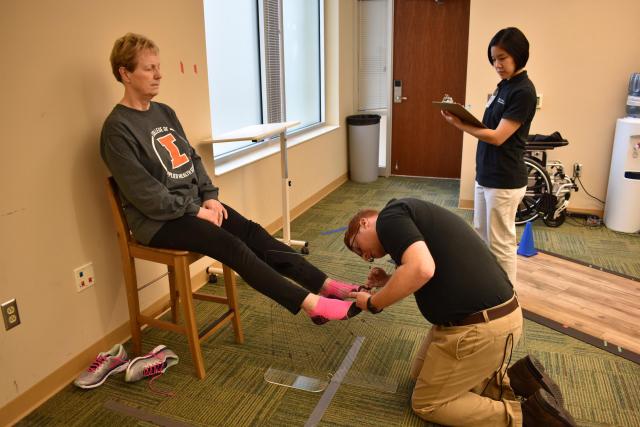
People who come into the clinic go through a four-part consultation that takes into account things such as balance, leg strength, vision, and body awareness. The measurements are suitable for all level of skills and functional abilities. Data from the various tests are compiled into a fall risk score and used to develop individualized prevention strategies to meet the client’s specific needs. Tyler Wood, a licensed athletic trainer and Ph.D. student who is the lead trainer in the clinic, says the main issues they see are deficits in lower body strength, balance, and reaction time.

“Based on each individual’s results, we work out an intervention plan tailored to their particular needs,” he said. “We give them a set of exercises that they can do at home, and we make sure they can do them properly before they leave the lab.” Clients are encouraged to return to the clinic six months later so that their progress can be measured and their intervention plans updated, if necessary.

Not only is the clinic providing potentially lifesaving screening, but it also serves as a learning opportunity for undergraduate students in the College of Applied Health Sciences to gain real-life clinical experience working with a diverse group of older adults. Currently, more than 15 undergraduates contribute to the clinic.

Extending The Reach

Because Dr. Sosnoff and his team recognize that not everyone can make it into the clinic in Huff Hall, they take the clinic to other venues such as retirement homes and churches when needed. Since opening the clinic in late spring of 2016, they have assessed the fall risk of more than 130 people in the surrounding community.

Working with his former doctoral students Doug Wajda, now an assistant professor of exercise science at Cleveland State University, and Jason Fanning, now an assistant professor of health and exercise science at Wake Forest University, Dr. Sosnoff developed a smart phone app that accurately assesses fall risk and provides personalized suggestions on ways to minimize risk. With support from the Collaboration in Health, Aging, Research, and Technology (CHART), the app was tested at Clark-Lindsey Village, a retirement community in Urbana.

Dr. Sosnoff’s team recently partnered with Dr. Sanjiv Jain of Carle’s Bone Health and Osteoporosis Clinic to test a new system that enables seniors to complete their own fall risk assessment without clinical oversight. Preliminary data suggests that the system accurately measures fall risk and that users enjoy it. His team is currently working on the system’s ability to provide feedback and individualized prevention strategies. Dr. Sosnoff’s overarching goal is to make falling avoidable rather than inevitable. “People come into the clinic because they’ve noticed changes with aging and don’t know what to do about them, or they bring in an aging parent or a spouse they’re concerned about,” he said. “We want to give them objective evidence that helps them understand what they’re dealing with, as well as concrete steps to promote functional independence and quality of life.”

For more information on the Illini Fall Prevention Clinic and its services, or to schedule an assessment, visit www.illinifallclinic.com.

here is a news quote as an example:

Here’s an edior’s note — feel free to remove it if it’s not needed! To show an example of what an editors note or model news layouts I’ll put some resources below:

Editor’s note:

To reach Nancy Averett, email naverett@illinois.edu.
 

Share on social

Related news

Toy Talk promotes language development


Research shows that the more language-rich interactions children have with their parents, the faster they learn words and the better they understand them. Toys can help facilitate language-rich interactions.

The quantity and quality of interactions between parents and children are critical in early language development. Research has shown that the more language-rich interactions children have with their parents, the faster they learn words and the better they understand them. The quality of the interaction is also important, especially in terms of the responsiveness to children’s attempts to communicate.

Responsive Labeling, Self-talk, Parallel-talk

Language interventionists have typically relied upon three main language modeling strategies when working with parents to increase their responsiveness. The rest, responsive labeling, occurs when the parent labels an object that the child is playing with, saying, for example, “That’s a baby.” In self-talk, parents describe their own actions with the toy, for example, “I’m rocking the baby.” Parallel talk involves the parent describing the child’s actions with the toy, for example, “You’re feeding the baby.” Research has shown that these language modeling strategies lead to increases in the vocabulary used by toddlers and the length of sentences they produce. Dr. Pamela Hadley and Dr. Matthew Rispoli, associate professors in the Department of Speech and Hearing Science, were concerned that the language modeling strategies did not do enough to increase toddlers’ development of syntax, or the way words are combined to form sentences.

“These strategies—responsive labeling, self-talk, and parallel talk—actually reduce the diversity of the words in the input to the child, especially in the number of different words that appear as sentence subjects,” Dr. Hadley said. “They promote pronoun subjects such as it, that, you, and I to the exclusion of vast numbers of possible noun subjects.”

Toy Talk

Pam Hadley and Matt Rispoli

To increase the number of different words appearing as sentence subjects during interactions with children, Drs. Hadley and Rispoli designed a new language modeling strategy they call toy talk. The strategy shifts parent-child talk during play from the interpersonal space, or what the parent and child are doing, to descriptive talk about the toy itself, such as its location, properties, or actions in the play environment. Parents also are taught to give the object its name.

“Consider a child holding a bottle to a doll’s mouth,” Dr. Hadley said. “Instead of responding with ‘That’s a bottle,’ which is labeling, or ‘You’re feeding the baby,’ which is parallel talk, the parent could say, ‘The baby likes her juice’ or ‘The juice is gone.’ That’s toy talk.” Both toy talk sentences have noun subjects rather than pronouns, a subtle shift, she notes, but one that creates opportunities for parents to produce more diverse sentences.

It sounds simple but, perhaps surprisingly, toy talk sentences with nouns in the subject position are rare in naturally-occurring conversations between adults and young children, Dr. Rispoli noted. “It is much more common for adults to ask children questions—‘Are you feeding the baby?’—or to direct their behavior—‘Give the baby more juice’—or to make descriptive statements using pronoun subjects—‘It’s all gone,’” he said.

Toy Talk Benefits

The challenge of language acquisition has been described as putting words together. “But maybe the challenge is pulling words apart,” he said. “When children consistently hear phrases such as ‘It’s a doll,’ ‘That’s a horse,’ and so on, the subject and the verb get chunked together. The child may not understand that ‘itsa’ and ‘thatsa’ are actually three separate words.”

With funding from the National Institute of Child Health and Human Development, Drs. Hadley and Rispoli evaluated the effectiveness of toy talk in a study that taught parents of toddlers how to use toy talk in both group and individualized coaching sessions over a three-month period. Their study demonstrated that not only did parents’ use of toy talk sentences increase following the instruction but also that their use of toy talk predicted children’s rate of growth in the production of diverse simple sentences and other crucial elements of syntactic development over the following six months.

“We think toy talk works, in part, because the diversity of noun subjects in parents’ input makes it easier for children to identify the boundary between a subject and a verb,” Dr. Hadley said. She and Dr. Rispoli emphasized that toy talk is not a replacement for other language modeling strategies. “Rather, it should be integrated with other strategies to interpret and expand children’s communication attempts and to model diverse combinations of words within simple sentence structure,” she said.

Because toy talk represents a relatively minor modification of familiar language modeling strategies, both scholars believe it can be incorporated rapidly into existing clinical practice.

Share on social

Related news

College of Applied Health Sciences
110 Huff Hall
1206 South 4th Street
Champaign, IL 61820
(217) 333-2131