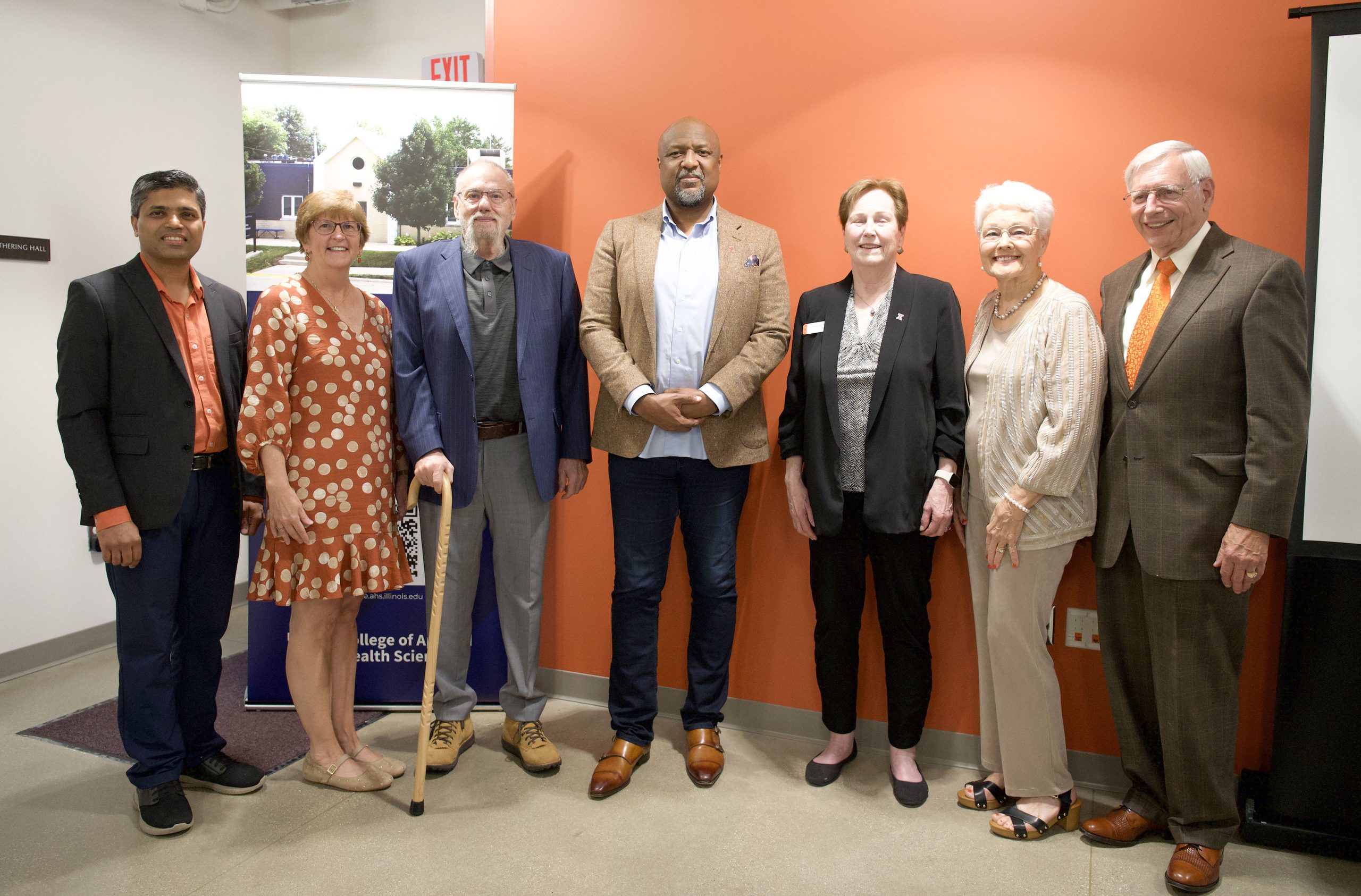
Kim Graber, Shahid and Ann Carlson Khan professor and head, Department of Health and Kinesiology (Photo by Craig Pessman)
Hello, Health and Kinesiology family,
Welcome to the spring 2025 edition of our newsletter! This marks our first spring semester under our new department name, officially changed last August. We have exciting updates to share and plenty to celebrate.
Inside, you’ll learn about the importance of specialized faculty, how digital-voice assistants support older adults and read about innovative research and a prestigious honor for our faculty. I hope this edition leaves you inspired by our collective impact and the momentum we’re building together.
Wishing you a successful and fulfilling semester!
Warmly, Kim Graber Shahid and Ann Carlson Khan Professor and Head, Department of Health and Kinesiology
Students, faculty and staff got a taste of the findings from AHS’ budding student researchers during the AHS Undergraduate Research Expo
Kinesiology juniors Elizabeth Martinez, center, and Aubrey Cervantes, left, present their research at the AHS Undergrad Research Expo (Photo by Ethan Simmons)
For a freshman at the College of Applied Health Sciences, Saiesha Bollapragada’s research portfolio is impressive.
At last week’s Undergraduate Research Symposium, the I-Health major got to present the results from her first research project, “Public Health Preparedness Among UIUC Students During Extreme Heat Conditions,” where she examined students’ awareness and handling of severe heat in the spring semester.
She completed her study with a push from Students Pursuing Applications, Research and Knowledge, or SPARK, an AHS program that jump-starts incoming undergraduate students research experiences by pairing them with professors in the college. Bollapragada was placed with Recreation, Sport, and Tourism Associate Professor Mariela Fernandez, whose experience with urban environmental injustices fit her research topic perfectly.
“Professor Fernandez motivated me to start this project on my own,” Bollapragada said. “There’s a lot more reading involved than I thought there was, it was a lot of work preparing for the symposium, but if it’s something you’re interested in it’s a fun process.”
Students, faculty and staff got a taste of the findings from AHS’ budding student researchers during the AHS Undergraduate Research Expo at Huff Hall on Wednesday, April 24, where a roster of undergraduates gave poster presentations on a diverse range of research topics.
Many students spearheaded their own research projects with significant support and guidance from faculty and graduate students. Others, like a group of Speech and Hearing Science students from the Intellectual DisAbilities Communication Lab led by Associate Professor Marie Moore Channell, provided updates on long-range research projects they’ve assisted with on campus.
Three SHS seniors, Emma Mueller, Abigail Keasler and Liz Gremer, presented initial findings from their glimpse into the Speech Accessibility Project, an ongoing research endeavor looking to make voice recognition software—such as Apple’s Siri or Amazon’s Alexa—more accessible for people with different speech patterns.
Each of the students has helped recruit participants with Down syndrome or aided vocal transcriptions from the samples they’ve collected. Under the leadership of Channell, the lab hopes to collect 240,000 voice samples from 400 participants.
“Our poster looked into the recruiting process with that population and took a look at patterns of articulation differences exhibited by individuals with Down syndrome,” said Mueller, who transcribed vocal samples for the project.
All three of the students met in Channell’s lab, and immediately found research responsibilities once the Down syndrome portion of the project came under Channell’s purview.
“It’s been very rewarding, very interesting and very impactful,” Keasler said. “A lot of families in meetings or over the phone say, ‘Siri doesn’t really understand what we’re trying to say,’ so this is very important and I can’t wait to see the results of it.”
Coming to a project affiliated with SHS with “so much publicity and so much money coming in is encouraging,” said Gremer, who has helped recruit participants and set up their first meetings for collecting voice samples.
AHS student programs, such as the first-generation focused Mannie L. Jackson Illinois Academic Enrichment and Leadership Program (I-LEAP), were well represented in the research symposium. I-LEAP juniors Elizabeth Martinez and Aubrey Cervantes, both studying kinesiology, brought results from their research collaboration on high-intensity interval training.
Working within KCH Professor Steve Petruzzello’s Exercise Psychophysiology Lab, the pair analyzed 25 participants’ emotional responses to high-intensity exercise, compared with their scores and symptoms of several mental health qualities: namely anxiety, depression and neuroticism.
“We were looking at exercise adherence—how can we get more people to get more active—and we were really interested in HIIT exercise, so we put it all together in one research project,” Cervantes said.
What they found: Participants with more symptoms of depression reported more negative affect responses during the HIIT exercise, while anxiety and neuroticism didn’t show significant predictive power, they said.
“This is my first hands-on [study] that I can call my own and Aubrey’s,” said Martinez, who’s applying to physical therapy schools. “My favorite part is meeting with the participants. It’s so fun getting to know everyone, even if there’s a lot more hours behind the desk just plugging and chugging data.”
Alicia Kraay’s study shows getting vaccine boosters and using non-pharmaceutical interventions can reduce cumulative deaths from COVID-19.
In a recent publication, Kinesiology and Community Health assistant professor Alicia Kraay and her collaborators write that combining boosters and non-pharmaceutical interventions results in a 30 percent decrease in cumulative deaths due to COVID-19, with potential for greater impacts if variant-adapted boosters are used.
Non-pharmaceutical interventions, or NPIs, include wearing a mask and social distancing, but also “surface decontamination and improved hygiene,” said Kraay.
According to Kraay’s publication, “The role of booster vaccination and ongoing viral evolution in seasonal circulation of SARS-CoV-2” in the journal The Royal Society, a rise in COVID-19 infection rates are expected this fall as the use of NPIs is relaxed.
“This year, we expect a fall surge, in part because we expect the transmission rate to be seasonal,” she said. “And we’ve also seen people have relaxed NPIs.”
Kraay attributed the decrease in NPIs in part to pandemic fatigue.
“Also, people’s different perception of safety now that vaccination is more widespread,” she said. “Some of the initial strategies that were proposed are simply not sustainable in the long term. It’s not really possible for elementary schools to do virtual learning only for the next 10 years. And there are issues with feasibility in certain contexts like elementary schools, with adequately distancing young children and getting perfect mask compliance.”
But Kraay wanted to emphasize that the important thing about NPIs is they’re not all or nothing.
“You don’t just tell people, ‘Oh, you need to stay at home now because cases might be increasing, and you should do nothing. That’s, I think, what happened at first early in the pandemic,” she said “You’re not going to get high compliance if you make recommendations like that. And it’s also not scientifically appropriate because not every type of interaction has the same level of risk. I think in order to get NPI compliant, it’s being clear about when NPIs are needed and when they’re not and what type is the most effective.”
Kraay, an infectious disease epidemiologist who did her undergraduate work at North Carolina-Chapel Hill and got her Ph.D. at Michigan, recommends wearing a mask in crowded situations you cannot avoid, and limiting appearances at large gatherings.
In terms of boosters, Kraay said ongoing safety studies will be important to ease concerns about vaccine safety, especially among parents.
“It’s going to be important to understand more about the impact of boosters,” she said. “In my paper, we assumed that boosters could reduce risk of infection. But the booster data hasn’t been fully analyzed yet. Seeing what happens with these variant-specific boosters and are there impacts in reducing transmission, and really quantifying how much it can help if you get boosted … at the population level, I think it could be useful.”
One thing Kraay remains uncertain about is whether the current pandemic has made the United States, and the world, for that matter, better prepared to handle the next global health crisis.
“I think we definitely have a better public health infrastructure, [but] I think there are still challenges from the health care access perspective. We know that there’s been a lot of new sources of funding that have been created to allow researchers to respond quickly to emergent priorities. We also know the way that vaccine development was streamlined is a major achievement.
“We have a better capacity to forecast infectious disease patterns over time. And we have new positions that have been created in pandemic preparedness at academic institutions throughout the country. There are challenges with health care access that I think still need to be worked out, [such as] health care access for marginalized populations. I do think we are in a better position just in terms of being able to respond from a public health and testing perspective, hopefully being able to respond more quickly from a vaccination perspective. The challenge still remaining of how to treat the people who do get sick is what I see going forward.”
And although President Biden declared the pandemic over in September 2022, Kraay isn’t as certain.
“COVID as we knew it in February and March 2020 is over,” she says. “I think that it’s true that our experience of COVID-19 has dramatically changed now. But I don’t think that we’re all the way to the point that it’s just in the background. It’s something that we definitely need to monitor. And we’re just not there yet.”
The 2022-23 academic year is off to a great start. We enrolled 396 first-year and transfer students in August, and added seven tenure-track and specialized professors to our faculty. Although the return of students to campus led to a spike in COVID cases, the University of Illinois’ revolutionary testing program and voluntary masking in classrooms helped us to bring the positivity rate back down. We will, of course, continue to follow best practices to keep our students, faculty, and staff safe throughout the year.
The KCH faculty continues to experience outstanding success in securing external funding for their research, and you’ll read about some of the most recent grants in this newsletter. Our scholars apply their research to the benefit of the community, as you’ll learn when you read about Dr. Laura Rice’s Illini Wheelchair and Scooter Clinic. You’ll also read about graduate students in our professional master’s degree program in health technology, who contribute to community organizations while gaining valuable experience through capstone projects.
I am so proud to lead this renowned and accomplished group of scholars, earnest and enthusiastic students, and dedicated and hard-working staff who come together to make the Department of Kinesiology and Community Health a truly vibrant and exciting place to be. It gives me great pleasure to report to you that KCH is thriving, thanks in no small part to your continued interest and support!
The University of Illinois is part of a consortium that has been awarded a five-year, $14.7 million grant from the National Institute on Aging (National Institutes of Health) for the Center for Research and Education on Aging and Technology Enhancement (CREATE).
University of Illinois Professor Wendy Rogers—of the Dept. of Kinesiology and Community Health within the College of Applied Health Sciences—is the principal investigator for the Illinois site. Co-investigators include Raksha Mudar of the Dept. of Speech and Hearing Science, Dan Llano of the Dept. of Molecular & Integrative Physiology, and Avinash Gupta and RS Sreenivas, both of the Dept. of Industrial & Enterprise Systems Engineering. “One of the most exciting aspects of the Illinois engagement is the breadth of our involvement, representing four departments across three colleges,” Dr. Rogers said. “Such interdisciplinarity is critical for advancement in technology designed to support older adults.”
Weill Cornell Medicine, Florida State University, and Illinois are the lead universities on CREATE, a multi-institutional, interdisciplinary center. The research will focus on employing emerging and existing technologies to promote wellbeing, quality of life and independence for diverse populations of older adults, and to provide support for older adults with cognitive impairments.
Initially funded in 1999, the goal of CREATE is to ensure that older adults can use and realize the benefits of technology for improving daily living. Through the four previous funding cycles of CREATE, the landscape of aging and technology has changed dramatically.
Given that age is a significant risk factor for cognitive impairments such as mild cognitive impairment (MCI) and Alzheimer’s Disease/Alzheimer’s Disease Related Dementias, CREATE V will expand its target populations to include older adults with MCI and involve three integrated cross-site projects. With a focus on enhancing cognitive health, social engagement and preventing cognitive impairment, the first study will look at how virtual reality technology can be used to foster cognitive and social engagement among aging adults.
It will be one of the largest randomized controlled trials of virtual reality in home settings. Preliminary development and testing will be conducted at the McKechnie Family LIFE Home on the Illinois campus.
SPICE-Healthcare is meant to assist the growing population of older adults from culturally diverse backgrounds who are enrolling in long-term care services
A cross-campus team of researchers at the University of Illinois Urbana-Champaign, led by Kinesiology and Community Health Assistant Professor Mina Raj, has received two grants to test an online platform designed to help dietitians, clinicians and food service personnel make dietary assessments and care plans that are tailored to patients’ medical and cultural needs.
The web-based platform to Support Personalized and Inclusive Cuisines in Environments for Healthcare (SPICE-Healthcare), is in line to receive nearly $120,000 in grant support to test its usability with community partner ClarkLindsey Village and other healthcare organizations.
“We will conduct usability testing locally but also with clinicians from other parts of the country,” Raj said.
Raj focuses her research at the College of Applied Health Sciences on healthcare administration and disparities, particularly on supporting the needs of diverse older adults and family caregivers. Her preliminary studies inform the purpose of SPICE-Healthcare.
Collaborators include KCH Associate Professor Naiman Khan, an expert in nutrition and health behaviors and outcomes; Margarita Teran-Garcia, assistant dean and program leader of Integrated Health Disparities at Illinois Extension; Ian Brooks, director of Center of Health Informatics; and Lisa Gatzke, who leads the User Interface and User Experience Team at The National Center for Supercomputing Applications (NCSA).
“This team has been in conversations for over a year contributing their expertise in nutrition, community outreach, informatics, and design to come up with the platform that aims to improve health service delivery for culturally diverse older adults,” Raj said. “Working together across disciplines has been pivotal to bringing this idea to reality.”
To develop and test this electronic-dietary assessment tool (eDA), the team received a $50,000 seed grant from the Personalized Nutrition Initiative, a University of Illinois project led by the Office of the Vice Chancellor for Research and Innovation, partnered with Carl R. Woese Institute for Genomic Biology and College of Agricultural, Consumer and Environmental Sciences at Illinois.
The Personalized Nutrition Initiative recruits an interdisciplinary group of researchers to investigate ways to optimize human health by making nutrition recommendations based on the individual’s genetics, microbiome and metabolome, along with their dietary history and phenotype.
Another $68,210 is heading to the project from Illinois Chancellor Robert Jones’ Call to Action Research Program, an annual $2 million commitment that funds research targeting racial inequities and injustices.
SPICE-Healthcare is meant to assist the growing population of older adults from culturally diverse backgrounds who are enrolling in long-term care services. Many long-term care facilities and hospitals lack inclusive cuisine for different cultural, ethnic and religious identities.
When food isn’t personalized to these needs and preferences, these older adults face risks of undernourishment, unintentional weight loss, or overburdened family caregivers, investigators say.
Interviews with institutional leaders at ClarkLindsey and other community organizations suggested that a “point of care” resource to improve culturally tailored nutrition assessments was sorely needed.
The first phase of the platform, a click-through prototype electronic-dietary assessment, is almost ready for testing, Raj said.
“We will then continue working with our collaborators at NCSA to refine the tool to be culturally tailored,” she said.
A funny thing happened to Carson Smith on his way to a career as a physician’s assistant. He “fell in love with health technology.”
Smith graduated in May with a bachelor’s degree in Interdisciplinary Health in the College of Applied Health Sciences, but notably he came to Illinois as a freshman in the inaugural class for the Students Pursuing Applications, Research and Knowledge (SPARK) program.
You could say SPARK sparked Smith’s interest in a new career.
“When I applied to the university, I was a kinesiology major. But I knew senior year of high school, after I had been admitted, that I wanted to switch to Interdisciplinary Health.
Because I wanted to be a physician’s assistant,” Smith said. “When I was filling out the SPARK application, I said I was interested in health robotics. I thought robots are cool, not really knowing much about it. And then once I got in with the SPARK program and started working in the lab, I realized that I love working in the lab and doing research into assistive technologies.”
Smith said SPARK was a catalyst to get into research.
“It is a little bit difficult for freshmen to get involved in research, especially their first semester, so I knew right away that was going to be a great opportunity for me. I knew I wanted to be involved in research of some sort. It’s always been a goal of mine.”
Smith got a great introduction to research as he was placed into Dr. Wendy Rogers’ Human Factors & Aging Laboratory. Rogers, a Shahid and Ann Carlson Khan Professor of Applied Health Sciences, is a renowned researcher in the areas of design for aging, technology acceptance, human-automation interaction, aging-in-place and human-robot interaction, among other areas.
Smith did not know of Rogers’ work, but quickly came to realize he wanted to learn from her.
“Once I got placed in her lab, I did some research and looked at what she was publishing and putting out there. As a freshman, I had no clue what human factors were. And now I want to make a career in working with human factors,” he said. “The SPARK program got my foot in the door.”
Smith so enjoyed working with Rogers that he applied for and was accepted into the Master of Science in Health Technology (MS-HT) program that was spearheaded by Rogers. Smith said working in the Human Factors & Aging Lab helped him “realize there’s a very large need for health technology.”
“I realized that was what I really loved doing, just from really working in the lab,” he said. “It’s going to really prepare me for a successful career in health technology. I’m very interested in assistive tech for older adults, aging in place. If we can keep people out of nursing homes, that’s one of my biggest goals.”
That acknowledgement has led to Smith altering his future plans.
“I have changed what I want to do. I mean, in my life, I have changed it five times. But I think this one’s going to stick. I no longer want to go to physician’s assistant school. I decided last spring, and it was really because I had fallen in love with health technology and looking at things from a human factors perspective.”
Rogers said Smith was a “wonderful addition to our laboratory since he arrived. Initially he was on multiple projects—everyone wanted Carson on their team because he was so reliable. He found his niche on our hypertension medication management system team and has been a key player. It has been a pleasure to watch him learn and grow over the years—I know he will continue to make important contributions in the field of health technology.”
One thing that is clear is that 2022 has been very successful for Smith. In addition to completing his undergrad work and being accepted into the MS-HT program, he also earned a designation of Outstanding for his Undergrad Research Symposium presentation, entitled, ”Development and Iteration of Medication Adherence: Applications for Older Adults.”
Additionally, Smith earned a McKechnie Family Fellowship and this summer, Smith will be working at a human factors in health technology internship in Washington D.C.
Whatever lies ahead for Smith, it is certain it will involve helping people age.
“I have grandparents and great grandparents that always want to be doing things themselves. They don’t want to have to ask other people to do it for them. And just growing up and seeing that, you see that people really do want to be able to take care of themselves, especially as they get older. I think that (explains) a lot of my interest in health technology.”
Students in the College of Applied Health Sciences have the opportunity to do their internships in a variety of fields. Today, we speak with Cecilia Kattan, a student in the Interdisciplinary Health Sciences program in KCH, about her internship.
Cecilia Kattan, left, aspires to be a physician’s assistant
Q: Where did you complete your internship and what was your experience?
A: I completed my internship at the Champaign-Urbana Public Health Department in partnership with the maternal & child health department and community nutrition initiatives. My role at my internship was a hybrid of administration and observation. Some examples of projects I completed are: social media management, breastfeeding incentive program with the peer lactation consultant, coordinating with sponsors for the Mommy and Baby Expo, created an employer breastfeeding friendly certification toolkit, and led a grant proposal and presentation for the Carle HealthMaker Lab. I was also given the opportunity to shadow WIC consultations.
Q: How did you apply for the internship?
A: I applied via the C-UPHD internship website, followed by an interview with the director of the department, Valerie Koress.
Q: What did you learn from the internship?
A: I was given insight on how public health departments operate and allocate resources efficiently. In addition, I got an up-close look into the racial disparities experienced in our community and aided in the progression of initiatives to fill those healthcare gaps.
Q: What was your biggest takeaway from the experience?
A: My biggest takeaway was realizing the different levels of organizations that contribute to community health and the discrepancy in funding.
Q: Is this internship closely related to the field you are hoping to work in?
A: My internship gave me valuable experience working in maternal and child health, since women’s health is an interest of mine. As a future Physician Assistant I will be able to understand the value of non-clinical grassroots initiatives. In addition, community service is one of my intrinsic pillars. Therefore, I hope to participate in some of these initiatives in my future career.
Q: Would you like to share any other information that might be helpful for future I-Health students?
A: You get out what you put into your internship. My role was not clearly defined for me since I was the first intern since the arrival of the new director. Hence, I made it a point to do weekly check-ins with my preceptor, Valerie, to ensure I was being helpful. Remember to use your voice and advocate for yourself to ensure you have a valuable experience.
Students are attending college in a unique environment, and that includes students in the College of Applied Health Sciences at the University of Illinois. The AHS communications staff spoke with AHS seniors about online classes, truncated courses and how COVID-19 changed their expectations. Today, we speak with Falguni Deshpande, who graduated in May with a Bachelor of Science in Interdisciplinary Health Sciences.
Photo by caption
Q: Why did you pick I-Health?
A: I was unhappy in my previous major and my sister told me to meet with her previous advisor Beth (Frasca). I met up with Beth on the first day of my sophomore year and saw how welcoming the college of Applied Health Sciences is, which made me realize I wanted to transfer into this college. I knew about I-Health because my sister had majored in it, and I decided on majoring in I-Health because I was interested in expanding my knowledge about health and the ways in which our society and environment influence our health and wellbeing.
Q: Which professors had the most impact on you?
A: The (person) that had the most impact on me was my advisor Beth (Frasca). She has always been so supportive of me ever since I transferred into I-Health, and has helped me so much with figuring out my college life and also my future! She is the reason why I was able to make the switch into I-Health and is also the one who encouraged me to apply for the Health Technology master’s program at our university.
Q: What course did you most enjoy?
A: 3. CHLH 470: Technology, Health, and Aging—this class is what made me interested in the field of health technology! The professor Dr. (Tim) Hale was super amazing and I really enjoyed getting to work with a group on a project where we created a health technology product to solve a health issue.
Q: Did you enter I-Health knowing your career path, or did KCH help you decide?
A: 4. When I transferred into I-Health, my original plan was to go to medical school, but my time in I-Health made me realize how interested I was in helping serve diverse populations and also health technology! After talking with my advisor Beth and other people in I-Health, I decided that I wanted to work in the health care field for a few years before going straight to medical school.
Q: What do you hope to do after you graduate?
A: After I graduate, I will be spending another year at the University of Illinois pursuing a Master of Science in Health Technology. After that, I plan on finding a job in the health care field (hopefully related to health technology) and eventually apply for medical school!
Q: What was your favorite on-campus experience?
A: My favorite on-campus experiences are probably when I would go and explore new parts of campus that I had never been to before! As a freshman I lived in Snyder Hall on Peabody Dr, and one time I decided to walk with some friends down the road and I saw the Krannert Art Museum! I would definitely recommend going there, along with Japan House at the Arboretum!
Q: What do you miss most because of the pandemic?
A: I miss attending in-person classes and the walk to/between classes. I loved getting to know new people and saying hi to them if I see them on the quad. I also miss getting to hang out with my friends and doing in-person volunteering through my service organization.
Q: What are the biggest changes on campus, pre and during COVID?
A: The biggest change I noticed was the culture of campus. Before COVID, you would always see so many people hanging out outside on the quad, whether it be chilling with friends, playing sports, or studying. Now, many people tend to stay inside because most of their classes are online. During my entire senior year, I only had one in-person class, which was IHLT 475!
Q: What would you say to recommend I-Health to a prospective student?
A: I would tell a prospective student that the I-Health major really gives you a holistic view of health and helps expand your understanding of what health is and how it incorporates the different social determinants of health. If you plan on pursuing a career in the field of health and health care, I-Health is the perfect major for you!
Students are attending college in a unique environment, and that includes students in the College of Applied Health Sciences at the University of Illinois. The AHS communications staff spoke with AHS seniors about online classes, truncated courses and how COVID-19 changed their expectations. Today, we speak with Falguni Deshpande, who graduated in May with a Bachelor of Science in Interdisciplinary Health Sciences.
Q: Why did you pick I-Health?
A: I was unhappy in my previous major and my sister told me to meet with her previous advisor Beth (Frasca). I met up with Beth on the first day of my sophomore year and saw how welcoming the college of Applied Health Sciences is, which made me realize I wanted to transfer into this college. I knew about I-Health because my sister had majored in it, and I decided on majoring in I-Health because I was interested in expanding my knowledge about health and the ways in which our society and environment influence our health and wellbeing.
Q: Which professors had the most impact on you?
A: The (person) that had the most impact on me was my advisor Beth (Frasca). She has always been so supportive of me ever since I transferred into I-Health, and has helped me so much with figuring out my college life and also my future! She is the reason why I was able to make the switch into I-Health and is also the one who encouraged me to apply for the Health Technology master’s program at our university.
Q: What course did you most enjoy?
A: 3. CHLH 470: Technology, Health, and Aging—this class is what made me interested in the field of health technology! The professor Dr. (Tim) Hale was super amazing and I really enjoyed getting to work with a group on a project where we created a health technology product to solve a health issue.
Q: Did you enter I-Health knowing your career path, or did KCH help you decide?
A: 4. When I transferred into I-Health, my original plan was to go to medical school, but my time in I-Health made me realize how interested I was in helping serve diverse populations and also health technology! After talking with my advisor Beth and other people in I-Health, I decided that I wanted to work in the health care field for a few years before going straight to medical school.
Q: What do you hope to do after you graduate?
A: After I graduate, I will be spending another year at the University of Illinois pursuing a Master of Science in Health Technology. After that, I plan on finding a job in the health care field (hopefully related to health technology) and eventually apply for medical school!
Q: What was your favorite on-campus experience?
A: My favorite on-campus experiences are probably when I would go and explore new parts of campus that I had never been to before! As a freshman I lived in Snyder Hall on Peabody Dr, and one time I decided to walk with some friends down the road and I saw the Krannert Art Museum! I would definitely recommend going there, along with Japan House at the Arboretum!
Q: What do you miss most because of the pandemic?
A: I miss attending in-person classes and the walk to/between classes. I loved getting to know new people and saying hi to them if I see them on the quad. I also miss getting to hang out with my friends and doing in-person volunteering through my service organization.
Q: What are the biggest changes on campus, pre and during COVID?
A: The biggest change I noticed was the culture of campus. Before COVID, you would always see so many people hanging out outside on the quad, whether it be chilling with friends, playing sports, or studying. Now, many people tend to stay inside because most of their classes are online. During my entire senior year, I only had one in-person class, which was IHLT 475!
Q: What would you say to recommend I-Health to a prospective student?
A: I would tell a prospective student that the I-Health major really gives you a holistic view of health and helps expand your understanding of what health is and how it incorporates the different social determinants of health. If you plan on pursuing a career in the field of health and health care, I-Health is the perfect major for you!
Wellness ambassadors support the University of Illinois’ COVID-19 educational compliance efforts by providing health resources to the university community. The College of Applied Health Sciences is proud to boast several students who are participating in the Wellness Ambassador program. Periodically, we’ll speak with a student about what they have encountered in their role. Today, it’s Lauryn Praet, a student in Interdisciplinary Health Sciences.
Q: What kind of training did you receive to become a Wellness Ambassador?
A: We were trained as a group in both a Zoom training, as well as in-person training. These training sessions were facilitated by both the directors of the program as well as professionals from McKinley Health Center and the Champaign Public Health Department. We receive ongoing support through bi-weekly Zoom trainings to answer questions and problem solve any concerns. As a team lead, I received additional training specific to how to support my 8 person team, as well as address questions or concerns in between our biweekly meetings.
Q: What kind of activities are you performing while working?
A: Our workdays vary as well. We always have free wellness packets to hand out to students and faculty. Sometimes we are handing those out on the quad encouraging everyone to use COVID precautions, sanitizing, mask-wearing, and social distancing. Sometimes we are at the COVID test sites helping to support student testing. In the upcoming weeks, we will be helping to encourage students and faculty to get their yearly flu shots.
Q: How many hours do you work a week?
A: On average, I work 8-10 hours a week.
Q: Where are you stationed?
A: We have the opportunity to work all over campus. We are able to choose where we want to work each day from a list of facilities or areas that request assistance from the ambassadors. I have worked on the quad, at the COVID testing sites, and a variety of other University buildings. Typically, we are places where you would find students, faculty, and activity.
Q: What challenges have you faced in doing the job?
A: Being a Wellness Ambassador has been enjoyable, and most students are accepting of the information and wellness packets. We have observed most students complying with precautions, however, have experienced a few individuals who do not respect the safety precautions. We can remind and offer safety materials but have no authority to enforce.
Q: What kind of reactions do you get from students or faculty when you encounter them?
A: I have received very positive reactions from students and faculty. Most students and faculty seem to want to do their part by respecting and complying with COVID precautions. Most people I have spoken to understand the importance of the measures and respect the University for its extensive efforts to keep us safe and on campus. Most students want to be on campus and comply in hopes of staying on campus.
Q: What’s the toughest part of the job?
A: As I stated before, COVID safety is not always easy to enforce. However, knowing that I am making this campus a safer environment for all students to live and learn at makes it all worth it.