Sept. 30, 2026 | Vince Lara-Cinisomo
A time capsule to be opened in 2126 was placed inside Huff Hall
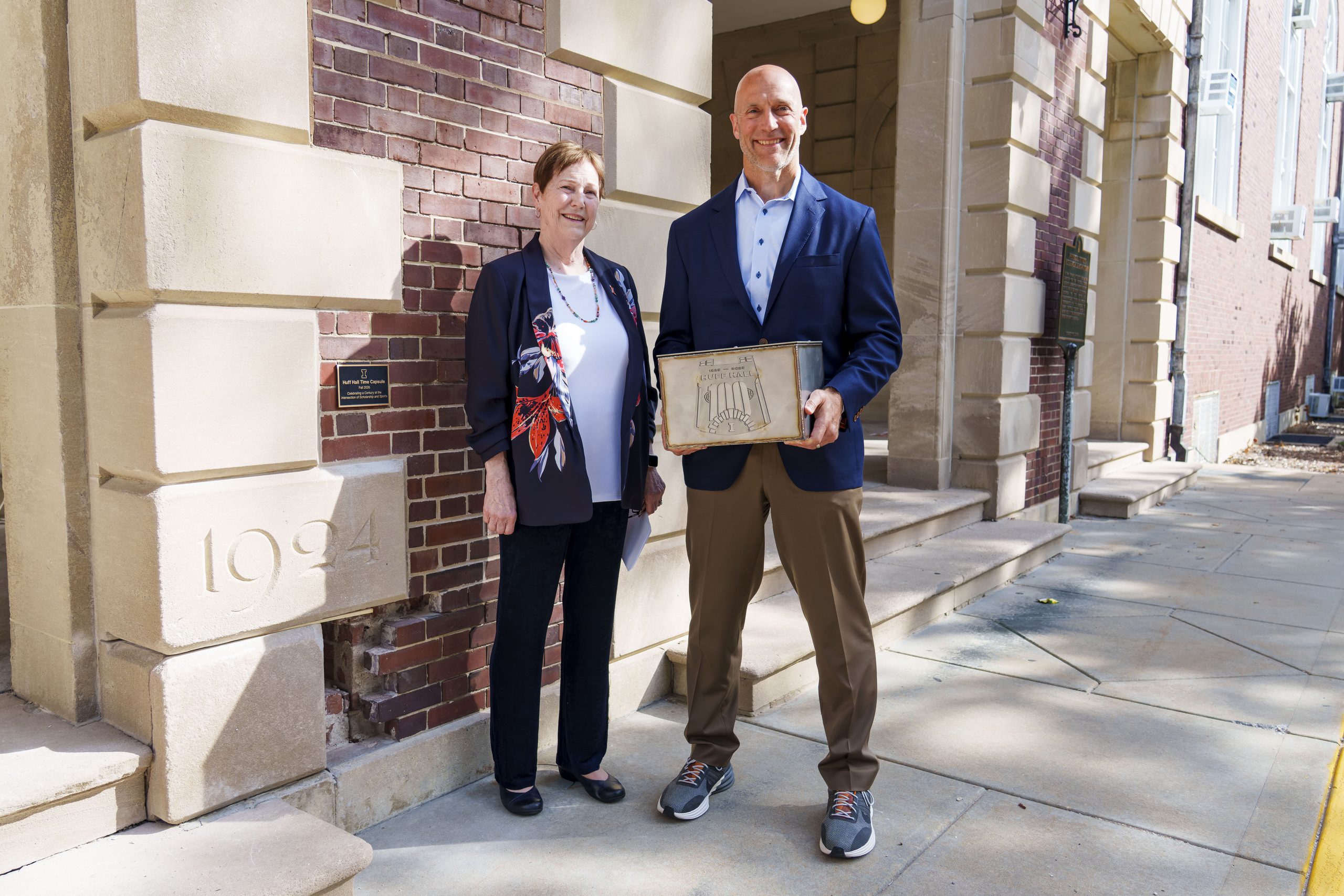
The people who open Huff Hall’s new time capsule in 2126 may inhabit a world that today’s University of Illinois community members would scarcely recognize. But the people sending messages forward hope some things will feel familiar: teamwork, curiosity and a commitment to helping others.
Those hopes framed the dedication of a new time capsule at Huff Hall, where university leaders looked a century ahead while reflecting on the values they want future generations to inherit.
Kent Brown, Illinois’ retired associate athletics director for media relations who is now serving as the Division of Intercollegiate Athletics’ historian, acted as the emcee of the event. Faculty, staff, alumni and donors from the College of Applied Health Sciences; Illinois Athletic Director Josh Whitman; and students from Brown’s sports public relations class attended.Joe Murphy, George Huff’s great-grandson, also was in attendance and provided an important family connection to the history invoked during the ceremony.
For Cheryl Hanley-Maxwell, dean of the College of Applied Health Sciences, the capsule offered an opportunity to speak directly to current and future students whose lives and circumstances remain beyond prediction.
“As we seal this time capsule, we are doing something both simple and remarkable: sending a message to students we will never meet, in a world we can only imagine,” she said.
When this capsule is opened, I hope inclusion and accessibility are no longer aspirations, but ordinary features of life.
Cheryl Hanley-Maxwell
Dean, College of Applied Health SciencesThe time capsule box is a 10”x13” container that will be filled with argon gas to preserve the items placed into it, including magazines, newspapers, photos of this and other Huff-related events and people. The box will also contain current high-tech pieces such as a hearing aid and wearable surface electromyography sensor (from the Department of Speech and Hearing Science) and a physical activity monitor from the Department of Health and Kinesiology.
Hanley-Maxwell’s message paired an account of life in 2026 with hopes for a more accessible future. Powerful computers fit into pockets, and communication crosses continents instantly, she noted. Yet health inequities, inadequate support for people with disabilities, loneliness, and barriers to education persist.
The contrast gave the capsule a purpose beyond preserving a record of campus life. Hanley-Maxwell asked its future audience to consider whether the opportunities available to people had expanded along with technological capabilities.
“When this capsule is opened, I hope inclusion and accessibility are no longer aspirations, but ordinary features of life,” she said.
She described a vision of health that extends beyond freedom from illness to encompass dignity, connection, movement and opportunity. Disability, she said, should be fully recognized as part of human diversity.
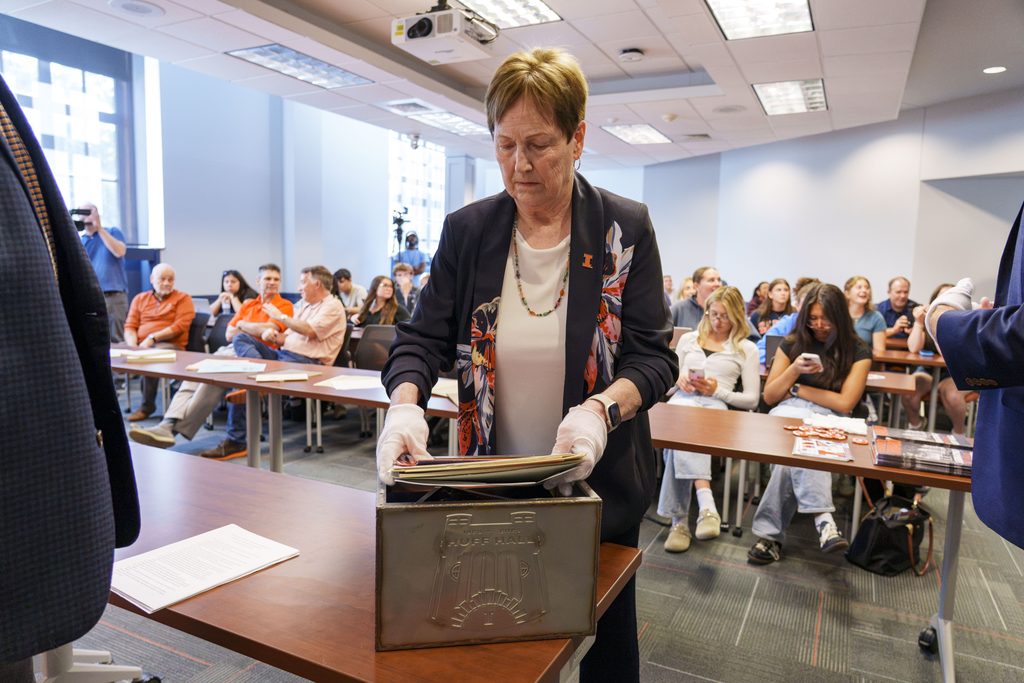
That vision also shapes the college’s work today. The students in Applied Health Sciences study subjects ranging from movement and communication to recreation, sport, tourism and disability, as they prepare for careers as clinicians, researchers, educators and advocates, among other roles.
Hanley-Maxwell challenged all to consider learning, “to ask not only, ‘What can we discover?’ but also, ‘Whom can we help?’”
Illinois Athletic Director Josh Whitman approached the century ahead through another question: What role will the university play in helping society solve its problems?
He cautioned against assuming that the challenges of the present are unprecedented. People a century ago faced difficulties of their own, he said, and those opening the capsule will almost certainly confront different ones.
His hope was that the university would continue helping find solutions and that higher education would strengthen its relationship with the public.
“I hope that 100 years from now, we have reclaimed our place and regained the trust of the society that we represent,” Whitman said.
Closer to home, he hoped Huff Hall would still stand and serve its community. Predicting the future of college athletics was another matter. Whitman drew laughter as he suggested it would probably look different, observing how much it had changed in just 10 years.
The qualities cultivated inside the building, however, were ones he wanted preserved: teamwork, self-discipline, hard work, excellence and competition.
“Those are things that have been a part of this building since it was first built,” he said. “And I hope those are in the bricks.”
With Murphy, George Huff’s great-grandson, in the audience, Whitman’s reflections on the legacy of Huff and his family had a living connection. He also recognized the people and programs that have occupied the building and contributed to the university’s story.
Hanley-Maxwell’s remarks further captured the uncertainty of the present, from lessons still emerging from the COVID-19 pandemic to artificial intelligence’s influence on classrooms, research and healthcare. Students, she said, are navigating questions about ethics, sustainability, belonging and responsible technology use.
Alongside those changes, she offered scenes that students in another century might recognize: studying late together, cheering at athletic events, forming friendships and searching for purpose.
Whitman also turned his attention to the students at the ceremony, hoping they would leave with a memory worth keeping and an appreciation for what the occasion might mean long after their time on campus.
In dedicating a commemorative plaque, Hanley-Maxwell linked preservation of the college’s story with its hopes for the future. Together, the messages offered future readers a sense of what university leaders valued and what they hoped would improve.
The capsule’s opening is intended to be a century away, leaving its senders to imagine who will receive it. Hanley-Maxwell addressed those future students as part of an ongoing community of learners and teachers entrusted with carrying the university’s story forward.
“Whatever has changed, I hope the spirit of this university endures: curiosity with humility, innovation with compassion, and knowledge in service to humanity,” she said.
Editor’s note:
You can read the full text of Cheryl Hanley-Maxwell’s remarks here.
To reach Vince Lara-Cinisomo, email vinlara@illinois.edu.
Share on social