A Celebration of Excellence


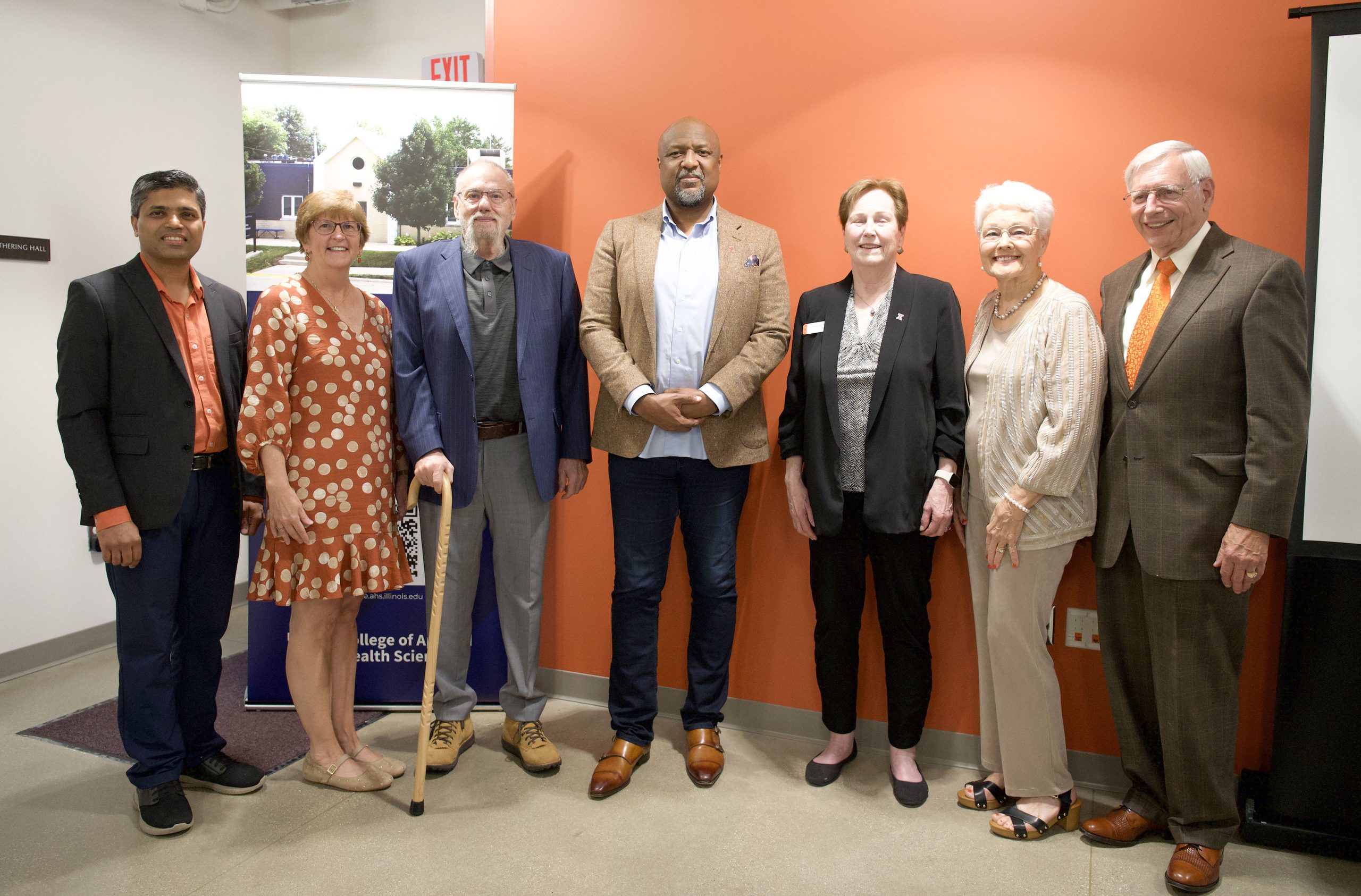
Karen McKechnie, left, James McKechnie, and Dr. Amy Woods (Photo by Anna Flanagan)

When Dr. Amy Woods was in third grade, school was a place where you were expected to be quiet and inactive. It was 1968, and there was no organized physical education in her elementary school. One day, a day she still remembers vividly, a physical education major from nearby Newberry College visited the class.

“And he stood at the front of the class and said, ‘We’re going to exercise.’ And there was a charge in the air,” she recalled. “That really was a pivotal moment for me.”

That physical education major who led her class in jumping jacks may never know the impact he had on her, but Dr. Woods went on to become a physical education major herself at Winthrop College in Rock Hill, South Carolina. She earned a master’s degree at the University of Tennessee and taught physical education in Newberry, South Carolina, for two years before pursuing her PhD in physical education instruction and curriculum at the University of South Carolina. She joined the Department of Kinesiology and Community Health in 2005 after teaching at Columbia College, St. Olaf College, and Indiana State University, and is currently the head of the department.

Last February, Dr. Woods’ many professional accomplishments were celebrated as she was named the first James K. and Karen S. McKechnie Professor in the College of Applied Health Sciences.

Through her research, publications, invited lectures, and conference presentations, she has become internationally recognized for her work on school-based physical activity and the career cycles of K-12 physical education teachers. Part of her research focuses on the support that is needed to sustain innovative practices in teaching. She also studies factors that contribute to teachers’ self-efficacy, or their belief in their ability to succeed, as well as the power of productive reflection in professional development. Her findings have informed policies and practices in teacher education.

In the Pedagogical Qualitative Research Lab, which she co-directs with Dr. Kim Graber, Dr. Woods is investigating the benefits of recess. “You might look at recess as just an innocuous activity for children,” she said, “but it’s where they get a good bit of physical activity each day.” She is specifically interested in whether recess yields more benefits before or after lunch. Current federal policy encourages physical activity before lunch because children waste less food. But her team’s research into the impact of recess on physical activity, nutritional intake, body fat, and cognitive function calls that policy into question.

Dr. Woods, who is a Fellow of the National Academy of Kinesiology, says her ultimate goal is to help K-12 teachers promote health-enhancing physical activity that keeps children moving as much as reasonably possible in schools.

“We are intensely proud of our connection to this University.”

James and Karen McKechnie graduated from the University of Illinois in 1970, he with a degree in chemistry and she with a degree in physical education. He went on to become an orthopedic surgeon with practices in Mattoon and Urbana-Champaign that were managed by Mrs. McKechnie. As avid skiers and swimmers, they have long known the benefits of physical activity in their own lives. But Dr. McKechnie said that as they age, “We have an increasingly direct appreciation of the role that physical fitness plays in our ability to continue as productive and mentally fit citizens.”

The McKechnies are members of the President’s Council and Chancellor’s Circle, and their support has been enjoyed by the College of Liberal Arts and Sciences, Fighting Illini Athletics, and the University of Illinois library as well as AHS. They endowed the James K. and Karen S. McKechnie Lab of the AHS Center on Health, Aging, and Disability, located in the Khan Annex. Mrs. McKechnie serves on the AHS Board of Visitors.

In endowing the James K. and Karen S. McKechnie Professorship in the College of Applied Health Sciences, they hope to contribute to and continue the longstanding tradition of excellence for which the University is known. Dr. McKechnie lauded Dr. Woods’ selection as the inaugural recipient, saying, “I’ll be eager to learn of the contributions Dr. Woods makes in maximizing our human potential and assisting us with making the most productive, most comfortable, and most enjoyable use of the time that each of us has allotted to us in this world.”

Related news

Keeping Things In Balance


If it seems that falls are inevitable, there is good news: falls can be prevented if you know your risk level, where your weaknesses lie, and how to improve those weaknesses. The Illini Fall Prevention Clinic was created expressly to provide the surrounding community with the information and tools needed to prevent falls.

Custom-tailored Intervention

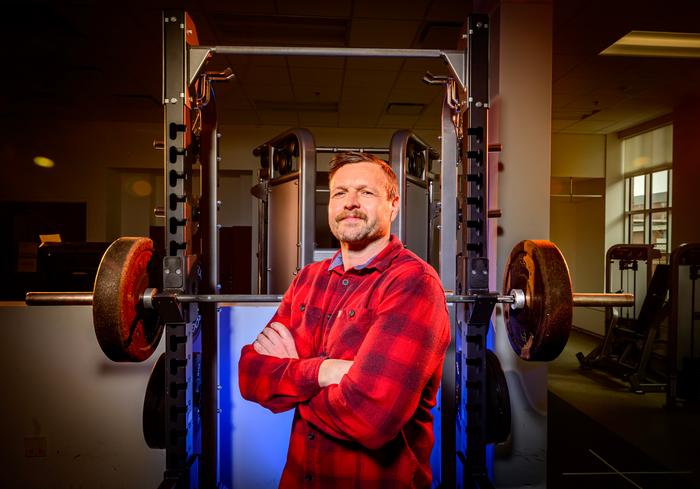
The brainchild of Dr. Jake Sosnoff, associate professor in the Department of Kinesiology and Community Health, the Illini Fall Prevention Clinic was founded on more than a decade of his research on neurophysiological and behavioral factors related to motor control and falling. In addition to healthy individuals of all ages, he has investigated issues related to mobility, balance, and gait in people with Multiple Sclerosis, chronic kidney disease, and spinal cord injuries.

“As a society, we tend to treat falls reactively and don’t become concerned until people suffer an injury, such as breaking a wrist or hip,” he said. “We are really good at mending broken bones, but we don’t really address the underlying causes of the falls. I have all this sophisticated equipment and the research results to show that we can help to prevent falls through an evidence-based approach, and I want to share that with the larger community.”

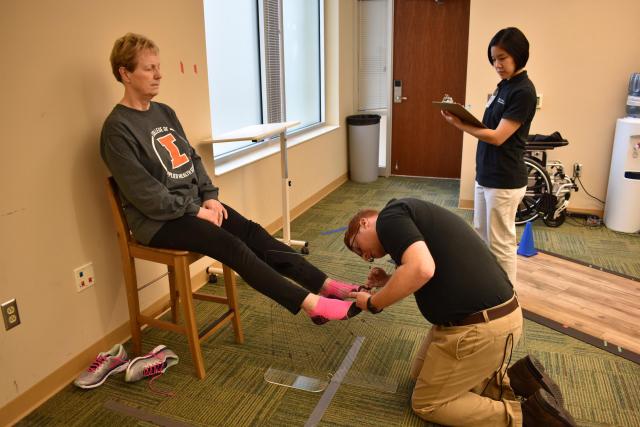
People who come into the clinic go through a four-part consultation that takes into account things such as balance, leg strength, vision, and body awareness. The measurements are suitable for all level of skills and functional abilities. Data from the various tests are compiled into a fall risk score and used to develop individualized prevention strategies to meet the client’s specific needs. Tyler Wood, a licensed athletic trainer and Ph.D. student who is the lead trainer in the clinic, says the main issues they see are deficits in lower body strength, balance, and reaction time.

“Based on each individual’s results, we work out an intervention plan tailored to their particular needs,” he said. “We give them a set of exercises that they can do at home, and we make sure they can do them properly before they leave the lab.” Clients are encouraged to return to the clinic six months later so that their progress can be measured and their intervention plans updated, if necessary.

Not only is the clinic providing potentially lifesaving screening, but it also serves as a learning opportunity for undergraduate students in the College of Applied Health Sciences to gain real-life clinical experience working with a diverse group of older adults. Currently, more than 15 undergraduates contribute to the clinic.

Extending The Reach

Because Dr. Sosnoff and his team recognize that not everyone can make it into the clinic in Huff Hall, they take the clinic to other venues such as retirement homes and churches when needed. Since opening the clinic in late spring of 2016, they have assessed the fall risk of more than 130 people in the surrounding community.

Working with his former doctoral students Doug Wajda, now an assistant professor of exercise science at Cleveland State University, and Jason Fanning, now an assistant professor of health and exercise science at Wake Forest University, Dr. Sosnoff developed a smart phone app that accurately assesses fall risk and provides personalized suggestions on ways to minimize risk. With support from the Collaboration in Health, Aging, Research, and Technology (CHART), the app was tested at Clark-Lindsey Village, a retirement community in Urbana.

Dr. Sosnoff’s team recently partnered with Dr. Sanjiv Jain of Carle’s Bone Health and Osteoporosis Clinic to test a new system that enables seniors to complete their own fall risk assessment without clinical oversight. Preliminary data suggests that the system accurately measures fall risk and that users enjoy it. His team is currently working on the system’s ability to provide feedback and individualized prevention strategies. Dr. Sosnoff’s overarching goal is to make falling avoidable rather than inevitable. “People come into the clinic because they’ve noticed changes with aging and don’t know what to do about them, or they bring in an aging parent or a spouse they’re concerned about,” he said. “We want to give them objective evidence that helps them understand what they’re dealing with, as well as concrete steps to promote functional independence and quality of life.”

For more information on the Illini Fall Prevention Clinic and its services, or to schedule an assessment, visit www.illinifallclinic.com.

here is a news quote as an example:

Here’s an edior’s note — feel free to remove it if it’s not needed! To show an example of what an editors note or model news layouts I’ll put some resources below:

Editor’s note:

To reach Nancy Averett, email naverett@illinois.edu.
 

Share on social

Related news

College of Applied Health Sciences
110 Huff Hall
1206 South 4th Street
Champaign, IL 61820
(217) 333-2131