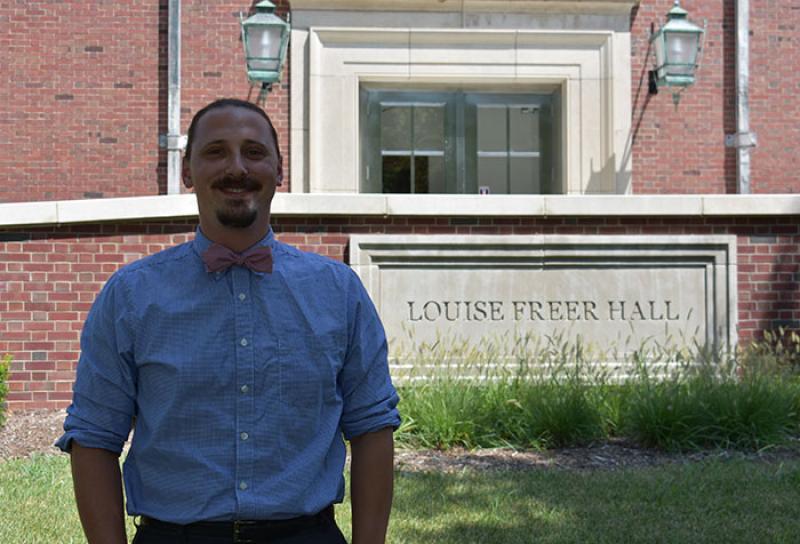
Boppart awarded Beckman’s Vision and Spirit Award


The Beckman Institute Vision and Spirit Award.

Marni Boppart, an associate professor of kinesiology and community health, is the 2020 winner of the Beckman Institute Vision and Spirit Award. Boppart is also a faculty member in the Carle Illinois College of Medicine and at the Carle R. Woese Institute for Genomic Biology.

You can read more about the award in the Beckman Institute’s release.


Related news


Podcast: A Few Minutes With … Kevin Richards


Kinesiology and Community Health assistant professor Kevin Richards spends a Few Minutes With AHS media relations specialist Vince Lara and speaks about his pedagogy research and the socialization of teachers, primarily in physical education.

Transcript

VINCE LARA: This is Vince Lara in the College of Applied Health Sciences at the University of Illinois. Today it’s been a few minutes with Kevin Richards, Assistant Professor in the Kinesiology and Community Health Department of AHS, to talk about his pedagogy research and the socialization of teachers.

Kevin, what inspires your research? Let me ask it this way. What led you to do what you do?

KEVIN RICHARDS: Yeah, that’s a good question. It’s interesting because a big thrust of my research is socialization. So, basically, you’re asking me what socialized me into the research that I do. But so I did my undergraduate degree back in Massachusetts in physical education. And I had every intention to go out into schools and to become a K-12 physical education teacher.

But back east, you have to have a master’s degree within five years to keep teaching in schools. And so a lot of people did like the night– the night school thing, and that just wasn’t for me. So I decided that I was going to look at graduate programs so I could just knock out that master’s degree in one shot, and then focus on teaching after. And that led me out to Purdue University, where I did my master’s and built the relationship with my advisor, Tom Templin.

And Tom studied socialization. And he was one of kind of the forefathers of that area of research in physical education. And I just got really passionate about that area of research through talking with him. So, you know, the main thrust of my research through the work that I did on my PhD and then, you know, and the majority of my career since focuses on how we recruit, prepare– recruit and prepare teacher– individuals to go into the field of physical education.

And then once they’re out in the schools, what are their lives and careers like? Physical education tends to be a marginalized subject in a lot of schools. And so I do a lot of work looking at marginality and how that affects teachers’ understanding of themselves and their relationships with others.

VINCE LARA: So, basically, to streamline what you’re saying is, you’re trying to build the best teacher you can, is that fair to say?

KEVIN RICHARDS: Yes, in a sense. You know, we look to recruit people into our programs who are diverse in terms of things like traditional markers like race and ethnicity. But then also in terms of their background experiences. Physical education’s been traditionally a discipline that potential recruits really see to align with coaching.

So those who want to coach extra curricular school sports sometimes come into physical education with these really solid, developed backgrounds in team sport. And they see physical education as kind of a conduit to continue that. But not every kid who is out taking physical education in schools loves sports. So we try to recruit more diverse students.

But then also looking at the methods that we use in our physical education programs to give those students the knowledge and skills that they’re going to need in order to become effective practitioners into the future. But, also, you know, we focus a lot on dispositions, because, you know, while they’re in our classes, we can hold them accountable. So we can grade them. If they don’t do what we tell them to do, you know, we can fail them even.

But the reality is that once our students transition out of our programs out into schools, we lose that control. And so at that point the true marker is, you know, have they internalized these beliefs to the extent that they’re going to use them even when we’re not watching. And so, we really try to work with students to help them develop ideologies that align with best practice, but are grounded in their own experience, and that they’ll follow through on.

VINCE LARA: What are some of the challenges, you know, physical education teachers– there’s some stigma around that, right? So what are some of the challenges of getting kids into the program? And what do you do to try to, you know, defeat some of those stigmas, if you will?

KEVIN RICHARDS: Yeah, yeah. That’s– it’s a really good question. And it’s timely, because this has actually been one particular area that I’ve been focusing on quite a bit in my work right now. But, you know, there are a lot of those negative social stigmas. And some of them, you know, are grounded in fact. You know, unfortunately, there are some physical education teachers, especially at the secondary level, the middle school and high school, who teach using ineffective practices.

The colloquialism in our field is that they roll out the ball. So they just kind of throw a ball out and let the kids play. It’s not educational. It’s not purposeful. And I think that sometimes people think about physical education and they reflect upon their own past experiences or maybe what their kids are going through in school, and they use that as the marker to evaluate the whole discipline. But, you know, of course, physical education can and should do so much more than that.

And so we really try to work with, you know, on the pre-service teacher side of it, develop teachers that are ready to step out into the world of schools, and teach using effective practices. And then a lot of my work has then also looked at those teachers who are in-service, working out in the schools, and how can we help to improve their work conditions and reshape their ideologies so that they’re using best practice. And then you have kind of this streamlined approach in the ideal situation where pre-service teachers are stepping out into schools that are ready to embrace the practices that they’ve learned.

And then, you know, this is all kind of a cyclical process, because the next generation of teachers are going to come out of those schools, and they’re going to see physical education as it’s presented to them by their own teachers, and use that as the basis for evaluation to determine whether or not they think physical education is for them. And so if we can get better physical education in the schools, then we’ll have better recruits coming into our programs.

VINCE LARA: One segment of your research, I noticed, deals with helping teachers deal with stress.

KEVIN RICHARDS: Yeah.

VINCE LARA: So what methods do you use to research that?

KEVIN RICHARDS: Yeah, yeah. So I was initially trained as a qualitative researcher. My advisor, Dr. Templin, was very qualitative. I joke, in that, I don’t think he’s ever, like, calculated a mean in his career, like it just wasn’t his bag. Now I’m exaggerating, he has. But he’s very qualitative. So that’s how I was originally trained.

But then I did a postdoc at Purdue with a woman named Chantal Levesque-Bristol. And she was a cognitive psychologist that used primarily quantitative methods. So I kind of got a mix of both, and have really come to appreciate mixed methods and multiple methods working together. A lot of my studies are designed using sequential approaches.

So we might do a large scale survey of teachers, you know, and get hundreds of responses, asking them questions about stress and burnout, and, you know, protective factors like resilience and perceived mattering. And then we’ll take a sub sample of people who complete that survey, and then do qualitative interviews with them.

But what I’m really excited about is we’re taking all of this information that we’ve learned over the last few years studying teacher stress, and we’re putting it into practice. We got some funding through a small seed grant to develop a professional development program for teachers in local Champaign-Urbana area.

We’re calling it the Dream Project. That’s developing resilience and enhancing appraisals of mattering. And it’s kind of the culmination of the last six years of my career learning about stress and burnout in the relationships among these variables, and how teachers experience their work life, and then putting that to practice to try to do something about it.

VINCE LARA: You also look at social and emotional learning in physical education. Would you elaborate a little bit on that?

KEVIN RICHARDS: Yeah, yeah. So that’s kind of a sub area or a second, maybe not sub area, but it’s kind of like a second tree of my research. So I had a colleague when I was going through grad school together– grad school named Michael Hemphill. And Michael and I– or Michael was very interested in social and emotional learning using this one particular best practice model called teaching personal and social responsibility.

And so TPSR, as we call it, is a way to teach within a physical activity context that views physical activity as kind of a mediator or a vehicle to get kids talking about personal and social responsibility. So there you have that hook of physical activity that a lot of kids like. It draws them in. And then that opens the door to say, OK, well, yeah, we’re going to focus on skill development. We’re going to focus on activity. But we’re also going to help you learn to be better people.

And so we focus on goals like participation and showing good effort, respecting the rights and feelings of others, self direction, and some goal setting, leadership and helping other people. And then the ultimate goal of all of that is to take lessons learned in the gym and transfer that out into other aspects of your life. So you know, you learn about respect in a physical activity program where you can use that in school.

Before I came to the University of Alabama, I was at– or excuse me, before I came to the University of Illinois, I was at the University of Alabama. And while I was there, a doctoral student and I, Tori Ivey, we ran a after-school program that focused on social emotional learning through physical activity over the course of three years, and learned a ton about best practices and best ways to do that.

And so then moving up here to Illinois, myself, Naiman Kahn, who’s another faculty in KCH, and my wife, Felicia Richards, who’s an instructor in our department, have been collaborating to take a summer program that our department’s actually offered for like 60 years. It’s one of the longest running summer programs, physical activity summer programs in the country. It used to be called Sport Fitness.

And so we took that and made some modifications to the structure, and rolled out a revised version of the model that we’re now calling IPAL. So it’s Illinois Physical Activity and Life Skills is what we are calling the program now. And that– that’s kind of a framework that we’re going to use this summer to roll out a couple of different summer program offerings using physical activity as kind of the hook, but really trying to get at those social emotional learning goals.

VINCE LARA: Is that program one of the reasons why you chose Illinois?

KEVIN RICHARDS: You know, I chose Illinois for a lot of reasons. I really like the people I worked with at Alabama, had great relationships down there. But Kim Graber and Amy Woods who are in pedagogy area with me, they’re leading scholars in the field. And Kim was actually on my dissertation committee. So we have this relationship that goes back a ways. And then, you know, Amy and I have collaborated over the years, too.

So those pre-existing relationships are a big part of what drew me here. But then, you know, or at least piqued my interest. But then after having come onto campus and see everything that Illinois has to offer, I mean this is a magical place. I really love it here. And, you know, my wife and I couldn’t be happier with the decision we made.

VINCE LARA: Now research obviously is a big part of why you’re at Illinois and our institution, obviously. But you know you also have to teach.

KEVIN RICHARDS: Yeah, yeah.

VINCE LARA: So do you– is there a particular class that you enjoy more than others?

KEVIN RICHARDS: Yeah, yeah. And people who listen to this might find this a bit surprising. But I love teaching actually. You know, it’s a huge part of my identity. I look forward to it. It’s not a burden. I love interacting with students. And the way that my teaching appointment is split here is that I teach one physical education majors course, so I still have my connection with the PE majors.

I teach a rotating course for our doctoral students. And then actually my favorite course is– it’s KIN201, Physical Activity Research Methods. And when the course got turned over to me, Neha Gothe and I actually collaborate on it. I teach it fall, she teaches in the spring. And when the course got turned over to us, you know, I think that it was a good idea, but it needed some fleshing out and development. And it’s been really fun to do that over the last couple of years with Neha.

And, you know, we’ve got the course to a position now, where the feedback that we’re getting at least, is that the students really enjoy it. We use kind of a lecture lab format. So they– you know, a large group lecture, where we can kind of talk about these concepts. But then the students break out into lab groups, where they get more kind of intimate contact and attention.

And, you know, I love talking about research. And so sparking that interest in the minds of our undergraduates, I think is a really cool part of our job. And so, I just got an email the other day actually from a student who was able to take something that we talked about in class a few weeks ago, and apply it in her life, reading a research article, and she wrote to me to tell me about that, which I thought was really cool and that really speaks to what I hope students get out of this class.

VINCE LARA: My thanks to Kevin Richards. This has been A Few Minutes.

Related news

Alumni Spotlight—Marty Morse


Q: Why did you pick AHS?

A: In 1980, my coach told me that the Department of Kinesiology at Illinois was the finest in the world. Also in 1980, the Director of Boston University’s Spinal Cord Injury Center, Dr. Murray Freed, recommended that I pursue my wheelchair athletics dreams at the Division of Disability Resources and Educational Services (DRES). I visited in 1980 with both kinesiology and DRES faculty. I fell immediately in love with the campus.

Q: Which professors had the most impact on you?

A: In kinesiology, it was Dr. Helga Deutsch and Dr. Richard Boileau. At DRES, it was Dr. Bradley Hedrick and Dr. Stephen Figoni. In kinesiology, I was surrounded by professors who knew of my goals and they became involved in making sure I reached or surpassed my academic dreams. At DRES, Doctor Hedrick and Figoni set the bar high for me in athletics and academics. Each day was crammed full with learning at the feet of these two giants in the field of athletics and academics.

Q: What course did you most enjoy?

A: Everything I was required to take in kinesiology I enjoyed. The same can be said for DRES. Hedrick and Figoni kept the learning challenging, but fun.

Q: Did you enter AHS knowing your career path, or did AHS help you decide?

A: I had no idea where I was going when I entered AHS other than the fact I would be coaching. Dr. Hedrick made sure I received a graduate assistantship at DRES. That alone set my career path in coaching at DRES.

Q: Did your AHS experience lead to your current job?

A: Yes. I was (the first) wheelchair track and field coach at DRES from 1984-2005.

Q:What is your current job?

A: I retired from full-time coaching in 2009.

Q: What was your favorite on-campus experience?

A: Day-to-day contact coaching Illinois student-athletes. There is a vibe being around Illinois student-athletes that can’t be found anywhere else. I thrived in that environment. Each day I was surrounded by the best and the brightest wheelchair athletes that come to the Urbana-Champaign campus to realize their academic and athletic dreams.

Q: What would you say to recommend AHS to a prospective student?

A: Kinesiology and DRES remain where I found them in 1981, the best. If you want to help people live an active, vigorous, healthy lifestyles, the College of AHS is the place to be. You will be challenged outside your current comfort level to achieve your dreams.

Editor’s note:

To reach Vince Lara-Cinisomo, email vinlara@illinois.edu.

Related news

Podcast: A Few Minutes With … Nick Burd


Kinesiology and Community Health associate professor Nick Burd speaks with AHS media relations specialist Vince Lara about his research on potatoes as an exercise fuel and that physical activity and nutritional guidelines are inextricably linked.

Transcript

VINCE LARA: This is Vince Lara in the College of Applied Health Sciences at the University of Illinois. Today, I speak with Nick Burd, Associate Professor in the Department of Kinesiology and Community Health, to talk about his research on nutrition and exercise performance. So, Nick, what inspires your research?

NICK BURD: Yeah, sure. I’d say the inspiration comes from answering a lot of real world questions. A lot of our research is aimed at being translational in nature. Most of our work is done in vivo in humans, which obviously is a good model to be able to have translational messages.

VINCE LARA: Mm-hmm. Now why pick Illinois? I notice you went to Ball State, right? So you were in the general region, but why pick here for where you’re teaching?

NICK BURD: Well, I like corn, I like to see it, I like to eat it. No, but in all seriousness, so a lot of my research is tech specialized infrastructure. In particular, it would take this kind of R1 infrastructure, which we have here at the University of Illinois. So coming to a place that could support my research needs, but also had good colleagues in place to create a synergy with my research. And Illinois sort of checked all those boxes, so it just made a lot of sense to come here. And as you sort of alluded to, I was born in Ohio, so it’s sort of home as well in terms of the Midwest.

VINCE LARA: Got you. Now your recent research on the effectiveness of potatoes as exercise fuel got great media attention, so I’m wondering, what led you to study that?

NICK BURD: Yeah, I mean, a lot of my research, I view my research team, we are truly a team. So any project we develop, I sort of develop it in collaboration with my research team. And what I mean by that, my PhD students normally. So that particular idea was sort of derived in collaboration with one of my formal students, Joe Beals. He happened to be a cyclist. Anecdotally, he used potatoes as a fueling source during exercise. Scientifically, it made a lot of sense to test that as a fueling source. I mean, keep in mind, right, sports marketing is– sports nutrition marketing, in particular, they sort of have tuned us to think that we need these specialized sports gels, which they do work, but they can become expensive.

And just trying to find a strategy that’s not too fancy, simple, accessible, cost effective, sort of underpin that sort of idea, potato just happened to be a nutrient dense carbohydrate food source. Students wanted to do it. Scientifically, it made sense, so we went for it. And then sometimes I always say some of the most, I guess the best way to– some of these weird questions always get the most media attention, and that happened to be one of those, right? I think it’s because everybody could kind of relate to it. There’s a lot of runners out there. It was timed well around the marathon, some of the major marathons. So a lot of the news networks just grabbed it and ran.

VINCE LARA: You talked about in your answer here about cost effective means.

NICK BURD: Sure.

VINCE LARA: And so I’ve noticed some of your research really focuses on that, promoting health through diet and exercise changes in a cost effective way.

NICK BURD: Yeah, I’d say that’s fair. I mean, a lot of our work is focused on whole food-based approaches, right? Again, I think we get tuned that sometimes. Certain strategies have to be specially formulated or highly specialized. But a lot of research is aimed at it doesn’t have to be that fancy. And let’s be honest here, a lot of my work is aimed at protein, dietary protein in particular, trying to optimize that within a diet. In terms of that, protein supplements are huge. And once again, they could become expensive.

And we need to be more focused on food first approaches, is what I say. Supplements are fine, but they should be just that, a supplement. But a lot of times, these are the front line strategy for people. But we need to stay focused on the food first approaches. Exercise is a brilliant tool to utilize to support a healthy lifestyle. I mean, it goes back to the old adage, you are what you eat and how you move, right? And that’s what our research shows. It’s aimed at showing that.

VINCE LARA: I know that you hope to look at aging and chronic disease and how exercise and diet can combat those conditions. Talk a little bit more about that, if you would.

NICK BURD: Yeah, I mean, I’m trained as a muscle physiologist, so a lot of times we’re focused on skeletal muscle health. And we do that for a variety of reasons, not to get too reductionist, but muscle has a lot of pertinent roles in a healthy lifestyle, in particular, huge contributor to basal metabolic rate, which for most of us is the biggest contributor to total daily energy expenditure. So we want to make sure we’re protecting muscle for weight maintenance essentially. And certainly, if you were under a period of energy restriction and lose some weight, you don’t want to lose muscle because that’s going to put you at a greater chance for weight regain.

But for metabolic health as well as for performance, we’re focused on muscle. But our experiments, we study obesity, obviously a prevalent disease, especially in Western society, end stage renal disease, aging. These are all areas of emphasis for us because, once again, these are all situations where muscle health is compromised. So we need strategies to sort of help or improve or augment muscle health so hopefully we can ultimately improve overall health.

VINCE LARA: My thanks to Nick Burd. This has been A Few Minutes With.

Related news

A Celebration of Excellence


Karen McKechnie, left, James McKechnie, and Dr. Amy Woods (Photo by Anna Flanagan)

When Dr. Amy Woods was in third grade, school was a place where you were expected to be quiet and inactive. It was 1968, and there was no organized physical education in her elementary school. One day, a day she still remembers vividly, a physical education major from nearby Newberry College visited the class.

“And he stood at the front of the class and said, ‘We’re going to exercise.’ And there was a charge in the air,” she recalled. “That really was a pivotal moment for me.”

That physical education major who led her class in jumping jacks may never know the impact he had on her, but Dr. Woods went on to become a physical education major herself at Winthrop College in Rock Hill, South Carolina. She earned a master’s degree at the University of Tennessee and taught physical education in Newberry, South Carolina, for two years before pursuing her PhD in physical education instruction and curriculum at the University of South Carolina. She joined the Department of Kinesiology and Community Health in 2005 after teaching at Columbia College, St. Olaf College, and Indiana State University, and is currently the head of the department.

Last February, Dr. Woods’ many professional accomplishments were celebrated as she was named the first James K. and Karen S. McKechnie Professor in the College of Applied Health Sciences.

Through her research, publications, invited lectures, and conference presentations, she has become internationally recognized for her work on school-based physical activity and the career cycles of K-12 physical education teachers. Part of her research focuses on the support that is needed to sustain innovative practices in teaching. She also studies factors that contribute to teachers’ self-efficacy, or their belief in their ability to succeed, as well as the power of productive reflection in professional development. Her findings have informed policies and practices in teacher education.

In the Pedagogical Qualitative Research Lab, which she co-directs with Dr. Kim Graber, Dr. Woods is investigating the benefits of recess. “You might look at recess as just an innocuous activity for children,” she said, “but it’s where they get a good bit of physical activity each day.” She is specifically interested in whether recess yields more benefits before or after lunch. Current federal policy encourages physical activity before lunch because children waste less food. But her team’s research into the impact of recess on physical activity, nutritional intake, body fat, and cognitive function calls that policy into question.

Dr. Woods, who is a Fellow of the National Academy of Kinesiology, says her ultimate goal is to help K-12 teachers promote health-enhancing physical activity that keeps children moving as much as reasonably possible in schools.

“We are intensely proud of our connection to this University.”

James and Karen McKechnie graduated from the University of Illinois in 1970, he with a degree in chemistry and she with a degree in physical education. He went on to become an orthopedic surgeon with practices in Mattoon and Urbana-Champaign that were managed by Mrs. McKechnie. As avid skiers and swimmers, they have long known the benefits of physical activity in their own lives. But Dr. McKechnie said that as they age, “We have an increasingly direct appreciation of the role that physical fitness plays in our ability to continue as productive and mentally fit citizens.”

The McKechnies are members of the President’s Council and Chancellor’s Circle, and their support has been enjoyed by the College of Liberal Arts and Sciences, Fighting Illini Athletics, and the University of Illinois library as well as AHS. They endowed the James K. and Karen S. McKechnie Lab of the AHS Center on Health, Aging, and Disability, located in the Khan Annex. Mrs. McKechnie serves on the AHS Board of Visitors.

In endowing the James K. and Karen S. McKechnie Professorship in the College of Applied Health Sciences, they hope to contribute to and continue the longstanding tradition of excellence for which the University is known. Dr. McKechnie lauded Dr. Woods’ selection as the inaugural recipient, saying, “I’ll be eager to learn of the contributions Dr. Woods makes in maximizing our human potential and assisting us with making the most productive, most comfortable, and most enjoyable use of the time that each of us has allotted to us in this world.”

Related news

Keeping Things In Balance


If it seems that falls are inevitable, there is good news: falls can be prevented if you know your risk level, where your weaknesses lie, and how to improve those weaknesses. The Illini Fall Prevention Clinic was created expressly to provide the surrounding community with the information and tools needed to prevent falls.

Custom-tailored Intervention

The brainchild of Dr. Jake Sosnoff, associate professor in the Department of Kinesiology and Community Health, the Illini Fall Prevention Clinic was founded on more than a decade of his research on neurophysiological and behavioral factors related to motor control and falling. In addition to healthy individuals of all ages, he has investigated issues related to mobility, balance, and gait in people with Multiple Sclerosis, chronic kidney disease, and spinal cord injuries.

“As a society, we tend to treat falls reactively and don’t become concerned until people suffer an injury, such as breaking a wrist or hip,” he said. “We are really good at mending broken bones, but we don’t really address the underlying causes of the falls. I have all this sophisticated equipment and the research results to show that we can help to prevent falls through an evidence-based approach, and I want to share that with the larger community.”

People who come into the clinic go through a four-part consultation that takes into account things such as balance, leg strength, vision, and body awareness. The measurements are suitable for all level of skills and functional abilities. Data from the various tests are compiled into a fall risk score and used to develop individualized prevention strategies to meet the client’s specific needs. Tyler Wood, a licensed athletic trainer and Ph.D. student who is the lead trainer in the clinic, says the main issues they see are deficits in lower body strength, balance, and reaction time.

“Based on each individual’s results, we work out an intervention plan tailored to their particular needs,” he said. “We give them a set of exercises that they can do at home, and we make sure they can do them properly before they leave the lab.” Clients are encouraged to return to the clinic six months later so that their progress can be measured and their intervention plans updated, if necessary.

Not only is the clinic providing potentially lifesaving screening, but it also serves as a learning opportunity for undergraduate students in the College of Applied Health Sciences to gain real-life clinical experience working with a diverse group of older adults. Currently, more than 15 undergraduates contribute to the clinic.

Extending The Reach

Because Dr. Sosnoff and his team recognize that not everyone can make it into the clinic in Huff Hall, they take the clinic to other venues such as retirement homes and churches when needed. Since opening the clinic in late spring of 2016, they have assessed the fall risk of more than 130 people in the surrounding community.

Working with his former doctoral students Doug Wajda, now an assistant professor of exercise science at Cleveland State University, and Jason Fanning, now an assistant professor of health and exercise science at Wake Forest University, Dr. Sosnoff developed a smart phone app that accurately assesses fall risk and provides personalized suggestions on ways to minimize risk. With support from the Collaboration in Health, Aging, Research, and Technology (CHART), the app was tested at Clark-Lindsey Village, a retirement community in Urbana.

Dr. Sosnoff’s team recently partnered with Dr. Sanjiv Jain of Carle’s Bone Health and Osteoporosis Clinic to test a new system that enables seniors to complete their own fall risk assessment without clinical oversight. Preliminary data suggests that the system accurately measures fall risk and that users enjoy it. His team is currently working on the system’s ability to provide feedback and individualized prevention strategies. Dr. Sosnoff’s overarching goal is to make falling avoidable rather than inevitable. “People come into the clinic because they’ve noticed changes with aging and don’t know what to do about them, or they bring in an aging parent or a spouse they’re concerned about,” he said. “We want to give them objective evidence that helps them understand what they’re dealing with, as well as concrete steps to promote functional independence and quality of life.”

For more information on the Illini Fall Prevention Clinic and its services, or to schedule an assessment, visit www.illinifallclinic.com.

here is a news quote as an example:

Here’s an edior’s note — feel free to remove it if it’s not needed! To show an example of what an editors note or model news layouts I’ll put some resources below:

Editor’s note:

To reach Nancy Averett, email naverett@illinois.edu.
 

Share on social

Related news

College of Applied Health Sciences
110 Huff Hall
1206 South 4th Street
Champaign, IL 61820
(217) 333-2131