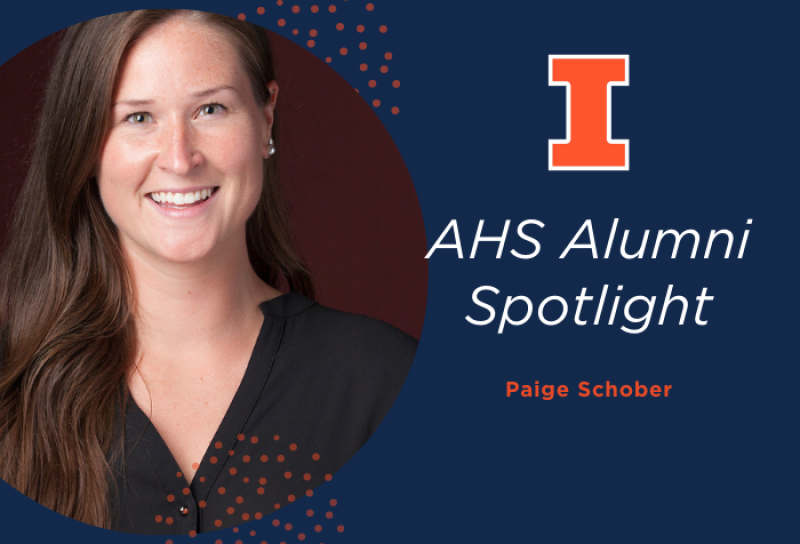
Alumni Spotlight—Paige Schober


Q: Why did you pick AHS?

A: I chose AHS because the areas I was interested in studying all fell in the cross section between science and research fields and the health and human study fields.

Q: Why did you pick KCH?

A: I knew I wanted to study Kinesiology because I was passionate about the growing field and all the areas one can take a degree into such as human performance and athletics.

Q: Which professors had the most impact on you?

A: I had so much respect and appreciation for Tina (Matilla) Greenlee, who taught and served as the teaching assistant for several of my courses in KCH. She was so helpful to me and supportive of my growth in the classroom and on the dance team as she was an alumni herself. Amy O’Neill also made a tremendous impact on me in how well she helped me map out my path with such care and consideration.

Q: What course did you most enjoy?

A: I enjoyed KIN 355, Biomechanics of Human Movement with Dr. (Ian) Rice. It was the first time I experienced a crossover between physics and physiology. I was very interested in the quantifiable aspects of movement and the technologies that accompany that tracking.

Q: Did you enter AHS knowing your career path, or did AHS help you decide?

A: I did not know my career path specifically, just that I wanted a career in movement. I started on the Physical Therapy track because it seemed like that was what most people did. It was Amy O’Neill that helped me explore all my options and ultimately discover the world of strength and conditioning through a summer internship.

Q: Did your AHS experience lead to your current job?

A: My experience in AHS absolutely laid the foundation for the rest of my career. I went on to earn a M.S. in Exercise Science from the University of Montana and now I work as an athletic performance coach at UCLA.

Q: What was your favorite on-campus experience?

A: I was a member of the Illinettes Dance Team, so my favorite experience was performing at football games in Memorial Stadium.

Q: What does AHS mean to you?

A: I’m so grateful for my experience in AHS because it truly laid the foundation for the rest of my career. I was exposed to literature, research, and technology at such a high level and it opened my eyes to the world of kinesiology. I learned tools and techniques that I carried with me into graduate school and into my career in exercise science and athletic performance.

Editor’s note:

To reach Vince Lara-Cinisomo, email vinlara@illinois.edu.
 

Related news

Aguiñaga looks at the benefits of dance


Can dancing slow cognitive decline and improve health of middle-aged and older Latinos?

Can dancing slow cognitive decline and improve health of middle-aged and older Latinos? That’s something that KCH Assistant Professor Susan Aguiñaga is seeking to find out.

Aguiñaga has a new publication entitled, “BAILAMOS With mHealth Technology! Improving Physical Activity and Well-Being in Middle-Aged and Older Latinxs: A Pre–Post Feasibility Study” in the journal Health Education and Behavior. Aguiñaga and her collaborators looked at the physical activity and health outcomes of middle-aged and older Latino and Latina adults in BAILA TECH—an intervention that combines the BAILAMOS™ Latin dance program with mobile health technologies (such as a Fitbit Charge 2). The study found that participants in the intervention increased physical activity and fitness levels, social support, quality of life, and executive function.

BAILAMOS™ (Balance and Activity In Latinos, Addressing Mobility in Older Adults) is a Spanish-language, Latin dance program for older Latinos that was created by Dr. David Marquez at the University of Illinois at Chicago and Miguel Mendez, a professional dance instructor, Aguiñaga said.

For Aguiñaga, a Latina, the study is personal.

“I have witnessed how the social determinants of health create disparities that negatively impact my Latino community,” she said. “As a physical activity researcher, I know that many health disparities can be ameliorated through physical activity. I have chosen to create physical activity interventions that are community-based and culturally responsive for Latinos to reduce the burden of disease in this population.”

Aguiñaga said the study aim is to increase Latinos’ physical activity levels and improve cognitive performance and/or slow cognitive decline in this population that is at high risk of health disparities, and particularly increased risk of developing Alzheimer’s disease.

Aguiñaga said the most surprising result was an increase in 34 minutes of moderate-to-vigorous physical activity at post-testing. The data was collected in Pilsen, a predominantly Mexican neighborhood in Chicago, she said.

The next step, Aguiñaga said, is to assess the efficacy of combining BAILAMOS™ with a culturally tailored diet program to see if it improves cognition further in middle-aged to older Latinos.

Editor’s note:

To reach Susan Aguiñaga, email saguina2@illinois.edu.
 

Share on social

Related news

Khan’s R01 grant aimed at measuring lutein effect on cognitive function


Can spinach and other leafy, green vegetables improve cognitive function? (Fred Zwicky)

Whether you’re a parent or Popeye, you’ve been extolling the virtues of spinach for decades. Now, one of AHS’ researchers is prepared to study the effects of the leafy green vegetable.

KCH Associate Professor Naiman Khan has received an R01 grant from the NIH’s National Institute of Child Health and Human Development for his project titled “Enhancing Children’s Cognitive Function and Achievement through Carotenoid Consumption.” The five-year project has a budget of approximately $3 million.

The overall aim for Dr. Khan and his collaborators—KCH Associate Professor Sean Mullen and Professor Neal Cohen, director of the Interdisciplinary Health Sciences Initiative—is to conduct a randomized-controlled clinical trial to test the effects of daily lutein supplementation over nine months on children’s cognitive function and academic achievement.

Lutein is in most fruits and vegetables, but green and yellow foods have the highest amounts. Loaded with iron, vitamin K, and magnesium, spinach is an all-in-one source of many essential vitamins and minerals. It is also high in antioxidants such as lutein, with eight milligrams in one cup. The same serving of cooked spinach has up to 16 milligrams. Kale, corn, bell peppers and parsley are also excellent sources of lutein.

Khan’s research has linked macular pigment optical density (MPOD)—a noninvasive measure of retinal and brain lutein—to greater childhood cognitive function. However, the cognitive implications of lutein and zeaxanthin intake in children have not been directly investigated.

The goal, Khan said, is to provide important knowledge on potential dietary recommendations for supporting achievement and cognitive function in childhood. In other words, can eating spinach help a child excel in school?

Khan’s collaborators also include Charles Hillman at Northeastern University and Lisa Renzi-Hammond at the University of Georgia, with data collection taking place at the Illinois.

Share on social

Related news

Kinesiology student Jackie Buczkowski talks about her internship


Jackie Buczkowski demonstrates different exercises for patients.

Q: Where did you complete your internship and what was your experience?

A: I completed my internship at Active Rehab Clinics in Bucktown, a neighborhood in Chicago, Illinois. Initially, I began shadowing the head chiropractor of the clinic and his assistant. I observed the chiropractor while he worked hands-on with his patients and observed his assistant while he coached the patients through various exercises pertaining to their injury. After two to three months of observation, I began working with patients myself. I was taught the Burdenko Method which consists of a series of exercises used to treat patients on land and in water. Throughout the fall 2020 semester, I worked with patients at the clinic in Bucktown as well as out of Lutheran General Hospital in Park Ridge, Illinois.

Q: How did you apply for the internship?

A: Since I completed my internship during the summer and fall of COVID-19, I did not apply for this internship as a student conventionally would. My cousin is a patient of the chiropractor and asked if he was allowing students to shadow during this time. However, when I have shadowed previous physical therapists I would typically reach out through email. I have also dropped off my resume at a few different locations to see if they would allow me to shadow. More often than not they would agree! Since physical therapists understand shadowing is a requirement in order to apply to PT school, they are very understanding and willing to help.

Q: What did you learn from the internship?

A: This internship was the most fulfilling internship I’ve had so far. I learned to trust my judgment and to not be embarrassed of being incorrect or struggling to learn something new. I was often quizzed and asked questions before being told the answer. This style of teaching helped stimulate my brain which overall felt more interactive. I wasn’t simply watching passively but rather actively engaging in assessing a patient.

Q: What was your biggest takeaway from the experience?

A: My biggest takeaway from this experience is understanding that every patient is different. What might work for one patient may not work for the other. Although you’re taught to go by the book in some cases, you may need to think outside the box in other scenarios. It was fascinating for me to see the chiropractor and his assistant not only assess the part of the body that was injured or had pain but to go beyond that and see if another part of the body was actually causing that pain. For example, if a young athlete was having pain in her knee, they would rehab her hip and build strength there.

Q: Is this internship closely related to the field you are hoping to work in? 

A: This internship is closely related to the field I want to go into which is physical therapy. Although I shadowed a licensed chiropractor, he also specializes in rehabilitation. In my previous experiences I shadowed physical therapists at hospitals and chain outpatient clinics such as Athletico, however, this experience was different because it was a privately owned clinic. In many ways this faces its own challenges because billing and scheduling is in your control. I was able to see the “behind the scenes” of what owning your own business might look like.

Q: Would you like to share any other information that might be helpful for future Kinesiology students?

A: The advice I recommend to any Kinesiology student is to reach out to any company or any specific person you’d like to shadow or intern for! Internships are truly the best opportunity to figure out whether or not you really want to go into a certain field. I’ve shadowed many physical therapists and have learned something new from each of them. They inspire me to finish school and start doing what I believe to be the best career there is for me. With a bachelor’s in Kinesiology there are many career paths you can take and you want to find which fits you best!

Share on social

Related news

Kinesiology senior Casey Cushing talks campus during COVID


Photo by caption

Q: Why did you pick KCH?

A: I picked KCH because it was a great program at a university that offered me so many benefits compared to other universities. I knew by being in this program that I would gain the basic knowledge to continue on to occupational therapy graduate programs.

Q: Which professors had the most impact on you?

A: There were multiple professors that I really enjoyed having and that made an impact on experience. Dr. (Steve) Petruzzello created such a fun and engaging learning environment and was always willing to help his students so they could be more successful. I worked as an assistant in Dr. (Kevin) Richards’ research lab for the past three years. He helped me grow as a researcher and student, always had so much confidence in me and provided me with opportunities that I could have never imagined! I’m so grateful for them and all the other professors I had along the way.

Q: What course did you most enjoy?

A: My favorite course was KIN340, which Dr. (Petruzzello) taught. I liked the content of the course, as well as the lab. The information we learned in lab was useful and my TA was amazing. I also really enjoyed this class because I was able to develop friendships with my peers.

Q: Did you enter KCH knowing your career path, or did KCH help you decide?

A: I entered KCH planning to go to occupational therapy school. However, KCH reinforced my interest in the field and provided opportunities to get more involved within the OT community.

Q: What do you hope to do after you graduate?

A: I will be attending (Illinois-Chicago) for a Doctorate in Occupational Therapy.

Q: What was your favorite on-campus experience?

A: My favorite on campus experience was being on the quad on a beautiful spring day when it is busy with students. I loved finding a good spot to hammock and relaxing with friends.

Q: What do you miss most because of the pandemic?

A: Because of the pandemic, I really missed in-person classes. I don’t enjoy online classes as much because it is not as easy to foster the relationships with friends, TAs, and professors that I value so much.

Q: What are the biggest changes on campus, pre and during COVID?

A: I am definitely not socializing on campus as much as I did before COVID. I always loved walking around, seeing familiar faces, engaging in campus events, but because of the pandemic I haven’t been doing this stuff as much.

Q: What would you say to recommend KCH to a prospective student?

A: I would 100 percent recommend KCH to a prospective student. Since KCH is within a small college, you feel like you get a personalized education which is very comforting when college can be such a scary change. The professors and other students are great and it will provide you the opportunities you need to succeed in the future!

Share on social

Related news

Wearable tech being used to assess healthcare worker stress


Wearable technology for health care workers.

Kinesiology and Community Health Professor Manuel Hernandez is among the researchers across campus who recently received funding through the Jump ARCHES (Applied Research for Community Health through Engineering and Simulation) research and development program. The Jump ARCHES program is a partnership between the University of Illinois and its College of Medicine in Peoria and OSF HealthCare.

Hernandez’s project involves monitoring the stress of healthcare workers, specifically physician trainees, through wearable technology.

The pilot grant of $75,000 for one year, Hernandez said, allows for his team to gather remotely collected multimodal wearable data, and to develop software aimed at integrating sensor data and creating a novel framework for detecting state anxiety.

The study subjects will wear Hexoskin smart shirts, wristbands (Embrace 2 sensors), and use a smartphone app (EARS) that will allow for physiological recordings and passive mobile sensing. The physician trainees will wear sensors for 8-12 hours a day for two weeks at a time, Hernandez said, in two separate, two-week sessions.

Hernandez said he hopes the study will provide a foundation for the development of a novel machine learning/artificial intelligence framework for detecting anxiety in adults.

It could, he added, “Allow us to quantify changes in mental health and wellness in physician trainees due to the ongoing pandemic.”

Third-year physician trainees were specifically targeted as subjects, Hernandez said, because of their exposure to clinical rotations, which is particularly timely because of potential COVID-19 exposure.

Hernandez said he and his colleagues chose trainees, rather than older, established physicians, because of the “long-term implications of mental wellness and health in young adults.” The project serves “as a starting point for future examination of mental health and wellness in adults in stressful environments. For physician trainees, even during normal times, the need to both provide care and learn clinical best practices already presents significant challenges for emotional well-being, let alone when faced with a pandemic.”

The study is vital now, Hernandez said, particularly because of the ongoing pandemic. Healthcare professionals often lack the time for traditional services to assessing their mental health, such as therapy.

“Given the potential long-term ramifications on mental health, such as anxiety, depression, or burnout, and well-being of our frontline healthcare providers, particularly trainees, there is an urgent need for objective measures and monitoring of mental health and well-being.”

Editor’s note:

To reach Vince Lara-Cinisomo, email vinlara@illinois.edu.
 

Share on social

Related news

AHS researchers adapt iPALS for the COVID-19 world


Nothing in 2020 has gone according to anyone’s expectations, because of the pandemic. But thanks to some adaptation and innovation from College of Applied Health Sciences researchers and their cross-campus collaborators, Champaign County schoolchildren are learning some new life skills.

The Illinois Physical Activity and Life Skills Wellness Program, or iPALS for short, engages children in kindergarten through fifth grade in both physical activity and nutrition instruction. But according to KCH assistant professor K. Andrew R. Richards, iPALS was forced to undergo a COVID-related makeover.

“What we’re doing now is not what we had intended to do,” he said. “We’d been funded on an Illinois State Board of Education grant to run a summer program, an in-person, face-to-face summer camp style program in collaboration with (Champaign) Unit 4 (schools) that was going to be hosted at one of the local elementary schools. And we’d have about 150 kids that would come and spend the day with us for five consecutive weeks. And so that was the original plan, but then COVID happened. And all of that went out the window.”

With summer programming canceled by the University of Illinois and the school district, Richards and his collaborators were faced with a choice of having to spend the money by the end of this semester or having to return it to the state.

“And so that kind of left us with this decision, do we want to return the money?,” he said, “Or do we want to find some way to do some good with this in the local community to help children and family in the time of this pandemic, when health, and nutrition, and wellness are perhaps even more important than they ever have been?”

That’s where some of Richards’ collaborators come in, including fellow KCH assistant professor Naiman Khan, and graduate students in KCH and the Division of Nutritional Sciences. For example, Richards credits KCH doctoral student Shelby Ison for developing multiple options for a fall version of iPALS that included some face-to-face elements as well as virtual and asynchronous plans.

Richards and Khan then worked with Champaign Unit 4 Schools Director of Student, Family & Community Engagement, Katina Wilcher, about opportunities to engage more with the community.

“We brainstormed schools that might benefit most, developed a framework, the two agencies co-wrote a grant, and here we are,” Wilcher said in an email. “Of course, we had to adjust due to COVID, but the University did an outstanding job coming up with an alternative virtual program that is going well.”

IPALS has existed at UIUC in some form since the 1950s, Richards said, and at one point was called the Sport Fitness Program. It was once a multi-activity sport program, but Richards et al recognized iPALS needed to be more responsive to wellness in a broader sense. So, while there continues to be a physical activity component, they’ve added a social and emotional learning component, and a nutrition and wellness component.

Annabelle Shaffer, a master’s student in the Division of Nutritional Sciences, helped craft the nutrition element, part of which involves videos.

“They’ll get a video … basically just why you should hydrate,” she said. “What types of drinks are best for hydration, things like that. And then for their activity they’ll be provided cooking video that we’re making in collaboration with the ARC Instructional Kitchen, who has primarily dietetics and human nutrition undergrads teaching the courses. So they’ll create the cooking class video with the recipes given to them. And also we provide all the food for the kids with the socially distanced pickups.”

One-hundred and 10 children are participating in the program, which runs until Nov. 12. For the cooking program, they receive a set of child-safe knives, a spatula, their own mixing bowls, their own measuring spoons and cups.

“We wanted to be able to engage them in both physical activity and nutrition instruction,” Richards said. “But because we’re targeting primarily communities affected by poverty, we didn’t want to have to rely on them to have things that they were going to need.”

The researchers stressed that parents are involved in most aspects of the program, while still allowing their children to have creative freedom.

“Our current program is six weeks long, and each week students participate in three virtual activities through platforms such as Flipgrid and Edpuzzle. Each of the 3 activities have a different objective,” Ison said. “Activity 1 is designed to facilitate peer-to-peer social and emotional learning, Activity 2 is meant to educate children on physical activity and nutrition, and Activity 3 is the application of the learnings from Activity 2 where students work with their family members to complete a physical activity or nutrition activity or challenge.”

Khan, whose research interests focus in most part on nutrition, said one set of research outcomes would be “qualitative and getting an idea of the experience of the children participating in the program. We have an interest in our lab with physical health and mental and cognitive health in kids. So the Fitbits, for example, will be used to assess students’ physical activity.

“We’ll use a survey approach for them to report their nutritional intake. There’s a survey also on nutrition literacy that we’ve concluded to get an idea of their knowledge of foods and healthy eating. And some additional surveys that we have in place for understanding the home environment, in terms of just commotion and chaos in the household, some demographic information.”

The researchers plan to replicate iPALS next summer, although they’re uncertain if they’ll be able to host children in person. But they certainly hope for bigger grants as they go forward.

“If we were able to use what we’re learning and down the road leverage that towards larger, perhaps federal grant structures, then that might be able to set us up so we’d have funding for consecutive years,” Richards said.

“I feel like we’re in a position now, having been through this, where we won’t be going into that blind and trying to create the wheel while we’re driving the car. We’ll have the car created. And we can just gas it up along the way.”

Editor’s note:

To reach Vince Lara-Cinisomo, email vinlara@illinois.edu.
 

Related news

Wellness Ambassador Rachel Brokenshire talks about COVID and campus


Q: What kind of training did you receive to become a Wellness Ambassador?

A: For training, all of us (the Wellness Ambassadors) met with our supervisors over Zoom a week before school started to discuss more about the position. We talked about how things on campus would look different, how to be positive influences while at school, and overall what our tasks would be as a Wellness Ambassador. We also have biweekly training sessions to discuss things like being prepared for interviews, how to post on social media, and different ideas we can bring to life on campus.

Q: What kind of activities are you performing while working?

A: While we are working, there a variety of activities that can be done throughout our shifts. Our main task since the beginning of the school year has been packing “Wellness Kits” that includes a lot of resources about testing, the flu shot, and fun goodies (sunglasses, masks, hand sanitizer). We go out around campus and hand out these bags to students. We have also been to testing sites to pass out fun temporary Illinois tattoos. As Wellness Ambassadors, we are striving to bring more joy and positivity to campus during these confusing times.

Q: How many hours do you work a week?

A: I work between 6-10 hours a week.

Q: Where are you stationed?

A: Before our shifts, we either meet at the Illini Union or at a testing site that we are assigned to. It really depends what our tasks are for that day.

Q: What challenges have you faced in doing the job?

A: I think sometimes encountering people who may not want to wear a mask or seeing very large groups of people in a certain area can be a bit hard to see. As Wellness Ambassadors, our job is to not “police” students around and tell them what to do. We are simply being role models for our peers and when some students do not want to comply, it is a little disheartening. Other than that, the job is very rewarding in itself and I am so proud to be helping my college during a time like this.

Q: What kind of reactions do you get from students or faculty when you encounter them?

A: Mostly, students and staff are so excited that we are handing out free stuff. It is amazing to see others around us happy and thankful for what we are doing. That part of the job is my favorite and knowing that other students are seeing us make a difference on campus is great.

Q: What’s the toughest part of the job?

A: I think the toughest part of the job, as mentioned before, is seeing some people not wanting to comply with the rules on campus. As Wellness Ambassadors, it was hard having to read that email from Chancellor Jones when most of the students here are doing their part to stay on campus this semester. The actions of a few students may cost us the opportunity to stay here for the whole semester and we are trying our best to not let that happen. After the email, we realized we needed to work harder to promote social distancing and wearing a mask while in public, and that is exactly what we did. I am so proud of my fellow Wellness Ambassadors and the amazing work we are doing this year.

Share on social

Related news

Exercise Is Medicine Is Gold For Illinois


Nick Burd, center, is chair of the Exercise Is Medicine—On Campus committee (Photo provided)

The Illinois Exercise is Medicine—On Campus initiative has been recognized by the American College of Sports Medicine as a gold-level campus. UIUC is being recognized as a healthy academic environment, with physical activity and exercise opportunities and the commitment to create a culture of wellness on campus.

By encouraging faculty, staff and students to engage in regular physical activity and exercise, EIM-OC is positively influencing the overall health of the community. A focus of the initiative is to make movement a part of the daily campus culture, assessing physical activity, and giving students tools to build good physical activity habits, said Alana Harris, Associate Director Assessment, Student Wellness, and Adventure Recreation at Illinois Campus Recreation, who was a member of the founding committee at Illinois in the fall of 2017.

“It is creating a space and a place for students to see all of the different ways they can engage in physical activity and find things they enjoy doing,” she said. “We serve as a hub for all of the things related to physical activity and exercise that are available as resources and services to students on our campus.”

EIM-OC at Illinois has members from across campus and the community, with representation from the following areas: Kinesiology and Community Health, Campus Recreation, Counseling Center, McKinley Health, Christie Clinic and the Kinesiology Students Association. KCH assistant professor Nick Burd is the committee chair, and other members include Harris, Dr. Scott Paluska (Christie Clinic), Felicia Fordyce (McKinley Health), Deidre Weathersby (Counseling Center) and Alexis King, who is serving as the grad student representative.

The program serves multiple objectives: relationship builder, recruiting student participants for other programs, and spreading the word on important topics of wellness. The committee is designed as a mix of professionals and students to engage listeners in different ways, as well as provide experience to student facilitators.

“Everybody was working independently with the same common goal of improving the health and well-being of students and faculty,” Burd said. “And  this was an initiative to integrate us, people who have the same common goals—students and professionals on campus—to work together, to promote all of these great programs that we certainly have on campus. And that, I think, encompasses what EIM is.”

Harris agreed.

“We were doing great things already, but the recognition requirements state that your campus health center must discuss physical activity at health appointments. By simply asking students, during intake, at the McKinley Health Center if they are achieving the recommended 150-minutes of moderate intensity physical activity weekly we are building awareness and potentially giving a cue to action,” she said, “Something simple but potentially very impactful. We have partners at the Counseling Center who are represented on this committee … mental health is another new area of emphasis for this committee. And so we invited colleagues from the Counseling Center last year to assist in having conversations with students about the benefit of regular physical activity on mental health and cognition. Just recognizing that physical activity isn’t just for students who are already in good health, but that it has a positive impact no matter where you are on the health continuum and that your gateway to a more active lifestyle could be through many different doors on this campus.”

One of the main functions of the EIM program is making movement part of campus culture, but Burd and Harris were quick to point out that physical activity and exercise are different.

“Some of our initiatives have been around active transport,” Harris said. “So, building physical activity into your day. There is a deep pool of research supporting the benefits of moderate intensity exercise on health outcomes, but reductions in sedentary time and the accumulation of short bouts of physical activity throughout your day are also shown to have positive health effects. As part of our initiative, we encourage people to walk when they can, to ride their bikes when they can, and to engage structure moderate intensity exercise at the ARC if that’s what they enjoy.”

Harris says that as part of EIM month, in October every year, that the committee and Kinesiolosy students regularly set up activities on the quad.

“As students pass by on their way to class, we engage them. We bring Frisbees, soccer balls, skipping ropes, and footballs, and we had all different ways to ‘play’. We talk to them about opportunities on campus and the benefits of finding activities they enjoy doing to accumulate the recommended physical activity that they should get in a day, and that there are a lot of health benefits to that if that’s what you can fit in.”

But the part that “bumped us up into gold-level status” was the assessment piece, Burd said. “The first step of our assessment piece occurs at McKinley Health, where students provide information related to their physical activity levels, with the ultimate goal of McKinley Health to provide a referral system for students to increase their physical activity.” 

Harris said there is no formal assessment of activity levels, but added, “We’re focusing on awareness building and identifying gaps in opportunities. We’ve put out marketing and promotional materials about wearing activity trackers and set up free physical fitness assessments, again as cues to action. We encourage people to put prompts on their calendars every 60 minutes to get up and move until it becomes habitual.”

Of course, because of COVID-19, keeping people active when just going outside is fraught with issues can be problematic, and the Activities and Recreation Center on campus is closed.

But Harris said “we have really focused on maintaining our community through virtual opportunities. We have Illini Running and Illini Cycling intramural programs, where people are tracking and logging their participation. Our group fitness classes are being offered for free over Zoom, and in the fall we plan to continue virtual offerings via Facebook Live. So we’re looking at connecting people and creating community around physical activity and exercise in a virtual way. Students have been really positive about this and we would not have had this shift in programming without COVID 19. I think that outdoor space may allow us to continue to meet people where they are as well. Connecting exercise with being outside could prove to have positive impacts as well. But I think this next year will focus a lot on engaging people and creating communities virtually.”

Editor’s note:

To reach Vince Lara-Cinisomo, email vinlara@illinois.edu.
 

Related news

Can a wearable device combined with PT improve results?


A new publication from Kinesiology and Community Health assistant professor Manuel Hernandez looks at how use of a wearable device combined with physical therapy can improve patient results.

The paper, entitled, “Design of a Low-Cost, Wearable Device for Kinematic Analysis in Physical Therapy Settings,” was published in the June 2020 edition of Methods of Information in Medicine.

Hernandez said he hoped to learn if test subjects—who were from the Champaign-Urbana area—had a positive or negative experience with a novel wearable device, and to identify key areas for improvement in future versions of the device, so as to improve how well future wearable devices get adopted.

The wearable device, Hernandez said, was a standalone suite of sensors that track movement (using IMUs, or inertial measurement units), together with a power supply and mini computer (i.e., a Raspberry Pi), aimed at aiding physical therapy patients in improving exercise technique, through the classification of different upper extremity exercises, monitoring of progress, and biofeedback.

Participants were asked to complete nine upper-extremity exercises while wearing the device: Standing row; external rotation with arm abducted 90 degrees; external rotation; bicep curl; forearm pronation/supination; wrist curls; lateral arm raise; front arm raise, and horizontal abduction.

The aim, Hernandez said, is to validate the ability of the wearable device to accurately identify different upper extremity exercises using machine learning techniques and improve the ergonomics and usability of the device through further miniaturization, increased wireless connectivity, and development of a companion smartphone app.

“It is important to note that everyone is unique and will benefit from personalized care following an injury,” Hernandez said. “We hope that through the integration of smart devices together with evidence-based physical therapy practices, we can achieve improved rehabilitation outcomes, such as a higher restoration of function and speed up recovery, by providing an affirmation of exercise quality, feedback on progress, and minimization of re-injury.”

Related news

College of Applied Health Sciences
110 Huff Hall
1206 South 4th Street
Champaign, IL 61820
(217) 333-2131