Brian Bell had 31 points for Team USA against Canada (Photo by Tullio M. Puglia/Getty Images for IPC)
Team USA’s wheelchair basketball teams have two shots at gold this weekend.
Illinois alum Brian Bell had 31 points as the Team USA men overcame an early deficit to beat Canada 80-43 Friday to advance to the gold medal game of the Paralympics in Paris.
The American men will seek an unprecedented third straight gold on Saturday against Great Britain.
The women, meanwhile, rallied to beat China—who they lost to in the semifinals in Tokyo three years ago—50-47 and will play for gold on Sunday.
For the men, Canada jumped out to an 8-2 lead and led 16-10 before the U.S. went on a 19-5 run and never looked back. Bell also had 10 rebounds and Jake Williams and Illini alum Steve Serio combined for 20 assists.
Bell credited Williams and Serio for allowing him to get open.
“I know that teams are going to jump Jake,” Bell told reporters. “He’s one of the best shooters in the world. So just to be able to capitalize on that, and then once they jump, being able to attack their two-on-one and utilize the inside presence.”
Canada was held to 38 percent shooting from inside the 3-point line and scored just 11 points in the entire second half as the U.S. cruised to victory.
“Our plan was to push up the tempo a little bit,” Bell said. “So press them a little bit, make their top threats a little tired. We know that that would benefit us as the game goes on because we can rotate some of our guys in and out.”
Serio, 36, who is competing in his fifth and final Paralympics, says that the gold medal match will be a night to remember, no matter the outcome.
“I’m sure there is going to be tons of emotions after the game, but honestly when it comes down to it, it has nothing to do with legacy, it has nothing to do with reflection, but I’m going to do everything I can do to help our team win a basketball game,” Serio said.
Black women mention social support as an important consideration for them to be physically active
With roots in Pennsylvania, an upbringing in Connecticut and newly planted ideas in Champaign, freshly minted Ph.D. recipient Imani Canton sees community gardening as a way to improve health equity.
Canton graduated with her doctorate in kinesiology in May, which involved successfully defending her dissertation, entitled “Tending to Our Roots to Increase Our Wellness (TRIOWell): A Community Gardening Intervention.” Canton’s dissertation revolves around a program designed to expand physical and mental health among Black women through community gardening programs, alongside researching health disparities among middle-aged Black women and how to combat them.
“Community gardening addresses multiple dimensions of health,” Canton said. “It is a type of physical activity, which we know can improve physical and mental health, and by working in a community garden, it provides opportunities to improve social health.”
Canton’s story begins at Spelman College, an all-women’s historically Black university in Georgia. But while applying to and completing her undergraduate degree, the college removed all NCAA sports due to the lack of student participation, due to disproportionate health disparities among Black women.
Instead of continuing NCAA sports, the college instead invested in a campus-wide health initiative, “Wellness Revolution,” that included a new gymnasium, as well as policy changes to the physical education curriculum. This eventually kickstarted Canton’s interest in investigating health trends among Black women.
“That actually had been my first-time hearing that, and then it just kind of clicked to me when people say that racism is pervasive that it is in all types of systems,” Canton said. “Now I see how it’s within a health system, too. Fast forward to University of Illinois. I knew that I wanted to design physical activity programs specifically for African-American women.”
Canton began her stint at Illinois by enrolling in a B.S./Ph.D. in Kinesiology program in the College of Applied Health Sciences. Working with an advisor, Canton narrowed her research concentration to wellness in Black communities.
Her journey to a Ph.D. was not an easy one, though. Canton worked with multiple advisors, looking for the best fit within AHS.
During her research, Canton found out that Black women prefer walking as their preferred method of exercise. The reasoning—access to equipment—or lack of it—in Black communities.
“[The] lack of gym access due to racism and historical redlining leaving Black communities disproportionately in areas with less access to a built environment, which includes gyms and also green spaces, like gardens,” Canton said.
Gardening is a lower intensity physical activity compared to traditional forms of exercises such as running and weightlifting, and thus it may encourage those who have health concerns as a barrier to engage in physical activity to want to be physically active, she said.
And, according to Canton, research shows that Black women mention social support as an important consideration for them to be physically active and this is likely due to collectivism being a salient component of Black American culture.
So, Canton combined the two activities—gardening and social support within the community—which is where the concept of community gardening programs came to life.
“Those who have higher levels of social support, typically, are more likely to participate in physical activity,” Canton said. “And you know, it makes sense because if you see your friend working out or doing some kind of physical activity, or if you have someone to do it with, you might be more encouraged to do it yourself.”
As far as the garden, Canton’s choice was the Randolph Street Community Garden, which is planted, cultivated and loved within the Champaign community. The Randolph Street Community Garden was started by another Illinois Ph.D. student as a small, urban planning project, which evolved into a full-scale garden that now has around 65 beds.
During her Ph.D. program, Canton applied for a community grant, Building Beyond the Barriers, alongside Dawn Blackman, the Randolph Street Community Garden stewardess, to bridge the gap between academic and community, and continue the programs at the garden. With that funding, the garden can continue to bloom.
After tending to her planted ideas for six years, Canton is ready to let them flourish and grow within Champaign, and now, she is ready to return home to Connecticut, where she will attend the Yale School of Public Health, pursuing an advanced professional Master of Public Health in Applied Biostatistics and Epidemiology. When she completes that program, she will begin her fellowship at the National Cancer Institute in Maryland.
Canton made many discoveries about her research and herself during her doctoral studies. But one of the first ones had perhaps the biggest impact on her. She found out that in the late 1800s, Anita J. Turner was the first Black woman physical education instructor and later considered one of the pioneers of that field. That helped Canton find her path.
“You see black women doing this, then you think that OK, ‘I can do this myself, too,’ and just kind of build pride around that,” Canton said. “I wanted us to connect to our roots, roots in the garden and then our cultural roots.”
Six-time weightlifing champion Andy Askow is pursuing a Ph.D. at the University of Illinois (Photo provided)
To anyone who knows Andy Askow, the marrying of his personal interests and research interests is no surprise.
The Ph.D. candidate in the Department of Health and Kinesiology is a six-time national powerlifting champion. He’s also planning to defend his dissertation in the fall and graduate from the College of Applied Health Sciences at the University of Illinois Urbana-Champaign in December.
Askow’s dissertation is focused on a randomized controlled trial aiming to understand the role of dietary protein distribution throughout the day and dietary protein source on daily muscle protein synthetic rates throughout a nine-day intervention.
“We can’t look at nutrition without working with the exercise component as well,” said Askow, whose advisor is HK Associate Professor Nick Burd. “Certainly, it cradles a holistic approach to research and setting up to research and setting up the experiments.”
Askow came to Illinois in 2019 after completing his master’s degree in exercise physiology and sport science at Texas Christian University. Before that, he completed his bachelor’s degree in kinesiology and exercise science at University of Wisconsin-La Crosse.
While at TCU, Askow—a Wisconsin native—came to Illinois for the summer to work as a research associate. During that time, he found he wanted to return to the Midwest for his Ph.D., and found a perfect fit in Burd’s Nutrition and Exercise Performance Group.
“We have an interest in trying to identify innovative approaches to promote muscle health across the lifespan,” Askow said. “And every day is complete chaos. It’s really inconsistent, but it’s a fun inconsistent. It doesn’t get stale, because nothing’s ever the same.”
Burd agreed.
“It’s always exciting,” Burd said. “Andy and I were just sitting here for a few hours this morning, trying to figure out some data sets. And I literally told him, ‘This is where you earned your Ph.D.’ It’s fun, being a critical thinker, and being in the trenches in terms of answering the questions, generating that cutting edge information and then sharing it with other people.”
In addition to carrying his course load and his workouts, Askow has also made time for awards. He’s won four scholarships, most recently the Laura J. Huelster Award in spring 2024.
“Being a Ph.D. student, there aren’t a lot of opportunities for external confirmation that you’re doing things the right way. Winning these awards has been a nice reminder that hard work pays off and that I’m on the right path.”
As for future plans, Askow has been collaborating with Dr. Andrew Jagim, the director of Sports Medicine Research at the Mayo Clinic in Wisconsin, and hopes to return there after graduation.
As much mentorship as he offers, Burd knows that students, especially doctoral students, have to be self-starters.
“I’m just there to help them stay afloat and steer them in the right direction, but they’re really doing it on their own,” Burd said. “They’re just very self-driven. I’m there to help create a positive learning environment for him and help culture those passions and foster those passions.”
“The people that have been here have been some of my closest friends and collaborators,” Askow said. “I think you can’t get through a Ph.D. without having a good group around you or, it’s certainly not going to be very nice if you try.”
An RST alumnus developed a digital platform to help venues maximize their booking potential.
Atop the usual final exams and projects, University of Illinois senior Sean Chang has been charting a different path for his final year in the Recreation, Sport and Tourism program—by building his own business.
With the help of mentors and the entrepreneurial ecosystem at the U. of I., Chang is growing “DoubleSpot,” a digital platform designed to help venues maximize their booking potential.
The business officially launched this summer, and already partners with venues such as the I-Hotel and Conference Center in Champaign, Bedford Park’s Wintrust Sports Complex, and campus cafe BrewLab.
“When we talk about video, we talk about YouTube—my long-term goal is when people think of venues or events, I want them to think about DoubleSpot,” Chang said.
The senior’s ambitious idea has found catalysts through the iVenture Accelerator, an entrepreneurial bootcamp designed to kickstart U. of I. students’ startups, and in guidance from RST faculty members, such as Interim Associate Dean for Undergraduate and Graduate Affairs and former RST department head Carla Santos, who’ve dispensed their industry expertise and helped Chang connect with potential clients.
“[Sean] embodies that entrepreneurial spirit of RST,” Santos said. “We’re constantly reminding our students that while we are training you to go into this field, we’re training you to take risks, to reimagine what the field could look like.”
Chang grew up in Taiwan, but moved to California when he was a junior in high school when his father got a job at tech giant Nvidia.
“It was a new beginning for me,” he said. “Moving to a new country was completely different for sure, like culture, friends, school, everything.”
He fortunately joined his high school’s varsity basketball team, which helped him integrate within his new home, find friends and grow his love for sport.
When time came to apply for college, Chang wasn’t sure what he wanted for his future. He wanted to balance his desire for a career in the sports industry with the stability his family sought for him, he said. Chang applied for sports management programs, with the United States’ huge entertainment market in mind.
“There’s not a lot of Asian Americans in this field and I want to prove that if other people can do it, why can’t I do it? I think this kind of mentality has always been pushing me,” Chang said.
Illinois became his lead college option for its global reputation. Many famous Illinois graduates from his native Taiwan, such as YouTube co-founder Steve Chen, had cited the school as a powerful starting point. He went for the RST program in the College of Applied Health Sciences and obtained his family’s blessing by minoring in computer science.
“The U. of I.’s kind of a perfect match for me,” Chang said. “RST gives us a lot of opportunity to do what we like, and the faculty and professors are super supportive.”
Chang quickly made connections with faculty, including retired RST adjunct instructor Don Hardin, who had more than 30 years of NCAA volleyball coaching experience at the University of Louisville and the University of Illinois, where he was the head coach of the women’s team.
The COVID-19 pandemic hit during Chang’s freshman year and changed his course. He took a gap year to visit National Taiwan University, where he studied computer science and clarified his career goals.
“I figured entrepreneurship could be a good fit for me, I have the sports background, CS knowledge, and something we can bounce together,” he said. Plus, “U. of I. has a really good entrepreneurship ecosystem.”
With more professional knowledge, Chang started to dip his toes into the startup world. After returning to the U. of I., he engineered “Courtero,” a community basketball app designed to help players find games near them.
In 2022, he landed a summer job with the Los Angeles Dodgers as a business strategy analytics intern—essentially helping the team find more ways to generate revenue.
His idea for DoubleSpot first flashed in the walls of Dodger Stadium. Since the stadium only hosts 81 home games per season, he thought, what could all this square footage be used for in the downtime?
“Imagine people want to have their wedding in center field, or have their kids at a VIP lounge?” Chang said.
Sean Chang. (Provided)
He returned to campus with the idea fresh in his mind, finding early users for DoubleSpot in area park districts and local vendor CRS Hospitality, which owns several venues in the Champaign-Urbana area.
The pitch: For a small vendor fee, businesses can use DoubleSpot to drive users and event-planners to use the promoted venues on the site, or hopefully “double” their “spot’s” utilization rate, as Chang put it.
Landing a spot in the recent iVenture Accelerator cohort alongside several other student startups was “such a privilege,” Chang said. With the program’s extra time, resources, and mentoring opportunities, his team at DoubleSpot has catapulted its efforts.
“Sean and his team were culture-setters over the summer,” said Mayank Mehta, assistant director of entrepreneurial education at iVenture. “At every given time, you could see their team focused on developing their product. Whether it was during lunch, morning updates, and even after people had left for the day—someone was coding away.
“A lot of people’s passion shines in the way they talk about their idea, but Sean and DoubleSpot’s passion shines through in how they work on their idea.”
What’s driven the startup’s early success is a “customer-centric approach,” Mehta said, which solved a direct problem these vendors were facing. As for finding these vendors, RST faculty such as Santos have been a valuable resource to his team.
The Wintrust Sports Complex in Bedford Park has been an important early adopter of DoubleSpot, using the service to help digitalize its venue management process, Chang said. The complex is run by Chief Business Officer Joe Ronovsky, a two-time graduate of the U of I’s RST program.
Santos and Chang’s conversations have revolved around the ‘human component’ of building a business: how can you sell this product and what will you bring to the table that others won’t? Who from the RST alumni base could help him out?
Chang has a sponge-like ability to absorb information from mentors’ meetings, quickly implementing important slices of advice into his business, Santos said.
And yet, “Sean doesn’t really need mentoring,” Santos said. “He’s very self-directed and he knows what he’s doing. In our meetings, I hope I’ve given him as much as I’ve gotten out of it, to be quite honest.”
“He wants to deliver a product that makes a difference in not just the operation side of things but building a sense of community through using spaces more efficiently.”
MedFest was set up to provide free medical screenings for Special Olympics athletes.
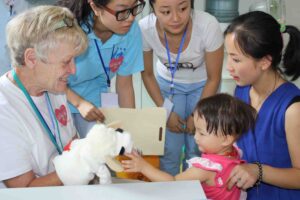
A small team of student audiologists-in-training conducted hearing examinations for nearly 100 athletes (Photo provided)
The stage was set at Wintrust Sports Complex in the Village of Bedford Park—a suburb of Chicago—when nearly 600 Special Olympics athletes from across the state began to stream in.
With the help of a substantial volunteer staff, including more than 25 students from the College of Applied Health Sciences at the University of Illinois Urbana-Champaign, many of the athletes left the facility ready to play.
As part of the 22nd annual “MedFest” event, hundreds descended on Bedford Park to help athletes from Special Olympics Illinois receive their physical certifications to compete in the state.
In the most recent edition, hosted on Nov. 30, students from the Departments of Speech and Hearing Science and Recreation, Sport and Tourism took time out of their fall break from classes to help the event run smoothly.
A small team of student audiologists-in-training conducted hearing examinations for nearly 100 athletes, while 15 RST students helped from the event management side, signing in the athletes and directing them to the right locations.
“You can tell that they got so comfortable and were having a blast, talking with athletes and interacting with them,” said Melissa Garritano, senior director of Special Olympics Illinois region D, which covers the Chicagoland area. “Thinking back to when I was at the U. of I., I wish I would’ve done stuff like this. They drove up two hours to spend the day with us—the athletes loved them.”
The connection stemmed from Bedford Park’s budding partnership with the College of AHS. The Department of Recreation, Sport and Tourism has a grant with the Village of Bedford Park, which heavily invested in the Wintrust Sports Complex. The project-heavy facility hosts community events on a regular basis, atop of its normal sports operations.
Joe Ronovsky, chief business officer of Village of Bedford Park, is a two-time RST graduate. He saw that the complex could serve as a real-world “lab setting” for community engagement projects led by RST faculty and students.
“Frankly, it’s kind of a one-stop shop, and it’s an opportunity for me as a teacher to show how all these things interact with each other,” said RST Clinical Associate Professor Michael Raycraft.
MedFest was set up to provide free medical screenings for Special Olympics athletes. Wintrust Sports Complex at Bedford Park began partnering with Special Olympics Illinois about a year and a half ago.
“Their facility is unbelievable,” Garritano said. She met Raycraft through their common connections to the Wintrust Complex.
Nicole Dudek, a junior in the RST program, was taken aback by the organizational strength and scale of the event. She started her day at MedFest positioned at the height and weight station, an entry point for many of the athletes.
When students showed up around 8:30 a.m., the Special Olympics staff had the gear and answers: nametags, T-shirts, and where each student would be working within the complex.
“From the event management side of things, you could tell how well-run this event was start to finish,” Dudek said. “It helped to have such a large open space and so many volunteers, and everyone worked well together with the sole goal to help these students get their necessary medical certifications.”
The “noisy, upbeat” energy of the event bolstered the volunteer experience for RST senior Carson Bounds.
“As you could imagine, with 450 kids taking a field trip to a large indoor sport facility during a school day, they all were quite excited to be there,” Bounds said.
Third-year audiology student Yadira Espinoza appreciated the pre-event workshop on how to work with a special needs population.
“Since it was a Special Olympics event, it was important for us to know what to expect; that every kid will be different depending on their needs and accommodations,” she said.
The athletes—ranging from elementary schoolers to full-grown adults—had a variety of responses to the hearing tests. Espinoza used her bilingual fluency to help some of the families who only spoke Spanish, she said.
“These opportunities are very important because they provide more or confirm what we learn in the classroom. It’s different to work with someone who may have Down syndrome or a speech delay; seeing it firsthand really makes a difference and puts you in a situation to put your critical thinking in place,” she said.
Students from RST and SHS teamed up at MedFast (Photo provided)
SHS audiology students are regular volunteers in the community, typically getting out for a handful of outreach events per semester, such as a recent visit to the ClarkLindsey retirement community in Urbana.
Clinical associate professor Sadie Braun supervised the audiology students in the volunteer event. Seeing her students persist with the athletes who didn’t respond right away to testing made the experience worthwhile.
“The athlete got this sense of pride when they were doing what we were asking them to do,” Braun said.
“It was awesome and unique to bring the U of I [audiology] crew up,” Garritano added. “Some of those athletes they got to see may have never had a hearing test in their life.”
Ronovsky thanked Raycraft and Village of Bedford Park President David Brady for tying together all the stakeholders in November’s event.
“Seeing the large group of RST and Speech and Hearing Science students volunteering at MedFest really tied together the meaning of community we’re trying to build at the Wintrust Sports Complex, in Bedford Park and throughout the state of Illinois,” Ronovsky said. “These Illini students are the next leaders in our communities.”