I-Health student Cecilia Kattan discusses her internship


Cecilia Kattan, left, aspires to be a physician’s assistant

Q: Where did you complete your internship and what was your experience?

A: I completed my internship at the Champaign-Urbana Public Health Department in partnership with the maternal & child health department and community nutrition initiatives. My role at my internship was a hybrid of administration and observation. Some examples of projects I completed are: social media management, breastfeeding incentive program with the peer lactation consultant, coordinating with sponsors for the Mommy and Baby Expo, created an employer breastfeeding friendly certification toolkit, and led a grant proposal and presentation for the Carle HealthMaker Lab. I was also given the opportunity to shadow WIC consultations.

Q: How did you apply for the internship?

A: I applied via the C-UPHD internship website, followed by an interview with the director of the department, Valerie Koress.

Q: What did you learn from the internship?

A: I was given insight on how public health departments operate and allocate resources efficiently. In addition, I got an up-close look into the racial disparities experienced in our community and aided in the progression of initiatives to fill those healthcare gaps.

Q: What was your biggest takeaway from the experience?

A: My biggest takeaway was realizing the different levels of organizations that contribute to community health and the discrepancy in funding.

Q: Is this internship closely related to the field you are hoping to work in?

A: My internship gave me valuable experience working in maternal and child health, since women’s health is an interest of mine. As a future Physician Assistant I will be able to understand the value of non-clinical grassroots initiatives. In addition, community service is one of my intrinsic pillars. Therefore, I hope to participate in some of these initiatives in my future career.

Q: Would you like to share any other information that might be helpful for future I-Health students?

A: You get out what you put into your internship. My role was not clearly defined for me since I was the first intern since the arrival of the new director. Hence, I made it a point to do weekly check-ins with my preceptor, Valerie, to ensure I was being helpful. Remember to use your voice and advocate for yourself to ensure you have a valuable experience.

Share on social

Related news

Kinesiology student Jackie Buczkowski talks about her internship


Jackie Buczkowski demonstrates different exercises for patients.

Q: Where did you complete your internship and what was your experience?

A: I completed my internship at Active Rehab Clinics in Bucktown, a neighborhood in Chicago, Illinois. Initially, I began shadowing the head chiropractor of the clinic and his assistant. I observed the chiropractor while he worked hands-on with his patients and observed his assistant while he coached the patients through various exercises pertaining to their injury. After two to three months of observation, I began working with patients myself. I was taught the Burdenko Method which consists of a series of exercises used to treat patients on land and in water. Throughout the fall 2020 semester, I worked with patients at the clinic in Bucktown as well as out of Lutheran General Hospital in Park Ridge, Illinois.

Q: How did you apply for the internship?

A: Since I completed my internship during the summer and fall of COVID-19, I did not apply for this internship as a student conventionally would. My cousin is a patient of the chiropractor and asked if he was allowing students to shadow during this time. However, when I have shadowed previous physical therapists I would typically reach out through email. I have also dropped off my resume at a few different locations to see if they would allow me to shadow. More often than not they would agree! Since physical therapists understand shadowing is a requirement in order to apply to PT school, they are very understanding and willing to help.

Q: What did you learn from the internship?

A: This internship was the most fulfilling internship I’ve had so far. I learned to trust my judgment and to not be embarrassed of being incorrect or struggling to learn something new. I was often quizzed and asked questions before being told the answer. This style of teaching helped stimulate my brain which overall felt more interactive. I wasn’t simply watching passively but rather actively engaging in assessing a patient.

Q: What was your biggest takeaway from the experience?

A: My biggest takeaway from this experience is understanding that every patient is different. What might work for one patient may not work for the other. Although you’re taught to go by the book in some cases, you may need to think outside the box in other scenarios. It was fascinating for me to see the chiropractor and his assistant not only assess the part of the body that was injured or had pain but to go beyond that and see if another part of the body was actually causing that pain. For example, if a young athlete was having pain in her knee, they would rehab her hip and build strength there.

Q: Is this internship closely related to the field you are hoping to work in? 

A: This internship is closely related to the field I want to go into which is physical therapy. Although I shadowed a licensed chiropractor, he also specializes in rehabilitation. In my previous experiences I shadowed physical therapists at hospitals and chain outpatient clinics such as Athletico, however, this experience was different because it was a privately owned clinic. In many ways this faces its own challenges because billing and scheduling is in your control. I was able to see the “behind the scenes” of what owning your own business might look like.

Q: Would you like to share any other information that might be helpful for future Kinesiology students?

A: The advice I recommend to any Kinesiology student is to reach out to any company or any specific person you’d like to shadow or intern for! Internships are truly the best opportunity to figure out whether or not you really want to go into a certain field. I’ve shadowed many physical therapists and have learned something new from each of them. They inspire me to finish school and start doing what I believe to be the best career there is for me. With a bachelor’s in Kinesiology there are many career paths you can take and you want to find which fits you best!

Share on social

Related news

University of Illinois designated as Purple Heart university


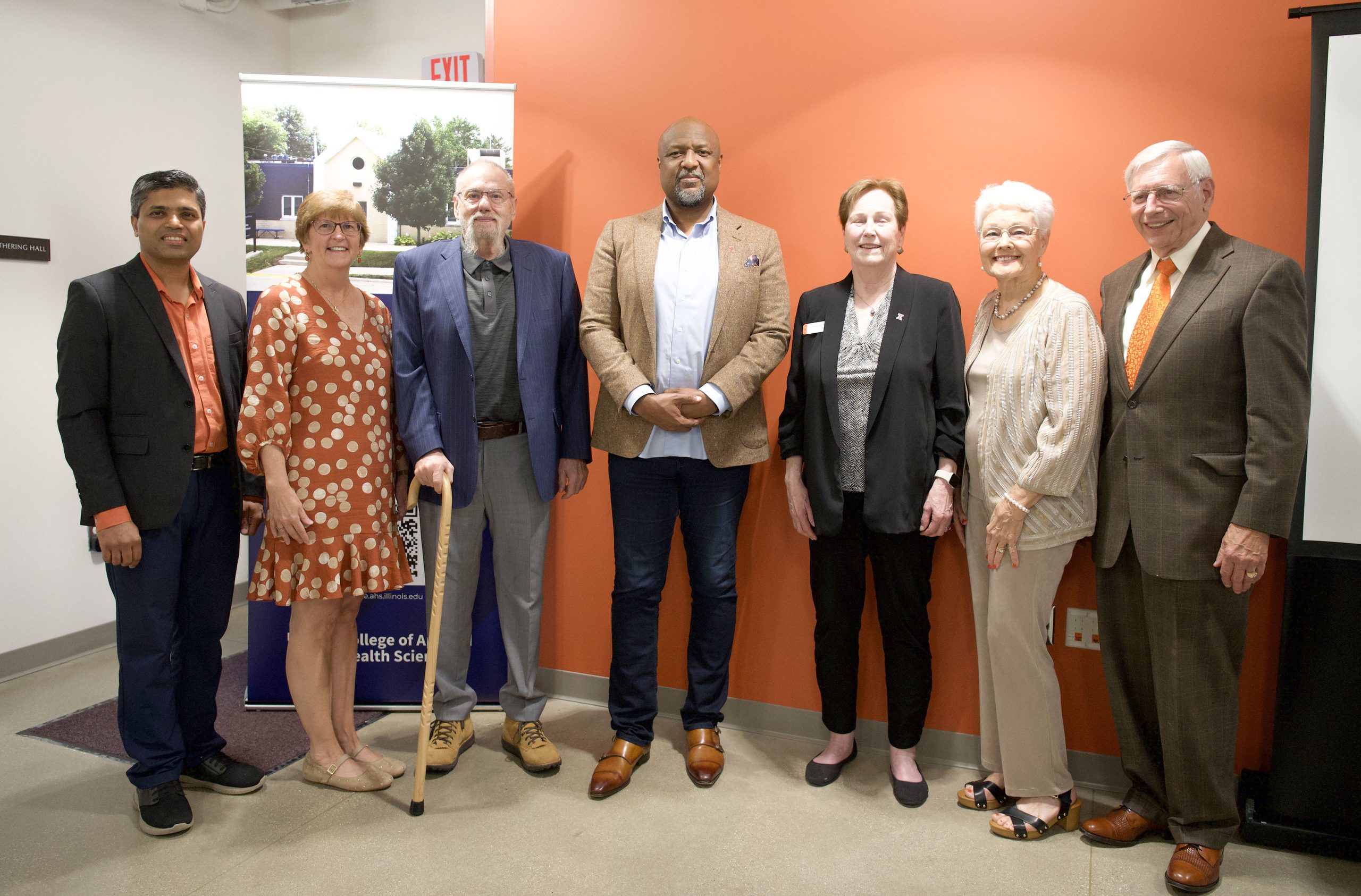
(from left) Dean Cheryl Hanley-Maxwell, Chancellor Robert Jones and Chez’s Garrett Anderson

The University of Illinois was designated Friday as a Purple Heart university, awarded the honor because of the university’s longstanding commitment to military veterans.

“This university has a tradition unlike any other that goes far beyond just remembering those who lost their lives in service,” Chancellor Robert Jones said. “This has been a place of world-changing ideas, innovations and, sometimes just plain old hard-headed determination to help those who come home to find success in their educational hopes and to lead lives and careers of impact after they earn their degree.”

Illinois was the first university to call for compulsory military training at all land grant colleges, as part of the Morrill Act of 1862, and developed the first post-secondary disability support service program in the world for Veterans. Established by Dr. Tim Nugent, this program allowed injured World War II veterans to use their GI Bill benefits for higher education.

In 2015, UIUC opened the doors at the Chez Veterans Center to provide an open, welcoming space for all student veterans and military-connected communities.

“During my tenure as dean of the College of Applied Health Sciences, I have had many opportunities to feel proud of leading such an outstanding unit. Today, that pride deepens with this truly humbling recognition by the Military Order of the Purple Heart,” said AHS Dean Cheryl Hanley-Maxwell.

“The commitment of this college and this university to helping wounded veterans pursue their degrees goes back more than 70 years, when Dr. Timothy Nugent established the very first support program in higher education for World War two veterans with disabilities. At a time when people in wheelchairs were not expected or encouraged to attend college and dream of careers, Dr. Nugent said, “Why not?”’

The Chez Veterans Center is the largest, most comprehensive facility of its kind in the United States, and serves more than 550 military-connected students.

“AHS continues to be the unwavering force pushing us forward to do more and to find new and better ways to open doors of access and success to the student-veterans who trust this university with their academic futures,” Chancellor Jones said.

The event was well-attended and VIPs included Matt Janes from the office of Congressman Rodney Davis; State Senator Scott Bennett; State Senator Chapin Rose; State Representative Mike Marron; State Representative Brad Halbrook, Champaign Mayor Deborah Frank Feinen, members of the Chez Veterans Center advisory board, and members of the Veterans Assistance Commission and Department of Veterans Affairs.

Editor’s note:

To reach Vince Lara-Cinisomo, email vinlara@illinois.edu.
 

Share on social

Related news

Alumni Spotlight—Tim Clary


Q. Why did you pick AHS?

A: In high school, I knew I wanted to be an Athletic Director/Coordinator, and AHS provided the pathway to doing that with Sports Management. 

Q: Which professors had the most impact on you?

A; Dr. (Michael) Raycraft: A personable man that would lead with honesty but connect on a level that helped you understand the intricate complexities within RST. Also, Nuno Ribeiro: he was a man that helped me a ton even after I graduated. He taught me about his life experiences and how they shaped his life in hopes it could influence mine. 

Q: What course did you most enjoy?

A: Two courses equally, both taught by Dr. Raycraft. One, Sports Management and two, Sports Ethics. 

Q: Did you enter AHS knowing your career path, or did AHS help you decide?

A: I entered knowing I wanted to be in athletics in some capacity. 

Q: What was your favorite on-campus experience?

A: Most of my time was taken up by athletics; I did appreciate the study sessions in the underground library prepping for some of the harder courses (Research Methods). 

Q: What does AHS mean to you?

A: I’m thankful for my time in AHS. Led by many wonderful professors and provided the path to achieving my goal of becoming an athletic director one day. 

Editor’s note:

To reach Vince Lara-Cinisomo, email vinlara@illinois.edu

Related news

SHS alum Anjali Forber-Pratt named director of NIDILRR


SHS alum Anjali Forber-Pratt named director of the National Institute on Disability, Independent Living and Rehabilitation Research

Anjali Forber-Pratt, who earned her bachelor’s and master’s degrees from the Department of Speech and Hearing Science in the College of Applied Health Sciences at the University of Illinois, has been named as director of the National Institute on Disability, Independent Living and Rehabilitation Research (NIDILRR).

Forber-Pratt, most recently an assistant professor at Vanderbilt University, is an elite wheelchair racer, having won two bronze medals at the 2008 Summer Paralympic Games in Beijing, China. She also represented Team USA in London at the 2012 Paralympic Games.

Her research is focused on disability identity, inclusion, disability sport, and work related to disability activism. Forber-Pratt holds a B.S. in Speech and Hearing Sciences, an M.A. in Speech-Language Pathology, and a Ph.D. in Human Resource Development, all from the University of Illinois Urbana-Champaign.

A two-time Paralympian and medalist in the sport of wheelchair racing, Dr. Forber-Pratt has dedicated her life to helping others recognize their potential. Globally, she is involved with disability advocacy efforts related to access to employment, education and sports. She was honored with the inaugural American Psychological Association Citizen Psychologist Award for Advancing Disability as a Human Rights and Social Justice Issue Award in 2020 and was recognized by Diverse: Issues in Higher Education as a 2018 Emerging Scholar. In 2013, she was awarded the American Association of People with Disabilities’ prestigious Paul G. Hearne Leadership Award, given to emerging leaders within the national disability community. Also in 2013, she was named a Champion of Change by the White House and had an opportunity to participate in a roundtable discussion with President Obama about disability policy issues.

“I am extremely honored and humbled by this appointment as well as the opportunity to serve our country,” Forber-Pratt said in a statement. “From my U of I days, I distinctly remember being explicitly taught that we had an obligation as alums to make the world a better place and to be ambassadors, especially for the broader disability community. Dr. Timothy Nugent taught us that, and my coach Adam Bleakney and others reinforced that every day—it was always more than just our athletic journey or just our academic journey. Many of us have found our own unique ways to embody that—I believe serving as Director of the National Institute of Disability, Independent Living and Rehabilitation Research is one way that I will continue to try to serve the broader disability community and educate others. I believe my collective training—with two degrees in Speech & Hearing Sciences as well as my PhD in education that taught me the analytic research skills—it truly is the combination of these degrees and U of I experiences and my own lived experiences as a proud disabled alum that position me well to transition into this role.”

Forber-Pratt served as principal investigator for research projects covering a range of disability issues, including training of special education teachers, experiences of students with disabilities at every education level, and identity development. She has authored 33 peer-reviewed journal articles and is the author or co-author of a number of textbook chapters.

Editor’s note:

To reach Vince Lara-Cinisomo, email vinlara@illinois.edu.
 

Share on social

Related news

I-Health senior Falguni Deshpande discusses COVID and the class of 2021


Photo by caption

Q: Why did you pick I-Health?

A: I was unhappy in my previous major and my sister told me to meet with her previous advisor Beth (Frasca). I met up with Beth on the first day of my sophomore year and saw how welcoming the college of Applied Health Sciences is, which made me realize I wanted to transfer into this college. I knew about I-Health because my sister had majored in it, and I decided on majoring in I-Health because I was interested in expanding my knowledge about health and the ways in which our society and environment influence our health and wellbeing.

Q: Which professors had the most impact on you?

A: The (person) that had the most impact on me was my advisor Beth (Frasca). She has always been so supportive of me ever since I transferred into I-Health, and has helped me so much with figuring out my college life and also my future! She is the reason why I was able to make the switch into I-Health and is also the one who encouraged me to apply for the Health Technology master’s program at our university.

Q: What course did you most enjoy?

A: 3. CHLH 470: Technology, Health, and Aging—this class is what made me interested in the field of health technology! The professor Dr. (Tim) Hale was super amazing and I really enjoyed getting to work with a group on a project where we created a health technology product to solve a health issue.

Q: Did you enter I-Health knowing your career path, or did KCH help you decide?

A: 4. When I transferred into I-Health, my original plan was to go to medical school, but my time in I-Health made me realize how interested I was in helping serve diverse populations and also health technology! After talking with my advisor Beth and other people in I-Health, I decided that I wanted to work in the health care field for a few years before going straight to medical school.

Q: What do you hope to do after you graduate?

A: After I graduate, I will be spending another year at the University of Illinois pursuing a Master of Science in Health Technology. After that, I plan on finding a job in the health care field (hopefully related to health technology) and eventually apply for medical school!

Q: What was your favorite on-campus experience?

A: My favorite on-campus experiences are probably when I would go and explore new parts of campus that I had never been to before! As a freshman I lived in Snyder Hall on Peabody Dr, and one time I decided to walk with some friends down the road and I saw the Krannert Art Museum! I would definitely recommend going there, along with Japan House at the Arboretum!

Q: What do you miss most because of the pandemic?

A: I miss attending in-person classes and the walk to/between classes. I loved getting to know new people and saying hi to them if I see them on the quad. I also miss getting to hang out with my friends and doing in-person volunteering through my service organization.

Q: What are the biggest changes on campus, pre and during COVID?

A: The biggest change I noticed was the culture of campus. Before COVID, you would always see so many people hanging out outside on the quad, whether it be chilling with friends, playing sports, or studying. Now, many people tend to stay inside because most of their classes are online. During my entire senior year, I only had one in-person class, which was IHLT 475!

Q: What would you say to recommend I-Health to a prospective student?

A: I would tell a prospective student that the I-Health major really gives you a holistic view of health and helps expand your understanding of what health is and how it incorporates the different social determinants of health. If you plan on pursuing a career in the field of health and health care, I-Health is the perfect major for you!

Share on social

Related news

Students are attending college in a unique environment, and that includes students in the College of Applied Health Sciences at the University of Illinois. The AHS communications staff spoke with AHS seniors about online classes, truncated courses and how COVID-19 changed their expectations. Today, we speak with Falguni Deshpande, who graduated in May with a Bachelor of Science in Interdisciplinary Health Sciences.

Q: Why did you pick I-Health?

A: I was unhappy in my previous major and my sister told me to meet with her previous advisor Beth (Frasca). I met up with Beth on the first day of my sophomore year and saw how welcoming the college of Applied Health Sciences is, which made me realize I wanted to transfer into this college. I knew about I-Health because my sister had majored in it, and I decided on majoring in I-Health because I was interested in expanding my knowledge about health and the ways in which our society and environment influence our health and wellbeing.

Q: Which professors had the most impact on you?

A: The (person) that had the most impact on me was my advisor Beth (Frasca). She has always been so supportive of me ever since I transferred into I-Health, and has helped me so much with figuring out my college life and also my future! She is the reason why I was able to make the switch into I-Health and is also the one who encouraged me to apply for the Health Technology master’s program at our university.

Q: What course did you most enjoy?

A: 3. CHLH 470: Technology, Health, and Aging—this class is what made me interested in the field of health technology! The professor Dr. (Tim) Hale was super amazing and I really enjoyed getting to work with a group on a project where we created a health technology product to solve a health issue.

Q: Did you enter I-Health knowing your career path, or did KCH help you decide?

A: 4. When I transferred into I-Health, my original plan was to go to medical school, but my time in I-Health made me realize how interested I was in helping serve diverse populations and also health technology! After talking with my advisor Beth and other people in I-Health, I decided that I wanted to work in the health care field for a few years before going straight to medical school.

Q: What do you hope to do after you graduate?

A: After I graduate, I will be spending another year at the University of Illinois pursuing a Master of Science in Health Technology. After that, I plan on finding a job in the health care field (hopefully related to health technology) and eventually apply for medical school!

Q: What was your favorite on-campus experience?

A: My favorite on-campus experiences are probably when I would go and explore new parts of campus that I had never been to before! As a freshman I lived in Snyder Hall on Peabody Dr, and one time I decided to walk with some friends down the road and I saw the Krannert Art Museum! I would definitely recommend going there, along with Japan House at the Arboretum!

Q: What do you miss most because of the pandemic?

A: I miss attending in-person classes and the walk to/between classes. I loved getting to know new people and saying hi to them if I see them on the quad. I also miss getting to hang out with my friends and doing in-person volunteering through my service organization.

Q: What are the biggest changes on campus, pre and during COVID?

A: The biggest change I noticed was the culture of campus. Before COVID, you would always see so many people hanging out outside on the quad, whether it be chilling with friends, playing sports, or studying. Now, many people tend to stay inside because most of their classes are online. During my entire senior year, I only had one in-person class, which was IHLT 475!

Q: What would you say to recommend I-Health to a prospective student?

A: I would tell a prospective student that the I-Health major really gives you a holistic view of health and helps expand your understanding of what health is and how it incorporates the different social determinants of health. If you plan on pursuing a career in the field of health and health care, I-Health is the perfect major for you!

Paceley receives award for excellence in graduate contacts


Andrea Paceley is ‘indispensable,’ according to nominators. (Photo by Jerry Thompson)

The Graduate College in February announced that Andrea Paceley (Office Manager, Speech and Hearing Science) was named a winner of the 2024 Graduate College Excellence Award for Graduate Contacts. The award is given annually as part of the Graduate College’s Annual Workshop for Directors of Graduate Study and Graduate Contacts. It recognizes staff members whose service has exceeded expectations in enhancing graduate students’ experiences and has positively impacted their graduate program or department’s operations.

Paceley has served as the Office Manager in Speech and Hearing Science for more than eight years. Nominators named her an “indispensable” part of the department for her streamlining of processes, commitment to transparency and “contagious cheerfulness.” One nominator said that Andrea “has demonstrated sustained excellence in support of our graduate programs, students, and faculty.” A graduate student in Speech and Hearing Science added that “her skills, kindness, and ability to navigate challenges with grace set her apart as a truly exceptional graduate secretary.”

Graduate Contacts are essential to the success of our graduate students. They welcome students into our campus community, provide valuable support through both the good and challenging times, and celebrate students’ accomplishments. The care and compassion that Graduate Contacts demonstrate every day are an invaluable contribution to the university and its community of students, faculty, and staff. The Graduate College extends its thanks to all of our Graduate Contacts for their work in our campus community.

Related news

Freshman Todd Marshall talks about campus and COVID


Q: Are you on campus?

A: I do not live on campus, but I grew up in Champaign so I live at my house off campus.

Q: What made you decide to be on campus?

A: It was a cheaper option to stay home especially with classes being mostly online. Although I am still able to attend my in-person classes since I live close.

Q: What challenges have you found in navigating campus?

A: I’ve been on campus quite a lot and navigating is not very difficult to me.

Q: Have often are you in a classroom, as opposed to taking remote classes?

A: Two days a week I go to in-person classes, (but) only the Spring semester, though. I spend much more time on computer classes than in-person.

Q: What challenges are you discovering with remote classes?

A: Deadlines often conflict or get mixed up with each other. I have not had very many technology barriers, other than having to pay for services teachers use.

Q: Tell me what you think about the COVID testing process. Has it been easy to find a testing site?

A: I believe the university is doing a great job providing testing and access to students health history through the app. The U of I has taken this opportunity to actually demonstrate their innovation and commitment to student safety, and as a student that is very valuable.

Q: What are the differences between your high school remote learning experience, and here at Illinois?

A: Not much is different, other than more Zoom calls with university classes.

Q: What is the one thing you can’t wait to do when you get to campus?

A: Go to Kams (bar in Champaign).

here is a news quote as an example:

Related news

Community Health student feels confident about return to in-person instruction


Nick Olivieri is an EMT and can give vaccines (Stock image)

Nick Olivieri is a senior in the University of Illinois’ College of Applied Health Sciences, and expects to graduate with a bachelor’s degree in community health in May. But if he was returning to school in the fall—when UIUC and many other schools are expecting to return to in-person instruction in the midst of the pandemic—he would be looking forward to it.

“100 percent,” said Olivieri, an Orland Park, Ill., native. “U of I has put on an example for the rest of the nation. I get tested multiple times a week, and if people continue to do that, I don’t see a reason why I can’t be sitting next to my fellow classmates once we all know we’ve had some negatives. People are going to get vaccinated. I don’t see why our campus can’t be back in person, and people will actually get the real U of I experience that they thought they would when they signed up to come to the school.”

Part of the reason Olivieri is so confident is that, as a licensed Emergency Medical Technician, he is eligible to administer COVID-19 vaccines. As part of his graduation requirement, Olivieri is doing an internship as a medical assistant at Frances Nelson Health Center, a walk-in clinic in Champaign, where UIUC is based.

“One of the first things they said my first day on the internship, was like, ‘OK, cool. You got your EMT license. You are eligible to give the vaccine,’” he said. “And it took a bit of asking after that. But eventually a slower day around the clinic, so one of the physician’s assistants brought me over to the vaccination clinic, and he let me do it. And only through this internship would I be able to do that, which I’m grateful for.”

Not that Olivieri—who has himself gotten vaccinated—didn’t have some hesitation about putting needles into arms.

“Well, I won’t lie. When I first was approached, asked to do it, I was a little hesitant. I didn’t have any previous experience giving shots, but I knew someone would be training me. And I’ve always learned throughout EMS that you’re only going to learn through actually doing it. You can’t overthink it.”

Most people age 16 and older in Central Illinois are now eligible for a COVID-19 vaccine, and Frances Nelson is administering vaccines to “almost anyone who asks,” Olivieri said. Still, some are naturally concerned about taking the needle or the potential side effects.

“There are cases where people get a wave of anxiety or fear,” he said. “And these people, we take them to the side and we try to calm them down by just like talking to them. Because these bad reactions, they’re very rare. But I do tell these people that I take this vaccine. And every institution worth their while in the U.S. opts for the vaccine. And I think it’s a civil duty getting it.”

In his role as an EMT and at Frances Nelson, Olivieri is an obvious choice for classmates and friends to come to for advice.

“I am somewhat knowledgeable about health care, and I’ve taken enough science classes to know how the vaccine works,” he said. “But I’m still no expert on this whatsoever. (Classmates) do ask me questions about the vaccine. And I have nothing but good to say about it. I’m pretty confident in the safety of it. (But) with the collective knowledge of all the scientists in America, the CDC is the best source.”

Olivieri added that he will not “baby-sit” his fellow classmates about their behavior on campus.

“It is frustrating to see a large group of campus going out every weekend, things like that,” he said. “But people are also in control of their own decisions. But I would say yes, it is a bit frustrating when people do not follow such recommendations given by the CDC and university.”

Olivieri is quick to point out that he wouldn’t be in the position he’s in without his AHS training.

“You can enter many different fields through Community Health, and they kind of give you a good way of thinking about health care,” he said. “I wanted to help people in health care, but I wasn’t really sure in what way. Community Health at AHS really helps you learn about all the types of positions throughout the health system.”

Olivieri already has had a number of experiences for someone of his age. Yet, he has big plans ahead.

“I want to get a job at an ambulance company, but also look for other jobs in a clinical setting. I want to do that for a couple of years and hopefully take the (Medical College Admission Test), do well, and gain admission into medical school.”

With his training, Olivieri is well on his way.

Editor’s note:

To reach Vince Lara-Cinisomo, email vinlara@illinois.edu

Related news

Alumni Spotlight—Eric Seper


Q: Why did you pick AHS?

A: I chose AHS because I knew I wanted to be in a healthcare field. The college has a family-like aspect, which was very welcoming. As I began my AHS coursework, I learned that the school was tight-knit and filled with bright individuals working towards a common goal.

Q: Which professors had the most impact on you?

A: Could I say all of them?! My first class in the department was an introduction to communication disorders and was taught by Dr. David Gooler. His teaching style resonated with me and many of my classmates. Dr. Gooler co-chaired my doctoral capstone project along with another influential professor—Dr. Ron Chambers. Dr. Chambers was available to speak with me as I decided upon a doctoral program in Audiology. He helped make the transition into graduate school easy and less intimidating than I anticipated. Our clinical supervisors—Lou Chambers and Carol Parker—taught me countless clinical lessons that I still employ today!

Q: What course did you most enjoy?

A: I completed two semesters of American Sign Language in the department and wish I had started sooner so I could complete the third course while an undergraduate. The instructors were thoughtful and great at understanding what each student needed to work on. Learning another language is powerful, especially when you are able to use that language to communicate with others in everyday situations.

Q: Did you enter AHS knowing your career path, or did AHS help you decide?

A: I entered AHS with the intention of learning more about speech-language pathology and audiology—AHS helped me decide from there. My first course introduced various communication disorders from both fields. Once the audiology portion began, I immediately knew that this was what I wanted to pursue long-term.

Q: Did your AHS experience lead to your current job?

A: Yes! AHS helped craft my professional experience in multiple ways. I developed strong clinical skills under the clinical leadership on campus. I still employ many lessons in the professional clinic today. The smaller, family-like atmosphere in AHS helped make me more comfortable with public speaking; the doctoral capstone project was a major learning process. That project allowed me to feel more comfortable in a research-based position where I authored and co-authored peer-reviewed journal articles. I also felt much more confident speaking at conferences following my experiences in AHS.

Q: What is your current job?

A: I am currently a clinical audiologist at the University of Chicago Medicine. I see mostly adult patients and we are fortunate to offer diagnostic audiology, cochlear implant services, vestibular evaluations, and hearing aid services to our patients. Seeing all these different disciplines—sometimes all in the same day—is a thrill. I am extremely fortunate to work alongside a tremendously skilled team of audiologists, physicians, and speech-language pathologists.

Q: What was your favorite on-campus experience?

A: If I need to pick only one, then graduating from the Doctor of Audiology program was a special day. Everybody graduating (from all programs) put in an amazing amount of work to develop skills and understanding in a particular field. For my Audiology classmates and I, we spent eight years honing our skills. Our hard work was rewarded with degrees and the trust that we will be strong practitioners in the field.

Q: What would you say to recommend AHS to a prospective student?

A: AHS is dedicated towards making sure students feel comfortable in the college. They are interested in developing strong students, but also strong societal contributors. I highly recommend AHS!

Editor’s note:

To reach Vince Lara-Cinisomo, email vinlara@illinois.edu.
 

Related news

College of Applied Health Sciences
110 Huff Hall
1206 South 4th Street
Champaign, IL 61820
(217) 333-2131