Chez Center hosts program to ready veterans for higher ed


Apsan Bishwokarma looks over notes in a Warrior-Scholar Project class, hosted at the Chez Veterans Center. (Photo by Ethan Simmons)

While Adam Sherman Jr. sat for the two-hour bus ride from Chicago O’Hare Airport to the University of Illinois Urbana-Champaign campus, a pit was forming in his stomach. 

He’d spent six years in the Navy, stationed in Japan and California for three years apiece, sometimes working out at sea for six or 12 months at a time. But a few preparatory problem sets for the Warrior-Scholar Project’s academic boot camp had him stumped. 

“I didn’t know if I’d be able to knock off the dust and the rust to get going in this program,” said Sherman, who grew up in New Jersey. 

After spending four days in the camp absorbing astronomy and physics lectures from University of Illinois faculty at the Chez Veterans Center, Sherman’s first taste of higher education was going “really smooth,” he said. 

“They broke it down in a way that’s really digestible, and they’re building it up in a way where it’s really fast-paced, but it’s comprehensible,” he said.  

This July, 15 student Veterans took classes and teamed up on projects in the Chez Veterans Center, the University of Illinois’ one-stop shop for military-connected students. The center has hosted the nonprofit Warrior-Scholar Project for the three consecutive years. 

The Warrior-Scholar Project, or WSP for short, takes place in college campuses across the country as an eight-day higher ed experience for military Veterans of all ages. 

The WSP and Chez Veterans Center’s missions are aligned—both are dedicated to easing the transition of military-connected students back into education and civilian life. 

“The premise of WSP is really about showing them they can do it, giving them the confidence they can leave the military and go to a place like the University of Illinois,” said Chez Veterans Center Director of Operations Andy Bender. 

“I think what’s great for us in particular is (WSP) follows our mission. We’re all about the successful transition from the military into higher education—this is a good steppingstone for it. But it also gets a lot of our campus partners who may not have connections to the military to come and meet these students.” 

WSP Education Programs Coordinator Rebecca Mills called Illinois’ Chez Veterans Center one of the program’s “top campus stakeholders,” for going “above and beyond” for student cohorts. A core component for both organizations: Showing Veterans that the talents they’ve built in the service are transferable to the classroom.

“It’s less the content—we know they’re capable, we know they have the experience. But how do they use the skills they developed in the military to be successful in higher ed?” Mills said. 

Warrior-Scholar Project student-veterans chat during a tour of Hourglass Medical in Illinois Research Park, alongside Chez Veterans Center staff.
A whopping 88 percent of Warrior-Scholar Project alumni have either obtained a college degree or are on track to complete one (Photo by Ethan Simmons)

Some students, such as Sherman, enter the Warrior-Scholar Project with no college credits. Others, such as Sergio Perez Jr., a 26-year-old Marine Corps veteran from Oklahoma, used WSP to re-familiarize himself with the pace of university life.  

When he left the service in October 2023, he “had one goal in mind: and that was to go back and finish my degree,” he said. 

“For me, WSP was a ‘two birds with one stone’ type of deal, because University of Illinois was actually one of the schools I’m thinking about applying to in the future,” Perez added. “When I saw they still had openings for this, I thought, ‘You know what? I can do a quick campus tour while still self improving.’ So this has given me a better understanding of how this campus functions.”

A whopping 88 percent of Warrior-Scholar Project alumni have either obtained a college degree or are on track to complete one, according to their internal statistics. This year, Illinois also hosted WSP’s annual alumni conference, where bootcamp graduates return to network and listen to industry professionals with military connections. 

A Veteran careers panel discussion included Mona Dexter, Comcast’s vice president of Military and Veteran Affairs; Michael Pett, Uber’s head of Military and Veteran Programs at Uber; Erica Jeffries Purdo, vice president of Strategy and Operations at Johnson & Johnson; and Tommy Jones, senior director of Military and Talent Programs at Walmart. 

During the campus visit, the student cohort got to tour Research Park businesses such as Caterpillar’s Innovation Center and Hourglass Medical, a wearable technology company. Before they left campus, Chez staff brought them to a celebratory visit to the Colonnades Club in Memorial Stadium, itself a tribute to U. of I. veterans who fought in World War I. 

“Illinois might be one of the best-kept secrets in higher ed; You walk into a building and learn about a Nobel prize winner who invented something you use every day,” Bender said. “We’ve had a couple people who’ve told us, ‘I wanna come here.’”

Editor’s note:

To reach Ethan Simmons, email ecsimmon@illinois.edu.
 

Related news

Student Profile: Ariel Freehill


Ariel Freehill

What kept you busy outside of your coursework?

I love doing projects, so I spent a lot of time doing those. I was able to even refurbish a 100-year-old round dining room table, and I love how it turned out. I also enjoyed having lazy days with my husband and my dog when I wasn’t working on coursework.

What inspired you to pursue a MHA degree?

I started my undergraduate college career thinking I wanted to be a doctor, then I switched to being a nurse. I even took a CNA course through Parkland College, and I realized that the clinical side of healthcare was just not for me. I knew I wanted to have a career in healthcare, so that led me to getting my Bachelors in Community Health. Once I was done with that, I knew I wanted to have the ability to hold a leadership position in healthcare someday, which ultimately led me to purse a MHA degree.

Why did you choose Illinois for your MHA?

My choice to go to Illinois for college started when I was super young. That’s why I pursued my undergraduate degree at Illinois, and I loved the university so much that I decided to stay two more years to complete the MHA program.

What advice do you have for current students OR prospective students?

Enjoy your time as a student and take advantage of all of the opportunities the program and university have to offer. I know all too well what it’s like to feel like you’re behind, like you should be onto the next step of life already. BUT once your time as a student is over, you have to enter the scary world of adulting so take full advantage of the life as a student while you can as everything will work itself out, and you’ll be grateful for all of the experiences you received during your time at Illinois.

Share on social

Related news

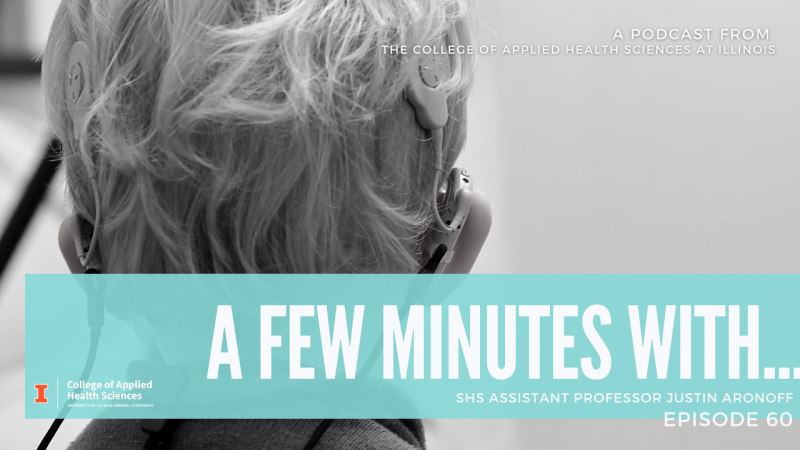
A Few Minutes With … Justin Aronoff


Transcript

VINCE LARA: Hi, and welcome to another edition of A Few Minutes With, the podcast that showcases Illinois College of Applied Health Sciences. I’m Vince Lara, and today I’m speaking with Justin Aronoff, an assistant professor in the Department of Speech and Hearing Science, about his research on the binaural auditory system as it relates to cochlear implants.

All right, Dr. Aronoff, thank you for joining me on this edition of the podcast. And commonly, I ask guests of the podcast about their inspirations for their research. So what made you look into auditory research? And you do primarily cochlear implants. So what made you look into that kind of research?

JUSTIN ARONOFF: So I kind of fell into this area. I was actually– I was having a bad experience at a postdoc. And there was another research position at the institute that I was at. And it was a hearing aid lab, primarily, that happened to have one cochlear implant project.

And I ended up on that project. So it’s a complete chance I ended up working a cochlear implant users at all. And I just fell in love with this field. I fell in love with the work. And it’s so rewarding to work with cochlear implant users.

One of the unique things about working with this patient population is that you tend to be individuals who come back to lab, you know, sometimes month after month for years. We’ll see them, and so we build up these relationships. It becomes very rewarding.

And it’s also a population that really values the research. So we do what is not necessarily the most exciting experiments to be in. We have people listen to beeps for five hours sometimes, which sounds very thrilling, I know. And I do sometimes ask them, look, I really appreciate that you’re coming in here and doing these incredibly boring experiments. I got to ask why, though. I appreciate it, but why are you doing it?

And what they often respond is they say, well, you know, I realize that what this device has done for me is a miracle. And I realize that the reason that it does what it does for me is because 20 years ago, there was someone sitting in a chair like this, listening to beeps for hours on end. And I really want to pay it forward. I really want to give to the next generation. And that type of sentiment is really kind of motivating to me, kept me really interested in continuing and working in this field.

VINCE LARA: Yeah, you kind of answered my next question, but I’ll ask it anyway. So you did your undergrad work in teaching, in the teaching of Spanish.

JUSTIN ARONOFF: Yes.

VINCE LARA: So then you followed with a masters in linguistics, which makes sense, right? You had these two– you had a pattern here. And then that led to Speech and Hearing Science. And that’s primarily because of how you felt about the population within that demographic, if you will?

JUSTIN ARONOFF: Well, I didn’t find cochlear implants until my postdoc.

VINCE LARA: OK.

JUSTIN ARONOFF: So my path was definitely fortuitous, to say the least. So when I was an undergrad here at U of I, in teaching Spanish, I did study abroad in Spain. And I took a linguistics course. And that got me very interested in linguistics.

And when I came back to campus, the only linguistics course that fit into my schedule was a neurolinguistic course by Molly Mack. And that really got me interested in the brain, and language, language acquisition. And so I went on and did my master’s in linguistics.

I was actually in the PhD program in linguistics at the University of Southern California. And as I got more and more interested into the neuro side of it, it felt like it didn’t quite fit into just the narrow range of neurologistics. I was interested in broader issues in neuroscience. And so I actually changed over into the neuroscience program to finish up my PhD.

And as I was doing that, I had the naive idea that, hey the auditory system seems like a fairly easy system to work with and to understand. But I was definitely a little naive at the time. And so that got me interested in working auditory work, and led to working at the House Ear Institute, and then eventually into doing postdoc there.

VINCE LARA: Mmhmm, now, Dr. Aronoff, for you listeners, recently received a seven-figure grant for a project that examines how the binary– binaural auditory system works. And so I’m curious, so the binaural system, for those of you who are uninitiated in this, is how the brain combines signals from our two ears. But I’m curious, why is that important?

JUSTIN ARONOFF: So having the ability to combine information from two ears can help in a lot of different situations. One of the big benefits is noisy environments. So typically, when you’re in a noisy environment– let’s say you’re at a restaurant– you’ve got the person you’re listening to is right in front of you but you’ve got all this background noise. You might have a table to side where those people are talking, you’re trying to tune them out.

The ability to basically attend to and separate out these spatially distinct sources of sound is dependent on the fact that you have two ears and that you can combine that information so it allows you to better focus on the person that you want to attend to, depending on wherever they are in space.

It’s also really important for localizing. So when you only have one ear, you really can’t tell if a sound is coming from the left or the right, especially if you don’t know what the volume is. There are some tricks you can use. But in general, most people are just very, very bad at being able to even tell the side that a sound is on when they only have one ear. Having two ears allows you to localize where the sound is.

You know, and also, patients also describe that having two ears makes the world seem fuller. It’s just this kind of qualitative sense to the world with two ears that you also don’t get having one ear alone.

VINCE LARA: Hmm. Your research is primarily focused on the importance of the study relative to cochlear implants. And–

JUSTIN ARONOFF: Yeah.

VINCE LARA: –the study states that you plan to maximize binaural benefits. And I wonder how you propose to do that.

JUSTIN ARONOFF: So one of the things that we found, my lab and other labs in this field, is that one of the big detriments in terms of getting those benefits from having two ears is when the information that you’re getting from the left and the right ear are mismatched.

And this can happen in a number of different ways. But the way that we see it happening with cochlear implants has to do with where the cochlear implant array is sitting, within the left or right cochlear, within the left and right ear, as well as what neurons are actually surviving in those two ears.

So it turns out that if you do not stimulate the same places, the same relative neurons in the left or the right ear, your ability to localize or ability to use these binaural cues and these cues that you get from having two ears decreases quite a lot.

Now, we know that there are potentially some mechanisms that can help you with that. There’s some ability to adapt. And our lab and other labs have looked at the ability to adapt to this mismatch between the two ears. It’s not clear how limited that is. We know you can do it in terms of the perception of what sounds like the same pitch in the two ears. Whether or not that translates to other things or not is not clear yet.

And really, what we’re trying to understand is how does that adaptation affect your ability? How do we need to change how we program these devices? When do we need to change? So if adaptation can handle a lot, maybe we can wait. If adaptation cannot handle a lot, then we need to start reprogramming very early on when you first get these devices.

And so we’re trying to look at kind of how do you manipulate where the stimulation is, how do you manipulate how similar the stimulation is in the two ears in order to improve those binaural benefits.

VINCE LARA: You helped develop a test that measures spectral resolution. And I’m wondering– two questions– what’s spectral resolution? And what’s the test?

JUSTIN ARONOFF: So spectral resolution is basically your ability to tell that two notes that you’re playing on the piano are not the same note. So people who have poor spectral resolution basically are not going to be able to tell that two notes that are roughly two notes apart are actually not the same note. And this is a common problem that we see with cochlear implant users.

And the reason that this is important is because it turns out that your ability to understand speech in a noisy environment really relates, in part, to your spectral resolution. And that’s something that we know that is a problem for cochlear implant users, as well as other patient populations.

So this is a test that I co-developed with David Landsberger when we were both at the House Ear Institute. And basically, this is a spectral-temporally modulated ripple test, or the SMRT. We’ve since modified it to create a version that can be used in the clinics as well, that’s the SMRT Lite for computeRless Measurement or SLRM. And basically what these measures are, they sound a lot like 1980s arcade sounds.

VINCE LARA: Hmm.

JUSTIN ARONOFF: And basically, it’s a fairly easy test. You just need to tell which sound is different, all right? And so you’ll hear three sounds that kind of sound– it’s kind of Space Invaders-y sound. And you’re trying to tell what’s [? different. ?] We’re manipulating, and there is some of the spectral properties, basically how close together these little ripples that we have across the spectrum, how close together they are and whether you can tell that one of them is closer than the other two.

VINCE LARA: Hmm.

JUSTIN ARONOFF: So it’s a fairly easy test for people to do. We’re not asking them to do anything but tell which one is different. And what’s nice about it is it turns out that it correlates well with speech perception in quiet as well as in noise. We’ve found that other labs around the world have found that as well.

So it turns out to be a nice kind of proxy test. Why the clinics have gotten interested in this is because one of the big problems that a lot of clinics have– I work with UIC in Chicago, for instance– is that they’ll often have patient populations that speak a wide range of languages, where English is not the native language. And when English is not your native language, testing someone on speech perception in English can be problematic because you don’t know if the problem is an auditory problem or if it’s a language problem.

VINCE LARA: Mmhmm.

JUSTIN ARONOFF: And so what’s nice about this test is that it’s a non-linguistic test. It doesn’t depend on languages. These are, like I said, kind of arcade-type sounds. There’s no linguistic content. But it does predict language performance.

VINCE LARA: Using your master’s in linguistics there, I would imagine.

JUSTIN ARONOFF: Yeah.

VINCE LARA: Yes. You know, you’re at an R1 university. And with that, your time is often dominated by research here at the University of Illinois. But teaching is a part of your responsibilities as well. And so I’m wondering what’s your favorite course to teach?

JUSTIN ARONOFF: That is a hard question. It’s hard to choose one, for sure. I really do enjoy teaching. And obviously, I got my degree in teaching. And I’m a licensed teacher in the state of Illinois. I come from a family of teachers. So it’s something I’m very passionate about.

If pressed, I would have to say it’s probably SHS280, Communication Neuroscience. It’s something that’s in that area where I got my PhD. I’m definitely very passionate about neuroscience. I really liked the large undergrad classes. I like those classes where this might be their first exposure to the area and you can really see the growth and the coming in really knowing next to nothing about the topic area, and then leaving. You can see kind of the growth of balance that they come out with.

So it’s a really rewarding class. And it’s just a fun class.

VINCE LARA: My thanks to Justin Aronoff. For more podcasts on Illinois College of Applied Health Sciences, search A Few Minutes With on iTunes, Spotify, iHeart Radio, radio.com, and other places you get your podcasts fix Thanks for listening, and see you next time.

Editor’s note:

To reach Vince Lara-Cinisomo, email vinlara@illinois.edu.
 

Share on social

Related news

Podcast: A Few Minutes With … Clarion Mendes and Amanda Lawrence on non-essential care during COVID-19


The Audiology and Speech-Language Pathology Clinic (Photo provided)

Vince Lara of the communications office of the College of Applied Health Sciences at the University of Illinois speaks with Clarion Mendes, clinical assistant professor and director of Clinical Education in the Department of Speech and Hearing Science, and Amanda Lawrence, clinical assistant professor in SHS, about the impact of COVID-19 on so-called non-essential health issues such as speech-language pathology and audiology and how those patients are treated.

Transcript

VINCE LARA: Hi. And welcome to another edition of A Few Minutes With, the podcast that showcases Illinois College of Applied Health Sciences. I’m Vince Lara. And today I’m speaking with Clarion Mendes and Amanda Lawrence from the speech and hearing science department to talk about how the SHS clinics are impacted by the coronavirus crisis. I know Speech and Hearing Science operates the Speech-Language Pathology Clinic and the audiology clinics. And are those still open?

CLARION MENDES: So that’s a great question. The physical location of the clinic is currently closed for the safety of our clients, our patients, our families, and our students and staff. So we’re following CDC recommendations as far as that’s concerned. However, like most of the rest of the world, we are diving deep into the world of telepractice, tele-interaction. So from the speech-language pathology standpoint, we have started to introduce telepractice for our patients and clients, and their families.

For audiology, it’s a little bit more complicated because of the types of equipment that are often used for audiological assessment and intervention. So what we’re doing currently for audiology patients is working with them to make sure that their hearing aids are up and running appropriately and making sure that their equipment is running smoothly. So repairs are still up and running for audiology.

VINCE LARA: How do you get hearing aids repaired without having that kind of face-to-face interaction?

AMANDA LAWRENCE: So there’s a couple things. So if a hearing aid’s malfunctioning, everything from– sometimes we can talk them through it. Because there’s a handful of things you just do to start, like, say, diagnosing what the issue is. And sometimes that fixes the issue. So that can be everything from just talking them through appropriate cleaning, just making sure there’s not wax that’s the problem or a microphone that’s blocked to that extent.

So once we’ve worked through that, if need be– current pandemic– one of the things that we can do is, if a patient were to– most of what I need to know in trying to assess or diagnosis is what their problems or the difficulties are, what’s happening with the actual instrument.

They could bring it in without– either drop it– I mean, set it on a bench or a t– outside the clinic. I would be there at the same time, pick it up, go in the clinic, diagnose it. I mean, figure out what’s happening– does it need to be sent in? Is it something I can replace or fix in the clinic?

Once I verify that it’s functioning properly, I can clean it back off and disinfect it, and set it back somewhere for the patient to come back and pick up. I mean, it would be sitting there in the meantime, so not just sitting out for somebody to just come by and pick it up. So that can be done.

And most the time, the same thing can even happen even if they need– if it’s a sound– like if I need programming adjustments, those kind of things. Usually, most, vast majority, 90% or better, I can do without the patient sitting there at all.

The only issue I would have is sometimes the problem is actually wax in the patient’s ear. And I cannot do anything about that without seeing or touching the patient, though medical offices are open. So primary care or somebody could do that. But most things I can assess or take care of just by their feedback. It works.

VINCE LARA: You raise a good point, though. What are some of the complications for getting care for what people might deem as non-essential care during this time? And I think you know you bring up one of them. If a patient has an ear wax issue that’s going to affect their hearing aid, I don’t know, is that considered essential care? Is that something they could go to get care for?

AMANDA LAWRENCE: I don’t know how they’re doing it. Do we know how the system is set up here? So this I can tell you, just because I’ve had a friend who’s had to go in Florida, who’s in the same kind of stay-at-home.

So what they were doing was, well patients, not, say, for a primary care, they were doing those all in the morning. And if anyone– ill or sick, then they were separating them out and seeing them in the afternoon so that they disinfect in between. So I can tell you there. I haven’t tried to go to the doctor here, so I don’t know what that means here.

I don’t know if Christi and Carl are not seeing any well patients at all, if a patient or somebody called and said, I cannot hear at all, and this is the reason, like if somebody said they could not hear, if it would actually be considered a medical emergency. And if it ended up just being earwax, that would be a great day for their PCP. I mean, because that’s something they can actually fix.

VINCE LARA: And Clarion, for someone with a speech-language issue, how would that be handled? And is that considered essential care or not?

CLARION MENDES: That’s a great question. So it’s going to depend quite a bit on the particular type of diagnosis that we’re dealing with. So for instance, one of the specialties of speech-language pathologists is dysphagia, or difficulty eating and swallowing. And dysphagia is often frequently coupled with respiratory issues.

So for speech-language pathologists that are working in a acute care setting or an ICU, they’re going to be pretty busy right now. And those services are kept up and considered essential. And of course, it’s going to vary on a case-by-case basis from medical facility to medical facility. Something that we’ve been seeing a lot right now is, for individuals that have acquired neurogenic language or cognitive issues, having SLPs who can communicate with individuals to explain what COVID is and what their limitations are currently. That’s something that has also been popping up in their speech-language pathology community quite a bit.

VINCE LARA: Clarion, I’m directing this toward you only because I know you’ve worked with geriatric populations a lot. And in fact, I think you’ve said in the past it’s your favorite population to work with. Since they’re most at risk at this time, what extra steps, if any, would you have to take to ensure their health?

CLARION MENDES: So that is incredibly difficult right now, both from the that they’re staying healthy, because they are at the highest level of risk of contracting the virus, but the other challenge is– I don’t mean to stereotype, but they’re not digital natives. And so currently, the way that the world is going with managing all aspects of health care in this current state is to do everything as digitally as possible. And so because they’re not digital natives, this has been very, very problematic.

I can speak for– I think I speak about my grandmother a lot when I’m interviewed by you, Vince. She’s currently 89 at home. And she’s talking with my parents on the phone, but she’s excluded from the family Zoom meetings and all that kind of thing. So I wish I had a great answer for you, but currently I don’t.

VINCE LARA: And Amanda would you– how about from an audiology side of things?

AMANDA LAWRENCE: It’s the same. That’s [INAUDIBLE]. It’s how tech savvy they are or have interest in being. So some, it’s just frightening all the way around. And there is no interest, little interest, more just out of the anxiety of it or misunderstanding of it. And then some are interested, if you can help them work through it and how well you can do that via telepractice, or just some really does depend on auditory skills. I mean, there is something about telepractice that does depend on the institution.

And the other issue with hearing aids and the older population is, when we have declining visual acuity, hearing aids are very small. Everything about them is very small. So sometimes that alone is one of the things that they need more support with or something they miss clinic when the clinic is an open, because I’m asking them to look for something or wax in an area that’s about the size of the head of a pin. And if your visual acuity is not there– it’s not because they’re not trying. It’s because they can’t see it, so the same issues.

But we have a lot of– I mean, the older population around here a in Champaign-Urbana is definitely a little bit of a sliver or a slice of just a very unique group in that many tend to be retired professors. And so they sometimes have an interest, or at least more inclination, into things that are different, and a lot of times, I would say above average willingness to try. Something that’s a little bit different, particularly in my hearing aid population, which can certainly be helpful. But that doesn’t change their visual acuity or the dexterity issues that can come with managing hearing aids.

VINCE LARA: We’ve touched on telehealth a little bit. But I’m wondering, in general, how has the buy-in been from patients with calling them about issues?

CLARION MENDES: So I’ll get started with that. This is Clarion. I have jumped in, maybe cart before the horse, with telepractice with many of my voice clients. And I was tentative. I was nervous.

But surprisingly, the buy-in has been pretty good. And I think the reason is, one, I have found overall everybody is in this mood of, we’re all in this together. We’re collaborating together. We’re all figuring out those unknown territories together. And so people have been extraordinarily gracious and understanding that this is something we’re all working through.

And I’ll say, as far as my client population, a lot of folks are stuck at home. And so people are just happy to have a piece of normalcy, even if it’s delivered in an alternate model. And so, so far it’s been it’s been very positive.

And we’re starting to work with this with children as well. And there’s some great evidence that suggests that telepractice works very nicely with kids. And to be honest, I think parents are grateful to have somebody else be educating their children and supporting their communication needs right now during this complicated time.

VINCE LARA: That’s well put. How about you, Amanda? Are you finding the same thing?

AMANDA LAWRENCE: Yeah. So in audiology and telepractice, you are more limited to being able to give some type of verbal instruction with a device. Otherwise, a lot of what we do is diagnostics, which, it does not lend. Because we have so much equipment. It does not lend to telepractice as well. But making the contact, or to know that somebody can be there via– even if that is just phone, but if it needs to be talked through, that kind of thing, that there is an availability there. But in general, large swaths of what we do, if it’s diagnostic in nature, the equipment just isn’t available to be supported through telehealth practices, telepractice.

VINCE LARA: And I think that works well with what my final question is, is that, what are students doing to replace internships, replacing what have to be in-person internships? Clarion, do you want to start with that?

CLARION MENDES: That’s a very interesting question. So I have been e-mailing and calling my certifying body, the American Speech-Language Hearing Association, the Council on Academic Accreditation, the Illinois Department of Federal and Professional Regulation, the Illinois Board of Higher Education, and many other entities. Because currently, students are not allowed to participate in telepractice and count it for their certification in the state of Illinois for speech-language pathology and audiology.

As of this recording, every other state permits it for speech-language pathologists. But Illinois is an isolate. So we have been working pretty around the clock to try to get our Practice Act updated so that students can participate in this important aspect of care that I imagine is going to be just becoming more and more common in our current state of affairs.

So that’s something we’ve been working towards. And we check the updates daily, sometimes hourly, for changes in telehealth rules, regulations, and certification. So this has been keeping me up day and night. I have not gotten much sleep recently, to tell you the truth.

CLARION MENDES: I am overjoyed to share this update with you since you interviewed Dr. Lawrence and me on Friday, April 3, 2020. The Illinois Practice Act for Audiology & Speech-Language Pathology has been revised. Effective today, April 6, 2020, the Illinois Department of Financial and Professional Regulation, is allowing, through 7/31/2020, students of speech-language pathology and audiology, to provide their services via telepractice, provided that, per best practice, there is a licensed and certified clinician overseeing all services in real time. This variance is congruent with current best practice for speech-language pathology and audiology, and allows our students to successfully continue a high quality, clinical education while meeting the communication needs of our community during a pivotal time in health care. We are excited to step up and offer this medium of service delivery to our current and future clients. This opportunity, for our energized and dedicated students to offer services with the supervision of experts, allows us to maintain and enhance our standing as a highly-ranked program in audiology and speech-language pathology.

VINCE LARA: Well, I appreciate you both being on today to talk about these really important issues. And I hope that we can see a return to campus and to normalcy very soon. My thanks to Clarion and Amanda.

For more podcasts on Illinois College of Applied Health Sciences, search A Few Minutes With on iTunes, Spotify, iHeartRadio, radio.com, and other places you get your podcast fix. Thanks for listening, and see you next time.

Related news

A Few Minutes With … Toni Liechty


Toni Liechty (Photo by Brian Stauffer)

Vince Lara speaks with Toni Liechty, an associate professor in the department of Recreation Sport and Tourism to talk about her research on why people get involved in fitness programs, what keeps them involved, and how life stage and body image impact that involvement.

Transcript

VINCE LARA: Hi, and welcome to another edition of A Few Minutes With, the podcast that showcases Illinois’s College of Applied Health Sciences. I’m Vince Lara and today I’m speaking with Toni Liechty, an associate professor in the Department of Recreation Sport and Tourism, to talk about her research on why people get involved in fitness programs, what keeps them involved, and how life stage and body image impact that involvement.

All right. Sitting with Toni Liechty. Toni, thank you for being on the podcast. I really appreciate it. You know, commonly, when I meet with faculty, I ask them about their inspirations for their research. Because usually, there’s something that inspired you to look at what you study. And so for you, how did you get interested in your line of study?

TONI LIECHTY: So, I think maybe I might be a little different than some folks. I never had any interest in doing research or becoming a professor at all. In my field, in recreation sport and tourism, a lot of people go into the profession. And it’s not as common to go into research. And I thought that’s what I was going to do.

I used to work at a summer camp that was a sport and fitness camp. Which means that a lot of parents sent their kids there because they wanted them to lose weight. And while I was there, I in some ways saw that it was an amazing place for kids to come. I heard some kids say things like, I feel really comfortable at camp because I don’t feel like I’m going to get bullied because of my weight and things like that.

At the same time, I saw some things that were really problematic. You know, kids would share stories of how they would lose five pounds over the weekend and these sort of unhealthy weight loss issues. Another thing that I heard that kind of broke my heart was, I still remember a camper telling me that she said, I love swimming. It’s one of my favorite things to do. But I only swim at camp because at home, I don’t want to be the fat kid in the pool. And it kind of broke my heart that she would have something that she loved to do that would be good for her, but her body image made it so that she felt that she couldn’t do that.

And then I started to hear it more often, people saying, well, I like to play tennis. But I won’t play tennis because people will be looking at me if I were a little short skirt. Or even in other sports like soccer or basketball, I don’t want to run up and down the field and have people looking at my body.

And I thought initially, this was a thing that made sense at this weight loss camp. But when I came home and I decided to do a master’s degree, I started to notice it very commonly. Other people who I wouldn’t think of as having a weight issue still felt uncomfortable about their body.

And I think part of the reason that I really wanted to do a master’s degree was because, as a professional, I looked for information about how to improve our camp, how to make it better, how to address these body image issues in the setting. And I couldn’t find the information that I wanted. I didn’t feel like there was enough in terms of understanding of management of camps and sport facilities and so on. I didn’t feel like there was enough information about addressing body image issues specifically.

So that’s why I decided I was going to go back to school and study this. And I thought I was going to go back to school and study it so that I could come back to the camp and do a better job. But I kind of got hooked on the whole research thing and it went from there.

VINCE LARA: So you never really wanted to teach or anything. But the research part of it kind of sucked you in, I guess.

TONI LIECHTY: Especially in terms of how I viewed that it could make a difference in the professional world and how it could help to sort of make people’s lives better in a very noticeable way or direct way.

VINCE LARA: You know, some of your research looks at why people get into fitness programs and what keeps them there. And I’m interested, what led to that line of research?

TONI LIECHTY: Well, so when I started looking at body image, there’s a lot of research that says that people start out– that having a poor body image might encourage someone to start a fitness program. But it generally doesn’t lead to long term participation. Because if your motivation is just to look good and you start doing something physically active, it’s very unlikely you’re going to see results immediately. And if your only motivation was to see a physical result in terms of your appearance, then that result doesn’t happen so you stop doing the activity.

So I wanted to start to understand what else encourages people to be active, how can we get away from just the appearance factor, help to address different types of motivations that will keep people participating longer.

There’s also a lot of research saying that body image doesn’t lead to the most healthy behaviors. So if I’m trying to lose weight because of the way I look, I’m more likely to do sort of unhealthy dieting, excessive exercise, things that are going to just be focused on the way that I look.

Whereas if I’m motivated by my general health, I want to feel good, I want to interact with my friends, I want to get outdoors, things like that, I’m more likely to engage in healthy behaviors. So the idea is trying to shift people’s motivation and their reasons for physical activity away from the appearance focus and toward other types of things.

VINCE LARA: I’m curious if you ever are asked to consult with, let’s say, Planet Fitness or any of these other sorts of chains that pop up.

TONI LIECHTY: There’s a tension there.

VINCE LARA: OK.

TONI LIECHTY: Because I think there’s sort of an old fashioned thinking that if we can make people feel bad about the way they look, it will motivate them to be active.

VINCE LARA: Interesting.

TONI LIECHTY: And that’s the old school marketing approach, right? If you tell people, oh, you gained weight over the holidays. Don’t you want to lose that weight so that you can look good in a bikini in the summer, that it will encourage people to join your gym. But what we know from the research is that if people join the gym or whatever because of body shaming, then they do not continue to participate. So the difficulty in getting people to accept what the research says as opposed to what may seem a little bit more logical to them.

VINCE LARA: You know, one of your studies looks at barriers to physical activity. And what are some of those barriers and how do you go about trying to combat them?

TONI LIECHTY: I mean, the first barrier I was interested in was just the body image in general, being sort of self-conscious about the way you look. I think for a lot of people– So one of the things that people will report most commonly is that their barrier is time. They’ll say, well, I don’t have time to do it. Yet we know from research that people have time to do a whole lot of other things, right? They have time. Everybody has 24 hours in a day.

So it’s not necessarily how much time you have, but how you choose to allocate your time and what things you prioritize. A lot of people don’t prioritize physical activity because it’s not as easy or enjoyable as pulling out your phone and surfing on social media or doing something that’s more fun.

So one of the barriers, and is going to sound silly, but is just the fact that exercise is not fun for a lot of people. And I am not– I think a lot of people get into studying physical activity because they’re fitness gurus. But I am not a fitness guru. I don’t like going to the gym. I don’t like running. I don’t like working out in the traditional sense.

VINCE LARA: Sure.

TONI LIECHTY: But I like playing tennis. I like hiking. I like doing a lot of things that are active if they have something else that makes them enjoyable. And so for me, well, we also know in terms of research that there is a certain percentage of the population that would probably be active no matter what. They enjoy being active. But that’s a relatively small proportion. And most people, the majority of us don’t particularly like being physically active.

So I’m trying to help figure out how we can make physical activity more fun, more enjoyable, and more of a priority for people. If they have a barrier of just the inertia of getting started, if they view physical activity as a chore, if they think of it as something negative, if they don’t have anyone to participate with, that’s going to be more boring than if they want to do something that’s social.

And then there are a lot of barriers that people face just in their community. They face just the cost. We even hear people say that they don’t go to an activity that’s relatively low cost even if it’s only a couple of dollars. If their income is very low, that couple of dollars on a regular basis is not something they can afford.

Being in their local neighborhood, a lot of people are not willing or able to travel a long distance to work out at a gym or to hike in a park or something like that. So it needs to be relatively accessible to help people overcome that inertia of getting out and doing something active.

VINCE LARA: So what do you try to do to combat those things? Is there a movement that you– do reach out to, let’s say, a local park or community or something like that?

TONI LIECHTY: One of the things that we’ve been doing– So, I’m particularly interested in different life stages. And one group of people that are particularly inactive are older adults. And so, we’ve been working a little bit with Aurora Park District to find out what they do to help get people more active and what they do that is successful and is less successful.

And some of the things that they’ve been doing, one thing that they do is they have a punch card system so that people can buy a punch card. And every time they go to a class, they just take one punch. And that makes it so that they’re not paying for a whole class if they know that they’re not going be able to come every time. It makes it more cost effective. It also makes it feel less overwhelming to pay, say, a large amount of money for a session if they can’t afford it all at once.

And they make the classes fun. They make sure that there’s variety from class to class. They have fun music. They do fun moves during the act during the process. They encourage social interaction so that you come out come out and you hang out with your friends and you all laugh together and have a good time together. And it may sound silly, but fun is a pretty enticing element of any kind of leisure activity. So specifically for physical activity, which is not viewed as being very fun, if you can make it fun, that’s going to get people coming back.

VINCE LARA: You talked about looking at specific segments of people. So one specific segment you look at is women who play tackle football, really interesting. How did you get involved with that?

TONI LIECHTY: So I actually knew someone. She was a mature student who had come back to school. And she took a class from me and I was talking a little bit about body image. And she came up to me after class and said, this really resonated with me because I’ve always had a poor body image because I’ve always been really big. And I wanted to do things like figure skating. This was when I lived in Canada and figure skating’s very popular.

She said, but I never felt that I could do figure skating because I don’t have a body for it. And as an adult, I started playing tackle football and I realized that suddenly, instead of being a negative thing, my size was a positive thing. People appreciated, they wanted me on their team because I was big. So I thought, that’s such a unique setting. That’s such a unique sport that celebrates a bigger body, which is very uncommon for women.

You know, I used to do gymnastics or I played basketball or softball or tennis, different sports that have a sort of body that’s an ideal. And when I started talking to these women on the team, they said, what’s awesome about football for women specifically is that we can be any size that we are, whatever our body is now, and there will be a position that suits us. So instead of me trying to make my body be the way that the sport requires, I have the body that I have and I just find a position on the team that suits the way that my body is. And that makes a big difference in terms of the way I view my body and appreciate what my body can do instead of how my body looks.

VINCE LARA: Interesting. That’s a league in Canada for women who play tackle football?

TONI LIECHTY: Yeah. And there are leagues in the US, too. They’re just not as well-known.

VINCE LARA: Really interesting. You know, Illinois is an R1 university. So research projects are your bailiwick, right. And typically, there’s always a lot in your pipeline. So what have you got going on that you’re really excited about that you’re ready to talk about? It’s at that stage that you’re ready to talk about?

TONI LIECHTY: I think the thing that I’m kind of focusing on right now is a study I’m doing on roller derby. A colleague of mine out of Eastern Illinois University had kind of an in with some local roller derby leagues. And we did, actually, a photo voice approach where we asked the participants to take photographs of what roller derby means to them.

And they took photos of themselves doing derby. They took photos of their outfits. They took photos of their team, their family, and so on. And we interviewed them asking, why did you take these photos? Tell us about your experiences with roller derby.

And in some ways, there were some similarities to the football study in that they said, it’s a really cool sort of empowering sport that celebrates your body instead of telling you to fight your body and make it a certain way. That sense of celebrating your body as it is also encourages you to keep participating because there’s not a constant frustration that my body’s not correct, quote unquote, for this sport.

They also talked a lot about the social aspect and how they felt a lot of social support with the team, which kept them coming back. And a lot of people talked about how participating in that sport in that moment served a really valuable need for them. Like maybe they were going through a divorce or dealing with a health issue or something like that. They found this team and this sport and they were able to enjoy doing something physically active. They felt strong and empowered. They had this social network. So it really filled a lot of needs in their life.

And again, I think that’s one thing that we sometimes miss out on about physical activity. A lot of times, if you’re thinking, OK, I have 30 minutes in the day or a couple of hours in the day. If I can just only get physical activity out of it, that might not be a good enough use of my time. But if I can get physical activity. I can also get fun. I can also develop friendships. I can also develop connections in the community and all these different things, then that’s much a better use of my time, more efficient use of my time.

I don’t know that they all said it in those exact words. But a lot of them just talk about getting multiple benefits from participating in a given sport. And that’s another way that I think we can help promote ongoing activity and physical activity, or ongoing participation in physical activity.

VINCE LARA: My thanks to Dr. Liechty. For more podcasts on Illinois College of Applied Health Sciences, search A Few Minutes With on iTunes, Spotify, iHeartRadio, Radio.com, and other places you get your podcast fix. Thanks for listening and see you next time.

Related news

Podcast: A Few Minutes With … David Strauser


Vince Lara, media relations specialist at the College of Applied Health Sciences at the University of Illinois, speaks with David Strauser, professor of Kinesiology and Community Health at Illinois, about Dr. Strauser’s research on work personality and vocational behavior with a focus on people with chronic health conditions and disabilities.

Transcript

VINCE LARA: Hi, and welcome to another edition of A Few Minutes With, the podcast that showcases Illinois College of Applied Health Sciences. I’m Vince Lara, and today I’ll speak to Dr. David Strauser of our Kinesiology and Community Health Department about his research on work personality and vocational behavior with a focus on people with chronic health conditions and disability.

All right. Speaking with Dr. David Strauser. Dr. Strauser, I appreciate you taking the time to come on with our podcast. The first question I ask when I meet with faculty is I’m interested– I do my prep as any journalist would, and I try to find out– hmm, I wonder what led this person to our fine institution? Your background is at the University of Wisconsin-Madison is where you got your degrees. So I wonder what led you to Illinois.

DAVID STRAUSER: That’s a good question. There’s probably a variety of things that led me to the University of Illinois. I came to the University of Illinois from the University of Memphis where I spent 10 years. And that was the first job that I got after completing my PhD at the University Wisconsin-Madison. Down there, I started a research center, had about 30 people working for me. We were doing a lot of work across the state of Tennessee in the southeast.

And then this opportunity came available at the University of Illinois. And I think for a combination of probably family reasons, being a native Midwesterner, and also an opportunity to be at a school like Illinois, it just seemed like a nice opportune time to make that switch from the University of Memphis to the University of Illinois. And a chance to be in a Big Ten school, at a big research school just seemed like a hard opportunity to turn down.

Also, I think Illinois is a little bit unusual compared to other programs in the Big Ten that have my area of study that it focused a little bit more on health and health behavior. And so that was something that maybe initially didn’t come into the mix but became a point of what I really appreciated over the course of my time here.

VINCE LARA: Are you from the Midwest originally?

DAVID STRAUSER: I’m from Madison, Wisconsin originally.

VINCE LARA: That makes sense. I know research is a big part of this job, obviously. But did you always want to teach? Was that something that was top of mind, or was it the research first for you?

DAVID STRAUSER:: That’s a really good question. And I would say it’s probably teaching first, research second. I started out as an undergraduate thinking that I would go on and do– as an athlete, I was going to go on and do coaching of some kind. So I think that was always kind of my focus as an undergraduate.

And I had some very influential faculty people who pulled me aside and said, hey, what about me be doing this? What about looking at this opportunity? And that started to peak my interest enough to go look into it a little bit deeper. After completing my undergraduate, I was out in the private sector for about a year or so and decided, you know, this is good, but really being affiliated with the university and pursuing that academic work would really be something that I’d want to do as a career.

With that then became the teaching, and then the research developed through my work as a doctoral student to really look at their research. But I was very much trained from faculty at UW Madison who trained me as a professor. So when we talk about a professor, in my opinion, it’s the research, teaching, and service together. It’s not just one aspect of it. So that relates to your first question about being in Illinois. I think Illinois gives me an opportunity to do all three of those core components of being a professor, and that’s teaching, research, and service.

VINCE LARA: Focusing on that research part, now, your research, to an extent, focuses on work, health, and well-being. And I’m wondering, commonly with researchers, there’s something that inspired them to look at that. And I was wondering if there’s anything that inspired you to look at those research lines.

DAVID STRAUSER:: Yeah, that’s an interesting story probably as a reflecting back on it. Again, as I was an athlete in college and struggled with injuries in college, it became losing the opportunity to compete in college because of injuries. I guess that was happening at the same time that I had some of these influential faculty in my year talking about, hey, what about pursuing rehabilitation psychology as a career? What about some of those things? So I guess serendipity of those things coming together.

That extended then to probably my first job, as I mentioned, before I went back to graduate school, and that was working with injured workers in Southern California. And through that and my own experience of injury and then working with industrial injured workers solidified my interest into working with people with disabilities as a whole and working with people who are having problems working– pursuing their careers because they have an injury or illness.

VINCE LARA: Yeah. You get some of your research was in marginalized workers. Could you talk a bit about that?

DAVID STRAUSER: Yeah, I think that’s a pretty big term, marginalized workers, in that it’s a good word. It’s an encompassing word. I look at– especially right now, for probably about the last 15 years, I’ve really looked at young adults who are having a hard time entering the labor market for some reason related to a chronic health condition, whether that’s cancer– I do a large group of that. Could be some mental health issues, autism.

So they’ve been marginalized because they have a chronic health condition. We have a project right now where we’re looking at foster care youth, formerly incarcerated or justice involved youth. So you’re correct to save my work has always looked at people who’ve been marginalized from entry or participation in the labor market, usually because of some chronic health condition or combination thereof.

So my research has focused a lot on undergraduate– or I mean younger adults in terms of their entrance in the labor market. Probably an advocacy side of me has continued to deal with industrial injured workers– I’ll use that term– people who’ve been injured on the job and advocating for their overall well-being and helping them manage and deal with their loss. So that’s probably more of an outreach service component of it than it is a research part, where my research is primarily focusing on these young adults’ entrance into the labor market.

VINCE LARA: So what particularly do you deal with? Is it trying to overcome the stigma of what these workers have dealt with?

DAVID STRAUSER: Most people who have chronic health conditions are likely to experience difficulty in meeting the demands of working how it’s typically performed. So they’re having some issue with meeting the job requirements or figuring out how they identify with the labor market. They may– for example, somebody might have an interest in doing something as a career, but because they have a limitation or a functional impairment, can’t pursue that, so that causes a lot of stress. So I deal with that.

There also is just a lot of people right now and a lot that we more to learn about mental health that they’re having a lot of mental health issues that are impacting their ability to function on the job and meet the demands on the job. So they might get a job but they can’t keep a job. And so after a period of time, they start to develop that resume that looks very scattered, very thin in terms of duration on the job. And that becomes then stigmatizing and marginalized.

So stigma is an issue, obviously, that everybody deals with with chronic health conditions. That is something I deal with, but I’m more interested in how they fit to the environment, how do they see themselves fitting as a worker, and how did they develop their identity as a worker.

VINCE LARA: Has your research ever led to you being a consultant for either a company or perhaps an industry looking to help these marginalized workers get back in?

DAVID STRAUSER: I do a lot of work with a group called Children’s Brain Tumor Foundation, where I work a lot with them to help young adult cancer survivors and businesses help understand issues related to cancer survivors, try to help that fit. So yes, I’ve worked with some non-profits and some NGOs to work with them to understand, develop plans, develop programs to help them address these issues.

VINCE LARA: You developed what’s called the Illinois Work and Well-being Model. I’m interested about that. Tell me a little bit what that is.

DAVID STRAUSER: Yeah, the Illinois Work and Well-Being Model is kind of a byproduct of my 30 years of in this field of how I was thinking about career stuff and finally came together for me as a model, where in our field, in the health field, we use a lot of the International Classification of Functioning or the ICF. So I use components of the ICF and then Common Career Development domains and mesh those two together.

And the model really tries to explain about how people’s functioning and how their personal environmental factors impact how they function and how their functioning impacts the career domains of how people become aware of what they are in terms of what they want to do, their vocational identity, how they go about acquiring jobs, and how they go about maintaining jobs.

And so that model helps provide a framework for research, and it’s guided a lot of my research over my whole career. Probably the last four or five years it’s been formalized as a model that we’re using to guide our research, to help us identify factors and variables. But also, we’ve been using it quite a bit with practitioners to help them guide their services to identify where interventions might need to be placed, where are points of intervention.

So as an example, if we’re having a person, a young adult cancer survivor who has a brain tumor, they’re trying to figure out, where do I fit into the world of work? What am I going to do? How am I going to do it? We might want to look at their functioning. What are the residual factors of their brain tumor? How do they function in terms of physically, cognitively, emotionally? And how do they communicate? And look at that.

However, even though as we look at those factors or those components, we also understand that personal factors, psychological factors such as resilience, hope, self-efficacy, impact how they perceive their functioning. In addition, environmental factors– ethnicity, social class. I say ethnicity. Ethnicity is a personal factor, but their cultural background. Their social factors, their schooling, their family also impact how they perceive their functioning.

So we want to make sure that we’re looking at all those factors and then how do they relate over to the career domain and those three factors I talked about in terms of awareness. We call it awareness. Basically, vocational identity. Acquisition and maintenance.

VINCE LARA: You always have research going on, several projects in the pipeline. That’s one of the things you have to do.

DAVID STRAUSER: Right.

VINCE LARA: What are some of the ones that you have that you’re excited about, that can talk about, say?

DAVID STRAUSER: Yeah. We actually have a lot of good stuff going on right now, and I’m very excited about it. We’re at a good time. We’re having a lot of data and a lot of projects. So we are right now– a couple things. In terms of the cancer group, we have several data sets right now, one with Dana Farber, one with Children’s Brain Tumor Foundation, where we’re looking at these psychological career factors that impact employment and employment outcomes with a group of brain tumor survivors.

What’s really exciting about that, and this might– compared to people in other areas like epidemiology or even breast cancer, our data set combined right now is we have about 300 brain tumor survivors. That’s quite a good number for brain tumor survivors. So it’s a hard group to get. So we have some data there that we’re starting to analyze and look at working with these Dana Farber and Children’s Brain Tumor Foundation that look at what are these factors that impact employment outcomes.

And we’re very excited about that. We have several papers submitted right now. They’re under review. A couple of papers that have been accepted that are looking at using the Illinois Model, as we talked about, looking at how functioning and perception of functioning impacts the different domains of career. Highlight to that would be we’re starting to get good evidence to suggest that how people’s emotional function, the perceptions of their emotional functioning, really impact a lot of their identity development, contributes some to the acquisition phase.

Conversely, we know that people now who start to– how they perceive themselves physically really has a lot to do with how they perceive their ability to maintain a job. So what we can start to do there is start to parse out of, where people are in their career development, what our interventions need to target and what areas of functioning do we need to maybe support or address to maximize outcomes? So that’s very exciting with that.

Another population that we’re starting to look at or another group that we’re working with is, as I mentioned, a broader group of people with disabilities looking at developing some instruments related to the Illinois Work and Well-Being Model. We have a couple of instruments being developed right now to measure some of those constructs within the model, so we’re very excited about that. That’s not as maybe exciting, but for us, that’s a very practical piece.

Another area that we’re really starting to get into because we have seen it quite a bit with the young adults in foster care and the formerly incarcerated young adults is the issue of trauma and how trauma is impacting them, but how trauma is impacting their perceptions of their career development and their career development opportunities. And not surprisingly, we’re finding again there’s quite a bit of an impact there in terms of how much trauma, how they’re experiencing that trauma, how they feel about that trauma, how close to the surface, so to speak, that trauma is is going to be impacting a lot of how they see themselves as a worker, their identity, and their motivation to pursue those things.

VINCE LARA: My thanks to David Strauser. For more podcasts on Illinois’ College of Applied Health Sciences, search A Few Minutes With on iTunes, Spotify, iHeart Radio, Stitcher, and other places you get your podcasts fix. Thanks for listening, and see you next time.

Related news

A Few Minutes With … Pasquale Bottalico


Pasquale Bottalico’s research looks at noisy environments, such as restaurants. (Google Images)

In this edition of “Five Minutes With …,” AHS media relations specialist Vince Lara-Cinisomo interviews Dr. Pasquale Bottalico in the department of Speech and Hearing Science about his study of the effects of ambient noise in restaurants.

Bottalico, in his study, “Lombard effect, ambient noise and willingness to spend time and money in a restaurant,” published in The Journal of the Acoustical Society of America, found that subjects reported a disturbance of their speech when noise reached 52.2 A-weighted decibels (dBA) and that vocal effort began to increase at 57.3 dBA. The sound level of speech increased as ambient noise increased. As background noise increased, it triggered a decrease in the willingness to spend time and money in that establishment. You can read more about Dr. Bottalico’s research here.

Transcript

VINCE LARA-CINISOMO: Hello, this is Vince Lara, Media Relations Specialist at the College of Applied Health Sciences at the University of Illinois. Today I spend five minutes with Dr. Pasquale Bottalico, of the Department of Speech And Hearing Science, to talk about his recent study on ambient noise in restaurants and its effect on the bottom line.

PASQUALE BOTTALICO: So the goal of the restaurant, the idea of the restaurant, is what we can do to improve the situation in restaurant. So my study was actually started because there was a lack in the literature. And I’m always being interested, it’s not the first paper that I worked about Lombard effect. I’m very interested in Lombard effect.

And I started to be interested in Lombard effect, again, starting from classroom acoustics, because the Lombard effect is basically characterized by a rate of voice increase per dB increasing noise in the environment. And the value is 72 for teachers, which is the highest. Generally, in the literature, it’s reported between 0.3 and 0.6. But teacher, 0.72., so they’re increasing their voice even higher.

VINCE LARA-CINISOMO: Every day?

PASQUALE BOTTALICO: Every day, for every dB of noise increasing in the classroom. So this means that restaurant noise– everyone went to a restaurant in his life, and it can happen that after dinner with some people, at a restaurant, you go out and your throat’s sore. And you don’t really understand why. And because the Lombard effect is an unconscious effect, so you are not conscious of the fact that you are actually screaming.

But your voice, your body, and your physiology knows that. And so you will have the effect that your throat is burning. And I found particular the fact that this effect was never studied in a restaurant. And there were not studies correlating it with the willingness to spend money. So I thought it was a good idea to do the study. And I already did similar study for understanding other aspects of the Lombard effect. I was quizzing in the past about at which level of noise it starts, these effects, in other papers.

So I use a similar protocol, but I changed the setting, and it changed the noise. So I tried to recreate a restaurant in one of our sound booths. I had my students, my undergraduate students, that were the partner in the dinner. And we used typical restaurant noise, and we changed the level in a random way, covering a very large interval of noise, so from a medium level to a very loud level. Again, using the range of noise level reported by the literature, in restaurant noise.

And what it came out, that a level between 50 and 55 dB is starting this willingness to leave that place, and also to spend less money to eat in that place, and is starting the disturbance in the communication. And because of that, there is the objective evaluation of the voice, that is starting to increase at about 60 dB of noise. And all of these effects were quite strong.

We are starting to work again on the project. After the forum actually, because I kind of figured out that in this case, we used college students for this study, and I’m considering it like a pilot. But I want to move forward with the elder population.

And so, we know also that we have child in our college that’s interested in new research on aging people. And we have a movement, that is the age friendly in Urbana-Champaign, to make the city more friendly for aging people. And I think that this project will fit perfectly.

So I have a doctoral student in audiology. She’s going to start to collect data next semester. And the goal will be to create a different group in the elder population, normal hearing, and people with a moderate hearing loss, and people with a severe hearing loss. And try to understand better how these vulnerable populations are affected by the problem.

VINCE LARA-CINISOMO: My thanks again to Dr. Bottalico. This has been Five Minutes With.

Related news

Podcast: A Few Minutes With … Brandon Peters


Brandon Peters (Photo courtesy of Division of Intercollegiate Athletics)

Vince Lara of the College of Applied Health Sciences speaks with Illinois starting quarterback Brandon Peters, a graduate student in the Recreation, Sport and Tourism department of AHS.

Peters, who got his undergraduate degree at Michigan before transferring to Illinois, talks about why he picked RST and what he enjoys about the classes.

Transcript

VINCE LARA: This is Vince Lara at the College of Applied Health Sciences at the University of Illinois. Today, I speak with Brandon Peters, starting quarterback for the Illinois football team, and RST grad student.

I’m talking with Brandon Peters, who’s the starting quarterback for the Illinois football team. So Brandon, how much did graduate programs– in terms of deciding where you wanted to continue playing– how much did the academics part of it, and how much, honestly, did the football playing part it have a play in your decision?

BRANDON PETERS: I would say football was the main focus for me. But, you know, when I came on my official visit, they kind of laid out the academic plan for me. And, you know, kind of weighing my options. Illinois being the university that it is, they offered the RST program for me to be in, and sport management was always something I was interested in at Michigan. And I just thought it was a great opportunity to come to Illinois, also at the academic level.

VINCE LARA: Now, you’re taking some online courses, what I had read. But you’re on campus obviously a lot. Have you run into any of your professors? Or have you had a chance to interact with any of them?BRANDON PETERS: Not yet, but I’m going to set up a meeting with the RST– I forget. Tiger?

VINCE LARA: Mm-hmm.

BRANDON PETERS: (Prof.) Tiger. Yeah. I’m going to set up a meeting with him, and just get to know him a little bit, and talk to him.

VINCE LARA: Now obviously, football’s the goal. Right? Ultimately, whether it’s the NFL, CFL, XFL, or whatever it is. But if that doesn’t happen, or even thinking post-football, do you have any ideas? Like, maybe RST hopes? You know, like you can work as a GM, or you can work in– you’re doing sport management as your focus, right? So what have you thought about post-football?

BRANDON PETERS: I really haven’t thought much into it yet. I still have another year to play. When it gets to that time, I think I’m going to think at it in more depth. But like you said, I’ve always thought about staying in the sport world, since I’ve always been so close to it my whole life. I think this will definitely help me propel myself into the future when I get to that point.

VINCE LARA: You’re from Avon, Indiana.

BRANDON PETERS: Yeah.

VINCE LARA: So did the proximity of Illinois play a big factor in deciding to come here?

BRANDON PETERS: Yeah. I mean, the other school that I had a lot of interest in too was Miami, Ohio, which is even closer than Illinois. Being able to stay at home was a great opportunity for me. And then just to be even closer to my family, and they could come to even more games. You know, my elders, my grandma and grandpa can travel well to games. So you know, it’s nice to have that.

VINCE LARA: Definitely. One last question I have for you. What classes are you taking right now?

BRANDON PETERS: RST 515 and 512.

VINCE LARA: 512? What are those courses like?

BRANDON PETERS: Organization and marketing.

VINCE LARA: My thanks to Brandon Peters. This has been A Few Minutes With.

Related news

A Few Minutes With … Susannah Scaroni


Paralympic medalist Susannah Scaroni (Getty Images)

College of Applied Health Sciences media relations specialist Vince Lara speaks with two-time Paralympian Susannah Scaroni, who is training at Illinois for the 2020 Games in Tokyo.

Transcript

VINCE LARA: Hello, this is Vince Lara in the College of Applied Health Sciences at the University of Illinois. Today I spend a few minutes with Susannah Scaroni, two-time Paralympian who’s looking for her third trip to the games in 2020 in Tokyo.

Well I’m speaking with Susannah Scaroni, who is a 2020 Paralympian hopeful, we’ll say–

SUSANNAH SCARONI: Yes.

VINCE LARA: –if that sounds right to you.

SUSANNAH SCARONI: Yes.

VINCE LARA: And you also competed in 2016 in Rio, so this will be your second games.

SUSANNAH SCARONI: Also 2012.

VINCE LARA: Wow, so this will be your third.

SUSANNAH SCARONI: Hopefully will be the third.

VINCE LARA: Hopefully it will be the third for you.

SUSANNAH SCARONI: Yeah.

VINCE LARA: Well, let’s talk about where you got your start in racing.

SUSANNAH SCARONI: Well, I grew up in a little tiny farming community in eastern Washington. And I was fortunate enough to be close to Spokane, Washington, just about an hour away. But there’s an adaptive sports program for youth there. So I learned about it through Shriners Hospital and immediately fell in love with it.

So I started out on the ParaSport Spokane team. And when you’re in that world of adaptive sports, you learn about the University of Illinois. They have been just such a powerhouse with wheelchair athletes for decades. So I applied to come here, and here I am. And I love it.

VINCE LARA: Yeah, that was going to be my next question is that you’re from the Pacific Northwest, and you ended up here. So obviously coach Bleakney’s reputation preceded him, and that was part of why you decided to come here.

SUSANNAH SCARONI: Absolutely. Yeah. So I went to school a couple years in Montana before I came here, just based on financial reasons. But the second year I was there, coach Adam, he gave me a call and was like, hey, I don’t know– are you still interested in coming?

Because we have this other funding opportunity now. And so I was. After even two years of training on my own and doing my own thing, I still loved racing. I had my racing chair out there with me and decided to transfer over in 2011.

VINCE LARA: That’s amazing. Now, we talked about you were in 2012 and 2016. So let’s say you’re one of the veterans on the team. Because a team, you have people as young as 19.

SUSANNAH SCARONI: Right, exactly.

VINCE LARA: So do your teammates come to you for advice, and is that mentor role something you like?

SUSANNAH SCARONI: Yes and yes, and especially more recently I’ve been realizing more and more that we have new waves of freshmen coming in, and I’m in my third year of grad school now. And just being able to be this wealth of knowledge for a whole host of reasons, whether it’s living independently at college, whether it’s navigating accessible areas on campus, or I’m really passionate about nutrition. So there are some questions about nutrition and training and not doing certain things downstairs, like being tiny. All of these experiences are things I love to share with the new athletes that come in.

VINCE LARA: Now, this being potentially your third, do you look ahead to 2024 already? Or are you saying to yourself, this might be my last one? Especially when you are in school.

SUSANNAH SCARONI: That’s a good segue into that question because I have thought about this. But one thing I also really love in my career is the role model aspect of it. So right now we’re at a really cool part of wheelchair marathon awareness because Abbott World Major Series has a wheelchair division now. And I can still foresee myself continuing to push that wave of women wheelchair racers while the next group gets up to that point.

But it kind of sort of depends on where that is. There’s a lot of women I race with that are all within the same age. And so I wouldn’t want us all to stop at one time, and then all that really hard work just kind of go down a little bit. So I might see how it goes, see where the rest of the world is and the rest of the US females, and keep racing. I’m also not entirely sure yet.

VINCE LARA: OK. Well, what are your plans– well you just talked a little bit about your plans. You’re training to become a registered dietitian here at Illinois.

SUSANNAH SCARONI: Yes.

VINCE LARA: And so what’s after sport?

SUSANNAH SCARONI: Yeah, well, that’s a great question. The way I sort of foresee my career goals, I would love to be a sports dietitian with US Paralympics. I think it’s great to– nutrition is a basic field. But when you can apply it and adapt it to para athletes, I think having been one will add a really nice element to the advice I can give in the future. So I want to just try it out and see what it’s like being a sports dietitian.

And I haven’t completely thrown out the possibility of continuing research. There’s a lot of things that need to be studied in para athletes still. So I’ve really enjoyed sports physiology as well as nutrition science in my grad school program so far. So I think I could see that being a possible future thing to do as well. Yeah.

VINCE LARA: My thanks to Susannah Scaroni. This has been A Few Minutes With.

Related news

Podcast: A Few Minutes With … Daniel Romanchuk


Daniel Romanchuk (Getty Images)

Vince Lara, media relations specialist at the College of Applied Health Sciences at the University of Illinois, spends a few minutes with Daniel Romanchuk, 2016 Paralympian who’s training at Illinois for a spot in the 2020 games in Tokyo.

Transcript

VINCE LARA: Hello. This has Vince Lara and the College of Applied Health Sciences at the University of Illinois. Today, I spent a few minutes with Daniel Romanchuk, 2016 Paralympian who’s training at Illinois for a spot in the 2020 games in Tokyo. All right. I’m speaking with Daniel Romanchuk who is a 2020 Paralympic trainee hoping to make the team for the Tokyo games. So, Daniel, you started with the Bennett Blazers. But I want to go back a little bit before that. When did you know that sports was something you wanted to do?

DANIEL ROMANCHUK: Ooh. So I started with the Bennett Blazers when I was two years old. Sports has always just been a part of my life. So I’m not sure if there was ever really a moment where I was like, oh, I want to play sports. I got started in wheelchair racing with the Bennett Blazers when I was, I believe, around four years old.

VINCE LARA: Wow.

DANIEL ROMANCHUK: And, so yeah. With that program, a lot of kids just tried everything. You didn’t have to really stay in anything, but you’d try it to see if you’d like it and kind of just go from there. If you liked it, of course you can stay in it. Also I think a little bit with your question, their motto is actually, tell kids they can before they’re told they can’t.

VINCE LARA: Wow, that’s great.

DANIEL ROMANCHUK: We’re athletes. And so there’s never really been, to me, oh, well I can’t play basketball. I can’t do this. There’s really never been any of that really in my life.

VINCE LARA: Which is great. You’re from Maryland, which is where the Bennett Blazers are located. But how did you end up training here at Illinois? And is it a testament to Coach Bleakney that you ended up here? Had you known about Coach Bleakney before getting here?

DANIEL ROMANCHUK: So I grew up in the Mount Airy, Maryland, about a half hour outside of Baltimore where the sports program was located. And then it was just over four years ago that I was training all on my own. We’d eventually gotten in contact.

We had asked the high performance director, at that time, are there any training facilities or anything that I maybe can go train at? Because I wanted to try and make the 2016 games. And so after them kind of looking around a bit, we got put in contact with Adam Bleakney. And so he had let me come out and train, at first kind of intermittently. And then we moved out here.

VINCE LARA: Wow. When you say you were training on your own, how did you even know how to train?

DANIEL ROMANCHUK: I would say my mom did a lot of that. So we would just basically go out to there’s a cul-de-sac that I would just do repeats on. It was a slight hill. And so I would just go out and do repeats of about 200 meters long. And then, eventually, just going out on the road.

I would just kind of push. I especially did not know any training methods. I didn’t know anything about taper or any of the phases or anything of training. And so we would just kind of go out on rides at that point.

VINCE LARA: Had you watched the Paralympic Games, and is that what gave you the idea, oh, I need to do 200’s or whatever training you had done on your own?

DANIEL ROMANCHUK: I would say really it was kind of my mom that, at that time, was sort of guiding training. But yeah, they are one of the very few sports that I actually watched– the Olympic and Paralympic Games. So yeah. I don’t remember when I first watched it, but I do remember Beijing, and Tatyana McFadden, Josh George, and a number of other Paralympic racers, and other sports, as well.

So a number of other athletes had come through the Bennett Blazers sports program. And they had come back. Even after they’re gone off to college or whatever, they would come back every once in a while to kind of just come back– of course, say hi, and then just help the next generation along. And so that’s something I like to do when I can, is to get back and help bring along the next generation.

So I wouldn’t necessarily say when I first saw the games that I wanted to go. I’d probably say I just kind of known about them through other older athletes. And I’ve always been one to just push myself to see how far can I go? How fast can I go? And I think a lot of this just happened at such a young age. I don’t really remember too much of it.

VINCE LARA: OK. Well, you spoke about Tatyana. And you spoke about giving back. So, at this point given your experience in the marathons that you’ve had and the 2016 games, do you feel yourself as a mentor to some of your younger teammates? Because some of them are as young as 19, let’s say Alexa Halko. So what kind of role do you see yourself in now, while you’re competing, but also as one of the more experienced members?

DANIEL ROMANCHUK: I mean I think I’ve been very–

VINCE LARA: Fortunate?

DANIEL ROMANCHUK: Yeah, to have older athletes and mentors that have helped me get to where I am. And so I certainly want to help any athlete and help them just reach their potential.

VINCE LARA: Mm-hmm. Now, you’ve competed in several world majors of the marathon circuit. And does that training help you with the Paralympic Games, or do you consider them really kind of separate?

DANIEL ROMANCHUK: As far as the marathon at the games, that certainly does help. You’ll see a lot of the same racers. Courses of course vary, but I would say it does help with the marathon.

VINCE LARA: You’re also now training for Dubai. Is that a springboard also for 2020?

DANIEL ROMANCHUK: Yep, the last world championships just leading into the games. And so that does have a lot of things to do with the games. Slots can be earned for the country at the World Championships. I believe if you end up in a medal spot, you earn a spot. So it certainly is a big event going into the 2020.

VINCE LARA: Mm-hmm. So now you’ve talked about potentially enrolling at Illinois, maybe 2020, 2021. What do you think comes after sport for you?

DANIEL ROMANCHUK: Certainly like to stay in the sport to whatever degree, as long as I can. One thing I’ve learned in racing and just otherwise is I don’t know what God has planned for me. And so I try not to make a plan too much and to hold too tightly to it. Because I can make a plan for a marathon, and chances are it’s going to fall apart somewhere along the way. So I’m not sure where I’ll end up, but I’d certainly like to stay in the sport.

VINCE LARA: My thanks to Daniel Romanchuk. This has been A Few Minutes With.

Related news

College of Applied Health Sciences
110 Huff Hall
1206 South 4th Street
Champaign, IL 61820
(217) 333-2131