SHS’ Rispoli retired from academia, but not done educating


It really should not surprise anyone that someone who grew up in Brooklyn, N.Y., had an interest in languages. After all, Brooklynese is its own special code, spoken by millions.

So, the fact that Matt Rispoli—Illinois professor by way of Marine Park (a neighborhood way at the south end of Flatbush Avenue and home of Nathan’s, Coney Island and Buddy’s Fairyland)—ended up as an academic researcher whose expertise is developmental psycholinguistics makes perfect sense.

Rispoli—who recently retired after four decades in academia—credited his teachers, starting with Judith Marcus, his Spanish teacher at Madison High, and primarily his professors at Hunter College in New York, for influencing his interest in linguistics.

“When I got to Hunter, they had a bunch of great teachers, and I remember them really well,” he said in an accent that gives away his birthplace. “A guy named Robert White, (and also) Tamara Green. They taught Greek and Latin. Best of all was Ralph Ward. The stuff he knew was incredible. I’m lucky I got a chance to study with the guy.

“Those were my influences. Their enthusiasm for language inspired me.”

After graduating from Hunter, Rispoli got his master’s degree in Library Science at Queens College and worked as a librarian for four years in New York, including at the Brooklyn Public Library from 1978-79. 

But his love for language kept calling and he answered, receiving a master’s degree in linguistics at Penn. He followed with a Ph.D. in developmental and educational psychology at Teachers College at Columbia University in New York, and then embarked on an academic career that wound from Cal-Berkeley through the Midwest—the University of Kansas, where he met future wife Pamela Hadley, now the department head of the Department of Speech and Hearing Science at Illinois—to Oklahoma State, Northern Arizona and Arizona State.

Family reasons brought Rispoli and Hadley to Northern Illinois in 1999, and it wasn’t long before the couple/colleagues ended up in Urbana-Champaign.

“It was only a matter of time before someone at Illinois noticed my wife’s career and said, ‘Gee, we’d love for you to come down here,” said Rispoli, who joined the SHS faculty in 2007 as a visiting assistant professor and became an associate professor in 2017.

“I was delighted to move down to a campus where they actually have a linguistics department and great psychology department, but most of all, a department where we get the brightest kids in the state.” 

Hadley and Rispoli have collaborated on dozens of projects and publications and Rispoli enjoyed the work, but at the end of 2022, he felt it was time to step away.

“I’m 70,” he said when asked why he retired. 

But he had no desire to sit on his couch all day or go play golf.

“After you retire you begin to say, ‘What can I give back?’ I have the time. I have the passion.”

With that time and passion, Rispoli expanded on the Sentence-Focused Framework project created by him and Hadley. The pair developed the Sentence-Focused Framework to build a bridge between early vocabulary and grammar interventions for toddlers and preschoolers with language disorders.

The Sentence-Focused Framework is an approach to language intervention that helps toddlers produce more diverse simple sentences, Rispoli said. 

“Then in retirement, I learned how to animate and create films,” he said. “Now I can actually give expression to these ideas, visualizations that I had while I was lecturing that never came through.”

Rispoli developed a YouTube channel also called the Sentence-Focused Framework, uploading a series of 24 videos that explore language, language development and language intervention. The intended audience is students of language development, parents of young children and professionals involved in early intervention. Rispoli encourages instructors to use the videos in class. 

“It (the YouTube channel) really comes off of my experiences teaching (SHS 320) which is language development. In 320, we couldn’t really be sure of the student’s background and how much they understood or knew. We knew we needed to augment. But I never had enough time as an instructor to augment, to really build up the teaching materials

Rispoli sees Sentence-Focused Framework as addition to the college curriculum, and has just finished a website that houses the videos and other tools.

Whatever the future for that project, it’s clear retirement hasn’t slowed Rispoli, who sees it as just another phase of life.

“First chapter I was a librarian,” he said with a laugh. “Second chapter I was a Ph.D. Third chapter I’m an educator of sorts. … who really speaks Adobe Premiere.”

Editor’s note:

To reach Vince Lara-Cinisomo, email vinlara@illinois.edu.
 

Share on social

Related news

SHS’ Nudelman takes Research Live prize


Now in its eighth year, Research Live! is a fun, fast-paced competition that celebrates graduate student research at the University of Illinois. Twelve finalists shared their passions in three minutes or less at the Knight Auditorium at the Spurlock Museum on April 6. 

The winners are: 
The Visionary Award: $200
Yaman Yu, Information Science, “How do Internet Users from Bangladesh and India Deal with Targeted Ads on Social Media?”

The Storyteller Award: $200
Joe Mirabelli, Educational Psychology, “How Ecological Perspectives Can Help Address Graduate Student Stress”

The Impact Award: $200
Ricky Price, Special Education, “Why Work Matters”

The Design Award: $200
Erick Hernandez Alvarez, Materials Science and Engineering, “How much is a color worth? Quantum dots can tell you!”

The People’s Choice Award: $200
Abdulgafar Sulaiman, Civil Engineering, “Be Asphalt, My Friend!”

The Grand Prize: $500
Charles Nudelman, Speech and Hearing Science, “Preventing Vocal Injuries in Teachers Using Voice Acoustic Biomarkers and Immersive Virtual Reality”

Share on social

Related news

New KCH faculty members study biomechanics of shoulder pain


According to an article published in 2020 in Clinical Rehabilitation, up to 71 percent of manual wheelchair users report that they have experienced shoulder pain at some point in their lives. There is no question that manual wheelchair propulsion puts stress on the upper extremities. But if the pain is related only to the repetitive motion of wheelchair propulsion or overuse, why don’t all manual wheelchair users experience shoulder pain? Why are adults who began using a wheelchair in adulthood more likely to experience pain than adults who began using a wheelchair in childhood, despite significantly fewer years of wheelchair use? Why do female wheelchair users experience shoulder pain at twice the rate and intensity of males? What are the most effective ways of treating shoulder pain? What role does physical activity play in reducing pain and pathology?

These are some of the questions two of the newest scholars in the Department of Kinesiology and Community Health hope to answer through their research. Assistant Professors Matt Hanks and Josh Leonardis joined KCH last fall. Both had just completed post-doctoral research fellowships at the University of Wisconsin-Milwaukee in the Department of Rehabilitation Sciences and Technology. 

The Biomechanics of Shoulder Pain

As a doctoral student in kinesiology at the University of Michigan who focused on shoulder biomechanics and neuromuscular control, Leonardis had been investigating shoulder morbidities in breast cancer survivors. Treatments for breast cancer are highly invasive to the shoulder joint complex and upper extremity musculature. “There are a lot of downstream effects that are underappreciated because the focus is on beating breast cancer,” he said. “As breast cancer becomes an increasingly survivable disease, the focus needs to shift to what life is like after the fact.” A small percentage of biomechanics literature focuses on the shoulder, he added, because it’s difficult to study. 

When he began looking for a post-doctoral position, he wanted to study shoulder biomechanics in a new population in which pain and pathology were ongoing secondary problems. He chose to complete a post-doctoral fellowship in rehabilitation engineering in the Mobility Lab at the University of Wisconsin-Milwaukee, where studies of wheelchair propulsion biomechanics and shoulder pain and pathology in pediatric and adult populations were underway.

“It felt as though I was given the opportunity to contribute toward improving the quality of life of a couple of different populations, and that was important to me.” Leonardis said.

He describes his general research interest as the adaptability of the neuromusculoskeletal system. One question he will pursue is whether the absence of shoulder pain in some wheelchair users with pediatric-onset disabilities and the presence of pain in others is related to adaptations to the neuromuscular and musculoskeletal systems that occur during the transition from childhood to adulthood, a period between the ages of 8 and 21 when bodies grow and change tremendously. He currently is investigating the possibility of sex-specific adaptations during this period that might contribute to females experiencing pain more frequently and more intensely than males. Similarly, he also believes adaptation might explain why pain is more common in people who begin using wheelchairs as adults when compared to adults who began using wheelchairs as children and adolescents.

The Role of Physical Activity

Matt Hanks, who completed his Ph.D. in Kinesiology at Auburn University, had been investigating the biomechanics of sports-related movement, primarily overhead throwing, in adapted and traditional sport athletes. Working as an athletic trainer with wheelchair athletes sparked his interest in understanding the shoulder biomechanics of manual wheelchair users during activities of daily living and in sport and their association with the development of shoulder pain and pathology. He pursued this during his post-doctoral experience in Milwaukee by investigating shoulder biomechanics during wheelchair propulsion and adapted sport among children and adults with spinal cord injuries. His particular focus is on the potential effects of physical activity to mitigate shoulder pain and pathology in manual wheelchair users by examining changes in shoulder musculoskeletal development and biomechanics as a result of engaging in physical activity during childhood and early adulthood.

“Manual wheelchair users, particularly children and young adults, are populations that are largely understudied in the physical activity realm,” he said. “Of the research that does exist, there is not a clear consensus on the benefits and drawbacks of physical activity. Is it helpful or hurtful? How much makes a difference? How much is too much? When should it begin? A lot of the broad questions remain to be answered.”

Hanks believes children and adults perceive physical activity differently, which can impact motivation and adherence to physical activity. Children are typically motivated by the opportunity to play, have fun, and interact with others socially. Adults often are more motivated by aesthetics and health. They want to look or feel better, or their doctor has encouraged them to be more active. Using a manual wheelchair can certainly make engaging in physical activity more complicated.

“Now you introduce the obstacles of accessibility, the need for adapted equipment and facilities, and adapted educators—people who understand you and are qualified to give you sound advice based on research,” Hanks said.

Both Hanks and Leonardis observe that the biomechanical study of manual wheelchair users is relatively young. As techniques and technology evolve, they said, the means for identifying factors that go into shoulder pain and pathologies as well as effective interventions get better and better. They will pursue answers to their various research questions individually and in collaboration. Hanks is the director of the Disability and Movement Biomechanics Laboratory. His team’s multimodal approach to investigating the role of physical activity on shoulder health in manual wheelchair users utilizes motion analysis and biomechanical modeling, diagnostic and quantitative imaging, and upper extremity strength testing. Leonardis directs the Musculoskeletal Morphology and Biomechanics Laboratory, where he and his team investigate the intimate relationship between musculoskeletal structure and function using traditional biomechanical technologies, computational evaluations of neuromuscular control, and quantitative musculoskeletal imaging techniques. They also co-direct the Movement Analysis Laboratory, a state-of-the-art space equipped for the biomechanical evaluation of various populations across the lifespan. 

Share on social

Related news

KCH changes name to HK


Beginning August 16, 2024, the name of the Department of Kinesiology and Community Health (KCH) will officially change to the Department of Health and Kinesiology (HK).

The new name better reflects significant changes in our disciplines, research interests and educational mission. Health and Kinesiology allows for a broader, more inclusive representation of a department that focuses on multiple aspects of health and physical activity in a diverse society. It also honors our legacy as leaders in the field of health and kinesiology, while pointing the way forward to a future that is both dynamic and innovative. 

We are excited about the new name and hope you are as well!

For more information, read our news release on the name change, and check out the News-Gazette‘s story on the decision.

Related news

Long-time RST faculty member Espeseth remembered for work and friendship


Bob Espeseth was an RST faculty member for three decades (Photo provided)

It’s no surprise that a man who was as outgoing as Bob Espeseth dedicated his life to creating opportunities for others to be outdoors.

“When we grew up, we were always doing stuff, always camping a lot, being outdoors,” said Robert Espeseth, one of Bob’s five children with wife Mary Anne. “That was just us. Part of the trips was to get to see the country … we got to grow up seeing a lot of the parks and a lot of the country and different things. 

“He was always happy to meet everybody. He went out of his way when he traveled to look up people and stop in and visit, or at the very least call when he was in the area.”

Espeseth, who was a faculty member in the Department of Recreation, Sport and Tourism at Illinois from 1973-95, died on Dec. 15, 2023 at the age of 93. 

Espeseth grew up in Wisconsin and earned a degree in landscape architecture at the University of Wisconsin, all while serving in the ROTC. Espeseth’s ROTC commitment sent him into the Navy, where he was on active duty for three years. He was an ensign in the Navy when he was the films officer for the USS Purdy, a destroyer that traveled around the world to provide support in the Korean War.

“After he got out of the Navy, he went back and got his master’s degree, and then he started working for the Wisconsin parks system,” son Robert said. “He was instrumental in developing and modernizing a lot of the Wisconsin State Parks, the rails to trails.”

Espeseth also worked in parks administration in Michigan before coming to the University of Illinois, where he was a professor of leisure studies. Colleagues remembered him as warm and helpful.

“He was kind and fun-loving. He was very quick to laugh. Most of my memories are I would go for a run in the morning and he and Mary Ann would walk from their house on Healy Street down to Prospect Avenue.”

RST faculty member Kim Shinew

“And they were standing in front of this tree on Healy one day. And just something about it made me stop, which was unusual. When I run, I usually don’t stop. I stopped, and he said, ‘Do you know what kind of tree this is? And I said, ‘I have no idea, Bob. And he said, ‘It’s a ginkgo tree. They lose their leaves in one day.’ And he said, ‘Long after I’m not around, when you go by this tree, you think of me. And I always have. I always just thought of him when I ever go by that tree.”

In addition to his academic endeavors, Espeseth volunteered for more than 45 years for the Champaign County Forest Preserve District, first as an elected official and later as a foundation board member. His volunteer work and philanthropic endeavors played a significant role in establishing and caring for nearly 4,000 acres of preserves, the Museum of the Grand Prairie, and the Kickapoo Rail Trail.

“He knew the important role that public parks and places like forest preserves, the role that they play in overall life satisfaction and quality of life and places of exercise,” Shinew said. “I know that he really valued and appreciated the outdoors. He was an advocate for that in communities.”

“When I came and Bill McKinney was the (RST) department head, Bill’s area was public parks and recreation. Bob played a big role in that.”

Even now, Shinew said, the connection between landscape architecture and community planning and engagement—two other significant RST industry fields—is significant, a testament to Espeseth’s pioneering work.

Espeseth was also, not surprisingly, an advocate for environmental causes and helped to launch the Illinois-Indiana Sea Grant, which support coastal, marine and Great Lakes communities through research, extension and education. The Illinois-Indiana Sea Grant, one of 34 Sea Grants in the United States, is focused on the southern Lake Michigan region—104 miles of heavily urbanized and industrialized shoreline in Illinois and Indiana. Espeseth was at the helm of IISG from 1982 through 1994. 

But family and greenspace were really Espeseth’s loves. He was part of the National Parks and Recreation Association, and thanks to that, he took his family on many trips.

“We stopped at every state park and national park in the country,” Robert said. “Well, he would pose us, all of us—my brothers and I—in front of the sign to the park, the entrance to the park to take a picture of the entrance. Part of it was he wanted this file of information, but then he also could use it as family pictures. We used to joke that our father has the best collection of park entrances and bathrooms, because he’d always shoot the restroom facilities, how they were designed, how they were landscaped with natural stone or other things. 

“So we’re posed in front of stuff, whether it was in Yosemite, whether it was Yellowstone, whether it was in Grand Teton, whether it was in Craters of the Moon Park, you name it. We used to joke he has the most amazing collection of bathroom pictures in the United States. 

“That was how practical and frugal he was.” 

Related news

Department of Speech and Hearing Science rose from a humble start


Dr. Severina Nelson (left) was a pioneer in the field of speech therapy. (photo courtesy University of Illinois Archives)

As humble beginnings go, it would be difficult to top that of the Department of Speech and Hearing Science at the University of Illinois.

In 1938, Dr. Severina E. Nelson repurposed a closet in Lincoln Hall to start an outreach program providing speech therapy. She began by assisting a student with some articulation difficulties. Sharing an office with colleagues and unable to find a private room, Nelson said, “Finally, the janitor volunteered to donate his mop closet so that I could set up a speech therapy lab. He moved to the basement.”

If that were all there was to it, Nelson would go down in campus history as one of the more determined, innovative, and resourceful professors at Illinois and as a founder of what, in 1973, became the Department of Speech and Hearing Science (SHS).

But there is more to Severina Nelson, and SHS, than that.

“Nowadays, our culture is notoriously rough on the dedicated person with a cause, especially a woman,” wrote a group of students to Nelson upon her retirement in 1964. “It is true that all new concepts only get recognition after someone has spent years being persistent and farsighted until finally, the disbelievers are made uncomfortable and become believers. You’ve been a woman with a gleam in your eye, and thank heaven, you never became a casualty of our system.”

Nelson earned her B.S. in 1918 and her M.A. in 1923 in English at the University of Illinois at Urbana-Champaign. She began her professional life as a high school teacher in Iowa, coming back to Urbana-Champaign in 1920 as an associate instructor in the Division of Public Speaking in the Department of English. After earning her M.A. degree, she pursued a career teaching interpretive speech. She was an engaging speaker, giving countless readings for campus groups, on tours across Illinois, and on radio shows. This led to her co-authoring a best-selling speech textbook with Charles H. Woolbert in 1927: The Art of Interpretive Speech (with a fourth edition still in press in the 1960s).

In 1932, Nelson was elected president of Sigma Delta Phi, a national honorary women’s dramatic and speaking fraternity. Fittingly, it was Nelson who introduced aviator Amelia Earhart during her March 21, 1935 appearance on campus—two years before Earhart’s disappearance. Nelson had built a profile as a director of dramatic productions, including those for the Women’s League, the annual Homecoming “Stunt Show,” and the Hillel Players.

Nelson earned her Ph.D. in 1938 in Speech Pathology at the University of Wisconsin in Madison and then did post-doctoral work at the New York Medical College. The work Nelson began by helping college students with speech difficulties received funding and was then extended to community members. In 1938, she brought clinical practice at the University of Illinois into existence by establishing its speech clinic, serving as its director from 1939-59 and as a professor of speech from 1941-64. Some of Nelson’s early research in speech disorders focused on stuttering. She published three seminal articles from 1939-45 in the Quarterly Journal of Speech and The Journal of Pediatrics, on the role of heredity in stuttering, and in the Journal of Speech Disorders, on stuttering in twin types.

In 1939, the Daily Illini described Nelson as “one of the most popular instructors in summer school,” noting that “her office is different from the usual. Here you open the door and find yourself looking into a full-length mirror. Vanity isn’t the reason for the mirror’s being there. She finds it very useful in her speech correction work. Just during the past year, the speech department has made great advances in this work, and much of it has been under Miss Nelson’s supervision. Patients are studied and classified according to their type of speech defect, then they are turned over to students in speech correction classes for help.” (Please see Editor’s Note below regarding terminology use in historical records) Most of the student therapists were women whom Nelson supported as the faculty advisor to the campus chapter of Zeta Phi Eta, the national women’s speech sorority.

By 1940, Nelson had secured a $2,000 grant to support her clinic and extensive office and clinical space in Gregory Hall, where individuals with cerebral palsy, hearing disabilities, and cleft palate received therapy. She also had established an educational program in speech therapy at the University of Illinois, with four years of undergraduate coursework and one year of graduate study. From 1943-1944, as the chair of a state legislative committee, Nelson delivered 50 to 75 speeches throughout Illinois to win passage of the committee’s bill to provide supplemental funds for local clinical efforts. With the onset of the World War II, veterans were returning with “organic and psychological disabilities.” The clinic’s funding from the farsighted bills in the Illinois legislature was augmented by federal assistance to veterans. Twenty-seven nationwide colleges and universities received this funding, notably clustered in the Midwest around the University of Illinois, including Indiana University, Northwestern University, the University of Michigan, and several branches of what would become the University of Wisconsin system.

The demand for speech and hearing specialists was such that Nelson wrote to her department head in 1945 that the University of Illinois Speech and Hearing Clinic was competing against Army and Navy hospitals to recruit therapists for work in the Champaign and Urbana school districts. By 1946, there had been 16 master’s theses recorded in Speech and Hearing Science.

In 1950, under Nelson’s leadership and advocacy the clinic moved to the Lorado Taft House on campus (though, as she wrote in a letter, Nelson was convinced the University planned to demolish the building.) The St. Louis Post-Dispatch reported that “her enthusiasm, plus a brisk business-like air, are reflected in the rest of her efficient and enthusiastic staff.” A newsletter describing “Dr. Severina Nelson’s informative, vivid, and impressive account of the Illinois Speech Clinic” to the Urbana Rotary Club in January 1955 noted that “Professor Nelson filled her talk with case histories … all interesting. Urbana Rotary played a large part in sparking the state’s program—a program which for some years has been one of the best in the Union.”

When Nelson stepped down as director of the speech clinic in 1959, it had 10 full-time therapists. She resumed full-time teaching in speech pathology and oral interpretation, and by then, had advised more than 125 graduate theses. With her national renown, she was often requested as a speaker by groups and organizations across the country. After retiring in 1964, Nelson moved to Dallas and in 1978, received Honors of the Association from the Illinois Speech-Language-Hearing Association.

Contributor: Cynthia Johnson Parsons

Editor’s Note: As in many fields, perspectives and terminology in speech and hearing science (also called communication sciences and disorders) have evolved over the years, away from those appearing early in the historical record. For example, our focus has shifted away from correcting a person’s speech defects toward improving the intelligibility of their speech and enhancing the effectiveness of their communication with others.

Share on social

Related news

Q&A with RST student Emily Jordan


VINCE LARA: All right, so Emily, the first question I wanted to ask you is what made you choose the University of Illinois?

EMILY JORDAN: Well, originally, back in 2020, when I was about to graduate with my associate’s degree, I went to Danville Area Community College, where my associate’s is from. My original plan, before COVID hit, I went and visited three different schools, and the U of I was one of them just because I actually only live about 45 minutes away from campus, so I grew up coming over here coming the games and stuff all the time. So I was already kind of familiar with everything. I just wanted to see what the actual school was like.

So when I visited here originally, I was thinking I was going to major in communications because that’s what my associate’s is in. So when I did my visit over here, I actually spoke with a communications advisor, and I told her what I wanted to do and everything, and she actually redirected me to RST, which is where I’ll be graduating now. So that’s how it ended up. I realized that it was a good fit for me. I’m familiar with it over here. I could live at home, save money, and everything like that, so that ended up being why I came over here.

VINCE LARA: Yeah, and that answers the second question I had for you, which was why RST? And RST does have some similarities to communications. So when you were looking into RST at first, what really appealed to you there?

EMILY JORDAN: I guess I wanted something that was very people-based. I feel like I need communication with people all the time. I don’t see myself working at a sit down job. I need that interaction and everything. And so when I looked into RST more, after discussing different options with that communications advisor, I kind of figured out like, OK, these classes look really appealing to me, it all seems really enjoyable and something that could lead me to a really strong career, and it’s focusing on something that I really want to do, and more sport-based.

Communications is like a big bubble, so it’s really wide, and that’s why you can kind of go different routes with them. So that’s why I wasn’t sure what it was like over here, but I realized that RST encompassed a lot of things that I wanted to learn about and kind of navigate through as I got my bachelor’s degree.

VINCE LARA: Yeah, that’s a good point. And you talked about it being a big bubble, but it’s interesting that I noticed recently– part of the reason I’m having Emily on the podcast is that she won the Joan Braswell Scholarship at the RST scholarship ceremony, and as part of that social media post that we did over here, it mentioned that you wanted to be an athletic director. So I wonder how you made that leap from a communications associate’s degree to RST to now thinking about that as a future career?

EMILY JORDAN: Well, I took a class last semester, in the fall of 2021, and actually, that was my first semester physically on campus because my junior year, when I transferred here, everything was online. So when I came over here in person as a senior last semester, I was kind of worried and intimidated a little bit– a big school and everything. But once I got settled down in the classes and stuff, I felt comfortable in everything.

But one of the classes that I took was Dr. Welty-Peachey’s class. It’s RST 430, and it’s a Sport and Development class, and that was probably one of my favorite ones I’ve taken over here. It talks about how we can use sport as a tool to kind of help develop athletes and develop different parts of life as well as helping athletes be better in the sport that they want to be in.

And I think that kind of opened my eyes as to, OK, I think I have a passion for trying to fix the problems that are within sports because obviously, everything has issues and flaws, but I think that that’s where I found my passion was that I want to keep, especially, kids and youth and high school athletes involved in sports just because I know all the benefits that come from playing and participating in them.

So that’s kind of where I learned like, OK, I feel like, as an athletic director, I could help navigate athletes into the routes that they want to go in and steer them in the right direction and resolve those problems that are taking place as of today. And that’s kind of where I learned that being an AD might be a good fit for me.

VINCE LARA: I’m curious about what or who inspired your love of sports.

EMILY JORDAN: So I’m the youngest of my family. I have two older brothers, and I grew up watching them play sports. They played soccer, a little bit of football, a lot of basketball, track, baseball a little bit, so I just like grew up watching them play everything and, of course, as a younger little sister, you want to do everything that your older brothers or siblings are doing.

So that’s kind of how I got into playing T-ball as a little kid, and then that grew into softball, and then I played soccer just like they did and ended up playing school volleyball, and I ran a little bit of track and played basketball like them. So that’s kind of where it stemmed from. I mentioned before, too, we would always as a family come over to the U of I and watch basketball games and football games. So I kind of just grew up playing them and being around them all the time. We talk about it all the time still today. So that’s kind of where that all stems from.

VINCE LARA: Yeah, that makes sense. And recently, you were an announcer for the Men’s National Junior College Athletic Association Division II basketball tournament. How did that come about? Did you express interest? Did someone seek you out? Tell me how that came together.

EMILY JORDAN: When I was at Danville Area Community College, I took some college classes, like dual credit classes, in high school, so I was already familiar with DACC. And then when I graduated high school, that’s where I finished my associates at for that remaining one year. And one of the classes I took was like a media production class, and the assistant professor I had, her named Laura Hensgen, and she’s kind of in charge of the media department there and everything, and DACC has hosted that tournament, the championship portion of the tournament for– I think it’s been 29 years, I believe. So they’re very familiar with it and everything.

So they have broadcasters and the radio and the livestream come out and everything, and there was myself and another student in her class at the time that was interested in media broadcasting, media stuff, sports in general, and she just asked us if we would be interested in doing it, if that would be a good opportunity to expand our horizons a little bit and get us some experience and everything. So I’m not going to lie, I was a little intimidated just because it’s a big setting and everything, but myself and the other student ended up doing it that first year of 2020.

But then, of course, COVID happened, so that season got cut short. And then when I actually came over here to the U of I my junior year, she asked me to come back, even though I wasn’t a student at DACC anymore. She asked me to come back and commentate again, and so I did it with that student there that following year, as well as I did it with my dad too. So it was really cool to do it, come back and do it, and do it for a full season because I didn’t get that opportunity before. But that’s kind of how it all got started and everything.

VINCE LARA: You said you did it with your dad. Is your dad a broadcaster?

EMILY JORDAN: Yeah, so I live over in Vermilion County, and one of the radio stations, he will do some high school basketball games here and there. And they’ve asked him to do that tournament, the NJCAA tournament there, so he did that one with me. We’ve actually called some of the Vermilion County high school basketball tournament games together too, so it’s been really fun to have that experience with my dad too because, obviously, that doesn’t come around too often, but it was really a lot of fun to do it with him as well as with that teacher at DACC and the other student at DACC.

VINCE LARA: Sure, and DACC being, of course, Danville Area Community College, just for our listeners’ context there. So the obvious next question to you is why not pursue sports media because it seems like you’re really passionate about it and your dad is involved, and so why not go that way?

EMILY JORDAN: Well, I think it goes back to that class that I took last semester. I think that the media world obviously is a huge part of today’s society and how we function and everything, how we get our information, and spread information, and stuff like that. I think it’s a super unique job. Originally, I wanted to do social media or marketing for a team of some sort. That was my original thought.

But I think I was passionate about it too, and broadcasting I enjoy and everything, but I think that where my– I want to get like a lot of fulfillment out of what I do, so I think that helping athletes in some way, making sure they stay involved in sports and, like I said, fixing the issues that are in the systems right now, I think those are really important so we can see the same participation levels throughout time and everything.

And I feel like I’ll get the most fulfillment out of doing something like that versus doing a sports media type job, I would say, just because that I know I’d be helping more people in that way. Not that sports media, obviously, is any– isn’t bad or anything, but I just think I would get more fulfillment out of helping athletes and stuff like that.

VINCE LARA: Sure. Have you had a chance at all to spend any time with Josh Whitman or kind of shadow him?

EMILY JORDAN: No, but I’m going to be doing my internship as part of– I’m not sure if you know, but the RST internship we have to do as part of our degree work requirement– this summer, I will be doing it under the athletic director and the media productions person Laura as I mentioned before. I’ll be working under them this summer at DACC as well. So that’ll be, I think, a really good interesting time for me and kind of allow me to see what it’s like being an AD, so I’m really looking forward to that as well.

VINCE LARA: Yeah, that’s terrific. And I think to wrap up I’d like to just ask, what would you tell other students who may be in a similar situation that you were at the end of your associate’s degree about RST, and how would you recommend the program to them?

EMILY JORDAN: I would say, when I was getting ready to transfer and I was looking at the schools I was looking at, the U of I seems massive. I mean, that was my initial thought, and what I told my parents and everything, but there’s 50,000 to 60,000 kids that come here, and it just seems so big and everything.

But when I actually came here and visited campus and stuff and saw that it’s like you know broken down into colleges and then your major and everything, I think that it helped it be more appealing to me, and also made me feel more at ease and comfortable with coming here, especially since it is so big. But in all honesty, I still feel like I’m kind of going to a community college. I’m not traveling across campus for classes or sitting in super big classes with 100 to 200 kids or anything like that. I really feel comfortable here knowing that I’m in the right major, and then with RST, I think that you’re going to get a lot of experiences out of being in that major.

It’s not necessarily a lot of book work. Obviously, there’s things you take from text and apply it to real life, but I think it’s more real life scenarios that you learn hands-on and in the classroom that can help you further on in your career. So I think that’s why it was so eye-opening for me and really attractive to me to come to RST because I felt that I would get the most out of majoring in this major. So it just felt like that. It felt comfortable, it felt right, and it just, like I said, would be an awesome experience for anyone, I think, who’s interested in this kind of work.


Related news

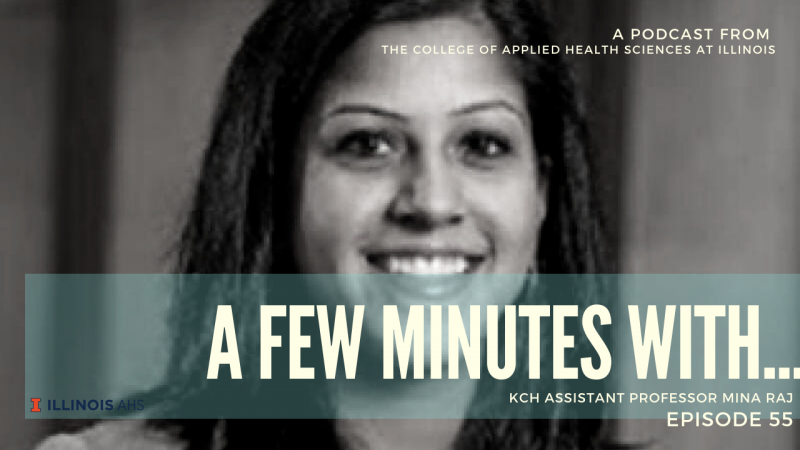
A Few Minutes With … Mina Raj


Transcript

VINCE LARA: Hi, and welcome to another edition of A Few Minutes With, a podcast that showcases Illinois’ college of Applied Health Sciences. I’m Vince Lara. And today I’m speaking with PCH Assistant Professor Mina Raj about why she chose Illinois, teaching during a pandemic, and her research with caregivers of older adults. So Mina, thanks so much for speaking with me today. I always try to find out about faculty and how they got their start, especially new faculty like yourself. So did you always want to teach?

MINA RAJ: Thank you so much for doing this with me today, this podcast. So I have always enjoyed teaching. And I did look forward to it, especially since my experiences of teaching as a graduate student. As a graduate student, I think it’s been really rewarding to observe students evolve in their critical thinking about a topic over the course, form evidence-based opinions about different topics, and especially policies in the health care classes that I teach, and discover new aspects of our health care system that they are passionate about but they didn’t necessarily understand, though they can resonate from their personal experiences as being patients.

VINCE LARA: Yeah, interesting. I wonder, typically, when a person goes into research, there’s something that sparked their agenda, what they wanted to look into. And one of your primary research agendas is incorporating caregivers into health care. And I’m curious what made you look into that? What was the impetus for doing that kind of research?

MINA RAJ: Sure. So during my PhD, my dissertation research was focused on understanding how older adults and their family caregivers make decisions about geriatric care. So geriatrics is the medical field that specializes in the care for older adults, especially those with complex clinical conditions. And then some other projects where I was working to understand patients with cancer, it was kind of a similar situation of recognizing that family caregivers are really influential in health care and in medical decision making.

But they aren’t really talked about that much in policy in that way. So the way we think mostly about family caregivers are their assistance with things like eating and dressing and transportation and meal preparation. But they’re really kind of neglected from health care conversations. And I think my research seeks to really help caregivers because these are the people that are supporting patients who are going through intense challenging periods of their lives. And so seeing this major gap in our policies and in research led me to want to focus on supporting caregivers so that they can support their care recipients.

VINCE LARA: Mm-hmm. I want to take a step back. I meant to ask you first, what made you choose Illinois?

MINA RAJ: Yeah. So that’s a great question. There was a lot that I enjoyed. When I visited Illinois, I found the first thing that struck me was how supportive and what an emphasis there is on the campus on collaboration within the department, as well as across the departments.

So I’ve already sort of started forming teams with people in fields that I previously knew very little about, and I’m learning so much. And it’s really nice to think outside the box and get to be creative. And that’s my other point is that it seems like the kind of place where I can be very creative, a place where your ideas can really translate into different types of technology or different types of policies. And seeing ideas come to fruition like that was something that really sparked my interest in Illinois.

VINCE LARA: Mm-hmm. One of the things that you also look at, switching back to your research, is you look at technology to support caregivers. And I’m wondering what sort of technology do you use?

MINA RAJ: Yeah. So I examine a variety of different technologies. So for instance, within health technology, there’s the electronic health record, which if you go to the doctor’s office, you might sign onto your patient portal before you go to the office in order to fill out a questionnaire. Then when you go to your doctor’s office, your doctor might be on the computer filling out information about you into the electronic health record or the computer system. And so this is one type of technology that I look at in terms of policies or design to integrate caregivers so that they can access their care recipient’s patient portal or health record.

Another type of technology to look at is telemedicine. And in the past several months, we’ve seen a huge shift to telemedicine visits for health care. So this is where a patient might visit their doctor through a phone or through video conferencing. And so, again, how do we allow caregivers to be part of that visit? We know that caregivers often assist their relatives to the doctor’s office, may take notes, may provide the doctor with more information about the patient’s concerns, and how do we make the same situation happen when we’re doing care over telemedicine.

VINCE LARA: Mm-hmm. You reference telemedicine. And obviously, telemedicine has become an important part of how we treat people and that’s because of the pandemic. And I’m wondering, how has the pandemic changed how you teach and also how you conduct research?

MINA RAJ: Sure. So in terms of my research, I would say that it has led me to shift a little bit more to survey research. I’m a mixed-methods researcher. So I do primary data collections through surveys, interviews, focus groups, as well as secondary data. And so I’ve really been focusing on developing online surveys and analyzing secondary data.

I have missed being able to interview key participants and conduct focus groups. I’ve done a little bit of that through virtual modes. But it’s a little bit different. You don’t really get to form the same type of relationship with your participants, which is key to building trust in the context of research, especially.

And so I think that’s a similar situation in terms of teaching, where I’ve definitely seen a lot of positive benefits of online teaching. I think, for instance, I’ve noticed that students may even be more comfortable with speaking up in class. I think there are a lot of really great polls and breakout rooms and other opportunities for creating an interesting classroom environment. But again, one of the things I miss is that face to face, walking into the classroom, and seeing students and getting to know them in a different way and feeling the enthusiasm in a room when students understand a concept that relates to something in their lives that they’ve experienced.

VINCE LARA: Mm-hmm. I’m interested in your most recent publication. In it, you looked at characteristics that helped shape medical trainees and their specialties in treating geriatrics. And you spoke about geriatrics earlier. What kind of characteristics do you mean when you talk about the characteristics that help shape their specialties?

MINA RAJ: Sure. So I drew upon a sociological framework for that particular study that says that the way that we decide what career or specialty in medicine we go into– this can actually apply to any career; it’s actually called a model of careership– is a combination of personal experiences, our social network and social circle and those experiences, and then institutional characteristics. So this can be the school that we are educated in, the medical institution that we go to and get our training in. And so we have a really significant workforce shortage in geriatrics.

We need over 20,000 geriatricians in order to meet demand for our current aging population. And so geriatrics happens to be a pretty new field that was really developed in the 1980s. And we’ve had problems with recruiting medical trainees to go into geriatrics.

Now, one of the earlier areas of discussion was that medical trainees may have poor attitudes towards aging and may not really understand the aging process and may think of it negatively. And so a lot of institutions have implemented training and skills and exposure to older adults in order to mitigate the effect of that characteristic. And so I felt like that didn’t solve the whole problem.

There’s still something missing in our understanding of what’s going on. So I decided in that study to focus on those three characteristics, so personal, social, and institutional. And what I found was that institutional characteristics were particularly influential in this qualitative study of trainee interest in geriatrics.

So this can include things like do you have many geriatricians in leadership positions who are role models to medical trainees and teach medical trainees about what it means to be a geriatrician? How close by are geriatrics clinics to where residents are training? So that’s another way that different institutions can influence the exposure of their trainees have to geriatrics and also make them feel like it’s a different type of medicine. It’s a complex type of medicine. And it requires different skills. But it’s still medicine.

And so I think one of the main conclusions of the paper is that we need to expand our understanding of complexity in medicine. It can be knowing a lot about an organ system or about a part of the body. But it can also mean knowing about the lifespan and knowing about the health care system and an older adult’s social and economic circumstances.

VINCE LARA: I know researchers are always looking at what’s next, right? You have to always think about publishing. So I wonder, what’s next for you? Like, what do you hope to tackle next? And I know you’re building collaborations here at UIUC. And so what do you have on the horizon?

MINA RAJ: Sure. I so my main area is going to continue to be looking at different ways of designing technologies and policies to integrate family caregivers into health care teams. And so this involves both what do these technologies look like and then in addition, what do our policies need to look like in order to make sure that this integration is both effective and also safe? So for instance, if caregivers can see their older relative’s medical record, we want to make sure that we have policies in place to protect patient privacy and caregiver privacy and make sure that caregivers aren’t discriminated against in a workplace because maybe they have certain health risks. And so that is really what I see as the primary area of my research agenda.

Another project that I’m really excited about and I’m working on right now is actually a text-based survey of youth across the United States. So these are adolescents aged 14 to 24. And so this text-based text message-based survey, prompts qualitative responses. And the questions that I have asked are to get a sense of how young adults and youth in the US think about family caregiving and their potential for being a family caregiver in the future, including what policies or educational practices or health care practices they perceive meeting in order to carry out potential caregiving responsibilities while promoting their well-being and their educational and professional success.

VINCE LARA: My Thanks to Mina Raj. For more podcasts on Illinois’ College of Applied Health Sciences, search A Few Minutes With in iTunes, Spotify, IHeartRadio, radio.com, and other places you get your podcast fix. Thanks for listening and see you next time.

Share on social

Related news

A Few Minutes With … KCH Assistant Professor Sheena Martenies


Transcript

VINCE LARA: Hi, and welcome to another edition of A Few Minutes With, a podcast that showcases Illinois’ College of Applied Health Sciences. I’m Vince Lara, and today I’m speaking with KCH Assistant Professor, Sheena Martenies, about why she chose Illinois, teaching during a pandemic, and her research experience. Did you always want to teach?

SHEENA MARTENIES: So, I didn’t ever really envision myself as a teacher as I was going through graduate school, as I was going through my postdoc. But I took a position as an adjunct lecturer in the last year of my postdoc at Colorado State. And I was teaching at the University of Northern Colorado, and I really enjoyed it. I loved talking to the students. I was working with MPH, Masters of Public Health students, about environmental health, and I really enjoyed it. I found it very rewarding. So I never really envisioned myself being a teacher, but I found that it’s something that I really enjoy and I’m thankful for the opportunity to get to continue that and to continue to grow as an educator. It’s been really rewarding.

VINCE LARA: Yeah. You mentioned that you grew up in Southern California. I wonder how you made your way to the Midwest and the University of Illinois?

SHEENA MARTENIES: Yeah. So that was– it’s a little bit of a journey. I did my undergraduate degree in San Diego. I went to San Diego State. And then after that, I got a job. And the recession in 2008 hit and I didn’t have a job anymore, and so I kind of bounced around. And eventually, I decided to pursue a Master of Public Health degree, and I moved to Washington D.C. to do that. And I thought I was going to be a regulator. I wanted to work for EPA, or maybe the Department of Energy. And I had a really wonderful advisor when I was at GW, and they really pushed me to pursue my doctoral degree. And so I moved to Ann Arbor, Michigan and went to the University of Michigan, and got my PhD.

So I had been in the Midwest before, and I really enjoyed my time in Ann Arbor, but I moved out to Colorado to do a postdoc, like I mentioned, at Colorado State University, and loved being out in the Mountain West. It was just really, really wonderful having mountains, and all the hiking, and all that great stuff.

But then the opportunity to come to the University of Illinois came up, and I thought, well, you know, I loved being in a college town in the Midwest. Maybe this would be a great place for me. It didn’t hurt that my partner was originally from Michigan, and so he got to be a little closer to home as well. So when that opportunity came up, it felt very appropriate for me to come back to the Midwest.

VINCE LARA: Yeah. You really can’t beat the Midwest college towns, for sure. You know, you– what’s it been like teaching in this pandemic? You know, I’m sure you prefer being in a classroom with students. But you know, what kind of challenges have you experienced, or have there been, maybe, benefits of Zoom teaching that you didn’t anticipate?

SHEENA MARTENIES: There is definitely some challenges, but a lot of opportunities as well. I think one of the biggest challenges, like you mentioned, is just not being there in the classroom. It’s hard to get that real-time feedback from your students, or really make those kind of personal level connections.

Another thing is that I’m really new to teaching. Like I said before, this is not something that I’ve done a whole lot of in my graduate career. And so now that I’m an Assistant Professor, I’m really trying to learn how to teach, and learn how to teach online. So that’s been a little bit of a challenge, but it’s been wonderful. There’s so many supportive resources here on campus that have really allowed me to make the best of teaching online.

One of the things that I think that’s been sort of unexpectedly helpful is that students– you’re able to meet with students one-on-one in a more effective way. You know, office hours aren’t always accessible to people. They’ve got scheduling conflicts. They have family obligations that don’t really allow them to come to campus when you might be holding office hours. But it’s really easy to hop on a quick, 20-minute Zoom meeting.

And so I think sometimes there are opportunities to meet with students, and we’ve got a much more robust framework for doing those types of quick, one-on-one opportunities that might be always accessible to students. And so I think that has been a real benefit of this online environment, where we’ve got these kind of quick and easy meetings, and people are generally more available if they don’t have to come all the way to campus, or come all the way to your office.

VINCE LARA: Most of the faculty that I speak to here at the University of Illinois– the faculty, I find that there are different things that inspire their research– something that happened to them, some experience along the way. And I wonder what your inspiration was?

SHEENA MARTENIES: Sure. So like I mentioned, I grew up in Southern California. And I can remember we lived in Ventura County, and we would drive into the San Fernando Valley to go visit my grandparents. And you know, you’d come over this small mountain pass and you’d drop down into the valley, and every time, it didn’t matter what time of year it was, there was always just this thick brown haze hanging over where my grandparents lived. And I just remember that from my childhood.

And then I took some courses in college and in graduate school and just realized how important environmental health is. It’s one of those things that, a lot of people don’t have control over their environment. They live where they live because of their socioeconomic status, or their job, or their family. And so they’re just sort of in the environment that they’re in. And so I think that there are a lot of really interesting research and policy questions we can ask about the environment and environmental health.

And so I think that is really where my interest comes from, I think. Just knowing that those exposures are out there, they’re largely involuntary, and they can have a pretty dramatic impact on a person’s health.

VINCE LARA: Yeah, which leads into my next question which is about your research and focusing on pollution and child health outcomes. And can you talk a little bit more about what that is?

SHEENA MARTENIES: Sure. So I’m particularly interested in air pollutant exposures that happen during the prenatal period and during that early life period, and sort of what the subsequent health outcomes are for children. So we know that developing fetuses, infants, and small children, they have respiratory symptoms that are rapidly developing. Their bodies are undergoing a lot of changes, and they might be really susceptible to those air pollutant exposures.

So a lot of the research I’m doing right now is with a cohort study based in Denver, Colorado called Healthy Start. And this is a group of children that have been followed from their prenatal period on, and we’ve been able to look at things like air pollution in the prenatal period, some of those features of the built environment. You know, whether there are a lot of trees and parks or a lot of paved surfaces– those types of factors.

And we’ve found that there are some relationships between those early life exposures and those prenatal exposures to outcomes like birth weight, which is a really good neonatal indicator of later life outcomes like obesity and respiratory health. So we’re starting to explore how the environment in which children develop and then grow impacts their long-term health. And so that’s a line of research that I’m really interested in continuing as we start to understand how these environmental exposures that are really not voluntary impact children’s health.

VINCE LARA: At an R I University, you always are thinking of what’s next in the pipeline. And I wonder, is there something that you have planned, post-vets research for your next project?

SHEENA MARTENIES: Yeah. That’s a really great question. I am becoming increasingly interested in some of the spaces that children spend their time outside of their home. A lot of environmental epidemiology and environmental health research that looks at childhood health outcomes really focuses on home environments, and those are so important.

We want all children to grow up in a healthy home, but we also know that kids, especially young kids, don’t spend all of their time at home. A lot of children might be spending time in daycare facilities or preschools, and I’m becoming more interested in what’s going on in those types of environments.So I’m hoping to partner with some of the faculty here on campus in the Family Resiliency Center and in the College of Engineering to start to look at those types of indoor spaces– those child care facilities, those preschools. Try to understand what the exposures might be in those spaces so that we can get a more complete idea of what early childhood exposures might be for kids as they grow up.

VINCE LARA: My thanks to Sheena Martenies. For more podcasts on Illinois’ College of Applied Health Sciences, search A Few Minutes With on iTunes, Spotify, iHeart Radio, Radio.com, and other places you get your podcast fix. Thanks for listening, and see you next time.


Editor’s note:

To reach Vince Lara-Cinisomo, email vinlara@illinois.edu.
 

Share on social

Related news

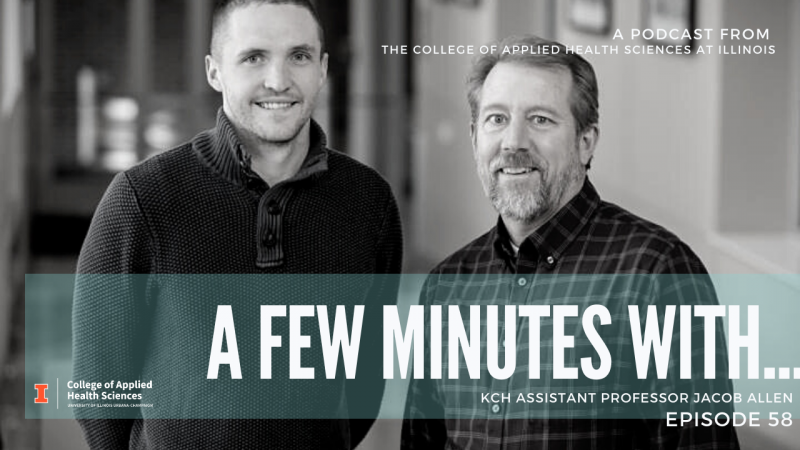
A Few Minutes With … Jacob Allen


Transcript

VINCE LARA: Hi, and welcome to another edition of A Few Minutes With, the podcast that showcases Illinois College of Applied Health Sciences. I’m Vince Lara, and today, I’m speaking with KCH Assistant Professor Jacob Allen about his research on how exercise, stress, and diet influence gut microbial communities.

So I’m talking with Jacob Allen, who is a new addition to the Department of Kinesiology and Community Health. And, Jacob, I notice from your CV that you had done your undergrad and master’s at the University of North Carolina at Chapel Hill. And yet you left Chapel Hill, which is a lovely place in which I lived for a while, for Chambana, which we’re covered in snow this morning. Tell me, what made you do that? What prompted your move here?

JACOB ALLEN: That’s a good question. Well, so I did my bachelor’s in exercise science with a minor in biology. And coming out of undergrad, I didn’t really know what I wanted to do– surprise, surprise, a little bit young. But I was interested in exercise physiology, and so I decided to stay on and do a master’s program in the Exercise Physiology group at UNC-Chapel Hill.

And I did my masters in working with breast cancer survivors, where we looked at how exercise affected inflammatory markers in these patients that were coming off of breast cancer treatments to see if exercise could reduce some of the systemic inflammation they experienced. So that was my foray into exercise. And then because I was looking at inflammatory markers, these proteins called cytokines in the blood, I started getting interested in immunology.

And at the time, and still is, Jeff Woods, Dr. Woods here at University of Illinois, was prominent and one of the few exercise immunologists in the field. So I figured if I was going to study exercise and study the immune system, I should probably go get a PhD with somebody that knows what they’re doing. And so I looked up Jeff’s name and gave him a call.

And that’s what started my process of moving to Champaign to do my PhD in 2013 to look at exercise and the immune system. And so I came to Illinois, and I took off from there, where we started to look at both the immune system, but also the microbes in the gut and how the microbes affect the immune system. So I guess it was more of a career path that took me from Chapel Hill, where it’s a little bit warmer, to Champaign, Illinois.

VINCE LARA: Right, yeah, absolutely. And then the opportunity to work with Jeff obviously is a big part of it.

JACOB ALLEN: Right, yup, it was, definitely.

VINCE LARA: Yeah. So you talked about how your research focuses on exercise and diet and how they influence gut microbiota. What led you to study that? Usually there’s some sort of inspiration to what a researcher decides to study. Was there something in your early life that led you to look into that?

JACOB ALLEN: You know what? I wish I could say there was some beautiful epiphany I had or something like that. But I can’t really tag it to anything specific. I’d say I’m interested in questions that we don’t understand, and that’s probably why I did biology.

And when I started in Jeff’s lab, there was this emerging topic of the microbiome and these trillions of microbes that live in our gut that we still don’t know exactly what they do. And so it kind of just spiraled into studying it. Again, like I said, I was an exercise scientist looking at how exercise affects breast cancer survivors.

And it got me interested in the immune system. And then being interested in the immune system led me to study the microbiome. And what we know now is that the microbes in our gut are really important for training the immune system and establishing the immune system, and then in many inflammatory diseases, affecting the immune system. And so the study of the microbes tied in directly with my interest in immunology. And so that’s how I got to studying the gut microbiota.

VINCE LARA: How granular can we get in terms of, if you change one food, if you stop eating one food, can you determine how that affects the gut and how it affects disease?

JACOB ALLEN: That’s a great question. Number one, I’ll say, it depends– depends on the food. We know a lot about– relatively a lot– about certain types of food with regards to the microbiota. One of them is dietary fiber and something that our lab is interested in.

So fiber comes in different forms, but in one of the forms, it’s a soluble, fermentable fiber. And what that means is that it can reach the colon, where most of the microbes are. And the microbes use that fiber as food, as a sugar source.

And so what we know is that by feeding the microbes with this fiber– and again, there’s various types of it– we can change the microbiota quite extensively. What’s still not understood is how different types of fiber feed the microbiota differentially. And does that matter for our health?

And what’s important is that once the microbes get a hold of these– this food type, this fiber– they can degrade it into these bioactive molecules that then affect our immune system. So we’re still trying to understand that process of how the microbes feed off of these– off of our diet. What type of metabolites do they produce? How does that change the microbial communities? And then how does that all affect our immune system and our health is our interest in our lab.

VINCE LARA: What you’ve said is that you wanted to provide a new perspective on environmental conditions and microbiota. Is that tying into what you’re looking into?

JACOB ALLEN: Exactly. You know, our lab is named Integrative Microbiota Lab. And the reason for that is that I think that in science, we’re really good at isolating things and tying down to what we call a mechanism, which is really important. And that’s part of our lab, too.

But in especially humans, as we walk through our daily life, we’re doing all sorts of things. We have different exercise patterns. We have different levels of psychological stress. And that’s another component of my lab, is looking at how stress affects the microbes as well.

And then obviously, we all have different dietary patterns. And so trying to tease out those factors and how they regulate the microbiome in a daily life is the purpose. And my long-term goal of my lab is to look at these individual environmental factors in isolation. And then long-term, how are they all together affecting the microbes in the gut?

VINCE LARA: Can you tease out things like physical stress versus mental stress? Or is that something that you even can separate?

JACOB ALLEN: Another great question. There’s debate among this in the field of how to define stress in humans. And obviously, it’s all based off of the experience of the person.

But we can measure certain biomarkers that correlate heavily with stress. So we know some classical pathways that are activated by psychological stress– the hypothalamic pituitary axis, which ultimately results in the release of a glucocorticoid called cortisol, which I’m sure many are familiar with. And so we can look at levels of cortisol in the blood, but also, more long-term, elevations of cortisol in things like hair roots and stuff like that to see if these individuals are experiencing acute levels of stress, which we all experience, or if they’re experiencing stress on a chronic level on a daily basis, where we see this long-term elevation of hormones associated with stress.

So the short answer is it’s complicated. But we can at least get somewhat of a diagnostic of how stressed people are or individuals are based off of some of the hormonal responses we see in the blood and other tissues.

VINCE LARA: Interesting. You know, you recently received a grant along with Jeff Woods to study age-related dysbiosis and physical resilience. What can you tell me about that project? I mean, first of all, what’s age-related dysbiosis?

JACOB ALLEN: Yeah, so first, the word “dysbiosis,” for those that don’t know, is essentially a broad term to suggest a disrupted microbial community in the gut. And so there’s various forms of, quote, “dysbiosis.” But what we know is that if the community of microbes in your gut is healthy, it usually is fairly stable and goes through similar– has similar patterns amongst individuals that stays fairly stable over time.

What we see with, quote, “dysbiosis” is that those communities become less stable and less even. So you sometimes get what we call pathobiont species that expand in the gut. And these are potentially bacteria that might induce some negative consequence on our immune system or other components of physiology. And so that’s what we term– what we call dysbiosis. And what the age part is that there’s accumulating evidence that aging, getting older, might contribute to some form of dysbiosis.

And what we’re studying with this grant– so it’s a one-year grant funded by the NIH that will hopefully extend into a longer grant– is to see how antibiotic exposure affects the microbiome in aged populations. And there’s a couple of reasons for this. One of them is that aged individuals tend to consume antibiotics more extensively because they’re experiencing more sickness as they get older. And so we want to study it on that level.

And number two, obviously, these antibiotics affect the microbiome. And so we want to see if a, quote, “aged microbiome” responds differentially to antibiotics versus a young, healthy microbiome. And so to test this, we’re using first, a preclinical model, which is a mouse model, to test these hypotheses.

And tying it in, we think that those microbes, if we disrupt them in old animals, there’s going to be consequences both within the gut, but we also think that is affecting their physical resilience– so how well they perform on particular tasks such as exercise tasks. And so that’s our hypothesis going in. And of course, we don’t know the answers yet, and that’s why we’re running the studies.

But we think that the aged animals will respond differentially to the antibiotics and maybe not recover as well. And that might lead to some potential issues with how they move and how they respond to challenges. So that’s the purpose of the grant, if that makes any sense.

VINCE LARA: Yeah, absolutely. How symbiotic is the relationship between exercise and gut health? Does one influence the other more?

JACOB ALLEN: Yeah, that’s a great question. So some of my PhD work showed that exercise changes the microbiome. And it increases some beneficial metabolites that we think are health-promoting.

And one of them is called a short-chain fatty acid that initiates some overall anti-inflammatory and beneficial effects on our tissue. Now, whether it’s, quote, “good” or “bad,” I think we still need to figure out. There’s definitely changes with exercise and the microbiome. But again, trying to delineate the long-term effects and whether it’s good or bad is still up for debate and up for what we need to investigate with our science.

Your other question– does gut health affect exercise? And I think that that’s another open question in the field. Is there some gut-brain signaling that affects motivational behavior to exercise? And that really has not been investigated at all to my knowledge. So I think you bring up a good point. And it’s something we don’t know quite yet.

VINCE LARA: Yeah. You mentioned that you’re hoping that this grant with Jeff is going to be a long-term grant– multiyear. But researchers always have to look to the next thing, right? And so I’m curious what you’re working on or what your next big project might be.

JACOB ALLEN: Yeah. There’s a couple. Currently, I did some work that was independently funded at the end of my postdoc that I was able to take with me to start my lab here in Illinois, focused on some of the stress effects on the microbiome. And so we’re currently, in the lab, really interested in how the microbes interact with the cells that line the gut, called epithelial cells.

And what we found is this really intricate interaction between the gut microbes and these epithelial cells. You think of it as like a tit for tat. As the epithelial cells, which are our cells that line the gut, produce some molecules, they change the microbes. The microbes then feed back and change those epithelial cells.

And what we found is that stress, for some unknown reason, really changes the profile of these epithelial cells. And we’re not sure why yet. But what the evidence is pointing towards is that those changes in epithelial cells with stress is really driving the microbial changes that we see in the gut, and potentially in negative ways.

And so we’re trying to understand that process in a little more detail in our lab currently. So that’s the next frontier where we’re focused. And then we have some other focuses, too, particularly with exercise.

And going back to the integrative portion of it, we’re interested in how exercise and dietary fiber interact to modify the microbiome. We know that both in isolation change the microbiome. But really, not a lot of work has been done with a focus on how the interaction of diet and exercise might change the microbes and what that might mean for our health. So that’s another focus of the lab currently as well.

VINCE LARA: My thanks to Jacob Allen. For more podcasts on Illinois’s College of Applied Health Sciences, search A Few Minutes With on iTunes, Spotify, iHeart Radio, Radio.com, and other places you get your podcast fix. Thanks for listening, and see you next time.

Editor’s note:

To reach Vince Lara-Cinisomo, email vinlara@illinois.edu.
 

Share on social

Related news

College of Applied Health Sciences
110 Huff Hall
1206 South 4th Street
Champaign, IL 61820
(217) 333-2131