Homecoming hangout sparked clinical research partnership


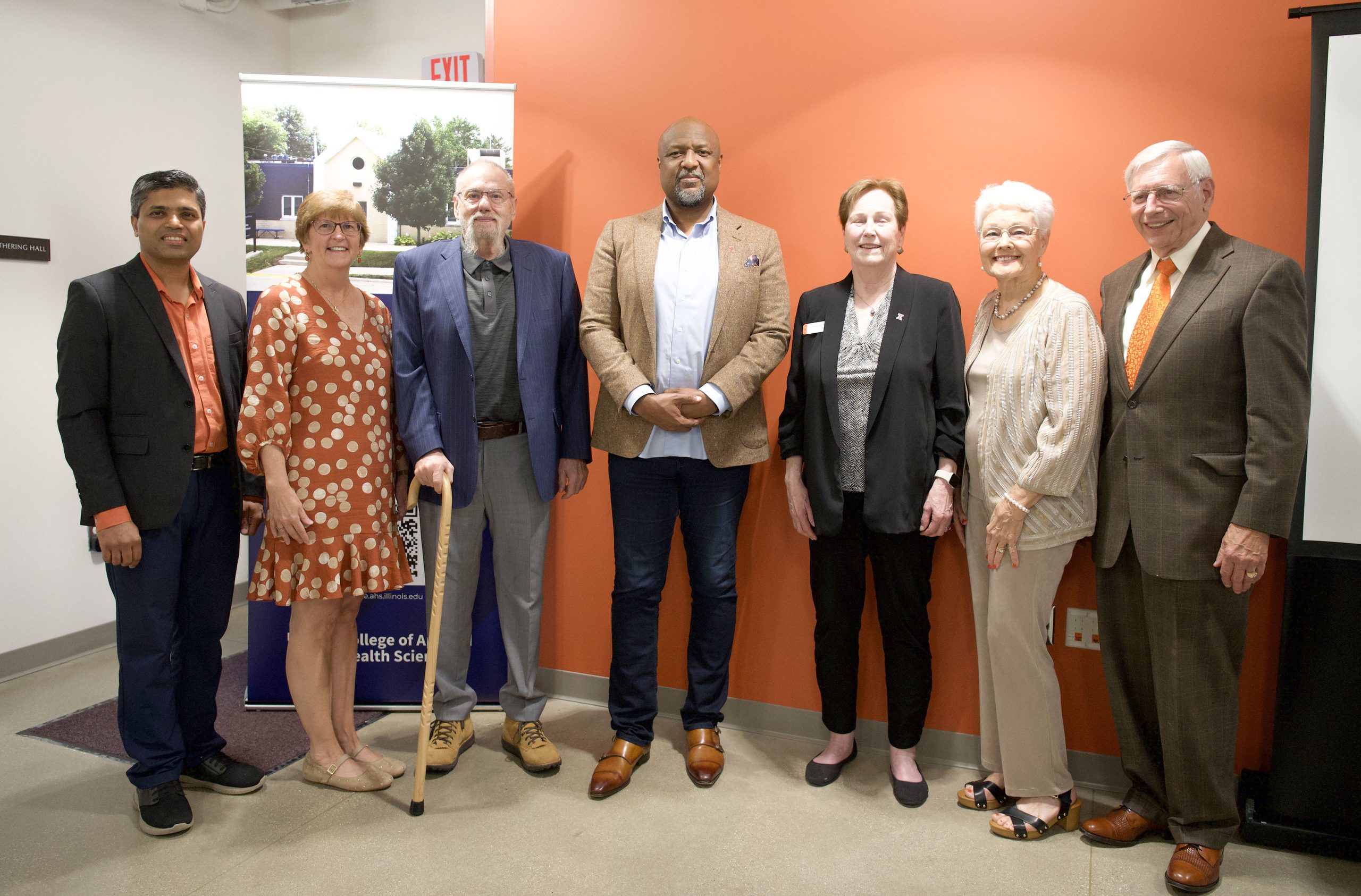
Amy Brummel planned to catch the Illini’s Homecoming football game against Wisconsin last October and maybe grab some food at the College of Applied Health Sciences’ pregame tailgate. She had no idea it would lead to a research collaboration.

Brummel, a two-time alumna (B.S. in 1994, M.A. in 1997) of the Department of Speech and Hearing Science, has established a clinical research partnership with SHS Assistant Professor Meaghan McKenna to evaluate a literacy intervention protocol  she developed. 

The pairing came about innocuously. Brummel only went to the AHS tailgate after getting an email about a celebration of SHS’ 50th anniversary.

“My husband, Pete (B.S., Agricultural Economics, 1985), my son, Tyler, and I were already going to the football game,” Brummel said. “So I said, ‘Let’s go check out this tailgate and see if any of my classmates are there.’”

Brummel did not find any classmates, but when she got up to get food, she encountered Anna Pucilowski, an SHS teaching assistant professor who just happened to be handing out slices of cake.

“I asked, ‘What is the U. of I. researching in the area of literacy? I’m an SLP that specializes in literacy. So (Pucilowski) connected me with Dr. McKenna. And Dr. McKenna and I have been communicating ever since.”

They’ve been more than communicating. Brummel developed an research-based literacy intervention, so McKenna and Brummel are researching the efficacy of the intervention and are planning to disseminate the findings

“The ultimate goal of the intervention is to increase reading automaticity,” Brummel said. “That just means we’re going to improve the decoding ability, or oral reading fluency, of children. This is different than comprehension. This is pure decoding, sounding out words.”

As Brummel explained, when people read, they read automatically—it should be effortless. But when children are struggling to learn to read, they read sound by sound to decode—consciously retrieving each sound in every single word. 

But Brummel said a literacy crisis—32 percent of fourth graders in the United States are reading below a proficient level—encouraged her to try to do more to help students. In her private practice, Amy’s Academics, parents ask, “What can I do to help my child?”

“I developed this intervention in my clinic. I provide it to parents for daily practice, and it has been extremely effective in improving automaticity and reading outcomes of my clients,” Brummel said.

Automacity is the ability to do things without occupying the mind with the low-level details required, allowing it to become an automatic response pattern or habit, or, simply, reading without thinking. When children can read with automaticity, they think less about sounding out the words, allowing them to think more about comprehending what they are reading. 

As Brummel explained, the intervention is both phonological—manipulating sounds in words—and orthographic—spelling patterns in words—and consists of two phases. The first phase allows for decoding and encoding practice on words with short vowels and what is called “high neighborhood density and high phonotactic probability.” Once automaticity is achieved, the child starts the second phase, which is decoding and encoding words with long vowels, she said. 

“The intervention presents the opportunity to practice reading and spelling words while explicitly studying the orthography of the words and deleting and substituting initial phonemes in words,” Brummel said. “The extra exposure to phonological and orthographic patterns allows the child to obtain the additional practice necessary to create mental orthographic images to increase automaticity in their reading.”

McKenna said the intervention is important because “we need to recognize the contributions (speech-language pathologists) can make to speaking, listening, reading, and writing. Brummel agreed.

“We have such dire statistics for children who are struggling to read,” she said. “There are mental and  emotional health issues as a result of not being able to learn to read in school, as well as decreased academic and occupational outcomes. I believe that learning to read is the most important thing happening in our schools. We need to make sure 100 percent of our students can read.”

Brummel taught phonetics as an undergraduate teaching assistant and researched morphology in multicultural settings as a graduate research assistant. That work inspired her to earn a clinical doctorate in speech-language pathology with a focus on language and literacy. She first developed the intervention in her private practice and provides it to parents for daily practice. 

“It has been extremely effective in improving reading outcomes in my clients. The beauty of it is it’s research-based,” she said. “Dr. McKenna and I are both excited about this intervention because this is the first of its kind. I’ve been using it for years in my clinic, and the outcomes have been amazing. There is nothing like this in the school system, or in the private sector, or anywhere else that I’ve seen.”

Since meeting, Brummel and McKenna have engaged in monthly research practice partnership meetings to evaluate the intervention. They are now recruiting participants and will begin their first study in April.

“If we can do research on this and share it, it’s going to change the lives of children across our country and hopefully help all of these students struggling so they can catch up,” Brummel said. “They will have excellent academic and occupational outcomes, and we’ll help fight this literacy crisis.”

Related news

Welcome to AHS: Meet the Class of 2027


The AHS Class of 2027 gathered in Huff Hall for the first time.

Welcome Week at the University of Illinois Urbana-Champaign capped off with individual college celebrations scattered across campus.

The College of Applied Health Sciences brought first-year students to Huff Hall for a spirited welcome and resource-sharing session. A few members of the newest freshman class offered their thoughts on why they chose AHS and what they’re looking forward to in the new academic year. 

Mustafa Siddique, hailing from Naperville, Ill., had a lot of fun with the “festive” atmosphere of University of Illinois Welcome Week, where it felt like everyone was there to lend a helping hand. 

Mustafa is studying interdisciplinary health sciences on the pre-medical school track. The College of Applied Health Sciences won out in his school choice for its real-world usefulness.  

“It kind of gives you a perspective into the specific field that you’re going into instead of just science as a whole. So I thought AHS was a good choice,” he said.  

Arely Soto, from Aurora, Ill., was exposed to a wide range of therapists through her mother, who’s a social worker. After speaking with a speech pathologist and learning about her career, Arely decided speech and hearing science was the path she wanted to follow. 

Experiencing Illinois Sights and Sounds, the capstone Welcome Week event that teaches new students Illinois traditions, was an early highlight for her. Especially taking a huge picture with her class packed into a “Block I” on the Memorial Stadium field. 

“I’m really excited for RSOs to start, to get involved and see what the schools offer in general.”

Dallas Miles, from South Holland in the Chicago suburbs, said his family always encouraged him to do something in the health field. 

“I’m glad I’m here now,” said Miles, who’ll be studying interdisciplinary health sciences in his freshman year. After Welcome Week, he’s got plenty of Illini merchandise—shirts and stickers galore. 

Dallas’ vision for his career vision orbits around health technology, “making stuff like hearing aids and heart monitors” to help patients day-to-day, he said. 

Allison Pines is from Highlands Ranch, Colo., but she’s a “religious Cubs fan” through and through. In fact, she declared for recreation sport and tourism with a concentration in sports management in the hopes of becoming an analyst for a Major League Baseball team. 

“I was really impressed with the prestige that the concentration in sports management held, it’s something that I’ve been dreaming of for a very long time. The fact that I found a prestigious program at a school I’m passionate about drove me to Applied Health Sciences,” she said. 

“Sports management is my declared major but I may get involved in kinesiology or other opportunities this college has to offer.” 

Illinois freshmen Sam Rausenberger from Carterville and Mihir Patel from Vandalia share an interest in the human body and how it works. Majoring in kinesiology at AHS seemed an easy choice for both of them. 

“I like sports and fitness and I like helping people,” Patel said. “Physical therapy spoke to me, basically, I feel like that’s something I can do.” 

Both freshmen are interested in the physical therapy path, specifically in the world of athletics. 

“I took a health class my freshman year which was required and I loved learning about the skeleton and muscles and all the movement,” Rausenberger said. “I didn’t take another class like that until anatomy in my senior year, we did the bones and learned in-depth how muscles move and how they work. I was super interested in that and knew this is what I want to do.”

After putting their names in for student organizations at the AHS Student Welcome—and in Patel’s case, catching a prized Illini shirt thrown into the crowd at Sights and Sounds—both are excited to explore the U. of I.’s opportunities. 

“I’m definitely looking forward to getting to know more people and knowing the campus, what I’ve seen so far. It’s a beautiful campus. I just don’t know my way around yet,” Rausenberger said. 

Editor’s note:

To reach Ethan Simmons, email ecsimmon@illinois.edu
 

Related news

Freshman Brooklyn Clough talks about campus life during COVID-19


Brooklyn Clough (provided)

Freshmen are entering college in a unique environment, and that includes students in the College of Applied Health Sciences at the University of Illinois. The AHS communications staff spoke with new AHS students about campus life, why they decided to come to campus—or stay home—and how COVID-19 is changing their expectations. Today, we speak with Brooklyn Clough, a student in the Department of Speech and Hearing Science.

Q: Are you on campus?

A: I am on campus this semester because even though all of my classes are digital, I believed being on campus would give me the motivation I needed for my classes that I wouldn’t be able to find at home. Also, I wanted the experience; it is only my freshman year so I truly don’t know what I am missing with COVID-19 regulations.

Q: What challenges have you found in navigating campus?

A: Since all of my classes are digital, I don’t travel much on campus, but I do struggle with the bus system. Long story short, I was trying to head to my dorm and ended up in downtown Urbana.

Q: What challenges are you discovering with remote classes?

A: Digital classes have been a complete internal battle because many of my classes are asynchronous as well; So I must organize my schedule on my own and try to remember all of my due dates for different courses. 

Q: Tell me what you think about the COVID testing process. Has it been easy to find a testing site? 

A: Testing has been painless since I live in Nugent, which is connected to the SDRP (Student Dining and Residential Programs) where a testing center is. I also surprisingly have started getting better at finishing the testing faster, since I have been doing it for a while.

Q: What are the differences between your high school remote learning experience, and here at Illinois?

A: My high school remote learning was a lot less motivated than here at Illinois. I did take a remote class in Fall 2019, which was me cramming at the last minute before due dates and after the school went completely digital in spring 2020. I put in little effort because our grades couldn’t be negatively affected if we showed active participation. Here at Illinois, these classes matter and are important; However, it is quite similar in that I have few check-ins and mostly work is on my own.

Related news

Grant to help researcher study difference in hearing for preterm babies


Brian Monson in his office (Credit: Brian L. Stauffer)

A researcher in the Department of Speech and Hearing Science in the College of Applied Health Sciences has received funding to determine the difference in language exposures for preterm infants relative to what they would be hearing if they were still in the womb. 

SHS assistant professor Brian Monson earned a $300,000 grant from the National Institute of Deafness and Communication Disorders for his project entitled, “Auditory experience during the prenatal and perinatal period.”

Monson said the aims of the project include comparing typical fetal auditory exposures in the womb to preterm infant auditory exposures in the neonatal intensive care unit, and assessing the effect of these exposures on auditory neurodevelopment. The study, he said, is being conducted in collaboration with Carle Hospital, with the long-term goal of optimizing auditory exposures for preterm infants to foster healthy brain development in the neonatal intensive care unit.

“We also hope to see whether these differences in exposures have an effect on later brain and language development,” Monson said.

The grant from the NIDCD—which is part of the National Institutes of Health—helps extend upon research Monson undertook with funding from a Center for Health, Aging & Disability (CHAD) pilot grant.

Monson said the plan is to enroll 100 preterm infants and 100 pregnant women who carry to full term, with recruiting done locally of pregnant women from the Champaign-Urbana community and NICU patients from Carle Hospital. He said data collection had begun and that he had about 30 subjects in each group.

Once differences between exposures in the NICU vs. the womb are established, Monson said, the next step would be to develop an intervention that enhances NICU auditory exposures (e.g., by increasing language exposure) and assess the effects of this intervention with a clinical trial.  “We also plan to continue following up with the current study’s babies later in childhood,” he said.

“One out of every 10 babies born in Illinois is born premature, which is similar to the national rate,” Monson said. “Because of this, we feel this project is critically important as it will lead to improved health outcomes for our community’s tiniest human beings.”

Editor’s note:

To reach Brian Monson, email monson@illinois.edu.
 

Related news

College of Applied Health Sciences
110 Huff Hall
1206 South 4th Street
Champaign, IL 61820
(217) 333-2131