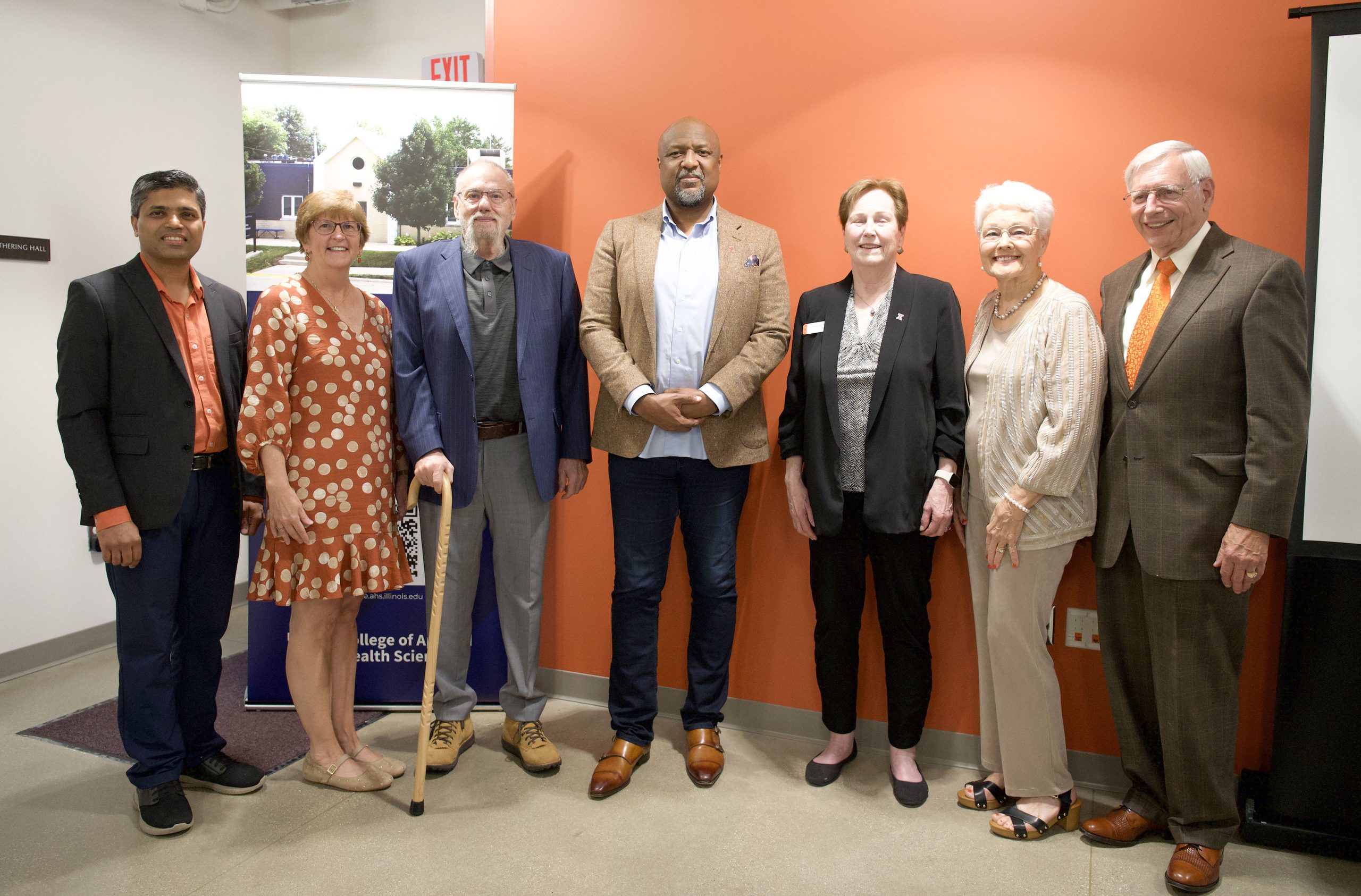
KCH becoming HK this fall


The University of Illinois at Urbana-Champaign’s College of Applied Health Sciences is proud to announce a significant milestone in its ongoing commitment to advancing health sciences education and research. Effective Aug. 16, the Department of Kinesiology and Community Health will officially change its name to the Department of Health and Kinesiology.

The new name better reflects significant changes in our disciplines, research interests, and educational mission. Health and Kinesiology allows for a broader, more inclusive representation of a department that focuses on multiple aspects of health and physical activity in a diverse society. It also honors our legacy as leaders in the field of health and kinesiology, while pointing the way forward to a future that is both dynamic and innovative. 

The name change was a decision that was made based on goals highlighted in the KCH Strategic Plan and upon the recommendation of the KCH Restructuring Task Force. It was supported by multiple stakeholders and was recently approved by the College of Applied Health Sciences, UIUC Senate, and Board of Trustees.

Cheryl Hanley-Maxwell, dean of the College of Applied Health Sciences, expressed enthusiasm about the department’s name change, saying, “The renaming of our department to Health and Kinesiology aligns with our strategic vision of fostering interdisciplinary collaboration and addressing the multifaceted aspects of health and wellness. This change reflects our commitment to providing innovative education, conducting impactful research, and serving our communities.”

HK Department Head Kim Graber said, “As the department evolves to better reflect the dynamic landscape of health and movement sciences, we believe the change to Health and Kinesiology not only embraces our commitment to comprehensive wellness but also underscores our dedication to advancing research, education and outreach in these vital areas.”

The Department of Health and Kinesiology offers a wide range of undergraduate, graduate and doctoral programs aimed at preparing students for careers in health promotion, exercise science, public health, rehabilitation, and related fields. With world-class faculty and state-of-the-art facilities, the department equips students with the knowledge, skills, and practical experience needed to excel in diverse healthcare settings.

For more information about the Department of Health and Kinesiology at the University of Illinois at Urbana-Champaign’s College of Applied Health Sciences, please visit this link.

Share on social

Related news

Welcome to AHS: Meet the Class of 2027


The AHS Class of 2027 gathered in Huff Hall for the first time.

Welcome Week at the University of Illinois Urbana-Champaign capped off with individual college celebrations scattered across campus.

The College of Applied Health Sciences brought first-year students to Huff Hall for a spirited welcome and resource-sharing session. A few members of the newest freshman class offered their thoughts on why they chose AHS and what they’re looking forward to in the new academic year. 

Mustafa Siddique, hailing from Naperville, Ill., had a lot of fun with the “festive” atmosphere of University of Illinois Welcome Week, where it felt like everyone was there to lend a helping hand. 

Mustafa is studying interdisciplinary health sciences on the pre-medical school track. The College of Applied Health Sciences won out in his school choice for its real-world usefulness.  

“It kind of gives you a perspective into the specific field that you’re going into instead of just science as a whole. So I thought AHS was a good choice,” he said.  

Arely Soto, from Aurora, Ill., was exposed to a wide range of therapists through her mother, who’s a social worker. After speaking with a speech pathologist and learning about her career, Arely decided speech and hearing science was the path she wanted to follow. 

Experiencing Illinois Sights and Sounds, the capstone Welcome Week event that teaches new students Illinois traditions, was an early highlight for her. Especially taking a huge picture with her class packed into a “Block I” on the Memorial Stadium field. 

“I’m really excited for RSOs to start, to get involved and see what the schools offer in general.”

Dallas Miles, from South Holland in the Chicago suburbs, said his family always encouraged him to do something in the health field. 

“I’m glad I’m here now,” said Miles, who’ll be studying interdisciplinary health sciences in his freshman year. After Welcome Week, he’s got plenty of Illini merchandise—shirts and stickers galore. 

Dallas’ vision for his career vision orbits around health technology, “making stuff like hearing aids and heart monitors” to help patients day-to-day, he said. 

Allison Pines is from Highlands Ranch, Colo., but she’s a “religious Cubs fan” through and through. In fact, she declared for recreation sport and tourism with a concentration in sports management in the hopes of becoming an analyst for a Major League Baseball team. 

“I was really impressed with the prestige that the concentration in sports management held, it’s something that I’ve been dreaming of for a very long time. The fact that I found a prestigious program at a school I’m passionate about drove me to Applied Health Sciences,” she said. 

“Sports management is my declared major but I may get involved in kinesiology or other opportunities this college has to offer.” 

Illinois freshmen Sam Rausenberger from Carterville and Mihir Patel from Vandalia share an interest in the human body and how it works. Majoring in kinesiology at AHS seemed an easy choice for both of them. 

“I like sports and fitness and I like helping people,” Patel said. “Physical therapy spoke to me, basically, I feel like that’s something I can do.” 

Both freshmen are interested in the physical therapy path, specifically in the world of athletics. 

“I took a health class my freshman year which was required and I loved learning about the skeleton and muscles and all the movement,” Rausenberger said. “I didn’t take another class like that until anatomy in my senior year, we did the bones and learned in-depth how muscles move and how they work. I was super interested in that and knew this is what I want to do.”

After putting their names in for student organizations at the AHS Student Welcome—and in Patel’s case, catching a prized Illini shirt thrown into the crowd at Sights and Sounds—both are excited to explore the U. of I.’s opportunities. 

“I’m definitely looking forward to getting to know more people and knowing the campus, what I’ve seen so far. It’s a beautiful campus. I just don’t know my way around yet,” Rausenberger said. 

Editor’s note:

To reach Ethan Simmons, email ecsimmon@illinois.edu
 

Related news

It’s not a Stretch to see future opportunities for this robot


The project involves the use of Stretch, a research robot designed for homes

Kinesiology and Community Health Professor Wendy Rogers is no stranger to robots.

She began working with robots more than two decades ago at the Georgia Institute of Technology, where she was a professor in the School of Psychology, and director of the Human Factors & Aging Laboratory. It was at Georgia Tech where Rogers connected with Professor Charlie Kemp, director of the Healthcare Robotics Lab at Georgia Tech.

Now the two are collaborating on a robot that can help people age in place, a vital part of Rogers’ research agenda.

Rogers and her collaborators, which include Dr. Harshal Mahajan and Dr. Travis Kadylak from KCH, received a Phase I Small Business Innovation Research Grant from the National Institute on Aging—a division of the National Institutes of Health—for a project entitled, Stretching Their Reach: Robotic Support for Domestic Activities for Older Individuals with Mobility Limitations.

Rogers is the Principal Investigator for the University of Illinois, and Dr. Aaron Edsinger is the Principal Investigator for Hello Robot, the company he co-founded with Kemp. The grant amount is $256,064. The project involves the use of Stretch, a research robot designed for homes. The research will identify home tasks for which support is needed; develop tools to enable Stretch to effectively perform these tasks; and design an easy-to-use interface that older adults can use to control Stretch to carry out their desired tasks.

Developed by Kemp and Hello Robot co-founder Aaron Edsinger, former robotics director at Google, Stretch weighs about 50 pounds and costs less than $20,000. A robot resides at the McKechnie Family LIFE Home, which Rogers directs, where researchers are assessing how Stretch can support tasks around the home, investigating facilitators and barriers to usage, comparing different ways of controlling the robot, and determining the level of instructional support necessary to make it user friendly.

When Kemp and Edsinger created Stretch, it was immediately clear to them who they wanted to work with.

“Dr. Rogers was one of the first people Hello Robot spoke with when we were exploring viable research and commercial paths for Stretch,” Edsinger said. “Dr. Rogers and her team are doing incredible work to support the independence of people aging in place. We thought Stretch would be a great tool to advance her team’s research on robots as assistive devices.”

In fact, in a new course offered this semester at Illinois called Human-Robot Interaction in Community Health, Rogers is focusing on how robots can be used to improve health and well-being in populations with diverse needs and abilities.

Edsinger said the goal of the SBIR grant is to “demonstrate the feasibility of Stretch as an assistive device for older adults with mobility and cognitive impairments. We plan to obtain feedback from older adults and explore tasks and tools that could be beneficial. These will be valuable steps towards our long-term goal of assisting older adults with disabilities.”

Edsinger even sees potential commercial applications for Stretch.

“Stretch is intentionally designed to be used around people. We envision a future where Stretch is a platform that equips people to create a variety of businesses with mobile manipulators.”

One thing is certain; this collaboration between Hello Robot and Rogers is not the last.

“Hello Robot deeply respects the work Dr. Rogers and the Illinois team are doing to promote the independence of adults aging with physical and cognitive disabilities,” Edsinger said. “We hope that this is just the beginning of a long-standing collaboration to advance the usefulness of robots as assistive devices in people’s homes. “

Share on social

Related news

College of Applied Health Sciences
110 Huff Hall
1206 South 4th Street
Champaign, IL 61820
(217) 333-2131