Illini students making masks for people with spinal cord injuries


The COVID-19 pandemic has caused people to pause plans, change directions and pivot to new careers. For two Illinois students, it means becoming inventors and distributors.

Joey Peters, a Ph.D. candidate in Kinesiology and Community Health, and Gies College of Business alum Arielle Rausin collaborated on a grant application to make protective masks for people with spinal cord injuries, and found out this week that the Craig H. Neilsen Foundation—which focuses on funding projects for people with an SCI—awarded them a $10,000 grant.

The funding is provided through the Neilsen Emergency grants, which are intended to directly support the provision of services to those living with SCI and their caretakers to relieve the stress of the COVID-19 pandemic. People with SCI have above-average risk in the COVID-19 pandemic due to the prevalence of comorbidities that could complicate any SARS-CoV-2 infection. Also, obtaining effective masks for people with SCI has proven challenging.

Peters and Rausin will help make 750 masks, using 3D printers located at Disability Resources and Educational Services (DRES), and the company Rausin started, Ingenium Manufacturing. 

It’s fitting that DRES is involved since that is where Peters and Rausin met. Peters was a renowned gymnast when he got to Urbana-Champaign in 2013, as a two-year American junior national team member. He quickly established himself as a star athlete on campus, however, he sustained a left rotator cuff injury before his senior year and could not compete that season. 

The time away from competing allowed him to reflect on what was next and he decided to pursue a master’s degree in Kinesiology. His advisor, Laura Rice, is married to Ian Rice, another member of the KCH faculty and a former gymnast himself. 

“Dr. Ian Rice had a research project looking at pressure, like preventing pressure ulcers and adapted sport equipment,” Peters said. “And so it seemed kind of interesting. So I wanted to get involved in it, so I got involved in that project and did my masters with that. And with that, I kind of got involved with the racing team here, doing research on them. And then, next thing you know, I’m volunteering, going out on the road with them, and kind of fell in love with the sport. And that was about four years ago, four or five years ago, and I’m still here.” 

Peters became the grad assistant for the wheelchair track team, and that’s how he met Rausin, one of the athletes. Rausin herself has a spinal cord injury.

Since Peters plans to focus on SCI research and preventing secondary complications with SCI, working with Rausin made perfect sense.

“Arielle has an amazing 3D printing company, and it just seemed like a really good fit for the whole sort of COVID relief kind of plan to action,” Peters said.  “We thought it could be a really cool idea to help people in need in the SCI community.”

This grant won’t be the first time Rausin has put her skill to good use for a good cause. 

In a class during her junior year, she was tasked with creating a prototype of a useable product. Thanks to her passion for wheelchair racing, and a challenge from her coach, she decided to make wheelchair racing gloves. A good pair of wheelchair racing gloves is as important as good shoes for a marathon runner, but they’re very costly, going for as much as $250 a pair. Rausin decided to create a more durable, more affordable solution.

From that idea was born her company, Ingenium Manufacturing, in 2016, currently the only business in the country which offers wheelchair racing products using 3D scanning and printing technology.

In the grant application, Peters and Rausin said they could begin production on the masks within a week of securing funding. Rausin said logistics of distribution haven’t been worked out yet, but they’ll be working with DRES partners, and they plan to mail some to Great Lakes Adaptive Sports Association (GLASA), a youth organization in Chicago that promotes physical activities for people with a physical or visual disability.

The masks have been approved by the National Institutes of Health (NIH), but they’re not taking supplies from N95 masks that are meant for first responders and hospitals, Rausin said.

“The 3D printed mask that we’re going to be distributing, it’s meant for community use,” she said. “It’s going to protect people better than the cloth masks or bandannas or whatever that they have around their home. And so this is just an opportunity for us to give them a free mask that’s going to be better than their own, but still not taking away from the need that doctors and hospitals have.

“This was a perfect opportunity for us to be able to donate the use of the printers towards a good cause, and use them to help people.”

Editor’s note:

To reach Vince Lara-Cinisomo, email vinlara@illinois.edu.
 

Share on social

Related news

Podcast: A Few Minutes With Kim Shinew, Monika Stodolska and Liza Berdychevsky


In this new podcast, Recreation, Sport and Tourism Department faculty Kim Shinew, Monika Stodolska and Liza Berdychevsky discuss their study and findings on youth gang involvement and recreation programs.

Transcript

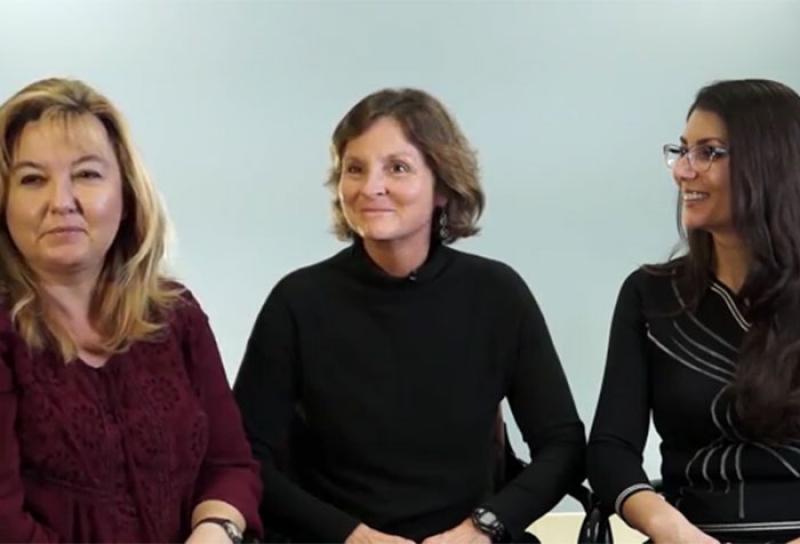
VINCE LARA: This is Vince Lara in the communications department of the College of Applied Health Sciences at the University of Illinois. Recently, Kim Shinew, Monica Stodolska and Liza Berdychevsky, all of the recreation, sport, and tourism department, discussed their research on how recreation programs can be effective in addressing youth gang involvement and violence.

KIM SHINEW: My name is Kim Shinew, and I’m a faculty member in the department of recreation, sport, and tourism, in the College of Applied Health Sciences. And I’m here with my two colleagues.

MONIKA STODOLSKA: Monika Stodolska– I’m also the faculty of the department of recreation, sport, and tourism. And I work with Kim for almost 20 years.

LIZA BERDYCHEVSKY: My name is Liza Berdychevsky. I’m also a faculty of the department of recreation, sport, and tourism. And we’ve been working together on this project for several years now.

KIM SHINEW: Well, we’re here today to talk about a study that we did up in Chicago. The study started many years ago in a project that Monica and I did as it relates to youth in Chicago and their access to recreation and sport programs. When Liza joined us, she had an interest in gang activities. And that coincided very nicely with research findings that we had had in previous studies. And so we wanted to conduct a study that focused more specifically on the gang experience and their motivations for joining gangs and their experiences once they left gangs.

MONIKA STODOLSKA: Some of our research topics were the factors that affect people’s use of outdoor recreation spaces, specifically Latina youth. And we conducted focus groups. And some of the things that people talked about over and over again was how crime affects people’s ability to use public spaces and recreation resources. And that’s how it all started.

LIZA BERDYCHEVSKY: And then in this particular study, which was funded by the campus research board grant, we have focused on the roles and benefits of using recreation in the prevention, intervention, and rehabilitation programs targeting youth involved in gangs. Recreation is a tool that can be used on many levels in the prevention, intervention, and rehabilitation efforts for vulnerable youth who are involved in gang violence. Now, not every recreation effort would necessarily work.

There are key features that we have to deliver to those recreation programs. They have to be consistent. They have to be affordable.

They have to be attractive to youth. They have to offer structure and supervision. And they have to target high risk youth appropriately.

And then if we are successful with that, we can deliver pro-social relationships, positive role models. We can deliver capacity for transformation and reappraisal. And we can also offer safe havens to vulnerable youth, which is extremely important.

One of the programs that was particularly instrumental in our society and helped us a lot, both with recruitment and data collection and even understanding the results that we’re getting, is Cure Violence, formally known as Ceasefire. They’re actually an intervention program. They employ former gang members who act as violence interrupters and mentors and coaches who work with high risk youths who are already involved in gangs and gang violence.

So many of the features that we are discussing were successfully implemented in their programming efforts. They were using recreation both as a hook to entice people to join their programs, but they were also using it as much more than that to helping them open up, grieve over things that happened, connect to each other, communicate better to each other, connect to positive role models, and even things like learning how to be a father because some of them– not all of them.

Some of him never had a fatherly role model. So they use recreation in various roles. And many of our findings are linking well to that example.

KIM SHINEW: And I would just like to add to what Liza said about Ceasefire. They were instrumental in the success of this study. As you might imagine, it is difficult to find former gang members that want to sit down and talk to you about a research study.

And we reached out to Ceasefire, and they reached out to their group, their members, and asked them if they would participate in this study. So when we would go up to Chicago, they coordinated the interviews. And we would sit in this room with them, and we would interview someone. And then we would walk out, and we would say next.

And the next person would come in. So in terms of data collection, it was a dream because of their willingness to help us. And when we asked them about their willingness to help us, they felt that our studies, goals, aligned with the goals of their project. And that’s why they wanted to assist us with recruiting people for the study.MONIKA STODOLSKA: It was actually interesting because some of the older gang members who, you know, deceased from the activity decades ago, they mentioned that gangs in the 1960s and ’70s and ’80s, there were action organization that provided recreation opportunities to youth. They were the ones who set up the soup kitchens in the neighborhoods. They are the ones who took kids to Six Flags, and they actually provided recreation opportunities for the kids. And now they comment that is no longer the case.

It’s more everybody’s, you know, on their own, and they’re focused more on obtaining money from drug sales than caring for the community. Obviously, this was the more of a romanticized notion of gangs, what happened 20, 30, 40 years ago. But they were sort of disillusion about the landscape of crime that is happening in Chicago and major urban areas right now. And it’s more difficult to police them as well.

KIM SHINEW: Monika mentioned something that I just thought of when she was talking about the type of individual that is attracted to gangs. I mean, sometimes, it’s been a family tradition, and they just, it’s what they know. Other times, it’s youth looking for thrills, right, and the risk associated with being a member of the gang. And I believe that this is another place where recreation and sport programs could play a role because if they can find other avenues to get that thrill and that excitement that comes with a gang, then that might be a good alternative to joining a gang.

MONIKA STODOLSKA: Absolutely, and the role models. For many of the youth, they mentioned that they’ve never had a real family. They never had someone they could depend on and someone who would actually care for them. And this is what they are looking for in gang affiliation. So the recreation practitioners whom we spoke with, they mentioned that a recreation professional, a coach, can be the mentor, can be this important person that can actually change the life of a child.

KIM SHINEW: The other thing we learned doing that study when we were interviewing middle school students is how early the recruitment for gangs started. It was much earlier than what we had anticipated and that it was happening in late elementary school, early middle school when they were being approached and asked to join gangs. We need to be on the lookout for gang activity in elementary schools and that that’s where a lot of the recruitment happens. I remember interviewing someone who said that by the time they get to high school, they’ve already decided, right?

They’re either in or they’re out. But it’s that late elementary school where they’re making that decision and then into middle school. So I think by the time you get to high school and you think about programs to prevent gang involvement at high school, that’s too late. And so it really needs to be much earlier.

LIZA BERDYCHEVSKY: And I think it also refers to what kind of programs would be offered to those different age brackets because if we’re talking about primary and middle school, we should be focusing on primary prevention efforts– so focusing on broader youth. And then when we are offering programs that are targeting high school age kids, at that point, since, like Kim said, the decision for most of them has been made already, maybe offering intervention programs that are more tailored towards high risk groups who are already involved in gangs– so different efforts and using recreation differently in those efforts.

MONIKA STODOLSKA: Our study had a lot of interesting findings, and some of the things that really struck us was that gangs have evolved in recent decades, and they have become much less organized, much less structured, more violent. There is much less cohesion among gang members and less loyalty. And what happens is that they’re mostly focused right now on earning money from drug sale.

What we are also seeing increasingly is the influence of Mexican drug cartels, especially the Sinaloa cartel in Chicago. And that really affects the landscape of violence in the city. So one of the things that we need to learn from future research is how to protect you from that new violence that is happening in our urban areas.

Another thing that was really interesting in our study that we discovered is that gangs operate not only in those impoverished central city communities– gangs are present in every city, in every neighborhood, even in small communities like Champagne Urbana. They attract youth not only from working class families but also from middle class families. So youth of all kinds of backgrounds are exposed to gang activity. So what we need to learn more in future research is what are the protective factors, what are the personal characteristics of youth that makes some kids more resilient to crime than others, and how communities and how families can use recreation to protect their children from crime and violence.

KIM SHINEW: Some of the areas that we haven’t talked about today that was certainly evident in our findings was a difference between males and females and their gang experience. And I think that is also a fertile area of research just as it relates to sexuality and risk-taking. And that’s an area that Liza has done quite a bit of work in.

LIZA BERDYCHEVSKY: Mm-hm, that’s one of the papers that we are currently writing up gangs have an extreme chauvinist culture. It’s like taking double standards that we still unfortunately have in the society and magnifying the amplitude of their influence on what roles are available to men and what roles are available to woman, what different kinds of victimization female and male gang members are being subjected to. And unfortunately, a gang is a horrible place for everybody but even more so for young women.

KIM SHINEW: What we feel is that we need to be at the table when these different intervention and rehabilitation programs are being developed because if those key qualities are not there, they will not be successful. So practitioners who are working for YMCAs and park districts and public schools and Boys and Girls Clubs can play a really pivotal role. But they need to be included at the initial stages to ensure that the programs are set up in a way that allows them to be successful.

So recreation in sports is not a panacea. It’s not an automatic that they will have a positive impact. But I think our findings highlight very well the potentially positive impact that they can have.

VINCE LARA: My thanks to Monica, Liza, and Kim. This has been A Few Minutes With.

Share on social

Related news

MPH alums are on the front line of the pandemic battle


Graduates of the Master of Public Health degree program in the College of Applied Health Sciences are finding themselves on the front line in the battle against COVID-19. And thanks to their University of Illinois education, they are better-equipped to handle a pandemic for which few could have been prepared.

Ken Borkowski, a 2012 MPH graduate, is working for the Michigan Department of Health and Human Services, conducting contact tracing with known cases of COVID-19 within the Metro-Detroit area. He credits his ability to succeed in the job in part because of what he learned in the MPH program.

Going back to the basics of EPI 101, it kind of goes back to how this disease moves, and collecting all the information that’s necessary to give us accurate models of how things are going to look and progress, and what do we need to do to inform the public-health work that we do here in Michigan.”

Borkowski’s job involves calling people dealing with COVID-19—or their family members if the patient is too ill—and collecting information.

Some of the key things that we’re looking at now is onset date of symptoms, as well as have people been able to quarantine and then did they go to any sort of high-risk areas such as nursing homes, long-term-care facilities, childhood daycare centers, and so on.”

Teresa Castaneda, who graduated from the MPH program in 2019, has a similar job as a communicable disease investigator for the Champaign-Urbana Public Health District, and also gives credit to her Illinois experience.

“The (epidemiology) knowledge and biostatistics prepared us for how a pandemic is going to come in waves, how we can track cases. There’s really no way to prepare for this, but just knowing the science and the (epidemiology) behind it really helps,” she said.

Castaneda started at CUPHD as a case manager for HIV patients, and was working with a communicable diseases investigator for routine communicable disease cases.

“I assist her when we have someone who tests positive for e-coli or salmonella, or hepatitis B or C, so I’m used to doing that type of investigation.” But she wasn’t surprised when the pandemic hit, or by getting pulled into that type of investigation.

“I’ve been involved in these conversations since right around Christmastime,” she said. “We’ve been having ‘When-it-comes-to-Champaign-County conversations,’ not ‘If-it-comes-to-Champaign-County conversations.”’

Derrius Carter is also a 2019 MPH grad and working for CUPHD in contact tracing and as a public information officer. Part of his job is akin to what Borkowski and Castaneda are doing, but Carter also has a public-facing role.

“What we do is create and provide guidance,” Carter said. “How to grocery shop, how long people should stay home.” Like Castaneda, Carter’s background was more involved with HIV and other infectious disease.

“But we have to be mindful about how all the variables intersect, and create avenues in which we can educate people about both HIV and COVID-19.”

One of Carter’s task is engaging in community-based risk reduction.

“Like using dating apps,” he said. “Just because COVID-19 is around, it doesn’t mean people aren’t being sexually active; so talking about how to reduce their risk of contracting COVID-19, in addition to contracting HIV.”

Like Borkowski and Castaneda, Carter credits his MPH education for getting him ready as he could be.

“We had some classes that touched on emergency preparedness, but I don’t think anybody can prepare you for doing the work,” he said. “Moreso learning the different mechanisms to respond. But when you’re actually in it, it’s a little bit different.”

One thing the MPH alums agree on is that their knowledge and healthcare experience have caused them to approach their personal lives with a high degree of COVID-19-related care.

“Because I take this very seriously, I have not been in a grocery store in so long,” Carter said. “I just feel like it makes the most sense. Limiting my risk. I haven’t been to the gym in quite some time. I knew gyms weren’t practicing social distancing.”

Castaneda also tries to limit her time outside.

“Definitely going less frequently (to the grocery store),” she said. “My husband and I, one of us goes once a week. I pretty much go to work, and go to the store once a week.”

The MPH alums are heeding their own advice, but they are most concerned that some people are listening to advice from less-reputable sources.

“Misinformation is most alarming for me,” Carter said. “I’ve gotten calls from people asking, ‘Oh, I can hold my breath for a minute. Does that mean I don’t have COVID-19?’ And I’ve gotten calls asking if a specific demographic is immune.

“And that’s alarming to me because then it means people aren’t taking it as seriously. (Director of the National Institute of Allergy and Infectious Diseases) Dr. (Anthony) Fauci has been continuously been on a media campaign to spread information about COVID-19, but it’s Facebook articles that people are adhering to, and not his guidance.”

Castaneda agreed.

“The public’s response … I didn’t expect the craziness.”

The Illinois graduates remain hopeful the crisis can end in the upcoming months, but are imploring people to follow state and federal guidelines.

“Pandemics come in waves, and we see that historically,” Castaneda said. “So I don’t think when we get to the end of the downturn of this one, that will be the end of COVID-19, but social distancing and washing your hands are the best things you can do for yourselves.

“Look at the amount of flu outbreaks we have every year, and think about what social distancing and hand-washing could do to those. I do hope in a couple of months we will return to some normalcy,” she said.

“My advice for anybody who wants good information is follow your local health department or the state, we always have the best stuff.”

Now engaged in the worst pandemic since the outbreak of H1N1 in 2009, Michigan-native Borkowski is grateful for what he learned at Illinois.

“There’s been times where people that ask me, ‘Do you regret going out of state for school and doing your degree elsewhere and so on? And given everything that my schooling has led me to and got me into the field that I’m in and working in the job that I’m currently working, it was all well worth it. I definitely appreciate knowing that I have such a profound impact on the community that I’m trying to help and serve.”

Editor’s note:

To reach Vince Lara-Cinisomo, email vinlara@illinois.edu.
 

Share on social

Related news

NBA All-Star Weekend was a slam dunk for RST students


RST junior Brendan Ross was part of a three-student crew working the NBA All-Star Game in Chicago in February

Chatting with Bill Murray was a highlight. Seeing NBA owners such as Mark Cuban up close was dazzling. Finding themselves in a room with more than $1 million in NBA merchandise was overwhelming.

But for three students in the Department of Recreation, Sport and Tourism, their five-day experience at the NBA All-Star Game in Chicago was about one thing.

“Helping people,” said Matt Maguire, a sophomore in the RST program.

Maguire, junior Brendan Ross, and sophomore Harry Figiel were hired to help NBA events coordinator Lauren Mroz—herself an Illinois College of Media grad—with the corporate services portion of the All-Star Game, arguably the sport’s most-important event of the season.

Responsibilities included preparing the NBA’s command center for visiting dignitaries such as league owners and celebrities, putting together gift baskets for stakeholders and delivering credentials and tickets across Chicago, Mroz said.

“All-Star Weekend is way more than just a game, obviously,” Mroz said. “They were very good at doing whatever needed to be done.”

Mroz was happy to have RST students in the employee candidate pool because though she was a College of Media student, she often took RST classes and even took one of professor Mike Raycraft’s RST 180 courses in which students visit some of the most iconic sport and tourism sites in the country.

Mroz explained that the students were hired by Zorm Event & Transportation Services, which works with the NBA on several events and whose owner is RST alum Kevin Mroz, Lauren’s brother. Zorm, contracted by the NBA, has hired Illini students such as Ross to work on other NBA events such as the Draft Combine.

While the All-Star Game experience involved “pretty typical office work” as Maguire described it, none of it seemed mundane or menial to the students.

“We were walking to the elevator and saw (Dallas Mavericks owner) Mark Cuban walk out and we’re just like, ‘this guy’s worth billions of dollars,’” Maguire said. “I talked with Bill Murray for like 15 seconds. That’s a huge highlight for me, I love Bill Murray. He’s one of my favorite actors. So it was really nice to just meet these people you would never meet in a normal circumstance and get to talk with them, even if it was only for a few seconds.”

Celebrity chef Guy Fieri, director Spike Lee, and Bears coach Matt Nagy were among the luminaries with whom students got to interact.

“The chance to talk to Spike Lee … we got to banter with him a little bit and just talk with him, and it was a great experience,” Ross said. “And it was just so cool just to be around there and be in a more professional setting but still get to see those very wealthy and famous people.”

All three students plan to pursue careers in the sports industry and they took lessons away from their NBA experience.

“I was like, whoa, there’s a lot more that goes on here than you would really think of,” Maguire said. “Normally everyone thinks ‘Oh, the glamor in sports, you get to work for playoff teams, stuff like that.’ But when we’re there, it’s 1 a.m., and we’re just doing stuff. It makes you realize that it’s not all glamor and there’s hard work that’s going to go into it, too.”

For Ross, it cemented his career plans.

“Ever since getting the opportunity to do the NBA Draft Combine last summer, I have put it in my head that I would like to work for the NBA,” he said. “So an opportunity like this was not just cool, but educational. And I learned so much.”

Figiel, who works for the Kankakee Daily Journal as an Illini sports beat writer and photojournalist, agreed.

“It was an intense experience,” he said. “I got to see the operation and even though we played a small role in it, just being a part of the experience from a work side as opposed to a fan side, you get a lot more information, and I will have a much better appreciation for those things in the future.”

Mroz said that was the lesson she hopes the students took out of the experience.

“You need to be willing to do whatever it takes to get your foot in the door,” she said. “To make those connections and build those relationships. They’re seeing what it takes to be doing what they could be doing, or they could see what they don’t want to be doing.”

Other highlights for the students included helping former NBA star Grant Hill find his room, seeing some of the participants of the NBA Rising Stars Game—including former Illini hoops star Kendrick Nunn—and seeing Aaron Gordon, who many believed should have won the All-Star Slam Dunk contest, check in. But for the RST students, they got just as much joy out of that as seeing people enjoy all the festivities.

“One of the coolest parts of the last week was that they gave each of us two tickets to each event,” Ross said. “These tickets are selling for insane amounts of money, but I get to call my buddy and say ‘Hey, grab somebody and get to Chicago and you’re going to go to the game.’

“And that was just so rewarding and awesome, and it felt good to give them that experience, but it felt good to watch them have such an awesome experience. That’s why sports are so awesome, and that’s why I want to be around sports.”

Editor’s note:

To reach Vince Lara-Cinisomo, email vinlara@illinois.edu.
 

Share on social

Related news

Mattie gets grant to study children with fragile X syndrome


Speech and Hearing Science Department assistant professor Laura Mattie is launching a study in August in hopes of developing ways to help children with fragile X syndrome communicate better.

Mattie received a grant of $454,977 over three years from The National Institute on Deafness and Other Communication Disorders (NIDCD), part of the National Institutes of Health, aimed at identifying the contribution of child and maternal gestures and responsive maternal language input to word learning opportunities, production practice, and spoken vocabulary growth for toddlers with fragile X syndrome (FXS).

Fragile X syndrome is an inherited genetic condition that causes a range of developmental delays, including learning disabilities and cognitive impairment. Affected individuals usually have delayed development of speech and language by the age of two.

Data collection will start on Aug. 1, Mattie said, and take place across the country.

“Fragile X syndrome is a rare neurogenetic disorder, so that means we will go to where the families live to collect the data,” she said. “It is easier for us to travel because the child participants are all toddlers.”

While existing research in FXS has revealed impairments in child gesture use, Mattie says in her abstract describing the study, no studies to date have examined the link between gesture use and the onset of first words prospectively.

“Our long-term goal is to develop and evaluate early language interventions for these children,” she said.

The term maternal language input is more than just a mom saying a word, and a child repeating it, Mattie said. “High-quality input involves what mothers are saying and how they use non-linguistic cues like gesture to connect their words to the objects children are playing with,” she said. “The timing of spoken words with the gesture cues also play a role in language learning.”

The study will involve toddlers with FXS and their biological mothers completing three assessments over a one-year period starting when the child is between 18 and 24 months. The mother and toddler will be observed to measure child gesture use, child vocabulary, and maternal gesture use and language input.

The ultimate goal, Mattie said, is helping children with FXS communicate. “It will improve their interactions with others in the community and helps with independence,” she said.

The next step for Mattie is conducting cross-syndrome comparisons between children with FXS and children with Down syndrome. A recent pilot grant from the Center on Health, Aging & Disability (CHAD) has allowed Mattie to examine similar skills in children with Down syndrome.

“Together these studies will support my long-term goal of designing early language interventions that build on the strengths of each population,” she said. “Early interventions have long-term and lasting effects on the outcomes of those who receive them.”

Editor’s note:

To reach Vince Lara-Cinisomo, email vinlara@illinois.edu.
 

Share on social

Related news

Tim Nugent honored by Naismith Memorial Basketball Hall of Fame


Tim Nugent’s award is the Hall of Fame’s highest honor, outside of enshrinement.

Tim Nugent, considered the “Father of Accessibility,” and the founder of the Division of Disability Resources and Educational Services at the University of Illinois, has been posthumously awarded the John W. Bunn Lifetime Achievement Award from the Naismith Memorial Basketball Hall of Fame.

It is the Hall of Fame’s highest honor outside of enshrinement.

Nugent, who died on Nov. 11, 2015, at the age of 92, was a 24-year-old World War II veteran and University of Wisconsin graduate student when, in 1948, he took charge of a new program that has since become the Division of Disability Resources and Educational Services at Illinois. Established first to serve the needs of wounded World War II veterans seeking to attend college, DRES, as it became to be known, later opened to other students with disabilities and would become the first comprehensive service program of its kind.

Named in honor of Hall of Famer John W. Bunn, the first chairman of the Basketball Hall of Fame Committee who served from 1949-1964, the award honors coaches, players and contributors whose outstanding accomplishments have impacted the high school, college, professional and/or the international game.

“The Basketball Hall of Fame is pleased to posthumously recognize Timothy Nugent as the recipient of this year’s Bunn Lifetime Achievement Award,” said Jerry Colangelo, chairman of the Naismith Memorial Basketball Hall of Fame. “Mr. Nugent was truly ahead of his time when it came to ideas of accessibility and creating opportunities for those with physical limitations. As the founder and original commissioner of the National Wheelchair Basketball Association, we appreciate his contributions to the game we celebrate.”

Nugent will be formally honored during Hall of Fame Enshrinment Weekend in Springfield, Mass., Aug. 28-30.

After concluding his military career, Nugent organized wheelchair sports for wounded veterans who were otherwise limited by lack of opportunity. Wheelchair basketball started up around the country, and most of the teams were organized at Veterans Administration hospitals. Nugent and his team, the Gizz Kids, organized the first wheelchair basketball tournament; from this, the National Wheelchair Basketball Association was formed. The Gizz Kids took their game on the road and went around the country expanding acceptance for wheelchair basketball.

Marty Morse, who was an assistant coach for the Illinois men’s wheelchair basketball team from 1984-92 and coached the wheelchair track and field racing team from 1981 to 2004, called Nugent a “visionary.”

“I was fortunate to be an undergrad when Tim was working at DRES. He expected excellence from me as a student-athlete and as a coach,” Morse said.

Nugent in 1973 was inducted into the National Wheelchair Basketball Association Hall of Fame after serving as the first CEO of that organization and last year was inducted into the U.S. Olympic & Paralympic Hall of Fame.

Two-time Paralympic medalist Will Waller, an Illinois graduate, DRES alum and current CEO of the National Wheelchair Basketball Association, said Nugent, “created a venue for me to recognize and pursue my potential.

“I’m forever grateful for his vision and stubborn passion to pursue it and expand it in the face of active resistance. The result: he created a movement that would inexorably change the trajectory of lives of people with disabilities. Sport was a catalyst to change the perception of people with disabilities, including self-perception. Nugent’s legacy extends far beyond the field of play. His name is synonymous with the terms accessibility and disability rights, making his societal impact extraordinary to say the least.”

Current Illinois men’s wheelchair basketball coach Matt Buchi said no one was more deserving of the honor than Nugent.

“Dr. Nugent has dramatically impacted my life and so many of my friends and teammates in the wheelchair basketball community through his passion for providing opportunities for individuals with disabilities,” Buchi said. “His never-ending drive to push the status-quo of accessibility and resources for individuals with disabilities, paved the way for us to be able to achieve a college degree and pursue our passions in sports and in life.”

Illinois women’s wheelchair basketball coach Stephanie Wheeler, an NWBA Board of Directors member, said she was excited when she heard the news.

“The most incredible part of Dr. Nugent legacy is that he saw the potential in every person he met,” she said. “At that time, disabled people were seen as less than simply because they were disabled. Dr. Nugent knew that disability didn’t impact their ability to be valued members of society and demanded that those individuals were treated as such. The other part of his legacy that I carry with me everyday is his dogged pursuit of justice. He never let someone telling him no stop him from doing what he knew was right and just. I’m grateful to be a small part of carrying on his legacy at Illinois. I can’t think of anyone who is more deserving of this honor from the NBA.”

In 2014, the first U.S. Paralympic training site for wheelchair racing was established at DRES, and today no university as is dominant as the University of Illinois is in Paralympic track and field.

The credit for that is unmistakable, Morse said.

“That wouldn’t have been possible without Tim,” he said. “When I got here in 1981 as a student, much of the hard work had been done, changing people’s perceptions. He laid such solid ground work.”

Editor’s note:

To reach Vince Lara-Cinisomo, email vinlara@illinois.edu.
 

Share on social

Related news

ORPR gets contract to study lake need in Springfield


The Office of Recreation and Park Resources (ORPR), a unit within the College of Applied Health Sciences’ Recreation, Sport and Tourism Department, was awarded a $90,000 contract by the Springfield City Council to study whether there is a need for a second lake in the city.

ORPR director K. David McCann said his office will “try to determine whether there’s an unmet aquatic outdoor recreation need for fishing, water skiing, swimming.”

The study was requested by the U.S. Army Corps of Engineers, which last year said information provided by Springfield’s City Water Light & Power showing recreational demand for a second lake was insufficient.

McCann said ORPR won’t ultimately make a recommendation as to whether the second lake is needed. “We will provide information based on community surveys and analysis of existing outdoor aquatic opportunities to the U.S. Army Corps of Engineers, for them to include in the Supplemental Environmental Impact Study that will be used to determine whether there is a need for this reservoir.”

Lake Springfield

The lake is part of a larger plan, McCann said, involving a backup water source. A recreational use of water was considered an ancillary benefit.  “In order to create a reservoir there will need to be a dam constructed and that requires a permit from the US Army Corp of Engineers.”

The survey development and implementation will be conducted by professors from the University of Illinois – Springfield Institute for Illinois Public Finance, Dr. Kenneth Kriz, and Dr. Travis Bland.

The study is expected to be completed by August. The lake would cost about $125 million to construct, according to the utility’s latest estimates, and would take about one year to design the lake and about two years to construct.

Editor’s note:

To reach Vince Lara-Cinisomo, email vinlara@illinois.edu.
 

Share on social

Related news

The Office of Recreation and Park Resources (ORPR), a unit within the College of Applied Health Sciences’ Recreation, Sport and Tourism Department, was awarded a $90,000 contract by the Springfield City Council to study whether there is a need for a second lake in the city.

ORPR director K. David McCann said his office will “try to determine whether there’s an unmet acquatic outdoor recreation need for fishing, water skiing, swimming.”

The study was requested by the U.S. Army Corps of Engineers, which last year said information provided by Springfield’s City Water Light & Power showing recreational demand for a second lake was insufficient.

McCann said ORPR won’t ultimately make a recommendation as to whether the second lake is needed. “We will provide information based on community surveys and analysis of existing outdoor acquatic opportunities to the US Army Corps of Engineers, for them to include in the Supplemental Environmental Impact Study that will be used to determine whether there is a need for this reservoir.”

The lake is part of a larger plan, McCann said, involving a backup water source. A recreational use of water was considered an ancillary benefit.  “In order to create a reservoir there will need to be a dam constructed and that requires a permit from the US Army Corp of Engineers.”

The survey development and implementation will be conducted by professors from the University of Illinois – Springfield Institute for Illinois Public Finance, Dr. Kenneth Kriz, and Dr. Travis Bland.

The study is expected to be completed by August. The lake would cost about $125 million to construct, according to the utility’s latest estimates, and would take about one year to design the lake and about two years to construct.

Jeff Woods Named First Mottier Family Professor


AHS Dean Cheryl Hanley-Maxwell congratulates Dr. Jeff Woods on becoming the first Mottier Family Professor

Dr. Jeff Woods, internationally renowned scholar in the area of exercise physiology, was named the first Mottier Family Professor of Applied Health Sciences in an investiture ceremony in the Alice Campbell Alumni Center on October 28.

Dr. Woods is a professor in the Department of Kinesiology and Community Health, Director of the Center on Health, Aging, and Disability, and Associate Dean for Research in the College of Applied Health Sciences. His research focuses on the effects of exercise on the immune system, the gut microbiome, and aging. He was among the first scholars to demonstrate that regular exercise can have an anti-inflammatory effect on the body and showed that exercise can improve the response to the flu vaccine in adults. He was the first to show that exercise, independent of diet, can affect the gut microbiome.

The author of more than 130 peer-reviewed scientific journal articles, Dr. Woods is a Fellow of the National Academy of Kinesiology and the American College of Sports Medicine. He completed his Ph.D. in Exercise Science at the University of South Carolina.

Among the many people he thanked in accepting his professorship were his AHS colleagues, who, he said, “…guide and challenge me and make this an inspiring place to work.”

The professorship was made possible through an estate gift of Charles and Audrey Phyllis Mottier, both of whom graduated from the University of Illinois. She completed her undergraduate degree in Physical Education for Women and had a lifelong interest in links between exercise, movement, and health. Sons Chip and Brad Mottier said they were excited to see their mother’s wish fulfilled.

“She believed participation was the height of enjoyment,” Chip said. Audrey Phyllis and Charles both lived life to the fullest, Brad added, and believed in making each day a little above average.
 

Share on social

Related news

Rogers, Mudar receive $4.6M grant to establish center focused on older adults with cognitive impairment


The University of Illinois is part of a team receiving a $4.6 million grant aimed at helping adults with cognitive disabilties deal with challenges associated with everyday activities.

The grant from the National Institute on Disability, Independent Living, and Rehabilitation Research runs from Sept. 30, 2019 to Sept. 29, 2024 and is a collaborative effort with Weill Cornell Medicine and Florida State University, with Illinois’ share amounting to approximately $1.4 million.

Kinesiology and Community Health professor Wendy Rogers and Speech and Hearing Science associate professor Raksha Mudar are the principle investigators on the research for Illinois. Harshal Mahajan, assistant research professor of Kinesiology and Community Health, is also an investigator on the project.

The funding is for a Rehabilitation Engineering Research Center entitled ENHANCE (Enhancing Neurocognitive Health, Abilities, Networks, and Community Engagement).

Rogers and Mudar said the primary research aims are to understand challenges adults with cognitive disability deal with every day, and to identify existing and emerging technology that can help. Three segments of the population are part of the study group: Adults 60 and older with mild cognitive impairment, cognitive impairments due to stroke and those who have sustained a traumatic brain injury.

“What we’re trying to do is understand the challenges that they experience in their daily activities,” Rogers said. “In one study, we’ll be interviewing them about what they do outside the home, what they do around the home; shopping, transportation, health, finances and then just basic daily activities, such as mobility and medication regimen.”

Rogers said the study’s participants will include both the the individuals with cognitive disability as well as their family members who provide support and care. They will be exploring whether needs change over time, with interviews repeated across the five-year project.

“Really, we’re trying to get an understanding in general of people with cognitive disability on an everyday basis, what kind of challenges are they experiencing and how might we design technology to support that.”

Another goal is understanding what this population uses in terms of current technology to mitigate their impairments.

One of the projects, Rogers said, involves helping adults with cognitive disability use Google Maps and rideshare apps, through additional instructions and support, which could include an app on their phone that walks them through steps, or a video that illustrates what to do and helps them as they learn.

Mudar explained that they also plan to engage healthcare providers and the technology industry in hopes of developing partnerships.

Editor’s note:

To reach Vince Lara-Cinisomo, email vinlara@illinois.edu.
 

Share on social

Related news

Undergraduate Jocelyn Solis shares her story


Jocelyn Solis, second from left, with her family

Grit.

This is the word that describes Jocelyn Solis. When she decided to come to the University of Illinois as a first-generation student, her extended family asked, “Are you just going to last a semester or are you going to push through?” She describes her initial semester as “rough.” Everything was new, and she didn’t know whom to turn to for advice. She had to wade her way through the murky waters of college life and figure things out for herself. When she first decided to go to college, she knew that she would be responsible for supporting herself through school and had intended to go to the least expensive school that offered her admission. Jocelyn had visited the University of Illinois when she was a child and had attended an Illini baseball with her uncle. Upon admission, she realized that despite being more expensive than other offers, her heart yearned to be here. She created a budget and payment plan, took on multiple jobs, and figured out how to make it work.

A huge weight was lifted off of Jocelyn’s shoulders when she made it through her first semester with decent grades and zero debt. Eventually she made her way to RST after taking RST 100: Recreation, Sport, and Tourism in Modern Society. Once in RST, the small class sizes allowed Jocelyn to better connect with her professors. A natural introvert, she was encouraged to network and connect with people, and she found that exercise helped her combat stress. She grew as both a person and a professional. “I learned how to network here. During my sophomore year when I went on the Chicago Facility Tour, Don [Hardin] pushed me out of my comfort zone and introduced me to a facility manager during the trip. I didn’t know how to go up to people and introduce myself, and it was a little uncomfortable for me, but afterward, I was like, ‘Oh, this is how you do it.’”

When asked about her favorite RST memories, Jocelyn describes loving RST341: Community Recreation Planning and RST465: Event Implementation and Evaluation in Recreation, Sport and Tourism. These hands-on courses made her feel like she was really in the field, allowed her to actually “do something” for a community, and taught her how to work with a team. After graduation, she knows she is going to miss the RST community and her multicultural sorority, Sigma Lambda Gamma, which focuses on empowering women and has provided her a support network of like-minded individuals.

Jocelyn credits her mother, Virginia Mejia, for her accomplishments. A single-parent and self-directing woman, Virginia raised her “to be a strong independent woman who knows her worth.” She showed her that “she was going to be who she was and that she didn’t need to change for anyone else.”

This past spring, Jocelyn won the Margaret K. and Edward W. Harvey Scholarship in Parks and Recreation, and on May 11th, she was the first in her family to graduate college. This summer, she will complete her internship with the Associate Director of Facilities, Jessica Lee Adkisson, at University of Illinois at Chicago Campus Recreation. Afterward, she wants to work in campus recreation or with a park district.

Jocelyn hoped she could pave the way for her younger brothers and sisters to also go to college and pursue their dreams. She wanted them to know that “you can still be great and do what you want to do even if others have chosen a different path.”

Her trailblazing efforts have paid off. Her brother, Luther, recently came to the University of Illinois and has fallen in love with RST as well.

Share on social

Related news

College of Applied Health Sciences
110 Huff Hall
1206 South 4th Street
Champaign, IL 61820
(217) 333-2131