For First-Generation Student Week in 2024, we highlighted stories from students at the College of Applied Health Sciences
RIHANNA SHEGOG
Kinesiology first-year student Rihanna Shegog grew up between Bradley and Shawneetown, Illinois—essentially, at both ends of the state.
It wasn’t until a college fair her senior year of high school that the University of Illinois first came on her radar. “Which is crazy, because it’s such a big school,” she said.
Shegog credits her time with I-LEAP—an AHS leadership program that supports first-generation college students—for helping her adjust to campus life.
“At first I felt a lot of pressure because I’m the first one in my family to go to college,” Shegog said. “But they really just want me to be happy and successful.”
VINCENT ANELLI
Vincent Anelli’s decision to come to Illinois was “a pretty obvious” one, he said, when he factored in the realistic tuition with the university’s top-notch speech and hearing science program. Now a sophomore, Anelli credits I-LEAP for teaching the basics of applying to research positions and internships early on.
“Being a first-gen scholar, there’s a lot of pressure to it, especially because my parents worked really hard for me to be here,” Anelli said. “It definitely helps me refocus, that I’m here for my academics. It’s a little daunting at times, but it’s a big motivator.”
AVA MONTAÑEZ
Freshman Ava Montañez searched for college programs that would help support a career in the sports industry. Illinois rose to the top of her list with its RST degree. And her family has helped her transition into college life. As the youngest of six siblings, Montañez leaned on her older twin sisters for advice in the application process. Together, they’re part of the first generation in their family to pursue higher education.
“I went to a small elementary school and middle school; coming to a school like this was a big change because I’m so used to knowing everyone around,” Montañez said. “But I had friends from my old school who came with me, and I have the I-LEAP program with staff I can go to.”
CLARISSA HARRINGTON
Clarissa Harrington was drawn to Illinois after a high school field trip to Champaign-Urbana, 90 minutes from her hometown of Springfield.
The sophomore initially wanted to join a pre-medicine track, but the focus of community health aligned best with her interests.
“After taking my first intro class and learning about community health and public health, I realized it was avbetter fit for me,” Harrington said. “I stayed in because I think it does a great job of helping minority communities on a large scale.”
The first-generation college student says she acclimated to campus “really fast,” serving on the I-LEAP student advisory board to help shape the university experience for incoming students on her same path.
Hoda Elshorbagy’s journey from rural Egypt to central Illinois was an unlikely story, a path littered with numerous obstacles.
Hoda Elshorbagy aims to develop the sport of wheelchair racing and become Egypt’s first qualified wheelchair racing coach (Photo provided)
By JONATHAN KING
In her home in southern Egypt, Hoda Elshorbagy glanced at the TV, then turned to her father with clear-eyed conviction and said, “One day, I’m going to do that.”
Without missing a beat, he said, “Yes—you need to be one of them.”
Elshorbagy and her father were glued to the 2016 Paralympic Games that day in their rural village when they saw for the first time a sport that would become Hoda’s passion: Wheelchair racing.
Only eight years later, Elshorbagy—now a member of the Illinois wheelchair racing team—finished 10th in the women’s wheelchair division of the 128th Boston Marathon. The timing seemed improbable, but for those who know Elshorbagy and her determination, it was no surprise.
Elshorbagy’s journey from rural Egypt to central Illinois was an unlikely story, a path littered with numerous obstacles.
At eight months old, she was paralyzed due to a medical error. With her parents’ help, she endured 13 surgeries, enabling her a degree of mobility supported by crutches and braces. Elshorbagy then discovered adaptive sports and chose discus throwing and weightlifting. But wheelchair racing? She didn’t own a wheelchair and wheelchair racing was unfathomable in Egypt, where wheelchair accessibility is uncommon.
Without a wheelchair, team or coach, what was she to do?
Elshorbagy traveled to Cairo to meet with adaptive sport leaders but met resistance. Still, she was unbowed.
“When they told me ‘No, no, no,’ I heard ‘Yes, yes, yes,’” she said.
So, she ventured into the unknown and found someone to build a custom wheelchair, and she worked with a friend to fabricate custom gloves. She used YouTube to find videos of the Illinois wheelchair team and Coach Adam Bleakney. To understand Bleakney’s videos, though, she had to learn English. She dreamed that one day she would join the Illinois team to learn from Bleakney face to face. For seven years, she planned, prayed, persevered and practiced.
And then came her break.
She applied for and was awarded a grant by the Challenged Athletes Foundation. Elshorbagy traveled to the U.S. for one week at the invitation of CAF Coach Carlos Moleda. This experience further ignited the fire in her belly. Returning to Egypt, Elshorbagy began to contact anyone she could find on Facebook who might be able to help make a connection that would open a door to the prestigious Illinois wheelchair team.
“How can I get to Illinois and train with Coach Bleakney? That question fueled me,” she said. “Eventually, someone introduced me to Coach Marty Morse (DRES’ first wheelchair track and field coach), and he became my online coach for the next year and a half.”
And then came the news. Coach Morse invited Elshorbagy to come to Illinois in April 2023. What was originally planned as an introductory visit to fit her for a racing chair turned into Bleakney encouraging her to enroll in Parkland College as a precursor to becoming a student at Illinois and then the Illinois wheelchair racing team.
Today, two years later, Elshorbagy is a kinesiology student in the College of Applied Health Sciences and the newest recipient of the Morse-Hedrick Scholarship, created by Illinois alumna and decorated Paralympian Jean Driscoll in honor of her coaches, Morse and Brad Hedrick.
“Hoda had a very difficult time pursuing her athletic goals, but she kept pushing forward, literally and figuratively. She has an incredibly strong spirit and her determination is beyond compare,” Driscoll said. “Hoda aligns with the spirit of this scholarship through her commitment to excellence, doing the work required to get stronger, trusting her coach and the training process, respecting everyone from teammates to race directors and organizers, and having a fire inside that drives her to be the best she can be. She is very deserving of this scholarship. Hoda has a promising future, and a vision that will undoubtedly touch many lives.”
The Morse-Hedrick scholarship provides financial assistance to undergraduate students with disabilities who participate in athletic programs through Disability Resources and Educational Services. The DRES program has been an incubator for the growth and success of students with disabilities since its inception in 1948. Morse and Hedrick, alumni of the College of Applied Health Sciences, are internationally known for their dedication to coaching and mentoring athletes with disabilities, including numerous Paralympic champions.
“Words cannot describe how it feels to have this support,” said a glowing and grateful Elshorbagy. “I’m surrounded by the best athletes and coaches in this sport, and I have a home away from home at Illinois. I’m living a dream.”
In her brief career on the Illinois team, Hoda has finished third in the Illinois Half Marathon, 10th in the Boston Marathon, seventh in the Chicago Marathon, sixth in the New York City Marathon and will compete in her second Boston Marathon later this month.
But Elshorbagy’s dreams don’t stop there.
Upon the completion of a master’s degree in kinesiology, Elshorbagy has a vision to return to Egypt to help others who face similar challenges that have marked her journey. In her home country, the field of kinesiology is not available for those with disabilities. Elshorbagy wants to change that. Equipped with her kinesiology education from Illinois, she wants to educate and train others with disabilities in Egypt. As a wheelchair athlete, Elshorbagy aims to develop the sport of wheelchair racing and become Egypt’s first qualified wheelchair racing coach.
“Hoda will be successful at whatever she does. She is a woman with determination and vision,” Bleakney said. “Our wheelchair community at Illinois serves as an incubator for her continual growth in the sport. If all goes well, I’m confident we are going to be able to get Hoda onto the Egyptian national team for the 2025 or 2027 World Championships.”
For Elshorbagy, who once sat watching the Paralympic wheelchair racers on TV, the dream of being one of those Paralympians is suddenly within reach. The 2028 games in Los Angeles are on the horizon. Twelve years after that memorable day with her father, Elshorbagy is hopeful to be one of those athletes herself. This time, her father will watch, not on TV, but in person, seeing his daughter represent their country and bringing hope to others like her to do what some say was impossible.
Alexandra Carbajal wants to work with bilingual children as a speech-language pathologist. (Photo provided)
Alexandra Carbajal discovered her passion for her major, Speech and Hearing Science, during her freshman year at the University of Illinois. After that, everything else she found was through drive and dedication.
“I had a speech therapist when I was a kindergartener,” Carbajal said. “So, I know what a speech therapist says—I’ve had that background and familiarity with it. But I never even thought about it as a career until that day.”
The day Carbajal refers to is the day she visited the University of Illinois, after she was accepted as a student, to learn more about the university. Immediately, she was drawn to speech-language pathology, she said. She transferred to the Department of SHS within the College of Applied Health Sciences in her sophomore year.
Now a junior, Carbajal is one of five Humanities in Action scholars at Illinois. The HIA program works with students to remove some of the financial barriers that prevent undergraduate humanities students from taking advantage of community engagement opportunities.
Scholars are matched with a community partner in Champaign-Urbana and work toward a shared goal. As one of these scholars, Carbajal will work closely with a placement that is within her field.
Carbajal’s career goal is to become a bilingual Spanish speech-language pathologist for Spanish- and English-speaking children. She is majoring in speech and hearing science with a concentration in speech-language pathology.
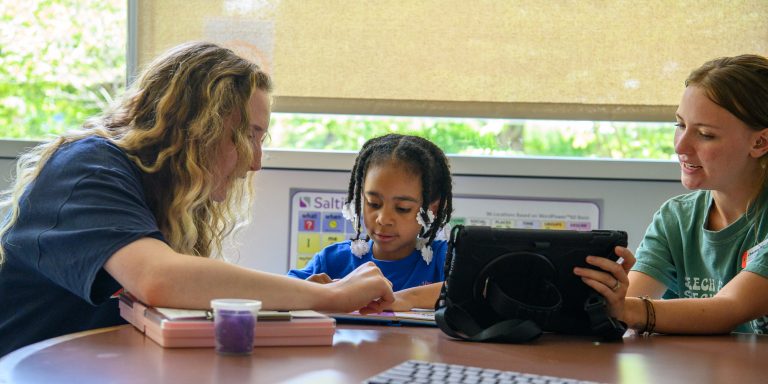
Carbajal is also an intern at The Autism Program, where she participates in play group programs and creates visual resources for individuals on the autism spectrum. Additionally, she had the opportunity to volunteer at two elementary schools as a student teacher aide at the International Prep Academy in Champaign, and as a mentor at Dr. Preston L. Williams Jr. Elementary in Urbana.
“[TAP] has been a really great experience, definitely my favorite experience I’ve had so far. Because I want to be a speech therapist,” Carbajal said, “I know I will be working with the neurodiverse population. So that has really opened my perspective. Seeing their gratitude, they’re always so appreciative, and it just makes me more excited for what I’m going to be going into later.”
Alongside her SHS major, Carbajal also has a minor in Spanish.
“I just love the language,” Carbajal said. “I love the people. I love learning about different cultures, I love learning about how big the needs are for different Spanish communities. But I’ve always known I wanted to work with that population, specifically kids as well. That’s kind of my niche, bilingual kids, I’ve just always seen myself helping them out.”
The immediate effect of her work is one of Carbajal’s favorite parts about the field.
“I’d say just hearing the different stories from the families and the individuals that I work with, I think they all come from different backgrounds,” Carbajal said. “Each week, you get to see the progress that you’ve made. And you get to build a connection with them. And then knowing that you’re helping, not only them, but their families.”
June 03, 2024 | Praachi Mudar, University High School
Praachi Mudar (in pink) said she enjoyed working with Wendy Rogers, center, and the LIFE Home team. (Photo provided)
Before this summer, whenever I thought of robots, I thought of the clunky Disney robot WALL-E and his mission to save mankind. I didn’t have any direct experience interacting with robots or the components involved, so my only point of reference was a kid’s movie. This summer Dr. Wendy Rogers and Dr. Harshal Mahajan gave me the opportunity to intern at the McKechnie Family LIFE Home. I spent my summer with social robots, assistive robots, home appliances, virtual reality and other technology that are used to help people’s daily lives, which completely changed my understanding of robots and technology.
One of my favorite parts of this experience was interacting with the social and therapeutic robots—Moxie, Jibo and Paro. I had engaging conversations with Moxie about celebrity book authors using her generative AI. In the game Circuit Saver, I saved Jibo’s motherboard, and in doing so, learned about its camera and motion sensors. I also experienced Paro’s calming effect when petting it. It was especially exciting to have the freedom to interact with the robots in ways that interested me, like getting to play games with them or talk about my own interests. It was incredible to not only learn about these robots’ capabilities but also see how they can assist people with daily tasks like grabbing pill bottles or talking to their family from miles away.
The most challenging part of this experience was coming into a space I had so little knowledge about. For the first few weeks I struggled to understand basics, like how to start up the robots and navigate the robots’ interfaces, but I was surrounded by patient and knowledgeable people who helped me understand and learn. By the end of the internship, I was knowledgeable about most if not all of the technology. I likely wouldn’t have enjoyed or learned as much if it hadn’t been for the support I got from Dr. Samuel Olatunji, my supervisor; Abbey Paik, an undergrad intern; and Yvona Vlach, the operations coordinator.
As I got more comfortable with the robots, I really enjoyed doing demonstrations and sharing information about the robots with people on tours. Almost all of the technology had an immense amount of research surrounding it. The research I learned about the most displayed the ways these robots can help people who face social isolation and older adults who need help with basic tasks. It was exciting to explore this growing field. Even more so, I enjoyed sharing this knowledge and explaining the research being conducted with these robots at the LIFE Home.
This summer has been an incredible opportunity that I am so grateful to have. It has genuinely made me more interested in the intersectionality of technology and applied health sciences.
Mothers of Mexican descent living in southern California discussed the hardships they faced during the COVID-19 pandemic obtaining food, up-to-date medical information and health care with a team of researchers led by kinesiology and community health professor Sandraluz Lara-Cinisomo. (Photo by Brian L. Stauffer)
Public policies blocked many families of Mexican descent living in the U.S. from accessing vital services such as food and mental health care during the COVID-19 pandemic, even though these communities experienced some of the highest infection and mortality rates.
Thirty-eight perinatal women and mothers of young children were interviewed about the challenges they faced during the pandemic and proposed solutions to better meet the needs of their communities during future large-scale crises in a study led by KCH Associate Professor Sandraluz Lara-Cinisomo.
Co-authors of the study are molecular anthropologist Amy L. Non of the University of California-San Diego; Kimberly D-Anna-Hernandez, a professor of psychology at Marquette University; and U. of I. graduate student Mary Ellen Mendy and undergraduate students Jessica Avalos and Jacqueline Marquez.
The women in the study discussed the stressors they encountered during the pandemic, including their difficulties accessing mental health treatment, child care and food. Their suggestions and insights were used to identify actionable policies and programs that could help meet the needs of Latino communities during future emergencies.
The participants, who were interviewed between September 2021 and December 2022, were part of a longitudinal study that recruited them from a clinic in San Diego, one of the U.S. cities with large Latino populations of Mexican heritage.
The women were about 36 years old on average. Although about 81% of them were born in Mexico, many had resided in the U.S. for 17 years or more. About 31% reported having an annual household income of less than $21,000, while a similar percentage earned $40,000 or more, according to the study.
Lara-Cinisomo said participants faced complex stressors during the pandemic. Half of the women in the study said their families had challenges obtaining food due to loss of income and subsidies such as school lunches, as well as supply chain shortages and consumer stockpiling.
“While early in the pandemic various federal and state programs and policies were deployed to mitigate people’s risks for exposure and enhance families’ economic security, millions of tax-paying families of Mexican descent and other Latino backgrounds were excluded because of restrictions and exclusions set by those programs,” Lara-Cinisomo said.
The researchers found that more than twice as many Spanish speakers reported food-related issues compared with their English-speaking counterparts.
“Policymakers should consider how language barriers increase the risks of Spanish-speaking families losing out on benefits designed to meet their needs, such as CalFresh,” California’s iteration of the federal SNAP food assistance program for low-income people, Lara-Cinisomo said.
“Communicating food and health and safety information in linguistically appropriate media, such as texts, videos or commercials, is vital to ensure accessibility to people with differing literacy and technological skills and should be carefully considered by policymakers.”
Involving trusted sources in disseminating relevant and critical information was also recommended by the participants. For marginalized communities that have experienced historical discrimination and anti-immigrant propaganda, trust in these sources is vital, Lara-Cinisomo said.
“Research has shown that community engagement is critical in emergency preparedness and increases the likelihood of meeting the needs of marginalized communities,” Lara-Cinisomo said. Accordingly, she and her team recommended developing a contingency plan to train culturally and linguistically competent community health workers to cultivate networks of trusted community members to assist in crisis communication efforts.
Some women discussed feeling anxiety about the uncertainties associated with the pandemic, such as lockdowns and conflicting health information. These feelings were exacerbated by employment disruptions, pregnancy, and food access problems, and their concerns extended to family members residing in other households and those living in Mexico, participants told the researchers.
The majority of those interviewed advocated broadening access to food subsidy programs such as WIC and SNAP to offset income losses and food shortages during large-scale crises, along with providing public awareness campaigns about local food banks and assistance programs.
Even though California provides more services for undocumented immigrants—including paid family leave and one year of emergency coverage with mental health services under Medi-Cal, the state’s Medicaid plan, for pregnant women—caring for their mental health needs was a significant problem for many participants. Fifteen women reported needing mental health care, but twice as many of the English-speaking women mentioned these issues compared with their Spanish-speaking counterparts, the researchers found.
The researchers hypothesized that this difference may have been associated with cultural beliefs, with Spanish-speaking women feeling less comfortable disclosing mental health problems because of stigmatization compared with those who spoke English. Or, it may have been that those who spoke Spanish were more resilient or more concerned about immediate needs such as food assistance, the team said.
Participants recommended broadening access to mental health services for mothers and their families, promoting awareness with providers and patients, and disseminating mental health information and resources through videos and other media and via programs such as WIC.
Many of the women—largely those who spoke only Spanish—reported difficulties obtaining personal protective equipment and sanitization supplies because of shortages, consumer stockpiling, and price gouging, in keeping with other studies that showed low-income and marginalized communities were disproportionately affected.
Although the study sample was small, Lara-Cinisomo said it highlighted critical needs for responsive, culturally appropriate policies and programs to ensure the well-being of Mexican-descent perinatal women and mothers of young children during public health crises.
Lara-Cinisomo discussed the team’s findings and study participants’ recommendations during a virtual Briefing on Perinatal Health and Well-being on April 3 hosted by the journal Health Affairs, which published the study.
The University of Illinois at Urbana-Champaign’s College of Applied Health Sciences is proud to announce a significant milestone in its ongoing commitment to advancing health sciences education and research. Effective Aug. 16, the Department of Kinesiology and Community Health will officially change its name to the Department of Health and Kinesiology.
The new name better reflects significant changes in our disciplines, research interests, and educational mission. Health and Kinesiology allows for a broader, more inclusive representation of a department that focuses on multiple aspects of health and physical activity in a diverse society. It also honors our legacy as leaders in the field of health and kinesiology, while pointing the way forward to a future that is both dynamic and innovative.
The name change was a decision that was made based on goals highlighted in the KCH Strategic Plan and upon the recommendation of the KCH Restructuring Task Force. It was supported by multiple stakeholders and was recently approved by the College of Applied Health Sciences, UIUC Senate, and Board of Trustees.
Cheryl Hanley-Maxwell, dean of the College of Applied Health Sciences, expressed enthusiasm about the department’s name change, saying, “The renaming of our department to Health and Kinesiology aligns with our strategic vision of fostering interdisciplinary collaboration and addressing the multifaceted aspects of health and wellness. This change reflects our commitment to providing innovative education, conducting impactful research, and serving our communities.”
HK Department Head Kim Graber said, “As the department evolves to better reflect the dynamic landscape of health and movement sciences, we believe the change to Health and Kinesiology not only embraces our commitment to comprehensive wellness but also underscores our dedication to advancing research, education and outreach in these vital areas.”
The Department of Health and Kinesiology offers a wide range of undergraduate, graduate and doctoral programs aimed at preparing students for careers in health promotion, exercise science, public health, rehabilitation, and related fields. With world-class faculty and state-of-the-art facilities, the department equips students with the knowledge, skills, and practical experience needed to excel in diverse healthcare settings.
Speech and Hearing Science Associate Professors Marie Moore Channell and Laura Mattie have long been interested in the development of communication and life skills in individuals with neurodevelopmental and intellectual disabilities.
Channell directs the Intellectual DisAbilities Communication Lab, where her research team works toward a comprehensive understanding of skills that support day-to-day communication for people with Down syndrome in order to identify and develop strategies for supporting their social and academic success. In Mattie’s Development in Neurogenetic Disabilities Lab, research addresses the early development of individuals with Down syndrome and fragile X syndrome. She, too, aims toward promoting the developmental success and well-being of people with these neurogenetic disabilities.
The scholars’ shared interests have led to fruitful collaborations in the past. They led a team of researchers who used a large, national database developed by the Down Syndrome Cognition Project to characterize variability in IQ, executive functioning, adaptive and challenging behavior, and autism symptomatology among individuals with Down syndrome.
Those in the “normative” group showed a profile of cognition and behavior that is typically represented in the literature on Down syndrome. Those in the “cognitive” group had lower cognitive scores and adaptive behaviors such as self-care and daily living skills than their peers with Down syndrome, along with high rates of autism symptoms.
Those in the “behavioral” group showed cognitive scores and adaptive behaviors similar to their peers with Down syndrome but had high rates of autism symptoms and challenging behaviors such as hyperactivity and conduct problems. Thus, with a large enough sample size, different patterns of autism symptoms and other characteristics can be seen across individuals with Down syndrome. The ultimate goal in precisely characterizing individual variability within Down syndrome is to optimize daily living through targeted treatments and interventions.
Overcoming diagnostic hurdles
Channell and Mattie currently are collaborating as principal and co-principal investigators on a study funded by the National Institutes of Health INCLUDE Project, which supports research related to the health and quality of life of individuals with Down syndrome. Working with researchers at Emory University, Johns Hopkins University and the Kennedy Krieger Institute, their study seeks to increase understanding of the co-occurrence of autism with Down syndrome to improve its diagnosis and treatment.
“There is a stereotype of people with Down syndrome as happy, social people who can’t have autism,” Channell said. “It’s more common than previously thought, but underdiagnosed.”
Interventions and therapies that people with autism receive could be a beneficial add-on to services offered to individuals with Down syndrome. Part of the problem in diagnosing autism in this population is that autism screening tools that were developed for the general population need to be adapted. To work toward the goal of developing better tools to screen for autism in people with Down syndrome, Channell, Mattie and their collaborators are conducting a nationwide survey of caregivers of youth with Down syndrome in which they are completing existing screening tools and other developmental questionnaires. The researchers will then examine and adapt the screening tools as needed so they can be used by practitioners to determine whom to refer for a full autism evaluation.
They are casting a wide net in hopes not only of representing all the varying abilities within Down syndrome, but also of including groups that are not well represented in the existing research.
“Underrepresentation is a big problem in research related to Down syndrome,” Mattie said. “We have a diverse board of stakeholders, are building relationships with the Black Down Syndrome Association, and targeting rural and Hispanic families as well.”
The questionnaires and other screening tools completed by caregivers are just one element of an autism diagnosis. There also is an in-person evaluation component, which is conducted by either developmental behavioral pediatricians or clinical psychologists who are specifically trained in autism diagnostics and assessment, as well as neuropsychological methods. The difficulty with this aspect of diagnosis is two-fold, Mattie said.
“First, the number of developmental behavioral pediatricians and clinical psychologists with this specialized training is limited, so there’s a bottleneck,” she said. “Also, while they may have expertise in autism, they don’t necessarily know about Down syndrome. So the ability to identify a true co-occurring condition is really lacking.”
Channell and Mattie may be conducting the first large-scale study using the broad screening measures doctors and clinicians give to families when autism is first suspected. Theirs may also be the first study that will explore the use of telehealth to conduct diagnostic evaluations of autism in children with Down syndrome.
“If we can figure out how to make that work, we can increase access to evaluations by specialists,” Channell said. They are working with a clinician at Kennedy Krieger, Natasha Ludwig, who will conduct the evaluations of autism in the telehealth sessions, and with Amy Cohen, director of the University of Illinois Autism Clinic, who will review and “score” the evaluations as well to ensure that evaluation tools will lead to consistent results when used by different clinicians.
With the dual focus on developing effective autism screening and diagnostic tools for individuals with Down syndrome and increasing access to specialists who are skilled in both autism and intellectual disability, Channell and Mattie intend to make a significant and lasting impact on improving the quality of life of a population that has historically been underdiagnosed and underserved. That’s good news for the individuals themselves and their caregivers, as well as the scores of clinicians who dedicate their professional lives to providing the best services possible to their clients.
The 2022-23 Illini Success Report is out, and our graduates are taking the next step.
The ninth annual report released Wednesday shows that University of Illinois Urbana-Champaign graduates who graduated during the 2022-2023 academic year, including August 2022, December 2022 and May 2023, experienced exceptional success in finding jobs, enrolling in graduate school or beginning volunteer programs.
Within the data collected, 91% of reporting graduates had secured a first destination of employment—defined as a job, enrollment in graduate or professional school, or a volunteer position—within six months of graduation.
Approximately 56 percent started a job, 35 percent enrolled in additional education and less than 1 percent began a volunteer position. The report also shows that the average salary for a full-time-employed recent graduate is about $76,000, up from last year’s $74,974.
For the College of Applied Health Sciences, that number was 92 percent. Of the respondents, 62 percent reported enrolling in continuing education and 30 percent were employed full time. The average salary for an AHS graduate was $47,233.
“I am thrilled to see our graduates succeeding at such high rates,” said Chancellor Robert Jonnes. “And I am extremely grateful for the efforts from our faculty and staff who equip our students with transformational experiences for their next steps. I hope you will all join me in celebrating the success of our recent Illinois graduates.
This year marked the 76th anniversary of the first NIWBT
The Illini women’s basketball team finished third in the 2025 NIWBT (Photo by Craig Pessman)
The University of Illinois and Illinois Wheelchair Athletics played host last week to the 47th Annual National Intercollegiate Wheelchair Basketball Tournament and even though neither Illini team took home a title, the event at the State Farm Center was still an opportunity to showcase Illinois as a trailblazer for disability resources and adaptive sports.
This year marked the 76th anniversary of the first NIWBT, which was hosted in 1949 at a University of Illinois satellite campus in Galesburg, Illinois. The tournament was organized by Dr. Tim Nugent, the first director of Disability Resources and Educational Services, also known as DRES. In honor of the man known as the “father of accessibility,” the tournament winner is awarded the coveted Timothy J. Nugent Championship Trophy.
This season’s NIWBT featured 11 men’s teams and 6 women’s teams competing in 21 total games across four days, from March 26-29.
In terms of results, the Illini women’s team reached the semifinals after beating City University of New York 72-19, but lost to Texas-Arlington 59-40. The Illini women did defeat Arizona, 62-37, for a third-place finish.
Women’s coach Stephanie Wheeler praised the fans for making their voices heard.
“You could hear their screams, you could hear their I-L-Ls, you could hear them say the names of the players,” Wheeler said. “It’s that kind of energy that translates on court.”
The Illinois men beat Eastern Washington 79-39 in their first-round game, but were defeated by Alabama 65-47 in their second game. The Illini men did cap their play by beating Missouri 51-34 in a consolation game.
In the men’s bracket, top-seed Arizona beat Texas-Arlington 75-65 to win the Nugent trophy. For the women, top-seeded Alabama beat UTA 67-52 to secure the title, its fifth straight title since 2019 (the 2020 tournament was canceled because of the COVID-19 pandemic).
The Illinois men last won an NIWBT title in 2010, while the Illini women have yet to capture the Nugent trophy since women’s play began in 2011. Despite the teams’ current droughts, both programs hold 29 championships between them.
Three members of the men’s team—Ryan Fitzpatrick, Sebastian Milan and Martrell Stevens—left Champaign-Urbana shortly after the tournament to play for Team USA in the IWBF Men’s U23 Americas Championship from April 2-6 in Bogota, Colombia. That tournament features Brazil, Canada, Colombia and Team USA, competing for two qualification spots at the 2025 IWBF Men’s U23 World Championship, taking place in São Paulo, Brazil in June.
Next year’s NIWBT will be played at the University of Arizona.
Steve Serio celebrates Team USA’s Paralympic gold in Paris (Getty Images)
By VINCE LARA-CINISOMO
If this really was Steve Serio’s final Paralympic Games appearance, he went out in style.
The University of Illinois Urbana-Champaign alum had 24 points, 10 rebounds and eight assists as Team USA won its record third straight Paralympic Games gold medal, holding off Great Britain 73-69 in Paris.
“This team has grown so much over the course of the last couple of years,” said Serio, the five-time Paralympian, team captain and graduate of the College of Applied Health Sciences. “We knew that Great Britain was going to be a great opponent, a really tough group of guys. Right now, we’re just excited that we won a basketball game and got to bring home another gold medal for our country.”
Serio and Jake Williams combined for 19 points in the first quarter for the U.S., including a late 3-pointer from Serio to put Team USA in the lead. Great Britain clawed back within three points with three minutes to go in the game, but timely buckets from Serio, Williams, and Illinois alum Brian Bell as well as a few defensive stops put the game to bed. Team USA won its third consecutive gold medal—the first time that’s ever been accomplished—and its eighth all time.
Before the game, Serio said the Paris Games would be his last.
“This entire Games I’ve tried to be present,” Serio said. “Live in the moment more than I have in the past. You look at the game, you look at this experience a little bit differently when you know it’s going to be your last one. I can’t think of a better way to go out, I’m going to remember this for a really long time.”
The USA women’s wheelchair basketball team won a silver medal, falling short in its attempt at gold. The U.S. lost in the final to defending champ Netherlands, 63-49. The women’s team, which included Illini athletes Kaitlyn Eaton, Ali Ibanez and Emily Oberst, has not won gold since 2016.
In track and field, Illinois alum Susannah Scaroni took her fourth medal of the 2024 Games, winning bronze in the women’s marathon T54 came after a battle with Australian Madison de Rozario and China’s Zhaoqian Zhou.
“There was a moment in the race where Madison and I were working so hard and going back and forth and honestly, I didn’t care what color the medal was, but I was hoping she and I could get silver and bronze,” Scaroni said. “That’s what happened and I’m so happy for her.”
As for other Illini athletes competing in Paris, two-time medalist Daniel Romanchuk was Team USA’s top men’s finisher, taking fourth in the men’s T54 race with a time of 1:32.23. Romanchuk won the second Paralympic title of his career in Paris in the 5,000-meter T54 race on the track and also took bronze in the 400-meter.
Seven-time Paralympian Aaron Pike followed Romanchuk with a seventh-place finish in 1:36.23.
Matching Pike’s seventh-place finish on the women’s side was Tatyana McFadden, who won her 21st Paralympic medal in Paris and became the most decorated U.S. Paralympic track and field athlete in history.
Two-time Paralympic medalist Brian Siemann and two-time Paralympian Jenna Fesemyer rounded out Team USA’s results in 11th and 13th place in the men’s and women’s races, respectively. Siemann, who in his fourth Paralympic Games won his first two medals in Paris, finished in 1:51.56 while Fesemyer clocked a time of 2:05.42.