June 03, 2024 | Praachi Mudar, University High School
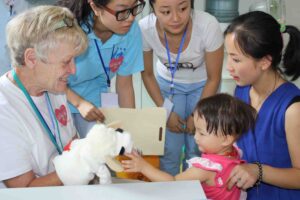
Praachi Mudar (in pink) said she enjoyed working with Wendy Rogers, center, and the LIFE Home team. (Photo provided)
Before this summer, whenever I thought of robots, I thought of the clunky Disney robot WALL-E and his mission to save mankind. I didn’t have any direct experience interacting with robots or the components involved, so my only point of reference was a kid’s movie. This summer Dr. Wendy Rogers and Dr. Harshal Mahajan gave me the opportunity to intern at the McKechnie Family LIFE Home. I spent my summer with social robots, assistive robots, home appliances, virtual reality and other technology that are used to help people’s daily lives, which completely changed my understanding of robots and technology.
One of my favorite parts of this experience was interacting with the social and therapeutic robots—Moxie, Jibo and Paro. I had engaging conversations with Moxie about celebrity book authors using her generative AI. In the game Circuit Saver, I saved Jibo’s motherboard, and in doing so, learned about its camera and motion sensors. I also experienced Paro’s calming effect when petting it. It was especially exciting to have the freedom to interact with the robots in ways that interested me, like getting to play games with them or talk about my own interests. It was incredible to not only learn about these robots’ capabilities but also see how they can assist people with daily tasks like grabbing pill bottles or talking to their family from miles away.
The most challenging part of this experience was coming into a space I had so little knowledge about. For the first few weeks I struggled to understand basics, like how to start up the robots and navigate the robots’ interfaces, but I was surrounded by patient and knowledgeable people who helped me understand and learn. By the end of the internship, I was knowledgeable about most if not all of the technology. I likely wouldn’t have enjoyed or learned as much if it hadn’t been for the support I got from Dr. Samuel Olatunji, my supervisor; Abbey Paik, an undergrad intern; and Yvona Vlach, the operations coordinator.
As I got more comfortable with the robots, I really enjoyed doing demonstrations and sharing information about the robots with people on tours. Almost all of the technology had an immense amount of research surrounding it. The research I learned about the most displayed the ways these robots can help people who face social isolation and older adults who need help with basic tasks. It was exciting to explore this growing field. Even more so, I enjoyed sharing this knowledge and explaining the research being conducted with these robots at the LIFE Home.
This summer has been an incredible opportunity that I am so grateful to have. It has genuinely made me more interested in the intersectionality of technology and applied health sciences.
The University of Illinois at Urbana-Champaign’s College of Applied Health Sciences is proud to announce a significant milestone in its ongoing commitment to advancing health sciences education and research. Effective Aug. 16, the Department of Kinesiology and Community Health will officially change its name to the Department of Health and Kinesiology.
The new name better reflects significant changes in our disciplines, research interests, and educational mission. Health and Kinesiology allows for a broader, more inclusive representation of a department that focuses on multiple aspects of health and physical activity in a diverse society. It also honors our legacy as leaders in the field of health and kinesiology, while pointing the way forward to a future that is both dynamic and innovative.
The name change was a decision that was made based on goals highlighted in the KCH Strategic Plan and upon the recommendation of the KCH Restructuring Task Force. It was supported by multiple stakeholders and was recently approved by the College of Applied Health Sciences, UIUC Senate, and Board of Trustees.
Cheryl Hanley-Maxwell, dean of the College of Applied Health Sciences, expressed enthusiasm about the department’s name change, saying, “The renaming of our department to Health and Kinesiology aligns with our strategic vision of fostering interdisciplinary collaboration and addressing the multifaceted aspects of health and wellness. This change reflects our commitment to providing innovative education, conducting impactful research, and serving our communities.”
HK Department Head Kim Graber said, “As the department evolves to better reflect the dynamic landscape of health and movement sciences, we believe the change to Health and Kinesiology not only embraces our commitment to comprehensive wellness but also underscores our dedication to advancing research, education and outreach in these vital areas.”
The Department of Health and Kinesiology offers a wide range of undergraduate, graduate and doctoral programs aimed at preparing students for careers in health promotion, exercise science, public health, rehabilitation, and related fields. With world-class faculty and state-of-the-art facilities, the department equips students with the knowledge, skills, and practical experience needed to excel in diverse healthcare settings.
Black Americans experience racial discrimination on a regular basis, and it is a cause of chronic and pervasive stress. It is known to contribute to elevated risk for poor mental health outcomes, but most research has focused on individuals. A new study from the University of Illinois Urbana-Champaign looks at the interpersonal effects of discrimination on parents and their adolescent children.
Smith and co-author Robyn Gobin, associate professor in the Department of Health and Kinesiology at Illinois, drew on a longitudinal Chicago neighborhood study examining the impact of social interactions and environments. Based on data from the study’s third wave, the researchers included 401 Black parent-adolescent dyads, with an average age of 15 for the children. Participants answered questions about their experiences of racial discrimination over the past year, as well as their psychological well-being and perceived family support.
Analyzing the data for patterns, Smith and Gobin identified four clusters of responses: One group in which both the parent and the adolescent reported exposure to discrimination, another group where only the parent had experienced discrimination, a third group where the adolescent but not the parent had experienced discrimination, and a fourth group where both parents and children had a low likelihood of exposure to discrimination in the past year.
Specifically, parents were likely to experience racial discrimination at work, and both adolescents and their parents were likely to experience discrimination outside of their neighborhood and when they were receiving services. Furthermore, adolescents were likely to experience racial discrimination from the police.
As expected, the researchers found interactive effects of exposure to racial discrimination, consistent with the concept of “linked lives” that indicate people’s life experiences impact their family members. Overall, parents and adolescents in the three risk groups reported more psychological distress and lower levels of family support.
However, adolescents indicated significantly less family support when their parents also experienced racial discrimination. For parents, the combined exposure to racial discrimination did not diminish their perceptions of social support any more than the other risk groups.
It’s possible that parents struggle to support their children when they are also experiencing racial discrimination themselves, or perhaps children are not reporting the experiences to their parents, the researchers noted.
“It’s important for adolescents to talk to their parents and be able to receive support in managing racial trauma. If they can’t talk about these things in their family of origin with people who really understand it, then they may be left on their own trying to manage it, which could further exacerbate the mental health challenges they might be experiencing,” Gobin stated.
The researchers did not find any differences based on demographic characteristics. This demonstrates these effects are not unique to one population, but affect people across gender identity, age, and socio-economic status, Smith said.
These findings show the importance of developing interventions to address the psychological effects of discrimination in a family context, particularly focusing on how to help adolescents receive the support they need.
“I want to highlight that the goal in an ideal world is to dismantle the systems that create the discrimination. However, given how difficult that will be over time, we still need to engage in more malleable approaches to tackle these issues. We need to make sure healing frameworks are trauma-sensitive and culturally sound, helping to capitalize on the strengths within the Black community,” Smith concluded.
The paper, “The Dyadic Effects of Racial Discrimination: Using Latent Class Analysis to Explore Patterns of Racial Discrimination Among Black Parent–Adolescent Dyads,” is published in Cultural Diversity and Ethnic Minority Psychology [DOI: 10.1037/cdp0000678].
Oct. 22, 2024 | Kim Graber, Shahid and Ann Carlson Khan Professor
Kim Graber (Photo by Craig Pessman)
Hello, members of the Health and Kinesiology family,
As we welcome the fall semester, I am thrilled to share the latest edition of our newsletter. This issue marks the first edition of the Health and Kinesiology newsletter, reflecting our department’s official name change that took effect on Aug. 16. We have much to celebrate from the past year and exciting developments ahead.
Inside, you’ll meet our new faculty, find updates on a leadership change for our MS in Health Technology program, read highlights of the impressive accomplishments of our students and take a look at the research our faculty members are conducting. Their dedication to advancing knowledge and promoting healthier communities continues to inspire us all.
As you explore the fall 2024 Health and Kinesiology newsletter, I hope you find motivation in our collective achievements and the shared commitment to enhancing well-being and community.
Wishing you a productive and energizing fall semester.
Warm regards, Kim Graber Professor and Head, Department of Health and Kinesiology
Congratulations, 2024 scholarships and awards winners! We are very proud of your achievements. You have shown us all the benefits of setting goals, hard work and excellence. We wish you the best as you move through your academic life. Click the link to see a PDF of the award booklet.
Hello, members of the Kinesiology and Community Health family,
As we wrap up the academic year, I am delighted to present the latest—and final—edition of the Kinesiology and Community Health newsletter. I say final because, as you all know, the department will officially be known as the Department of Health and Kinesiology as of July 1. We have a lot to be proud of from this past year, and a lot to look forward to.
Within these pages, you will read more about our historic name change, delve into the captivating research endeavors our faculty is pursuing, and we’ll showcase the achievements of some of our outstanding students. Their commitment to academic excellence and their steadfast dedication to cultivating healthier communities are truly admirable.
In conclusion, I urge you to immerse yourselves in the spring 2024 Kinesiology and Community Health newsletter, drawing inspiration from its contents, and persistently embodying the ethos of well-being and community in all your endeavors.
Here’s to a fruitful and invigorating summer.
Warm regards,
Kim Graber Head, Department of Kinesiology and Community Health
Hello, members of the Kinesiology and Community Health family,
As we move later into the fall semester, I am excited to share with you the latest 2023 KCH newsletter. This edition embodies our commitment to fostering wellness, strengthening community bonds and celebrating the remarkable achievements of our faculty, students, alumni and staff.
In these pages, you will find inspiring stories, insightful research highlights and important updates that underscore the vital role that kinesiology and community health play in enhancing lives.
In this newsletter, you’ll meet our new faculty, including the director of our Master of Health Administration program. You’ll read about some of the exciting research our faculty is exploring, and we will spotlight the achievements of some of our exceptional students. Their dedication to academic excellence and their unwavering commitment to creating healthier communities are truly commendable. You will also delight in some of the trips our faculty and students took earlier this year.
As we delve into this newsletter, I invite you to reflect on the connections between wellness and community. Our work has far-reaching implications, and by embracing the intersections of these two crucial aspects, we can inspire others to adopt healthier lifestyles while fostering a sense of belonging and togetherness.
The department is also excited to announce that next year, we will undergo a name change that better reflects our mission. In August of 2024, Kinesiology and Community Health will become Health and Kinesiology.
In closing, I invite you to immerse yourselves in the fall 2023 KCH Newsletter, to be energized by its contents, and to continue embodying the spirit of wellness and community in all your endeavors.
Wishing you all a productive and inspiring fall season.
Warm regards,
Kim Graber Head, Department of Kinesiology and Community Health
New Master of Health Administration director Lynne Barnes says, “After decades of working in healthcare, it’s really exciting for me to have the opportunity to impact the careers of future healthcare leaders.” Find out more about the past president of Carle Foundation Hospital and her move to lead the MHA program.
‘I’ll give them everything I’ve got,’ Lynne Barnes said about her new job.
A year of retirement felt like enough for Lynne Barnes, the longtime healthcare administrator.
After finishing her four-decade career at Carle Foundation Hospital as president, Barnes soon found herself auditioning for her newest challenge: directing the Master of Health Administration degree program in the College of Applied Health Sciences at the University of Illinois.
It was the third interview she’d ever taken, after her first Carle interview and her high school gig at the pastry chain Mister Donut.
Today, at 70, Barnes has “lots of energy, that’s a blessing,” she said. “I was ready to do something different.”
As the newest director of the six-year-old MHA program, Barnes brings an invaluable trove of administrative experience she hopes to impart to future healthcare leaders.
Barnes’s appointment officially began Aug. 1 when she succeeded two-year interim director Laura Rice.
“I’ll give them everything I’ve got, in terms of investing the program and helping it to grow in the ways that the university wants to see it grow,” Barnes said. “I want to see this program rise in the ranks of status.”
Raised in Catlin, Ill., Barnes was hired by Carle Health in January 1977 straight out of college as the system’s first occupational therapist. She went on to direct several departments and held numerous administrative roles before finishing her Carle career as president of the Urbana hospital.
“Throughout her career, Lynne has served the community and distinguished herself as a leader in healthcare innovation,” said Kim Graber, head of the Department of Kinesiology and Community Health. “Her background in clinical operations and occupational therapy, along with her distinguished experience as president of Carle Foundation Hospital, will provide graduate students in health administration with unrivaled leadership.
“Lynne has boundless energy and will help take our program to the next level.”
Barnes will continue to teach as a part-time clinical professor, a role she’s held at University of Illinois Urbana-Champaign since 2007. A frequent community volunteer, Barnes is board chair of the Stephens Family YMCA and Experience Champaign-Urbana, and previously served as a member of the United Way of Champaign County and Urbana City Council.
Barnes oversaw the growth of Carle Foundation Hospital’s therapy programs and clinical operations, leading the flagship location in the face of the COVID-19 pandemic before retiring in February, 2022.
“Everything I’ve done there is such a joy,” Barnes said. “I love healthcare, because all the time we’re just serving people, and serving people who are in a vulnerable situation.
“Nobody wants to have to go to the hospital. And I love the opportunity to serve people in that way and make that experience as palatable and positive as it can be under their circumstances. That is a joy.”
Barnes earned her bachelor’s degree in the emerging field of Occupational Therapy from the University of Illinois-Chicago in 1976, later obtaining her master’s degree in public administration from UIUC in 1988.
The MHA program was established in 2017 and accredited by the Council on Education for Public Health in 2019.
The opportunity to educate the next generation of healthcare leaders compelled Barnes to take the MHA directorship. She will work to develop the department’s new online MHA program and strengthen its position in the graduate landscape.
“The support has been terrific,” Barnes said. “I have no doubt we will be able to achieve these goals. I enjoy teamwork and I have already experienced that it is ‘all hands-on deck’ to continue to improve and optimize our educational opportunities for our students.
“After decades of working in healthcare, it’s really exciting for me to have the opportunity to impact the careers of future healthcare leaders.”
A gutsy start
Growing up the youngest of three, 30 miles east of the University of Illinois campus, Barnes said attending the U. of I. was basically inevitable.
Interested in taking a hands-on role within healthcare, Barnes enrolled in the new Occupational Therapy degree program, which sought to train physicians who could help patients with physical and sensory problems to regain their independence.
The program was run through the University of Illinois-Chicago, but the 10-student cohort studied on the Urbana-Champaign campus.
Upon graduating, Carle Hospital put out an ad for its first occupational therapist position. Half of Barnes’ class applied for the job, she said.
“The [physical therapy] director had a hard time figuring out who to hire,” Barnes said. “And he laid our resumes out on the table at home and his wife—who was the emergency department director at Carle—said, ‘Well, just pick the one that had the highest grade-point average.
“And I got the job.”
Barnes hit the ground running in Carle’s relatively small therapy department, back when the hospital only had about 150 beds.
I remember thinking, ‘I love this, I want to be a part of it.’ I’ve always had the desire to lead and share the enthusiasm and passion I have for whatever it is I’m doing. And I had that opportunity at Carle.”
Soon, her success led to a promising offer: work on her Ph.D. while teaching future occupational therapists on the UIC campus.
But Barnes went straight to administration and leveraged a proposal of her own. If she were to get a promotion, she’d grow her own occupational therapy department and stay at Carle Foundation. It worked.
“I was kind of gutsy, I had only been there a couple years,” she said.
Barnes quickly found an affinity for the business side of healthcare, growing the therapy department by about 60 employees before being promoted to Carle’s director of therapy.
Soon, the current CEO of Carle Healthcare, Jim Leonard, came to her office and asked if she’d like to be a vice president of the hospital.
“I was all about therapy, I was very focused on what I did,” she said. “But whether I could translate my leadership skills to other departments was unknown. They thought maybe I could, but they were taking a chance on me.”
The decision led to years of multifaceted administrative work for the Urbana hospital, while the system continued its growth trajectory, adding a handful of new hospitals across Illinois.
Barnes’ attention stayed fixed on Carle Foundation, where she took pride in handling complaints from patients and families in vulnerable situations.
“To me, a patient who’s had a complaint and had it successfully resolved is more loyal than a patient who’s never even had a problem. I’m competitive, and I like to win back people,” Barnes said.
“I love the atmosphere and culture of Carle, of always striving to fix things and make it better and push ourselves so we could be noted for having the best care around.”
Mission-driven healthcare leaders
While still at Carle, Barnes found a new passion bubbling up alongside her administrative duties. She took joy in passing on her knowledge to both peers and students.
Along with becoming teaching faculty at the College of AHS, she’s become a professional life coach, dispensing career advice for those inside her field and outside of it.
For the present and future students of the MHA program, Barnes wants to pass on the idea of healthcare as a mission-driven calling, not just a job.
“They’ve got to learn facts about what it’s like to run a healthcare system, but they also need what I would call the characteristics that make the kind of healthcare leader that you want. I try to blend them, and share with them the need for energy, for enthusiasm, the need for passion,” Barnes said.
With MHA embarking on the brand-new construction of an online degree, and the spotlight on healthcare after the COVID-19 pandemic, Barnes has high-minded goals for the future of the program.
“By the time I’m done, my goal is this place will be more well known and people will be clamoring to get their graduate degree from the University of Illinois Urbana-Champaign MHA program,” she said.
“That’s going to take work and it’s going to take connectivity, so I’m hoping I can use some of my healthcare connections to be able to get the word out.”
KCH Assistant Professor Hyojung Kang is a co-investigator on a nearly $100,000 Jump ARCHES grant to develop innovative models aimed at reducing ER wait times.
Pronounced staff shortages and a lack of hospital beds have led to prolonged wait times for patients in emergency rooms around the United States, recent studies show. Those studies also show that patient congestion is one of the main factors threatening efficiency, safety and quality of care.
Now two researchers, including one from the College of Applied Health Sciences at the University of Illinois, are looking at ways to reduce emergency care wait times.
Hyojung Kang, an assistant professor in the Department of Kinesiology and Community Health in AHS, is a co-investigator on a nearly $100,000 Jump ARCHES grant to develop innovative models aimed at reducing wait times. The Jump ARCHES program is a collaboration between OSF Healthcare, the University of Illinois Urbana-Champaign and the University of Illinois College of Medicine Peoria. It was established in 2014 by a $62.5 million gift to provide direct access and competitive grants to engineers and physicians working together to combat problems in the realm of health care.
Kang’s co-investigator is William Bond, an emergency department physician at OSF HealthCare Saint Francis Medical Center in Peoria.
“To acknowledge that suffering [in the waiting room] is to use compassion, which is part of us at OSF HealthCare, and to address those needs as quickly as we can; to acknowledge that timeliness is part of the quality of care and we really want to have as timely of care as we can for our emergency department patients,” Bond said.
Improving time to treatment
The project is called: STREAM-ED: Simulation to Refine, Enhance and Adapt Management of Emergency. The team is creating models to predict short-term, mid-range and long-term demand using historic data in de-identified electronic medical records. The goal is to combine machine learning prediction, discrete event simulation (a method to test processes and interventions ideally prior to intervention) and optimization techniques to determine best possible operational changes in emergency department management.
Kang specializes in discrete simulation, which provides a layered analysis of non-linear relationships among factors such as patient flow, availability of resources and operational policies that influence where patients are placed and for how long. The process provides a more comprehensive understanding of the way the system performs.
“Discrete-event simulation is a powerful technique used to model and analyze dynamic behaviors of complex systems, such as emergency departments,” Kang said. “In an ED DES model, individual entities like patients are simulated, along with their interactions with various resources like physicians and nurses.”
Kang says the EMR information leveraged by researchers to create predictive models includes chief complaints, acuity levels, whether a patient was discharged, and timestamps collected throughout the patient’s time in the emergency department. They’ll also use data about physical resources and providers, including nurses and technicians who deliver assessments or care in different pods within the emergency department.
Bond says it also offers a way of testing interventions and timing without having to do it in real life.
“Instead, we may find that staffing an area with a more balanced team is the thing to do, staffing the team earlier in the day or later in the day. These types of things may make significant changes in our ability to care for patients.”
Running those scenarios will help identify high-reward interventions that can make the biggest impact with the fewest resources to increase efficiencies that can also help providers from feeling burnt out.
There have been studies that use forecasting and modeling approaches in the past, but Kang says their practical application and integration into real-world operations have been limited. The project should result in helping decision-makers understand feasible actions they can take to improve emergency department flow.
“Our research team aims to empower [emergency department] leaders with the necessary, data-informed tools to navigate the complexities of resource allocation, making a tangible difference in the daily functioning of the ED,” Kang said.
Emerson Sebastião is joining the faculty of the Department of Kinesiology and Community Health as an assistant professor. Sebastião spoke about teaching at his alma mater, his research influences and the college’s diversity initiatives.
Q: You’re from Brazil and did your undergraduate work there. How did you end up at Illinois for your Ph.D.?
A: My story might not be different than many others. But I’ll tell you what happened. During my master’s in Brazil, I had a very important mentor [Sebastião Gobbi]. He was my advisor and he completed his Ph.D. abroad in Canada. But when he got back to Brazil to start his lab he would stop by every single day and say, ‘I’m not going to advise anybody for the Ph.D. You better go away, preferably abroad.’ I loved that idea, and I always wanted to know different places. When I was doing my master’s, we started looking at potential places and potential advisors. And, obviously, we started with Canada, where [Gobbi] completed his doctoral studies. But we were unable to find anything there. And then he ended up going to a conference in Tsukuba, Japan, back in 2008 where he met Wojtek Chodzko-Zajko. And Wojtek was presenting something related to older adults, and he ended up talking to Wojtek. And when he got back, he said, ‘I believe I found the perfect advisor for your Ph.D., so you’re going to Illinois.’ That’s how I ended up at Illinois. Things ended up being facilitated because of [KCH Associate Professor] Dr. [Andiara] Schwingel, as well. That’s how I ended up in Illinois, a world-class university, well-known researchers. So I was more than happy to join the cold land of Illinois.
Q: You’ll be teaching at your alma mater. Does that lower your anxiety about a new job?
A: I’ll tell you that does not lower my anxiety. It helps a little bit … I know that I’m coming back to a world-class university and a world-class program and that sets the bar pretty high, right? So it’s a different deal when you are a student. You are being trained and learning, so we are somehow protected. But as a faculty member, you are going to be involved in everything. You’re going to take part in big decisions not only at the department level but college as well—to fulfill the mission of the college, the university, the department. But I feel well-prepared for that. I believe that my five, almost six years at Northern Illinois provided me with the skills and abilities that I need to navigate all the things that I’m going to have to be doing as a faculty member at UIUC. And I love that. I love new challenges. To be honest, coming back to teach at Illinois and work at Illinois as a faculty is a dream come true. I’m going to work with people that have been really moving and shaping the field of kinesiology for many years. So I’m really happy and excited for that.
Q: What influenced you to study your research field?
A: In Brazil, it’s different than in the United States. For specific areas, like kinesiology and many others, you don’t really have a career outside academia to do research or even to really apply your knowledge as a researcher in the industry. So it’s either you go to a practical field, like professional, or you go to academia. I was having a lot of doubts until my sophomore year before I was invited to be part of Dr. Sebastião Gobbi’s lab. I studied physical activity and aging which was connected to an outreach program that was attending over 300 seniors in the university. So that really sparked my interest because we were conducting research and putting the knowledge we were creating in the lab into the community. So that where I fell in love and said, ‘OK, academia is the right place for me because I like to teach, but I also like to do research.’ And academia, at least at that time in Brazil, was the only environment that you could be doing that.
Q: Has having Pedro Hallal (director of the MPH program) created a pipeline for Brazilians to come to Illinois and AHS?
A: We hope so. That pipeline already exists in other departments. If you look at the economics department, by the time I was part of the doctoral program, I learned about this pipeline from Brazil, particularly, I believe, the Federal University of Pernambuco. And now I hope that’s going to be the same with kinesiology and Applied Health Sciences with Pedro. Pedro is a great scholar, a well-known researcher. He really is a scholar that we look at when it comes to physical activity and health. He led a very important study in Brazil regarding COVID, and he has a lot of connections, not only where he completed his studies in Pelotas, but throughout Brazil and across the globe to be honest. So I believe that he being there, now, is going to draw even more attention to Illinois, and not only for Brazilians that want to come and work but for students, as well. That’s very important. Brazil has a really good, strong scientific program … they send visiting scholars and students for a short period of time—say, one year—to work and learn new techniques and come back to Brazil and apply that there, to help training the future researchers in the field. So I believe, with Pedro being there, that will increase drastically.
Q: You look at the factors that influence physical activity participation and the consequences of physical activity. What were your influences to study that?
A: Since I was seven years old, I have been involved in sports—competitive sports, leisure sports. I come from a poor family, and growing up we did not have access to color TV or video games, VHS to watch movies. So most of the way I had fun was outside, mostly playing soccer, running around, those old-school type of activities, and I think that shaped me. Before college, I was thinking about something related to computer science—people said it was among the professions of the future. I wasn’t happy, and I found myself in kinesiology. And then my mom—my mom was almost 63 years old when I got into college. She had little time for leisure activity because she had to work. But she was always walking to everything—for work, to go to places. I saw how, based on the amount of movement that she had in her life compared to people at the same age, how different she was, physically different—being able to walk, do things, never getting so easily tired. So by the time I got into college, and I met Dr. Sebastião Gobbi, who was studying physical activity and aging and coordinating the physical activity program for seniors, I started to be more curious about it. What are the benefits of physical activity for older adults? Are these people participating because it is free of charge and close to their home or because of the social element involved in it? [Does] the environment matter? So all of these questions and talking to people and other researchers involved in that aspect shaped my interest to pursue this career.
Q: The college has been more intentional in recent years to address the lack of people of color in faculty roles. Did that influence you in coming back to Illinois?
A: I am aware of the efforts that the college and university have been doing to address this issue. For me it is very important, and I’m happy that the college is taking those concrete steps, drawing upon the Office of the Vice Chancellor on diversity, equity, and inclusion. Representation is important not only for students but also for faculty and staff. So, yes! That did influence my decision to coming back to Illinois. In Brazil, for example, throughout my education, I noticed that I was the only [person of color] in my class. And that was not different during college. Although I had excellent teachers, not a single one of them looked like me. So I started being more curious about it, and wonder, why is that? So definitely, this is something that I looked at when I applied to Illinois. I think this is very important, not only to provide an environment that people feel more comfortable but also for, as you said, a diverse student body to recognize that they can follow that path. Being intentional about faculty hiring will help create a more diverse next generation of leaders and researchers. Applying for jobs in academia, people normally look at the directory, at least I did. And if you see diversity, you immediately link that to place committed to the cause, so probably it is a good environment to work. Knowing all the college efforts, I am happy to join the department/college and help support the initiatives, and put my ideas to help move that agenda forward.