Steve Serio had seven assists to lead Team USA over host France in the 2024 Paralympics in Paris (Photo by Naomi Baker/Getty Images)
The U.S. men’s wheelchair basketball team is a step closer to a record third straight gold medal.
Led by Illini Paralympians Steve Serio and Brian Bell, Team USA routed France 82-47 on Wednesday in Paris.
Serio and Bell each had seven assists as Team USA had 34 assists total and just one turnover.
“They’re not ready for the speed that we can bring,” U.S. coach Robb Taylor told reporters. “It’s probably not something that they can practice. So when they see us coming up in a press Steve, Tre (Jenifer), Jake (Williams), Brian, (John Boie), it’s a formidable five to try to beat.”
From the very start of the game, Team USA was not fazed by the boisterous French crowd. Within the first 70 seconds, the score was 6-0, and France was forced to take a time out.
“Our starting five has been there before,” Taylor said. “A number of them have been around for a couple of Paralympics so they know how to handle crowd size. Those are the guys that we lean on when we need to… and they set the tone for us early.”
The U.S. next faces Canada on Thursday in the semifinals.
Students, faculty and staff got a taste of the findings from AHS’ budding student researchers during the AHS Undergraduate Research Expo
Kinesiology juniors Elizabeth Martinez, center, and Aubrey Cervantes, left, present their research at the AHS Undergrad Research Expo (Photo by Ethan Simmons)
For a freshman at the College of Applied Health Sciences, Saiesha Bollapragada’s research portfolio is impressive.
At last week’s Undergraduate Research Symposium, the I-Health major got to present the results from her first research project, “Public Health Preparedness Among UIUC Students During Extreme Heat Conditions,” where she examined students’ awareness and handling of severe heat in the spring semester.
She completed her study with a push from Students Pursuing Applications, Research and Knowledge, or SPARK, an AHS program that jump-starts incoming undergraduate students research experiences by pairing them with professors in the college. Bollapragada was placed with Recreation, Sport, and Tourism Associate Professor Mariela Fernandez, whose experience with urban environmental injustices fit her research topic perfectly.
“Professor Fernandez motivated me to start this project on my own,” Bollapragada said. “There’s a lot more reading involved than I thought there was, it was a lot of work preparing for the symposium, but if it’s something you’re interested in it’s a fun process.”
Students, faculty and staff got a taste of the findings from AHS’ budding student researchers during the AHS Undergraduate Research Expo at Huff Hall on Wednesday, April 24, where a roster of undergraduates gave poster presentations on a diverse range of research topics.
Many students spearheaded their own research projects with significant support and guidance from faculty and graduate students. Others, like a group of Speech and Hearing Science students from the Intellectual DisAbilities Communication Lab led by Associate Professor Marie Moore Channell, provided updates on long-range research projects they’ve assisted with on campus.
Three SHS seniors, Emma Mueller, Abigail Keasler and Liz Gremer, presented initial findings from their glimpse into the Speech Accessibility Project, an ongoing research endeavor looking to make voice recognition software—such as Apple’s Siri or Amazon’s Alexa—more accessible for people with different speech patterns.
Each of the students has helped recruit participants with Down syndrome or aided vocal transcriptions from the samples they’ve collected. Under the leadership of Channell, the lab hopes to collect 240,000 voice samples from 400 participants.
“Our poster looked into the recruiting process with that population and took a look at patterns of articulation differences exhibited by individuals with Down syndrome,” said Mueller, who transcribed vocal samples for the project.
All three of the students met in Channell’s lab, and immediately found research responsibilities once the Down syndrome portion of the project came under Channell’s purview.
“It’s been very rewarding, very interesting and very impactful,” Keasler said. “A lot of families in meetings or over the phone say, ‘Siri doesn’t really understand what we’re trying to say,’ so this is very important and I can’t wait to see the results of it.”
Coming to a project affiliated with SHS with “so much publicity and so much money coming in is encouraging,” said Gremer, who has helped recruit participants and set up their first meetings for collecting voice samples.
AHS student programs, such as the first-generation focused Mannie L. Jackson Illinois Academic Enrichment and Leadership Program (I-LEAP), were well represented in the research symposium. I-LEAP juniors Elizabeth Martinez and Aubrey Cervantes, both studying kinesiology, brought results from their research collaboration on high-intensity interval training.
Working within KCH Professor Steve Petruzzello’s Exercise Psychophysiology Lab, the pair analyzed 25 participants’ emotional responses to high-intensity exercise, compared with their scores and symptoms of several mental health qualities: namely anxiety, depression and neuroticism.
“We were looking at exercise adherence—how can we get more people to get more active—and we were really interested in HIIT exercise, so we put it all together in one research project,” Cervantes said.
What they found: Participants with more symptoms of depression reported more negative affect responses during the HIIT exercise, while anxiety and neuroticism didn’t show significant predictive power, they said.
“This is my first hands-on [study] that I can call my own and Aubrey’s,” said Martinez, who’s applying to physical therapy schools. “My favorite part is meeting with the participants. It’s so fun getting to know everyone, even if there’s a lot more hours behind the desk just plugging and chugging data.”
Weatherization typically assesses a home’s insulation, air leaking, heating and energy use, but many eligible households are turned away due to conditions like leaky roofs, pest infestations, or mold. (Photo provided)
A new initiative is taking aim at a key barrier facing low-income homeowners: weatherization deferrals. Weatherization is the process of making the home more energy-efficient, which can lower energy bills and improve overall home comfort. The project, titled “Reducing Deferrals by Integrating Healthy Homes with Weatherization,” is looking to enhance energy efficiency upgrades by also addressing the environmental health hazards that often disqualify homes from weatherization programs.
Funded by the U.S. Department of Energy in partnership with the Champaign County Regional Planning Commission, the three-year effort plans to integrate healthy home evaluations into the traditional Weatherization Assistance Program (WAP) audits. Using DOE funds, the program provides weatherization services to about 32,000 homes every year. These audits typically assess a home’s insulation, air leaking, heating and energy use, but many eligible households are turned away due to conditions like leaky roofs, pest infestations, or mold—problems that impact the health of residents.
“One of the focuses really is to be able to take credit for the health benefits,” said Paul Francisco, the director of Champaign County Regional Planning Commission’s Indoor Climate Research and Training team and the principal investigator of the project. “If we can take credit for the health benefits, now it makes it much more plausible to say, ‘Hey, let’s not defer this home’—let’s do this home, and the cost effectiveness is going to be great because of all of these non-energy impacts we’re going to be doing.”
Francisco said there’s been a lot of interest in trying to quantify those benefits in a way that allows the federal program to take credit for those benefits, since the weatherization program allows a certain amount of money for each state. Sheena Martenies, an assistant professor in the Department of Health and Kinesiology at the University of Illinois Urbana-Champaign, works on that quantifying aspect of the project.
“We have tons of evidence from the epidemiological literature that says these indoor environmental conditions are are harmful to health, and that improving these indoor conditions improves health, but sometimes you have to you have to a dollar value on it in order for it to be in the same vein as other pieces of evidence that these decision makers are considering,” Martenies said.
The project is currently working in seven homes all over Illinois, with more in the process of being recruited. Franscisco’s team does a pre- and post-assessment of each home, identifying issues such as leaking roofs and old windows, as well as conducting a number of assessments on indoor environmental quality measures, like air pollutants.
“My lab takes information from Paul’s evaluations and we translate it into health benefits: for example, fewer individuals who are being hospitalized for asthma exacerbations,” Martenies said. “After we quantify the number of benefits of these programs, we can actually attach a dollar value to those health benefits so that we can perform a more comprehensive cost benefit analysis, of ‘Do we see a better cost-benefit ratio?’”
Martenies said her calculations provide numbers for avoided health impacts, or the health outcomes that would have occurred had we not remediated these homes. Those final results are then reported to their funders, like the Department of Energy, as well as peer-reviewed papers, conferences and other avenues of dissemination.
Currently, an average home gets about $250 to $300 in energy savings, according to Francisco. He said success with this project would make it possible for these households to get those benefits.
If the project is successful in integrating health benefits into the calculations for return on investment, the team said they would like to apply the same methods to other settings where kids spend a lot of time, like schools, to help support health-positive infrastructure projects. They hope that for policies, that energy programs would include health benefits in their decisions of what measures to implement, and be able to take credit for those health benefits.
Both Francisco and Martenies said it’s incredibly important for individuals to have access to healthy homes.
“Our homes are incredibly important places, emotionally and socially, but also from an environmental health perspective,” Martenies said. “I firmly believe that everyone deserves to live in a healthy home and a healthy environment, and I don’t think that your income level should dictate the quality of your housing.”
Francisco said a lack of healthy homes impacts everyone—not just those who don’t have one.
“There’s an economic cost to all of us. There’s a moral cost to all of us. There is a societal cost to all of us. There is a productivity cost to all of us,” Francisco said. “This is why we should care—because when thousands and millions of families are struggling with this every day, we’re lying to ourselves if we think we’re not paying a price for that.”
Revamped online degrees are expected to expand the accessibility of AHS programs worldwide, reaching new students from underrepresented and nontraditional backgrounds
RST interim department head Bill Stewart, left, chats with MHA director Lynne Barnes and MPH director Pedro Hallal (Photo by Ethan Simmons)
Three master’s programs in the College of Applied Health Sciences are undergoing transformations for the digital age.
After receiving a $2.035 million award from the University of Illinois Investment for Growth program, AHS faculty, administrators and industry partners will collaborate to create online versions of the Master of Public Health and Master of Health Administration degrees. Additionally, the Master of Recreation, Sport and Tourism online degree will be restructured into three specialized programs: recreation and park management, sport management and administration, and tourism and event management.
The revamped online degrees are expected to expand the accessibility of AHS programs worldwide, reaching new students from underrepresented and nontraditional backgrounds.
“Going global has been a priority of this university for years,” said Pedro Hallal, Alvin M. and Ruth L. Sandall professor in the Department of Kinesiology and Community Health and director of the MPH program. “So now going global is a priority of this program as well.”
The addition of “stackable certificates” across each discipline will attract nontraditional students looking to boost their knowledge as well as mid-career professionals seeking expertise in their chosen industry.
Each program is committed to including new voices in their online instructional material, mainly experienced professionals working in the respective fields.
“It’ll be a nice blend,” said Lynne Barnes, the longtime top Carle Foundation Hospital administrator who was hired as director of the MHA program this fall. “We’ll have professors who really understand the knowledge base of the field, and we’ll also have clinical people who are working in the field doing the teaching, just like we do for the in-person program.”
The creation of new online master’s degree formats will start with collaboration with AHS’ online learning team. The online MPH program and restructured RST online master’s degrees will begin enrolling students in fall 2025; the online MHA program will debut in fall 2026.
“We’re taking the ‘growth’ term very seriously,” said Professor Bill Stewart, interim department head for RST. “This is a long-term investment for us, not just a one-off thing.”
MPH: ‘The perfect storm’ for growth
To populations around the globe, the COVID-19 pandemic was a clarion call to the vital importance of public health infrastructure.
The awakening clearly reached young people pondering their life paths: According to data from the Association of Schools and Programs of Public Health, applications to public health graduate degree programs increased 40 percent from 2020 to 2021.
“It’s so much easier now to choose a career related to public health,” said KCH Associate Professor Andi Schwingel, who is working alongside Hallal in developing the online coursework.
“Going global has been a priority of this university for years. So now going global is a priority of this program as well.”
Pedro Hallal
HK Professor, director of the MPH program
For the University of Illinois’ MPH program, the decision to create an online program is also a matter of maturity, Hallal said. Four years have elapsed since the program obtained accreditation from the Council on Education for Public Health.
“Some people in your neighborhood will add a security camera, and you don’t think it’s important until your house gets robbed, and then you see, ‘Oh, I needed that camera,’” Hallal said. “I think that is exactly what happened with public health.
“It was the perfect storm for our time to grow.”
The work ahead will be rigorous, with 20-plus courses awaiting development. Faculty plan to work with external partners, such as public health professionals, to create new course content. And it will be suited to the future landscape of public health, Hallal said: How might climate change and global warming transform health needs? How can we address the coexistence of infectious diseases with chronic conditions, like hypertension and diabetes?
A target for the MPH online expansion is the non-traditional student population. The MPH program will offer six certificates: epidemiology, biostatistics, public health, one health, physical activity and health and health promotion.
“It’s the time for us to reach nontraditional students, we feel ready for it,” Schwingel said. “We want to keep the rigor, the quality that we’ve been giving students in their residential program to the online space as well.”
MHA: Making health administration accessible
The MHA program at Illinois is designed to prepare students for leadership in the healthcare industry.
What the MHA program has recently observed, according to KCH Assistant Professor Mina Raj, is an influx of requests for an online equivalent, especially among mid-career healthcare administrators.
“The pandemic has made salient how important the healthcare system is, and how important it is to have administrators who can respond to public health emergencies and other unpredictable situations,” Raj said.
The overriding goal for the online degree is accessibility, Raj said: What material can be packaged into a four-week or eight-week course? The MHA online degree will offer three professional certificates: health finance, healthcare quality and health informatics.
“I think for this group of professionals it’s really about giving them the context and rationale behind why certain decisions are made as administrators or within a healthcare organization, as well as the tools to anticipate the impacts or consequences of various administrative decisions,” Raj said. “We have faculty with different expertise, different professional backgrounds, and everyone is excited to teach these courses.”
The work has already begun for Barnes, who wants to incorporate seasoned industry experts into course content. Barnes came to the university after retiring from a 45-year career at Carle Foundation Hospital.
“I hope to use real clinicians, people doing the work like at Christie Clinic, Carle and OSF Healthcare to be part of the lectures, so that the students who are online, all over the world and all over the United States experience instruction through people who are actually doing the work,” Barnes said.
RST: Degrees for specialized industries
The Department of Recreation, Sport and Tourism has been a leader in online education, debuting the first online master’s program in the discipline back in 2008.
But there wasn’t much fanfare, Stewart said. Online degrees were seen as “second-class programs” two decades ago.
“We were there at the beginning of the front to move online learning into a respectable degree process of education,” Stewart said.
Today, recreation, sport and tourism combine for an estimated $90 billion global set of industries. The pandemic resulted in a surge of public interest in leisure time and nature exploration, opening up new opportunities for professionals in the field, Stewart said.
“[RST] is about what we do in our free time to extend who we are and add value to our lives,” Stewart said. “We’ve come to embrace our needs for leisure-time activities in the last two years in ways that enhance our well-being and nurture our souls.”
The upcoming split of the current online master’s program into three tracks is a response to internal and external trends. Enrollment in the online MS in RST has plateaued in recent years, while other institutions have introduced their own online degrees in the discipline.
Online degrees were seen as “second-class programs” two decades ago, but no longer, said Bill Stewart, center. (Photo by Ethan Simmons)
Meanwhile, the demands of the industry have become more specialized over time.
“There’s still a need for the generalist degree, but because of the growth, we are finding professionals out there who need more help with the specialty,” Stewart said.
Students and mid-career professionals will be able to enroll in a new slate of RST certificates in high-demand topics, including inclusive design, agricultural tourism, sport analytics, e-sport administration, and diversity, equity and inclusion.
The department is in the process of searching for a director of the RST online program, Stewart said, while tapping into a vast network of alumni to help develop new course content.
“Our alumni value the friends and faculty they came to know as students and find various ways to give back to the department,” Stewart said. “Many of our alums are leading remarkable careers in contexts related to recreation, sport and tourism; they readily share their expertise through assistance in course development, guest lectures, creating internship opportunities for our current students, and in some cases, teaching classes for us.
“Our students come here because they care about making people feel better, their well-being, their sense of community and health. They want to give back to the community and they want to give back to the department that gave them this path in life.”
The College of Applied Health Sciences boasts a diverse student body in which 33 percent of the students belong to historically underrepresented racial and ethnic groups and 149 students are from other countries
Jemimah Bakare, right, Emmanuel Dubure and Byron Juma, left, are parts of a growing contingent of Illinois students from Africa (Photo by Michelle Hassel)
The Republic of Ghana has the second-largest population in West Africa. Until recently, Emmanuel Dubure was one of its more than 32 million inhabitants. He said the part of the country where he grew up faces many health challenges, and he wanted to develop the expertise to make a difference. He chose to study in the United States, he said, because “the U.S. has the best educational system at the graduate level and is a hub for research and experts in many fields.”
Dubure aspires to work at the community level to improve health back home. He learned of Illinois on LinkedIn and liked the idea of obtaining his master’s degree in community health from a well-ranked Research 1 university.
“Most importantly, I chose to come here because the College of Applied Health Sciences had faculty doing good research in my area of interest, which is the use of nutrition education to improve health, particularly in relation to chronic conditions,” he said.
Dubure described his experience at Illinois as “amazing” and said he would strongly recommend it to other international students.
“I have met a lot of wonderful people, both students and professors. The environment here is very stimulating and supportive of learning,” he said. “AHS is very multicultural, which gives you an opportunity to learn about different cultures. It also helps you feel at home because you meet other people from your home country.”
A common sense of humanity
The University of Illinois Urbana-Champaign boasts one of the largest international student populations among public institutions in the United States. According to the university’s Vision 2030 Global Strategy document, the first international students arrived on campus just four years after the university was founded. In 1907, the University of Illinois Urbana-Champaign became the first university in the nation to create the position of international student advisor, an early recognition of the benefits of worldwide perspectives in education and scholarship.
Marta Schneider, associate director for global communication at Illinois International, said the university’s global strategy puts a high priority on intentional engagement in Global South countries.
“The number of students from the African continent have indeed been increasing, with Nigeria being among the top 10 represented countries at Illinois in 2021 and 2022,” she said. “The university also is committing resources to increasing ties with Latin America and underrepresented parts of Asia.”
Bill Stewart, interim head of the Department of Recreation, Sport and Tourism, thinks encouraging international enrollments is a good idea.
“A world-class university needs a world-class student body to prepare future professionals for careers that will involve advancing relationships across international and cultural boundaries,” he said. “International students elevate class discussions and activities and research programs by sharing insights and cultural values.”
As a result, he adds, domestic students often better understand cultural differences and similarities and reflect on their own cultural heritage. International students can increase understanding of a common sense of humanity.
This has certainly been the case for Sandraluz Lara-Cinisomo, associate professor of kinesiology and community health. Her research addresses disparities in the mental health of women and mothers in different racial, ethnic and immigrant groups and the military. In her Laboratory for Emotion and Stress Assessment, she has graduate students from Nigeria, Ethiopia and The Republic of The Gambia. She said the insights that international students provide on perinatal mental health disparities are critical for addressing the diverse needs of mothers not only globally but also within the United States.
The University of Illinois Urbana-Champaign is a prestigious institution, and I am extremely proud of being a student here. I wouldn’t want other international students to miss out on these crucial opportunities.
MaryEllen Mendy
Doctoral candidate, Community Health
“International students have lived experiences that are valuable when considering risk factors for perinatal mental health, barriers to care and innovative strategies that respect diverse communities’ cultural and linguistic needs,” Lara-Cinisomo said.
Domestic students also benefit from learning, she added, that while public health crises abroad may appear identical to ones in the United States, they may actually involve layers of complex cultural and political systems that aren’t observed here.
One of Lara-Cinisomo’s mentees, Mary Ellen Mendy, hails from the smallest country within mainland Africa, the Republic of The Gambia. Women in The Gambia face many challenges to their physical and mental health. After completing her Ph.D. in community health, Mendy hopes to apply all that she has learned from this program and her Master of Public Health program at the University of Illinois Springfield to making a difference back home.
“The skills I am developing are already paving the way for my future career as a researcher,” Mendy said. “I have received so much training in the Laboratory for Emotion and Stress Assessment lab, which I greatly value.”
Mendy said she already has recommended the program to friends back in The Gambia: “The University of Illinois Urbana-Champaign is a prestigious institution, and I am extremely proud of being a student here. I wouldn’t want other international students to miss out on these crucial opportunities.”
A wholehearted recommendation
Like their domestic colleagues, international students also benefit from the exposure to different cultures. Kenyan student Byron Juma said he has seen the months fly by as he’s grown “leaps and bounds” from his interactions with students from different parts of the world.
“I have taken classes from different departments and appreciated the opportunities to interact with students from diverse academic and social backgrounds and nationalities,” he said. “Such interactions have enriched my academic life and allowed me to view my research from different perspectives. Furthermore, these interactions have allowed me to learn and appreciate other cultures, thus building my emotional and social intelligence.”
Juma, who is pursuing a Ph.D. in recreation, sport and tourism, has researched doping in sport in Africa and Europe. The unique closed-league system and heavy commercialization of sport in the United States offered an exciting new perspective for his research. The possibility of studying with RST Assistant Professor Julian Woolf, one of the world’s leading scholars on the topic, was also enticing.
“I firmly believe that AHS has some of the best faculty in the country,” Juma said. “Getting a degree in the college counts as a prestigious achievement.”
Juma also noted that the outstanding diversity of the student body in AHS, where 33 percent of the students belong to historically underrepresented racial and ethnic groups and 149 students are from other countries, makes it easy to feel at home. Nigerian student Jemimah Bakare, who is pursuing a master’s degree in community health, agrees.
“The campus’ commitment to diversity and inclusion makes it an attractive choice for an international student,” she said. “The sense of belonging and the opportunities for cultural exchange are enriching aspects of the university experience that I believe are essential for personal growth and academic success.”
Bakare’s interests focus on the management of type 2 diabetes and chronic kidney disease in older adults. She was drawn to the strong academic and research reputation of the campus and the college as well as the student body diversity.
“The academic rigor and quality of instruction have exceeded my expectations,” she said. “Furthermore, the university’s emphasis on research and practical application of knowledge has provided me with valuable hands-on experiences that will undoubtedly contribute to my future career in community health.”
Because of this combination of academic excellence, diversity and translational research opportunities, Bakare would “wholeheartedly” recommend the University of Illinois Urbana-Champaign and the College of Applied Health Sciences to other Nigerian students. In addition, she said, the support services and resources available to international students at the university help to ensure a smooth transition to life in the United States.
The College of Applied Health Sciences featured students in its annual magazine, Moving Forward: Emmanuel Dubure, left, Byron Juma and Jemimah Bakare, right. (Photo by Michelle Hassel)
In its 2020-2025 strategic plan, the College of Applied Health Sciences makes a commitment to improving the access and affordability of its programs and reducing barriers that have historically limited individual opportunity.
For international students, the prospect of pursuing degrees in the United States can be both alluring and daunting. While the U.S. system of higher education is widely regarded as among the best in the world, the expense of moving overseas, securing required visas, learning a new language in some cases and adapting to a new culture can be overwhelming. One way to increase educational opportunities for both international and U.S.-based students is to offer degree programs and professional certificates online.
Currently, AHS offers a master’s degree and professional certificate in recreation, sport and tourism online, as well as a certificate of professional development in information accessibility design and policy. Efforts are underway to create two new online degree programs in the Department of Kinesiology and Community Health, the Master of Public Health and the Master of Health Administration. In addition, the online master’s degree in RST will be restructured into three specialized degrees. Each new program also will offer online certificates that focus on professional skills that are in demand. For example, non-degree students and other professionals can take advantage of the college’s expertise in public health and health administration by pursuing certificates in epidemiology, biostatistics, public health, physical activity and health, health promotion, health finance, healthcare quality and health informatics.
Cheryl Hanley-Maxwell, dean of AHS, said the college is always happy to welcome students to campus but recognizes the challenge residential learning poses for many.
“We have incredible, internationally renowned scholars on our faculty and degree and research programs that are exceptional and visionary,” she said. “We want to continue our leadership in health and health-related education by sharing our outstanding resources with a global audience.”
According to the Investment for Growth proposal submitted by the college, the online MPH program could begin enrolling students by year three of the process, while the MHA program is expected to enroll students by the fourth year. As far as the RST plan, following two years of redesign, the department plans to enroll students by year three.
In 2023, the College of Applied Health Sciences chose four AHS graduates to receive alumni awards. These awards serve as a testament to the unwavering dedication and great contributions of our graduates.
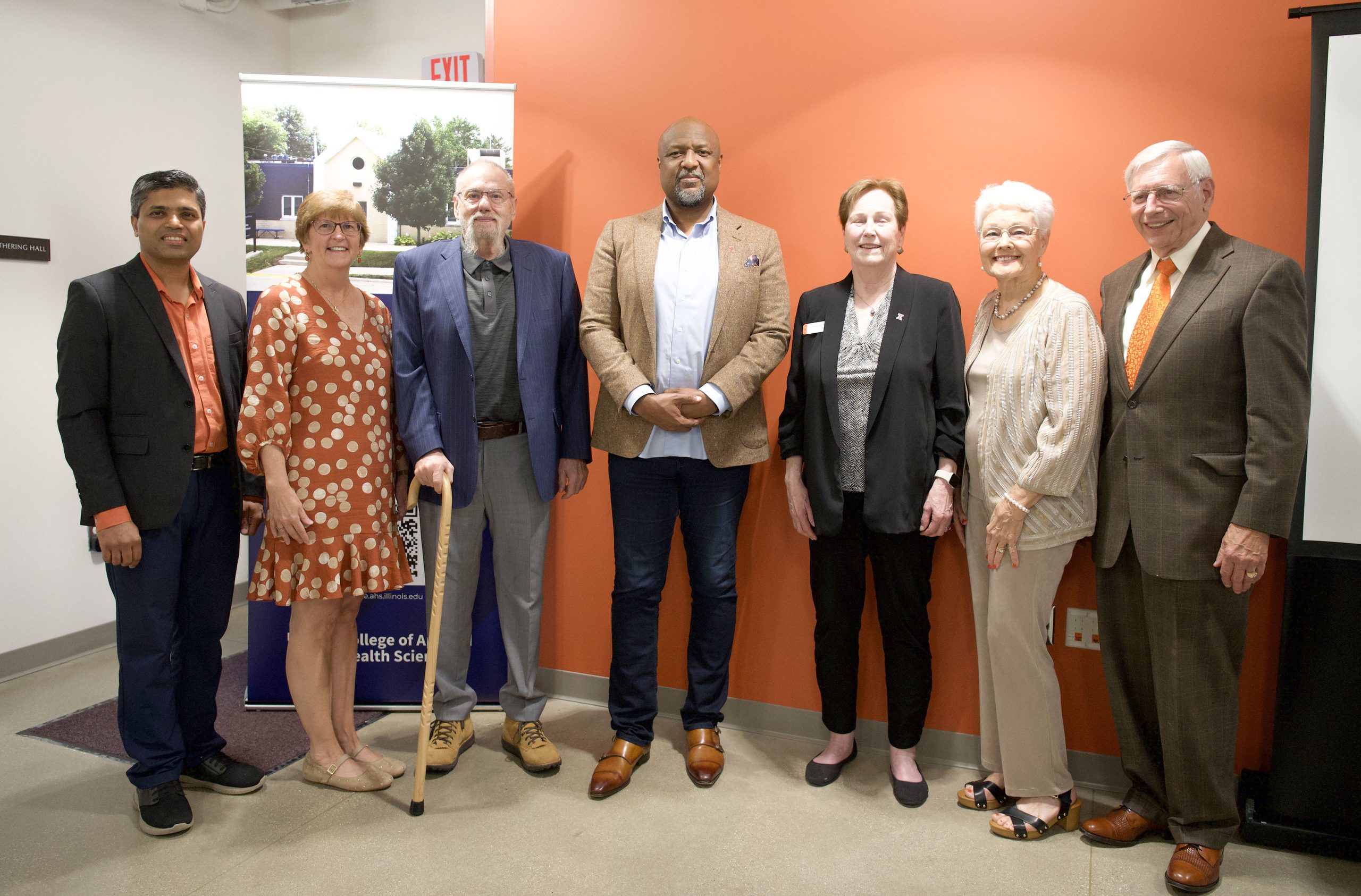
Dean Cheryl Hanley-Maxwell, left, stands with alumni award winners Michael Leach, Saul Morse and Walter Johnson. William Haskell was unable to attend the ceremony. (Photo by Jerry Thompson)
Young Alumni Award Michael Leach Recreation, Sport and Tourism
Michael Leach was appointed as the first-ever chief diversity and inclusion director for the White House in January of 2021. Leach, who earned his bachelor’s degree from RST in 2009, spent more than five years working for the National Football League on the NFL Management Council and later worked for the Chicago Bears and Miami Dolphins.
“I am truly humbled and honored to receive the 2023 Young Alumni Award from the University of Illinois at Urbana-Champaign,” Leach said. “My time in the College of Applied Health Sciences, and the institution more broadly, was nothing short of transformative.”
Harold Scharper Award Saul Morse Disability Resources and Educational Services
Saul Morse earned his bachelor’s degree (1969) and law degree (1972) at the University of Illinois and since has focused his practice on legislative matters, health law, insurance and municipal law. In 2010, with the passage of the Affordable Care Act, Morse was asked by the Illinois Department of Insurance to establish and manage an insurance pool for individuals with pre-existing health conditions.
“The Harold Scharper award is of great importance to me,” Morse said. “I came to the University of Illinois as a 17-year-old freshman. At the time, no other university in this country had a program which fully included students with a disability in all aspects of campus life, from academics to housing to activities. Most of what I have been able to do personally, professionally and within the broader community is due to the DRES program of the college.”
Distinguished Alumni Award William Haskell Kinesiology and Community Health
William Haskell is an internationally renowned researcher and emeritus professor of medicine at Stanford University. Haskell earned his Ph.D. in exercise physiology from the University of Illinois in 1966, and his work and achievements have clearly fulfilled the Illinois mission.
“It is truly an honor to receive the Distinguished Alumni award,” Haskell said. “Attending the University of Illinois at Urbana-Champaign offered me the opportunity to study and work with a large range of outstanding faculty and students, many of whom became exceptional leaders in exercise science research and teaching, as well as lifelong colleagues and friends.”
Walter Johnson Recreation, Sport and Tourism
Walt Johnson was born in Watseka, Ill., and graduated from the University of Illinois in 1958 with an undergraduate degree from the RST program. Later he entered the graduate program in RST and had the privilege of learning from both Professor Charles Brightbill and Dr. Alan Sapora. Upon graduation from the RST master’s program in 1962, Johnson moved immediately into a career in parks and recreation, where he served in a number of key leadership positions.
“The University of Illinois has always been the reason for my success and the lifestyle I live today,” Johnson said. “It gave me knowledge, hope and encouragement. Growing up on a farm and spending hours on a John Deere tractor since age 8, and milking cows, planting, cultivating and raising cattle and pigs, I determined I did not want to be a farmer.”
Stephanie Voss’s research at the College of Applied Health Sciences looks at how might yoga be used to manage lasting pain
Stephanie Voss, a kinesiology Ph.D. candidate, is a yogi and occupational therapist. Her research blends the two interests together. (Photo by Ethan Simmons)
To doctoral candidate Stephanie Voss, chronic pain treatment and yoga have more in common than we think.
Voss, now in her third year of a kinesiology Ph.D program at the University of Illinois, first came across the connection while working as an occupational therapist at the Shirley Ryan AbilityLab, a rehabilitation research hospital in Chicago.
While she consulted patients who were dealing with persistent, chronic pain, Voss was training to become a yoga instructor—an out-of-class hobby that helped her overcome her own studying-induced back pain.
“I couldn’t get over how similar the treatment approaches are,” Voss said. “Yoga is very much a holistic practice, and we address chronic pain in very much a similar way—it involves working as part of an interdisciplinary team on strength and muscle conditioning and posture and body mechanics. We also work on the psychological components, the emotional components and how we can integrate pain management strategies into daily life.”
Today, Voss’s research at the College of Applied Health Sciences merges the two: How might yoga be used to manage lasting pain?
This fall, she was named a recipient of the Paul D. Doolen Graduate Scholarship for the Study of Aging, an annual award given to two University of Illinois graduate students whose scholarly work advances research on the human aging process.
With the help of the Doolen scholarship, Voss will develop a yoga protocol that specifically targets interoception, or the ability to perceive and interpret the sensations within one’s own body, an ability which may fade as we age.
The project will explore whether yoga can improve older adults’ abilities detect and interpret feelings of pain and discomfort within their bodies.
“I found [the scholarship] relevant to my research because most of my patients are older adults,” she said. “Chronic pain is immensely prevalent in older adult populations for various reasons but interestingly older adults tend to not be included in pain trials as often.”
What the $4,250 scholarship gives her for now is “breathing room,” Voss said. “Being a grad student isn’t always easy from a financial standpoint, so having a little bit of extra support to free up my time and mental space, it’s one less thing to worry about.”
She’s very smart, and very personable. It’s just refreshing for somebody to have such a good perspective on the science of what she does, but to also be very respectful and willing to take criticism for what it’s worth.
Steve Petruzzello
Health and Kinesiology professor
Voss received her B.S. in Communication Sciences and Disorders from Northwestern University in 2014 and her M.S. in Occupational Therapy from Rush University in 2018.
She began at the University of Illinois in August 2021, working under former Illinois KCH Associate Professor Neha Gothe in Gothe’s Exercise Psychology Lab. Gothe was one of the only academics exploring the connection between yoga and pain management. Voss, then fully working as an occupational therapist, reached out to Gothe over email, expressing her desire to pursue a Ph.D. under her.
Since then, Voss has worked as a research assistant and teaching assistant, having instructed an introductory-level yoga class while periodically working with patients at the AbilityLab in Chicago. She recently taught the yoga intervention for one of Gothe’s research studies working with older adults.
“That got to really challenge my clinical and yoga teaching skills to integrate modifying postures for people who live in different bodies than mine,” Voss said. “It’s so immensely important that my research questions are rooted in the clinical needs of the patients. I want to make sure I’m still in touch with that population.”
When Gothe departed Illinois for Northeastern University in Boston, Voss decided to stay and finish the final stages of her Ph.D. program, with KCH Professor Steve Petruzzello stepping up as her on-site doctoral co-advisor.
“She’s very smart, and very personable,” said Petruzzello, who first met Voss while she made insightful comments in his class, KIN 443: Psychophysiology of Exercise & Sport. “It’s just refreshing for somebody to have such a good perspective on the science of what she does, but to also be very respectful and willing to take criticism for what it’s worth.”
Both her mentors described Voss as a methodical, talented researcher whose clinical experience has given her unique perspective and a deft ability to communicate scientific concepts to different audiences.
“She has an eye for translation and application of the research in clinical as well as real-life settings,” Gothe said. “Her years of yoga training and teaching also give her a unique advantage to work and communicate with her patients and research subjects.”
After her graduation, expected in spring 2025, Voss hopes to work in a hybrid clinical-academic position. In the meantime, Voss has seen great recruitment interest in her dissertation research, examining yoga as a strategy for chronic pain management.
“I do feel like I will be leaving with a degree that gives me a lot of opportunity and flexibility that I can teach in occupational therapy departments. I’ll be fully qualified for that, but I’ll also be fully qualified to teach in more traditional academic university-based settings that are not necessarily a clinical program,” Voss said.
Anyone who has been fortunate enough to work with Kim Graber should be thankful she wasn’t a very good cook.
Kim Graber was appointed as the Shahid and Ann Carlson Khan Professor in AHS on April 22 (Photo by Craig Pessman)
Graber, the head of the Department of Health and Kinesiology in the College of Applied Health Sciences, was appointed as the Shahid and Ann Carlson Khan Professor in AHS on April 22.
In a heartfelt ceremony attended by university leadership, colleagues, students and alumni, Graber was recognized for her outstanding contributions to research, education and service over a career spanning more than three decades.
Graber, who grew up in Barrington, Illinois, said she did not think about becoming a professor because, at that time, “Career opportunities for women were limited, and girls were taught to dream about a career in teaching, nursing, or secretarial work.”
So, when she started college at Valparaiso University, she began as a student in home economics.
“That, however, lasted only a year because I didn’t enjoy cooking and wasn’t very good at it, as my family will attest,” she said during her investiture ceremony.
The event was opened by Cheryl Hanley-Maxwell, dean of the College of Applied Health Sciences, who highlighted the significance of an endowed professorship.
“Endowed professorships enable us to recognize, reward and retain outstanding scholars whose work brings renown not only to them but also to the college and the university,” Hanley-Maxwell said.
Hanley-Maxwell emphasized that such honors are reserved for faculty members at the pinnacle of their fields, affirming Graber’s well-deserved recognition.
The investiture ceremony also paid tribute to Shahid and Ann Carlson Khan, whose philanthropy made the professorship possible. Hanley-Maxwell recounted the Khans’ inspiring journey from their days as University of Illinois students to becoming leading entrepreneurs and philanthropists. Shad Khan’s story, from washing dishes for $1.20 an hour to leading a multi-billion-dollar global enterprise, was shared as a testament to resilience, innovation and community spirit.
Today, the Khans’ support extends across the university, including significant contributions to the Krannert Center for the Performing Arts, the College of Business, the College of Veterinary Medicine and the Khan Annex to Huff Hall.
Following remarks from University Provost John Coleman, the ceremony turned its focus to Graber’s achievements. After Valparaiso, she transferred to the University of Iowa to study physical education, setting her on her current path.
Graber’s academic journey took her to Columbia University for a master’s degree in movement sciences, an experience she describes as “the best year of my life.”
Graber embraced New York and would have continued for her doctorate at Columbia if not for the fact that the university didn’t offer teaching assistantships, and the accumulation of debt. So, she pursued her doctorate at the University of Massachusetts at Amherst, developing a passion for understanding how individuals learn and socialize into teaching professions.
“It’s where I learned to understand research, write like a scholar and think like an academic,” she said.
It’s where I learned to understand research, write like a scholar and think like an academic.
Kim Graber
Shahid and Ann Carlson Khan Professor
Graber’s research, grounded in teacher socialization theory, has significantly influenced how scholars and practitioners view learning and professional development in education, particularly within physical education.
Graber’s work has been widely published in leading journals such as Teaching and Teacher Education, Research Quarterly for Exercise and Sport, Quest, and Kinesiology Review. She has been a leading voice in examining how undergraduate education shapes future educators, and her later work has expanded to issues such as legislative policy in schools, children’s wellness, curriculum design, and the demographics of teacher educators.
Beyond her research, Graber is a well-recognized as an educator and mentor. Her devotion to undergraduate education has earned her prestigious awards, including the University of Illinois’ Distinguished Teacher/Scholar Award and the college’s Phyllis J. Hill Award for Exemplary Mentoring.
She emphasized the joy of teaching, saying, “To play a small role in preparing individuals to make a better future for others is very satisfying.”
Her service contributions are equally significant. As department head of Health and Kinesiology, Graber assumed leadership just as the COVID-19 pandemic unfolded. Undeterred by unprecedented challenges, she spearheaded efforts to revitalize the department through strategic planning, curriculum redesign and faculty expansion. Under her leadership, the department saw a substantial decrease in the student-to-faculty ratio, bolstering its academic standing.
In her speech, Graber expressed profound thanks to Shahid and Ann Carlson Khan for their support, to her mentors and collaborators such as Tom Templin and Amy Woods, and to her colleagues, students and family. She also shared touching stories of the relationships that sustained her through her academic life, including the pivotal support of her mother, now 95 years old, whose wisdom and encouragement made her achievements possible.
“She and my dad are the reason I attended college,” Graber said. “It was a family expectation that has served me well. As she will tell you, I’ve always been fiercely independent and determined, and she had the wisdom to set me free. That freedom has led to a very rich life and fulfilling career. Thanks, mom.”
In closing, Graber thanked for Khans for their “many contributions to the greatness of the University of Illinois.
“You are role models for sharing your success with others, and that is no small feat. Thank you from the bottom of my heart.”
June 03, 2024 | Praachi Mudar, University High School
Praachi Mudar (in pink) said she enjoyed working with Wendy Rogers, center, and the LIFE Home team. (Photo provided)
Before this summer, whenever I thought of robots, I thought of the clunky Disney robot WALL-E and his mission to save mankind. I didn’t have any direct experience interacting with robots or the components involved, so my only point of reference was a kid’s movie. This summer Dr. Wendy Rogers and Dr. Harshal Mahajan gave me the opportunity to intern at the McKechnie Family LIFE Home. I spent my summer with social robots, assistive robots, home appliances, virtual reality and other technology that are used to help people’s daily lives, which completely changed my understanding of robots and technology.
One of my favorite parts of this experience was interacting with the social and therapeutic robots—Moxie, Jibo and Paro. I had engaging conversations with Moxie about celebrity book authors using her generative AI. In the game Circuit Saver, I saved Jibo’s motherboard, and in doing so, learned about its camera and motion sensors. I also experienced Paro’s calming effect when petting it. It was especially exciting to have the freedom to interact with the robots in ways that interested me, like getting to play games with them or talk about my own interests. It was incredible to not only learn about these robots’ capabilities but also see how they can assist people with daily tasks like grabbing pill bottles or talking to their family from miles away.
The most challenging part of this experience was coming into a space I had so little knowledge about. For the first few weeks I struggled to understand basics, like how to start up the robots and navigate the robots’ interfaces, but I was surrounded by patient and knowledgeable people who helped me understand and learn. By the end of the internship, I was knowledgeable about most if not all of the technology. I likely wouldn’t have enjoyed or learned as much if it hadn’t been for the support I got from Dr. Samuel Olatunji, my supervisor; Abbey Paik, an undergrad intern; and Yvona Vlach, the operations coordinator.
As I got more comfortable with the robots, I really enjoyed doing demonstrations and sharing information about the robots with people on tours. Almost all of the technology had an immense amount of research surrounding it. The research I learned about the most displayed the ways these robots can help people who face social isolation and older adults who need help with basic tasks. It was exciting to explore this growing field. Even more so, I enjoyed sharing this knowledge and explaining the research being conducted with these robots at the LIFE Home.
This summer has been an incredible opportunity that I am so grateful to have. It has genuinely made me more interested in the intersectionality of technology and applied health sciences.