External placements vital to students’ development


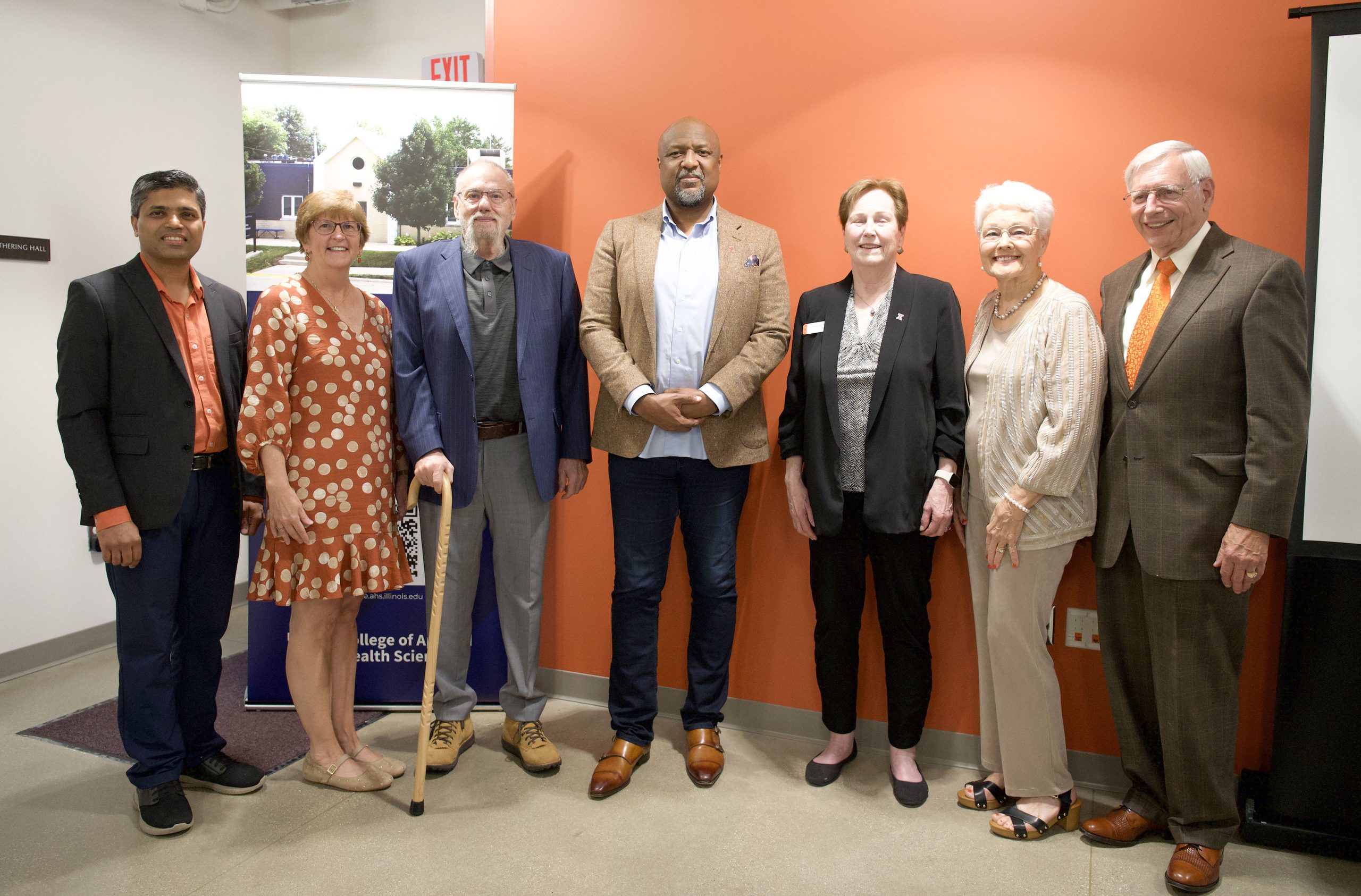
All SHS students are required to take part in external placements, which are essentially internships with an external organization (Photo by Brian Stauffer)

Students in the Department of Speech and Hearing Science in the College of Applied Health Sciences expect excellent instruction in the classroom. When they venture off campus, however, is when they get a better sense of the career paths they might choose.

All SHS students are required to take part in external placements, which are essentially internships with an external organization. For some students in the master’s program for Speech-Language Pathology, external placements might begin as early as their second semester, said Noa Hannah, director of the audiology and speech-language pathology clinic in SHS. On the audiology side, said Clinical Assistant Professor Sadie Braun, students are given external placements in the summer after their first year in the four-year program.

“I think that our external placements are really the first place that our students get a sense of what audiology is like in the real world,” Braun said. “I think that’s when a lot starts to gel between what they’re learning in their academic classes and what they’re doing in clinic—that starts to come together when they get to their external placements.”

Hannah, who joined the university in 2019 and became clinic director in 2020, agreed, calling external placements “pivotal.”

“They’re pivotal in their learning because there’s only so much we can teach within the clinic,” Hannah said. “Going out on these externals is about professionalism, but … it’s really about understanding different cultures—different cultures of schools, different cultures of hospitals, different supervisory styles than what we have here at the university. So it’s pivotal in their learning how to apply their skills to new patient populations as well as new environments.”

Braun said audiology students gain experience in environments that we just can’t simulate within the SHS clinic environment.

“For example, we send them to a hearing aid manufacturer to get experience with the manufacturer side of things, or to a private practice or a big hospital so they get to see different environments audiologists can practice in and figure out where they might want to start in their first job,” she said.

Hannah said external placements give students the opportunity to deal with different patient populations, such as patients with dementia or traumatic brain injuries, or patients who have had strokes.

Braun said the external placements also help students to increase their independence and competence in using their skills.

There are also benefits for the organizations, such as hospitals and clinics, in which the students are placed.

“I think a lot of professionals just appreciate having some input in shaping the future of our field,” Braun said. “And when we send our students who have more experience, like a third-year audiology student, sometimes they can utilize that student who can be more independent to get a little bit of extra work done themselves.”

Braun said the external placements can also be a job “pipeline,” as some students are hired right out of their fourth-year placements.

For some UIUC alumni, it is a chance to give back, Hannah said.

“I have heard that they want input into teaching the next generation and I think the other thing is, people like teaching. People like sharing their knowledge … a lot of professionals enjoy that part of their profession and maybe don’t get that opportunity as often as they would like. This is a way to give back to a program that’s helped them to be successful.”

Any organization that is willing to act as an external placement for students in the Department of Speech and Hearing Science is encouraged to email Noa Hannah.

Editor’s note:

To reach Vince Lara-Cinisomo, email vinlara@illinois.edu.
 

Related news

Aronoff’s R01 grant aimed at maximizing binaural benefits


Justin Aronoff’s study will provide insight into how the binaural auditory system combines signals from the two ears. (Photo provided)

Bilateral cochlear implants are used to provide hearing to both ears for deaf children and adults, as well as provide binaural hearing. But the benefits of bilateral implants can be hampered by poor integration of the devices’ left and right inputs. Thanks to an R01 grant, Department of Speech and Hearing Science associate professor Justin Aronoff has a plan to combat that.

Aronoff was awarded a $1.57 million grant from the National Institute on Deafness and Other Communication Disorders for his project “The contributions of interaurally correlated signals and interaurally symmetric place of stimulation for the binaural auditory system.” The proposed study will provide insight into how the binaural auditory system combines signals from the two ears and lay the groundwork for a shift in how and when clinicians program bilateral cochlear implant users’ devices to maximize binaural benefits.

Aronoff has just begun data collection, and recently gave a demonstration of some of the study’s testing, with research assistant Simin “Tina” Soleimanifar as the subject.

In Aronoff’s lab, Tina, who does not have a cochlear implant, sat next to a scope where she can see the signal that is coming out of a cochlear implant.

“The first thing that we need to do when we’re testing a cochlear implant patient is the same thing that you would do if you go into the (audiology) clinic,” Aronoff said. “And that’s basically setting what are the comfort and safety levels.”

As Aronoff explains, the simulations of cochlear implants are not really simulations of what it would sound like to cochlear implant users. “Most of them are just simulations of what it would sound like to only have 22 notes on your piano,” he said, “but everything has to be done on those 22 notes. That’s all you can hear. … (Renowned researcher) David Landsberger (said) listening with the cochlear implant is like playing the piano with a ping pong paddle.’ That you’re hitting a bunch of notes at once. And so if I turn off an electrode, that paddle gets a little wider for all the other notes. That’s the way to think about it.”

For Aronoff, the potential impact is deeply motivating. “Our ultimate aim is to improve speech perception in noise for cochlear implant users,” he said. “Being able to follow conversations in noisy environments is one of the biggest challenges they face, and we hope this technology can make a meaningful difference in their everyday lives.”

To understand what the signal from the cochlear implant actually is, you need to use a scope. Aronoff said the scope is connected to breakout boards, which allow him to tap the output from each electrode and put it on a scope and record it, to make sure the signal is what he thinks it is. Different devices have a different number of electrodes, Aronoff said. He was working with a cochlear device during this test run, which has 22 electrodes. During the test, he gradually increases the amount of stimulation until Tina can see something on the scope.

Aronoff compared the electrodes to shining a flashlight beam.

“As you walk away from a wall that you’re shining a flashlight beam on, the beam gets wider and wider. And these are fairly far away from the wall. What that means is if you have two flashlight beams right next to each other, they illuminate mostly the same spot on the wall. There’s a little difference on the edges, but they’re mostly overlapping. And that’s what’s happening as well with these electrodes. And so that’s why when you go from one electrode to the next, you’re stimulating most of the same neurons.”

One of the most important issues Aronoff hopes to tackle with this grant is about perception of interaural time differences (ITDs) and interaural level differences (ILDs), which limit the ability of bilateral cochlear implant users to localize sounds and understand speech in noisy environments.

“This is actually a big question of the grant,” he said. “We know for a pitch that it is very malleable. That over time whatever I tell you in your map, whichever electrodes get the same frequencies in the outside world will start sounding the same in terms of pitch. We don’t know if that’s true for ITDs and ILDs. That if the best electrodes paired together change over time or not. It definitely seems to be less malleable. We don’t know if it’s malleable at all. And that’s a big purpose of this grant, to see if that correlated input only affects the pitch that you hear, or if it’s affecting the entire auditory system.”

Another issue is that people who have two cochlear implants don’t always hear one coherent sound from the two ears. They will sometimes hear a left ear sound and a right ear sound, Aronoff said.

“If you’re listening over headphones and one of them is bad, the way to tell is you lift one up. You can’t be like, ‘Oh, I can hear it’s the left one that’s bad. You have to lift one up.’ That’s how well things fuse together into one perception. Now, for cochlear implant users, that’s often not the case. They often do not have things fusing together completely. And so that’s one thing that we look at. There’s big benefits to it.”

The benefit of having bilateral cochlear implants is more than just having a backup if one implant goes out, Aronoff said. They will allow you to hear better in noisy environments.

“If you’re listening to someone who’s across the table from you and there’s background noise, being able to spatially separate out where are the speakers from everyone else helps you. And having two ears gives you that ability. If you only have one ear, you cannot tell something’s coming from the left or the right. So two ears is really what you need. And most cochlear implant users can localize reasonably well. Not as good as normal hearing listeners, but reasonably well. So that’s a big benefit of having two ears as well. There’s other things in terms of when someone comes up on one side of you. If it’s on the side that doesn’t have a cochlear implant, you might not even know they’re talking to you. There’s a lot of benefits of having two instead of one.

Getting a good measure of fusion has been one of the more challenging aspects of the project, Aronoff said, since fusion is a central idea to the grant, and because everyone has a different idea of what fusion means.

“A lot of the other things are largely predicated on this idea that you hear it as a coherent sound,” he said. “You can’t localize a sound if it sounds like it’s coming from both ears. And so, yeah, fusion is very central to this grant. And so we have a lot of experiments where we are looking at that fusion and how different things affect it. “

Editor’s note:

To reach Vince Lara-Cinisomo, email vinlara@illinois.edu

Related news

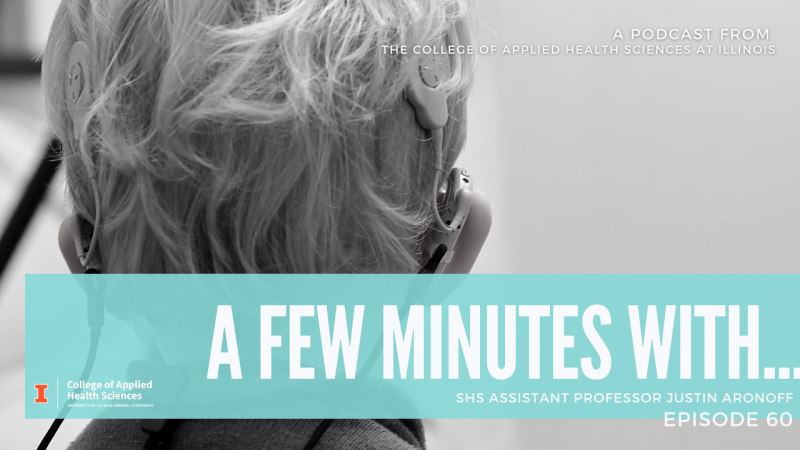
A Few Minutes With … Justin Aronoff


Transcript

VINCE LARA: Hi, and welcome to another edition of A Few Minutes With, the podcast that showcases Illinois College of Applied Health Sciences. I’m Vince Lara, and today I’m speaking with Justin Aronoff, an assistant professor in the Department of Speech and Hearing Science, about his research on the binaural auditory system as it relates to cochlear implants.

All right, Dr. Aronoff, thank you for joining me on this edition of the podcast. And commonly, I ask guests of the podcast about their inspirations for their research. So what made you look into auditory research? And you do primarily cochlear implants. So what made you look into that kind of research?

JUSTIN ARONOFF: So I kind of fell into this area. I was actually– I was having a bad experience at a postdoc. And there was another research position at the institute that I was at. And it was a hearing aid lab, primarily, that happened to have one cochlear implant project.

And I ended up on that project. So it’s a complete chance I ended up working a cochlear implant users at all. And I just fell in love with this field. I fell in love with the work. And it’s so rewarding to work with cochlear implant users.

One of the unique things about working with this patient population is that you tend to be individuals who come back to lab, you know, sometimes month after month for years. We’ll see them, and so we build up these relationships. It becomes very rewarding.

And it’s also a population that really values the research. So we do what is not necessarily the most exciting experiments to be in. We have people listen to beeps for five hours sometimes, which sounds very thrilling, I know. And I do sometimes ask them, look, I really appreciate that you’re coming in here and doing these incredibly boring experiments. I got to ask why, though. I appreciate it, but why are you doing it?

And what they often respond is they say, well, you know, I realize that what this device has done for me is a miracle. And I realize that the reason that it does what it does for me is because 20 years ago, there was someone sitting in a chair like this, listening to beeps for hours on end. And I really want to pay it forward. I really want to give to the next generation. And that type of sentiment is really kind of motivating to me, kept me really interested in continuing and working in this field.

VINCE LARA: Yeah, you kind of answered my next question, but I’ll ask it anyway. So you did your undergrad work in teaching, in the teaching of Spanish.

JUSTIN ARONOFF: Yes.

VINCE LARA: So then you followed with a masters in linguistics, which makes sense, right? You had these two– you had a pattern here. And then that led to Speech and Hearing Science. And that’s primarily because of how you felt about the population within that demographic, if you will?

JUSTIN ARONOFF: Well, I didn’t find cochlear implants until my postdoc.

VINCE LARA: OK.

JUSTIN ARONOFF: So my path was definitely fortuitous, to say the least. So when I was an undergrad here at U of I, in teaching Spanish, I did study abroad in Spain. And I took a linguistics course. And that got me very interested in linguistics.

And when I came back to campus, the only linguistics course that fit into my schedule was a neurolinguistic course by Molly Mack. And that really got me interested in the brain, and language, language acquisition. And so I went on and did my master’s in linguistics.

I was actually in the PhD program in linguistics at the University of Southern California. And as I got more and more interested into the neuro side of it, it felt like it didn’t quite fit into just the narrow range of neurologistics. I was interested in broader issues in neuroscience. And so I actually changed over into the neuroscience program to finish up my PhD.

And as I was doing that, I had the naive idea that, hey the auditory system seems like a fairly easy system to work with and to understand. But I was definitely a little naive at the time. And so that got me interested in working auditory work, and led to working at the House Ear Institute, and then eventually into doing postdoc there.

VINCE LARA: Mmhmm, now, Dr. Aronoff, for you listeners, recently received a seven-figure grant for a project that examines how the binary– binaural auditory system works. And so I’m curious, so the binaural system, for those of you who are uninitiated in this, is how the brain combines signals from our two ears. But I’m curious, why is that important?

JUSTIN ARONOFF: So having the ability to combine information from two ears can help in a lot of different situations. One of the big benefits is noisy environments. So typically, when you’re in a noisy environment– let’s say you’re at a restaurant– you’ve got the person you’re listening to is right in front of you but you’ve got all this background noise. You might have a table to side where those people are talking, you’re trying to tune them out.

The ability to basically attend to and separate out these spatially distinct sources of sound is dependent on the fact that you have two ears and that you can combine that information so it allows you to better focus on the person that you want to attend to, depending on wherever they are in space.

It’s also really important for localizing. So when you only have one ear, you really can’t tell if a sound is coming from the left or the right, especially if you don’t know what the volume is. There are some tricks you can use. But in general, most people are just very, very bad at being able to even tell the side that a sound is on when they only have one ear. Having two ears allows you to localize where the sound is.

You know, and also, patients also describe that having two ears makes the world seem fuller. It’s just this kind of qualitative sense to the world with two ears that you also don’t get having one ear alone.

VINCE LARA: Hmm. Your research is primarily focused on the importance of the study relative to cochlear implants. And–

JUSTIN ARONOFF: Yeah.

VINCE LARA: –the study states that you plan to maximize binaural benefits. And I wonder how you propose to do that.

JUSTIN ARONOFF: So one of the things that we found, my lab and other labs in this field, is that one of the big detriments in terms of getting those benefits from having two ears is when the information that you’re getting from the left and the right ear are mismatched.

And this can happen in a number of different ways. But the way that we see it happening with cochlear implants has to do with where the cochlear implant array is sitting, within the left or right cochlear, within the left and right ear, as well as what neurons are actually surviving in those two ears.

So it turns out that if you do not stimulate the same places, the same relative neurons in the left or the right ear, your ability to localize or ability to use these binaural cues and these cues that you get from having two ears decreases quite a lot.

Now, we know that there are potentially some mechanisms that can help you with that. There’s some ability to adapt. And our lab and other labs have looked at the ability to adapt to this mismatch between the two ears. It’s not clear how limited that is. We know you can do it in terms of the perception of what sounds like the same pitch in the two ears. Whether or not that translates to other things or not is not clear yet.

And really, what we’re trying to understand is how does that adaptation affect your ability? How do we need to change how we program these devices? When do we need to change? So if adaptation can handle a lot, maybe we can wait. If adaptation cannot handle a lot, then we need to start reprogramming very early on when you first get these devices.

And so we’re trying to look at kind of how do you manipulate where the stimulation is, how do you manipulate how similar the stimulation is in the two ears in order to improve those binaural benefits.

VINCE LARA: You helped develop a test that measures spectral resolution. And I’m wondering– two questions– what’s spectral resolution? And what’s the test?

JUSTIN ARONOFF: So spectral resolution is basically your ability to tell that two notes that you’re playing on the piano are not the same note. So people who have poor spectral resolution basically are not going to be able to tell that two notes that are roughly two notes apart are actually not the same note. And this is a common problem that we see with cochlear implant users.

And the reason that this is important is because it turns out that your ability to understand speech in a noisy environment really relates, in part, to your spectral resolution. And that’s something that we know that is a problem for cochlear implant users, as well as other patient populations.

So this is a test that I co-developed with David Landsberger when we were both at the House Ear Institute. And basically, this is a spectral-temporally modulated ripple test, or the SMRT. We’ve since modified it to create a version that can be used in the clinics as well, that’s the SMRT Lite for computeRless Measurement or SLRM. And basically what these measures are, they sound a lot like 1980s arcade sounds.

VINCE LARA: Hmm.

JUSTIN ARONOFF: And basically, it’s a fairly easy test. You just need to tell which sound is different, all right? And so you’ll hear three sounds that kind of sound– it’s kind of Space Invaders-y sound. And you’re trying to tell what’s [? different. ?] We’re manipulating, and there is some of the spectral properties, basically how close together these little ripples that we have across the spectrum, how close together they are and whether you can tell that one of them is closer than the other two.

VINCE LARA: Hmm.

JUSTIN ARONOFF: So it’s a fairly easy test for people to do. We’re not asking them to do anything but tell which one is different. And what’s nice about it is it turns out that it correlates well with speech perception in quiet as well as in noise. We’ve found that other labs around the world have found that as well.

So it turns out to be a nice kind of proxy test. Why the clinics have gotten interested in this is because one of the big problems that a lot of clinics have– I work with UIC in Chicago, for instance– is that they’ll often have patient populations that speak a wide range of languages, where English is not the native language. And when English is not your native language, testing someone on speech perception in English can be problematic because you don’t know if the problem is an auditory problem or if it’s a language problem.

VINCE LARA: Mmhmm.

JUSTIN ARONOFF: And so what’s nice about this test is that it’s a non-linguistic test. It doesn’t depend on languages. These are, like I said, kind of arcade-type sounds. There’s no linguistic content. But it does predict language performance.

VINCE LARA: Using your master’s in linguistics there, I would imagine.

JUSTIN ARONOFF: Yeah.

VINCE LARA: Yes. You know, you’re at an R1 university. And with that, your time is often dominated by research here at the University of Illinois. But teaching is a part of your responsibilities as well. And so I’m wondering what’s your favorite course to teach?

JUSTIN ARONOFF: That is a hard question. It’s hard to choose one, for sure. I really do enjoy teaching. And obviously, I got my degree in teaching. And I’m a licensed teacher in the state of Illinois. I come from a family of teachers. So it’s something I’m very passionate about.

If pressed, I would have to say it’s probably SHS280, Communication Neuroscience. It’s something that’s in that area where I got my PhD. I’m definitely very passionate about neuroscience. I really liked the large undergrad classes. I like those classes where this might be their first exposure to the area and you can really see the growth and the coming in really knowing next to nothing about the topic area, and then leaving. You can see kind of the growth of balance that they come out with.

So it’s a really rewarding class. And it’s just a fun class.

VINCE LARA: My thanks to Justin Aronoff. For more podcasts on Illinois College of Applied Health Sciences, search A Few Minutes With on iTunes, Spotify, iHeart Radio, radio.com, and other places you get your podcasts fix Thanks for listening, and see you next time.

Editor’s note:

To reach Vince Lara-Cinisomo, email vinlara@illinois.edu.
 

Share on social

Related news

SHS rising junior Mia Mangialardi discusses her internship


Q: What was your experience with The Autism Program?

A: The Autism Program is a resource for individuals with autism and their families to gain support through networks of people. I worked in the resource room twice a week and also took a zoom class once a week that trained me to become a Registered Behavior Technician. At the resource room I would assist teachers, social workers and parents with any questions they had and directed them to specific books, pamphlets and hand outs. I also created devices for students on the spectrum to use such as Picture Exchange Communication Systems, personalized schedules and social stories.

Q: How did you apply for the internship?

A: After receiving an email from my advisor about a potential internship opportunity, I filled out an application that included my resume and letters of recommendation and emailed it to The Autism Program.

Q: What did you learn from the internship?

A: Through the years I have done a lot of hands on work with students with special needs. This internship really allowed me to work behind the scenes and see how the resources that aid communication are made and the purpose behind them.

Q: What was your biggest takeaway from the experience?

A: My biggest take away from this experience is that there is so much to learn from people who have Autism and their support systems. I had the amazing opportunity to get to know my supervisors, fellow interns, and different visitors that came in and each and every one of them gave me valuable information that I will be able to use in my career path.

Q: Is this internship closely related to the field you are hoping to work in?

A: My major is Speech and Hearing Sciences with a concentration in Speech Language Pathology. I have always wanted to work with individuals on the spectrum and this internship definitely taught me so much more about how to help and work with these individuals.

Q: Would you like to share any other information that might be helpful for future SHS students?

A: I suggest to try and get as much experience in different fields as possible! Just because a research, job or internship opportunity isn’t exactly what you will be doing in the future does not mean that it will not be beneficial in a multitude of ways.

Editor’s note:

To reach Vince Lara-Cinisomo, email vinlara@illinois.edu.
 

Share on social

Related news

SHS rising senior Jenna Pryor talks about her internship


Q: What was your experience with The Autism Program? 

A: I had many different experiences with The Autism Program, which is why I enjoyed it so much! We had observation hours watching an RBT interact with one of their clients. I also had hands-on experience working in the resource room making projects, communicating with other interns/clients, meeting new people, restocking the resource room and so much more! There was some slight research, we had to watch around 40 hours of training videos, those videos presented a great deal of information and expanded my knowledge for the internship and in general.

Q: How did you apply for the internship?

A: I initially heard about the internship through email from my consular. In the email, the application was attached. The instructions stated to fill out the application and then email it to the woman who conducts the interviews, Anne Hall. Later on I had an interview and then got offered the internship!

Q: What did you learn from the internship?

A: There are so many things that I have learned from this internship. I learned how to use different tools such as a laminator, different computer softwares, navigating a library database, answering phone calls, and creating books/stories. I also learned more about professionalism. Being in a resource room and interacting with different clients, interns, and coworkers in that setting gave me a better idea of how to behave as a professional. I also learned how amazing it is to step out of your comfort zone. I am not the most creative person, but I created and designed many different stories. It was great to work on my weaknesses and complete certain tasks that I do not have much experience on.

Q: What was your biggest take away from the experience?

A: My biggest takeaway from this experience is to give you all into everything that you do. I love helping and assisting others, and I got to use this strength of mine for many situations in this internship. It is important to give your all because not only are students/teachers/peers/parents/etc. using the resources that you make for them, a lot of individuals and families are counting on them. I’ve ran into situations where parents feel lost and need a sense of direction for their child. A diagnosis of autism for a parent who has a child with autism or the individual who has autism can be very overwhelming. I feel that The Autism Program helps ease the stress for these families. It is important to go above and beyond for all who come to us for resources/help.

Q: Is this internship closely related to the field you are hoping to work in? 

A: Yes, this internship is closely related to the field I am hoping to work with. I am a speech and hearing science student with a speech-language pathology concentration. When I saw the RBT interact with the child during my observation sessions, this is a similar situation I could be experiencing in the future. Children who have autism also tend to see speech-language pathologists, it was great to learn more about autism. It will help me for my future career getting to know more about different disorders, as they could be my potential future clients.

Q: Would you like to share any other information that might be helpful for future SHS students?

A: If you have any opportunity to apply to an internship or get hands-on experience, do it! These are eye-opening experiences that help you expand your knowledge greatly. It also builds character and puts you in different situations. I have grown academically and emotionally from my first internship. These are experiences that you don’t get from your courses! Be sure to get to know your professors and utilize office hours. Building a relationship with your professors is very important. Professors love when students reach out for help or when students want to get to know them.

Editor’s note:

To reach Vince Lara-Cinisomo, email vinlara@illinois.edu.
 

Share on social

Related news

SHS alum Anjali Forber-Pratt named director of NIDILRR


SHS alum Anjali Forber-Pratt named director of the National Institute on Disability, Independent Living and Rehabilitation Research

Anjali Forber-Pratt, who earned her bachelor’s and master’s degrees from the Department of Speech and Hearing Science in the College of Applied Health Sciences at the University of Illinois, has been named as director of the National Institute on Disability, Independent Living and Rehabilitation Research (NIDILRR).

Forber-Pratt, most recently an assistant professor at Vanderbilt University, is an elite wheelchair racer, having won two bronze medals at the 2008 Summer Paralympic Games in Beijing, China. She also represented Team USA in London at the 2012 Paralympic Games.

Her research is focused on disability identity, inclusion, disability sport, and work related to disability activism. Forber-Pratt holds a B.S. in Speech and Hearing Sciences, an M.A. in Speech-Language Pathology, and a Ph.D. in Human Resource Development, all from the University of Illinois Urbana-Champaign.

A two-time Paralympian and medalist in the sport of wheelchair racing, Dr. Forber-Pratt has dedicated her life to helping others recognize their potential. Globally, she is involved with disability advocacy efforts related to access to employment, education and sports. She was honored with the inaugural American Psychological Association Citizen Psychologist Award for Advancing Disability as a Human Rights and Social Justice Issue Award in 2020 and was recognized by Diverse: Issues in Higher Education as a 2018 Emerging Scholar. In 2013, she was awarded the American Association of People with Disabilities’ prestigious Paul G. Hearne Leadership Award, given to emerging leaders within the national disability community. Also in 2013, she was named a Champion of Change by the White House and had an opportunity to participate in a roundtable discussion with President Obama about disability policy issues.

“I am extremely honored and humbled by this appointment as well as the opportunity to serve our country,” Forber-Pratt said in a statement. “From my U of I days, I distinctly remember being explicitly taught that we had an obligation as alums to make the world a better place and to be ambassadors, especially for the broader disability community. Dr. Timothy Nugent taught us that, and my coach Adam Bleakney and others reinforced that every day—it was always more than just our athletic journey or just our academic journey. Many of us have found our own unique ways to embody that—I believe serving as Director of the National Institute of Disability, Independent Living and Rehabilitation Research is one way that I will continue to try to serve the broader disability community and educate others. I believe my collective training—with two degrees in Speech & Hearing Sciences as well as my PhD in education that taught me the analytic research skills—it truly is the combination of these degrees and U of I experiences and my own lived experiences as a proud disabled alum that position me well to transition into this role.”

Forber-Pratt served as principal investigator for research projects covering a range of disability issues, including training of special education teachers, experiences of students with disabilities at every education level, and identity development. She has authored 33 peer-reviewed journal articles and is the author or co-author of a number of textbook chapters.

Editor’s note:

To reach Vince Lara-Cinisomo, email vinlara@illinois.edu.
 

Share on social

Related news

Paceley receives award for excellence in graduate contacts


Andrea Paceley is ‘indispensable,’ according to nominators. (Photo by Jerry Thompson)

The Graduate College in February announced that Andrea Paceley (Office Manager, Speech and Hearing Science) was named a winner of the 2024 Graduate College Excellence Award for Graduate Contacts. The award is given annually as part of the Graduate College’s Annual Workshop for Directors of Graduate Study and Graduate Contacts. It recognizes staff members whose service has exceeded expectations in enhancing graduate students’ experiences and has positively impacted their graduate program or department’s operations.

Paceley has served as the Office Manager in Speech and Hearing Science for more than eight years. Nominators named her an “indispensable” part of the department for her streamlining of processes, commitment to transparency and “contagious cheerfulness.” One nominator said that Andrea “has demonstrated sustained excellence in support of our graduate programs, students, and faculty.” A graduate student in Speech and Hearing Science added that “her skills, kindness, and ability to navigate challenges with grace set her apart as a truly exceptional graduate secretary.”

Graduate Contacts are essential to the success of our graduate students. They welcome students into our campus community, provide valuable support through both the good and challenging times, and celebrate students’ accomplishments. The care and compassion that Graduate Contacts demonstrate every day are an invaluable contribution to the university and its community of students, faculty, and staff. The Graduate College extends its thanks to all of our Graduate Contacts for their work in our campus community.

Related news

SHS grad student Emma Boat talks about her program, campus and COVID


Q: Why did you pick SHS?

A: I chose Speech and Hearing Sciences because I love to use communication to connect with people. I want to help people who struggle to communicate to build their speech and language skills so they too can make connections and express their wants and needs.

Q: Which professors had the most impact on you?

A: Every single one of the SHS professors made an impact on me. I feel like I’ve learned from some of the most knowledgeable, passionate people in the field and I’m so grateful for every class. Jennifer Dahman has made a huge impact on me. She has so much passion and love for the field, and she finds a way to make even the driest topics meaningful. If I ever had a day when I was feeling uninspired, a class or client with Jen would always remind me of why I chose speech pathology.

Q: What course did you most enjoy?

A: My favorite course was probably Cognitive Communication Disorders, taught by Dr. Raksha Mudar. The topics were interesting, the class was discussion-based and engaging, and Dr. Mudar is so intelligent and shared so much valuable knowledge and insight with us.

Q: Did you enter SHS knowing your career path, or did SHS help you decide?

A: I came into SHS knowing I want to be a Speech-Language Pathologist, but my experiences in SHS, both within the classroom and in different clinical settings, exposed me to the diverse settings and roles within the field. All these experiences helped me learn what I’m most passionate about and where I want to take my career.

Q: What do you hope to do after you graduate?

A: I hope to work with kids in a private practice or school setting in Chicago.

Q: What was your favorite on-campus experience?

A: Right before COVID, my roommate and I went to a basketball game against Maryland. It was such a blast feeling the energy and cheering on the Illini, and it really made us feel like a part of the university!

Q: What do you miss most because of the pandemic?

A: The thing I miss most is being in class with my cohort. We are a small cohort of about 30 students, so we all became really close before the pandemic. We all would’ve loved to have one more class together in-person before graduation, but I’m thankful for the time we had before the pandemic.

Q: What are the biggest changes on campus, pre and post-COVID?

A: Before COVID, campus was always lively and energetic. People were always out and the energy was so fun. Immediately after COVID, campus lost that energy and became more isolated. Slowly but surely, campus has returned to its pre-COVID state.

Q: What would you say to recommend SHS to a prospective student?

A: When I entered the SHS department, I was coming from a different school and didn’t know anyone in the department. I immediately felt welcomed by the faculty and my new classmates. After just a few weeks, I felt comfortable and supported. In SHS, we all have different interests and goals, but with a shared love of speech and language. It’s a community of kind, open-minded, passionate people, so it’s been a special experience. I would highly recommend SHS to anyone who’s open-minded, ready to work hard and learn, and is interested in the field.

Editor’s note:

To reach Vince Lara-Cinisomo, email vinlara@illinois.edu.
 

Share on social

Related news

Alumni Spotlight—Eric Seper


Q: Why did you pick AHS?

A: I chose AHS because I knew I wanted to be in a healthcare field. The college has a family-like aspect, which was very welcoming. As I began my AHS coursework, I learned that the school was tight-knit and filled with bright individuals working towards a common goal.

Q: Which professors had the most impact on you?

A: Could I say all of them?! My first class in the department was an introduction to communication disorders and was taught by Dr. David Gooler. His teaching style resonated with me and many of my classmates. Dr. Gooler co-chaired my doctoral capstone project along with another influential professor—Dr. Ron Chambers. Dr. Chambers was available to speak with me as I decided upon a doctoral program in Audiology. He helped make the transition into graduate school easy and less intimidating than I anticipated. Our clinical supervisors—Lou Chambers and Carol Parker—taught me countless clinical lessons that I still employ today!

Q: What course did you most enjoy?

A: I completed two semesters of American Sign Language in the department and wish I had started sooner so I could complete the third course while an undergraduate. The instructors were thoughtful and great at understanding what each student needed to work on. Learning another language is powerful, especially when you are able to use that language to communicate with others in everyday situations.

Q: Did you enter AHS knowing your career path, or did AHS help you decide?

A: I entered AHS with the intention of learning more about speech-language pathology and audiology—AHS helped me decide from there. My first course introduced various communication disorders from both fields. Once the audiology portion began, I immediately knew that this was what I wanted to pursue long-term.

Q: Did your AHS experience lead to your current job?

A: Yes! AHS helped craft my professional experience in multiple ways. I developed strong clinical skills under the clinical leadership on campus. I still employ many lessons in the professional clinic today. The smaller, family-like atmosphere in AHS helped make me more comfortable with public speaking; the doctoral capstone project was a major learning process. That project allowed me to feel more comfortable in a research-based position where I authored and co-authored peer-reviewed journal articles. I also felt much more confident speaking at conferences following my experiences in AHS.

Q: What is your current job?

A: I am currently a clinical audiologist at the University of Chicago Medicine. I see mostly adult patients and we are fortunate to offer diagnostic audiology, cochlear implant services, vestibular evaluations, and hearing aid services to our patients. Seeing all these different disciplines—sometimes all in the same day—is a thrill. I am extremely fortunate to work alongside a tremendously skilled team of audiologists, physicians, and speech-language pathologists.

Q: What was your favorite on-campus experience?

A: If I need to pick only one, then graduating from the Doctor of Audiology program was a special day. Everybody graduating (from all programs) put in an amazing amount of work to develop skills and understanding in a particular field. For my Audiology classmates and I, we spent eight years honing our skills. Our hard work was rewarded with degrees and the trust that we will be strong practitioners in the field.

Q: What would you say to recommend AHS to a prospective student?

A: AHS is dedicated towards making sure students feel comfortable in the college. They are interested in developing strong students, but also strong societal contributors. I highly recommend AHS!

Editor’s note:

To reach Vince Lara-Cinisomo, email vinlara@illinois.edu.
 

Related news

A Few Minutes With … Dan Fogerty


Editor’s note:

To reach Vince Lara-Cinisomo, email vinlara@illinois.edu.
 

Transcript

VINCE LARA: Hi, and welcome to another edition of A Few Minutes With, the podcast that showcases Illinois College of Applied Health Sciences. I’m Vince Lara and today I’m speaking with SHS associate Professor Dan Fogerty about why he chose Illinois, teaching during a pandemic, and his research on the interaction between speech and noise. Dan, Thanks for being on the podcast. I appreciate it. You’re a Wisconsin guy, but what led you to teach at the University of Illinois?

DAN FOGERTY: I think it can be summarized in probably one word here, and that’s opportunity. Illinois has a long history of excellence in speech and hearing research and teaching and that tradition continues today. I see Illinois as a place where I can grow my research program.

I can attract high quality students and interact with them, as well as interact with experts who share related interests. Both within the departments and across campus. And so I think there’s a real collaborative atmosphere here at Illinois that I think is both important and rewarding.

VINCE LARA: Dan, did you always want to teach?

DAN FOGERTY: So I started out my career as a speech language pathologist. So the clinician who was focused in helping people attain functional skills for communication. And in many ways therapy is a form of teaching, although at the time I certainly didn’t think of myself directly as a teacher. The times that I felt most successful when I think back, are when I’ve helped someone overcome a challenge that they’ve had and in order to do something that they value. It has often been in the form of helping someone gain knowledge or skills to help them do something. And this happens both inside and outside the classroom where I have the opportunity to do just that.

So I think I am doing exactly what I’ve always wanted to do but I didn’t always know what to call it, what career to find it in, or even if I should call it teaching, but it certainly is.

VINCE LARA: What’s teaching been like in a pandemic? What sort of challenges have you experienced?

DAN FOGERTY: I’ve been teaching for a number of years and one of the things that I miss the most is the classroom environment. There’s an energy in the classroom where students are working together to solve problems. And while many of those activities or learning objectives can be translated to an online environment, for me, it’s been difficult to create and feel a sense of community. But on the other hand, the pandemic has really forced an opportunity to be creative about teaching. To re-evaluate things that I’ve done before, to seek out resources and how I can do things better. So through this process I’ve learned a lot. And I think that many of those tools and resources that have been discovered or created during this time was will still stay around and can still be used to enhance interactivity and engagement of courses, both online and in person in the future.

VINCE LARA: Commonly Dan, I find when I do these interviews, researchers had some sort of experience that they’ve had that inspires their research and I’m wondering what that was for you.

DAN FOGERTY: There have been the experiences that I’ve experienced both as a clinician and really just as an individual with members of my own family, where people have difficulty hearing. That poses significant challenges for them to participate in the life of others.

And this is a very common problem. So nearly one in three people between 65 and 75 have hearing loss. If you go over 75, half of individuals have hearing loss. And that hearing losses associated with cognitive decline later in life as well.

The good news is that hearing loss is also one of the largest modifiable factors for preventing dementia. Modifiable means that we can do something about it. We have the knowledge and the tools now to improve communication and cognitive function later in life. It involves protecting our hearing and it involves using appropriate hearing devices like hearing aids.

And in addition to just hearing loss, made listening environments are complex, they’re challenging. Think about going to a restaurant but there’s a lot of noise, or even trying to type at the TV on in the background. Listening in noisy environments presents even more challenges. Particularly, to those who have hearing loss, but really for anyone, even those who don’t.

Anyone can have difficulty with communication. And so what inspires me is that there is a real opportunity here. An opportunity to address a problem that so many people have difficulty with, to improve our ability to communicate with each other, to prevent cognitive decline. Communication is really central to our human experience and we can do something to increase access to that.

VINCE LARA: My background is communications, and so often in communications we talk about separating the noise from the message in order to facilitate communication. Is that similar to your research on interactions between speech and noise?

DAN FOGERTY: I think this is an interesting comparison. So we can think about noise really coming in two different types. We can think about noise as a purely acoustic signal. So you can think about road noise or the roar of a lawnmower or a hairdryer. And in the presence of that noise it can be hard to understand speech because these noises in the background mask the speech. They cover it up.

But in many cases, the noise that we hear can have its own meaning as well. So let’s say we’re in a lecture hall and we’re trying to listen to someone present but there are a couple of people in the back who are talking. In that context, we can think of that background speeches and noise that covers up what we’re trying to listen to, the presenter. But the people in the back of the room are also communicating real meaningful information.

And so we can also have competition from that meaningful information. So this is a sensory task, listening to speech that is partially masked by some other signal. But it’s also a cognitive task, one where we’re trying to find the message and separated out from competing sources of information. And I think it’s that latter task that we can really draw some parallels here.

So how do you hear the message you are trying to find when there are so many other sources of information that can be competing for your attention.

VINCE LARA: Part of your research looks at factors that predict how people perform in noisy conditions. And I’m wondering, what does that entail?

DAN FOGERTY: So it entails these sensory abilities. The ability to detect, to process sound, to detect moments in time when the intended speech pops out above the background noise. But it also entails certain cognitive and linguistic abilities. So this can be the ability to attend the message, to inhibit competing messages, to hold information in memory, and be able to use that information to facilitate future understanding and processing.

And these abilities can also interact with our previous experiences and skilled language as well.

VINCE LARA: Dan at an R1 university, research is always going on. You always have that next project you’re working on while you’re working on projects that are currently in front of you. So what’s next in your research pipeline?

DAN FOGERTY: So we already know a lot about the types of conditions that make it difficult for us to understand speech, and general principles that we can employ to improve understanding for groups of listeners. But people can have challenges understanding speech for different reasons and therefore, they can make different errors in understanding the message. And those errors have real consequences in terms of the actions someone might take.

So you can think about someone misunderstanding health information from their doctor. So I’m interested in identifying not just if someone is having difficulty, but why they’re having difficulty. How it might be different from someone else who might have the same level of performance, in terms of understanding it but they’re having different errors, different underlying sources that are resulting in that difficulty.

And this can lead to potentially different consequences for the individual. So I want to be able to characterize those individual differences and really look at what we can do to intervene on an individual level to maximize speech understanding.

VINCE LARA: My Thanks to Dan Fogarty. For more podcasts on Illinois College of Applied Health Sciences, search A Few Minutes With on iTunes, Spotify, iHeart Radio, radio.com and other places you get your podcast fix. Thanks for listening, and see you next time.
Share on social

Related news

College of Applied Health Sciences
110 Huff Hall
1206 South 4th Street
Champaign, IL 61820
(217) 333-2131