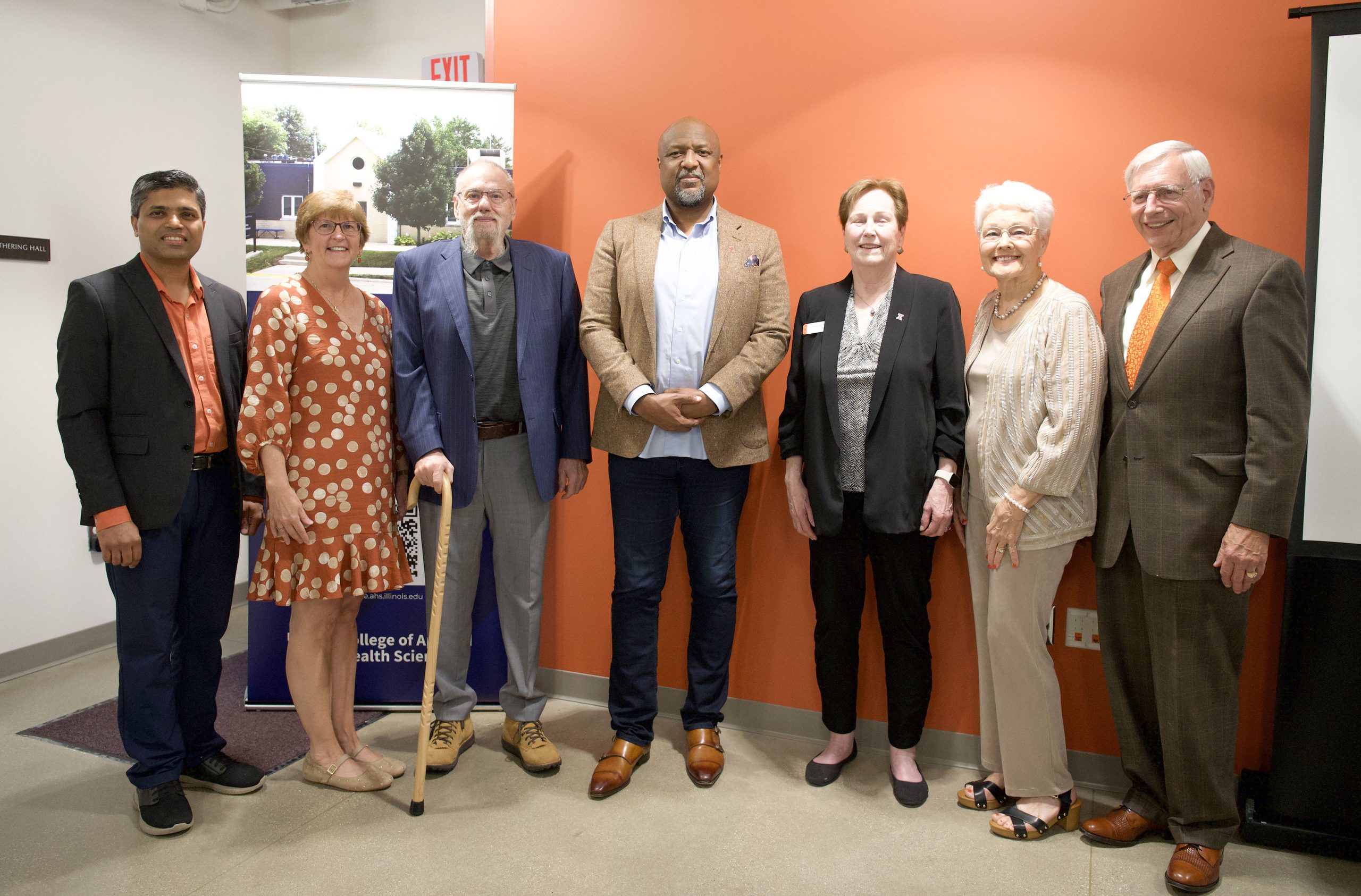
Here are the 2024 College of Applied Health Sciences and Campus award winners. The awards were presented at the Spring College Meeting on May 2. Congratulations to all of our colleagues on this outstanding achievement.
AHS Excellence in Undergraduate Teaching Award–Faculty Instructor Robyn Deterding Recreation, Sport and Tourism
AHS Excellence in Undergraduate Teaching Award–Teaching Assistant Graduate Teaching Assistant Emily Harrington Speech and Hearing Science
AHS Excellence in Guiding Undergraduate Research Award Associate Professor Brian Monson Speech and Hearing Science
AHS Excellence in Online Teaching Award Instructor Susan Dramin-Weiss Speech and Hearing Science
AHS Excellence in Graduate and Professional Teaching Award Associate Professor Naiman Khan Health and Kinesiology
AHS Excellence in Graduate Student Mentoring Award Assistant Professor Susan Aguiñaga Health and Kinesiology
Phyllis J. Hill Faculty Award for Exemplary Mentoring Associate Professor Laura Mattie Speech and Hearing Science
AHS Staff Excellence Award Assistant Director of Finance & Administration Mary Jones Health and Kinesiology
AHS Excellence in Undergraduate Advising Award Community Health Academic Advisor Hollie Heintz
Inclusive Leadership, Diversity, Service, and Excellence in Outreach Award Graduate Student Kaley Graves Speech and Hearing Science
Inclusive Leadership, Diversity, Service, and Excellence in Outreach Award Undergraduate Student Monserrat Ponce Health and Kinesiology
Campus Award Winners
Excellence in Undergraduate Teaching Award (Faculty)—Robyn Deterding
Excellence in Undergraduate Teaching Award (Teaching Assistant)—Emily Harrington
Excellence in Online Teaching Award—Susan Dramin-Weiss
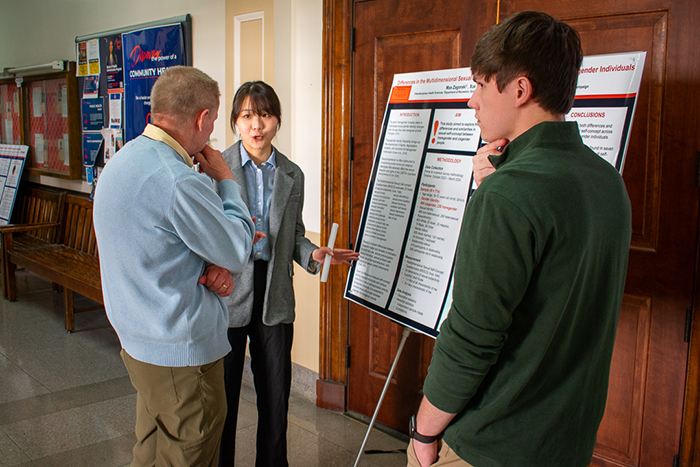
Budding student researchers at the College of Applied Health Sciences presented on a diverse range of topics.
Kinesiology juniors Elizabeth Martinez (center) and Aubrey Cervantes (left) present their research at the AHS Undergrad Research Expo on April 24, 2024. (Photo: Ethan Simmons)
For a freshman at the College of Applied Health Sciences, Saiesha Bollapragada’s research portfolio is impressive.
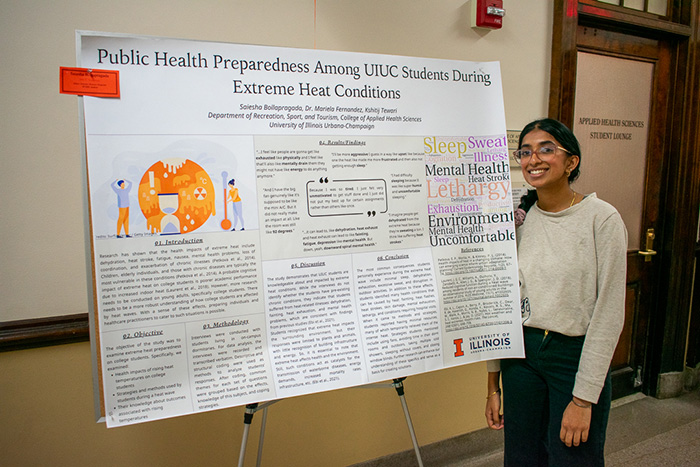
At last week’s Undergraduate Research Symposium, the I-Health major got to present the results from her first research project, “Public Health Preparedness Among UIUC Students During Extreme Heat Conditions,” where she examined students’ awareness and handling of severe heat in the spring semester.
She completed her study with a push from Students Pursuing Applications, Research and Knowledge, or SPARK, an AHS program that jump-starts incoming undergraduate students research experiences by pairing them with professors in the college. Bollapragada was placed with Recreation, Sport, and Tourism Associate Professor Mariela Fernandez, whose experience with urban environmental injustices fit her research topic perfectly.
“Professor Fernandez motivated me to start this project on my own,” Bollapragada said. “There’s a lot more reading involved than I thought there was, it was a lot of work preparing for the symposium, but if it’s something you’re interested in it’s a fun process.”
Students, faculty and staff got a taste of the findings from AHS’ budding student researchers during the AHS Undergraduate Research Expo at Huff Hall on Wednesday, April 24, where a roster of undergraduates gave poster presentations on a diverse range of research topics.
Many students spearheaded their own research projects with significant support and guidance from faculty and graduate students. Others, like a group of Speech and Hearing Science students from the Intellectual DisAbilities Communication Lab led by Associate Professor Marie Moore Channell, provided updates on long-range research projects they’ve assisted with on campus.
Three SHS seniors, Emma Mueller, Abigail Keasler and Liz Gremer, presented initial findings from their glimpse into the Speech Accessibility Project, an ongoing research endeavor looking to make voice recognition software—such as Apple’s Siri or Amazon’s Alexa—more accessible for people with different speech patterns.
Each of the students has helped recruit participants with Down syndrome or aided vocal transcriptions from the samples they’ve collected. Under the leadership of Channell, the lab hopes to collect 240,000 voice samples from 400 participants.
“Our poster looked into the recruiting process with that population and took a look at patterns of articulation differences exhibited by individuals with Down syndrome,” said Mueller, who transcribed vocal samples for the project.
All three of the students met in Channell’s lab, and immediately found research responsibilities once the Down syndrome portion of the project came under Channell’s purview.
“It’s been very rewarding, very interesting and very impactful,” Keasler said. “A lot of families in meetings or over the phone say, ‘Siri doesn’t really understand what we’re trying to say,’ so this is very important and I can’t wait to see the results of it.”
Coming to a project affiliated with SHS with “so much publicity and so much money coming in is encouraging,” said Gremer, who has helped recruit participants and set up their first meetings for collecting voice samples.
AHS student programs, such as the first-generation focused Mannie L. Jackson Illinois Academic Enrichment and Leadership Program (I-LEAP), were well represented in the research symposium. I-LEAP juniors Elizabeth Martinez and Aubrey Cervantes, both studying kinesiology, brought results from their research collaboration on high-intensity interval training.
Working within KCH Professor Steve Petruzzello’s Exercise Psychophysiology Lab, the pair analyzed 25 participants’ emotional responses to high-intensity exercise, compared with their scores and symptoms of several mental health qualities: namely anxiety, depression and neuroticism.
“We were looking at exercise adherence—how can we get more people to get more active—and we were really interested in HIIT exercise, so we put it all together in one research project,” Cervantes said.
What they found: Participants with more symptoms of depression reported more negative affect responses during the HIIT exercise, while anxiety and neuroticism didn’t show significant predictive power, they said.
“This is my first hands-on [study] that I can call my own and Aubrey’s,” said Martinez, who’s applying to physical therapy schools. “My favorite part is meeting with the participants. It’s so fun getting to know everyone, even if there’s a lot more hours behind the desk just plugging and chugging data.”
Susan Chaplinsky’s $3.4M estate gift funds endowments supporting disabled Illinois students
The family of Susan J. Chaplinsky sits on her memorial bench in the center of the Disability Resources and Educational Services building. Her siblings Kathy, Amy, Molly and Pete sat with her plaque. (Photo by Ethan Simmons)
To honor their sister’s time at the University of Illinois, the siblings of Susan Jane Chaplinsky thought a memorial bench in the open-air plaza of Disability Resources and Educational Services would be a fitting tribute.
Because the work of DRES was a big part of what propelled Chaplinsky, living with juvenile rheumatoid arthritis, to become an acclaimed business scholar and beloved instructor. She said so herself.
“[DRES at Illinois] … put me on a path to achieve the professional success I have attained over the course of my life,” Chaplinsky wrote in her will. “It remains a unique institution for students with disabilities to level the inequities caused by life and health and allows them to achieve a measure of success. I would be proud to have my name associated with an institution with these goals and aspirations.”
Upon her passing in November 2022, Chaplinsky dedicated a substantial portion of her wealth to the DRES: A $3.4 million estate gift which will support two endowment funds for Illinois students with disabilities.
The family got to witness the memorial for Chaplinsky at the DRES 75th Anniversary Open House on April 19, surrounded by staff, alumni and visitors. College of Applied Health Sciences Dean Cheryl Hanley-Maxwell gave thanks to the family and to Chaplinsky for her generosity.
”It’s going to change much of what we can do here at DRES, I can’t thank you guys enough for being willing to be here with us today to celebrate Susan’s commitment to us,” Hanley-Maxwell said. “Susan is an example of many students who have graduated from the University of Illinois who look back on DRES and say, ‘If it weren’t for DRES, I don’t know what I would have done.’”
‘A lifeline’
Chaplinsky graduated from Illinois in 1975 with her bachelor’s in economics. She went a couple hours north to obtain her MBA and a Ph.D. in Economics from the University of Chicago.
What followed was a stellar academic and teaching career, where Chaplinsky taught finance at the University of Michigan, Northwestern University, and eventually the University of Virginia’s Darden School of Business, where she spent her final 28 years.
But with her early obstacles, she charted a course her family could’ve never foreseen.
In sixth grade, Chaplinsky was diagnosed with a severe form of juvenile rheumatoid arthritis. In a matter of months, Chaplinsky went from being an active, able-bodied preteen to needing a wheelchair to get around day to day.
Growing up in Palatine, Illinois, a village 30 miles northwest of Chicago, Susan’s sister Kathy would bring her lunches during high school, since Susan couldn’t access the cafeteria with her wheelchair. As Chaplinsky confronted her new health challenges, others began to place unfair limits on her abilities.
“My sister was always very smart, brilliant, but there was no guidance counselor encouraging her to look at colleges,” Kathy Arter said.
“Then our parents learned about the program at Illinois, and it was just like a lifeline to them. There was a place that not only could accommodate her, but they wanted her there.”
Illinois, with its wheelchair accessible campus and the Division of Rehabilitation Education Services led by director Tim Nugent, was an opportunity too promising to pass up. After being accepted onto campus, Chaplinsky’s life and confidence transformed, her siblings said.
Every time they’d visit her at Allen Hall, she was surrounded by friends, going out to bars or movie showings on campus, living a regular student’s life.
But she took her studies seriously, and Nugent played a hand in that. Chaplinsky “talked a lot about Nugent,” Arter said; he was demanding, and held high expectations for the students he worked with.
“Some of that, with Susan, she left here with that: ‘They expect me to go on and be a success, I won’t disappoint them,’” Arter said. “I don’t think Susan ever forgot her debt to the university, for that opportunity.”
An outpouring of support flowed from the UVA campus after Chaplinsky’s passing. Her siblings didn’t always get to see the teaching side of Susan; a memorial event they attended allowed them to see a new side of their sister.
“The great passion of her life was teaching,” said her sister, Amy Meehan. “She was interested in students, she always rooted for the underdog. She just views this gift as an extension of that: ‘I can help for years to come.’”
Plenty of the traits they knew well—Chaplinsky’s sports fandom and dry humor, for example—also shined through in their remembrances.
“She’s funny, she’s brilliant,” sister Molly Gillis said. “I think about all the time, her footprint is ginormous when she had so many things that could’ve limited her reach and they didn’t.”
The siblings and extended family made a big showing at the DRES Open House. They gratefully packed in around their sister’s newly arrived memorial bench and posed for pictures in the cool spring weather.
“Maybe somebody sees that bench, and it gives them the confidence, the energy to go forward, to dream big, and to do something they didn’t think they could do,” brother Pete Chaplinsky said.
Laura Mattie joined the College of Applied Health Sciences in 2015. She leads the Development in Neurogenetic Disabilities Lab, or “DND” Lab.
Photo by caption
How would you describe your primary research interests?
My primary research interest is learning how young children with neurodevelopmental disabilities develop early social and communication skills to inform parent-implemented early language interventions.
Why did you decide to apply to work at Illinois?
I applied to Illinois because it was one of the only job postings that targeted expertise in children with disabilities and family well-being, which signified that my work was already valued.
What are you working on right now?
I have 4 main projects right now:
The Power of the Point Project focuses on the predictors of early language development in toddlers with Down syndrome and fragile X syndrome.
ASD Screening Tools in Down Syndrome is a large-scale survey of caregivers of individuals 6-18 years old that aims to determine how to best use autism screening tools for this population.
The Speech Accessibility Project aims to make voice recognition technology useful for individuals who may have diverse speech patterns and disabilities, including people with Down syndrome.
A Foundational Study of Adaptive Behaviors in Individuals with Down Syndrome is a survey of caregivers to learn about the practical, conceptual, and social skills used in everyday life by their children with Down syndrome who are between birth to 22 years old.
What’s a fun fact you’d like to share about yourself?
I am a twin mom to 15-month-old girls, so much of my free time is chasing after them! When I do have some down time, I enjoy rewatching TV shows like “The Office” and “Parks & Recreation,” reading, and snuggling with our dogs.
Miki Sato joined the College of Applied Health Sciences in 2020, after six years at James Madison University.
Miki Sato, assistant professor in Recreation, Sport and Tourism (Photo provided)
How would you describe your primary research interests?
My primary line of research focuses on exploring how and why engagement in sport-related consumption activities, such as sport participation and sport spectatorship, can contribute to improved health, health-related behaviors, and overall well-being.
I have conducted research in various sport settings, including participatory sport events (e.g., running events, walking events), fitness clubs, spectator sport events, and the Olympic Games.
What are you working on right now?
I am involved in research projects that examine the health benefits of sport participation and park and recreational facility availability within communities. Additionally, we are working on projects that explore the distinct roles of various sport participation locations, such as parks, fitness clubs, and community recreation centers, in promoting sport participation behaviors and enhancing well-being.
Regarding sport spectatorship, we are conducting projects that examine how engagement in professional sporting events, both through behavioral live spectating and psychological identification with professional sport teams, is associated with consumer well-being. We recently published a paper that provides evidence supporting sport spectatorship as a form of experiential consumption that fosters happiness among sport fans.
What’s a fun fact you’d like to share about yourself? What do you like to do in your free time?
I am a big fan of track and field and long-distance running. One of my childhood idols was Carl Lewis, who won nine Olympic gold medals in sprint and long-jump events. I am also a recreational runner.
Since moving to Illinois, I have participated in the Illinois Marathon’s 10k race twice. The event was incredibly well-organized, and I recommend it to runners of all levels, from novices to experienced athletes!
Black American distance runners played a pivotal role in the sport’s early growth. A professor in Recreation, Sport and Tourism is helping to uncover their hidden histories.
Ted Corbitt (bib #999) runs in the 1952 Olympic marathon in Helsinki, Finland. Retrieved from the International Olympic Committee database.
The world of competitive long-distance running took off in the 1970s. But stories of the sport’s Black architects and pioneers who laid its foundation have been largely untold for decades.
Teaching Assistant Professor Jake Fredericks in the Department of Recreation, Sport and Tourism at the University of Illinois has dedicated a significant part of his research to uncovering the legacies of successful Black long-distance runners who grew the sport “from the shadows” while challenging enduring racial stereotypes.
“The explosion of running in the 1970s could not have happened without the efforts of the earlier generation, in the ‘50s and ‘60s, to lay the groundwork for the races in the first place,” Fredericks said. “These are the men who established the marathon courses or put the structures in place for organizations that could support bigger and bigger races.”
This Memorial Day Weekend, he’ll co-lead a panel presentation on Black running history to an academic audience at a conference for the North American Society for Sport History (NASSH). Fredericks will present papers alongside Gary Corbitt, an archivist and son of legendary long-distance competitor Ted Corbitt, and Suzuko Morikawa, associate professor of History and Africana Studies at Chicago State University.
Dave Wiggins, the former NASSH president and professor emeritus from George Mason University, will co-moderate the discussion.
Fredericks’ paper, titled “When is it Okay to Run Around Your Neighborhood in Shorts?: Representations of Black Running at the National Marathon Championship,” examines the country’s perceptions of race and long-distance running through the prism of the AAU National Championship in Yonkers, New York, the nation’s second-oldest marathon.
From 1938 until 1966, Yonkers was the site of the country’s preeminent championship marathon race, and several Black American runners—such as Louis White, Ted Corbitt and Harold Harris—posted some of its best times, more than a decade before long-distance running grew beyond its niche, community-driven status.
While Black American athletes such as basketball’s Bill Russell, baseball’s Jackie Robinson and tennis’s Althea Gibson received significant coverage in the newspapers of the day, “marathoning was on the margins,” Fredericks said.
In 1952, Corbitt became the first Black American to represent the United States in the Olympic marathon. Two years later, Corbitt was crowned champion in the 1954 National Marathon Championship.
“That victory is so sparsely covered across the newspapers in the United States, that he’s mostly forgotten. Ted Corbitt is not a name that we often say alongside Jackie Robinson, even though they’re competing at the same time and had similar levels of success,” Fredericks said. “My research looks at how these Black Americans really shaped the sport, even from the shadows.”
Chicago’s Harris posted his best performance in the 1964 Yonkers Marathon, finishing fourth—just one spot removed from a bid to compete in that year’s Summer Olympics.
Compared to the more “glamorous” track and field events such as sprints and jumps, long-distance running lacked institutional support, Fredericks said. So, in 1958, many of the sport’s top competitors formed the Road Runners Club of America, opening chapters with running enthusiasts in major American cities.
Harris became one of the founding members of the Midwest Road Runners branch based in Chicago, which fostered a multiracial community of runners in the city, Fredericks said. Meanwhile, based in New York City, Corbitt pioneered techniques to measure more accurately the 26.2-mile marathon races.
Ted Corbitt is not a name that we often say alongside Jackie Robinson, even though they’re competing at the same time and had similar levels of success. My research looks at how these Black Americans really shaped the sport, even from the shadows.
Jacob Fredericks
Teaching Assistant Professor of Recreation, Sport and Tourism
Back when Harris competed, marathons were lucky to run 100 participants, Fredericks said. The “marathon boom” of the 1970s changed all of that.
A confluence of factors led to marathoning, and running writ large, to hit the mainstream. Medical science backing the health benefits of exercise had steadily grown while Cold War-era pressures to increase Americans’ fitness continued. Then, in 1972, Frank Shorter won the marathon at the Munich Games, scoring the United States’ first gold medal in the event since 1908, and first medal since 1924.
Shorter’s success was lionized in the media, and his profile—a white, educated American man—suddenly became the prototypical image of the long-distance runner.
“We lose the image of Ted Corbitt, who could have just as easily been the image of running, or somebody like Harold Harris, in Chicago, could have been the image of running,” Fredericks said. “Those kinds of pioneering figures get replaced throughout the ‘70s, by a Frank Shorter-esque, well-to-do upper middle-class person.”
The lack of recognition these Black American pioneers faced also played into athletic racial stereotypes. Fredericks’ dissertation, “Great Speed and Great Stamina,” in part challenged the lasting notion that Black athletes were “built” for explosive, powerful feats but couldn’t win in tests of endurance.
The stereotype seemed to build from the sport of boxing, where analysts alleged that Black fighters couldn’t “go the distance” in the ring. Jesse Owens’ prodigious success in the sprints and long jump Olympic events of the 1930s shattered racial barriers in the sporting world but reinforced some of the same athletic stereotypes that dogged Black American athletes of the day.
These Black runners’ success, however, “disproves these stereotypes that, unfortunately, have lasted 100 years. They’ve just been so hard to remove in the minds of the public,” Fredericks said.
Part of the mission of Fredericks’ research, along with Gary Corbitt’s new Ted Corbitt Institute for Running History Research, is to document the history of the sport’s development more accurately and recognize the oft-forgotten figures who laid its framework.
What stands out to Fredericks is many of these early organizers’ foresight: “They knew that road running had this potential to engage the masses,” he said. Even when races were lucky to field a dozen runners, they kept pushing to host events and spread the word.
“Black Americans are a huge part of the story of long-distance running. Today, we reap the benefits of their efforts to establish and grow the sport of running, yet that part of the history often gets left out.”
An RST alumnus developed a digital platform to help venues maximize their booking potential.
Atop the usual final exams and projects, University of Illinois senior Sean Chang has been charting a different path for his final year in the Recreation, Sport and Tourism program—by building his own business.
With the help of mentors and the entrepreneurial ecosystem at the U. of I., Chang is growing “DoubleSpot,” a digital platform designed to help venues maximize their booking potential.
The business officially launched this summer, and already partners with venues such as the I-Hotel and Conference Center in Champaign, Bedford Park’s Wintrust Sports Complex, and campus cafe BrewLab.
“When we talk about video, we talk about YouTube—my long-term goal is when people think of venues or events, I want them to think about DoubleSpot,” Chang said.
The senior’s ambitious idea has found catalysts through the iVenture Accelerator, an entrepreneurial bootcamp designed to kickstart U. of I. students’ startups, and in guidance from RST faculty members, such as Interim Associate Dean for Undergraduate and Graduate Affairs and former RST department head Carla Santos, who’ve dispensed their industry expertise and helped Chang connect with potential clients.
“[Sean] embodies that entrepreneurial spirit of RST,” Santos said. “We’re constantly reminding our students that while we are training you to go into this field, we’re training you to take risks, to reimagine what the field could look like.”
Chang grew up in Taiwan, but moved to California when he was a junior in high school when his father got a job at tech giant Nvidia.
“It was a new beginning for me,” he said. “Moving to a new country was completely different for sure, like culture, friends, school, everything.”
He fortunately joined his high school’s varsity basketball team, which helped him integrate within his new home, find friends and grow his love for sport.
When time came to apply for college, Chang wasn’t sure what he wanted for his future. He wanted to balance his desire for a career in the sports industry with the stability his family sought for him, he said. Chang applied for sports management programs, with the United States’ huge entertainment market in mind.
“There’s not a lot of Asian Americans in this field and I want to prove that if other people can do it, why can’t I do it? I think this kind of mentality has always been pushing me,” Chang said.
Illinois became his lead college option for its global reputation. Many famous Illinois graduates from his native Taiwan, such as YouTube co-founder Steve Chen, had cited the school as a powerful starting point. He went for the RST program in the College of Applied Health Sciences and obtained his family’s blessing by minoring in computer science.
“The U. of I.’s kind of a perfect match for me,” Chang said. “RST gives us a lot of opportunity to do what we like, and the faculty and professors are super supportive.”
Chang quickly made connections with faculty, including retired RST adjunct instructor Don Hardin, who had more than 30 years of NCAA volleyball coaching experience at the University of Louisville and the University of Illinois, where he was the head coach of the women’s team.
The COVID-19 pandemic hit during Chang’s freshman year and changed his course. He took a gap year to visit National Taiwan University, where he studied computer science and clarified his career goals.
“I figured entrepreneurship could be a good fit for me, I have the sports background, CS knowledge, and something we can bounce together,” he said. Plus, “U. of I. has a really good entrepreneurship ecosystem.”
With more professional knowledge, Chang started to dip his toes into the startup world. After returning to the U. of I., he engineered “Courtero,” a community basketball app designed to help players find games near them.
In 2022, he landed a summer job with the Los Angeles Dodgers as a business strategy analytics intern—essentially helping the team find more ways to generate revenue.
His idea for DoubleSpot first flashed in the walls of Dodger Stadium. Since the stadium only hosts 81 home games per season, he thought, what could all this square footage be used for in the downtime?
“Imagine people want to have their wedding in center field, or have their kids at a VIP lounge?” Chang said.
Sean Chang. (Provided)
He returned to campus with the idea fresh in his mind, finding early users for DoubleSpot in area park districts and local vendor CRS Hospitality, which owns several venues in the Champaign-Urbana area.
The pitch: For a small vendor fee, businesses can use DoubleSpot to drive users and event-planners to use the promoted venues on the site, or hopefully “double” their “spot’s” utilization rate, as Chang put it.
Landing a spot in the recent iVenture Accelerator cohort alongside several other student startups was “such a privilege,” Chang said. With the program’s extra time, resources, and mentoring opportunities, his team at DoubleSpot has catapulted its efforts.
“Sean and his team were culture-setters over the summer,” said Mayank Mehta, assistant director of entrepreneurial education at iVenture. “At every given time, you could see their team focused on developing their product. Whether it was during lunch, morning updates, and even after people had left for the day—someone was coding away.
“A lot of people’s passion shines in the way they talk about their idea, but Sean and DoubleSpot’s passion shines through in how they work on their idea.”
What’s driven the startup’s early success is a “customer-centric approach,” Mehta said, which solved a direct problem these vendors were facing. As for finding these vendors, RST faculty such as Santos have been a valuable resource to his team.
The Wintrust Sports Complex in Bedford Park has been an important early adopter of DoubleSpot, using the service to help digitalize its venue management process, Chang said. The complex is run by Chief Business Officer Joe Ronovsky, a two-time graduate of the U of I’s RST program.
Santos and Chang’s conversations have revolved around the ‘human component’ of building a business: how can you sell this product and what will you bring to the table that others won’t? Who from the RST alumni base could help him out?
Chang has a sponge-like ability to absorb information from mentors’ meetings, quickly implementing important slices of advice into his business, Santos said.
And yet, “Sean doesn’t really need mentoring,” Santos said. “He’s very self-directed and he knows what he’s doing. In our meetings, I hope I’ve given him as much as I’ve gotten out of it, to be quite honest.”
“He wants to deliver a product that makes a difference in not just the operation side of things but building a sense of community through using spaces more efficiently.”
Mina Raj’s research focuses on the ways family caregivers can be better integrated into healthcare settings and teams (Photo provided)
For clinical trials centered on individuals with Alzheimer’s disease and related dementias, what types of information are family caregivers given during the research process? A research team nested in the College of Applied Health Sciences recently evaluated that question by analyzing ADRD trials from the past 30 years.
Given that caregivers are often surrogate decision-makers for participants and are responsible for multiple tasks throughout a clinical trial, the finding stuck out.
“The people who are finding these trials are often caregivers, they’re probably deciding whether to enroll their relatives and whether they have the bandwidth to support their relative through that intensive process,” said co-author Mina Raj, assistant professor in the Department of Kinesiology and Community Health. “And yet less than half of the time they’re given information about what they’re supposed to do.”
For this report, funded by the Center for Social and Behavioral Sciences at the University of Illinois, Raj collaborated with Raksha Mudar, professor in the Department of Speech and Hearing Science at Illinois, and Dr. Vania Leung, a primary care physician in UI Health, which is part of the University of Illinois Chicago, and an assistant professor of Clinical Medicine at UIC.
Two Community Health students took a prominent role in the report: Armando Miranda, who graduated with his master’s degree in the spring, and Eve Rubovits, currently a senior in the program.
Raj’s research focuses on the ways family caregivers can be better integrated into healthcare settings and teams. The report’s topic arose from a separate study Raj conducted a couple of years ago, which centered on Asian American family caregivers, she said. The study combined qualitative interviews and surveys to learn about the caregivers’ challenges navigating the healthcare system.
What consistently came up, Raj said, were the difficulties of handling the intensity and demands of clinical trials.
“Dementia is underdiagnosed and underreported due to diagnostics that are not culturally relevant along with stigma within these communities,” she said. “Caregivers in our study experienced a lot of problems getting their relatives enrolled in clinical trials for Alzheimer’s and dementia-related diseases.”
For example, a lot of trials expect that participants are fluent in English, which would imperil results from screening measures such as word recall tests. Caregivers have additional responsibilities in these situations, including translation, and they are often overwhelmed and underinformed about their responsibilities.
“This led to the question, what are study teams actually telling participants and caregivers about their responsibilities?”
To expand on that question, the team dug deep into ADRD clinical trials, sampling from more than 250 trials completed between 1990 and 2021.
The two students, Rubovits and Miranda, spearheaded the data analysis, qualitatively coding information from relevant study information pages on clinicaltrials.gov, a website commonly used to identify clinical trials. The pair also reviewed the trials to evaluate how many trials included information on caregivers’ responsibilities, and what types of responsibilities were reported.
Rubovits joined Raj’s lab after her freshman year through the Students Pursuing Applications, Research and Knowledge program, also known as SPARK, which connects AHS undergrads to research opportunities. Six months of poring through clinical trial data was the most involved Rubovits felt in any academic study.
“I definitely learned a lot more technical and hard-research skills,” she said. “Having a mentor like Dr. Raj, and working with grad students like Armando has been so helpful, and has honestly shaped my career goals toward wanting to do research.”
Their findings that less than half of the analyzed trials contained instructions for caregivers gave way for a proposal: Clinical trials for ADRD should consistently provide caregivers information about their responsibilities.
“At a baseline, we need to tell our caregivers things like how many times per week they’re going to be transporting their relative back and forth to the study site. We need to tell them the risks and benefits to participating,” Raj said. “Often [instructions] are not clear or accessible, for example through different languages. In other cases, no information is provided at all.”
Researchers are already approaching new ground based on the study’s finding: The broader goal was to understand how to include racial and ethnic minority adults in clinical trials by engaging their family caregivers, Raj said. She has surveyed more than 100 Asian American, Hispanic and Latino caregivers for what information they’d seek in clinical trials for ADRD patients.
“We wanted a baseline understanding of how caregivers are involved right now—this was the first step,” Raj said. “We haven’t really asked caregivers what types of information they want to see in those information pages to prepare them for caregiving responsibilities, and that’s what we’re doing right now.”
Jenna Fesemyer’s approach to her academic pursuit matches her attitude on the track (Photo provided)
Jenna Fesemyer’s enduring love of wheelchair racing boils down to two factors. First, like other skill-heavy sports, there always a way to fine-tune her mechanics and improve her craft, she said.
The second reason is simpler: “I love the feeling of going fast,” Fesemyer said.
While the Ohio-born Paralympian keeps up her competitive pace, she’s also racing toward her next professional challenge: obtaining a Ph.D. in recreation, sport and tourism from the University of Illinois.
In many ways, Fesemyer’s approach to her academic pursuit matches her attitude on the track. She’s organized, consistent and utterly committed to both disciplines as avenues for personal growth.
“When I first met her, I worried how she’d manage both being this high-level athlete and doing a Ph.D., which is so time-consuming,” said her advisor, RST Associate Professor Toni Liechty. “But it seems like she takes the same dedication she applies to her training and her sport and she brings that to the Ph.D. She doesn’t do anything halfway.”
Fesemyer graduated from Illinois’ kinesiology program in 2019 and stayed to earn her master’s degree in education policy, organization and leadership. Initially, she wanted to be a physical therapist, but now has her sights set on becoming a faculty member at a university.
Now she’s returned to her “intellectual home” in the College of Applied Health Sciences, entering her second year of the RST Ph.D. program. Fesemyer chose RST to focus her research on the psychosocial benefits of sport interventions for youth with physical disabilities and building more inclusive recreation communities.
“Our faculty is really strong—I’ve enjoyed every single class that I’ve taken so far,” Fesemyer said. “When you have faculty that believes in the power of being in the classroom and passing on their legacy of their knowledge to their students, it makes a big difference.
“I’m excited to have my own classroom one day.”
Track star without a track
Tracing back, Fesemyer’s future in athletics seemed a far cry from the opportunities she had in hometown Ravenna, Ohio, about an hour south of Cleveland.
Due to a rare congenital condition known as proximal femoral focal deficiency, she was born without a hip socket. Her high school had an old cinder track, unsuitable for wheelchair sport.
“It’s interesting how I ended up being a track athlete not having access to a track,” she said.
So, Fesemyer and her family forged a path of her own; growing up with her two triplet siblings, competed in basketball, volleyball and golf with the use of a prosthetic leg and even threw discus and seated shotput for school track teams.
Fesemyer attributes a lot of her competitive nature to growing up as a triplet. But sibling rivalry never stood in the way of their bonds: The trio decided to stay in the same classrooms whenever possible.
“We were always competitive, but we always acknowledged we were teammates and advocates for each other,” Fesemyer said. “Watching them take on this role of constant allies for me as a sibling with a disability, we really have grown a lot together through those different facets. I attribute a lot of who I am to those experiences.”
In 2013, Ohio’s high school athletics association added wheelchair events to the state track meet. With some persuasion from her parents, Fesemyer began making the half-hour trip east to Newton Falls High School to practice wheelchair racing, and “quickly fell in love” with it.
As her skills grew and college drew nearer, she began investigating schools that would help to take her talent to the next level.
She reached out to University of Illinois wheelchair track coach Adam Bleakney and scheduled a visit in fall 2014. Immediately, the fit felt right—the proximity, the academic programs and the history of the school’s accessibility and wheelchair athletics.
Fesemyer’s application to Illinois was the only one she submitted.
“I put all my eggs in one basket. I’m very happy it worked out,” she said.
Early Illinois track practices were a wake-up call, Fesemyer said. She was back at the “bottom of the totem pole” athletically, and training became an all-day endeavor, maintained by constant hydration, good sleep and good fuel.
What helped her adjustment period was the understated style of Bleakney. His reserved nature and methodical approach to practice and competition appeals to Fesemyer and many of his student-athletes.
Fesemyer’s “sunny disposition” is near-constant, Bleakney said, to the point where her peers draw on her positivity to keep spirits high in tough practices.
“(Jenna’s) always had an attitude of comprehensively applying her work ethic, self-discipline and drive to all areas of her life—academics, athletics and work,” Bleakney said. “She shares my philosophy as a coach: We’re training versatile student-athletes who are successful not only in athletics and academics, but in skills that will make them more employable.”
That approach has carried Fesemyer’s improvement in the sport, culminating in an appearance the 2020 Tokyo Summer Paralympics, where she placed seventh in the women’s 5,000-meter T54 race and shattered her personal best time.
Three marathons remain for Fesemyer this year: Berlin on Sept. 24, Chicago on Oct. 8, and the New York City race on Nov. 5, which doubles as a Paralympic trial for wheelchair racers to punch their ticket to the 2024 Paris Games.
“We’ve had a really good block of training over these past couple of weeks and so I’m feeling really good—getting stronger, but also growing in that confidence piece as well,” Fesemyer said.
Circular moment
Fesemyer’s athletic and academic journeys crossed for in a moment this January when she hosted a wheelchair track clinic in Columbus, Ohio, for middle school and high school athletes.
While helping adolescent wheelchair athletes with their skills, the clinic served a broader purpose: It set the stage for her pilot academic study, where she’ll revisit Columbus for a follow-up next January.
“It really was a full-circle moment for me, starting as an athlete in Ohio in wheelchair racing to be able to go back and serve that same community through this wheelchair track clinic,” Fesemyer said.
So far, her academic endeavors number from collaborating on a paper about inclusivity in recreation centers to working in Department of Kinesiology and Community Health Associate Professor Laura Rice’s lab on a fall prevention project for people with disabilities.
Fesemyer’s experience in kinesiology has made it easier for her to collaborate across the college, her advisor said.
“I think she’s a great representation of AHS as a whole, and why our college goes together,” Liechty said. “Because she understands why lifestyle fitness is important, why it’s important for people with disabilities and how organizations or recreation or fitness centers can facilitate that happening in a way that promotes health.
“She’s kind of the epitome of everything we do in this college,” Liechty said.
Not all of Fesemyer’s contributions take place on the track, classroom or the lab. She recently served as a tour guide for the RST program during summer “Illini Days.”
Prospective students were particularly interested in her Paralympic resume—despite her best efforts.
“I don’t know why, but I always try to hide that part of my identity when I give tours because the identity of a student, for me, comes first,” she said. “That’s really important for me to showcase that, because my identity coming to Illinois was always to be a student first and celebrate the opportunity of being an athlete on the side.
“But it’s sports, and students get excited about sports which is great too.”
As year two of her four-year Ph.D. program begins, Fesemyer is continuously grateful to return to full classrooms and in-person experiences with her graduate cohort.
“Having that experience with my peers, coming in at the same time and progressing through the program at the same time has been a remarkable experience,” she said. “I believe in working in community and working with others.”
John O’Neill is credited with playing “a major role in the transformation of Speech and Hearing Science” at Illinois (Illinois archives)
The Department of Speech and Hearing Science’s history of cultivating a spirit of leadership through mentoring and service to the profession owes much to John J. O’Neill.
O’Neill interviewed to chair the Division of Speech and Hearing Science in the Department of Speech at the 1958 American Speech and Hearing Association convention in New York. Already known for his expertise in clinical psychology and rehabilitative audiology, O’Neill left Ohio State University for Illinois in 1959, where, as the new division chair, he instilled the expectation that faculty and students would match his dedication to service. Upon his hiring, O’Neill was charged with further integrating the speech and audiology areas, developing the graduate program, obtaining grants and centralizing the department under one roof. He tackled all this as he widened the department’s contributions to speech and hearing programs across Illinois and beyond. Department faculty, graduate students and undergraduates contributed to training, clinical work and the efforts of professional associations at the local, state and national levels.
In his obituary, published by the News-Gazette on July 5, 2009, O’Neill was described as having “played a major role in the transformation of Speech and Hearing Science at the University of Illinois to its current status as the nationally ranked Department of Speech and Hearing Science and served as the first head of the department from 1973 to 1979.” O’Neill published more than 80 journal articles and technical reports and was the author or co-author of four textbooks. Although he retired in 1991, O’Neill remained active in SHS, serving for years as the department’s format checker for theses and dissertations.
In a 2010 tribute at the Annual John J. O’Neill Lecture, Tanya Gallagher, a former dean of the College of Applied Health Sciences and an alumna of SHS, called O’Neill a “highly respected researcher whose landmark work advanced the field of aural rehabilitation, a skilled administrator who built one of the leading speech and hearing science programs in the nation and helped our national association take its place as one of the major scientific and professional organizations.”
Gallagher—who received her master’s degree and Ph.D. from SHS, said, “Dr. O’Neill had attracted some of the brightest thinkers of our field to this program, and the intellectual vitality within the small white house that housed the program then [the old Lorado Taft house] was palpable and energizing. It was the place to be, where it was happening, and we knew it even then.”
Another SHS alumna, Judith LeDuc, had a similar feeling about O’Neill.
“I first met John O’Neill when I came to interview him about the Speech Science Program at Illinois. I walked into his office, and there he was, with his feet resting on his desk. I thought, ‘My kind of guy!’”
LeDuc, who got her master’s degree in 1971, went on to work as a speech-language pathologist at the University of Illinois Medical Center and developed both outpatient and inpatient hospital-based pediatric programs, as well as a private practice.
“I was interested in child language, and he assured me that the faculty at Illinois brought a wealth of knowledge and research to the program,” said LeDuc, who has also been an adjunct professor at Northwestern University, Rush Medical Center and DePaul University. “He was passionate about the field, dedicated to serving, and somehow was always able to hold the department together, as faculty and students paraded through.”
John Deck, who got his master’s and Ph.D. from Illinois, credited O’Neill for his guidance and direction and said O’Neill encouraged him to take a job as a speech pathologist at the Danville VA Medical Center in Illinois. Through the years at Danville, more than 500 graduate and doctoral students from the division (and later, department) of SHS gained clinical experience. O’Neill was Deck’s Ph.D. advisor, and, as Deck said, “We would discuss important legislation affecting funding for the profession. Conversations Dr. O’Neill and I had about legislation struck close to home … During our discussions, I discovered that no one among the Big Ten schools in speech and hearing did more to help create traineeships for graduate students than John J. O’Neill. So many of us have benefited from his efforts and his legacy.”
O’Neill and Deck, who later worked at Richard L. Roudebush VA Medical Center in Indianapolis, worked to secure traineeships with stipends for speech-language-pathology and audiology students.
O’Neill was also a pioneer in forming the Illinois Speech and Hearing Association in February 1960, and he was a co-founder in 1966 and past president of the Academy of Rehabilitative Audiology, which helped establish the department’s national reputation in that area. In 1969, he served as president of ASHA. He was a charter member of the Council on Academic Programs in Communication Sciences and Disorders, a member of numerous ASHA committees and boards, and ultimately a recipient of ASHA’s Honors of the Association in 1979.
O’Neill’s activity with these associations transferred to his students and colleagues as well. LeDuc, for example, said O’Neill “encouraged us to attend Illinois Speech and Hearing Association meetings, as well as ASHA annual meetings. It was soon after graduate school that I began to serve on ASHA’s legislative council, and ISHA’s program and local arrangements committees. My work on ASHA’s boards and councils continued for more than 40 years. For most of my career, I served the underserved. It was that O’Neill voice in my head.”
The SHS faculty today continue in that spirit. Faculty serve on committees within ASHA, the American Speech-Language-Hearing Foundation and the Acoustical Society of America. They are officers in the Eastern Illinois Speech-Language Hearing Association and the Illini Chapter of the Illinois Association of the Deaf, and they serve on Advisory Boards of the Illinois State Board of Education, the American Tinnitus Association and the National Down Syndrome Society, among others.
“As we celebrate the department’s history and the contributions of its pioneering faculty, we also affirm our commitment to giving back to the community, serving the professions, and honoring the legacy of those who came before us,” said Department Head Pamela Hadley.