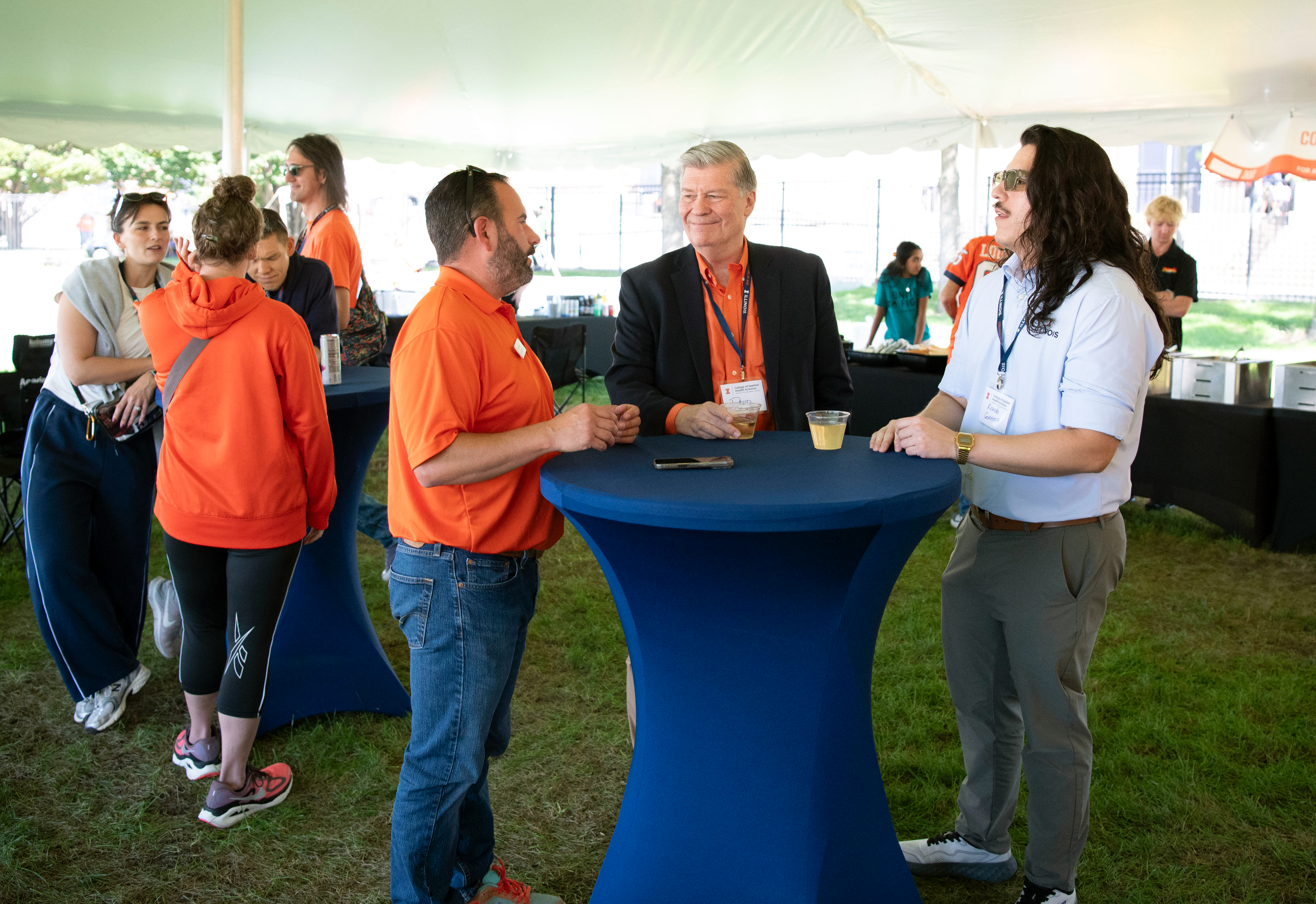
Chez plays host to Warrior-Scholar Project for second year


Warrior-Scholar Project students listen to a lecture about the U.S. Constitution from Assistant Professor of Political Science Alicia Uribe-McGuire. (Photo by Ethan Simmons)

For Chez Veterans Center director of operations Andy Bender, the function of the Warrior-Scholar Project is straightforward: Offer military Veterans a two-week-long academic “boot camp” to reacquaint themselves with the classroom environment before heading to a college or university. 

“One of the hardest things a service member is going to do is leave the service,” Bender said. “We really enjoy having the Warrior-Scholar Project here because it reflects what we want to be a part of: Making that transition.” 

In June 2023, the Chez Veterans Center, the hub for military populations at the University of Illinois, hosted a cohort of higher-ed-bound Veterans for the second year in a row. 

The Warrior-Scholar Project partners with American colleges and universities to host brief, intensive, no-cost college prep experiences for both enlisted Veterans and service members transitioning into civilian life.

The Chez Center brought in Warrior-Scholars for the first time in 2022, with a week of STEM-centered coursework taught by Illinois faculty. This year’s edition doubled the session’s length, adding a Humanities track of classes for participants. 

The cohort of 15 students and six fellows all hailed from outside of Illinois. Most hadn’t ever visited the Champaign-Urbana campus; though they may not choose Illinois for school, the experience still has a hand in their higher ed journeys. 

The two-week schedule was filled with visits to various campus landmarks and labs, including the AHS McKechnie Family LIFE Home, and a robotics and automation demonstration at the Agricultural and Bioengineering research farm. Humanities seminars focused on the United States’ founding principles and documents that the Veterans were sworn to defend. 

Assistant Professor of Political Science Alicia Uribe-McGuire led one of their first seminars, teaching an engaged class on the origin and execution of the U.S. Constitution. 

“I’ve always thought that the more a student wants it, the better a student they are. And I think they want it,” Uribe-McGuire said shortly after her seminar discussion. “I’ve had Veterans in my classes before, and they’re some of the best students.”

One frequent class contributor was Cody Lepp, an eight-year Navy SEAL who decided to return to school while still serving in the military. After three years taking online classes through National University in San Diego, Lepp is heading into his senior year and he wanted to use WSP to see how he measured up in the in-person classroom environment. 

“I came in with an open mindset, hopefully I can learn some new things,” Lepp said. “What I hope to get out of it is practice applying my skills, seeing where I stand against the majority of my fellows.”

Cody Lepp stands in a classroom of the Chez Center after a lecture (Photo by Ethan Simmons)

Jonathan Banasihan had spent seven years as a technician for the U.S. Navy when a new challenge—going back to school—entered his purview. The Warrior-Scholar Project seemed a great opportunity to refamiliarize himself with the flow of a classroom. 

Banasihan, the son of Filipino immigrants, never thought college was an option. With a bachelor’s degree from American University and now planning to go to law school at George Washington University, Banasihan feels he left the academic boot camp with far more than advertised. 

“I didn’t think that I could do the things that I did in college until I came here,” said Banasihan, now a facilitator for the Warrior-Scholar Project. “The confidence that WSP gave me to not just be uncomfortable, but to stretch myself in ways that I never really expected or wanted to was huge.” 

Banasihan is ushering through student Veterans who were in his same position. 

“UIUC has been an incredible, incredible partner. I can’t say anything but good things about this place,” Banasihan said. 

Among Veterans’ challenges reintegrating after their service, higher education can be a “completely different animal,” Bender said. 

“If you’re like some service members—if you’ve spent four, five, six years—how long has it been since you were in a classroom? You might have some of those creeping doubts come in. Can I make it? Am I going to fit in? Is this going to be successful?” he said. 

“(WSP) is providing the confidence to these service members that we can do it. That there is a future beyond my service time. That there is a way to make it.” 

Editor’s note:

To reach Ethan Simmons, email ecsimmon@illinois.edu.
 

Related news
How Joe Rank became a Chez Center guide


Joe Rank, left, stands with his son Jay Rank at the WWII Memorial. Rank, a Vietnam War Veteran, recently returned from an Honor Flight visit to Washington, D.C. (Photo provided)

By the fall of 1965, the conflict between North and South Vietnam had escalated, as had the United States’ military involvement. With the draft looming, Urbana teenager Joe Rank, newly enrolled at the University of Illinois, joined the Naval ROTC unit at the advice of one of his fraternity brothers a year after reserve officer training was no longer compulsory.

After four years as an undergraduate student majoring in advertising, Rank was deployed to Vietnam, where his responsibilities included pinging enemy submarines and managing gunners aboard the destroyer USS Lyman K. Swenson and the cruiser USS England.

Following his three-year tour, Rank returned to the university and embarked on several career journeys. He taught new cohorts of reserve officers, helmed a $20 million Navy advertising campaign, and developed two decades of relationships at the University of Illinois Alumni Association.

“If anybody 55 years ago said ‘You’re going to make a career of the Navy,’ I would’ve told them they were absolutely crazy,” Rank said. “All of life’s twists and turns, I couldn’t have planned it.”

The retired Rank, now 76, is helping sustain a campus resource he could’ve used as a military Veteran who returned for further education: The Chez Veterans Center.

“Joe is a bridge between the university’s deep history in the Veteran community and what the future can be,” said Chez Director of Operations Andy Bender. “Joe has the passion for this work, being able to take the things we need and then bringing in the support to do it.”

“They’ve got a clear mission now to serve all veterans,” Rank said of the Chez Center. “Veterans bring diversity to the campus.”

Rank, who lives in Urbana with his wife Pam, has strong ties with his identities as an Illinois alumnus and Veteran. He recently returned from an Honor Flight, a no-cost, full-day visit to military memorials in Washington, D.C., with 96 other Vietnam Veterans and three from the Korean War.

Witnessing historic monuments such as the Arlington National Cemetery and feeling warm receptions at every point led to an unforgettable experience. At the Vietnam Memorial Wall, Rank made a charcoal rubbing of the etched name of Marine Corps 2nd Lt. David Skibbe, a fellow Illinois Naval ROTC officer who died during a mission in 1970.

“He was just an outstanding leader,” Rank said. “His death brought the war close to home for me.”

Rank has stayed in the University of Illinois orbit since he was a kid. His mother worked in the Dean’s Office of the College of Commerce, now the Gies College of Business. Many of his friends coming up through Urbana High School were children of professors.

When he returned from Vietnam, Rank became an instructor for Illinois ROTC classes, earning the title of assistant professor of Naval Science while obtaining his master’s degree in advertising.

Three years of 18-hour days in Vietnam made the daily study grind feel easy.

They’ve got a clear mission now to serve all veterans,” Rank said of the Chez Center. “Veterans bring diversity to the campus.

Joe Rank

Vietnam War Veteran and Illinois alumnus

“I was at the library at 8 o’clock in the morning, got my work done by 4 p.m.,” Rank said. “I had that discipline—I got one B in graduate school.”

Rank soon went back to sea, when the Navy did something that “didn’t make much sense” to him at the time: Brought Rank in as director of National Advertising for Navy recruiting.

During his tenure, the Navy unveiled the “It’s Not a Job, It’s an Adventure” advertising slogan that rippled across national airwaves in the early 1980s. The campaign even inspired an infamous sketch from “Saturday Night Live.”

“You know you had a successful campaign when it was parodied on SNL,” Rank said.

After 20 years of active-duty service, Rank faced the test of reintegrating into civilian life and passed with flying colors. The mission of the Chez Center has connected with him from the start.

While serving as vice president of membership and marketing at the Alumni Association, he was brought into an ad hoc committee to address the vision of Chez, then known as the Center for Wounded Veterans in Higher Education.

“The intent was it would be much like (Disability Resources and Educational Services) was for the World War II Vets. It would accommodate severely, profoundly injured military veterans who wanted to come back to college.”

The technology of war has changed and casualties have decreased. As that cohort of seriously injured Veterans of college age dried up, the question was how to transform the center’s mission.

Like DRES, Chez has morphed its service to apply to a wider range of students and staff. On the advisory committee, the word “wounded” was eliminated from the title, as Chez became a one-stop shop for campus folks with military connections.

“Originally, it was a welcoming cocoon for people to recreate that military atmosphere and camaraderie. But in reality, the whole idea is to get people comfortable enough with the university and the civilian environment and push them out, get them involved in their major,” Rank said.

“The idea is not to segregate them into a pseudo military unit, but get them comfortable with what they’re going to experience in civilian life.”

Rank’s support of the Chez Center is multifaceted, as both a donor and member of its advisory board.

“He’s a great sounding board for me,” Bender said. “He’s been a part of this project since the very beginning.”

“He’s a great supporter of us, of the Veterans, and of the university at large.”

Editor’s note:

To reach Ethan Simmons, email ecsimmon@illinois.edu.

Related news

Fairbanks and Paden brought rigor to ASHA journals and credibility to SHS


Elaine Pagel Paden co-wrote the first book on phonological approaches to treatment for highly unintelligible children
(Photo provided)

From Johnson to Fairbanks,
Yes, let us all shout.
We now can forget
What semantic’s about…

For mere words and bandiage,
We’ll now take advantage
Of dials and meters
And stuff.

ASHA’s First Journal

This ode, written by D.W. Morris and quoted in Elaine Pagel Paden’s book “History of the American Speech and Hearing Association, 1925-1958,” was an introduction to Grant Fairbanks when he was selected as the third editor of the Journal of Speech and Hearing Disorders in 1948 (succeeding Wendell Johnson). It was the field’s first professional/scientific journal and the only journal of the American Speech and Hearing Association. Before Fairbanks’ tenure as editor, the journal had resembled, in part, a newsletter or trade journal for the nascent association and field more than the top-quality scientific journal he envisioned. All that was about to change.

Fairbanks was named professor of speech and director of a new Speech Research Laboratory at the University of Illinois in 1948. The laboratory gained renown for technical research, and students earned the first doctoral degrees in speech and hearing science bestowed by Illinois, going on to significantly influence the field. 

Whereas previous editors of JSHD were clinicians, Fairbanks, an expert in experimental phonetics, was the first research scientist to serve as editor. As such, he brought to the journal an ironclad devotion to science and determination to make it a rigorous scholarly publication and solidify ASHA as a credible organization. In her book, Paden noted the “razor-sharp intellect of Grant Fairbanks slashing directly at the core of the issue” during discussions at association business meetings. Fairbanks and his colleague Raymond Carhart were described as “clear-headed organizers” for the association’s new membership plan in 1950 and “forceful representatives of the research scientists and the audiologists, respectively.” This matched Fairbanks’ drive at Illinois as a teacher, researcher and mentor. The national impact and profile of the newly minted Department of Speech increased considerably after World War II, thanks in large part to his work and that of colleagues such as Paden.

As editor of JSHD, Fairbanks immediately shared the journal’s editorial work with a staff of five associate editors. Their work became truly editorial, aiding authors in crafting articles and carefully screening submissions to maintain a standard of excellence. Paden joined the editorial staff in 1949. The journal found its scholarly voice, based on what SHS Associate Professor Emerita Cynthia Johnson Parsons called, “a backbone of science.” With its headquarters at the University of Illinois, the university provided staff financial and logistical support for the journal, expanding the Department of Speech’s influence in speech and hearing science. 

Fairbanks and Paden

Fairbanks brought prior experience as a consulting or associate editor for the Quarterly Journal of Speech and other journals to his editorial position at JSHD, which he held from 1949-54. In 1955, he received ASHA’s Honors of the Association for his exemplary service and high-quality research, a testament to his crucial role in the association and the profession. Among his many accomplishments, Fairbanks was famous for his widely used textbook, “Voice and Articulation Drillbook, Second Edition,” published in 1960 by Harper and Row. Fairbanks left Illinois in 1962 to take a director of research position in California. Parsons summarized Fairbanks’ leadership at the journal and Illinois as “a powerful force as we grew our field from scratch.” 

Paden served on the editorial staff of JSHD for Fairbanks’ entire tenure as editor. She joined the Illinois faculty in 1952, working in phonetics and phonology and serving as acting head of the Department of Speech and Hearing Science from 1979-81. At Illinois, Paden was a forerunner in child phonology and its extension to intervention for speech disorders, helping preschoolers acquire speech sounds. Her work influenced clinical education in communication sciences and disorders at many of the top university programs throughout the country. Paden also helped establish the annual Midwestern Child Phonology Conference (now the International Child Phonology Conference) and interviewed pioneers in the field for ASHA’s archives and her 1970 book.

SHS Professor Emeritus Ehud Yairi said, “Paden pioneered research in normal child phonological development as well as in clinical methods applied to child phonological disorders.” He noted that she developed the earliest course dedicated to the topic. “Her work greatly altered the traditional concept of ‘articulation disorders,” he said.

Later, in collaboration with her former student, Professor Barbara Williams Hodson, Paden wrote the first book on phonological approaches to treatment for highly unintelligible children. Hodson and Paden’s “Targeting Intelligible Speech: A Phonological Approach to Remediation, Second Edition (1991)” has had a far-reaching and enduring impact. In the preface, the authors thanked Grant Fairbanks, writing that his “teaching and research have had a lasting influence on our thinking.”

In the early 1980s, Parsons was on faculty with Paden. “I used this book all the years I taught SHS 430 Development and Disorders of Phonology and Articulation, from Elaine’s retirement until my last semester of teaching before my own retirement, in the spring of 2021,” Parsons said.

Yairi first met Paden at the 1976 ASHA convention in Houston, when she interviewed him for his faculty position at Illinois.

“As I gradually built and expanded my research work into the Illinois International Stuttering Research Program, Elaine joined us and became an important member of the team,” Yairi said, adding that they co-authored several scientific articles and book chapters on the relation between stuttering and phonological disorders.

In 1993, Paden received both the Distinguished Alumni Award from the Department of Speech Pathology and Audiology at the University of Iowa and Honors of the Association from ASHA, the highest award in the field.

From One Journal to Many  

At its 1957 convention, ASHA’s Executive Council decided to split the content of JSHD into two journals, retaining JSHD and founding a new journal, the Journal of Speech and Hearing Research. JSHR was devoted to basic research in speech and hearing processes, while JSHD focused on clinical research. The first issue of JSHR was published in March 1958. It included “Effects of Delayed Auditory Feedback Upon Articulation,” written by Fairbanks and Newman Guttman, a researcher at Bell Laboratories who got his Ph.D. at Illinois. Subsequent issues of JSHR were filled with articles written by and with scholarly attribution to department graduates. 

The two journals were merged into one in 1991 under the JSHR title, with the name changed to The Journal of Speech, Language, and Hearing Research in 1997. There are six significant journals in speech and hearing sciences now—including The American Journal of Speech-Language Pathology and the American Journal of Audiology—no doubt a reflection of Fairbanks’ and Paden’s impact on ASHA’s first journal, with their firm commitment to straightforward facts, accuracy and scientific detail.

“I was a graduate student when the decision was made to consolidate JSHD and JSHR and create two new publications to disseminate work with direct clinical relevance,” said Professor and SHS Department Head Pamela Hadley. “These journals showcased cutting-edge clinical research studies and experimented with exciting and highly readable new formats such as tutorials and expert opinions. AJSLP and AJA remain critically important today for introducing best practices to graduate students and helping practicing clinicians stay up to date.”

In her book, Paden wrote “one of the chief reasons for the existence of a professional or learned society is the sharing of knowledge in the field among its members.” With the launch of its first journal, “not only was the status of the association notably increased, but its membership rolls began an accelerated upward surge which must be attributed, at least in part, to the reputation of the journal.“ 

In its 50th anniversary year, the Department of Speech and Hearing Science is proud to claim a seminal role in the establishment of the journals in the field, through the hard work and dedication of its pioneering faculty, Professors Fairbanks and Paden.

Related news

SHS Clinic gives students, faculty the opportunity to provide clinical services for the community


The Audiology and Speech-Language Pathology Clinic is located at 201 S. Oak Street in Champaign
(Photo provided)

Nestled in the University of Illinois’ Research Park is a place where the Department of Speech and Hearing Science improves communication and quality of life using evidence-based practices on a daily basis. This mission goes back to the founding of the department.

The Audiology and Speech-Language Pathology Clinic, operated by SHS, provides a full range of diagnostic and therapeutic services to 200 children and adults annually. The clinic serves individuals in the local community and across Illinois via in-person and telepractice means, providing services to clients across the lifespan. 

May is Better Hearing and Speech Month, and 2023 marks the 50th anniversary of the celebration of that occasion, as well as the 50th anniversary of SHS being established at the University of Illinois. The month’s theme of Building a Strong Foundation and its emphasis on “life-altering treatment” fit nicely with the department’s history of service, instruction and research.

During the month free pediatric and adult hearing and speech-language screenings will be offered to community members. Graduate students will perform the screenings with supervision from certified audiologists and speech-language pathologists. The event will be held at the clinic at 2001 S. Oak St. Suite B in Champaign on the morning of Wednesday, May 24, and the afternoon of Thursday, May 25. All are welcome and can call the clinic at 217-333-2205 if interested in scheduling a free screening.

Other community activities have included:

  • Presentations from second-year masters students at the OSF Heart of Mary Medical Center stroke support group’s monthly meeting.
  • Presentations at the Parkinson’s Disease Support Group of Champaign County about the role of speech-language pathology and its benefits for quality of life in Parkinson’s disease.
  • Convenient, no-charge audiology and hearing care services provide to residents of Clark Lindsey Nursing Home. Doctor of Audiology students informed residents about listening and repair strategies, cleaned and maintained hearing aids, and cleaned earwax out of residents’ ears.
  • Free hearing and speech-language screenings at the Child Development Laboratory on campus and at Chesterbrook Academy Preschool.
  • Sharing information about communication disorders and the services available at the clinic with the community as part of the College of Applied Health Sciences booth at the Urbana Market on the Square.

Graduate students in audiology and speech-language pathology develop knowledge and skills to provide clinical care to the community through their academic coursework and clinical practica experiences.

“As a clinic, we’re working very closely with the department,” said Clarion Mendes, a speech-language pathologist at the clinic and a clinical assistant professor in SHS. As Mendes explains, exposure to the needs of the community in the clinic informs teaching.

“Part of our mission is to intertwine the two and not see them as distinct entities,” she said. “The department has gone through a curriculum revision for the master’s program in recent years that highlights cultural and linguistic diversity, and if we look at that with a broader lens, that also includes looking at speech differences rather than considering them as disabilities. Speaking for myself, my clinical population nearly exclusively consists of marginalized populations. I work nearly exclusively with gender-diverse individuals. Working within that landscape requires a lot of reflection and cultural humility, constantly revising how I approach clinical practice and teach it to my students.”

The clinic gives students the unique opportunity to provide cutting-edge care informed by research and clinical expertise in an immersive environment under the supervision of licensed and nationally certified audiologists and speech-language pathologists. While clients are receiving care, they are contributing to new discoveries in the assessment and treatment of communication disorders and training the next generation of speech, language, and hearing clinicians and researchers.

Working with external partners and increasing the diversity of the student body bring fresh viewpoints and experiences to the clinic and department. In fact, the international composition in the clinical programs body is at a 10-year high, with seven international students in the clinical programs in audiology and speech-language pathology. “Efforts are also underway to expand the accepted insurances to get a broader patient base,” Clinical Assistant Professor Sadie Braun said.

Clinical work powers education and research and has motivated SHS since its humble beginnings. Jennifer Dahman, a speech-language pathologist and clinical assistant professor at SHS, credits her work as a clinical educator for making her a “better speech-language pathologist.”

“Yes, we teach the how, but more importantly, we teach the why,” she said. “And if we don’t know the why then we find out. Being able to explain that active kind of learning perspective to students translates into their service delivery.”

Learn more about the Audiology and Speech-Language Pathology Clinic by visiting the website.

Return to the SHS at 50 page

Related news

Message from Interim Dept. Head Bill Stewart


Bill Stewart (Photo by Jerry Thompson)

Greetings friends and alumni of the Department of Recreation, Sport and Tourism,

Welcome to the 2024 spring edition of the RST newsletter. This publication features research endeavors from our faculty, notable student accomplishments and the ongoing engagement of our esteemed alumni.

We were delighted this semester by a visit from Gov. J.B. Pritzker and saddened by the loss of a dear former colleague and mentor. We take great pride in showcasing the achievements of our students, and we shine a spotlight on faculty members, underscoring how their research endeavors propel our department forward as a trailblazer in advancing knowledge and shaping policy and practice. Whether you are an alum, a current student, or a member of our esteemed faculty, we trust that you will find these narratives both enlightening and enriching.

As I reflect on the past academic year serving as interim head, I am deeply appreciative of the rich legacy of leadership within our faculty and alumni. Your enduring goodwill and assistance have contributed to the strategic growth of our department, evident in the expansion of our educational offerings and the increased visibility of our scholarly endeavors.

Warm regards,

Bill Stewart
Interim Head
Department of Recreation, Sport and Tourism

Related news

Can you understand me, Siri?


The Speech Accessibility Project aims to amass a database of audio recordings from people with disabilities that affect their speech. (Getty Images)

Speech recognition software such as Alexa, Google Assistant, Amazon Echo, Cortana and Siri allow anyone to access information and use smart home technologies through spoken questions and commands. At least, that’s what they’re supposed to do. Unfortunately, these devices typically don’t recognize speech that is affected by a disability.

Mark Hasegawa-Johnson, professor of electrical and computer engineering at Illinois, wants to change that. He launched the Speech Accessibility Project (SAP), which aims to amass a database of audio recordings from people with disabilities that affect their speech. Volunteers with Parkinson’s disease, amyotrophic lateral sclerosis (ALS), stroke-related disabilities, cerebral palsy and Down syndrome record responses to three different types of prompts to capture commands, phonetically diverse speech such as one might produce when reading aloud, and conversational speech. 

SHS Associate Professors Laura Mattie and Marie Moore Channell are leading the Illinois Down Syndrome Team. “People with Down syndrome have intelligibility issues so it’s common for them to not be understood at all or to be misunderstood by voice recognition systems,” Mattie said. And it’s not just that it’s the hot new thing, as Channell observed. “These systems are among the strategies we put into place to make life easier for people with disabilities,” she said. One can imagine the frustration that results from being unable to use technologies that are supposed to improve your life.

Mattie said she and Channell put a lot of effort into developing the prompts for the recordings “…to make them representative of the kinds of things for which individuals would be using the software.” Added Channell, “It’s about making sure on the front end that the recordings are valuable and representative so that what goes into the database is relevant.”

The Speech Accessibility Project database initially will be available to the consortium of technology companies that are funding the project, including Amazon, Apple, Google, Meta and Microsoft, before becoming widely available to the public.

Related news

RST alumna Simmons discusses the importance of giving back


RST alumna Julie Simmons has joined AHS’ Board of Visitors (Photo provided)

Pivotal. That is how Julie Simmons, chief operating officer and co-founder of Paragon Marketing Group, described her experience earning a master’s degree in Recreation, Sport and Tourism at the University of Illinois Urbana-Champaign. The experience not only influenced her successful career in sports marketing, but also led her to where she is now, continually offering her generosity to the community that fostered her professional growth.

“When you truly learn and you really take to heart the lessons from your college experiences, I think you naturally want to give back to and support the institution that shaped you,” Simmons said.

Simmons has spent much of her career giving back to her alma mater, opening Paragon’s doors to current students in the form of mentorship and scholarships. The company sponsors four scholarships—one within Illinois’ own RST program as well as at Northern Illinois University, Illinois State University and DePaul University. 

For years, Paragon has also facilitated a number of internships with students in RST, as well as from other area universities.

“We strive for diversity in our recruitment, but supporting institutions within Illinois is particularly important to us,” Simmons said. “And because many of these applicants are local, it reduces the financial burden of internships and makes these opportunities more accessible.”

Internships at Paragon offer hands-on experience with sports marketing, priming students to work on a wide variety of client projects. According to Simmons, interns are exposed to different areas of the business including strategy, event logistics and planning, providing them with a broad understanding of the industry.

“For us, it’s about providing interns with a positive, real-world experience that equips them with the knowledge they need to pursue a career in sports marketing,” she said.

But Simmons didn’t want to stop at simply providing internships and scholarships. She is now part of the College of Applied Health Sciences’ Board of Visitors, an advisory board of volunteer alumni who aim to assist and advocate for the college’s goals. Simmons was nominated to the board in January of 2024 by Jean Driscoll, the assistant dean for advancement, who said “her [Simmons’] experience, leadership, and passion for service make her a wonderful addition to the board. Her accomplishments are too numerous to name, and the BOV will be a beneficiary of her talents and ideas.”

“I’m truly excited and honored that Jean nominated me for this position,” Simmons said. “For me, this is another way to give back to a place where I experienced tremendous growth.”

Simmons not only has her own professional expertise and experience on the corporate side of scholarships to offer the board, but also her unique experience as a woman owner in a male-dominated industry.

“When I started out, I was often the only woman in a room full of men, and that’s still often the case,” she said. “One of the most important things I learned was the value of finding advocates for myself and other women. Building that support network is crucial. When I worked at the University of Illinois in the athletic environment, I was the only woman on the promotions team for quite a while. Despite that, everyone was welcoming and open, showing me that you can coexist and support each other.”

Those experiences of positive mentorship are a large part of Simmons’ motivation to join the Board of Visitors, but she has yet another personal connection that draws her toward supporting an institution of learning. Simmons, being the first person in her family to go to college, has a particular appreciation for the privilege of higher education, especially for going on to receive her master’s degree from Illinois.

“If I didn’t have others helping me along the way, great mentors to guide me and people encouraging me to expand my horizons, I wouldn’t be where I am today. That’s what I want to do, as well. I want to provide others with the information they need, whether it’s about the sports industry, being a woman business owner or the importance of education. It’s all about paying it forward.”

Simmons reflected on the impact of a positive learning environment on her career and how it has influenced her and her peers to continue working with the university, recalling her time working with Michael Raycraft, a clinical associate professor in RST, and Stephen Staples, a member of the board.

“That’s why it was pivotal for me, and that’s why I feel very passionate about trying to give something back to something that really helped me.”

When it comes to her future on the board, Simmons expressed her excitement to join the Nominating and Governance Committee.

“I’m excited to be able to bring my background and experience,” she said. “I look forward to contributing substance and value to our initiatives. I’m excited to get some more meat on the bones.”


Related news

Stout Leadership


Heather Stout returned to the University of Illinois from the School of Law at St. Louis University and has roots in Central Illinois (Photo by Ethan Simmons)

When Disability Resources and Educational Services, better known as DRES, began advertising for a permanent director of operations in 2023, it was apparent to current employees who would be a great fit.

“Before there was ever the possibility of Heather [Stout] becoming DRES director of operations, my mentor and the first DRES director I worked for, Dr. Brad Hedrick, mentioned her as one of his respected colleagues working at a peer institution,” said Susann Sears, director of Beckwith Residential Support Services, which is affiliated with DRES and provides care for disabled students.

Stout was hired in June and officially joined DRES in August, succeeding interim Director Kim Collins, who retired at the end of June. Stout returned to DRES with established relationships in hand.

“I worked closely with Susann Sears, because she and I were in similar roles at [the University of Illinois Chicago] and Illinois, respectively,” Stout said. “Paige Lindahl-Lewis [assistant director at Beckwith] and I graduated from AHS together. Paige and I both graduated from rehab programs when I graduated from Illinois.” 

Stout returned to the University of Illinois from the School of Law at St. Louis University and has roots in Central Illinois. She got her bachelor’s degree from Penn State and a master’s in rehab counseling at Illinois, interning at DRES along the way. Stout emphasized the values of continuity.

“It’s important that Illinois has some long-term staff that have historical knowledge and cultural context for DRES and our program,” she said. “In higher ed, there have been a lot of changes across universities, particularly in disability. It’s good that there has been consistency at DRES, along with some of the changes in staffing.”

Maureen Gilbert, DRES’ coordinator for the unit’s Office of Campus Life, agreed that Stout’s understanding of the university was a huge plus.

“Her familiarity with campus and DRES is helpful because she understands the impact and presence DRES has,” Gilbert said. “With Heather’s experience and knowledge base, she can advocate for a strong presence at the table, especially when the discussion involves disability and accommodations across all aspects of the campus community.”

That’s especially important because of the tremendous growth in DRES student enrollment.

Gilbert said that “in four years, our numbers have increased 33 percent. Our access specialists have caseload numbers of 600 to 700 students; we have waitlists for mental health services counseling and neuropsych testing; and our service requests for deaf and hard-of-hearing students and staff are increasing. To continue supporting students and their growing needs, increased financial resources are essential to support current and prospective staff.”

Her familiarity with campus and DRES is helpful because she understands the impact and presence DRES has.

Maureen Gilbert

DRES coordinator, Office of Campus Life

Fulfilling the DRES mission and serving increasing enrollment will require expanded facilities. To that end, Stout said a new facility is necessary. She has seen proposed building designs and said, “It is my hope that in the next five years, we can talk more about that and what we can do to make DRES and each of the departments centrally located. That’s a very thoughtful conversation we’ll need.” 

Stout referenced the Center for Movement and Performance, a proposed state-of-the-art, stand-alone indoor multi-use facility for the wheelchair track and wheelchair basketball programs with enhanced strength and conditioning, equipment, sports medicine, training and meeting areas.

Adam Bleakney, renowned coach of the men’s and women’s wheelchair track and road racing teams, said, “We have a vision for a facility that is built upon the legacy pillars of our program—service, outreach, research, education and innovation—and that will allow us both room for growth and increased interdisciplinary collaboration across campus and the community.”

Although facility upgrades are high on her list of things to do, Stout acknowledged the priority is “serving the entire student.”

“We have a career services area,” she said. “We have mental health resources. One of the things I hope to expand upon is our connections with each academic department. Are we working with and partnering with them so that students are getting the accommodations that they need and each unit can work with us effectively? And are we doing what is best for graduate and professional students, as well as the faculty and administration in those programs?”

Early in her career, Stout worked as an interim coordinator/disability specialist at the University of Illinois Chicago, and worked as director of the Disability Resource Center at Purdue University.

She said Purdue’s approach to disability was “very methodical, very careful” and said Illinois had a similar approach.

“Illinois was the first model for disability resources in higher ed. It includes programs that few universities have,” Stout said. “It also has tremendous support. Being located within an academic college is a crucial connection for faculty and students. Our history is unparalleled in the U.S. and continues to include incredible resources. I hope to build upon that legacy as we look to the future and envision what DRES can be five years and 10 years from now.”

Related news

AHS students find varied paths to research


Kinesiology senior Ilya Ahmad stands with his research presentation on Wednesday, April 26, 2023.

By ETHAN SIMMONS

For her last semester as an undergraduate student, Daniela Hernandez spent a lot of time in campus libraries—more than the Community Health major had in her entire college career.

But all of Hernandez’s hours in the Main Stacks and Grainger Engineering Library went toward a worthy cause: conducting a literature review for her first research study, exploring the labor market value of Spanish-English bilingualism.

“It was very ambitious of me to do this my last semester of college, but it was something that I had never done before,” Hernandez said. “So I was like, ‘Why not?’”

Hernandez is enrolled in the Illinois Academic Enrichment and Leadership Program or I-LEAP, a support and mentorship program for underrepresented minority students, student-athletes and first-generation students in the College of Applied Health Sciences such as her.

“I’m excited to pass this on to my (I-LEAP) mentee and just say, ‘Hey, this is a great opportunity to develop those skills that you might not have,” she said.

Dozens of students from AHS lined the walls of Huff Hall on Wednesday to present findings from their recent research endeavors working in the labs of their mentors. The presentations coincided with the university-wide Undergraduate Research Symposium on April 27.

Plenty of paths exist for AHS undergrads looking for research involvement. There’s Students Pursuing Applications, Research and Knowledge (SPARK), which onboards high-achieving freshmen into research programs within the college, and Student Aging Researchers in Training (START), which brings students from underrepresented backgrounds into aging research.

Department of Speech and Hearing Science juniors Natalia Rzepa and Holly Panfil found their first research experiences through START and SPARK, respectively.

Both found their way into in SHS Associate Professor Raksha Mudhar’s Aging and Neurocognition Lab and stuck around because they liked it so much.

With SHS doctoral candidate Lizzy Lydon and School of Molecular and Cellular Biology senior Sharbel Yako, the group compared brain activity between older adults and younger adults during word recall tests.

Though both groups performed comparably in the test, event-related spectral perturbation data collected from participants suggested older adults had to use higher levels of neural compensation during the exercise, Panfil said.

“Research opens a lot of doors, and I think that we’re so lucky to be at a university that has so many different labs and ways to get involved,” said Panfil, who’s heading for a Fulbright-MITACS Globalink research internship in Canada this summer. “I’d really recommend it to anyone to just give it a shot.” 

For Recreation, Sport and Tourism sophomores Genna Peters and Vanessa Ramos, their presentation “Developing a Quality Evaluation Protocol for Racial Equity Park and Recreation Plans” was just a snapshot of their progress. Working with mentors RST Associate Professor Mariela Fernandez and doctoral student Wonjin Jeong, the students will reach out to community members.

Ramos, who transferred to Illinois from DePaul, called her first stab at research “a great experience.”

“Being able to learn how to work as a group, collect data, and just having someone to guide me through my first year at UIUC has been very helpful,” Ramos said.

Especially for underclassmen, joining a study can seem an intimidating task. Community Health sophomore Afnaan Afsar Ali transferred into AHS late last year, wanting a “broader outlook” on healthcare, but didn’t initially care for exploring any research opportunities.

“I think there’s a lot of fear when you first begin to try and get into a research lab,” Afsar Ali said. “But it does get easier, the whole purpose of research is so that you are able to develop as well.” 

However, some of the college’s work with health technology caught her interest. She contacted the Human Factors and Aging Laboratory led by KCH Professor Wendy Rogers, which connected the sophomore to an interview-based project involving sociable robot “Misty,” one of which exists inside the McKechnie Family LIFE Home.  

The project titled “Understanding the Role of a Socially Assistive Robot to Successfully Age in Place” surveyed eight older adults on their comfortability and interest in the open-source programmable robot after seeing videos of Misty in action. 

The eight adults, surveyed from across the country, all had warm responses on Misty’s appearance, size and functions, Afsar Ali said. Participants came up with three main use areas for the robotic companion: Completing domestic tasks, setting daily reminders, and socializing at home. 

Afsar Ali assisted in the literature review, sifting through previous research on the role of robots and health tech in the lives of older adults, and helped conduct video conference interviews with participants. 

“I realized that we have a really big misconception about how older adults feel about technology,” Afsar Ali said. “I thought that they wouldn’t be open to it at all, but they really are—they want to be involved and have more technology in their lives, things that can support them.” 

With a bit of luck, undergrads can find research labs that perfectly fit their interests. Fitness buff Ilya Ahmad, a senior in Kinesiology, combined two of his favorite topics for his presentation: working out and hormone function.

Under KCH Assistant Professor Diego Hernandez-Saavedra, Ahmad reviewed the effects of anabolic steroids on the body. He discussed how steroids impedes the body’s ability to produce testosterone, which can cause decreases in testicular size, sperm count and sex drive. Steroids can also cause other hormone dysregulation, and even cause DNA damage, he said.

A first-generation student, Ahmad said he had “no idea about research” when he came to the University of Illinois. He wants to attend medical school after graduation, but knows he wants to keep research in his life.

“I love research. I love endocrinology,” Ahmad said. “It’s kind of cool to show people things that are based on research findings.”

Find out more about the AHS Undergraduate Research Expo at this site, including a list of all projects.

Editor’s note:

To reach Ethan Simmons, message him at ecsimmon@illinois.edu.

Related news

College of Applied Health Sciences
110 Huff Hall
1206 South 4th Street
Champaign, IL 61820
(217) 333-2131