Alumni Spotlight—Katie Bradbury


Q: Why did you pick AHS?

A: There has not been a chapter of my life that did not include recreation, be it county recreation programs I took part in as a kid, or working at overnight summer camps for the better part of my teens and early 20s. My life has been pretty much dedicated to the field of recreation, and what better program to gain further knowledge in recreation than the RST program. Although there are plenty of universities that offered Recreation, Sports, and Tourism, the University of Illinois Urbana-Champaign was the only one (that) multiple professors from my undergrad days had mentioned to further my educational career.

Q: What course did you most enjoy?

A: I would say financing and budgeting as well as Human Resources in RST were both classes I enjoyed because I learned so much more than I did in my undergrad outdoor recreation budgeting classes. The course I enjoyed, because it was just a fun course, was marketing. It really allows a level of creativity to be used for each assignment.

Q: Did you enter AHS knowing your career path, or did AHS help you decide?

A: My career path was set a long time ago. I was working at a summer camp in Lake of the Woods, Ontario, Canada, when my director told me he has a degree in recreation. I had never heard of such a thing. Come to find out (Eastern Washington University) had outdoor recreation as a degree, I graduated a few years later. During that time I had learned so much about the business side of the field, we became certified in everything we could; however, seasonal work was difficult and getting your foot in the door of government agencies or not-for-profits at an administrative level was extremely difficult without having more education or more experience. As recreation professionals know, this field changes every 7-10 years. Continuing education is a necessity. Going back to school and becoming a part of the AHS RST program has really helped in employment and immediate job advancement.

Q:Did your AHS experience lead to your current job?

A: I owe a lot to my experience at AHS and I do believe it has led me to my current career choice. During college, I worked at the State Farm Center and Memorial Stadium and I would not have known about those positions without the College of Applied Health Sciences. It allowed me to network and let me know of positions that were available in event management. It ultimately lead me to finalize my decision on exactly what I wanted to be in addition to the qualities that I wanted and did not want to have as a leader in my field.

Q: What was your favorite on-campus experience?

A: My favorite on-campus experience was graduation, and meeting the professors I had only talked to online.

Q: What would you say to recommend AHS to a prospective student?

A: For me, AHS has allowed me the opportunity to work within the communities to help keep people active, children engaged, seniors mobile and social, and provide a service that are vital to the population we serve.

Editor’s note:

To reach Vince Lara-Cinisomo, email vinlara@illinois.edu.

Related news

Alumni Spotlight—Christian Perez


Q: Why did you pick AHS?

A: From a young age, I always had a fascination and passion for sports. My dream as a kid was to be a professional soccer player, but recognized early on that perhaps I didn’t have the full skillset to do it, but I knew I wanted to be involved in the game off the field. When it came time to apply for colleges, AHS made the most sense for the career path I wanted to take.

Q: Why did you pick RST?

A: I knew I wanted to be involved on the business side of sports, and the Sport Management program provided within RST caught my attention from the start. The atmosphere and family feel of RST and AHS made it a very comfortable environment to be in. You basically knew almost every one of your classmates since you were in 95 percent of the same classes every semester.

Q: Which professors had the most impact on you?

A: My academic advisor at the time, LoriKay Paden, played a big role in me wanting to stay in RST. As a freshman I had my doubts about the academic path I was on, but talking to LoriKay reassured me that I was making the right decision staying in RST. Dr. Michael Raycraft was someone that kept class interesting, even when he maybe knew that the material from that particular day in class wasn’t the most glamorous. He wasn’t afraid to put students on the spot in class when answering questions, which I am thankful for now. It’s always good to be comfortable being uncomfortable. Dr. Ryan Gower always had time to meet and chat with you, no matter what he was doing. I remember on days before class, my friends Tim, Tom and I would stop by his office and he was always down to chat or to tell us one his undergrad stories or how his kids were doing. That’s a personality trait that I hope I can replicate.

Q: What course did you most enjoy?

A: Not sure if it is still around, but RST 300 was my first introduction to real world experience. Events and Planning made us engage with outside businesses to put on an event from the bottom up and most of the skills I learned in that class, I can still apply today.

Q: Did you enter AHS knowing your career path, or did AHS help you decide?

A: I had an idea of the career path I wanted to take as far as being involved in the front office of a sports team. However, at the time I did not know that I wanted to get into game day and stadium operations, which is my current role. I always thought that I wanted to get into marketing, and to be honest it just sounded “cool” at the time, but really didn’t know what it entailed to be involved in marketing with a sports team. I was able to get an internship with a minor league baseball that first exposed me to stadium operations, but was not the biggest fan. When an opportunity for an operations internship came up with the Chicago Fire, I took it and haven’t looked back since.

Q:Did your AHS experience lead to your current job?

A: My AHS experience definitely helped prepare me for life after graduation. Being in RST helped build a foundation for what it means to be a business professional and how to market and network yourself to industry leaders. The skills I obtained from time management, communication and organization throughout my Illinois tenure definitely set me up for success post-undergrad.

Q: What was your favorite on-campus experience?

A: It is hard to narrow down a few experiences, let alone just one. That said, the friends I gained throughout my college experience will always be the best part about Illinois. Taking down No. 1-ranked Indiana basketball in 2012 will always be a good memory, though!

Q: What would you say to recommend AHS to a prospective student?

A: First and foremost, always try to keep an open mind! The close connections you can develop with your professors and staff can serve as a great steppingstone for your career post-undergrad. Being involved in a college like AHS gives you the opportunity to meet all your classmates, build relationships, and seek out your professors whenever you need them. Take advantage of being on a Big Ten campus and start to develop your professional network as early as possible, it never hurts to reach out to someone just ask some questions or to pick their brain.

Editor’s note:

To reach Vince Lara-Cinisomo, email vinlara@illinois.edu.
 

Related news

Alumni Spotlight—Charles Burton


Q: Why did you pick AHS?

A: If you are driven by curiosity, creativity, and the desire to improve the lives of others or you are interested/fascinated by the human body and the sciences it is natural, pursue a degree in Applied Health Science. As an athlete, with a passion for helping others, I chose AHS as a springboard to gain relevant practical experience working closely with other students and professors in fast-moving environments. The college of applied health sciences equips you to implement scientific principles together with practical clinical experience toward improving quality of life for patients in the rapidly growing and ever-changing healthcare and recreational, sport and tourism industries.

Q: Why did you pick RST?

A: As previously stated, as an student-athlete, I had become to appreciate the competition, adversity, theory practice and science that is required to be successful in sports. In looking at the professional climate, Recreation, Sport & Tourism had began to grow on a world-wide scale. The NBA had become a global brand and other sports were using metrics and science to gain competitive edges in competition. Hospitality & Tourism had also began to grow with more families traveling abroad and more individuals looking to become entrepreneurs in specific sciences. The concept of leisure had been studied and were in its early stages of understanding its effects on mental health and a healthy lifestyle. In Parks & Recreation as well as Youth Development, logic models and fundamental program development principles were becoming the standard. RST allowed me to gain experience in all of these arenas and develop analytical and critical thinking skills to adapt to the fast-growing and ever-changing environment. RST provided me with the opportunity to gain necessary hard & soft skills to be able to have success in any career. The transferable skills allowed to me to be flexible in my career choices and use my passion for helping others in a variety of ways professionally.

Q: Which professors had the most impact on you?

A: It’s hard for me to name one. Each professor brought a different perspective and level of expertise, which challenged me to adapt and always look at challenges as opportunities. The professors gave me more than academic information, they gave me perspective and skills that allowed me to be successful today. Here is a quote, “The world will never stop evolving, our responsibility is to accept the discomfort with change but use it to grow/expand our knowledge through the change to create new opportunities!”

Q: What course did you most enjoy?

A: RST 501 Concepts & Applications in Recreation, Sport & Tourism. This course opens your eyes to various opportunities via a conceptual lens.

Q: Did you enter AHS knowing your career path, or did AHS help you decide?

A: I had no idea of what I wanted to do! Outside of being an athlete, I didn’t know what I was good at.

Q:Did your AHS experience lead to your current job?

A: Yes, it did. I have worked in almost every aspect of Recreation, Sport & Tourism. My current position as Director of Operations/COO requires me to work conceptually on changing critical issues, finance/budgeting, problem solving, looking for new opportunities through challenges, program development, community relations, customer services, organizational leadership, mentoring/coaching, etc. The foundation for all of these skills came from AHS.

Q: What was your favorite on-campus experience

A: The Quad! Such a beautiful space and seeing the diversity and being able to speak with and understand various cultures were amazing. Spaces like this help us come together and develop a higher level of cultural competency.

Q: What does AHS mean to you?

A: AHS means 4 P’s (Passion; Purpose: Potential; Pathways). Getting a degree from AHS will assist you with Finding your Passion, Defining your Purpose, Discovering your Potential, and Developing Pathways to a Greater Future! These are the strategies for growth and development that are used every day.

Editor’s note:

To reach Vince Lara-Cinisomo, email vinlara@illinois.edu.
 

Related news

A Few Minutes With … Joe Cross


College of Applied Health Sciences media relations specialist Vince Lara speaks with Joe Cross, a former Illinois basketball player who went on to get his PhD in education policy, organization and leadership at Illinois, about his new role as an academic skills specialist at AHS.

Transcript

VINCE LARA: This is Vince Lara at the College of Applied Sciences at the University of Illinois. Today, I speak with Joe Cross, a former Illini basketball player who will not forget his PhD in education policy organization and leadership in Illinois, about his new role as academic skills specialist at AHS.

Joe, tell me about what led you to Illinois as a student.

JOE CROSS: Sure. Back in 1998, I was, I was playing basketball at Florida International University, down in Miami, Florida. And I had previous communications with the coach then here, Lon Kruger, who’s now the head coach at Oklahoma University.

And so had communications with him and his coaching staff. A good friend of mine, Robert McCullum, who’s his assistant coach, who’s now at FAMU, know they’re good friends of the family. He had heard about what I was doing at FIU. When he was at Florida, he had recruited me there.

When he got to the University of Illinois, he just thought it would be a good fit for me to be back at home. And I reached out to him, my family. And we thought it would be a better fit than where I was at, although I was having a great time in Miami. I knew here would put me in a position to be successful, not so much on the court, as far as going to the NBA or something like that, but does in my off the court, my career, things like that.

And so he recruited me to come in 1998, the fall, really the spring, start of the spring semester of 99, really. And that’s when I started, and that’s what brought me to Illinois, just the relationships that I had with that coaching staff, and my desire to play at the high level division 1 basketball.

And so, I like, sport management was my major there at FIU, that I was looking to go into. And I knew they had a sport major, sport management major here. It was leisure studies, really, at the time. The program was called leisure studies.

so it was like a– it was really a easy fit. I knew the majority of the players, Sergio McClain, Marcus Griffin, Robert Archibald, Brian Cook. You know, I kind of knew all those guys, Victor

And it was just really, I felt like they were my family already. So that’s kind of how I got here to Illinois. And I’ve been here ever since.

VINCE LARA: Wow. You mentioned your undergrad in sport management. I’m wondering, you transition to working with students. I wonder why you decided to do that.

JOE CROSS: Well, like most students, you know, after that undergrad degree with sport management, I just knew I had to you know, most of my jobs in high school were internships, working at, our summer jobs where we have YMCA, Boys and Girls Club, that type of thing.

And so when I got done with undergrad, I knew I was going to somehow transition into it. Really, Terry Cole, the former assistant athletic director, he had done a lot of work at the Boys and Girls Club, Boys and Girls Club here. And he was just like, Joe, I think this would be a awesome fit.

And I did some summer internships or experiences with Boys and Girls Club, as a community service stuff, and things like that. However, my the director of Academic Services at the time was Tom, who was my academic advisor too, I saw what he did as an academic advisor, and for the athletic department. And I was just, I was in awe of just the type of impact that he was making with all the athletes, you know, and how he just mentored. Because he played here at the University of Illinois at the time as well during the early 90s.

And so I saw him, how he mentors students and in the classroom, but not only in the classroom, in their sports, basketball, or track, or whatever, wrestling, and how he was just a mentor to them. And so I wanted to do– although Boys and Girls Club was great, and I wanted to be a mentor for the kids in the community, and the YMCA and things like that.

Joe DeLucia is over the parks Champaign Parks and Rec here. And so I was good friends with him, and did some work with him, community work with him. And so I had different avenues I could go into. But this piece that working with the student athletes, and being a sort of counselor, advisor, mentor, that really intrigued me.

And so I really talked to Tim Heichel about that. And he really started me on the path to being an academic advisor, and with DIA, Intercollegiate Athletics. And I actually loved my experiences there. And I did that for seven years. I was over football for a few years, working with under Ron Zook and his staff.

And so I got some really the experiences working with a variety of teams, softball and baseball and track and gymnastics and those types of areas. And I had an awesome time with that.

Well that led me over to the College of Education, where I was an academic advisor, and also working on Ph.D work, there in EPO, Education Policy Organization leadership.

And so a good friend of my, mentor, Dr. James Anderson, and Dr. Chris and Dr. Bill Trent and those guys is really who have been mentors since I’ve been here the University of Illinois, and they got me over there working in advising. And I finished the PhD program over there, which in turn kind of brought me full circle. I did a postdoc in IGB Institute for Genomic Biology, and on their outreach team there, working with the community and getting the community K through 12 students interested in STEM fields and things like that, and worked working with a guy, Bruce Fouke, Dr. Bruce Fouke over at IGB.

And once this position opened up in applied sciences, working with the IGB program, I knew Mannie Jackson. I know him. And there’s been an alum of the university, and knew his vision for the program. And once I found out who was over it, and April Carter, just the relationship, really just, you know, just, you know, it was just a good fit for me. Again, so I was really, really appreciative.

VINCE LARA: You mentioned, iLeap. And you know, the campus in general, UIUC, it’s one of the most diverse in the country, might be the most diverse. And I wonder, what does the university do well to attract students of color, in your opinion?

JOE CROSS: Sure. I mean, what attracts things of color is the faculty of color, is the people in leadership positions of color. Reg, Dr. Reggie Austin– and I mean, I’ve known him for quite some time. So when you can see people that look like you, talk like you, act like you, walk like you, think like you, process, you know, things like you, problem solve like you, can relate to your situation, you get drawn in.

It’s not any rocket science. You know, historically black colleges and universities get the numbers that they get, and they attract the people who they attract, is because they can say hey, you know, I come from where you come from. I think like you think. I understand how you process things. And this is how I made it out of my situation, or this is how I’m able to further my situation, and whether if it’s a great situation.

And so U of I does an awesome job in this, especially with our students. We see we see that because they can come right into our university and have a family right away, and to see people interact with people that come from similar backgrounds. And I think applied sciences sizes does a great job in doing that, and showing our students that balance and diversity.

VINCE LARA: Now what do you see your role at iLeap being?

JOE CROSS: Sure. Our basic role is to help students be successful in their academic experiences here while in college and at the university. I mean that’s what Mannie L. Jackson want this to be, where he had a place to come. And even though maybe were the university didn’t look all like him.

He was one of very few, and the only, you know, one of the only black athletes on his team, basketball players, he saw, he found a home, you know, at this college. And he talks very highly of about college. And so that’s what I want to make every student that’s a first generation student does.

You know, African-American, Latino, you know, those types of students, whether you have underrepresented in whatever area, I want to make sure that you’re comfortable in this space whenever you come in, that this is a safe haven for you, that you can get the resources that you need, get the help that you need, the assistance that you need, in order to continue to be here at the university.

We have so many students that are going through so many different things. They just need to know I can come to a place where I feel safe, I feel respected, and I know that I can get the answer to my question, or they can lead me directly to the answer to my questions.

VINCE LARA: Now as a former athlete yourself, you were in leisure sciences, as you said, what they called AHS back then. And AHS has a reputation for drawing a lot of students a lot of student athletes, Reggie Corbin, for example, Oluwole Betiku, right, guys who have spoken really highly of the RST program in general. What do you think is the pipeline that helps that, keep that going?

JOE CROSS: Well, their main interest is sport. And so that was the common interest. As a kid, I didn’t grow up knowing about sport management. Oh, I want to go into sport management as a major. No, I didn’t. I didn’t know about the major at all. You know, not until I got to college and I started messing around with different genetics, and then I found out– I went, wait, what is sport management? What is it all about?

And so I think that they’re attractive because it’s right up their alley. I mean, anytime that you can talk, if your sports minded person, and you’re talking about sports the majority of the time– you know, but a lot of people didn’t understand. You, you know, sport management deals a lot with– the management is the business yeah part of it.

And that’s really intriguing to a lot of students, because sports is a business, especially now that we’re moving into an age where see that these are, you know, maybe able to get paid for their likeness, you know, pretty soon. I mean, it’s a business to them. They have to market themselves.

VINCE LARA: For sure.

JOE CROSS: And sport management is a wonderful, gives you the background, wonderful background and intellect into that area. So I’m even, now that know that the, sports has gone into a different era, into a different genre, I think that this next generation of student will even look more favorably upon sport management. Because you know, it’s a business.

VINCE LARA: Now what do you see, what’s your role post graduation for these students? Like, how much can you follow them, and what does that outreach look like?

JOE CROSS: Sure. I mean, of course you want to stay with the students as much as you can, to help them into their career. My position right now is just to, in this area, just to make sure that they have the best experience possible while they’re here in college, with our students, whether they’re the athletes, not athletes, because we do have non-athletes in the iLeap program.

It’s really just to, you know, for first and second year students, to make sure that they have a good footing, a good foundation, you know, while they’re here.

Of course, yes, I’ve only been here for a short time. And I want to make those relationships and build those relationships, where you know, whoever is working with the Bulls, or whoever’s working with the Blues, you know, Dallas, or whoever’s working with whomever over at Indy, the Colts or whatever, we can still stay in that communication. Or if they’re in the medical field, there’s some type of way.

Or they’re out with the community, solving some pretty big health issues, that I could be working with them as well.

I just got here. So I would love to broaden that, and help those students when they graduate.

VINCE LARA: What do you, you’ve said you, you’ve only been here a short time. But what’s your favorite part of the job so far?

JOE CROSS: The interaction with the students.

VINCE LARA: Yeah.

JOE CROSS: Oh man. I mean, I come from– I miss that. For the two last two years, I was able to publish some writings and things like that while I was working on my postdoc. But I had little to no interaction with the students.

And that’s immediately what I found like, man, that makes my day. On students just, you build that relationship with students. And they can come in and out of your office. The door is always open. And they just drop by. Just, you know, just saying hello. You know, just so many students, it’s the first day of classes today.

So many students have come by, just say what’s up, Joe? How are you doing? Happy New Year. This is what I did during break. You know, so, so much fun. Or I’m so glad to be back. I hated being at home. I’m so glad to be back in my own apartment, you know, in my own bed, you know, and stuff like that. Just hearing those stories, and they’re ready for the semester to start.

You know, that’s really what I really enjoy.

VINCE LARA: My thanks to today’s guest, Joe Cross. For more episodes of A Few Minutes With, please go to iHeart Radio, Spotify, iTunes, by Buzzsprout, and other places where you can hear podcasts, and search A Few Minutes With.

Related news

Carla Santos named fellow of The Academy of Leisure Sciences


Carla Santos speaks to a crowd.

Recreation, Sport and Tourism department head Carla A. Santos was named a fellow of The Academy of Leisure Sciences.

Santos is one of two fellows named to TALS for the 2020 voting class, along with Dr. Brijesh Thapa of the University of Florida.

The Academy of Leisure Sciences, or TALS, was founded in 1980 with its central purpose as the intellectual advancement of leisure sciences. TALS began with 30 fellows and now counts 155 fellows, including 135 active.

TALS Fellows are outstanding performers and recognized leaders in the leisure profession with a minimum of 10 years of experience. To be named a fellow, the candidate must be nominated by an active fellow and received a two-thirds majority vote by active fellows.

The annual TALS conference is being hosted by the University of Illinois, running Feb. 11-14. The conference will open with the J. J. Bannon Lecture on Feb. 11. It will be preceded by the conference of the China-International Leisure Research Association Feb. 10-11, and the Academic Leaders Retreat Feb. 11. For more information, visit the conference website.

Santos’ research program is focused on the examination of communicative practices (from mass mediated narratives to the face-to-face dyad) as a means of addressing the socio-political and cultural impact of tourism on the world’s people and cultures.

Santos earned her Ph.D. from Penn State University and came to the University of Illinois as an assistant professor in 2002.

Related news

Day one of Sapora Symposium about Grange


RST students, wearing replicas of Red Grange’s jersey, gather around his statue in Grange Grove (Photo by Fred Zwicky)

The first day of the 16th annual Sapora Symposium was intended to be a tribute to Red Grange, the former Illini football star who put college football and the NFL on the map in the 1920s.

And while Grange was a main subject of the afternoon panel, so was the message from other speakers from the College of Applied Health Sciences and the Recreation, Sport and Tourism Department about the futures of most of the student attendees.

AHS Dean Cheryl Hanley-Maxwell, RST department head Carla Santos and Illini basketball coach Brad Underwood all implored RST students to embrace the opportunities that Sapora afforded them, while bracing for the careers that await them.

“This is your first opportunity for professional development,” Dean Hanley-Maxwell said to the 350 students and other guests at the Colonnade Club within Memorial Stadium. “RST has given students like you an extraordinary opportunity to learn from and network with people you might work with. You are tomorrow’s leaders. How will you learn from what you hear? Will it spark a passion in you?”

Coach Underwood, whose son Tyler is an RST student with a concentration in sport management, spoke about the rewards in industries that come with an RST degree, but also warned of the sacrifices and struggles.

“I was 26 years in the profession before I became a head Division I basketball coach. I’ve gone backward in salary several times,” the third-year Illinois coach said. “But I have never worked a day in my life. This is a passion. What you’re getting ready to take on in life, is very, very special.

“It’s an extremely competitive field. Don’t be bashful, don’t be shy. You don’t make it in this field that way. (But) don’t let it be work, let it be a passion.”

The Grange panelists then took center stage, moderated by former Illinois sports information director Mike Pearson. Former Sports Illustrated writer Lars Anderson, who wrote “The First Star: Red Grange and the Barnstorming Tour That Launched the NFL,” in 2009, was the first to speak and talked about how the man nicknamed the Galloping Ghost transcended sports in the 1920s because ‘What they were seeing from Grange was unlike anything else.”

Chris Willis, the head of research for NFL Films and author of the new book, “Red Grange: The Life and Legacy of the NFL’s First Superstar,” said some people claimed Grange saved the NFL.

“He was the first superstar athlete who joined the NFL. His legacy was almost a blueprint of what the modern player does today. He left school early, signed with an agent, got a huge contract, got endorsements, appeared in Hollywood movies, and won NFL championships. He has a huge legacy.”

Day Two of the Sapora Symposium — named for Dr. Allen Sapora, a pioneer in recreation education and research at Illinois — was termed a “Career Diversity and Global Readiness Summit, and speakers include former Illini basketball star Deon Thomas, Midwest Living Magazine publisher Melissa Luebbe, and Illinois physics emeritus professor and renowned physics-of-baseball researcher Alan Nathan.

The Sapora Symposium was created and developed by the alumni advisory board of the Department of Recreation, Sport and Tourism in honor of Dr. Sapora. Dr. Sapora was a cornerstone to the education and careers of many of our alumni. He believed in mentoring younger generations and in providing them with critical connections to professionals in the field.

Editor’s note:

To reach Vince Lara-Cinisomo, email vinlara@illinois.edu.
 

Related news

Podcast: A Few Minutes With … Nick Burd


Kinesiology and Community Health associate professor Nick Burd speaks with AHS media relations specialist Vince Lara about his research on potatoes as an exercise fuel and that physical activity and nutritional guidelines are inextricably linked.

Transcript

VINCE LARA: This is Vince Lara in the College of Applied Health Sciences at the University of Illinois. Today, I speak with Nick Burd, Associate Professor in the Department of Kinesiology and Community Health, to talk about his research on nutrition and exercise performance. So, Nick, what inspires your research?

NICK BURD: Yeah, sure. I’d say the inspiration comes from answering a lot of real world questions. A lot of our research is aimed at being translational in nature. Most of our work is done in vivo in humans, which obviously is a good model to be able to have translational messages.

VINCE LARA: Mm-hmm. Now why pick Illinois? I notice you went to Ball State, right? So you were in the general region, but why pick here for where you’re teaching?

NICK BURD: Well, I like corn, I like to see it, I like to eat it. No, but in all seriousness, so a lot of my research is tech specialized infrastructure. In particular, it would take this kind of R1 infrastructure, which we have here at the University of Illinois. So coming to a place that could support my research needs, but also had good colleagues in place to create a synergy with my research. And Illinois sort of checked all those boxes, so it just made a lot of sense to come here. And as you sort of alluded to, I was born in Ohio, so it’s sort of home as well in terms of the Midwest.

VINCE LARA: Got you. Now your recent research on the effectiveness of potatoes as exercise fuel got great media attention, so I’m wondering, what led you to study that?

NICK BURD: Yeah, I mean, a lot of my research, I view my research team, we are truly a team. So any project we develop, I sort of develop it in collaboration with my research team. And what I mean by that, my PhD students normally. So that particular idea was sort of derived in collaboration with one of my formal students, Joe Beals. He happened to be a cyclist. Anecdotally, he used potatoes as a fueling source during exercise. Scientifically, it made a lot of sense to test that as a fueling source. I mean, keep in mind, right, sports marketing is– sports nutrition marketing, in particular, they sort of have tuned us to think that we need these specialized sports gels, which they do work, but they can become expensive.

And just trying to find a strategy that’s not too fancy, simple, accessible, cost effective, sort of underpin that sort of idea, potato just happened to be a nutrient dense carbohydrate food source. Students wanted to do it. Scientifically, it made sense, so we went for it. And then sometimes I always say some of the most, I guess the best way to– some of these weird questions always get the most media attention, and that happened to be one of those, right? I think it’s because everybody could kind of relate to it. There’s a lot of runners out there. It was timed well around the marathon, some of the major marathons. So a lot of the news networks just grabbed it and ran.

VINCE LARA: You talked about in your answer here about cost effective means.

NICK BURD: Sure.

VINCE LARA: And so I’ve noticed some of your research really focuses on that, promoting health through diet and exercise changes in a cost effective way.

NICK BURD: Yeah, I’d say that’s fair. I mean, a lot of our work is focused on whole food-based approaches, right? Again, I think we get tuned that sometimes. Certain strategies have to be specially formulated or highly specialized. But a lot of research is aimed at it doesn’t have to be that fancy. And let’s be honest here, a lot of my work is aimed at protein, dietary protein in particular, trying to optimize that within a diet. In terms of that, protein supplements are huge. And once again, they could become expensive.

And we need to be more focused on food first approaches, is what I say. Supplements are fine, but they should be just that, a supplement. But a lot of times, these are the front line strategy for people. But we need to stay focused on the food first approaches. Exercise is a brilliant tool to utilize to support a healthy lifestyle. I mean, it goes back to the old adage, you are what you eat and how you move, right? And that’s what our research shows. It’s aimed at showing that.

VINCE LARA: I know that you hope to look at aging and chronic disease and how exercise and diet can combat those conditions. Talk a little bit more about that, if you would.

NICK BURD: Yeah, I mean, I’m trained as a muscle physiologist, so a lot of times we’re focused on skeletal muscle health. And we do that for a variety of reasons, not to get too reductionist, but muscle has a lot of pertinent roles in a healthy lifestyle, in particular, huge contributor to basal metabolic rate, which for most of us is the biggest contributor to total daily energy expenditure. So we want to make sure we’re protecting muscle for weight maintenance essentially. And certainly, if you were under a period of energy restriction and lose some weight, you don’t want to lose muscle because that’s going to put you at a greater chance for weight regain.

But for metabolic health as well as for performance, we’re focused on muscle. But our experiments, we study obesity, obviously a prevalent disease, especially in Western society, end stage renal disease, aging. These are all areas of emphasis for us because, once again, these are all situations where muscle health is compromised. So we need strategies to sort of help or improve or augment muscle health so hopefully we can ultimately improve overall health.

VINCE LARA: My thanks to Nick Burd. This has been A Few Minutes With.

Related news

AHS celebrates outstanding alumni


AHS Distinguished Alumni Award recipient John Consalvi and Dr. Patricia Barrett Malik, who received the 2019 Harold Scharper Award, shared advice from their academic and professional journies with student leaders during a luncheon on Oct. 18 (Photo by Jerry Thompson)

A bilingual speech-language pathologist who has helped train and place bilingual clinicians throughout the United States and a woman who began her career at Illinois as a graduate student and ended it as the director of the Division of Disability Resources and Educational Services were honored for their achievements during a ceremony on October 18.

In accepting the 2019 Distinguished Alumni Award from the College of Applied Health Sciences, John Consalvi said, “The best thing about receiving an honor like this is feeling that you are part of something special, something greater than yourself. What a tremendous gift.”

John completed his master’s degree in Speech-Language Pathology in 1991. He became a bilingual clinician in the Chicago Public Schools system, an enormous system with thousands of students who were native Spanish speakers and only six bilingual speech-language pathologists. He founded Bilingual Therapies Inc. to train bilingual clinicians and place them in schools, growing the company into a nationwide staffing provider in 10 years. He recently launched SPEDXchange, an online resource that facilitates connections among those in the special education community, including special education teachers, speech- language pathologists, occupational therapists, school psychologists, school district administrators, and all staff that serve special education students and their families.

John received the 2018 Louis M. DiCarlo Award for Recent Clinical Achievement from the American Speech-Language-Hearing Foundation. He is a Fellow of the Illinois Speech-Language-Hearing Association, which awarded him Honors of the Association in 2017.

Dr. Patricia Barrett Malik received the 2019 Harold Scharper Award from the Division of Disability Resources and Educational Services. Pat completed a master’s degree (1982) and Ph.D. (1988) in what is now the Department of Recreation, Sport and Tourism, focusing on therapeutic recreation. Her graduate assistantship was with DRES, then under the direction of its founder Tim Nugent.

Pat held a tenured position at Illinois State University until 1998, when she resigned to help her husband Ron Malik grow a community rehabilitation business that changed the model for group homes. In 2005, she returned to the University of Illinois as director of the Beckwith residential program within DRES and assumed the leadership of DRES in 2014. Pat oversaw many efforts to advance accessibility and inclusivity at Illinois, including the development of a wireless remote control that makes campus elevators more user-friendly for students with severe physical disabilities and an innovation technology project with the Toyota Foundation that made it to the top 10 international entries.

Among the things she learned at Illinois, she told the audience at the event, was that making mistakes is part of living life. “The greatest mistake one can make in life is to be afraid of making mistakes,” she said.

Related news

AHS to launch first-of-its-kind degree


Wendy Rogers, left, and Nicole Holtzclaw-Stone were on hand Dec. 10 as the Illinois Board of Higher Education approved the new Master of Science in Health Technology program. (Photo provided)

Following the approval this week of the Illinois Board of Higher Education, AHS will welcome its first cohort of students into the new Master of Science in Health Technology (MS-HT) degree program in the fall of 2020.

The degree, designed to advance applied health technology design and implementation, resulted from an “Investment for Growth” proposal submitted to the campus by AHS and the Grainger College of Engineering. It fills a void in the development of a workforce in the increasingly important areas of health technology and human factors, which addresses such issues as ergonomics, product design, and human-computer interaction.

Dr. Wendy Rogers, Khan Professor of Applied Health Sciences, will serve as director of the Health Technology Education Program. Dr. Nicole Holtzclaw-Stone will serve as Assistant Director.

At the first meeting of the MS-HT advisory board, Dr. Rogers shared findings of comprehensive research conducted by Illinois Business Consulting (IBC) and a survey she and Dr. Holtzclaw-Stone developed to assess the need and interest for such a program.

“Through surveys, focus groups, and cold calls to industry, IBC found that there are no existing master’s programs in health technology, either within the United States or internationally,” Dr. Rogers said. “Moreover, interest in this degree is high at both the undergraduate and graduate levels.  In our survey of 65 industry experts in health technology, 92 percent said the degree would be valuable.” That same survey revealed that 65 percent of respondents thought it was likely that their organization would be interested in hiring the program’s graduates. One industry respondent summed it up by saying, “There is a dire need for this unique program in the healthcare industry.”

While housed in the Department of Kinesiology and Community Health, the MS-HT is a collaborative effort with the Grainger College of Engineering, primarily the Department of Industrial and Enterprise Systems Engineering. Other collaborating departments in engineering include Mechanical Engineering, Electrical and Computer Engineering, Bioengineering, and Computer Science, as well as the Departments of Speech and Hearing Science and Recreation, Sport and Tourism in AHS.

Related news

A Celebration of Excellence


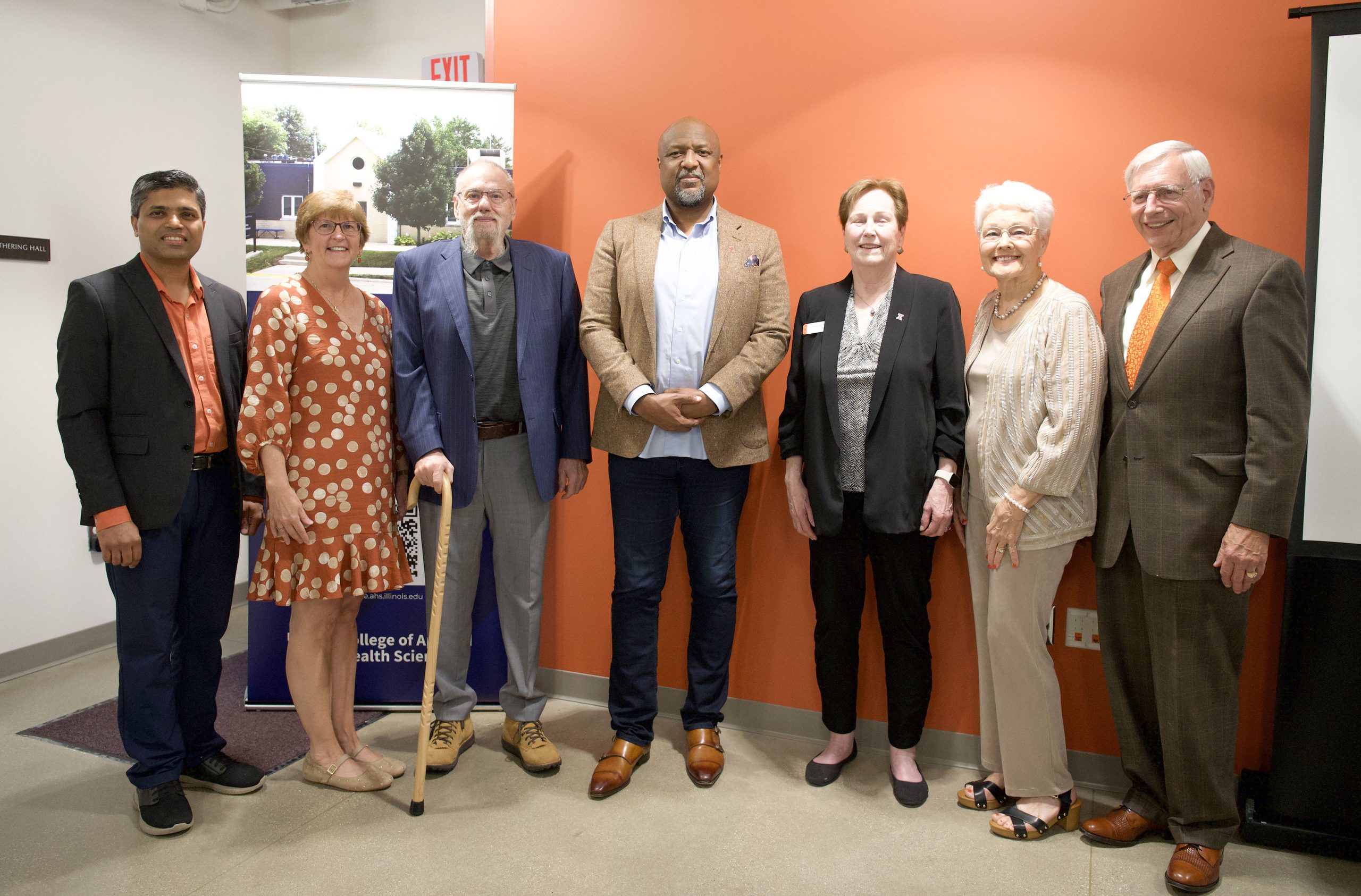
Karen McKechnie, left, James McKechnie, and Dr. Amy Woods (Photo by Anna Flanagan)

When Dr. Amy Woods was in third grade, school was a place where you were expected to be quiet and inactive. It was 1968, and there was no organized physical education in her elementary school. One day, a day she still remembers vividly, a physical education major from nearby Newberry College visited the class.

“And he stood at the front of the class and said, ‘We’re going to exercise.’ And there was a charge in the air,” she recalled. “That really was a pivotal moment for me.”

That physical education major who led her class in jumping jacks may never know the impact he had on her, but Dr. Woods went on to become a physical education major herself at Winthrop College in Rock Hill, South Carolina. She earned a master’s degree at the University of Tennessee and taught physical education in Newberry, South Carolina, for two years before pursuing her PhD in physical education instruction and curriculum at the University of South Carolina. She joined the Department of Kinesiology and Community Health in 2005 after teaching at Columbia College, St. Olaf College, and Indiana State University, and is currently the head of the department.

Last February, Dr. Woods’ many professional accomplishments were celebrated as she was named the first James K. and Karen S. McKechnie Professor in the College of Applied Health Sciences.

Through her research, publications, invited lectures, and conference presentations, she has become internationally recognized for her work on school-based physical activity and the career cycles of K-12 physical education teachers. Part of her research focuses on the support that is needed to sustain innovative practices in teaching. She also studies factors that contribute to teachers’ self-efficacy, or their belief in their ability to succeed, as well as the power of productive reflection in professional development. Her findings have informed policies and practices in teacher education.

In the Pedagogical Qualitative Research Lab, which she co-directs with Dr. Kim Graber, Dr. Woods is investigating the benefits of recess. “You might look at recess as just an innocuous activity for children,” she said, “but it’s where they get a good bit of physical activity each day.” She is specifically interested in whether recess yields more benefits before or after lunch. Current federal policy encourages physical activity before lunch because children waste less food. But her team’s research into the impact of recess on physical activity, nutritional intake, body fat, and cognitive function calls that policy into question.

Dr. Woods, who is a Fellow of the National Academy of Kinesiology, says her ultimate goal is to help K-12 teachers promote health-enhancing physical activity that keeps children moving as much as reasonably possible in schools.

“We are intensely proud of our connection to this University.”

James and Karen McKechnie graduated from the University of Illinois in 1970, he with a degree in chemistry and she with a degree in physical education. He went on to become an orthopedic surgeon with practices in Mattoon and Urbana-Champaign that were managed by Mrs. McKechnie. As avid skiers and swimmers, they have long known the benefits of physical activity in their own lives. But Dr. McKechnie said that as they age, “We have an increasingly direct appreciation of the role that physical fitness plays in our ability to continue as productive and mentally fit citizens.”

The McKechnies are members of the President’s Council and Chancellor’s Circle, and their support has been enjoyed by the College of Liberal Arts and Sciences, Fighting Illini Athletics, and the University of Illinois library as well as AHS. They endowed the James K. and Karen S. McKechnie Lab of the AHS Center on Health, Aging, and Disability, located in the Khan Annex. Mrs. McKechnie serves on the AHS Board of Visitors.

In endowing the James K. and Karen S. McKechnie Professorship in the College of Applied Health Sciences, they hope to contribute to and continue the longstanding tradition of excellence for which the University is known. Dr. McKechnie lauded Dr. Woods’ selection as the inaugural recipient, saying, “I’ll be eager to learn of the contributions Dr. Woods makes in maximizing our human potential and assisting us with making the most productive, most comfortable, and most enjoyable use of the time that each of us has allotted to us in this world.”

Related news

College of Applied Health Sciences
110 Huff Hall
1206 South 4th Street
Champaign, IL 61820
(217) 333-2131