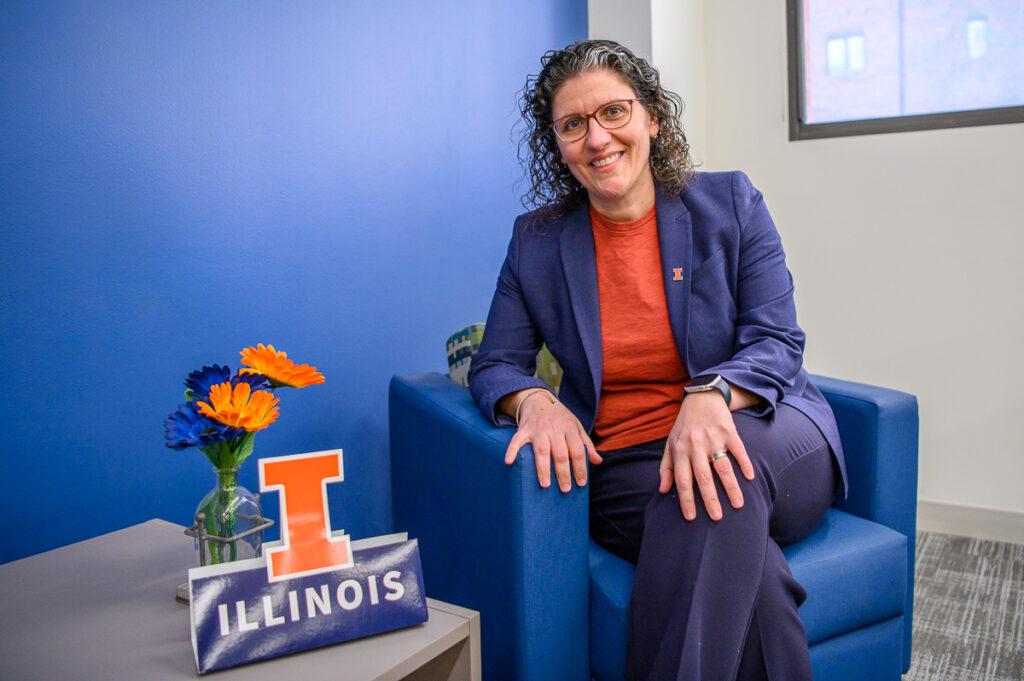
Audiology wasn’t initially Graves’ field of choice—she graduated from University of Illinois Springfield in 2011 with a bachelor’s degree in psychology
Third-year audiology doctoral student Kaley Graves is missing the first week of classes this fall, but she has a great excuse.
Thanks to her sterling accomplishments as a budding audiologist, she’s on an all-expenses-paid trip to visit one of the premier hearing aid manufacturers in the world: Oticon’s headquarters in Copenhagen, Denmark.
“I had to reread that email six times to make sure it said ‘Denmark’ and not ‘Denver, Colorado,’ or something,” Graves said. It’ll be her first time out of the United States.
Earlier this year, Graves was selected as one of six recipients of the American Academy of Audiology Foundation’s Empowering Student Scholarship, sponsored by Oticon and awarded to students who show “exceptional promise” as future clinical audiologists.
“I have hearing aids in both ears, so I’ve been the patient my entire life,” Graves said. “Now I’m on the other side of the booth and can be the clinician, which I think is so fun.”
Graves grew up in Monticello, Ill., a half-hour drive from the University of Illinois campus. Audiology wasn’t initially her field of choice—she graduated from University of Illinois Springfield in 2011 with a bachelor’s degree in psychology.
That career path didn’t fit, but Graves found her way into intriguing research projects that focused on hearing and visual cues. One of her undergraduate mentors encouraged her to apply for a behavioral neuroscience position at the Southern Illinois University School of Medicine, also in Springfield, where she studied the development of tinnitus in lab rats.
Graves went on to perform hearing research for a decade, but she craved more human connection on the job. A suggestion from her own doctor set Graves on her current course.
“I was admittedly kind of a pain in the butt to my current audiologist about all the things that she was constantly doing to my hearing aids and all of the things that she would do on a daily basis with her patients,” Graves said.
“And she eventually was like: ‘You should probably just get into this field. You’ve already got the hearing background, go deal with people—it’s more fun.” Graves’ mother was especially encouraging of her daughter’s new career path. When her parents first discovered their child had hearing loss, “it was terrifying,” Graves said.
“[My mom] said for patients, especially families that have young kids who are finding out their child has a hearing loss, it’s going to be huge for them to see their doctor has a hearing loss and can be successful in life.”
Today, Graves keeps busy as president of the Student Academy of Audiology chapter at Illinois. The registered student organization doubles as a networking site for SHS students and an outreach arm for the department.
A few events they’ve taken on: Hearing safety stand-ups at the Urbana’s Market at the Square, free hearing screenings in the SHS building, and recently, cerumen (earwax) removals for the ClarkLindsey Village retirement community.
Especially for older adults, earwax buildups can be a primary cause of muffled hearing, Graves said. Graves and another member of her graduate cohort cleared residents’ ears while a handful of first-year students in the audiology program cleaned their hearing aids.
“Being able to do a minimal amount of work over two hours to improve their quality of life was huge,” Graves said. “So many people left that room super happy.”
Her audiology work extends to Illinois’ student population as well. Graves has booked a hearing safety presentation in the fall for the student bandmates of the Marching Illini.
“The first thing that I’m really going to try and drive home to them is to please wear ear plugs when you’re out and constantly practicing,” Graves said. “We were taught first year what the acceptable levels of noise exposure are over X amount of time. If they’re out practicing for four hours and it’s about 90 decibels, they need to do something to mitigate the effects of those loud noises.”
For now, though, Graves is preparing her Denmark itinerary: visiting Tivoli Gardens, one of the world’s oldest amusement parks, and seeing the Danish Crown Jewels. “I’m super excited to go be a tourist,” she said.
Of course, she’s ready for her Oticon visit. “They do a lot of innovation, they do a lot of workshops, they do a lot of Ph.D. student type-things,” Graves said. “I am just really, really fascinated by what I’m going to see behind the scenes at their research center.”
Longtime healthcare executive takes lead role in AHS
Lynne Barnes
Lynne Barnes, past president of Carle Foundation Hospital, has been hired as director of the Master of Health Administration degree program in the College of Applied Health Sciences at the University of Illinois.
Barnes’ appointment officially begins Aug. 1, succeeding interim director Laura Rice.
Raised in Catlin, Ill., Barnes was hired by Carle Health in January 1977 straight out of college as the system’s first occupational therapist. She directed several departments and worked numerous administrative roles before finishing her Carle career as president of the Urbana hospital.
“Throughout her career, Lynne has served the community and distinguished herself as a leader in healthcare innovation,” said Kim Graber, head of the Department of Kinesiology and Community Health. “Her background in clinical operations and occupational therapy, along with her distinguished experience as president of Carle Foundation Hospital, will provide graduate students in health administration with unrivaled leadership.
“Lynne has boundless energy and will help take our program to the next level.”
Barnes will continue to teach as a part-time clinical professor, a role she’s held at University of Illinois Urbana-Champaign since 2007. A frequent community volunteer, Barnes is board chair of the Stephens Family YMCA and Experience Champaign-Urbana, and previously served as a member of the United Way of Champaign County and Urbana City Council.
Barnes oversaw the growth of Carle Foundation Hospital’s therapy programs and clinical operations, leading the flagship location in the face of the COVID-19 pandemic before retiring in Feb. 2022.
Barnes earned her bachelor’s degree in the emerging field of Occupational Therapy from the University of Illinois-Chicago in 1976, later obtaining her master’s degree in public administration from Illinois in 1988.
The MHA program was established in 2017 and accredited by the Council on Education for Public Health in 2019.
The opportunity to educate the next generation of healthcare leaders compelled Barnes to take the MHA directorship. She will work to develop the department’s new online MHA program and strengthen its position in the graduate landscape.
“The support has been terrific,” Barnes said. “I have no doubt we will be able to achieve these goals. I enjoy teamwork and I have already experienced that it is ‘all hands on deck’ to continue to improve and optimize our educational opportunities for our students.
“After decades of working in healthcare, it’s really exciting for me to have the opportunity to impact the careers of future healthcare leaders.”
The study analyzed cognitive performance for groups of older adults (ages 70 to 84) with untreated hearing loss
A new study published in the medical journal The Lancet found that hearing aids might slow cognitive decline for at-risk older adults with hearing loss.
Sadie Braun, audiologist and clinical assistant professor in the Department of Speech and Hearing Science in the College of Applied Health Sciences at the University of Illinois, said she’ll incorporate these findings into her counseling with patients.
“For people who have any sort of high risk for cognitive decline such as dementia (or) Alzheimer’s, this study tells us that those individuals should get hearing aids as soon as they need them,” Braun said. “The average person waits 5 to 7 years or more to get hearing aids once they know they have a hearing loss.”
The study, co-led by Dr. Frank Lin of Johns Hopkins University School of Medicine and the Bloomberg School of Public Health, analyzed cognitive performance for groups of older adults (ages 70 to 84) with untreated hearing loss.
Participants were randomly assigned to either the control group that received counseling on disease prevention, or to the intervention group, which received regular audiology treatment and hearing aids.
Researchers followed up with participants every six months for three years. For participants at lower risk of cognitive decline, hearing aid interventions showed no significant effect on cognitive function. But for participants with high risk for dementia, cognitive decline slowed by 48 percent over the three-year period.
“That’s a pretty amazing statistic to me,” Braun said. “We’ve known there was a correlation between hearing loss and cognitive decline, but there were a lot of unknowns regarding the exact nature of that correlation as well as whether hearing aids or other treatments could have a positive impact.”
The connection between hearing loss and dementia is well-documented, but the “why” is still up for research inquiry, Braun said. Regardless, the finding adds to the growing list of reasons for adults to check their hearing sooner rather than later.
Long-term speech understanding can improve the earlier a patient uses hearing aids, Braun said.
“Cognitive health is something that people really care about,” Braun said. “I think this is going to cause more people to be more concerned about a mild or moderate hearing loss.”
For at-risk adults and anyone interested in checking their hearing, Braun recommends a visit to an audiologist.
The Audiology and Speech Language Pathology Clinic at 2001 S. Oak Street in Champaign is open to all patients, regardless of affiliation to the University of Illinois and accepts some insurance plans. It is operated by the College of Applied Health Sciences’ Department of Speech and Hearing Science.
New patients are required to schedule an appointment by calling 217-333-2205 or emailing shsclinic@illinois.edu.
A scholarship formed by recent Illini wheelchair basketball players supports today’s athletes
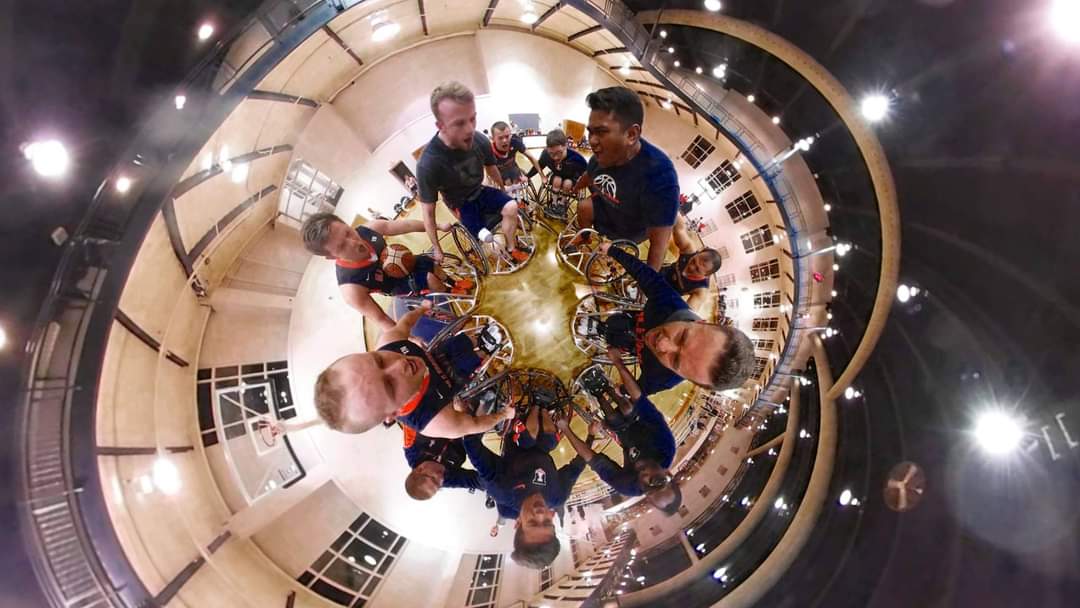
The 2016-17 wheelchair basketball men’s team poses in front of Grange Grove. Several alumni contributed to a legacy scholarship to support current wheelchair basketball athletes.
In the heat of an Illinois men’s wheelchair basketball season, intense morning practices roll into sociable team meals and lively late-night gaming sessions. The hours spent between busy student-athlete schedules—on buses and dorm rooms—are where teammates became brothers.
For all that the Illinois men’s wheelchair basketball teams of the early 2010s accomplished on the court—a National Wheelchair Basketball Association intercollegiate championship and three second-place finishes under former Coach Mike Frogley and Coach Matt Buchi—they’ve surpassed that off it, starting careers and raising families.
Now, the alums of this so-called “Band of Brothers” have come together once more to support the next generation of Illini wheelchair sport athletes through the establishment of an annual scholarship.
Their contributions, through “The Fighting Illini Wheelchair Basketball Alumni Legacy Scholarship Fund,” have been granted to two wheelchair basketball athletes in the past two terms.
“This scholarship is born from people that truly love each other and care about the future of the program at the University of Illinois,” said Mak Nong, former Illinois wheelchair basketball player and founder of the fund. “For us to be able to give back and make things easier for the future generation, that’s our moral obligation: to make this place even better than it was for us.”
The most recent recipient, rising senior Mary Wagstaff of the women’s wheelchair basketball team, used the $1,200 to pay out the remainder of her spring semester tuition.
Wagstaff “was both surprised and extremely honored” to receive the recognition, she said. Men’s team junior Martrell Stevens, now a team co-captain, received the inaugural sum in 2022.
For the alumni who funded this scholarship, it represents a continued commitment to growing the game of wheelchair basketball. Many have taken jobs in the field of adaptive athletics, managing sports programs designed for children and adults with disabilities.
Moreover, the fund honors what money can’t capture: the enduring teachings from their coaches and tight teammate bonds that have carried far beyond their last plays on the basketball floor.
“I think at a certain point towards the end of our run, we started realizing these really were the golden years,” Nong said. “But even now, establishing the scholarship and still talking as adults, we’re making the platinum era now, right?”
Tight Bonds
Maureen Gilbert wears many hats as coordinator for the Office of Campus Life at Disability Resources and Educational Services, better known as DRES. To more than 29 classes of Illinois wheelchair student-athletes, she’s “Mo,” director of their athletic programs, point-person for travel and eligibility questions and trusted confidante. Some lovingly call her “Mom.”
On bus rides with track and field and basketball events, one can usually tell if the team is gelling off the floor, Gilbert said. Team chemistry always takes work to develop, but some teams bond faster than others.
“Once in a while, you get those athletes who seem to click and they make it happen themselves,” Gilbert said. “Like with Mak’s group.”
The men’s basketball team gets hyped up. (Photo provided)
Martinez Johnson joined the team in 2013 as a transfer student from Atlanta. It didn’t take long for the memories to start stacking up with his teammates.
“[We’d] just hang out and make sure we were doing our best to balance our social life, school and basketball,” Johnson said. “And we leaned on each other to make sure everyone was doing OK mentally as well.”
Just before the school year, Johnson recalls the team traveling to the 4H campground of Allerton Park for several memorable exercises. In what’s now a yearly tradition under Coach Buchi, the players wrote down their individual fears for the season before throwing them into a burning campfire.
“When I came in 10 years ago as a coach, that was one of the first things that I tried to do: have a bonding experience to learn about each other outside of basketball,” Buchi said. “And that’s what really bonds a lot of these guys for a lifetime, a comfortable place to be vulnerable as young men with our team.
“That bonding took a while to get there, but it just needed activities and locations to blossom.”
Jacob Tyree’s favorite memories with the team tend to revolve around food: morning rushes to Original House of Pancakes or Merry Ann’s Diner after long, physical practices, or cherished visits to Cravings, the Asian cuisine restaurant.
“It could be a really crappy practice, like maybe things just were not clicking on the court—coach is yelling at you for things, your teammates are yelling at you for things—and then you go out afterwards and it’s now a positive bonding experience,” Tyree said.
As the teammates graduated and dispersed across the country and the world, those relationships stayed strong.
A random, gloomy day in the early weeks of the COVID-19 pandemic led Nong to check in with many of his old teammates. He’d been pondering ways to give back to the things “he truly cared about,” and Illinois neared the top of Nong’s list.
His calls gave way to proposals: “Would you want to contribute to a scholarship?”
After checking with DRES and the College of Applied Health Sciences advancement team, the groundwork was laid.
“Mak took the lead on all of that,” Gilbert said. “In fact, it was a great gift when they told me what they were doing. It gives a good example to our current students of paying forward and how to support those who come after you.”
The generosity didn’t stop with the scholarship, either. In the spring, program alumni used crowdfunding to finance customized, tailored suit jackets for the graduating seniors on the men’s and women’s wheelchair basketball teams.
“It was a surreal full circle moment to see my alumni, the guys that I coached, are now taking care of the players that I’m coaching now,” Buchi said.
For us to be able to give back and make things easier for the future generation, that’s our moral obligation: to make this place even better than it was for us.
Mak Nong
Illinois Class of 2017, wheelchair basketball player
Life After Basketball
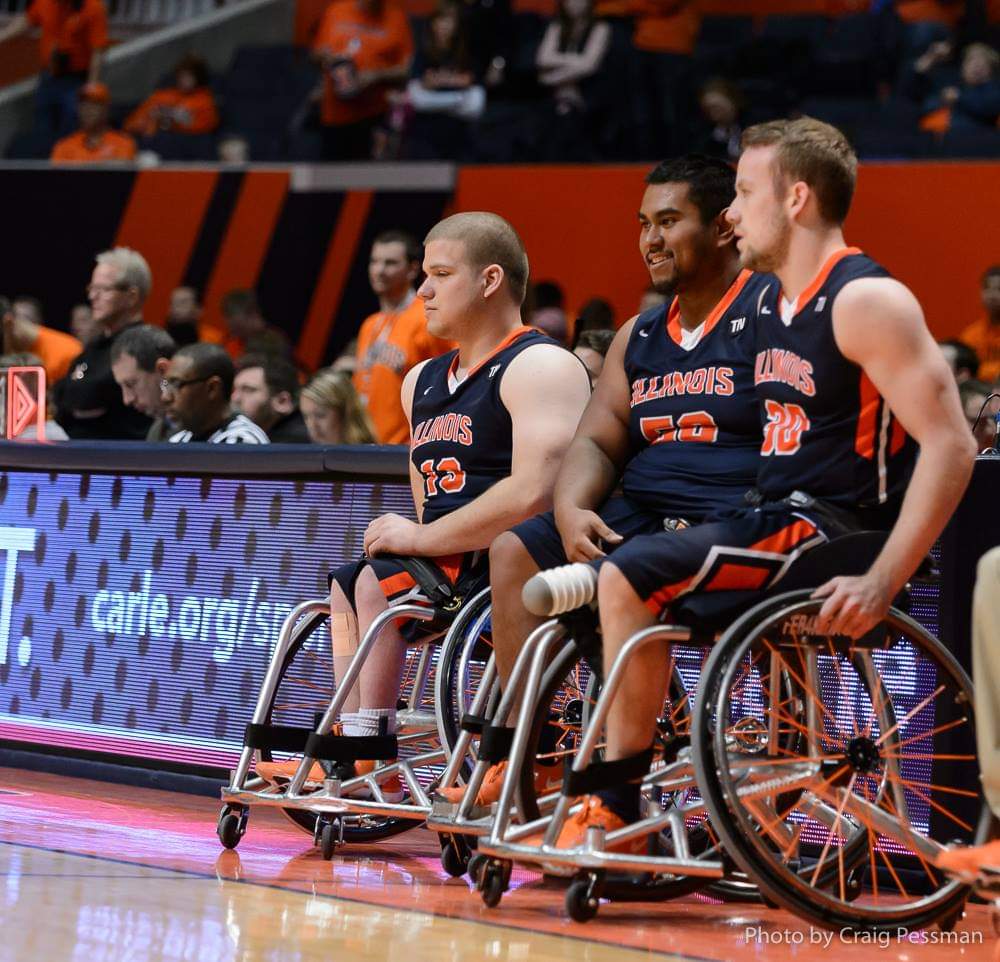
Mak Nong (center) prepares to check into the game. (Photo by Craig Pessman)
After graduating in 2017, Nong played professional wheelchair basketball in Europe for a spell, winning a league championship for LUC Handibasket in Lille, France. What stuck with him was the governance over the sport that was present overseas.
“To them, it was just sport. People without disabilities were playing wheelchair basketball and getting paid to do it,” Nong said. “So, I was thinking, ‘How do I spread this joy to people?’ Recreation is a big opportunity for that.”
Years after graduating, many members of the wheelchair basketball teams have stayed in the orbit of adaptive sports, committing time and effort to growing the scene in myriad ways.
Nong is a program manager for Great Lakes Adaptive Sports Association (GLASA) in Lake Forest, Ill., overseeing a wide range of sports programs—from football, tennis, track and field, swimming, soccer—suited to disabled athletes of all ages.
His journey truly began as a young boy pushing along his wheelchair in Los Cerritos Mall near Long Beach, Calif. Longtime coach Lisa Hilborn noticed Nong and asked if he’d be interested in trying wheelchair sports.
“I didn’t want to do it at all, I was freaking out, but then I went to a practice and I fell in love with it and kept going back,” Nong said. “I’m trying to spread the love she gave to me to other people.”
By the time he was a senior in high school, Nong was heavily recruited for wheelchair basketball. Coach Frogley’s pitch from the University of Illinois stood out from the pack.
“He stressed the importance of education, he catered to me as not only a person but an athlete as well. Just having that balance and showing that we can use sport as a tool to get to where our success is,” Nong said.
Tyree, too, has found a career in the field as training coordinator for Move United, a nonprofit committed to facilitating adaptive sports opportunities. He returned to his hometown of Roanoke, Va., to found the Roanoke Stars Wheelchair Basketball program.
Like other program alums, he repeatedly credits his coaches’ attention to detail for his professional success.
“We all saw ourselves as having our roles, and thought about how do we support each other to fill in the gaps where this is my weakness, but that’s your strength? When I’m struggling, I can lean on you a little bit more,” Tyree said. “I think that that mindset really fell into creating that excellence and trickled into what we do full-time.”
Alums who haven’t found careers in adaptive athletics have stayed around the game in some way, like Derek Hoot and Johnson, who started recording podcasts about it.
In the “Push Podcast,” the pair of alums discuss the happenings of U.S. wheelchair basketball and bring on established guests. The duo wants to break its hiatus soon, Johnson said.
“Wheelchair basketball has made a big impact on all our lives. Being able to find a sports community as individuals with disabilities is huge,” Johnson said. “I think that’s a big reason we have all stuck around adaptive athletics, is we know the change it made in our lives could be duplicated for the next generation.”
Buchi subscribes to the coaching axiom that a “successful season” can’t be determined until the players leave the program and grow into adults. Ten years in, those seeds are starting to sprout: Buchi is beginning to see talented recruits who’ve been coached by his own wheelchair basketball alums.
“The next step is happening, I have so many of my guys that are actually coaching and are giving back to juniors programs,” Buchi said. “They get to put a little bit of our Illinois stamp on these kids before I even get them.
“Our alumni need to think as soon as they graduate, how do I give back to the guys that are coming up next? Because there’s always going to be that next person that comes up and you want them to have the best experience possible.”
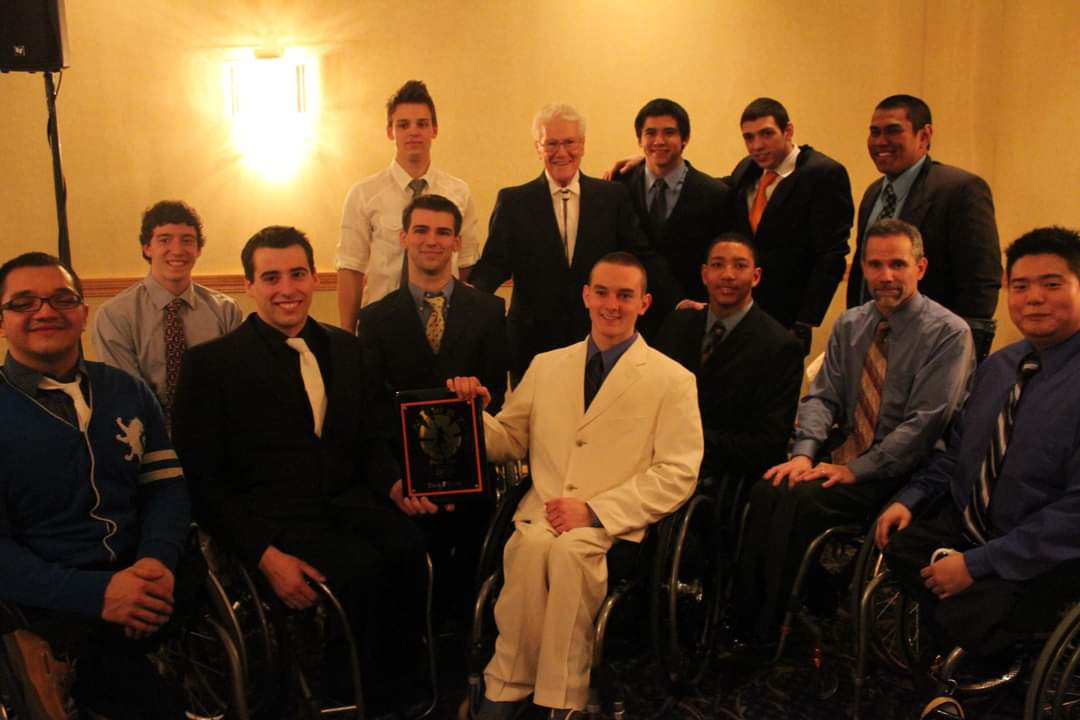
Teammates pose with Coach Mike Frogley (bottom row, second from right) and legendary accessibility pioneer Tim Nugent (second row, second from left).
MedFest was set up to provide free medical screenings for Special Olympics athletes.
A small team of student audiologists-in-training conducted hearing examinations for nearly 100 athletes (Photo provided)
The stage was set at Wintrust Sports Complex in the Village of Bedford Park—a suburb of Chicago—when nearly 600 Special Olympics athletes from across the state began to stream in.
With the help of a substantial volunteer staff, including more than 25 students from the College of Applied Health Sciences at the University of Illinois Urbana-Champaign, many of the athletes left the facility ready to play.
As part of the 22nd annual “MedFest” event, hundreds descended on Bedford Park to help athletes from Special Olympics Illinois receive their physical certifications to compete in the state.
In the most recent edition, hosted on Nov. 30, students from the Departments of Speech and Hearing Science and Recreation, Sport and Tourism took time out of their fall break from classes to help the event run smoothly.
A small team of student audiologists-in-training conducted hearing examinations for nearly 100 athletes, while 15 RST students helped from the event management side, signing in the athletes and directing them to the right locations.
“You can tell that they got so comfortable and were having a blast, talking with athletes and interacting with them,” said Melissa Garritano, senior director of Special Olympics Illinois region D, which covers the Chicagoland area. “Thinking back to when I was at the U. of I., I wish I would’ve done stuff like this. They drove up two hours to spend the day with us—the athletes loved them.”
The connection stemmed from Bedford Park’s budding partnership with the College of AHS. The Department of Recreation, Sport and Tourism has a grant with the Village of Bedford Park, which heavily invested in the Wintrust Sports Complex. The project-heavy facility hosts community events on a regular basis, atop of its normal sports operations.
Joe Ronovsky, chief business officer of Village of Bedford Park, is a two-time RST graduate. He saw that the complex could serve as a real-world “lab setting” for community engagement projects led by RST faculty and students.
“Frankly, it’s kind of a one-stop shop, and it’s an opportunity for me as a teacher to show how all these things interact with each other,” said RST Clinical Associate Professor Michael Raycraft.
MedFest was set up to provide free medical screenings for Special Olympics athletes. Wintrust Sports Complex at Bedford Park began partnering with Special Olympics Illinois about a year and a half ago.
“Their facility is unbelievable,” Garritano said. She met Raycraft through their common connections to the Wintrust Complex.
Nicole Dudek, a junior in the RST program, was taken aback by the organizational strength and scale of the event. She started her day at MedFest positioned at the height and weight station, an entry point for many of the athletes.
When students showed up around 8:30 a.m., the Special Olympics staff had the gear and answers: nametags, T-shirts, and where each student would be working within the complex.
“From the event management side of things, you could tell how well-run this event was start to finish,” Dudek said. “It helped to have such a large open space and so many volunteers, and everyone worked well together with the sole goal to help these students get their necessary medical certifications.”
The “noisy, upbeat” energy of the event bolstered the volunteer experience for RST senior Carson Bounds.
“As you could imagine, with 450 kids taking a field trip to a large indoor sport facility during a school day, they all were quite excited to be there,” Bounds said.
Third-year audiology student Yadira Espinoza appreciated the pre-event workshop on how to work with a special needs population.
“Since it was a Special Olympics event, it was important for us to know what to expect; that every kid will be different depending on their needs and accommodations,” she said.
The athletes—ranging from elementary schoolers to full-grown adults—had a variety of responses to the hearing tests. Espinoza used her bilingual fluency to help some of the families who only spoke Spanish, she said.
“These opportunities are very important because they provide more or confirm what we learn in the classroom. It’s different to work with someone who may have Down syndrome or a speech delay; seeing it firsthand really makes a difference and puts you in a situation to put your critical thinking in place,” she said.
Students from RST and SHS teamed up at MedFast (Photo provided)
SHS audiology students are regular volunteers in the community, typically getting out for a handful of outreach events per semester, such as a recent visit to the ClarkLindsey retirement community in Urbana.
Clinical associate professor Sadie Braun supervised the audiology students in the volunteer event. Seeing her students persist with the athletes who didn’t respond right away to testing made the experience worthwhile.
“The athlete got this sense of pride when they were doing what we were asking them to do,” Braun said.
“It was awesome and unique to bring the U of I [audiology] crew up,” Garritano added. “Some of those athletes they got to see may have never had a hearing test in their life.”
Ronovsky thanked Raycraft and Village of Bedford Park President David Brady for tying together all the stakeholders in November’s event.
“Seeing the large group of RST and Speech and Hearing Science students volunteering at MedFest really tied together the meaning of community we’re trying to build at the Wintrust Sports Complex, in Bedford Park and throughout the state of Illinois,” Ronovsky said. “These Illini students are the next leaders in our communities.”
Like the millions of other high school seniors who applied for college during the COVID-19 pandemic, Anjali Patel made her choice of campus sight unseen.
Hailing from Memphis, Tenn., she hadn’t set foot near the University of Illinois Urbana-Champaign when she was accepted to the College of Applied Health Sciences in spring 2020.
“I guess I got here by luck,” said Patel, now a rising senior in Interdisciplinary Health Sciences. “I didn’t have a particular reason other than I just loved what this major was.”
Patel often credits good fortune for guiding her college experience, from deciding to go to Illinois to landing in the research lab of Kinesiology and Community Health Associate Professor Sandraluz Lara-Cinisomo.
But chance alone can’t explain the continued academic rise of this first-generation AHS student, who’s heading for a prestigious research opportunity this summer.
As she progresses toward her goal of medical school, Patel is satisfied with her choice of major.
“You do learn the science as part of your prerequisites for whatever path you want to follow,” she said. “But then also you get to learn about health disparities and organizations of health care—there’s just so much more that you learn with this major that makes it different from all the others.”
Patel’s next stop is a 2023 Summer Undergraduate Psychology Experience in Research fellowship. Patel and a cohort of 24 other American and Canadian undergrads from underrepresented backgrounds were selected from a competitive field of applicants to spend nine weeks in laboratory settings for psychological science.
Patel will continue a critical study documenting the experiences of women living with postpartum pain and depression, work she began in Lara-Cinisomo’s Laboratory for Emotion and Stress Assessment.
The I-Health major found the lab in the second semester of her freshman year. “She hit the ground running,” Lara-Cinisomo said, adding that Patel helped grad students in the lab prepare materials for new studies.
“It was evident that Anjali was eager to learn more about research,” Lara-Cinisomo said.
Patel has already conducted participant interviews with intense research studies, such as a broad look at how COVID-19 affected Latina and Mexican American mothers in the U.S. With the subjects at hand, many interviews become emotionally difficult.
“There’s a learning curve in trying to understand how to respond to someone who’s sensitive to what they’re talking about while trying to complete your job,” Patel said.
But her role is also an exercise in empathy, discussing issues such as pregnancy and medical complications in an academic setting.
“It was just very eye-opening to listen to all those experiences, and even now with my current interviews, it’s interesting to learn so much about mothers’ experiences,” she said.
Lara-Cinisomo will continue to be Patel’s mentor through the summer fellowship.
“She takes every role seriously and is diligent,” Lara-Cinisomo said. “The summer research experience will build on Anjali’s passion for research. I am confident Anjali will excel.”
In addition to her studies on the pre-med track, Patel will serve as president of the student organization Mentors in Medicine next year, which pairs upperclassmen and underclassmen interested in healthcare careers.
“As a freshman, I didn’t know what I needed to do. Now, I feel like as a junior I have so much to tell people to help them,” Patel said.
Joe DeLuce, a Recreation, Sport and Tourism graduate [M.S., 2001] and former visiting instructor, retired in December 2022 after 43 years in the park management industry, including his final 25 at the Champaign Park District, where he was executive director at the time of his retirement. DeLuce is not someone who likes the spotlight, so we sought out a couple of longtime colleagues and alumni who were more than happy to talk about working with him.
Elliott Bortner Superintendent of Recreation Geneva Park District
Bortner got his bachelor’s degree from RST in 2011. He met DeLuce in 2007 as a freshman when he was a kinesiology major.
Q: When did you first meet Joe?
A: I learned in my first semester that this field of study was not my passion and I met with my advisor in AHS. After asking a few questions about my interests, where I had worked in the past, and more, she let me know about RST and suggested I take a couple courses second semester. The first class I took was instructed by Joe and, by semester’s end, I felt confident this was the field of study I wanted to pursue. Fast forward to my senior year, I was fortunate enough to intern at the Champaign Park District while Joe was serving as the director of recreation.
Q: What has Joe meant to Urbana-Champaign?
A: I only lived in town a couple years following graduation, but those two years I was able to see the profound impact Joe had on the community. The way he interacted with people and everything he was involved in are two things that stand out to me when I think back to those times. Seemingly every place we went he knew someone, asked about their family or how their job was going, talked Illinois athletics and more.
Q: What was Joe’s main contribution to the parks department?
A: During my time at the Champaign Park District [2011-2013], I think one of his biggest contributions to the district was how the Virginia Theatre grew under his leadership, including its renovation/restoration. Since that time, I think one of the most impactful contributions is the new Martens Center in Champaign.
Q: Do you have a funny story to share?
A: I knew Joe played racquetball and I had played a few dozen times at CRCE [Campus Recreation Center East] and the ARC [Activities & Recreation Center] when I was a student. During my time working at the Champaign Park District, I challenged Joe to racquetball many times—challenges that were often met with chuckles and “Are you sure?!” He finally took me up on the challenge one day. He beat me three straight games and I don’t think I scored a single point. But, being the teacher/mentor he has always been for me, we then went to a different court where two others were playing. He and I teamed up for doubles and, after a few quick pointers, I improved enough to where we won a game.
Q: What has Joe done to make an impact on your life?
Following my internship and graduation, Joe asked if I would stay on and work under him as the recreation intern. In the following year, I had the opportunity to lead the District’s effort for Illinois Park and Recreation Association’s (IPRA) Distinguished Agency award and projects related to the District’s ADA Transition Plan. Joe brought me along to staff meetings, involved me in project planning meetings, encouraged me to make connections throughout the community, etc. A new full-time position was created at the Douglass Community Center and I was fortunate enough to be hired into that role. A year later, I became the special events and volunteer coordinator. In 2013, I moved back to my hometown of Batavia and began working at the Geneva Park District. In the fall of 2022, I applied for the Superintendent of Recreation position at the Geneva Park District and Joe spent over an hour on the phone with me prepping me with things to think about, ideas to prepare, and questions to consider. About a month later, outside of my family, he was the first person I called to tell I was named the new superintendent. One of Joe’s aphorisms is “You interview for your next job every day”—I have tried to keep that in mind throughout my career. Joe has truly shaped my career in recreation and as a professional—ultimately his biggest impact has been being a mentor and a friend.
Sue Grey President and CEO United Way of Champaign County
Grey is a 1983 RST graduate and serves on the AHS Board of Visitors. She worked with DeLuce at Champaign Park District, and has known him for more than two decades.
Q: What has Joe meant to Champaign-Urbana?
A: Joe has been a quiet, steady leader. He has brought innovative and fun ideas to the community—helping our park district be the best in the area and across the state and country.
Q: What was Joe’s main contribution to the parks department?
A: Joe has brought consistency, stability and strong leadership. He carefully managed the budget, and worked to make necessary improvements to facilities and parks.
Q: What has Joe done to make an impact on your life?
A: I appreciate that Joe was always a good listener. He took the time to make sure you were heard. That is an important quality that we could all use
It is difficult to believe that another academic year is coming to an end. It has been an eventful year in the Department of Recreation, Sport and Tourism. I’m excited to share some of those events with you in this issue of RST E-News.
Professor Monika Stodolska, who has been with RST for more than 20 years, was named the Brightbill/Sapora Professor in Applied Health Sciences. Monika is an outstanding scholar, teacher, and mentor. She has served the department, college, campus, and profession in a variety of significant roles, and is renowned for her work in the area of culture and leisure. We celebrated Monika’s many accomplishments with an investiture ceremony in February.
RST assistant professor Sharon Zou applies marketing principles to her studies in tourism. She recently published a study of fee-based pricing at Indiana Dunes State Park that reflects her belief that parks and other tourism industries must build sustainable revenue models and not rely on state and federal support. We tell you about that study in this issue.
Alumnus Joe DeLuce, who gave so selflessly to this department and our students over the years, retired last December after a 43-year career in the park management industry. His last position was executive director of the Champaign Park District. Find out more about Joe as we wish him well in the next chapter of his life.
Finally, we celebrate the outstanding undergraduate and graduate students who have earned scholarships and awards this year in recognition of their academic, professional, and personal accomplishments.
I am so proud to be the head of this incredible department, to work with a phenomenal group of scholars and alumni, and to support them in mentoring our students. We continue to work hard to remain a leader in recreation, sport and tourism education, research, and public engagement. You have my pledge that we will do whatever it takes to make sure that our faculty, staff, and students have the resources to continue to shine.
In gratitude, Carla Santos Professor and Department Head
While cannabis use is increasing for military Veterans, most aren’t getting it from medical sources
Photo by caption
By ETHAN SIMMONS
Twenty-one states have legalized recreational cannabis, and 88 percent of American adults are in favor of legalizing the use of marijuana for medical and recreational use, according to a recent Pew Research Center survey. Military Veterans aren’t an exception from this rising tide.
While the percentage of Veterans reporting past-year marijuana use has increased in the last decade, few of them obtain it from medical sources, a new study shows.
An analysis from Department of Kinesiology and Community Health Assistant Professor Rachel Hoopsick and co-author R. Andrew Yockey, assistant professor at the University of North Texas Health Science Center at Fort Worth School of Public Health, dove into national trends in marijuana use among U.S. Veterans from 2013 to 2019.
The researchers pulled data from the National Survey on Drug Use and Health, which surveyed 16,350 veterans ages 18 and older on their experience with various substances.
Hoopsick’s and Yockey’s analysis revealed a sharp increase in marijuana use among Veterans in recent years. More than one in eight Veterans surveyed (12.9 percent) reported past-year marijuana use in 2019, up from 8.24 percent in 2013.
“Where it gets interesting is we did not see a similar increase in self-reported medical marijuana use among vets,” said Hoopsick, whose research focuses on substance use and mental health for people in high-stress occupations. “This is telling us that although marijuana use is increasing in Vets, it’s not medical marijuana, it’s recreational marijuana.”
In the U.S., 38 states have authorized the sale of medical marijuana, and 21 of them regulate cannabis for recreational use as well. But the drug remains federally illegal, classified as Schedule I by the Drug Enforcement Administration “with no currently accepted medical use and a high potential for abuse.”
Therefore, Veterans Health Administration providers cannot prescribe or recommend patients marijuana, though they may discuss the drug in a general sense.
Many Veterans clearly use marijuana, often seeking it out for therapeutic purposes, Hoopsick said. Veterans show higher instances of physical and mental health conditions than the general population.
This disconnect presents two issues, Hoopsick said: VA health care providers might be missing a critical piece of health information during consultations with Veteran patients. And with less frequent medical prescriptions, some Veterans could be obtaining cannabis from unregulated sources with added safety risks.
“Veterans should discuss with their care providers how the addition of cannabinoids or any other medication to their routine may interact with or impact other medications or treatments they are receiving,” an official from the Veterans Health Administration wrote in an email.
Veterans will not be denied their VA benefits for using marijuana.
“I think that that is a fear among some Veterans that if they divulge that information that they’ll lose their benefits, but that’s not the case at all,” Hoopsick said.
“It’s important for their health care providers to have a full understanding of all the substances that they might be using and how that might affect their health and treatment plan.”
Nudelman was raised by a speech language pathologist: His mother
Charles Nudelman, right, with adviser Pasquale Bottalico
What comes to mind when you hear “professional voice-user?” Perhaps the image of an opera singer or a sports announcer pops in your head.
Ask Department of Speech and Hearing Science doctoral candidate Charles Nudelman, and he’ll conjure dozens of examples: Canvassers, radio DJs, telemarketers, clergy and lawyers are just a few of the professions who’ve come to him with vocal problems.
“The voice is something I feel like we take for granted—we wake up in the morning and expect everything to go fine,” Nudelman said. “If you’re relying on your voice for your job, hoarseness is going to get worse as you use it. And there’s a lot of costs related to that.”
After spending a year diagnosing voice issues in a clinical setting, 2019 SHS graduate Nudelman has returned to his alma mater to obtain his doctorate, focusing his research on preventing vocal disorders for the near-30 percent of adults who face them.
Nudelman, from Gurnee, Ill., was raised by a speech language pathologist: His mother. But he came to the University of Illinois with his major undeclared, initially hoping to veer from the course she traveled.
“I wanted to carve out my own path, but I ended up loving the classes and loving the faculty of (SHS),” Nudelman said. “That’s what drew me here to the U. of I., knowing regardless of the path I took I would have a really good education. And it was true.”
Under his advisor and friend SHS Associate Professor Pasquale Bottalico, Nudelman has become a decorated student researcher within the department, receiving the Phyllis Ariens Burkhead Memorial Fellowship and the Elaine Paden Award this spring.
And for his presentation at 2023’s “Research Live!,” where graduate students describe their own studies to a judge panel of high school juniors, he came away with the grand prize of $500.
From the start of his undergraduate experience, Nudelman was using his communication skills often, joining student radio and broadcasting Illinois athletics events through Big Ten Network’s Student U.
“It brought me to figure out what exactly is the voice, how does it work, what is this instrument we all have? And how can I make it better while I’m on TV? That’s a wormhole to itself, and I’m still living in it.”
Those questions brought him to SHS 301: General Speech Science, taught by then-first-year Assistant Professor Bottalico. Nudelman sat in the front row every lecture, taking copious notes. He quickly attached to Bottalico’s “distinct” teaching style, and gratefully accepted an invite to his lab.
For the better part of six years, the pair have worked “nonstop” on projects together, even when Nudelman left to obtain his master’s degree from the MGH Institute for Health Professions in Boston. Now back at the Illinois, he’s set to obtain his Ph.D. in 2025.
“The stars aligned, he’s an amazing mentor and friend and person,” Nudelman said. “He’s not only looking to open doors for me but any person who works with him.”
What’s “astonished” Bottalico about his mentee is how Nudelman has responded to escalating expectations with every new research project. Just one year into his Ph.D. program, Nudelman’s research output is already comparable to that of an advanced scholar, Bottalico said.
“I have a very high standard, it’s not easy to surprise me.” Bottalico said. “And Charlie has done it constantly since we met.”
Nudelman’s winning study for Research Live! took a close look at the vocal performance of teachers. He used a virtual reality headset to simulate various classroom environments for 30 schoolteachers, closely monitoring the acoustics of their voices.
What it showed: Teachers who spoke to virtual classrooms fuller with simulated students reported more vocal discomfort and fatigue, Nudelman said, while larger virtual classrooms negatively affected the teachers’ voice quality.
“I think it’s something to think about within classrooms when class sizes are only increasing and we want our teachers to be comfortable,” Nudelman said. “I guess I’m a proponent for smaller class sizes based on this study.”
He has his sights set on a career in academia, “hopefully being a mentor like Dr. Bottalico has been to me to as many students as I can,” he said. But the doctoral student finds fulfillment in making research accessible to the general public as well.
For example: Instead of clearing your throat before speaking, sip on some water. Avoid whispering — it’s worse for your voice than just talking. And if you’re speaking to a large group, use a microphone and take pauses to breathe to avoid hoarseness afterward.
It’s this brand of practical science that made Nudelman feel right at home at AHS.
“It doesn’t matter what AHS major you are, you’re working with people to improve their quality of life,” he said. “Even though we’re all doing different things, the goal is the same, and you can feel that whenever you’re interacting with anyone in this college.
“It’s a great place to come if you’re interested in helping people.”