Transcript
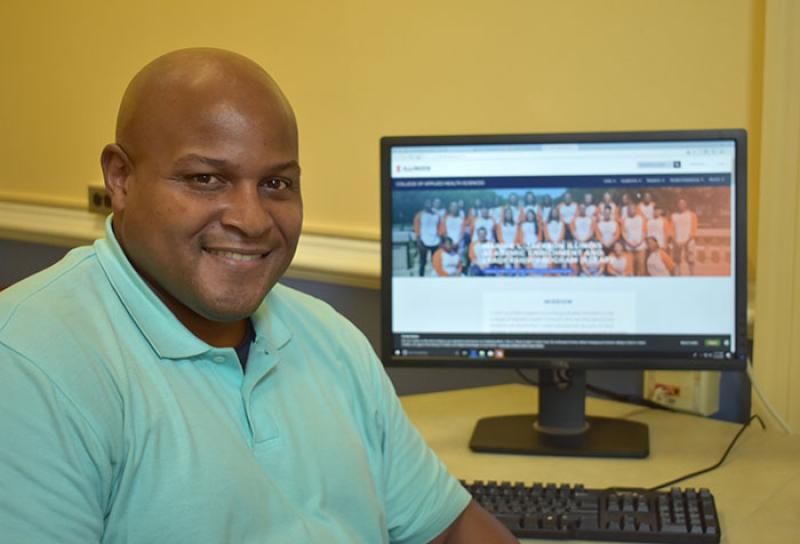
VINCE LARA: This is Vince Lara at the College of Applied Sciences at the University of Illinois. Today, I speak with Joe Cross, a former Illini basketball player who will not forget his PhD in education policy organization and leadership in Illinois, about his new role as academic skills specialist at AHS.
Joe, tell me about what led you to Illinois as a student.
JOE CROSS: Sure. Back in 1998, I was, I was playing basketball at Florida International University, down in Miami, Florida. And I had previous communications with the coach then here, Lon Kruger, who’s now the head coach at Oklahoma University.
And so had communications with him and his coaching staff. A good friend of mine, Robert McCullum, who’s his assistant coach, who’s now at FAMU, know they’re good friends of the family. He had heard about what I was doing at FIU. When he was at Florida, he had recruited me there.
When he got to the University of Illinois, he just thought it would be a good fit for me to be back at home. And I reached out to him, my family. And we thought it would be a better fit than where I was at, although I was having a great time in Miami. I knew here would put me in a position to be successful, not so much on the court, as far as going to the NBA or something like that, but does in my off the court, my career, things like that.
And so he recruited me to come in 1998, the fall, really the spring, start of the spring semester of 99, really. And that’s when I started, and that’s what brought me to Illinois, just the relationships that I had with that coaching staff, and my desire to play at the high level division 1 basketball.
And so, I like, sport management was my major there at FIU, that I was looking to go into. And I knew they had a sport major, sport management major here. It was leisure studies, really, at the time. The program was called leisure studies.
so it was like a– it was really a easy fit. I knew the majority of the players, Sergio McClain, Marcus Griffin, Robert Archibald, Brian Cook. You know, I kind of knew all those guys, Victor
And it was just really, I felt like they were my family already. So that’s kind of how I got here to Illinois. And I’ve been here ever since.
VINCE LARA: Wow. You mentioned your undergrad in sport management. I’m wondering, you transition to working with students. I wonder why you decided to do that.
JOE CROSS: Well, like most students, you know, after that undergrad degree with sport management, I just knew I had to you know, most of my jobs in high school were internships, working at, our summer jobs where we have YMCA, Boys and Girls Club, that type of thing.
And so when I got done with undergrad, I knew I was going to somehow transition into it. Really, Terry Cole, the former assistant athletic director, he had done a lot of work at the Boys and Girls Club, Boys and Girls Club here. And he was just like, Joe, I think this would be a awesome fit.
And I did some summer internships or experiences with Boys and Girls Club, as a community service stuff, and things like that. However, my the director of Academic Services at the time was Tom, who was my academic advisor too, I saw what he did as an academic advisor, and for the athletic department. And I was just, I was in awe of just the type of impact that he was making with all the athletes, you know, and how he just mentored. Because he played here at the University of Illinois at the time as well during the early 90s.
And so I saw him, how he mentors students and in the classroom, but not only in the classroom, in their sports, basketball, or track, or whatever, wrestling, and how he was just a mentor to them. And so I wanted to do– although Boys and Girls Club was great, and I wanted to be a mentor for the kids in the community, and the YMCA and things like that.
Joe DeLucia is over the parks Champaign Parks and Rec here. And so I was good friends with him, and did some work with him, community work with him. And so I had different avenues I could go into. But this piece that working with the student athletes, and being a sort of counselor, advisor, mentor, that really intrigued me.
And so I really talked to Tim Heichel about that. And he really started me on the path to being an academic advisor, and with DIA, Intercollegiate Athletics. And I actually loved my experiences there. And I did that for seven years. I was over football for a few years, working with under Ron Zook and his staff.
And so I got some really the experiences working with a variety of teams, softball and baseball and track and gymnastics and those types of areas. And I had an awesome time with that.
Well that led me over to the College of Education, where I was an academic advisor, and also working on Ph.D work, there in EPO, Education Policy Organization leadership.
And so a good friend of my, mentor, Dr. James Anderson, and Dr. Chris and Dr. Bill Trent and those guys is really who have been mentors since I’ve been here the University of Illinois, and they got me over there working in advising. And I finished the PhD program over there, which in turn kind of brought me full circle. I did a postdoc in IGB Institute for Genomic Biology, and on their outreach team there, working with the community and getting the community K through 12 students interested in STEM fields and things like that, and worked working with a guy, Bruce Fouke, Dr. Bruce Fouke over at IGB.
And once this position opened up in applied sciences, working with the IGB program, I knew Mannie Jackson. I know him. And there’s been an alum of the university, and knew his vision for the program. And once I found out who was over it, and April Carter, just the relationship, really just, you know, just, you know, it was just a good fit for me. Again, so I was really, really appreciative.
VINCE LARA: You mentioned, iLeap. And you know, the campus in general, UIUC, it’s one of the most diverse in the country, might be the most diverse. And I wonder, what does the university do well to attract students of color, in your opinion?
JOE CROSS: Sure. I mean, what attracts things of color is the faculty of color, is the people in leadership positions of color. Reg, Dr. Reggie Austin– and I mean, I’ve known him for quite some time. So when you can see people that look like you, talk like you, act like you, walk like you, think like you, process, you know, things like you, problem solve like you, can relate to your situation, you get drawn in.
It’s not any rocket science. You know, historically black colleges and universities get the numbers that they get, and they attract the people who they attract, is because they can say hey, you know, I come from where you come from. I think like you think. I understand how you process things. And this is how I made it out of my situation, or this is how I’m able to further my situation, and whether if it’s a great situation.
And so U of I does an awesome job in this, especially with our students. We see we see that because they can come right into our university and have a family right away, and to see people interact with people that come from similar backgrounds. And I think applied sciences sizes does a great job in doing that, and showing our students that balance and diversity.
VINCE LARA: Now what do you see your role at iLeap being?
JOE CROSS: Sure. Our basic role is to help students be successful in their academic experiences here while in college and at the university. I mean that’s what Mannie L. Jackson want this to be, where he had a place to come. And even though maybe were the university didn’t look all like him.
He was one of very few, and the only, you know, one of the only black athletes on his team, basketball players, he saw, he found a home, you know, at this college. And he talks very highly of about college. And so that’s what I want to make every student that’s a first generation student does.
You know, African-American, Latino, you know, those types of students, whether you have underrepresented in whatever area, I want to make sure that you’re comfortable in this space whenever you come in, that this is a safe haven for you, that you can get the resources that you need, get the help that you need, the assistance that you need, in order to continue to be here at the university.
We have so many students that are going through so many different things. They just need to know I can come to a place where I feel safe, I feel respected, and I know that I can get the answer to my question, or they can lead me directly to the answer to my questions.
VINCE LARA: Now as a former athlete yourself, you were in leisure sciences, as you said, what they called AHS back then. And AHS has a reputation for drawing a lot of students a lot of student athletes, Reggie Corbin, for example, Oluwole Betiku, right, guys who have spoken really highly of the RST program in general. What do you think is the pipeline that helps that, keep that going?
JOE CROSS: Well, their main interest is sport. And so that was the common interest. As a kid, I didn’t grow up knowing about sport management. Oh, I want to go into sport management as a major. No, I didn’t. I didn’t know about the major at all. You know, not until I got to college and I started messing around with different genetics, and then I found out– I went, wait, what is sport management? What is it all about?
And so I think that they’re attractive because it’s right up their alley. I mean, anytime that you can talk, if your sports minded person, and you’re talking about sports the majority of the time– you know, but a lot of people didn’t understand. You, you know, sport management deals a lot with– the management is the business yeah part of it.
And that’s really intriguing to a lot of students, because sports is a business, especially now that we’re moving into an age where see that these are, you know, maybe able to get paid for their likeness, you know, pretty soon. I mean, it’s a business to them. They have to market themselves.
VINCE LARA: For sure.
JOE CROSS: And sport management is a wonderful, gives you the background, wonderful background and intellect into that area. So I’m even, now that know that the, sports has gone into a different era, into a different genre, I think that this next generation of student will even look more favorably upon sport management. Because you know, it’s a business.
VINCE LARA: Now what do you see, what’s your role post graduation for these students? Like, how much can you follow them, and what does that outreach look like?
JOE CROSS: Sure. I mean, of course you want to stay with the students as much as you can, to help them into their career. My position right now is just to, in this area, just to make sure that they have the best experience possible while they’re here in college, with our students, whether they’re the athletes, not athletes, because we do have non-athletes in the iLeap program.
It’s really just to, you know, for first and second year students, to make sure that they have a good footing, a good foundation, you know, while they’re here.
Of course, yes, I’ve only been here for a short time. And I want to make those relationships and build those relationships, where you know, whoever is working with the Bulls, or whoever’s working with the Blues, you know, Dallas, or whoever’s working with whomever over at Indy, the Colts or whatever, we can still stay in that communication. Or if they’re in the medical field, there’s some type of way.
Or they’re out with the community, solving some pretty big health issues, that I could be working with them as well.
I just got here. So I would love to broaden that, and help those students when they graduate.
VINCE LARA: What do you, you’ve said you, you’ve only been here a short time. But what’s your favorite part of the job so far?
JOE CROSS: The interaction with the students.
VINCE LARA: Yeah.
JOE CROSS: Oh man. I mean, I come from– I miss that. For the two last two years, I was able to publish some writings and things like that while I was working on my postdoc. But I had little to no interaction with the students.
And that’s immediately what I found like, man, that makes my day. On students just, you build that relationship with students. And they can come in and out of your office. The door is always open. And they just drop by. Just, you know, just saying hello. You know, just so many students, it’s the first day of classes today.
So many students have come by, just say what’s up, Joe? How are you doing? Happy New Year. This is what I did during break. You know, so, so much fun. Or I’m so glad to be back. I hated being at home. I’m so glad to be back in my own apartment, you know, in my own bed, you know, and stuff like that. Just hearing those stories, and they’re ready for the semester to start.
You know, that’s really what I really enjoy.
VINCE LARA: My thanks to today’s guest, Joe Cross. For more episodes of A Few Minutes With, please go to iHeart Radio, Spotify, iTunes, by Buzzsprout, and other places where you can hear podcasts, and search A Few Minutes With.