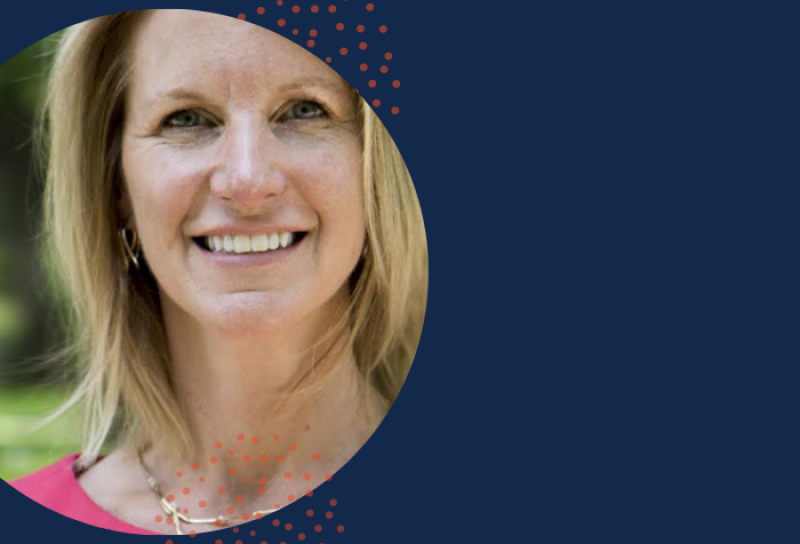
Alumni of the College of Applied Health Sciences have myriad career options thanks to the tremendous diversity of programs. We periodically will put the spotlight on an alum to find out what they’re doing now, what experiences they had and what AHS means to them. This week, we talk to Kelsey Beccue, an RST alum who is development manager for the Urbana Park District.
Q: Why did you pick AHS?
A: Choosing AHS was primarily a function of it being the home of my preferred major—Recreation, Sport, and Tourism.
Q: Which professors had the most impact on you?
A: This is kind of a toughie, but I’ll go with Professor (Cindy) Wachter. I was in the second semester of my sophomore year and still undecided. I had registered for a host of classes, attended them all my first week and promptly dropped them and registered for new ones. One of the classes I registered for was an Intro to Recreation, Sport, and Tourism class taught by Professor Wachter, and I LOVED IT! Once I was in there, I felt like I finally had some sense of direction and selected RST as my area of study. I still had some figuring out to do career-wise, but was finally taking classes that resonated with me.
Q: What course did you most enjoy?
A: I can’t remember the official course title anymore, but I did take a recreation programming class with Lori Kay Paden that was outstanding, and a great “real world” type of experience.
Q: Did you enter AHS knowing your career path, or did AHS help you decide?
A: I definitely did not know my career path when I headed into AHS, but with help from my RST advisor, I got a push in the right direction. When I first came into RST, I thought I wanted a concentration in Tourism Management, but after working through things with my advisor, it became quite obvious that Recreation Management was the right direction for me, and that set me on the course that brought me to where I am today.
Q: Did your AHS experience lead to your current job?
A: Yes—thanks required internship!
Q: What is your current job?
A: I am currently the Development Manager at the Urbana Park District.
Q: What was your favorite on-campus experience?
A: I worked in the concessions division of the Department of Intercollegiate Athletics during college, and getting the opportunity to work the different sporting events was really cool. I attended a lot of sporting events I might not have attended otherwise. The football game days were fun, too. Long, but fun—great crew to work with! Seeing Sara Bareilles perform at Foellinger with some of my best pals ranks highly, too!
Q: What would you say to recommend AHS to a prospective student?
A: I’d say that it’s a great college—it’s smaller so you don’t get lost in the crowd as much, and the faculty and advisors are great!
RST 180 packs 20 field trips into one, two-week-long bus ride
RST 180 examines elements of administration, programming, and facility planning and management to high profile recreation, sport, and tourism destinations.
RST 180, a class that takes students on a tour of some of the country’s best-known sports and tourism sites, returns in 2022 after a two-year hiatus due to COVID-19. But this year’s iteration has some new wrinkles: a visit to Shawshank prison, and funding for the two dozen students-turned-tourists.
The brainchild of Recreation, Sport and Tourism clinical associate professor Mike Raycraft, RST 180 packs 20 field trips into one, two-week-long bus ride. The course, in its fourth year, is part of the RST curriculum at Illinois, where students learn how to deliver a variety of leisure experiences to different populations. This can include anything from managing a professional sports team to running a historical museum to overseeing a state park facility.
The trip runs from May 23 to June 3, with 26 students—half of them freshmen—riding the bus with Raycraft. The group sets out from Champaign and winds through cities such as Cleveland, Cooperstown, N.Y., Princeton, N.J., Philadelphia, Canton, Ohio and Indianapolis, and sites such as the Rock and Roll Hall of Fame, Niagara Falls, the Baseball Hall of Fame, the Olympic training site in Lake Placid, the site of Woodstock in Bethel, N.Y., the 9/11 Memorial in Shanksville, Pa., and the Ohio State Reformatory, the site of the movie the “Shawshank Redemption.”
In addition to new places to visit such as the Ohio State Reformatory and the Eastern State Penitentiary Historic Site, this year’s RST 180 has another new feature: donations to offset student costs. The trip costs about $2,100 per student for food and lodging.
The Orange Krush Foundation, a section of the Registered Student Organization Illini Pride, gave a grant of $6,300 to RST 180. Kilton Rauman, a member of the Orange Krush executive committee, said the Orange Krush Foundation thought RST 180 was “a valuable thing to contribute to.”
“I thought that it was a really cool program giving students the opportunity to have those real world experiences,” Rauman said. “And going on a trip that could have such a long lasting impact. I thought that was a good place to support education in the university with something so hands-on.”
The Orange Krush Foundation builds its funding base with proceeds from student basketball and football tickets, Rauman said. The grant from Orange Krush came too late for this year’s trip, but in 2023, three students will get a full free ride.
“I would hate for someone else to miss out because they felt the cost was out of their price range, or something they couldn’t manage,” said Rauman, who was supposed to be on the tour in 2020 before COVID-19 hit. “So I’m happy that three students will be able to know that their trip is safely funded, and that’s not something they have to stress over.”
RST alum Carmen Rossi also made a generous donation to help RST students. The entrepreneur pledged $250,000 over a five-year period to the RST Domestic Site Tour Fund that will go toward paying part of students’ costs for RST 180.
“I live in the community,” Rossi said, explaining his motivation for the donation. “And the community has been amazing. I’m so absolutely fortunate for being able to have experienced the degree of success as a product of the community. And the community is representative of so many different cogs in so many different organizations.”
The donations from Rossi and Illini Pride will be used for future trips and as an enticement for students to join the RST degree program, Raycraft said.
“What I’m hoping is it triggers our alumni to engage,” he said.
Mark Thomas, the now-retired Western District Director for State Parks in New York—which included oversight of Niagara Falls—said you can’t replicate in a classroom what you learn on this trip.
“This class allows the students access to top-level professionals and facilities in recreation sport and tourism venues around the Northeast and North Central United States,” said Thomas, now an adjunct faculty member at Illinois. “And this is rare access that students that might just be going through any program without that access at the level that Mike with his connections and the arrangements in this class that have been set up for these students. They get in the door to places and really see inner workings and talk with people who are boots-on-the-ground people in the profession.”
In addition to Niagara Falls, other highlights included Gettysburg Battlefield and Saratoga Springs, Flight 93 National Memorial, Progressive and First Energy Fields (home to the Cleveland Indians and Browns), the U.S. Olympic and Paralympic Training Center, NCAA Headquarters, and Indianapolis Motor Speedway.
Thomas said he has been impressed with questions students ask, and the passion they have.
“They’re very motivated to learn,” he said. “They want to draw the most out of the experience. They asked very good questions about Niagara, but they also asked questions about the other parks that I had and what they were like. They are able to glean a lot of information, but then synthesize it on the fly.”
Thomas, who retired shortly after the 2019 tour—the last one before 2022 because of COVID—gives all the credit to Raycraft, whom he met and got to know because of this class.
“When you see the actual operations and facilities on the ground and the variety of them that Mike has scheduled in all three of those arenas, it gives these students a real good, deep look in. And you can’t get that from sitting in a classroom,” he said.
Thomas knows RST 180 can also help shape careers.
“It helps them in several ways. One is, it gives them a perspective of what kinds of work might be available to them and what kind of organizations when they graduate from the program. And I think that’s a real big deal for students. And second of all, it helps them kind of formulate does this track feel right to me, is this a better track for me.”
For Rauman, the RST 180 tour is personal.
“I had a solid foundation knowledge about the trip, because I was signed up to go on it my freshman year, prior to it being canceled by COVID. So I kind of knew a lot of what it entailed, and I did get some details from some class of 2022 classmates. And they’ve talked about how cool the Niagara Falls experience was, and how valuable it was to see not just sporting venues, but also you went to the Rock and Roll Hall of Fame, you kind of saw how that operated. The variety of experiences they talked about being valuable, and then just networking, being on a bus with all those people, you can really get a lot closer with them.”
This unique field exploration journey can provide our students and future professionals with lifelong benefits, giving them crucial experience as they move into their professional fields. Please consider making a donation to support this unique student experience: If you’d like to support the fund for the RST 180 Travel Scholarship Fund, please visit this website and fill out the form.
Watch Ingrid Schneider’s talk on COVID-constrained leisure.
Dr. Ingrid E. Schneider, Ph.D. Professor, University of Minnesota “Wrangling the waves: Coping with COVID-Constrained Leisure and its Impacts on Leisure-Time Physical Activity” Recorded Wednesday, April 6, 2022
The use of green spaces such as parks and trails has increased through the ebbs and flows of COVID-19 (Stock image)
Research has shown that leisure time physical activity in outdoor spaces has more positive health benefits than physical activity done indoors. Fully one-third of the U.S. population, however, has no access to green spaces, nor to the associated health benefits.
These were among the findings shared during the 2022 AHS Distinguished Lecturer presentation given by Dr. Ingrid Schneider, professor and eminent scholar of recreation and tourism in the Department of Forest Resources at the University of Minnesota.
Leisure time physical activity increases the immune response to viral respiratory infections. Dr. Schneider cited a study of 60,000 South Africans which found that those who exercised more had fewer hospitalizations with COVID, fewer intensive care admissions, less frequently required ventilators, and less frequently died.
“Nearly a decade ago, the America Public Health Association prioritized access to green spaces, emphasizing the need for safe, walkable communities and green spaces to promote an active lifestyle across the lifespan,” she said.
While the use of green spaces such as parks and trails has increased through the ebbs and flows of COVID-19, the ongoing pandemic also served to accentuate and compound issues of inequality.
“Communities of lower socioeconomic status and minority communities have less access to green spaces and tend to have lower quality parks,” Dr. Schneider said. “People of color are overrepresented in neighborhoods with lack of access to green space and live further from safe green space.”
The COVID pandemic has heightened awareness that racism is a public health threat. Prior to the pandemic, local officials viewed parks and recreation spending as discretionary. Those calling for green space have never been louder, more diverse, or more perfectly positioned, Dr. Schneider said.
“Collective planning and policy can amplify those voices for green spaces as critical infrastructure and contributors to health and well-being,” she said. “We can’t wait another decade, we can’t wait another year, we really can’t wait another day to address the inequities in systemic health.”
The severity of COVID’s impact on black communities was a predictable result of structural and social reality. Cities cannot be fixed, Dr. Schneider said, if we don’t insist on dismantling racial, economic, and environmental inequities.
“Green space is an essential part of healthy, resilient, and vibrant communities,” she said. “Given the evidence of the health benefits of green space, withholding access to them for a third of U.S. residents is simply unacceptable and unjust.”
Carmen Rossi has pledged $250,000 over a five-year period to the RST Domestic Site Tour Fund
Charity is fundamental, University of Illinois graduate Carmen Rossi says (Photo by Vince Lara-Cinisomo)
Lawyer, entrepreneur and University of Illinois Urbana-Champaign graduate Carmen Rossi has long been a believer in the importance of charitable works.
Rossi, who earned his undergraduate and master’s degrees at Illinois—the master’s in recreation, sport and tourism—years ago established the Chicago Knight Life Charities Scholarship. In 2014 he started “Chicago Knight Life,” a company he built to involve his hospitality portfolio with local Chicago charities. Chicago Knight Life reaches out directly to Chicago organizations and charities to provide a warm meal and companionship. All employees of his hospitality portfolio are encouraged to volunteer for weekly visits to charities.
“I would just put up signup sheets throughout our businesses and just say, ‘Hey, I’m going to show up here at this time. And if you want to, as well, great. If not, sounds good.’ And those signup sheets were never empty. I mean, every single day,” Rossi said.
The activities ranged from passing out food and engaging in conversation to enhance life. Chicago Knight Life has worked with Little Black Pearl, Sarah’s Circle, Ronald McDonald House, Asian Youth Services and many others.
Now Rossi has pledged $250,000 over a five-year period to the RST Domestic Site Tour Fund that will go toward paying part of students’ costs for RST180, a summer term class created and overseen by RST Clinical Associate Professor Mike Raycraft. The class includes a bus trip to historic sites of relevance for RST majors.
“I live in the community,” Rossi said, explaining his motivation for the donation. “And the community has been amazing. I’m so absolutely fortunate for being able to have experienced the degree of success as a product of the community. And the community is representative of so many different cogs in so many different organizations.”
Rossi started his academic career at Illinois as an English and political science major as an undergrad. Then he earned a master’s degree in RST and then he received a law degree at Northern Illinois University. He passed the bar in 2012, and worked for a law firm in Joliet, Ill., where he concentrated primarily on appellate court drafting. But he pivoted and founded 8 Hospitality Group, a restaurant, hospitality-development, and management company that specializes in food and beverage marketing, branding, promotions, public relations, and operations.
Rossi owns several restaurants in the Chicago area and recently became a partner with Champaign bar owner Scott Cochrane in the purchase of KAM’s, a fixture in campustown. The route might seem circuitous, but to Rossi, it is all part of the journey.
“Not everyone knows exactly where they’re going to land in the next four years or what they’re interested in,” said Rossi, who is from Frankfort, Ill. “I mean, I have a law firm today. And our concentration is mostly regulatory, government lobbying. But that was not at all what I had ever envisioned, even while I was in law school. And I think it is a contributor to a larger footprint, a larger vision.”
For his generous spirit, Rossi also credits his parents, who he said were patient as he matriculated for 10 years and tried to find what suited his interests best.
“Failure is sometimes a very necessary part of life’s lessons and journey,” he said. “And for any students out there who are frustrated with themselves and any parents who are equally frustrated or kicking themselves in the butt, I am one of those who lived with my parents until I was 27 years old. And I am super grateful that they allowed me that roof because it took off so many of the pressures and allowed me the time to develop.”
That is part of the reason Rossi wants to give back.
“(Charity) is fundamental,” he said. “If we had to create a bubble chart with singular themed words of this conversation, one of the words might be, community. If you believe that, and you make that a central tenet of your mission statement, then giving back is not a preference. It is a daily commitment.”
And it is a commitment Rossi takes seriously. His five-year pledge to RST180 will help students go on a trip that for many—including Rossi himself—can be life-changing, as they learn about how to deliver a variety of leisure experiences to different populations. This can include anything from managing a professional sports team to running a historical museum to overseeing a state park facility.
In previous iterations, the multiple day bus trip has included visits to the Baseball Hall of Fame in Cooperstown, N.Y., the Pro Football Hall of Fame in Canton, Ohio, the Rock N’ Roll Hall of Fame in Cleveland, as well as Niagara Falls, the Olympic training center in Lake Placid, N.Y., the site of the famed Woodstock concert, and Indianapolis Motor Speedway.
“I loved it,” Rossi said about his RST180 experience. “When you talk about political science in English, and then you go, RST has disciplines that are much—they’re hands on, boots on the ground. And the best way to learn is to engage. Not to take away from the academic curriculum, specifically. But there is a practical application that will best serve you for success. And that practical application is showing up, is getting involved, is trying it out. There’s only so much a textbook or course tech can teach and educate.”
Rossi gives much of the credit to Raycraft.
“Shout out to Mike Raycraft. He’s had a significant impact on my experience at the University of Illinois and in the larger community. He came up with the idea of creating a program through which I could provide financial support to help students to enroll in RST 180. And I’m so excited to participate in our next idea together.”
One former RST student who was a participant in RST180 loved the experience.
“This trip was definitely one of my most memorable experiences at Illinois!,” said Meridith Bradford, a 2017 RST graduate who now works as a specialist at Apple.
That kind of enthusiasm is thrilling for Rossi.
“I’m excited to see where this goes. And I’m not hardly done. And as long as you’ll have me, as long as the AHS family and community will have me, I’m committed to staying involved and excited to see where our journey together will go next.”
Alumni of the College of Applied Health Sciences have myriad career options thanks to the tremendous diversity of programs. We periodically will put the spotlight on an alum to find out what they’re doing now, what experiences they had and what AHS means to them. This week, we talk to Megan Gaseor, an RST alum who is now Assistant Director, Special Events for the Chicago Cubs.
Q: Why did you pick AHS?
A: Applied Health Sciences, and specifically Recreation, Sport and Tourism, has talented professors, an industry-focused curriculum, and allowed for hands-on experiences outside of the classroom which ultimately provided a unique opportunity to best position me for a career in sports.
Q: Which professors had the most impact on you?
A: Dr. (Ryan) Gower’s passion for this industry was evident in some of my first RST classes, and made me want to find a career where I felt that same passion. Dr. (Michael) Raycraft was and continues to be an advocate for all of his students, especially to ensure their success within in the sports industry. My goal is to bring a piece of that to those I manage.
Q: What course did you most enjoy?
A: RST 410: Strategic Thinking in Recreation, Sport and Tourism.
Q: Did you enter AHS knowing your career path, or did AHS help you decide?
A: I was interested in a career within sports-related business operations, but I didn’t have a definitive focus in mind. The classes and opportunities within RST allowed for me to explore a handful of different avenues, ultimately leading to events and operations.
Q: Did your AHS experience lead to your current job?
A: Definitely. My RST 485 internship at a large scale event production company turned into a full-time position after graduation. After four years at that role, the opportunity presented itself at the Chicago Cubs, and I made the transition over professional sports (while still focusing on events). AHS provided me with the foundation to obtain that initial internship, and continue to grow in my career.
Q: What is your current job?
A: I am the Assistant Director of Special Events at the Chicago Cubs. I focus on the strategy, development and operations of the Cubs’ Special Event business including Wrigley Field concerts, non-baseball sports, and other large scale events.
Q: What was your favorite on-campus experience?
A: I truly appreciated my time within my sorority and value the friendships I gained there (many of whom are AHS Alumni). Then again, you can’t beat an Illinois football night game or Illinois basketball beating No. 1 Indiana at Assembly Hall in 2013.
Q: What would you say to recommend AHS to a prospective student?
A: AHS provides the opportunity to take learning outside of the classroom, with classes and opportunities that lend themselves to what you’ll experience after graduation. In addition, the network and relationships that you build within the AHS community will stay with you well beyond your years at Illinois. I could not have asked for a better experience.
The course examines the core basics from idea generation through initial planning stages, according to the course description, and then through execution
One Winter Night is an annual event that provides a powerful opportunity for our community to learn about homelessness, raise awareness for our friends without an address, and experience a bit of what it might be like to be outside, overnight, in the cold
As a faculty member, you can hope that your course will make a lasting impact on students, and you hope they’ll learn from it. But the lofty, sometimes-elusive goal is that students will come away feeling that they can make a difference in someone’s life by utilizing what they’ve experienced.
That is the aim of RST 460 Event Management, and RST 465 Event Implementation and Evaluation. The two-course, event capstone series, taught by Teaching Associate Professor Mike Raycraft and adjunct instructor Robyn Deterding in the Department of Recreation, Sport and Tourism, examines the core basics from idea generation through initial planning stages, according to the course description, and then through execution. The two-course sequence was introduced into the curriculum three years ago.
The event planning classes involve students working with one of 13 local agencies (such as the Champaign Park District, the Parkland College Office of Student Life, University Housing at Illinois, Research Park, and Don Moyer Boys and Girls Club) to develop and plan an event from conception to execution. The students work in groups of anywhere from three to 17, depending on size of the event, and then they have deliverables to the instructor (Raycraft and Deterding), as well as to the agency liaison.
“The students do an amazing job,” Deterding said. “Part of this (course) is we’re trying to get them ready; these are senior-level students, so they’re going to be going out and doing their internships (next).”
For example, one project RST students are working on currently is One Winter Night, CU at Home’s annual fundraising event that gives the community the opportunity to raise awareness of homelessness.
“They do everything from marketing to (managing) the volunteers to management of the box dwellers,” Deterding said. “It just it depends on what (CU at Home Community Outreach and Development Director) Rob (Dalhaus) needs and what his team needs.”
“I decided to work with CU at Home because driving through Chicago you can see people sleeping outside, in tents, and under bridges,” said RST senior Diego Acosta, one of the five students working on the One Winter Night event. “I always find it really sad to see people living outside, especially in the harsh Chicago winters. So when I saw the opportunity to work with an organization that provides resources to people in that situation, I immediately jumped on board.”
For the first time this year, One Winter Night—which because of heavy snowfall moved its main location in downtown Champaign to the parking lot north of event headquarters, The Venue CU, 51 E. Main St.—will have a satellite site on the Quad on the UIUC campus, Dalhaus said. “I am super excited for the One Winter Night event mainly because this is the first year CU at Home is partnering with the University of Illinois and hosting a satellite location on the Main Quad as well as the original location in downtown Champaign,” Acosta said. “I am really excited for the university community to be able to witness the event and hopefully even participate.”
On Feb. 4, when the event is scheduled to take place, RST students will be on hand at both the main One Winter Night site and the Quad. But the culmination of the event is just the final step in a long process, with heavy involvement from the students.
“One of the students is helping put together PowerPoint presentation of all of our business sponsors that will be played throughout the night of the event,” Dalhaus said. “We’re actually livestreaming the event for 13 hours, so we’ve got a student working on that, putting all the business sponsors on the slides. We’ve got one student that’s focused on hospitality that night, so overseeing all of the food and drinks and those types of things that’ll be at the event headquarters. We’ve got a couple of guys working on kind of social media presence. We’ve got another student who is helping out with registration. We’ve got another one that’s going to be helping with accounting that night.”
Dalhaus expects approximately 150 people to turn out on Feb. 4, but expects that more people will be involved and donate, thanks to the livestream.
“Adding the live stream, adding the online giving, adding Venmo, those types of things have really expanded our abilities to collect those donations,” he said.
For Acosta, the chance to work on a “real-world event” was one of the most important parts of the capstone courses.
“It is not a made-up event that I have created and need to write a paper on it,” Acosta said. “I am a big fan of real-world work compared to traditional schoolwork. The classes also expose students to organizations that they may not even know existed. In my case, I had no idea CU at Home was an organization before taking the classes. I am glad I can help them organize such an important event to be able to help the Champaign-Urbana homeless community.”
Alumni of the College of Applied Health Sciences have myriad career options thanks to the tremendous diversity of programs. We periodically will put the spotlight on an alum to find out what they’re doing now, what experiences they had and what AHS means to them. This week, we talk to Sarah Beth Reno, an RST alum who is now Vice President of Guest Operations at Carnival Cruise Line.
Q: Why did you pick AHS?
A: I started my freshman year at U of I as a journalism major. But when I found out there was a major specifically for recreation, I immediately applied to transfer over. Growing up in a small town in Illinois, I always watched “The Love Boat” growing up. My dream was to leave small town and cold weather and work on a cruise ship. I really wanted my career to be fun. And I figured this was the path to get there.
Q: Why did you pick RST?
A: At the time, it was called Leisure Studies, so it took some courage to tell my friends and family this was my choice. And, when I went to visit someone at the college to talk about career opportunities, she informed me that “only magicians and comedians” work on ships. According to her, my career focus should be with the Chicago Park District. I’m sure she thought I was crazy when I asked her what that was (remember, I was from a VERY small town). Despite my lack of understanding, they let me in. I forged ahead, with the hope that a door would open for me somehow.
Q: Which professors had the most impact on you?
A: I had one professor that I will remember forever, and I lost track of him over the years (I know that’s a crazy thing to say in 2021). His name was Michael Phelan, and he made me and my fellow students feel we could do anything. We sat in his office for hours before and after class and talked about everything in life. He always told me that taking opportunities naturally leads to other opportunities. So, even if the job was not perfect—open the door and walk through it. That door will get you to another room (with another door or window) that may just be the opening to the perfect career. It was great advice. He also encouraged me to take an internship with the National Recreation and Park Association for a broader perspective. He was an amazing teacher, husband and father, and I will always remember his kindness and inspiration.
Q: What course did you most enjoy?
A: I’m too old to remember specific courses, but I enjoy all my courses because my professors were so much fun. Everyone was demanding but accessible, which I really valued. I always felt I found my home at AHS. I was no longer “lost” at a big university. This was a place I felt I could be myself and be appreciated for what I contributed.
Q: Did you enter AHS knowing your career path, or did AHS help you decide?
A: I was able to secure a job within the cruise industry through AHS. A recent graduate, Sally Evans, worked at Norwegian Cruise Line. She returned to interview students to work as youth staff onboard during high-season holidays. I secured a job as a teen coordinator onboard during my college breaks and continued within the industry ever since.
Q: Did your AHS experience lead to your current job?
A: The program Sally set up for us was an inspiration for me as my career progressed. When I arrived at Carnival Cruise Line’s Entertainment department, I worked with my team to set up an internship program for recreation students across the country. It was a big success, and many of the students secured full-time jobs within the entertainment department after graduation. I actually returned a few years ago to speak to AHS students about this opportunity. The students were so impressive and far more well-rounded than I ever was at that age. They knew what they wanted and were going for it.
Q: What does AHS mean to you?
A: Looking back to my college career, there were two, distinct benefits to being part of AHS:
1. The camaraderie everyone had with each other. The atmosphere was like working on board a cruise ship. Everyone was so different, but we all had the same “zest” for life. We all supported each other 100 percent—whether it be for a personal reason or to help with a class project. We were in it together.
2. The staff’s focus on true learning and improving yourself for a better future. I recall taking business and marketing classes where students were so competitive and hyper-focused on their grade-point average—people would calculate their grades at the end of each test. I was always perplexed by these hard-driving business majors, who thought I was crazy for majoring in Leisure Studies. In AHS, it truly was about the love of learning, doing your best and developing skills to forge your path in life. The professors taught us so much more than just the facts. I’m so grateful for their guidance.
Alumni of the College of Applied Health Sciences have myriad career options thanks to the tremendous diversity of programs. We periodically will put the spotlight on an alum to find out what they’re doing now, what experiences they had and what AHS means to them. This week, we talk to Steve Staples, an RST alum who is now Executive Director of International Development at Princeton University.
Q: Why did you pick AHS?
A: I wanted to pursue a career in sports management and AHS (then known as Leisure Studies) was just starting to offer a M.S. in Sport degree at the time (early 1990s).
Q: Which professors had the most impact on you?
A: Bill McKinney had the most impact on me, academically and professionally. The vast majority of students in the program at that time were planning to pursue careers in parks and recreation. As the chair of the department at that time, Bill made sure that the handful of us interested in sports management, were not overlooked. While working on my master’s degree, I became interested in pursuing a Ph.D., as well. Bill was very supportive and became a terrific advocate and friend throughout the process. I feel very fortunate that I had the opportunity to thank Bill in person in Arizona before he passed away earlier this year.
Q: What course did you most enjoy?
A: I can’t remember the specific course, but I recall really enjoying Dr. (Joseph) Bannon’s class. He emphasized the importance of theoretical concepts in practical settings. His insight had a significant impact on my career and he was an excellent role model.
Q: Did you enter AHS knowing your career path, or did AHS help you decide?
A: I did enter AHS knowing that I wanted a career in sports. What I didn’t know is how much I would like working in athletic administration. After volunteering at (Division of Intercollegiate Athletics), I became a graduate assistant for the athletic department and spent 12 years of my career working in intercollegiate athletics.
Q: Did your AHS experience lead to your current job?
A: I feel that my experience as a master’s and especially a Ph.D. student prepared me well for my current role at Princeton. Writing a thesis and dissertation helped improve my writing skills and critical thinking. Being able to write articulately helps me every day in my job as a major gifts fundraiser.
Q: What was your favorite on-campus experience?
A: My favorite on-campus experiences were Illinois athletic events. Whether it was football at Memorial Stadium, basketball at the Assembly Hall or volleyball in Huff Hall, I attended a lot of games during my three years on campus and I loved every minute of it.
Q: What does AHS mean to you?
A: It means a great deal to me. It was a transformative experience for me. I help to support the study tour that Dr. (Michael) Raycraft leads each year because in my mind, it is the perfect blend of academic and experiential learning. I had a similar experience through my academic training and work at DIA. To understand the theoretical and practical sides of any industry is incredibly important. I am a proud alum of RST, AHS and the university as a whole!
Alumni of the College of Applied Health Sciences have myriad career options thanks to the tremendous diversity of programs. We periodically will put the spotlight on an alum to find out what they’re doing now, what experiences they had and what AHS means to them. This week, we talk to Edward W. Harvey, who used his RST experience as a springboard to working for 38 years in park district leadership.
Q: Why did you pick RST?
A: I actually entered the University in the College of Commerce (now Gies College of Business). I had been working for the Urbana Park District on a seasonal and part-time basis, doing park maintenance and working in sports and recreation programs. I really enjoyed the work but didn’t realize it was a career. When Robin Hall started at the Urbana Park District, he had a profound influence on me taking another look at my career plans. He arranged for me to talk to Chuck Pezoldt, who was on the faculty at that time. Chuck’s genuine enthusiasm for and boots-on-the-ground experience in the parks and recreation profession proved too persuasive to resist, and I transferred into the then-Department of Recreation and Park Administration.
Q: Which professors had the most impact on you?
A: As mentioned, Chuck Pezoldt’s background in Illinois Parks and Recreation on a local level fit right in with what I was interested in doing when I graduated. Jim Brademas was the Director of (Office of Recreation and Park Resources) ORPR at that time. He also had a wealth of practicable experience as a parks and recreation administrator and also as a consultant. Bob Espeseth didn’t come to the university until I was in graduate school but his background in Wisconsin State Parks and other park systems was very valuable to my education. Bob and I have continued a great relationship for nearly fifty years.
Q: What course did you most enjoy?
A: Chuck Pezoldt taught the undergraduate course in parks and recreation administration, which I found extremely interesting as well as directly related to my background. He gave a quiz on the Illinois Park District Code every class. Great way to learn the code!
Q: Did you enter AHS knowing your career path, or did AHS help you decide?
A: I had already tried two years in the College of Business taking accounting, economics and finance courses. I liked it a learned a lot but part of what I learned was that I probably didn’t want to do it for a profession. Once I learned that parks and recreation was a career choice, it sounded perfect for me.
Q: Did your AHS experience lead to your current job?
A: I’m retired now but yes, it did lead to a career of 38 years in three park districts: Urbana, Champaign and Northbrook. In retirement, one of my favorite activities is bicycle riding. I often ride through the local Champaign and Urbana Parks and see how the trees I planted 50 years ago are doing. It’s more than a career when you do it for a lifetime.
Q: What was your favorite on-campus experience?
A: I played in the Marching Illini for three seasons, carrying a sousaphone. I also played tuba in the Concert Band under Mark Hindsley for three years and under Harry Begian for one year. Those experiences provided a lifetime of memories.
Q: What does AHS mean to you?
A: I have always felt the college and department provided me with what I needed to have a successful career. At the time I was in school, I vowed that if I ever had the opportunity, I would try to help future students get the same opportunity. For that reason, my wife and myself have established a scholarship fund for undergraduate Recreation, Sport and Tourism students named for my late parents. It makes me feel good that I have been able to provided a small level of assistance for these future leaders in our profession.