Stodolska, Shinew get grant to combat systemic racism in access to nature


Undergraduate and graduate students Fredy Quevedo, Lateshia Dove, Jared Gleason, and Kristel Ong are actively involved in the study.

Two researchers from the Department of Recreation, Sport and Tourism in the College of Applied Health Sciences are among the recipients for this first year of Call to Action funding from the Office of the Chancellor.

RST Professors Monika Stodolksa and Kim Shinew received a grant of $93,428 for their project entitled, “Combating Systemic Racism in Access to Nature, Open Spaces, and Parks and Recreation.” Drs. Stodolska and Shinew plan to give a formal evaluation of continuing efforts by the Urbana Park District (UPD) to increase access to nature and recreation opportunities among diverse residents, as well as create a blueprint that can be shared nationwide on how to dismantle systemic racism and increase access to nature and recreation among people of color.

Parks and recreation services play critical roles in making neighborhoods and cities livable, the researchers said, helping to improve mental and psychological health, increase physical activity, decrease obesity and hypertension, and increase community pride. The critical roles of nature and recreation in people’s health and wellbeing have been underscored by the COVID pandemic, Drs. Stodolska and Shinew said.

Data collection is underway and undergraduate and graduate students Fredy Quevedo, Lateshia Dove, Jared Gleason, and Kristel Ong are actively involved in the study.

Drs. Stodolska and Shinew said the study builds on the research project their team conducted in 2016-2017 that evaluated the needs, interests, benefits, and constraints regarding the utilization of Urbana Park Districts’ programs among underserved residents. This area of research is important, they said, due to historical and contemporary systemic racism and exclusionary practices that have caused people of color to have fewer opportunities to access recreation services and natural environments at the community and national levels, making them less likely to obtain the physical and mental health benefits these types of experiences provide.

The previous study, Drs. Stodolska and Shinew said, showed that constraints such as fees, transportation, racial tensions, lack of knowledge of opportunities, safety, and language barriers negatively affected minority residents’ ability to access parks and recreation programs.

Thanks to the results of the researchers’ previous study, the UPD has, over the past four years, implemented a number of steps to improve the provision of their services to underserved residents that included the establishment of the new Outreach and Wellness Division, staff diversity trainings, development of a new action plan, translation services, multi-language signage, restoration of local parks, changes in marketing campaigns, new programs delivered on-site in low-income underserved neighborhoods, targeted outreach efforts, and a new “You Belong Here” campaign.

The UPD also was able to leverage resources from local grants to provide on-site scholarships to reduce the cost of recreation programs for low-income residents, the researchers said. The UPD staff estimated that the new outreach efforts resulted in more than 2,000 “new” users—mostly African American and Latinx children—being able to access play opportunities, recreation programs, and nature in Champaign County.

“Such efforts undertaken by the UPD are pioneering and, thus, have the potential to serve as a model for recreation agencies across the U.S. on how to dismantle obstacles to accessing nature and recreation opportunities that have roots in the historical systems of oppression,” Drs. Stodolska and Shinew said.

Editor’s note:

To reach Vince Lara-Cinisomo, email vinlara@illinois.edu.
 

Share on social

Related news

RST student aspires to future in baseball front office


RST senior Diego Acosta spent the summer as an intern for Prep Baseball Report

The Skokie, Ill., native worked this summer as an intern for Prep Baseball Report (PBR), one of the top independent baseball scouting services in the country. Acosta plans to go to graduate school after he graduates in the fall, but he aspires to work in the baseball operations department for an MLB team.

Like many scouts you might have seen on TV while watching a baseball game, Acosta carried the tools of the trade—a stopwatch and a radar gun—and loved every minute of it.

“I obviously have a passion,” Acosta said about baseball. “And if I have a passion for it—we were learning (that it is) statistically proven that workers that have the biggest passion for what they do will move up higher and faster than anyone else that doesn’t have a passion for what they do.”

Acosta’s love for baseball began when he started playing the sport at four years old.

“I just kept (playing) until I blew my knees out. And when I was looking to go to school, I wanted to play baseball. I knew that I wanted to keep it as a part of my future someway, somehow.”

Acosta was recruited by Cornell University to play baseball before he hurt his knees but felt a natural inclination to the University of Illinois.

“I have a long lineage of Illinois alums,” he said. “My parents went there, my uncles went there, my aunts. I’ve been going (to UIUC) since I was a very young kid, and I just wanted to keep it in. So I decided to just go to school and see what I can do with the baseball team there.”

Thanks to his connections to Illinois, Acosta caught on as a bullpen catcher for the Illini baseball team, which fed his fire to stay in the sport. And, Acosta said, the courses offered in RST are a perfect springboard to a career in sports. He particularly enjoyed Clinical Associate Professor Mike Raycraft’s RST130 (Foundations of Sport Management) course, RST354 (Legal Aspects of Sport), and RST199 (Sport Brand Management), taught by RST Assistant Professor Jules Woolf.

“I feel like when it comes to the business side … there’s definitely times where I’m just like, ‘I remember talking about this in this class, but I’m seeing it here with the whole PBR thing. The Future Games is a perfect example. I remember thinking to myself, ‘Well, this is exactly– we talked about the brand and everything with Dr. Jules Woolf.’ And it’s genius. You bring everybody. You have every single state bring the entire country to one place, and you put on an event in one place across the entire country. It’s absolutely genius.”

For many RST students, a career in the sports industry is the ultimate goal. Some aspire to the customer-service side, some to the hospitality section, and others to the management sector. After all, who doesn’t want to be general manager of the Cubs? But while Acosta definitely dreams of being in a big league front office some day, he is ready to pay his dues first as a baseball scout, an often-grueling job with long hours, low pay and not much notoriety.

“I have a long lineage of Illinois alums,” he said. “My parents went there, my uncles went there, my aunts. I’ve been going (to UIUC) since I was a very young kid, and I just wanted to keep it in. So I decided to just go to school and see what I can do with the baseball team there.”

Diego Acosta

Student, Recreation, Sport and Tourism

“You’ve got to start at the bottom,” he said. “That’s the very first thing I figured out working with PBR, is there’s going to be some really, really, really long days. I was at a tournament in Rantoul from 8 in the morning until midnight. And I get back home, and the Cubs were playing. And I was staying at my apartment with a couple of my buddies that were there for the summer in Champaign. I was like, ‘Put the Cubs game on for me, please.’ And then they were like, ‘Uh, you just watched almost 13 hours of baseball. How do you want to watch the Cubs game?’ I was like, ‘I just want to watch the Cubs game.’ ‘They were like, you’re crazy.”’

Acosta is realistic, knowing how competitive working in the sports industry can be. That’s why he plans to pursue graduate school, possibly law school, upon graduation this fall.

“I have, basically, a plan B,” he said. “And my plan B would be some type of lawyer. I mean, my mom and dad have always joked, ‘Why do you argue so much with everything? Just go be a lawyer.’ I’m like, ‘Honestly, I might.’”

As much as he loves the game, Acosta wants to work in baseball for a reason larger than his appreciation for the sport.

“I’m Mexican-Colombian … and I grew up playing in Humboldt Park, which is like all Puerto Ricans and inner city kids, and then Homer Park. So I have a lot of friends from all different backgrounds,” he said. “And if I can do anything for kids like that, especially in other countries, because I’ve been there. Especially in Colombia, I’ve seen the slums. I’ve seen kids playing with rocks and sticks in the street. And if I could really help them get to their ultimate goal, I feel like that would be really cool for me to do. So that’s why I sort of want to be in professional scouting.”

Editor’s note:

To reach Vince Lara-Cinisomo, email vinlara@illinois.edu.
 

Share on social

Related news

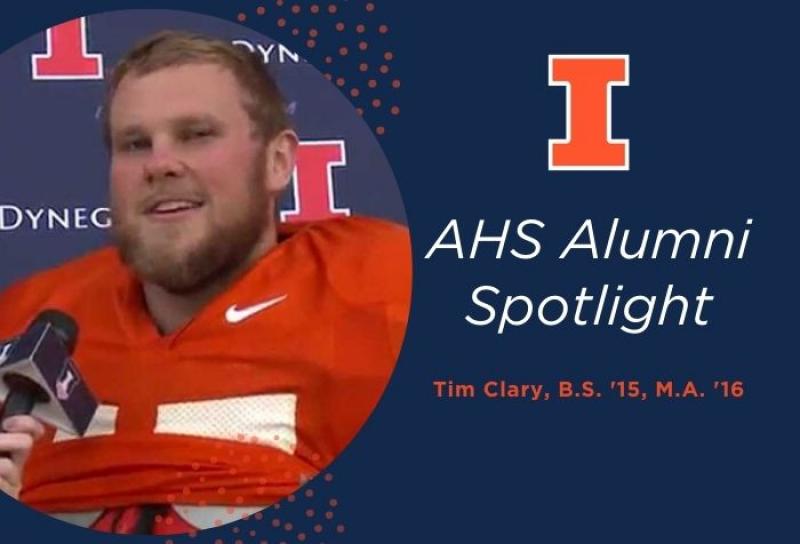
Alumni Spotlight—Tim Clary


Q. Why did you pick AHS?

A: In high school, I knew I wanted to be an Athletic Director/Coordinator, and AHS provided the pathway to doing that with Sports Management. 

Q: Which professors had the most impact on you?

A; Dr. (Michael) Raycraft: A personable man that would lead with honesty but connect on a level that helped you understand the intricate complexities within RST. Also, Nuno Ribeiro: he was a man that helped me a ton even after I graduated. He taught me about his life experiences and how they shaped his life in hopes it could influence mine. 

Q: What course did you most enjoy?

A: Two courses equally, both taught by Dr. Raycraft. One, Sports Management and two, Sports Ethics. 

Q: Did you enter AHS knowing your career path, or did AHS help you decide?

A: I entered knowing I wanted to be in athletics in some capacity. 

Q: What was your favorite on-campus experience?

A: Most of my time was taken up by athletics; I did appreciate the study sessions in the underground library prepping for some of the harder courses (Research Methods). 

Q: What does AHS mean to you?

A: I’m thankful for my time in AHS. Led by many wonderful professors and provided the path to achieving my goal of becoming an athletic director one day. 

Editor’s note:

To reach Vince Lara-Cinisomo, email vinlara@illinois.edu

Related news

RST Senior Sam Tinaglia Talks About His Program, COVID and Campus


Sam Tinaglia

Q: Why did you pick RST?

A: When I first came to UIUC, I started as a journalism major, but then was recruited to go on Dr. Michael Raycraft’s RST 180 Hall of Fame Class Trip. I enjoyed the trip and meeting other RST students and faculty so much that I eventually transferred into the RST program my sophomore year. I have always loved sports and knew I wanted to work in the sports industry and I felt RST was the major that could help me reach my goals. As I finish my undergraduate degree, I feel I made the right choice as the RST curriculum has thought me many valuable skills for the future.

Q: Which professors had the most impact on you?

A: Dr. Kim Shinew, Dr. Michael Raycraft, Dr. Sharon Zou, Dr. Bill Stewart, Robyn Deterding, and Don Hardin have left a lasting impact on me from my time in RST.

Q: What course did you most enjoy?

A: RST 180 with Dr. Raycraft was my favorite course as that class is one of a kind. As a group of about 20 individuals, we jumped on a big orange Illinois coach bus and traveled to recreation, sports, and tourism destinations in Ohio, New York, Pennsylvania, and Indiana. We saw the Major League Baseball Hall of Fame in Cooperstown, the Lake Placid Olympic facilities, the Woodstock Concert Grounds and Museum, the National Football League Hall of Fame, and the Indianapolis Motor Speedway, which were just a few of our many fantastic stops. This class was like no other I’ve ever taken in my years of schooling and I would take it again in a heartbeat.

Q: Did you enter RST knowing your career path, or did RST help you decide?

A: I entered RST knowing I wanted to work in sports, so I went the sports concentration route. But as I was taking classes in RST, I learned to love the recreation and tourism concentrations too. I think the parts of R, S, and T can be intermixed, and after finishing the course work, I can say I would love to work in any of the RST fields.

Q: What do you hope to do after you graduate?

A: After I graduate I hope to start up my online master’s degree with RST and get more experience in the RST field as I intern with the Niles Park District in Athletics.

Q: What was your favorite on-campus experience?

A: My favorite on-campus experience at Illinois was working with the Fighting Illini Marketing Team within the athletic department. For that opportunity, we handed out promotional materials before athletic events at UIUC and helped with in-game promotions too. Being able to work in person at various Illini sporting events was a fantastic experience and I’ll miss it when I graduate.

Q: What do you miss most because of the pandemic?

A: I have been schooling from home since March of 2020, so ever since the pandemic started. The thing I miss most is going in person to classes and interacting with other students and professors. You don’t realize something was so great until you can’t experience it anymore, and that was me at Illinois. I really enjoyed school and, sadly, it’s (technically) over.

Q: What are the biggest changes on campus, pre- and during COVID?

A: (I) haven’t been back since March 2020, I wouldn’t know.

Q: What would you say to recommend RST to a prospective student?

A: If you love and want to work in recreational activities, sports, and/or the tourism industry, RST is the place for you. Also, if you just want to get a good, well-rounded college experience in a smaller tight-knit college within a large university, RST would be a great home for you.

Editor’s note:

To reach Vince Lara-Cinisomo, email vinlara@illinois.edu.

 

Share on social

Related news

Freshman Todd Marshall talks about campus and COVID


Q: Are you on campus?

A: I do not live on campus, but I grew up in Champaign so I live at my house off campus.

Q: What made you decide to be on campus?

A: It was a cheaper option to stay home especially with classes being mostly online. Although I am still able to attend my in-person classes since I live close.

Q: What challenges have you found in navigating campus?

A: I’ve been on campus quite a lot and navigating is not very difficult to me.

Q: Have often are you in a classroom, as opposed to taking remote classes?

A: Two days a week I go to in-person classes, (but) only the Spring semester, though. I spend much more time on computer classes than in-person.

Q: What challenges are you discovering with remote classes?

A: Deadlines often conflict or get mixed up with each other. I have not had very many technology barriers, other than having to pay for services teachers use.

Q: Tell me what you think about the COVID testing process. Has it been easy to find a testing site?

A: I believe the university is doing a great job providing testing and access to students health history through the app. The U of I has taken this opportunity to actually demonstrate their innovation and commitment to student safety, and as a student that is very valuable.

Q: What are the differences between your high school remote learning experience, and here at Illinois?

A: Not much is different, other than more Zoom calls with university classes.

Q: What is the one thing you can’t wait to do when you get to campus?

A: Go to Kams (bar in Champaign).

here is a news quote as an example:

Related news

Former RST department head Joe Bannon dies at 89


Joe Bannon, right of center in sweatshirt, was central in establishing an interdisciplinary leisure research program at the University of Illinois in the 1970s.

Joseph (Joe) J. Bannon, 89, of Champaign passed away March 30, 2021, at his home in Champaign.

Joe was born on May 30, 1931, in Glens Falls, N.Y., to parents Leo and Elizabeth Bannon. Joe was preceded in death by his wife, Ann, and his grandson, Keegan. Joe is survived by his two sons, Joseph Jr., and Peter, and their spouses, Jill and Amy. Joe was blessed with eight grandchildren: Kelsey, Keegan, Erin, Sophie, Regan, Doug, Leo, and Rory, and one great granddaughter, Keegan Rose.

Joe was a loving and devoted father, grandfather, brother, uncle, cousin, boss, mentor, and friend. He was a wonderful role model for his family and was fiercely loyal to those he loved. When Joe was not busy working or spending time with family and friends, he enjoyed running, golf, and spending his summers with his family at his mountain retreat in upstate New York.

Professionally, Dr. Joseph J. Bannon graduated Cum Laude from Ithaca College in 1957. In 1958, he was awarded an assistantship at the University of Illinois in the Department of Park and Recreation to pursue his master of science degree. Upon graduation, he assumed the position of Superintendent of Recreation in Leonia, N.J. In 1963, he became the General Superintendent of the Topeka, Kansas, Recreation Commission where he served until 1966. In 1966, he returned to the University of Illinois to become the Chief of the Office of Recreation and Park Resources. During his tenure as Chief, he completed his Ph.D. in 1971. In 1973, he assumed the headship of the Department of Leisure Studies.

Dr. Bannon was a prolific writer, having authored or co‑authored nine books, contributed a number of chapters to edited books, and wrote more than 50 journal and magazine articles. He is a co-founding editor of the Journal of Park and Recreation Administration. Dr. Bannon was a founding member of The Academy of Leisure Sciences and the American Academy of Park and Recreation Association. He was presented numerous awards in his lifetime for his decades-long service to the park and recreation profession. In 2001, Dr. Bannon was honored with the Pugsley Award, the most distinguished award for park and recreation conservation given in the profession.

Dr. Bannon consulted extensively throughout the U.S. and Japan, China, Korea, South Africa, Germany, Netherlands, Italy, and Peru. In 1988, he spent an extended period of time in China consulting with universities as well as city officials in Beijing, Shanghai, and Suchow about fitness and recreation programs.

Joe developed the newsletter Management Strategy in 1977. The publication was dedicated to disseminating management information to parks and recreation professionals throughout the world. This led to the formation of the Sagamore Publishing Company, which he built and worked at full time, acquiring and developing titles after retiring from the University of Illinois alongside his son, Peter Bannon. Joe continued to maintain his close ties to the recreation field he loved throughout his life, advising and mentoring countless young professionals in the field.

He will be greatly missed by all of us.

Share on social

Related news

Alumni Spotlight—Andy Szabo


Q: Why did you pick AHS?

A: I entered the university in general studies as an undeclared student. Through a year or so of discovery and exploration, I was denied by the College of Business and at a loss. At a similar time, I was introduced to the College of AHS, specifically Sports Management. Ultimately, I chose AHS for its people, experiential opportunities and practical application to my aspirational career path—a college basketball coach, collegiate athletic director or professional sports team/agency executive. 

Q: Which professors had the most impact on you?

A: LoriKay Paden, Don Hardin, Kim Shinew, Ryan Gower, Michael Raycraft and so many others created an inclusive, collaborative, challenging and supportive educational experience. Specifically, LoriKay for her unconditional positivity and Professor Hardin for his mentorship and coaching.

Q: What course did you most enjoy?

A: Loved any Leadership, Strategy or Philosophy course… And Sports Law with Kyle Emkes was a great introduction to the business of sport. For a Leadership/Comms class, I recall having to reenact Jack Nicholson’s courtroom scene in ‘A Few Good Men’—mortifying but hilarious lesson in owning a room and breaking down mental barriers.

Q: Did you enter AHS knowing your career path, or did AHS help you decide?

A: A healthy mix of both. I had a vision to explore a few different paths. Through the AHS/RST curriculum, you learn so much about yourself. I did my best to focus on diversifying my experiences and it not only led to a discovery of what I was interested in, but most importantly why.

Q: Did your AHS experience lead to your current job?

A: Yes—in a variety of ways. First and foremost, it revealed to me my passion for the business of sport. Secondly, it taught me the value of relationships. One of the joys of my Illinois experience was the planning and execution of the annual Sapora Symposium, where we had the opportunity to host some of the most talented professionals in sports and entertainment for a two-day event. Dan Migala, Co-Founder and Chief Innovation Officer at 4FRONT, was kind enough to be our keynote speaker and offered an opportunity with his sports marketing agency upon graduation. Our then-Head Men’s Basketball Coach John Groce and then-Director of Basketball Operations Mark Morris also supported the event and went so far to recommend me for the Ohio University Sports Administration MBA/MSA graduate program. What was intended to be a simple volunteer opportunity, turned into an event that fundamentally changed the trajectory of my life and professional career. I owe a lot to Dan, Mark and Coach Groce for believing in me and showing me how to effectively navigate the industry through authentic relationships. 

Q: What is your current job?

A: Currently, I serve as the Director of Partnership Development for the Oakland Athletics of MLB. My role primarily consists of establishing marketing, business and community partnerships on behalf of the organization, working as a revenue generator, storyteller and strategist, while managing a partner portfolio of 20+ local, regional and global brands.

Q: What was your favorite on-campus experience?

A: Too many to count! As a team manager for the Fighting Illini men’s basketball team, I was grateful to learn from amazing coaches, build impactful relationships within the athletic department and represent the university as a whole. Winning the Maui Invitational, beating Gonzaga on the road and taking down No. 1 Indiana at home at the buzzer made for a memorable senior year, to say the least.

Q: What would you say to recommend AHS to a prospective student?

A: The University of Illinois is world-class, and the College of AHS provides a world-class, student-first experience. It felt like a family and there was reason for everything we did. Not an education for the sake of a degree and not a test for the sake of a grade. It is what you make of it, and there are plenty of chances to lean in and create your own personalized journey.

Editor’s note:

To reach Vince Lara-Cinisomo, email vinlara@illinois.edu.
 

Related news

Alumni Spotlight—Brian Smith


Q: Why did you pick AHS?

A: I just had and still do a real passion for sports, concerts, and events. I love the idea of working as a team to accomplish goals, problem solve, and to put something on that’s fun for people. I also enjoy the rush of the moment of things like live events that are happening in real time.

Q: Which professors had the most impact on you?

A: Professors Ryan Gower and Michael Raycraft, because they made learning fun. And as a disabled individual with a speech impediment, they made me feel very welcome and treated me just like any other student.

Q: What course did you most enjoy?

A: It was a long time ago so I don’t remember the names, but basically the ones that dealt directly with sport and event management.

Q: Did you enter AHS knowing your career path, or did AHS help you decide?

A: They helped me decide. I was debating between going into sports management or just a business degree.

Q: Did your AHS experience lead to your current job?

A: Unfortunately no. After I graduated I had went through some physical changes due to my disability, which hindered some of my capabilities, so my job search took some twists and turns.

Q: What is your current job?

A: I’m a digital strategist and social media manager at an advertising agency.

Q: When did you graduate and with what degree?

A: I got my bachelor’s degree in ‘05 in Recreation, Sport, and Tourism Management. I got my master’s in Sports Management in ‘07.

Q: What was your favorite on-campus experience?

A: I just enjoyed being a part of a major university and there’s nothing like a Big Ten atmosphere, and all the great friends I made. One great memory I have is celebrating the ‘05 Final Four basketball team.

Q: What would you say to recommend AHS to a prospective student?

A: You won’t regret your time at U of I and the College of AHS.

Editor’s note:

To reach Vince Lara-Cinisomo, email vinlara@illinois.edu.
 

Related news

Sapora Symposium: Lou Henson


The panel discussion of legendary coach Lou Henson will include his family members and colleagues. The theme of this year’s Sapora Symposium is Sports and Social Justice.

Lou Henson

Share on social

Related news

Alumni Spotlight—Skylar Peters


Q: Why did you pick AHS? ​

A: I knew I wanted to choose a master’s program in the Parks and Recreation Management field. I am passionate about outdoor and environmental education and the use of our public land to encourage outdoor exploration, especially in the younger years. While exploring online options for master’s programs with that in mind, I came across this program at University of Illinois. After speaking with Tim Tiger, the academic advisor, I knew that AHS was the place for me! I am so grateful I chose this program!

Q: Which professors had the most impact on you? ​

A: Because I completed an online master’s degree so I could work full-time in Extension, I wasn’t able to meet any of my professors personally. They all were wonderful and understanding of our schedules as adult learners and often were graceful when we turned in late assignments. I was always so thankful for that! My advisor, Tim Tiger, had a huge impact on me, he had so much confidence in my abilities and was so supportive that it made the online process a lot easier and more enjoyable! I am very grateful for him and all that he does for his students!

Q: What course did you most enjoy? ​

A: I really enjoyed my first class I took, which had me exploring the start of parks in the United States. It set a solid foundation for me to remember the “why” in our goal in parks and recreation programs. When you can understand and appreciate the history behind your passion, it helps to support your goals and vision for the future.

Q: Did you enter AHS knowing your career path, or did AHS help you decide? ​

A: I entered AHS already working professionally as an Extension Assistant working with youth development and the 4-H program in Pennsylvania. AHS helped support my professional career so I could be promoted to an Extension Educator (my current role) and support the events and programming that I develop. I knew I had a passion for parks and recreation and knew that AHS would help me explore that passion while I completed my degree. Because of AHS, I know my future career options are wide open in both the agriculture and parks fields. 

Q: Did your AHS experience lead to your current job? ​

A: My master’s degree and the work I did in AHS aided in my promotion to Extension Educator. In AHS I refined my research abilities and my evaluation skills to finish a project that directly impacted the work I was doing in Extension. Without AHS, I would not be where I am professionally. 

Q: What was your favorite on-campus experience? ​

A: Because I completed an online master’s degree, I only have one experience on campus. I was lucky enough to be able to make the trip to receive the Outstanding Online Masters Degree Student Award before I graduated. I explored campus, tried local favorites and was able to meet my advisor in person! It was a great trip!

Q: What does AHS mean to you? ​

A: AHS means the opportunity to explore my passion, challenge my thinking and develop new ways of thinking about the industry that is near and dear to my heart. AHS means establishing a future for myself while supporting my professional career. AHS was a chance for me to learn more about myself and my capabilities and learn from peers in the field. AHS was a chance for me to grow and become a better educator. 

Editor’s note:

To reach Vince Lara-Cinisomo, email vinlara@illinois.edu

Related news

College of Applied Health Sciences
110 Huff Hall
1206 South 4th Street
Champaign, IL 61820
(217) 333-2131