AHS honors four outstanding alumni


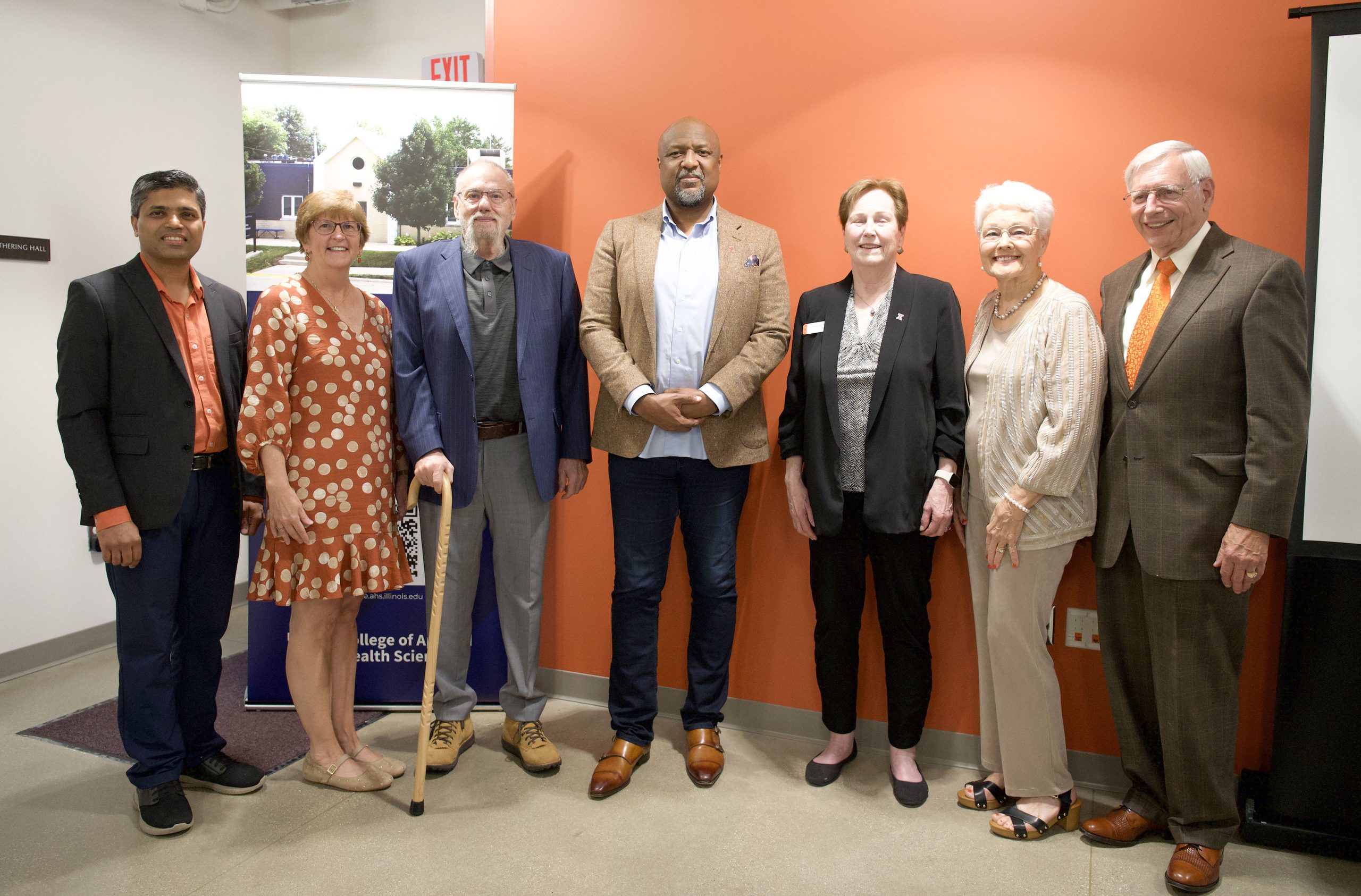
Dean Cheryl Hanley-Maxwell, left, stands with alumni award winners Michael Leach, Saul Morse and Walter Johnson. William Haskell was unable to attend the ceremony. (Photo by Jerry Thompson)

Young Alumni Award
Michael Leach
Recreation, Sport and Tourism

Michael Leach was appointed as the first-ever chief diversity and inclusion director for the White House in January of 2021. Leach, who earned his bachelor’s degree from RST in 2009, spent more than five years working for the National Football League on the NFL Management Council and later worked for the Chicago Bears and Miami Dolphins.

“I am truly humbled and honored to receive the 2023 Young Alumni Award from the University of Illinois at Urbana-Champaign,” Leach said. “My time in the College of Applied Health Sciences, and the institution more broadly, was nothing short of transformative.”

Harold Scharper Award
Saul Morse
Disability Resources and Educational Services

Saul Morse earned his bachelor’s degree (1969) and law degree (1972) at the University of Illinois and since has focused his practice on legislative matters, health law, insurance and municipal law. In 2010, with the passage of the Affordable Care Act, Morse was asked by the Illinois Department of Insurance to establish and manage an insurance pool for individuals with pre-existing health conditions.

“The Harold Scharper award is of great importance to me,” Morse said. “I came to the University of Illinois as a 17-year-old freshman. At the time, no other university in this country had a program which fully included students with a disability in all aspects of campus life, from academics to housing to activities. Most of what I have been able to do personally, professionally and within the broader community is due to the DRES program of the college.”

Distinguished Alumni Award
William Haskell
Kinesiology and Community Health

William Haskell is an internationally renowned researcher and emeritus professor of medicine at Stanford University. Haskell earned his Ph.D. in exercise physiology from the University of Illinois in 1966, and his work and achievements have clearly fulfilled the Illinois mission.

“It is truly an honor to receive the Distinguished Alumni award,” Haskell said. “Attending the University of Illinois at Urbana-Champaign offered me the opportunity to study and work with a large range of outstanding faculty and students, many of whom became exceptional leaders in exercise science research and teaching, as well as lifelong colleagues and friends.”

Walter Johnson
Recreation, Sport and Tourism

Walt Johnson was born in Watseka, Ill., and graduated from the University of Illinois in 1958 with an undergraduate degree from the RST program. Later he entered the graduate program in RST and had the privilege of learning from both Professor Charles Brightbill and Dr. Alan Sapora. Upon graduation from the RST master’s program in 1962, Johnson moved immediately into a career in parks and recreation, where he served in a number of key leadership positions.

“The University of Illinois has always been the reason for my success and the lifestyle I live today,” Johnson said. “It gave me knowledge, hope and encouragement. Growing up on a farm and spending hours on a John Deere tractor since age 8, and milking cows, planting, cultivating and raising cattle and pigs, I determined I did not want to be a farmer.”

Editor’s note:

To reach Vince Lara-Cinisomo, email vinlara@illinois.edu.
 

Related news

(Joe) Rank and file: Retired Naval officer became a Chez Center guide


Now retired, Joe Rank, left, is using his time to help support the Chez Veterans Center. (Photo provided)

By fall 1965, the conflict between North and South Vietnam had escalated, as had the United States’ military involvement. With the draft looming, Urbana teenager Joe Rank, newly enrolled at the University of Illinois, joined the Naval ROTC unit at the advice of one of his fraternity brothers a year after reserve officer training was no longer compulsory.

After four years as an undergraduate student majoring in advertising, Rank was deployed to Vietnam, where his responsibilities included pinging enemy submarines and managing gunners aboard the destroyer USS Lyman K. Swenson and the cruiser USS England.

Following his three-year tour, Rank returned to the university and embarked on several career journeys. He taught new cohorts of reserve officers, helmed a $20 million Navy advertising campaign, and developed two decades of relationships at the University of Illinois Alumni Association.

“If anybody 55 years ago said, ‘You’re going to make a career of the Navy,’ I would’ve told them they were absolutely crazy,” Rank said. “All of life’s twists and turns, I couldn’t have planned it.”

The retired Rank, now 76, is helping sustain a campus resource he could’ve used as a military veteran who returned for further education: the Chez Veterans Center.

“Joe is a bridge between the university’s deep history in the veteran community and what the future can be,” said Chez Director of Operations Andy Bender. “Joe has the passion for this work, being able to take the things we need and then bringing in the support to do it.”

“They’ve got a clear mission now to serve all veterans,” Rank said of the Chez Center. “Veterans bring diversity to the campus.”

Rank, who lives in Urbana with his wife, Pam, has strong ties with his identities as an Illinois alumnus and veteran. While visiting the Vietnam Memorial Wall, Rank made a charcoal rubbing of the etched name of Marine Corps 2nd Lt. David Skibbe, a fellow Illinois Naval ROTC officer who died during a mission in 1970.

When he returned from Vietnam, Rank became an instructor for Illinois ROTC classes, earning the title of assistant professor of naval science while obtaining his master’s degree in advertising.

Three years of 18-hour days in Vietnam made the daily study grind feel easy.

Veterans bring diversity to the campus.

Joe Rank

Illinois alumnus and retired Naval officer

“I was at the library at 8 o’clock in the morning, got my work done by 4 p.m.,” Rank said. “I had that discipline—I got one B in graduate school.”

Rank soon went back to sea, when the Navy did something that “didn’t make much sense” to him at the time: Brought Rank in as director of national advertising for Navy recruiting.

After 20 years of active-duty service, Rank faced the test of reintegrating into civilian life and passed with flying colors. The mission of the Chez Center has connected with him from the start.

While serving as vice president of membership and marketing at the Alumni Association, he was brought into an ad hoc committee to address the vision of Chez, then known as the Center for Wounded Veterans in Higher Education.

“The intent was it would be much like [Disability Resources and Educational Services] was for the World War II vets. It would accommodate severely, profoundly injured military veterans who wanted to come back to college.”

Like DRES, Chez has morphed its service to apply to a wider range of students and staff. On the advisory committee, the word “wounded” was eliminated from the title as Chez became a one-stop shop for military-connected people on campus.

“Originally, it was a welcoming cocoon for people to recreate that military atmosphere and camaraderie. But in reality, the whole idea is to get people comfortable enough with the university and the civilian environment and push them out, get them involved in their major,” Rank said.

“The idea is not to segregate them into a pseudo-military unit, but get them comfortable with what they’re going to experience in civilian life.”

Rank’s support of the Chez Center is multifaceted as both a donor and member of its advisory board.

“He’s a great sounding board for me,” Bender said. “He’s been a part of this project since the very beginning. “He’s a great supporter of us, of the veterans, and of the university at large.”

Editor’s note:

To reach Ethan Simmons, email ecsimmon@illinois.edu.
 

Related news

Stout Leadership


Heather Stout returned to the University of Illinois from the School of Law at St. Louis University and has roots in Central Illinois (Photo by Ethan Simmons)

When Disability Resources and Educational Services, better known as DRES, began advertising for a permanent director of operations in 2023, it was apparent to current employees who would be a great fit.

“Before there was ever the possibility of Heather [Stout] becoming DRES director of operations, my mentor and the first DRES director I worked for, Dr. Brad Hedrick, mentioned her as one of his respected colleagues working at a peer institution,” said Susann Sears, director of Beckwith Residential Support Services, which is affiliated with DRES and provides care for disabled students.

Stout was hired in June and officially joined DRES in August, succeeding interim Director Kim Collins, who retired at the end of June. Stout returned to DRES with established relationships in hand.

“I worked closely with Susann Sears, because she and I were in similar roles at [the University of Illinois Chicago] and Illinois, respectively,” Stout said. “Paige Lindahl-Lewis [assistant director at Beckwith] and I graduated from AHS together. Paige and I both graduated from rehab programs when I graduated from Illinois.” 

Stout returned to the University of Illinois from the School of Law at St. Louis University and has roots in Central Illinois. She got her bachelor’s degree from Penn State and a master’s in rehab counseling at Illinois, interning at DRES along the way. Stout emphasized the values of continuity.

“It’s important that Illinois has some long-term staff that have historical knowledge and cultural context for DRES and our program,” she said. “In higher ed, there have been a lot of changes across universities, particularly in disability. It’s good that there has been consistency at DRES, along with some of the changes in staffing.”

Maureen Gilbert, DRES’ coordinator for the unit’s Office of Campus Life, agreed that Stout’s understanding of the university was a huge plus.

“Her familiarity with campus and DRES is helpful because she understands the impact and presence DRES has,” Gilbert said. “With Heather’s experience and knowledge base, she can advocate for a strong presence at the table, especially when the discussion involves disability and accommodations across all aspects of the campus community.”

That’s especially important because of the tremendous growth in DRES student enrollment.

Gilbert said that “in four years, our numbers have increased 33 percent. Our access specialists have caseload numbers of 600 to 700 students; we have waitlists for mental health services counseling and neuropsych testing; and our service requests for deaf and hard-of-hearing students and staff are increasing. To continue supporting students and their growing needs, increased financial resources are essential to support current and prospective staff.”

Her familiarity with campus and DRES is helpful because she understands the impact and presence DRES has.

Maureen Gilbert

DRES coordinator, Office of Campus Life

Fulfilling the DRES mission and serving increasing enrollment will require expanded facilities. To that end, Stout said a new facility is necessary. She has seen proposed building designs and said, “It is my hope that in the next five years, we can talk more about that and what we can do to make DRES and each of the departments centrally located. That’s a very thoughtful conversation we’ll need.” 

Stout referenced the Center for Movement and Performance, a proposed state-of-the-art, stand-alone indoor multi-use facility for the wheelchair track and wheelchair basketball programs with enhanced strength and conditioning, equipment, sports medicine, training and meeting areas.

Adam Bleakney, renowned coach of the men’s and women’s wheelchair track and road racing teams, said, “We have a vision for a facility that is built upon the legacy pillars of our program—service, outreach, research, education and innovation—and that will allow us both room for growth and increased interdisciplinary collaboration across campus and the community.”

Although facility upgrades are high on her list of things to do, Stout acknowledged the priority is “serving the entire student.”

“We have a career services area,” she said. “We have mental health resources. One of the things I hope to expand upon is our connections with each academic department. Are we working with and partnering with them so that students are getting the accommodations that they need and each unit can work with us effectively? And are we doing what is best for graduate and professional students, as well as the faculty and administration in those programs?”

Early in her career, Stout worked as an interim coordinator/disability specialist at the University of Illinois Chicago, and worked as director of the Disability Resource Center at Purdue University.

She said Purdue’s approach to disability was “very methodical, very careful” and said Illinois had a similar approach.

“Illinois was the first model for disability resources in higher ed. It includes programs that few universities have,” Stout said. “It also has tremendous support. Being located within an academic college is a crucial connection for faculty and students. Our history is unparalleled in the U.S. and continues to include incredible resources. I hope to build upon that legacy as we look to the future and envision what DRES can be five years and 10 years from now.”

Related news

College of Applied Health Sciences
110 Huff Hall
1206 South 4th Street
Champaign, IL 61820
(217) 333-2131