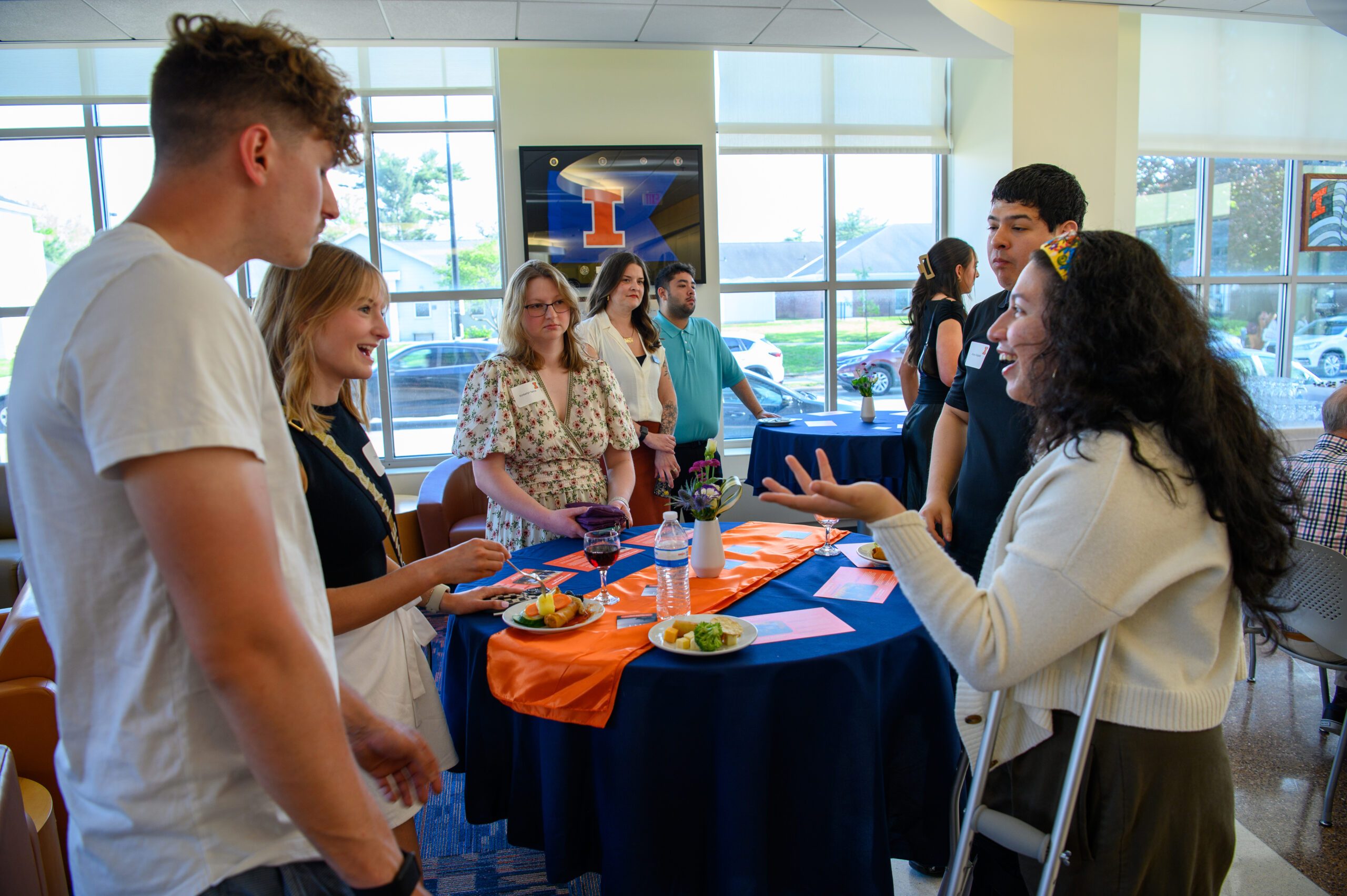
Freshman Regan Toole talks about campus life during COVID-19


Regan Toole (provided)

Freshmen are entering college in a unique environment, and that includes students in the College of Applied Health Sciences at the University of Illinois. The AHS communications staff spoke with new AHS students about campus life, why they decided to come to campus—or stay home—and how COVID-19 is changing their expectations. Today, we speak with Regan Toole, who is in the Department of Kinesiology and Community Health.

Q: Are you on campus?

A: I am on campus this fall, and I am actually a Chick Evans Scholar. Meaning that I am attending U of I on a full tuition-and-room scholarship. I am also currently staying in the Evans’ chapter house.  

Q: What made you decide to be on campus?

A: I decided to stay on campus because I wanted to get as much of the freshman experience as possible. I wanted to get to know other people and I wanted to familiarize myself with the campus. The campus is so beautiful, especially now that the weather is starting to cool down. I love taking walks around campus, but I still haven’t explored the whole thing because it so big! But one day I will.

Q: What challenges are you discovering with remote classes?

A: As for classes, some challenges for me are that I am still adjusting to college classes being online and each of them using different platforms. At my high school we used Google Classroom for everything, which was very convenient. Classes back then were also a lot easier because my grades could only improve from what they were before COVID-19. Since I had an “A” in all of my classes I couldn’t get anything lower, as long as I did all of my work. I also do not have any in-person classes this semester and it can be hard for me to be on my computer all day. However, I try to fit in breaks to walk around and socialize with people. Also, at first it was hard to find where the due dates and assignment where for some of my class, but after getting used to the websites it has gotten easier to access everything.

Q: Tell me what you think about the COVID testing process. Has it been easy to find a testing site? 

A: I am so grateful that U of I has its testing process because it makes me feel a lot safer being on campus. Altering hearing about all of the cases at Notre Dame and (North Carolina), it is very reassuring to know what is actually going on at our campus. There is also a testing center right next to my house and it is super easy and quick for me to get tested. I am still very conscious about COVID-19 and I always make sure to wear my mask and wash my hands frequently. However, I am still really glad to see lot of other people wearing their face masks around campus and it seems that most people understand the importance of them. 

Q: Have you encountered any of the Wellness Safety Ambassadors? What has that experience been like?

A: The Wellness Safety Ambassadors are a great addition to campus as well.  I think they do a great job of promoting safety for COVID-19 on campus. I even got an additional care package from them and I absolutely love the spray hand sanitizer! Overall, I am very happy and fortunate to be on campus this fall. I am very excited to see what my future holds here at U of I. I-L-L!

Related news

Freshman Brooklyn Clough talks about campus life during COVID-19


Brooklyn Clough (provided)

Freshmen are entering college in a unique environment, and that includes students in the College of Applied Health Sciences at the University of Illinois. The AHS communications staff spoke with new AHS students about campus life, why they decided to come to campus—or stay home—and how COVID-19 is changing their expectations. Today, we speak with Brooklyn Clough, a student in the Department of Speech and Hearing Science.

Q: Are you on campus?

A: I am on campus this semester because even though all of my classes are digital, I believed being on campus would give me the motivation I needed for my classes that I wouldn’t be able to find at home. Also, I wanted the experience; it is only my freshman year so I truly don’t know what I am missing with COVID-19 regulations.

Q: What challenges have you found in navigating campus?

A: Since all of my classes are digital, I don’t travel much on campus, but I do struggle with the bus system. Long story short, I was trying to head to my dorm and ended up in downtown Urbana.

Q: What challenges are you discovering with remote classes?

A: Digital classes have been a complete internal battle because many of my classes are asynchronous as well; So I must organize my schedule on my own and try to remember all of my due dates for different courses. 

Q: Tell me what you think about the COVID testing process. Has it been easy to find a testing site? 

A: Testing has been painless since I live in Nugent, which is connected to the SDRP (Student Dining and Residential Programs) where a testing center is. I also surprisingly have started getting better at finishing the testing faster, since I have been doing it for a while.

Q: What are the differences between your high school remote learning experience, and here at Illinois?

A: My high school remote learning was a lot less motivated than here at Illinois. I did take a remote class in Fall 2019, which was me cramming at the last minute before due dates and after the school went completely digital in spring 2020. I put in little effort because our grades couldn’t be negatively affected if we showed active participation. Here at Illinois, these classes matter and are important; However, it is quite similar in that I have few check-ins and mostly work is on my own.

Related news

MPH students adapt, adjust to COVID-changed internships


Eleven students in the Master of Public Health program in the College of Applied Health Sciences saw their Applied Practice Experiences this summer upended because of the COVID-19 pandemic.

But when they delivered their final reports on both their APEs and their integrated learning experiences (ILE) on Aug. 7 in a Zoom call with MPH interim director Justine Kaplan, they all spoke of perseverance, patience and making the most of their revamped opportunities.

For example, Stacia Simmons expected to work in the Narcan and PrEP program at the Champaign-Urban Public Health Department, which helps prevent people from overdosing on opioids. However, when the pandemic shut everything down, Simmons was told her role would shift to remote, and she’d be working as a COVID-19 contact tracer. Additionally, she was offered remote work with the Howard Brown Health Center in Chicago as a contact tracer. Although she was disappointed not to be working on site, she found positives in her new roles.

“My experience has been amazing in that the work that I am doing directly aligns with my career interest, which is infectious disease prevention/treatment,” she said. “Being able to gain firsthand public health experience and to also be able to do my part in helping stop the spread of COVID-19 has been wonderful. It is also great in that working for two different health departments allows me to serve two different populations and it’s also very interesting to see the differences in approach in regard to the roles of contact tracers between both health departments. Overall, it’s a blessing to be interning at both departments.”

Monica Astorga also ended up working at Howard Brown remotely, although she lives in Chicago. Astorga had hoped to work on site with MPH alumna Anais Cotillas, who is a diabetes case manager, but COVID-19 had other plans.

“I was supposed to be helping Anais work with her diabetes expertise,” Astorga said, about a survey assessment Cotillas is working on. “And of course everything got changed. I was just working remotely all the time. I was looking forward for it to be more hands-on and in person. But I’m still very grateful. I learned a lot. It was completely not what I expected that I was going to do, but I enjoyed it nonetheless.”

Kelly Licata was looking forward to the face-to-face interaction of her internship at Aging Care Connections in La Grange, Ill. Luckily for Licata, she was still able to work for Aging Care, but had to do it from home because of the pandemic.

“I did not expect to be doing my internship remotely,” she said. “I was expecting the immersive experience of working in the office, full-time, sitting in on meetings and programs that I get to learn from. But seeing as Aging Care Connections works with a much higher-risk population, everything (was) moved to online resources and (I interacted) with clients via Zoom.

Several of the students described similar undertakings, and all found themselves missing out on some of the intangible qualities of an internship.

Shivani Shah expected to work as a research intern with the South Asian heart lifestyle intervention (SAHELI) and South Asians Active Together (SAATH) studies.

“My internship was primarily outreach and education-based, which was entirely people-facing. I was looking forward to connecting with community members and hearing their stories in addition to better understanding their needs and perceptions around health. I certainly wish I had this experience, especially because participants also generally really enjoy the in-person interactions.”

Nicole Alberto was looking forward to working with the Carle Foundation. The shutdown, however, cancelled her APE, and she ended up working with former KCH teaching assistant professor Brynn Adamson as a Graduate Research Assistant of the MOVE MS program.

She was grateful to learn new skills, but admitted the loss of on-site work was disappointing.

“I really miss the bonding and social interaction in the office and out in the field,” she said.

Edson Flores worked as a research assistant for the Department of Recreation, Sport and Tourism within AHS. Like his classmates, he hoped to working in the field for 7-8 hours a day. That said, he feels like his internship allows him to exercise his knowledge.

“We are conducting bilingual cognitive interviews to increase the strength and reliability of a questionnaire targeting Mexican immigrants in the Midwest,” he said. “Previous coursework from the MPH program has taught me the influence intersectionality has on patterns and choices people make especially when it comes to the foods they consume. I am fortunate to have found a summer internship where I can use the skills I learned.”

All of the MPH students agree that what they miss most about their remote APEs was the interaction, the networking and the camaraderie of in-person internships. And their advice to students who might face similar adversity in the future was consistent: be ready for anything.

“I spoke to my classmates, we would speak to each other about any bumps on the road that we would hit, or frustrations, and we’d kind of vent to each other,” Astorga said. “So I think having a good team that you work with, or at least another person or co-worker or something that you can talk to a lot, because during a pandemic, it’s a lot you’re dealing with mentally, or emotionally. Everyone is going through hard times. Be patient, and be flexible. And just know, trying to remind yourself that you’re doing the best you can, and that you’re doing a good job.”

Editor’s note:

To reach Vince Lara-Cinisomo, email vinlara@illinois.edu.
 

Share on social

Related news

Paris Smith talks about her Applied Practice Experience change


Q: How are your experiences different from what you expected?

A: Having to complete projects from home allowed me to express my creativity, however I was not able to collaborate with other staff in a hands-on setting as I would have being in the Erie facility, physically.  

Q: Are you doing something for your APE than what you originally planned?

A: Some of my original projects were not able to happen, such as working with adolescent behavior health group visits, but I was still able to complete some other projects that will be implemented once Erie has more patients coming in person.

Q: Does your APE lead you to think about a different career path?

A: No, it has actually made me explore being in the health education field that focuses on promoting adolescents to being aware of their health.

Q: What happened to your original APE?

A: I am still working with the organization that I interviewed with interviewed with in January

Q: Are you working remotely?

A: Yes.

Q: Has anything been frustrating about your change in APE status?

A: Having the same routine of logging in on for my intern experience and being in the same place has not been as exciting as it would have been interacting with staff and patients everyday.

Q: What are you missing out on because of the pandemic, in terms of working face-to-face with people?

A: I am missing out on networking with people to be able to get more feedback on projects and potential job opportunities to have once I graduate.

Q: What advice do you have for future students who might have disrupted APEs?

A: Do not get discouraged because you can spend this time looking for other internship opportunities that you have been interested in, and even developing a new skill such as typing or making a flyers.

Q: What other ways has COVID-19 affected you? Have you traveled? Have you been able to go home, see family?

A: I have not been able to travel due to COVID-19. I usually spend time seeing family during the summer months and now I have to connect with them through video calls. 

Editor’s note:

To reach Vince Lara-Cinisomo, email vinlara@illinois.edu.
 

Share on social

Related news

RST senior Alex Yi talks about alternate internship in wake of COVID-19


How are your experiences different from what you expected?

My experience is exactly as I expected. Even though it is my first time participating in a remote internship, I had a good idea of how the internship would proceed. 

Are you doing something for your internship than what you originally planned?

Before COVID-19, I was expected to intern at a law firm. The internship I am doing right now does not lead me to think about a different career path because I have always wanted to partake in an internship like this. 

Has anything been frustrating about your change in internship status?

Nothing has been frustrating about the change in internship status because this internship is also extremely beneficial for me and helped me create a strong network for myself. I have always wanted to be in a position to network, but just never had the opportunity, so this internship is excellent in that sense. 

What are you missing out on because of the pandemic, in terms of working face-to-face with people?

Working with people face to face is definitely the ideal way of getting things accomplished, but in the sports field, I think that people must be able to adapt to any and every situation possible in order to make things work. So, working with other people through video chat is a good experience to have because I will definitely have to do work through video chat or online again. 

What advice do you have for future students who might have disrupted internships?

The best advice I can give other students who might have disrupted internships is to constantly try finding opportunities to connect with other people. Working and having an internship experience is extremely important, but knowing a lot of people within your field of work can sometimes be your best weapon or tool when finding an internship/job opportunity. 

What other ways has COVID-19 affected you? Have you traveled? Have you been able to go home, see family?

I have been stuck on campus not being able to go home because of COVID-19, but this is still a good experience for me because this time period is teaching me to adjust to unexpected situations.

Editor’s note:

To reach Vince Lara-Cinisomo, email vinlara@illinois.edu.
 

Share on social

Related news

RST student Javier Maldonado talks about how COVID changed his summer


Q: How are your experiences different from what you expected?

A: My experiences are very different from what I had expected from my internship; I expected something where I would be hands-on and not behind a computer screen. 

Q: Are you doing something different for your internship than what you originally planned?

A: No, not from when I found out about this internship and what it would be like. Since it’s begun, I don’t believe I have done anything different then what was originally planned. 

Q: Does your internship lead you to think about a different career path?

A: It doesn’t necessarily drive to a different path, but it does open up my eyes to different fields within my major. 

Q: What happened to your original internship?

A: I was waiting to hear back from a field house in Chicago but because of COVID-19, they didn’t know how many people they would actually need. Unfortunately, because of time, they weren’t able to give me an answer. 

Q: Has anything been frustrating about your change in internship status?

A: The only frustrating part is being at home and having to work from home.

Q: What are you missing out on because of the pandemic, in terms of working face-to-face with people?

A: I feel like face-to-face is the biggest thing I am missing out on; I am a very hands-on learner and would have liked to learn from a professional face to face. 

Q: What advice do you have for future students who might have disrupted internships?

A: The advice I have is to try and maintain a positive view on things. It’s going to be hard when things don’t go the way you expect but making the best out of situations goes a long way. 

Q: What other ways has COVID-19 affected you? Have you traveled? Have you been able to go home, see family? 

A: COVID-19 has just been a bummer and being stuck at home all the time hasn’t been fun, either. 

Editor’s note:

To reach Vince Lara-Cinosomo, email vinlara@illinois.edu.
 

Share on social

Related news

Shivani Shah talks about her Applied Practice Experience change


Q: How are your experiences different from what you expected?

A: Pre-COVID, I expected my experience with the SAHELI and SAATH research teams to be primarily community facing—I was going to be recruiting research participants and doing educational outreach. Now, my experience has been more focused on designing modified study arm materials and brainstorming implementation logistics for when research recruitment can resume. 

Q: Are you doing something different for your APE than what you originally planned?

A: While I am at my planned APE site, the work certainly shifted to be less hands-on and more planning and logistics, as I previously mentioned. This has exposed me to details including the protocols and extensive planning that goes into putting together a robust research study, alongside the challenges of modifying these components due to COVID. While unplanned, I am seeing a completely new side of organizational management, which is meaningful.

Q: Does your APE lead you to think about a different career path?

A: I was previously hesitant about working in a research setting as I worried it would be more distant from communities. However, this experience quickly shifted my understanding, as I see my team making important contributions to both the research world and on the lives of community participants. I’d love to continue exploring community based participatory research in my career. 

Q: What happened to your original APE? 

A: I’m grateful that my APE site was able to keep me onboard in a remote capacity.

Q: Are you working remotely? 

A: For the most part, yes. Given the importance of group cohesion and a basic medical examination for the research study efficacy, I was recently able to participate in a few minimal risk in-person activities.

Q: What are you missing out on because of the pandemic, in terms of working face-to-face with people?

A: My internship was primarily outreach and education-based, which was entirely people-facing. I was looking forward to connecting with community members and hearing their stories in addition to better understanding their needs and perceptions around health. I certainly wish I had this experience, especially because participants also generally really enjoy the in-person interactions. 

Q: What advice do you have for future students who might have disrupted APEs?

A: The world is very unpredictable, and things may not go the way you initially anticipated. But ultimately, it’s part of the learning and growing process. Stay true to yourself and your goals—there are alternative pathways to learn and achieve your goals, and the MPH program faculty is an incredible resource in helping you get there. 

Q: What other ways has COVID-19 affected you? Have you traveled? Have you been able to go home, see family?

A: This pandemic is a mentally and emotionally taxing event on the globe as a whole. It is difficult to find a new normal—as someone who loves being outdoors and struggles with online communications, it is an adjustment. Thankfully, however, I have the privilege of being home in the suburbs in the company of my family. 

Editor’s note:

To reach Vince Lara, email vinlara@illinois.edu.
 

Share on social

Related news

Large Lot Program demonstrates the power of private land stewardship in addressing urban vacancy


In the past five years, Chicago residents have purchased nearly 1,300 vacant lots and replaced weed trees and sagging fences with gardens and children’s play areas. In doing so, they have demonstrated that transferring city-owned vacant lands to local residents can be a successful strategy for cities seeking to reduce blight and strengthen neighborhoods. 

In assessing the potential benefits of the City of Chicago’s “Large Lot Program,” a team led by scientists Paul Gobster of the USDA Forest Service’s Northern Research Station and Recreation, Sport and Tourism professor William Stewart of the University of Illinois examined the visual and social effects of resident-driven urban greening efforts in high-vacancy areas of the city’s south and west sides.  In their most recent paper, published last week in the journal Landscape and Urban Planning, the research team found that the program has resulted in continued improvements in the condition and care of the purchased “large lots” over a five-year period and that these improvements were consistent across all five community areas studied. 

“While planners around the world are experimenting with ways to address urban vacancy, few cities have the tools to assess how well their programs work after they are implemented,” Gobster said. “In this latest paper we develop a practical monitoring tool, the condition-care scale, and detail how it can be implemented by planners to assess the progress of vacant lot repurposing programs. The scale also holds promise for other applications related to urban greening and we encourage others to adapt it to their particular needs. 

Previously reported findings from the study showed that visible changes to large lots in the year after purchase Ied to increases in lot “cues to care” including ornamental and vegetable gardens and social and recreational features, and that levels of lot condition and care were highest for owners who lived closest to their purchased large lot.

“In focus groups and a mail survey of large lot owners, we also found that residents who are improving the lots are gaining a stronger sense of place and belonging to their neighborhood, and they see the program is fulfilling community goals,” said Stewart of the College of Applied Healthj Sciences at Illinois. “Together our visual and social assessments show that ownership matters, and that through private stewardship of vacant neighborhood lands the Large Lot Program is helping to address issues of environmental and economic justice in communities that have been disenfranchised for decades.” The researchers’ next step is to try and quantify whether participating in the Large Lot Program is leading to broader social outcomes, including reductions in crime.

The City of Chicago collaborated with community groups to launch the Large Lot Program in 2014. Initially focused on the Greater Englewood area on the city’s south side, the program aims to reduce the inventory of more than 11,000 city-owned vacant lots by offering them to neighbors for $1; nearly 1,300 vacant lots have been purchased to date.

Co-authors of the new paper, “The Condition-Care Scale: A Practical Approach to Monitoring Progress in Vacant Lot Stewardship Programs,” include Alessandro Rigolon of the University of Utah and Sara Hadavi of Kansas State University. The paper is available through the Northern Research Station at https://www.nrs.fs.fed.us/pubs/60442

Editor’s note:

To reach Vince Lara-Cinisomo, email vinlara@illinois.edu.
 

Share on social

Related news

MPH student Mateo Solis Rueda discusses his APE change


Q: How are your experiences different from what you expected?

A: My initial expectation was to be on-site at the health organization throughout the week where we would work on contact tracing as a team. I pictured having a team leader who would guide us through the process of how to properly use the online system, and promptly address issues as they occurred. However, working remotely has presented with additional challenges. Although circumstances are less than ideal, we are powering through it all, and we are still able to maintain close contact through weekly meetings which are conducted virtually to address any problems and discuss future goals and obstacles we may encounter as we continue COVID-19 contract tracing.
 
Q: Are you doing something for your APE other than what you trained for?

A: I feel like my coursework provided me with adequate training for my APE. In my previous courses, we have discussed extensively about collecting data from community members. Additionally, we practiced hands on creating and administering surveys, as well as collecting, analyzing, and reporting our results. It is definitely interesting to see how this unravels in the real world, and how it differs from the classroom environment.
 
Q: Does your APE work lead you to think about a different career path?

A: Fortunately, my APE work surrounds one of my top interests in public health, infectious diseases. I am treating this as a great opportunity to get a feel for this discipline of public health. If anything, my work so far has reinforced my interest in this career path.
 
Q: You’re doing contract tracing for Spanish-speaking populations, as well as English. Are there differences in how you approach the two populations?

A: Due to a high demand for contract tracing within the Spanish-speaking population, I have only spoken with individuals who speak Spanish thus far. I have been pleased with the generally kind and open demeanor of all the individuals I have spoken with, as well as their willingness in allowing me to interview them and answer all my questions. Although, I have yet to contact someone who speaks English, I have thought about similarities and differences in approaching these two populations. Overall, I would say the approach would be very similar due to having a script we must stick with, and attempting to extract the identical information.
 
Q: What happened to your original APE?

A: My original plan was to conduct my APE at the local public health district (CUPHD), however with some guidance and encouragement from my instructor, we decided to switch it to working on contact tracing at a different health organization. Fortunately, I am still working alongside the original public health district, though it is now my ILE.

Q: Has anything been frustrating about your change in APE status?

A: Thankfully there have not been any major frustrations. Instructors, as well as supervisors and team members at the health organizations are all aware and understanding of the current unique circumstances. It has been interesting to watch everyone within the public health field come together and continue to help in any way they can.
 
Q: What are you missing out on because of the pandemic, in terms of working face-to-face with people?

A: I am missing out on the potential connections that could have been made within the community. Having to phone people at various hours of the day and asking for personal information makes it challenging to establish a connection at first, as many people are initially hesitant to answer questions. To overcome this, I try my best to start off with a bit of conversation to let them know I am only checking to ensure they are doing fine, while encourage them to stay safe. This seems to work well, as everyone I have spoken with has been gracious. A second thing I am missing out on is meeting and working alongside health professionals at the health organization. I have only met them through online video meetings, which is not the same as it would be in person. This makes communicating back and forth a bit slower and less personable.
 
Q: What advice do you have for future students who might have disrupted internships or APEs?

A: My advice is that if you ever find yourself frustrated or stuck, take it as a sign to pause, take a step back, and occupy yourself with something you enjoy. Go out for a run, a walk, a bike ride, read, take a nap, etc. After some time has passed, come back with a fresh mind and continue where you left off. I find that when I do this, I come up with new ideas, perhaps it might work for others. I also want to mention that the instructors are around to lend help whenever needed, so do not hesitate to reach out.
 
Q: What other ways has COVID-19 affected you? Have you traveled? Have you been able to go home, see family?

A: Due to COVID-19, I was pushed to move back to Chicago sooner than I previously anticipated.  Stay-at-home orders, and shelter-in-place regulations added additional challenges and stresses to this move. Fortunately, I have been able to stay in contact with family and friends through social media, and virtual meetups. More recently, I was able to visit family while continuing to follow health guideline and remaining safe.

Editor’s note:

To reach Vince Lara-Cinisomo, email vinlara@illinois.edu.
 

Share on social

Related news


MPH student Kelly Licata talks about her Applied Practice Experience


Q: How are your experiences different from what you expected?
 
A: Off the bat, I did not expect to be doing my internship remotely. I was expecting the immersive experience of working in the office, full-time, sitting in on meetings and programs that I get to learn from.  But seeing as Aging Care Connections works with a much higher-risk population, everything is moved to online resources and I’m interacting with clients via Zoom.  
 
Q: Are you doing something different for your APE than what you trained for?
 
A: No, the MPH program at U of I really prepares us for anything and my APE has moved a lot of its resources online, which has allowed my APE to move forward just with some flexibility of how we are providing education, information and data analysis to put our focus on whatever older adults need the most. 
 
Q: Does your APE work lead you to think about a different career path?
 
A: I’ve loved completing my APE at Aging Care Connections; it’s been a really great experience and despite working remotely, it’s been hands-on. I wouldn’t say it’s changed my career path, I’m still interested in policy and healthcare resources regarding older adults.
 
Q: What happened to your original APE?
 
A: I was really lucky that my APE was not cancelled or altered too significantly, that this placement and project is pretty much the original without data collection being administered in face-to-face surveys and teaching all programs through Zoom format and not on-site.  
 
Q: Are you working remotely?
 
A: I am working remotely. It’s definitely different than what I anticipated since now I can just roll out of bed and start working, but there’s still plenty to do and I am definitely learning a lot as we go!  
 
Q: Has anything been frustrating about your change in APE status?
 
A: The most frustrating part about the changes with my APE project are really just the lack of face-to-face interaction with my preceptor, team members and clients.  I was really looking forward to the hands-on experience of leading class programs face to face and getting to know our clients on a deeper level, and that can be tough on Zoom.  Also, our clients are older adults and Zoom can be challenging  for any new user. They’ve gotten the hang of Zoom with impressive speed but there still can be technological issues that sometimes arise in our classes and it can be difficult to troubleshoot for them.  
 
Q: What are you missing out on because of the pandemic, in terms of working face-to-face with people?
 
A: It’s been really interesting to say the least of starting a position when you haven’t met 95 percent of your co-workers.  To hop in on conference calls where you’ve never interacted with anyone face to face is a different experience.  There’s always a split second when I join Zoom meetings or conference calls that everyone thinks that they’ve got a Zoom crasher joining.  
 
Q: What advice do you have for future students who might have disrupted internships or APEs?
 
A: I guess just be flexible and open to any new program or project you may come across.  There’s still ways to complete APEs if you’re open to new ideas and different solutions.  

Editor’s note:

To reach Vince Lara-Cinisomo, email vinlara@illinois.edu.
 

Share on social

Related news

College of Applied Health Sciences
110 Huff Hall
1206 South 4th Street
Champaign, IL 61820
(217) 333-2131